Slides material sources:
Software Engineering - Theory & Practice, S. L. Pfleeger
Introduction to Software Engineering, I. Sommerville
SWEBOK v3: IEEE Software Engineering Body of Knowledge
Working Effectively with Legacy Code, M. Feathers
Software Testing – A Craftsman’s Approach, P Jorgensen
xUnit Patterns by Gerard Meszaros
Software Testing
www.cs.uoi.gr/~zarras/http://www.cs.uoi.gr/~zarras/se.htm
Testing fundamentals
Why does software fail?
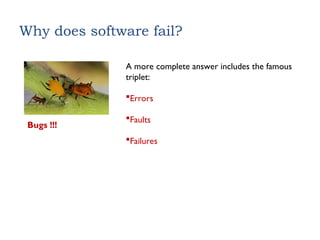
A more complete answer includes the famous
triplet:
Errors
Faults
Failures
Bugs !!!
What do we mean by error?
Errors
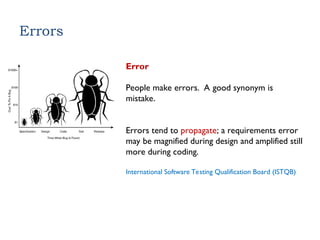
Error
People make errors. A good synonym is
mistake.
Errors tend to propagate; a requirements error
may be magnified during design and amplified still
more during coding.
International Software Testing Qualification Board (ISTQB)
What do we mean by fault?
Faults
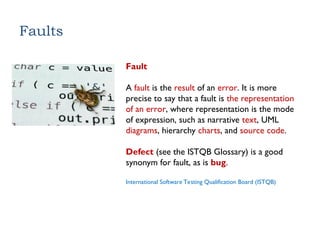
Fault
A fault is the result of an error. It is more
precise to say that a fault is the representation
of an error, where representation is the mode
of expression, such as narrative text, UML
diagrams, hierarchy charts, and source code.
Defect (see the ISTQB Glossary) is a good
synonym for fault, as is bug.
International Software Testing Qualification Board (ISTQB)
What do we mean by failure?
Failures
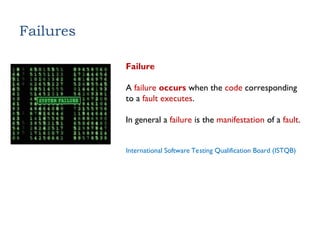
Failure
A failure occurs when the code corresponding
to a fault executes.
In general a failure is the manifestation of a fault.
International Software Testing Qualification Board (ISTQB)
What is software testing?
Software testing
Testing is the act of exercising software
with test cases.
A test has two distinct goals:
To find failures (verification
aspect).
To demonstrate correct execution
(validation aspect).
What is a test case?
Test cases
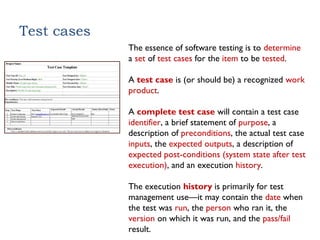
The essence of software testing is to determine
a set of test cases for the item to be tested.
A test case is (or should be) a recognized work
product.
A complete test case will contain a test case
identifier, a brief statement of purpose, a
description of preconditions, the actual test case
inputs, the expected outputs, a description of
expected post-conditions (system state after test
execution), and an execution history.
The execution history is primarily for test
management use—it may contain the date when
the test was run, the person who ran it, the
version on which it was run, and the pass/fail
result.
Why should we write tests?
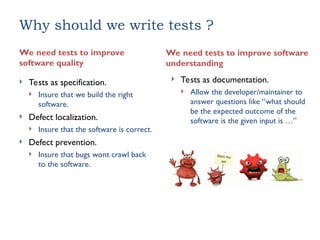
Why should we write tests ?
We need tests to improve
software quality
We need tests to improve software
understanding
 Tests as specification.
 Insure that we build the right
software.
 Defect localization.
 Insure that the software is correct.
 Defect prevention.
 Insure that bugs wont crawl back
to the software.
 Tests as documentation.
 Allow the developer/maintainer to
answer questions like “what should
be the expected outcome of the
software is the given input is …”
How do we write good tests?
How do we write good tests ?
The tests that we write should be
easy to run
 Fully automated.
 Execute without any effort.
 Self checking.
 Detect and report any errors without
human intervention.
 Repeatable.
 Can be run many times in a row and
produce the same results without
human interventions in between.
 Independent from each other.
 Can be run by themselves and NOT
depend on the execution order, failure
or success of other tests.
Tests should not introduce
new risks
 Refrain from modifying the
software to facilitate the
development of the tests as safety
net.
Which are the targets of testing?
Testing targets
The target of the test can vary:
A single module, a group of such modules (related by
purpose, use, behavior, or structure), or an entire system.
Three test stages can be distinguished: unit, integration,
and system.
xUnit Basic Patterns
http://xunitpatterns.com/index.html
Examples:
https://github.com/zarras/myy803-junit-mockito-
tutorials/tree/master/basic-xunit-patterns
How do we make it easy to write
and run tests written by different
people?
Test Automation Framework
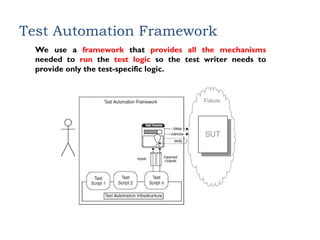
We use a framework that provides all the mechanisms
needed to run the test logic so the test writer needs to
provide only the test-specific logic.
…
Where do we put our test code?
Test Method
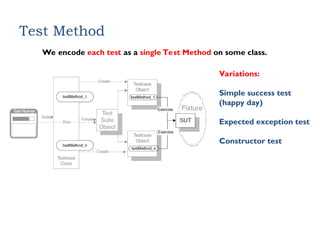
We encode each test as a single Test Method on some class.
Variations:
Simple success test
(happy day)
Expected exception test
Constructor test
Test Case Class
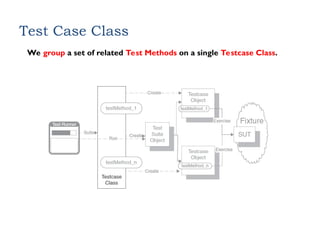
We group a set of related Test Methods on a single Testcase Class.
How do we structure our test code?
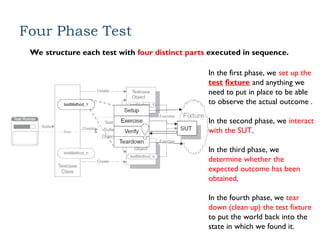
Four Phase Test
We structure each test with four distinct parts executed in sequence.
In the first phase, we set up the
test fixture and anything we
need to put in place to be able
to observe the actual outcome .
In the second phase, we interact
with the SUT.
In the third phase, we
determine whether the
expected outcome has been
obtained.
In the fourth phase, we tear
down (clean up) the test fixture
to put the world back into the
state in which we found it.
How do we make tests self-checking?
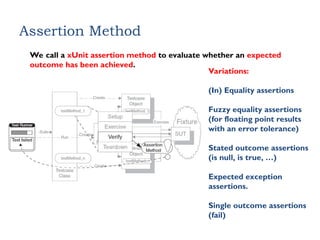
Assertion Method
We call a xUnit assertion method to evaluate whether an expected
outcome has been achieved.
Variations:
(In) Equality assertions
Fuzzy equality assertions
(for floating point results
with an error tolerance)
Stated outcome assertions
(is null, is true, …)
Expected exception
assertions.
Single outcome assertions
(fail)
How do we provide more
information about a failed
assertion?
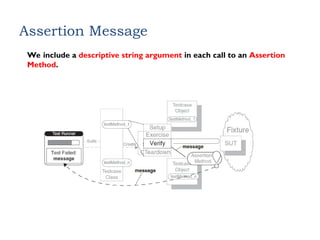
Assertion Message
We include a descriptive string argument in each call to an Assertion
Method.
How do we run the tests?
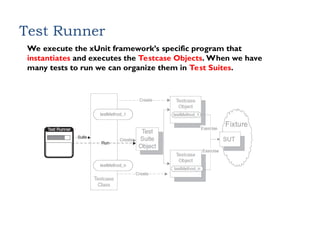
Test Runner
We execute the xUnit framework’s specific program that
instantiates and executes the Testcase Objects. When we have
many tests to run we can organize them in Test Suites.
Fixture Setup/Teardown Patterns
http://xunitpatterns.com/index.html
Examples:
https://github.com/zarras/myy803-junit-mockito-
tutorials/tree/master/fixture-patterns/
What is a test fixture?
A test fixture is everything we need in place to be
able to test the System Under Test (SUT)
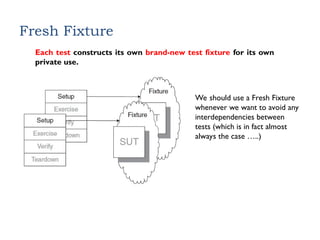
Fresh Fixture
Each test constructs its own brand-new test fixture for its own
private use.
We should use a Fresh Fixture
whenever we want to avoid any
interdependencies between
tests (which is in fact almost
always the case …..)
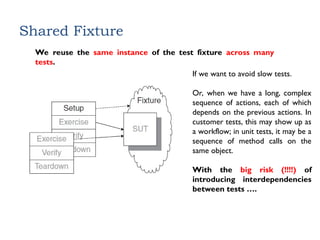
Shared Fixture
We reuse the same instance of the test fixture across many
tests.
If we want to avoid slow tests.
Or, when we have a long, complex
sequence of actions, each of which
depends on the previous actions. In
customer tests, this may show up as
a workflow; in unit tests, it may be a
sequence of method calls on the
same object.
With the big risk (!!!!) of
introducing interdependencies
between tests ….
How do we construct (destroy) a
fresh fixture?
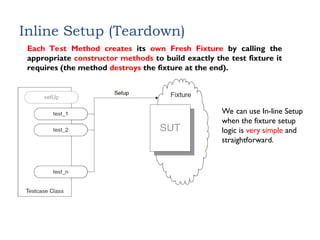
Inline Setup (Teardown)
Each Test Method creates its own Fresh Fixture by calling the
appropriate constructor methods to build exactly the test fixture it
requires (the method destroys the fixture at the end).
We can use In-line Setup
when the fixture setup
logic is very simple and
straightforward.
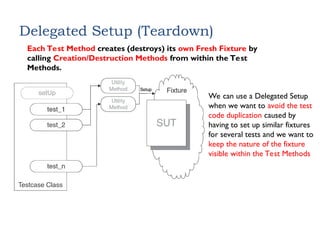
Delegated Setup (Teardown)
Each Test Method creates (destroys) its own Fresh Fixture by
calling Creation/Destruction Methods from within the Test
Methods.
We can use a Delegated Setup
when we want to avoid the test
code duplication caused by
having to set up similar fixtures
for several tests and we want to
keep the nature of the fixture
visible within the Test Methods
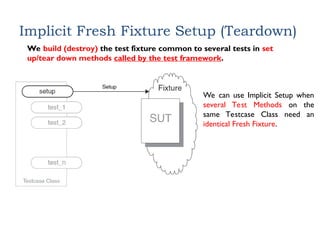
Implicit Fresh Fixture Setup (Teardown)
We build (destroy) the test fixture common to several tests in set
up/tear down methods called by the test framework.
We can use Implicit Setup when
several Test Methods on the
same Testcase Class need an
identical Fresh Fixture.
How do we create (destroy) a shared
fixture if the test methods that
need it are in the same test class?
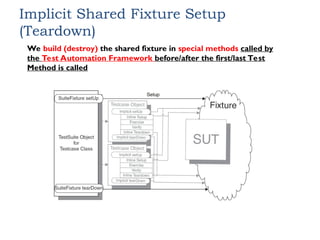
Implicit Shared Fixture Setup
(Teardown)
We build (destroy) the shared fixture in special methods called by
the Test Automation Framework before/after the first/last Test
Method is called
Result Verification Patterns
http://xunitpatterns.com/index.html
Examples:
https://github.com/zarras/myy803-junit-mockito-
tutorials/tree/master/result-verification-patterns
How do we verify a method that
returns a value?
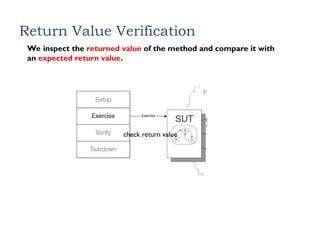
Return Value Verification
We inspect the returned value of the method and compare it with
an expected return value.
check return value
How do we verify a method that
changes the state of the SUT?
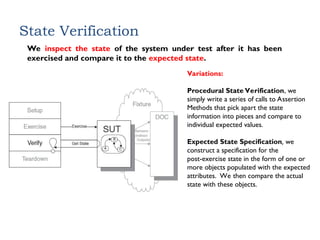
State Verification
We inspect the state of the system under test after it has been
exercised and compare it to the expected state.
Variations:
Procedural State Verification, we
simply write a series of calls to Assertion
Methods that pick apart the state
information into pieces and compare to
individual expected values.
Expected State Specification, we
construct a specification for the
post-exercise state in the form of one or
more objects populated with the expected
attributes. We then compare the actual
state with these objects.
How do we verify a method of the
SUT that interacts with other
Depend-On-Components (DOC)?
Behavior Verification
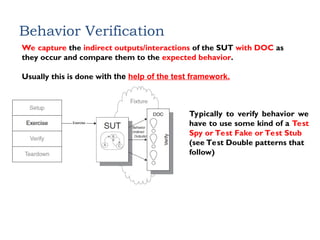
We capture the indirect outputs/interactions of the SUT with DOC as
they occur and compare them to the expected behavior.
Usually this is done with the help of the test framework.
Typically to verify behavior we
have to use some kind of a Test
Spy or Test Fake or Test Stub
(see Test Double patterns that
follow)
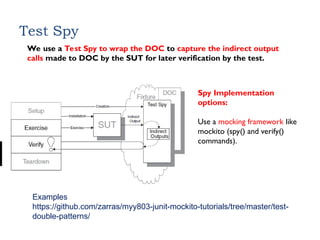
Test Spy
We use a Test Spy to wrap the DOC to capture the indirect output
calls made to DOC by the SUT for later verification by the test.
Spy Implementation
options:
Use a mocking framework like
mockito (spy() and verify()
commands).
Examples
https://github.com/zarras/myy803-junit-mockito-tutorials/tree/master/test-
double-patterns/
How do we verify the behavior of
the SUT when it calls another
component, independently from
this component?
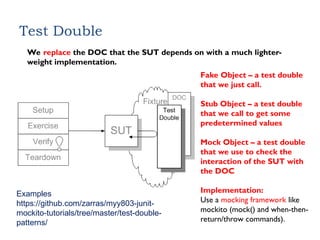
Test Double
We replace the DOC that the SUT depends on with a much lighter-
weight implementation.
Fake Object – a test double
that we just call.
Stub Object – a test double
that we call to get some
predetermined values
Mock Object – a test double
that we use to check the
interaction of the SUT with
the DOC
Implementation:
Use a mocking framework like
mockito (mock() and when-then-
return/throw commands).
Examples
https://github.com/zarras/myy803-junit-
mockito-tutorials/tree/master/test-double-
patterns/
Testing techniques
How do we create test cases?
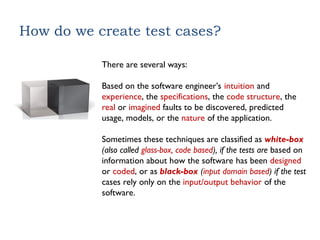
There are several ways:
Based on the software engineer’s intuition and
experience, the specifications, the code structure, the
real or imagined faults to be discovered, predicted
usage, models, or the nature of the application.
Sometimes these techniques are classified as white-box
(also called glass-box, code based), if the tests are based on
information about how the software has been designed
or coded, or as black-box (input domain based) if the test
cases rely only on the input/output behavior of the
software.
Which is the most widely
practiced technique?
Ad-hoc testing
Perhaps the most widely practiced technique is ad
hoc testing:
Tests are derived relying on the software engineer’s
skill, intuition, and experience with similar programs.
Ad hoc testing can be useful for identifying test
cases that not easily generated by more formalized
techniques.
Test (good, bad) scenarios, use cases, user
stories, …..
How about input domain based
techniques?
Input domain based techniques
Two widely know categories are:
Boundary value testing techniques.
Equivalence class testing techniques.
Normal boundary value technique
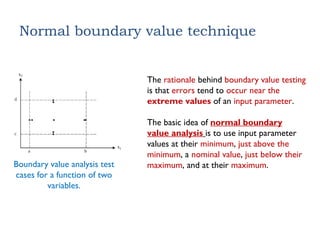
The rationale behind boundary value testing
is that errors tend to occur near the
extreme values of an input parameter.
The basic idea of normal boundary
value analysis is to use input parameter
values at their minimum, just above the
minimum, a nominal value, just below their
maximum, and at their maximum.
Boundary value analysis test
cases for a function of two
variables.
Normal boundary value technique
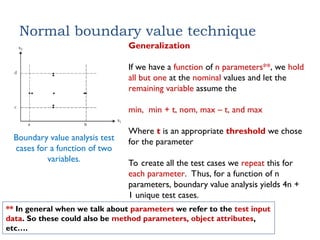
Boundary value analysis test
cases for a function of two
variables.
Generalization
If we have a function of n parameters**, we hold
all but one at the nominal values and let the
remaining variable assume the
min, min + t, nom, max – t, and max
Where t is an appropriate threshold we chose
for the parameter
To create all the test cases we repeat this for
each parameter. Thus, for a function of n
parameters, boundary value analysis yields 4n +
1 unique test cases.
** In general when we talk about parameters we refer to the test input
data. So these could also be method parameters, object attributes,
etc….
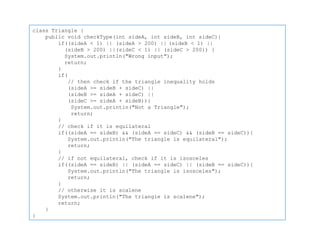
class Triangle {
public void checkType(int sideA, int sideB, int sideC){
if((sideA < 1) || (sideA > 200) || (sideB < 1) ||
(sideB > 200) ||(sideC < 1) || (sideC > 200)) {
System.out.println("Wrong input");
return;
}
if(
// then check if the triangle inequality holds
(sideA >= sideB + sideC) ||
(sideB >= sideA + sideC) ||
(sideC >= sideA + sideB)){
System.out.println("Not a Triangle");
return;
}
// check if it is equilateral
if((sideA == sideB) && (sideA == sideC) && (sideB == sideC)){
System.out.println("The triangle is equilateral");
return;
}
// if not equilateral, check if it is isosceles
if((sideA == sideB) || (sideA == sideC) || (sideB == sideC)){
System.out.println("The triangle is isosceles");
return;
}
// otherwise it is scalene
System.out.println("The triangle is scalene");
return;
}
}
Test Case sideA sideB sideC Expected
output
1 100 100 1 Isosceles
2 100 100 2 Isosceles
3 100 100 100 Equilateral
4 100 100 199 Isosceles
5 100 100 200 Not a triangle
6 100 1 100 Isosceles
7 100 2 100 Isosceles
8 100 199 100 Isosceles
9 100 200 100 Not a triangle
10 1 100 100 Isosceles
11 2 100 100 Isosceles
12 199 100 100 Isosceles
13 200 100 100 Not a triangle
sideA: [1, 200] sideB: [1, 200] sideC: [1, 200] t = 1
Robust boundary value technique
Robust boundary value analysis
test cases for a function of two
variables.
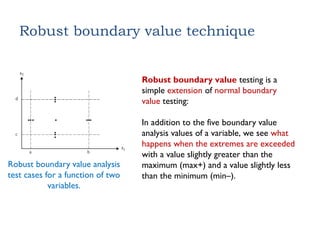
Robust boundary value testing is a
simple extension of normal boundary
value testing:
In addition to the five boundary value
analysis values of a variable, we see what
happens when the extremes are exceeded
with a value slightly greater than the
maximum (max+) and a value slightly less
than the minimum (min–).
Robust boundary value technique
Robust boundary value analysis
test cases for a function of two
variables.
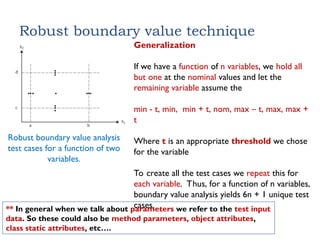
Generalization
If we have a function of n variables, we hold all
but one at the nominal values and let the
remaining variable assume the
min - t, min, min + t, nom, max – t, max, max +
t
Where t is an appropriate threshold we chose
for the variable
To create all the test cases we repeat this for
each variable. Thus, for a function of n variables,
boundary value analysis yields 6n + 1 unique test
cases.
** In general when we talk about parameters we refer to the test input
data. So these could also be method parameters, object attributes,
class static attributes, etc….
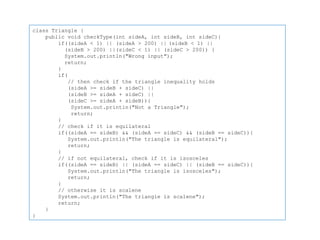
class Triangle {
public void checkType(int sideA, int sideB, int sideC){
if((sideA < 1) || (sideA > 200) || (sideB < 1) ||
(sideB > 200) ||(sideC < 1) || (sideC > 200)) {
System.out.println("Wrong input");
return;
}
if(
// then check if the triangle inequality holds
(sideA >= sideB + sideC) ||
(sideB >= sideA + sideC) ||
(sideC >= sideA + sideB)){
System.out.println("Not a Triangle");
return;
}
// check if it is equilateral
if((sideA == sideB) && (sideA == sideC) && (sideB == sideC)){
System.out.println("The triangle is equilateral");
return;
}
// if not equilateral, check if it is isosceles
if((sideA == sideB) || (sideA == sideC) || (sideB == sideC)){
System.out.println("The triangle is isosceles");
return;
}
// otherwise it is scalene
System.out.println("The triangle is scalene");
return;
}
}
Test Case sideA sideB sideC Expected
output
1 100 100 0 Wrong input
2 100 100 1 Isosceles
3 100 100 2 Isosceles
4 100 100 100 Equilateral
5 100 100 199 Isosceles
6 100 100 200 Not a triangle
7 100 100 201 Wrong input
8 100 0 100 Wrong input
9 100 1 100 Isosceles
10 100 2 100 Isosceles
11 100 199 100 Isosceles
12 100 200 100 Not a triangle
13 100 201 100 Wrong input
14 0 100 100 Wrong input
15 1 100 100 Isosceles
16 2 100 100 Isosceles
17 199 100 100 Isosceles
18 200 100 100 Not a triangle
19 201 100 100 Wrong input
sideA: [1, 200] sideB: [1, 200] sideC: [1, 200] t = 1
Issues and limitations
Boundary value analysis works well with a function of several
independent parameter that represent bounded physical quantities.
The parameters need to be described by a true ordering relation,
in which, for every pair <a, b> of values of a parameter, it is possible
to say that a ≤ b.
Test values for alphabet characters, for example, would be {a, b, m, y,
and z}.
When no explicit bounds are present, we usually have to create
“artificial” bounds (e.g., language specific Integer.MAX_VALUE,
Integer.MIN_VALUE, etc).
Boundary value analysis does not make much sense for boolean
variables; we can use as the extreme values TRUE and FALSE.
Equivalence class testing
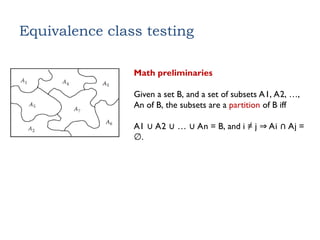
Math preliminaries
Given a set B, and a set of subsets A1, A2, …,
An of B, the subsets are a partition of B iff
A1 A2 … An = B, and i ≠ j Ai Aj =
∪ ∪ ∪ ⇒ ∩
.
∅
Equivalence class testing
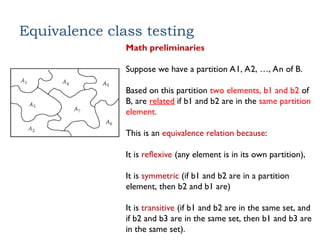
Math preliminaries
Suppose we have a partition A1, A2, …, An of B.
Based on this partition two elements, b1 and b2 of
B, are related if b1 and b2 are in the same partition
element.
This is an equivalence relation because:
It is reflexive (any element is in its own partition),
It is symmetric (if b1 and b2 are in a partition
element, then b2 and b1 are)
It is transitive (if b1 and b2 are in the same set, and
if b2 and b3 are in the same set, then b1 and b3 are
in the same set).
Equivalence class testing
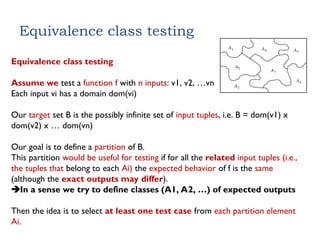
Assume we test a function f with n inputs: v1, v2, …vn
Each input vi has a domain dom(vi)
Our target set B is the possibly infinite set of input tuples, i.e. B = dom(v1) x
dom(v2) x … dom(vn)
Our goal is to define a partition of B.
This partition would be useful for testing if for all the related input tuples (i.e.,
the tuples that belong to each Ai) the expected behavior of f is the same
(although the exact outputs may differ).
In a sense we try to define classes (A1, A2, …) of expected outputs
Then the idea is to select at least one test case from each partition element
Ai.
For the triangle problem we can have the following partition:
B = A1 A2 A3 A4 A5
∪ ∪ ∪ ∪
A1 = {a, b, c | wrong input} A2 = {a, b, c | not a triangle} A3 = {a, b, c |
equilateral}
A4 = {a, b, c | isosceles} A5 = {a, b, c | scalene}
class Triangle {
public void checkType(int sideA, int sideB, int sideC){
……….
}
}
Test Case sideA sideB sideC Expected
output
1 100 100 0 Wrong input
2 100 100 200 Not a triangle
3 100 100 100 Equilateral
4 100 199 100 Isosceles
5 100 200 45 Scalene
How about code based
techniques?
Code based techniques
Two widely know categories are:
Control flow testing techniques.
Data flow testing techniques.
Which are the fundamental
concepts of control flow
techniques?
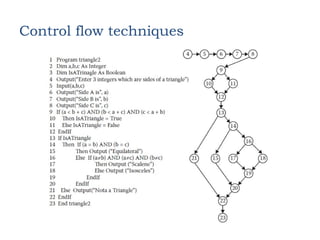
Control flow techniques
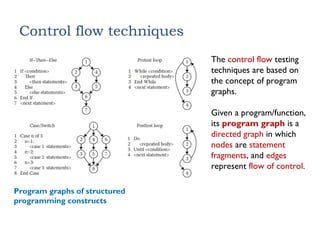
The control flow testing
techniques are based on
the concept of program
graphs.
Given a program/function,
its program graph is a
directed graph in which
nodes are statement
fragments, and edges
represent flow of control.
Program graphs of structured
programming constructs
Control flow techniques
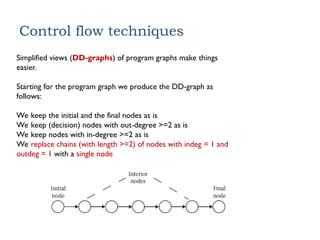
Simplified views (DD-graphs) of program graphs make things
easier.
Starting for the program graph we produce the DD-graph as
follows:
We keep the initial and the final nodes as is
We keep (decision) nodes with out-degree >=2 as is
We keep nodes with in-degree >=2 as is
We replace chains (with length >=2) of nodes with indeg = 1 and
outdeg = 1 with a single node
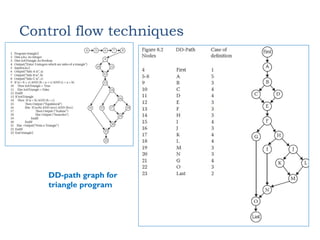
Control flow techniques
DD-path graph for
triangle program
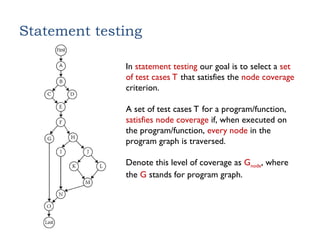
Statement testing
In statement testing our goal is to select a set
of test cases T that satisfies the node coverage
criterion.
A set of test cases T for a program/function,
satisfies node coverage if, when executed on
the program/function, every node in the
program graph is traversed.
Denote this level of coverage as Gnode, where
the G stands for program graph.
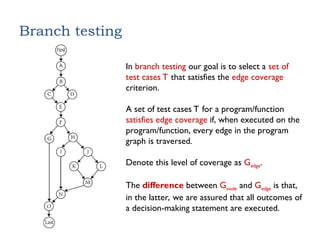
Branch testing
In branch testing our goal is to select a set of
test cases T that satisfies the edge coverage
criterion.
A set of test cases T for a program/function
satisfies edge coverage if, when executed on the
program/function, every edge in the program
graph is traversed.
Denote this level of coverage as Gedge.
The difference between Gnode and Gedge is that,
in the latter, we are assured that all outcomes of
a decision-making statement are executed.
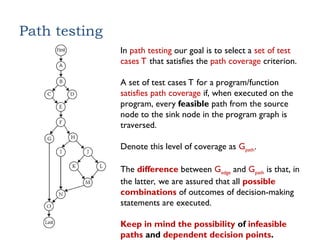
Path testing
In path testing our goal is to select a set of test
cases T that satisfies the path coverage criterion.
A set of test cases T for a program/function
satisfies path coverage if, when executed on the
program, every feasible path from the source
node to the sink node in the program graph is
traversed.
Denote this level of coverage as Gpath.
The difference between Gedge and Gpath is that, in
the latter, we are assured that all possible
combinations of outcomes of decision-making
statements are executed.
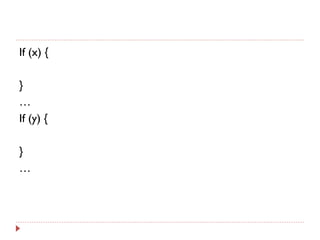
Keep in mind the possibility of infeasible
paths and dependent decision points.
If (x) {
}
…
If (y) {
}
…
Testing Software Engineering systems end to end

Testing Software Engineering systems end to end

  • 1.
    Slides material sources: SoftwareEngineering - Theory & Practice, S. L. Pfleeger Introduction to Software Engineering, I. Sommerville SWEBOK v3: IEEE Software Engineering Body of Knowledge Working Effectively with Legacy Code, M. Feathers Software Testing – A Craftsman’s Approach, P Jorgensen xUnit Patterns by Gerard Meszaros Software Testing www.cs.uoi.gr/~zarras/http://www.cs.uoi.gr/~zarras/se.htm
  • 2.
  • 3.
  • 4.
    Why does softwarefail? A more complete answer includes the famous triplet: Errors Faults Failures Bugs !!!
  • 5.
    What do wemean by error?
  • 6.
    Errors Error People make errors.A good synonym is mistake. Errors tend to propagate; a requirements error may be magnified during design and amplified still more during coding. International Software Testing Qualification Board (ISTQB)
  • 7.
    What do wemean by fault?
  • 8.
    Faults Fault A fault isthe result of an error. It is more precise to say that a fault is the representation of an error, where representation is the mode of expression, such as narrative text, UML diagrams, hierarchy charts, and source code. Defect (see the ISTQB Glossary) is a good synonym for fault, as is bug. International Software Testing Qualification Board (ISTQB)
  • 9.
    What do wemean by failure?
  • 10.
    Failures Failure A failure occurswhen the code corresponding to a fault executes. In general a failure is the manifestation of a fault. International Software Testing Qualification Board (ISTQB)
  • 11.
  • 12.
    Software testing Testing isthe act of exercising software with test cases. A test has two distinct goals: To find failures (verification aspect). To demonstrate correct execution (validation aspect).
  • 13.
    What is atest case?
  • 14.
    Test cases The essenceof software testing is to determine a set of test cases for the item to be tested. A test case is (or should be) a recognized work product. A complete test case will contain a test case identifier, a brief statement of purpose, a description of preconditions, the actual test case inputs, the expected outputs, a description of expected post-conditions (system state after test execution), and an execution history. The execution history is primarily for test management use—it may contain the date when the test was run, the person who ran it, the version on which it was run, and the pass/fail result.
  • 15.
    Why should wewrite tests?
  • 16.
    Why should wewrite tests ? We need tests to improve software quality We need tests to improve software understanding  Tests as specification.  Insure that we build the right software.  Defect localization.  Insure that the software is correct.  Defect prevention.  Insure that bugs wont crawl back to the software.  Tests as documentation.  Allow the developer/maintainer to answer questions like “what should be the expected outcome of the software is the given input is …”
  • 17.
    How do wewrite good tests?
  • 18.
    How do wewrite good tests ? The tests that we write should be easy to run  Fully automated.  Execute without any effort.  Self checking.  Detect and report any errors without human intervention.  Repeatable.  Can be run many times in a row and produce the same results without human interventions in between.  Independent from each other.  Can be run by themselves and NOT depend on the execution order, failure or success of other tests. Tests should not introduce new risks  Refrain from modifying the software to facilitate the development of the tests as safety net.
  • 19.
    Which are thetargets of testing?
  • 20.
    Testing targets The targetof the test can vary: A single module, a group of such modules (related by purpose, use, behavior, or structure), or an entire system. Three test stages can be distinguished: unit, integration, and system.
  • 21.
  • 22.
    How do wemake it easy to write and run tests written by different people?
  • 23.
    Test Automation Framework Weuse a framework that provides all the mechanisms needed to run the test logic so the test writer needs to provide only the test-specific logic. …
  • 24.
    Where do weput our test code?
  • 25.
    Test Method We encodeeach test as a single Test Method on some class. Variations: Simple success test (happy day) Expected exception test Constructor test
  • 26.
    Test Case Class Wegroup a set of related Test Methods on a single Testcase Class.
  • 27.
    How do westructure our test code?
  • 28.
    Four Phase Test Westructure each test with four distinct parts executed in sequence. In the first phase, we set up the test fixture and anything we need to put in place to be able to observe the actual outcome . In the second phase, we interact with the SUT. In the third phase, we determine whether the expected outcome has been obtained. In the fourth phase, we tear down (clean up) the test fixture to put the world back into the state in which we found it.
  • 29.
    How do wemake tests self-checking?
  • 30.
    Assertion Method We calla xUnit assertion method to evaluate whether an expected outcome has been achieved. Variations: (In) Equality assertions Fuzzy equality assertions (for floating point results with an error tolerance) Stated outcome assertions (is null, is true, …) Expected exception assertions. Single outcome assertions (fail)
  • 31.
    How do weprovide more information about a failed assertion?
  • 32.
    Assertion Message We includea descriptive string argument in each call to an Assertion Method.
  • 33.
    How do werun the tests?
  • 34.
    Test Runner We executethe xUnit framework’s specific program that instantiates and executes the Testcase Objects. When we have many tests to run we can organize them in Test Suites.
  • 35.
  • 36.
    What is atest fixture? A test fixture is everything we need in place to be able to test the System Under Test (SUT)
  • 37.
    Fresh Fixture Each testconstructs its own brand-new test fixture for its own private use. We should use a Fresh Fixture whenever we want to avoid any interdependencies between tests (which is in fact almost always the case …..)
  • 38.
    Shared Fixture We reusethe same instance of the test fixture across many tests. If we want to avoid slow tests. Or, when we have a long, complex sequence of actions, each of which depends on the previous actions. In customer tests, this may show up as a workflow; in unit tests, it may be a sequence of method calls on the same object. With the big risk (!!!!) of introducing interdependencies between tests ….
  • 39.
    How do weconstruct (destroy) a fresh fixture?
  • 40.
    Inline Setup (Teardown) EachTest Method creates its own Fresh Fixture by calling the appropriate constructor methods to build exactly the test fixture it requires (the method destroys the fixture at the end). We can use In-line Setup when the fixture setup logic is very simple and straightforward.
  • 41.
    Delegated Setup (Teardown) EachTest Method creates (destroys) its own Fresh Fixture by calling Creation/Destruction Methods from within the Test Methods. We can use a Delegated Setup when we want to avoid the test code duplication caused by having to set up similar fixtures for several tests and we want to keep the nature of the fixture visible within the Test Methods
  • 42.
    Implicit Fresh FixtureSetup (Teardown) We build (destroy) the test fixture common to several tests in set up/tear down methods called by the test framework. We can use Implicit Setup when several Test Methods on the same Testcase Class need an identical Fresh Fixture.
  • 43.
    How do wecreate (destroy) a shared fixture if the test methods that need it are in the same test class?
  • 44.
    Implicit Shared FixtureSetup (Teardown) We build (destroy) the shared fixture in special methods called by the Test Automation Framework before/after the first/last Test Method is called
  • 45.
  • 46.
    How do weverify a method that returns a value?
  • 47.
    Return Value Verification Weinspect the returned value of the method and compare it with an expected return value. check return value
  • 48.
    How do weverify a method that changes the state of the SUT?
  • 49.
    State Verification We inspectthe state of the system under test after it has been exercised and compare it to the expected state. Variations: Procedural State Verification, we simply write a series of calls to Assertion Methods that pick apart the state information into pieces and compare to individual expected values. Expected State Specification, we construct a specification for the post-exercise state in the form of one or more objects populated with the expected attributes. We then compare the actual state with these objects.
  • 50.
    How do weverify a method of the SUT that interacts with other Depend-On-Components (DOC)?
  • 51.
    Behavior Verification We capturethe indirect outputs/interactions of the SUT with DOC as they occur and compare them to the expected behavior. Usually this is done with the help of the test framework. Typically to verify behavior we have to use some kind of a Test Spy or Test Fake or Test Stub (see Test Double patterns that follow)
  • 52.
    Test Spy We usea Test Spy to wrap the DOC to capture the indirect output calls made to DOC by the SUT for later verification by the test. Spy Implementation options: Use a mocking framework like mockito (spy() and verify() commands). Examples https://github.com/zarras/myy803-junit-mockito-tutorials/tree/master/test- double-patterns/
  • 53.
    How do weverify the behavior of the SUT when it calls another component, independently from this component?
  • 54.
    Test Double We replacethe DOC that the SUT depends on with a much lighter- weight implementation. Fake Object – a test double that we just call. Stub Object – a test double that we call to get some predetermined values Mock Object – a test double that we use to check the interaction of the SUT with the DOC Implementation: Use a mocking framework like mockito (mock() and when-then- return/throw commands). Examples https://github.com/zarras/myy803-junit- mockito-tutorials/tree/master/test-double- patterns/
  • 55.
  • 56.
    How do wecreate test cases?
  • 57.
    How do wecreate test cases? There are several ways: Based on the software engineer’s intuition and experience, the specifications, the code structure, the real or imagined faults to be discovered, predicted usage, models, or the nature of the application. Sometimes these techniques are classified as white-box (also called glass-box, code based), if the tests are based on information about how the software has been designed or coded, or as black-box (input domain based) if the test cases rely only on the input/output behavior of the software.
  • 58.
    Which is themost widely practiced technique?
  • 59.
    Ad-hoc testing Perhaps themost widely practiced technique is ad hoc testing: Tests are derived relying on the software engineer’s skill, intuition, and experience with similar programs. Ad hoc testing can be useful for identifying test cases that not easily generated by more formalized techniques. Test (good, bad) scenarios, use cases, user stories, …..
  • 60.
    How about inputdomain based techniques?
  • 61.
    Input domain basedtechniques Two widely know categories are: Boundary value testing techniques. Equivalence class testing techniques.
  • 62.
    Normal boundary valuetechnique The rationale behind boundary value testing is that errors tend to occur near the extreme values of an input parameter. The basic idea of normal boundary value analysis is to use input parameter values at their minimum, just above the minimum, a nominal value, just below their maximum, and at their maximum. Boundary value analysis test cases for a function of two variables.
  • 63.
    Normal boundary valuetechnique Boundary value analysis test cases for a function of two variables. Generalization If we have a function of n parameters**, we hold all but one at the nominal values and let the remaining variable assume the min, min + t, nom, max – t, and max Where t is an appropriate threshold we chose for the parameter To create all the test cases we repeat this for each parameter. Thus, for a function of n parameters, boundary value analysis yields 4n + 1 unique test cases. ** In general when we talk about parameters we refer to the test input data. So these could also be method parameters, object attributes, etc….
  • 64.
    class Triangle { publicvoid checkType(int sideA, int sideB, int sideC){ if((sideA < 1) || (sideA > 200) || (sideB < 1) || (sideB > 200) ||(sideC < 1) || (sideC > 200)) { System.out.println("Wrong input"); return; } if( // then check if the triangle inequality holds (sideA >= sideB + sideC) || (sideB >= sideA + sideC) || (sideC >= sideA + sideB)){ System.out.println("Not a Triangle"); return; } // check if it is equilateral if((sideA == sideB) && (sideA == sideC) && (sideB == sideC)){ System.out.println("The triangle is equilateral"); return; } // if not equilateral, check if it is isosceles if((sideA == sideB) || (sideA == sideC) || (sideB == sideC)){ System.out.println("The triangle is isosceles"); return; } // otherwise it is scalene System.out.println("The triangle is scalene"); return; } }
  • 65.
    Test Case sideAsideB sideC Expected output 1 100 100 1 Isosceles 2 100 100 2 Isosceles 3 100 100 100 Equilateral 4 100 100 199 Isosceles 5 100 100 200 Not a triangle 6 100 1 100 Isosceles 7 100 2 100 Isosceles 8 100 199 100 Isosceles 9 100 200 100 Not a triangle 10 1 100 100 Isosceles 11 2 100 100 Isosceles 12 199 100 100 Isosceles 13 200 100 100 Not a triangle sideA: [1, 200] sideB: [1, 200] sideC: [1, 200] t = 1
  • 66.
    Robust boundary valuetechnique Robust boundary value analysis test cases for a function of two variables. Robust boundary value testing is a simple extension of normal boundary value testing: In addition to the five boundary value analysis values of a variable, we see what happens when the extremes are exceeded with a value slightly greater than the maximum (max+) and a value slightly less than the minimum (min–).
  • 67.
    Robust boundary valuetechnique Robust boundary value analysis test cases for a function of two variables. Generalization If we have a function of n variables, we hold all but one at the nominal values and let the remaining variable assume the min - t, min, min + t, nom, max – t, max, max + t Where t is an appropriate threshold we chose for the variable To create all the test cases we repeat this for each variable. Thus, for a function of n variables, boundary value analysis yields 6n + 1 unique test cases. ** In general when we talk about parameters we refer to the test input data. So these could also be method parameters, object attributes, class static attributes, etc….
  • 68.
    class Triangle { publicvoid checkType(int sideA, int sideB, int sideC){ if((sideA < 1) || (sideA > 200) || (sideB < 1) || (sideB > 200) ||(sideC < 1) || (sideC > 200)) { System.out.println("Wrong input"); return; } if( // then check if the triangle inequality holds (sideA >= sideB + sideC) || (sideB >= sideA + sideC) || (sideC >= sideA + sideB)){ System.out.println("Not a Triangle"); return; } // check if it is equilateral if((sideA == sideB) && (sideA == sideC) && (sideB == sideC)){ System.out.println("The triangle is equilateral"); return; } // if not equilateral, check if it is isosceles if((sideA == sideB) || (sideA == sideC) || (sideB == sideC)){ System.out.println("The triangle is isosceles"); return; } // otherwise it is scalene System.out.println("The triangle is scalene"); return; } }
  • 69.
    Test Case sideAsideB sideC Expected output 1 100 100 0 Wrong input 2 100 100 1 Isosceles 3 100 100 2 Isosceles 4 100 100 100 Equilateral 5 100 100 199 Isosceles 6 100 100 200 Not a triangle 7 100 100 201 Wrong input 8 100 0 100 Wrong input 9 100 1 100 Isosceles 10 100 2 100 Isosceles 11 100 199 100 Isosceles 12 100 200 100 Not a triangle 13 100 201 100 Wrong input 14 0 100 100 Wrong input 15 1 100 100 Isosceles 16 2 100 100 Isosceles 17 199 100 100 Isosceles 18 200 100 100 Not a triangle 19 201 100 100 Wrong input sideA: [1, 200] sideB: [1, 200] sideC: [1, 200] t = 1
  • 70.
    Issues and limitations Boundaryvalue analysis works well with a function of several independent parameter that represent bounded physical quantities. The parameters need to be described by a true ordering relation, in which, for every pair <a, b> of values of a parameter, it is possible to say that a ≤ b. Test values for alphabet characters, for example, would be {a, b, m, y, and z}. When no explicit bounds are present, we usually have to create “artificial” bounds (e.g., language specific Integer.MAX_VALUE, Integer.MIN_VALUE, etc). Boundary value analysis does not make much sense for boolean variables; we can use as the extreme values TRUE and FALSE.
  • 71.
    Equivalence class testing Mathpreliminaries Given a set B, and a set of subsets A1, A2, …, An of B, the subsets are a partition of B iff A1 A2 … An = B, and i ≠ j Ai Aj = ∪ ∪ ∪ ⇒ ∩ . ∅
  • 72.
    Equivalence class testing Mathpreliminaries Suppose we have a partition A1, A2, …, An of B. Based on this partition two elements, b1 and b2 of B, are related if b1 and b2 are in the same partition element. This is an equivalence relation because: It is reflexive (any element is in its own partition), It is symmetric (if b1 and b2 are in a partition element, then b2 and b1 are) It is transitive (if b1 and b2 are in the same set, and if b2 and b3 are in the same set, then b1 and b3 are in the same set).
  • 73.
    Equivalence class testing Equivalenceclass testing Assume we test a function f with n inputs: v1, v2, …vn Each input vi has a domain dom(vi) Our target set B is the possibly infinite set of input tuples, i.e. B = dom(v1) x dom(v2) x … dom(vn) Our goal is to define a partition of B. This partition would be useful for testing if for all the related input tuples (i.e., the tuples that belong to each Ai) the expected behavior of f is the same (although the exact outputs may differ). In a sense we try to define classes (A1, A2, …) of expected outputs Then the idea is to select at least one test case from each partition element Ai.
  • 74.
    For the triangleproblem we can have the following partition: B = A1 A2 A3 A4 A5 ∪ ∪ ∪ ∪ A1 = {a, b, c | wrong input} A2 = {a, b, c | not a triangle} A3 = {a, b, c | equilateral} A4 = {a, b, c | isosceles} A5 = {a, b, c | scalene} class Triangle { public void checkType(int sideA, int sideB, int sideC){ ………. } } Test Case sideA sideB sideC Expected output 1 100 100 0 Wrong input 2 100 100 200 Not a triangle 3 100 100 100 Equilateral 4 100 199 100 Isosceles 5 100 200 45 Scalene
  • 75.
    How about codebased techniques?
  • 76.
    Code based techniques Twowidely know categories are: Control flow testing techniques. Data flow testing techniques.
  • 77.
    Which are thefundamental concepts of control flow techniques?
  • 78.
    Control flow techniques Thecontrol flow testing techniques are based on the concept of program graphs. Given a program/function, its program graph is a directed graph in which nodes are statement fragments, and edges represent flow of control. Program graphs of structured programming constructs
  • 79.
  • 80.
    Control flow techniques Simplifiedviews (DD-graphs) of program graphs make things easier. Starting for the program graph we produce the DD-graph as follows: We keep the initial and the final nodes as is We keep (decision) nodes with out-degree >=2 as is We keep nodes with in-degree >=2 as is We replace chains (with length >=2) of nodes with indeg = 1 and outdeg = 1 with a single node
  • 81.
    Control flow techniques DD-pathgraph for triangle program
  • 82.
    Statement testing In statementtesting our goal is to select a set of test cases T that satisfies the node coverage criterion. A set of test cases T for a program/function, satisfies node coverage if, when executed on the program/function, every node in the program graph is traversed. Denote this level of coverage as Gnode, where the G stands for program graph.
  • 83.
    Branch testing In branchtesting our goal is to select a set of test cases T that satisfies the edge coverage criterion. A set of test cases T for a program/function satisfies edge coverage if, when executed on the program/function, every edge in the program graph is traversed. Denote this level of coverage as Gedge. The difference between Gnode and Gedge is that, in the latter, we are assured that all outcomes of a decision-making statement are executed.
  • 84.
    Path testing In pathtesting our goal is to select a set of test cases T that satisfies the path coverage criterion. A set of test cases T for a program/function satisfies path coverage if, when executed on the program, every feasible path from the source node to the sink node in the program graph is traversed. Denote this level of coverage as Gpath. The difference between Gedge and Gpath is that, in the latter, we are assured that all possible combinations of outcomes of decision-making statements are executed. Keep in mind the possibility of infeasible paths and dependent decision points.
  • 85.
    If (x) { } … If(y) { } …

Editor's Notes

  • #26 https://www.javatpoint.com/junit-test-case-example-in-java
  • #30 https://www.baeldung.com/junit-assertions https://howtodoinjava.com/junit5/junit-5-assertions-examples/
  • #34 https://howtodoinjava.com/junit5/junit5-test-suites-examples/
  • #42 https://www.baeldung.com/junit-before-beforeclass-beforeeach-beforeall
  • #44 https://www.baeldung.com/junit-before-beforeclass-beforeeach-beforeall
  • #51 Attention !!! these – self checking - mock objects are not supported by mockito, they have to be build by hand !!! Typical mockito mock objects are just fake objects or stub objects A way to make a spy without mockito is to subclass the DOC and override its methods to keep track of when they are called.
  • #70 When no explicit bounds are present, we usually have to create “artificial” bounds (e.g., language specific MAXINT, MININT, etc). For other data types, as long as a variable supports an ordering relation, we can usually infer the min, min+, nominal, max–, and max values. Test values for alphabet characters, for example, would be {a, b, m, y, and z}. Boundary value analysis does not make much sense for Boolean variables; the extreme values are TRUE and FALSE, but no clear choice is available for the remaining three.
  • #73 Ισοδύναμες κλάσεις/υποσύνολα πλειάδων τιμών για τα οποία η συμπεριφορά του συστήματος είναι παρόμοια