




Tests
                            Test


                           Paweł L. Lipiński


(or how to write tests so that they serve you well)
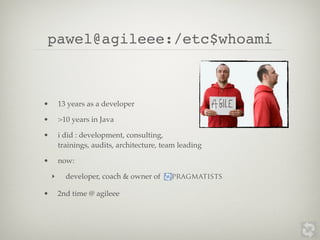
pawel@agileee:/etc$whoami


•       13 years as a developer

•       >10 years in Java

•       i did : development, consulting,
        trainings, audits, architecture, team leading

•       now:

    ‣     developer, coach & owner of      pragmatists

•       2nd time @ agileee
Agenda


• writing tests so that they’re reliable
• writing tests so that they document code
• writing tests so that they’re maintainable
• writing tests so that they’re readable
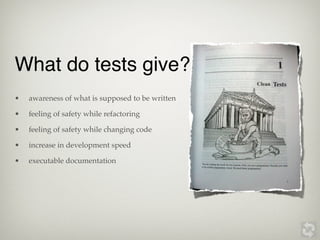
What do tests give?
                                                  Tests

•   awareness of what is supposed to be written

•   feeling of safety while refactoring

•   feeling of safety while changing code

•   increase in development speed

•   executable documentation
So whatʼs the problem?


•   Whenever you change something -
    they stop working
•   They become harder
    and harder to maintain
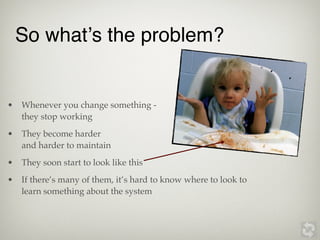
•   They soon start to look like this
•   If there’s many of them, it’s hard to know where to look to
    learn something about the system
Process


• Think First
• Trivial First
• Test specifies „what”,
  implementation says „how”
• Different levels of tests
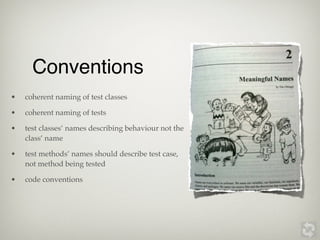
Conventions
•   coherent naming of test classes

•   coherent naming of tests

•   test classes’ names describing behaviour not the
    class’ name

•   test methods’ names should describe test case,
    not method being tested

•   code conventions
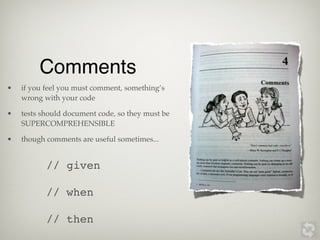
Comments
•   if you feel you must comment, something’s
    wrong with your code

•   tests should document code, so they must be
    SUPERCOMPREHENSIBLE

•   though comments are useful sometimes...


           // given

           // when

           // then
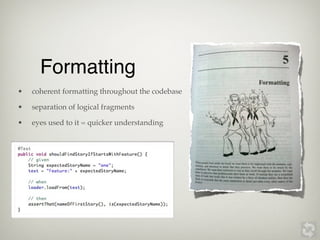
Formatting
•   coherent formatting throughout the codebase

•   separation of logical fragments

•   eyes used to it = quicker understanding
Given (test setup)


•   DRY (setup methods should be business-like)

•   setup method COMPREHENSIBLE

•   @Before vs. explicite call
Error handling
•    One test, one exception

•    NEVER:
     @Test(expected = Exception.class)
     Use only CONCRETE, UNIQUE exception

•    try / catch


    @Rule
    public ExpectedException throwing =
                             ExpectedException.none();
    ...
    ...

    // when
    throwing.expect(ParseException.class);
    parser.parse(text);
    // then exception is thrown
Behaviour Driven Development
• define behaviours not tests
• behaviours constitute a functional spec of
  the application
• behaviours should be worked upon by
  business people together with developers
• focus on why the code should exist
• naming in code is the same as names used
  by the business people (ubiquitous language)
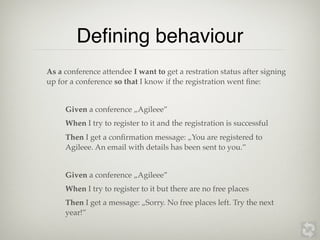
Defining behaviour
As a conference attendee I want to get a restration status after signing
up for a conference so that I know if the registration went fine:


     Given a conference „Agileee”
     When I try to register to it and the registration is successful
     Then I get a confirmation message: „You are registered to
     Agileee. An email with details has been sent to you.”


     Given a conference „Agileee”
     When I try to register to it but there are no free places
     Then I get a message: „Sorry. No free places left. Try the next
     year!”
Examples, not Tests
• BDD helps to think about objects from the
  perspective of their behaviours, so the code is
  more object-oriented
• examples help you create a „mental” model of
  the system
• test class shows examples of use of a
  functionality
• test code is an example of behaviour
• test code is also an example of use
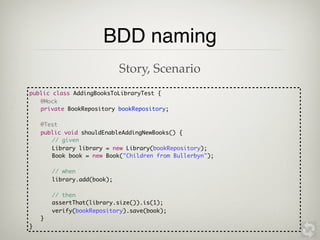
BDD naming
                             Story, Scenario
public class AddingBooksToLibraryTest {
   @Mock
	 private BookRepository bookRepository;

	   @Test
	   public void shouldEnableAddingNewBooks() {
	   	 // given
	   	 Library library = new Library(bookRepository);
	   	 Book book = new Book("Children from Bullerbyn");

	   	   // when
	   	   library.add(book);

	   	   // then
	   	   assertThat(library.size()).is(1);
        verify(bookRepository).save(book);
	   }
}
BDD rules
• test names should be sentences
• simple constant template of the sentence
  helps you focus in the test on one thing
  public void shouldBeSearchedByName()

• understandable test name helps when the
  test fails
• test are examples - think about them not as
  a means for future verification, but as a
  documentation of behaviour
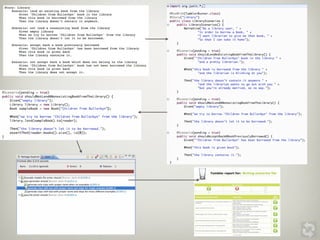
Tumbler


http://tumbler-glass.googlecode.com
A-TDD
• Acceptance tests may drive the development of scenarios.
• But the need to be:
  ‣   written by business people (or at least with them
      nearby)
  ‣   verify correctness of scenario accomplishment (be
      complete and fulfill acceptance criteria)
  ‣   be automatic
  ‣   be maintainable
• These are high-level tests, so changes to the application
  may force you to modify many of them
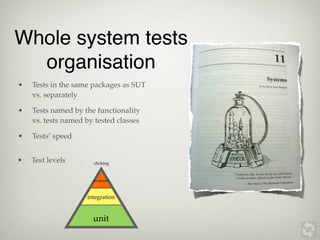
Whole system tests
  organisation
•   Tests in the same packages as SUT
    vs. separately

•   Tests named by the functionality
    vs. tests named by tested classes

•   Tests’ speed


•   Test levels       clicking


                      acceptance


                    integration


                      unit
Test smells
•   Long setup - lack of factory method, or perhaps
    a problem with the structure of created objects?

•   Long tests - perhaps you’re testing more than
    one behaviour at a time?

•   Many assertions - doesn’t the tested method
    have too many responsibilities?

•   Too many test methods in a test class - class
    under test has too many responsibilities? Or
    maybe you’re testing more than one
    functionality in a single class?
Maintainable tests
•   Reuse assertions, create „business” assertions
•   Reuse object construction methods - don’t be sensitive to
    changes of constructors
•   Reuse test setup
•   Tests should not depend on environment and order of execution
•   Avoid many assertions - when the first one fails, others are not
    executed (they could’ve give you a clue about possible reasons)
•   Separate assertion from the action to increase readability (or
    better use given/when/then pattern)
•   Use variables to pass and verify values in tests
•   Remove tests ONLY when you remove a functionality or when
    tests’ responsibilities overlap
TO WRITE READABLE TESTS
Thank you!
                      pawel.lipinski@pragmatists.pl

                          http://www.pragmatists.pl


All pictures were used exclusively to set the presentation context and advertise the original book.

Clean tests

  • 1.
    Tests Test Paweł L. Lipiński (or how to write tests so that they serve you well)
  • 2.
    pawel@agileee:/etc$whoami • 13 years as a developer • >10 years in Java • i did : development, consulting, trainings, audits, architecture, team leading • now: ‣ developer, coach & owner of pragmatists • 2nd time @ agileee
  • 3.
    Agenda • writing testsso that they’re reliable • writing tests so that they document code • writing tests so that they’re maintainable • writing tests so that they’re readable
  • 4.
    What do testsgive? Tests • awareness of what is supposed to be written • feeling of safety while refactoring • feeling of safety while changing code • increase in development speed • executable documentation
  • 5.
    So whatʼs theproblem? • Whenever you change something - they stop working • They become harder and harder to maintain • They soon start to look like this • If there’s many of them, it’s hard to know where to look to learn something about the system
  • 6.
    Process • Think First •Trivial First • Test specifies „what”, implementation says „how” • Different levels of tests
  • 7.
    Conventions • coherent naming of test classes • coherent naming of tests • test classes’ names describing behaviour not the class’ name • test methods’ names should describe test case, not method being tested • code conventions
  • 8.
    Comments • if you feel you must comment, something’s wrong with your code • tests should document code, so they must be SUPERCOMPREHENSIBLE • though comments are useful sometimes... // given // when // then
  • 9.
    Formatting • coherent formatting throughout the codebase • separation of logical fragments • eyes used to it = quicker understanding
  • 10.
    Given (test setup) • DRY (setup methods should be business-like) • setup method COMPREHENSIBLE • @Before vs. explicite call
  • 11.
    Error handling • One test, one exception • NEVER: @Test(expected = Exception.class) Use only CONCRETE, UNIQUE exception • try / catch @Rule public ExpectedException throwing = ExpectedException.none(); ... ... // when throwing.expect(ParseException.class); parser.parse(text); // then exception is thrown
  • 12.
    Behaviour Driven Development •define behaviours not tests • behaviours constitute a functional spec of the application • behaviours should be worked upon by business people together with developers • focus on why the code should exist • naming in code is the same as names used by the business people (ubiquitous language)
  • 13.
    Defining behaviour As aconference attendee I want to get a restration status after signing up for a conference so that I know if the registration went fine: Given a conference „Agileee” When I try to register to it and the registration is successful Then I get a confirmation message: „You are registered to Agileee. An email with details has been sent to you.” Given a conference „Agileee” When I try to register to it but there are no free places Then I get a message: „Sorry. No free places left. Try the next year!”
  • 14.
    Examples, not Tests •BDD helps to think about objects from the perspective of their behaviours, so the code is more object-oriented • examples help you create a „mental” model of the system • test class shows examples of use of a functionality • test code is an example of behaviour • test code is also an example of use
  • 15.
    BDD naming Story, Scenario public class AddingBooksToLibraryTest { @Mock private BookRepository bookRepository; @Test public void shouldEnableAddingNewBooks() { // given Library library = new Library(bookRepository); Book book = new Book("Children from Bullerbyn"); // when library.add(book); // then assertThat(library.size()).is(1); verify(bookRepository).save(book); } }
  • 16.
    BDD rules • testnames should be sentences • simple constant template of the sentence helps you focus in the test on one thing public void shouldBeSearchedByName() • understandable test name helps when the test fails • test are examples - think about them not as a means for future verification, but as a documentation of behaviour
  • 17.
  • 19.
    A-TDD • Acceptance testsmay drive the development of scenarios. • But the need to be: ‣ written by business people (or at least with them nearby) ‣ verify correctness of scenario accomplishment (be complete and fulfill acceptance criteria) ‣ be automatic ‣ be maintainable • These are high-level tests, so changes to the application may force you to modify many of them
  • 20.
    Whole system tests organisation • Tests in the same packages as SUT vs. separately • Tests named by the functionality vs. tests named by tested classes • Tests’ speed • Test levels clicking acceptance integration unit
  • 21.
    Test smells • Long setup - lack of factory method, or perhaps a problem with the structure of created objects? • Long tests - perhaps you’re testing more than one behaviour at a time? • Many assertions - doesn’t the tested method have too many responsibilities? • Too many test methods in a test class - class under test has too many responsibilities? Or maybe you’re testing more than one functionality in a single class?
  • 22.
    Maintainable tests • Reuse assertions, create „business” assertions • Reuse object construction methods - don’t be sensitive to changes of constructors • Reuse test setup • Tests should not depend on environment and order of execution • Avoid many assertions - when the first one fails, others are not executed (they could’ve give you a clue about possible reasons) • Separate assertion from the action to increase readability (or better use given/when/then pattern) • Use variables to pass and verify values in tests • Remove tests ONLY when you remove a functionality or when tests’ responsibilities overlap
  • 23.
  • 24.
    Thank you! pawel.lipinski@pragmatists.pl http://www.pragmatists.pl All pictures were used exclusively to set the presentation context and advertise the original book.