Clean Code
(why not do it)
Diego Pacheco
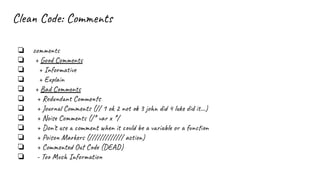
❏ comments
❏ + Good Comments
❏ + Informative
❏ + Explain
❏ + Bad Comments
❏ + Redundant Comments
❏ + Journal Comments (// 1 ok 2 not ok 3 john did 4 luke did it...)
❏ + Noise Comments (/* var x */
❏ + Don't use a comment when it could be a variable or a function
❏ + Poison Markers (///////////// action)
❏ + Commented Out Code (DEAD)
❏ - Too Much Information
Clean Code: Comments
❏ Emergence design ++ (existed prior clean code)
❏ Concurrency (existed prior clean code)
❏ + Thread-Safe Collections
❏ + Beware of dependencies being sync
❏ + Keep Synchronization small
❏ + Testing Thread Code
❏ refactoring / Smells (existed prior clean code)
❏ + Inappropriate information
❏ + Obsolete Comment
❏ + Redundant Comment
❏ + Poorly Written Comment
❏ + Commented Out Code
❏ + Duplication
❏ + Dead Code
Clean Code: Emergent Design, Concurrency, Refactoring
❏ +- intention revealing
❏ + avoid disinformation
❏ + avoid member_prefix
❏ - classes (i.g Processor)
❏ - avoid mental mapping (k,j)
❏ - searchable name (everything is searchable)
Clean Code: Naming
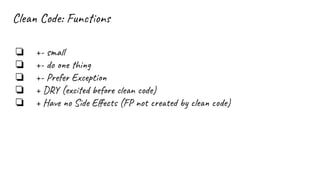
❏ +- small
❏ +- do one thing
❏ +- Prefer Exception
❏ + DRY (excited before clean code)
❏ + Have no Side Effects (FP not created by clean code)
Clean Code: Functions
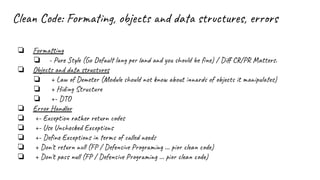
❏ Formatting
❏ - Pure Style (Go Default lang per land and you should be fine) / Diff CR/PR Matters.
❏ Objects and data structures
❏ + Law of Demeter (Module should not know about innards of objects it manipulates)
❏ + Hiding Structure
❏ +- DTO
❏ Error Handler
❏ +- Exception rather return codes
❏ +- Use Unchecked Exceptions
❏ +- Define Exceptions in terms of called needs
❏ + Don't return null (FP / Defensive Programing ... pior clean code)
❏ + Don't pass null (FP / Defensive Programing ... pior clean code)
Clean Code: Formating, objects and data structures, errors
❏ Boundaries
❏ -+ Learning boundaries are hard, Tests to understand (Prefer POC)
❏ Unit Testing
❏ - TDD (Does not improve design, JR devs)
❏ - One Assert Per Test
❏ Classes
❏ -+ Classes should be small
❏ - Cohesion (existed prior clean code)
❏ Systems
❏ + DI (really good for testing)
❏ - EJB
❏ + Java Proxy / AOP (Spring uses a lot for TXs mgmt) -ORM Sucks (uses proxy CGLIB)
Clean Code: Boundaries, Unit Testing, Classes, Systems
Clean code / TDD as a Cult == No Thinking(sometimes not even
read the book...)
Clean code / TDD is the “Flat Earth” of Engineering
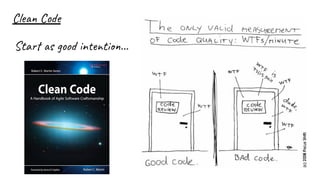
Clean Code
Start as good intention...
Clean Code
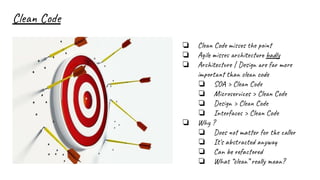
❏ Clean Code misses the point
❏ Agile misses architecture badly
❏ Architecture | Design are far more
important than clean code
❏ SOA > Clean Code
❏ Microservices > Clean Code
❏ Design > Clean Code
❏ Interfaces > Clean Code
❏ Why ?
❏ Does not matter for the caller
❏ It's abstracted anyway
❏ Can be refactored
❏ What “clean” really mean?
Clean Code == Style
What's really matters?
Flexibility Architecture Design Reliability
Performance Scalability
ANTI
Anti-Fragility Testability
Exercises
Constraints
1. You can use Java, Scala or Clojure
1. Revier all your previous code(previous exercises) make sure they
follow the #8 principles listed (What's really matters).
2. Fix at least 3 codes (if applies)
Clean Code
(why not do it)
Diego Pacheco

Clean Code (why not do it)

  • 1.
    Clean Code (why notdo it) Diego Pacheco
  • 5.
    ❏ comments ❏ +Good Comments ❏ + Informative ❏ + Explain ❏ + Bad Comments ❏ + Redundant Comments ❏ + Journal Comments (// 1 ok 2 not ok 3 john did 4 luke did it...) ❏ + Noise Comments (/* var x */ ❏ + Don't use a comment when it could be a variable or a function ❏ + Poison Markers (///////////// action) ❏ + Commented Out Code (DEAD) ❏ - Too Much Information Clean Code: Comments
  • 6.
    ❏ Emergence design++ (existed prior clean code) ❏ Concurrency (existed prior clean code) ❏ + Thread-Safe Collections ❏ + Beware of dependencies being sync ❏ + Keep Synchronization small ❏ + Testing Thread Code ❏ refactoring / Smells (existed prior clean code) ❏ + Inappropriate information ❏ + Obsolete Comment ❏ + Redundant Comment ❏ + Poorly Written Comment ❏ + Commented Out Code ❏ + Duplication ❏ + Dead Code Clean Code: Emergent Design, Concurrency, Refactoring
  • 8.
    ❏ +- intentionrevealing ❏ + avoid disinformation ❏ + avoid member_prefix ❏ - classes (i.g Processor) ❏ - avoid mental mapping (k,j) ❏ - searchable name (everything is searchable) Clean Code: Naming
  • 9.
    ❏ +- small ❏+- do one thing ❏ +- Prefer Exception ❏ + DRY (excited before clean code) ❏ + Have no Side Effects (FP not created by clean code) Clean Code: Functions
  • 10.
    ❏ Formatting ❏ -Pure Style (Go Default lang per land and you should be fine) / Diff CR/PR Matters. ❏ Objects and data structures ❏ + Law of Demeter (Module should not know about innards of objects it manipulates) ❏ + Hiding Structure ❏ +- DTO ❏ Error Handler ❏ +- Exception rather return codes ❏ +- Use Unchecked Exceptions ❏ +- Define Exceptions in terms of called needs ❏ + Don't return null (FP / Defensive Programing ... pior clean code) ❏ + Don't pass null (FP / Defensive Programing ... pior clean code) Clean Code: Formating, objects and data structures, errors
  • 11.
    ❏ Boundaries ❏ -+Learning boundaries are hard, Tests to understand (Prefer POC) ❏ Unit Testing ❏ - TDD (Does not improve design, JR devs) ❏ - One Assert Per Test ❏ Classes ❏ -+ Classes should be small ❏ - Cohesion (existed prior clean code) ❏ Systems ❏ + DI (really good for testing) ❏ - EJB ❏ + Java Proxy / AOP (Spring uses a lot for TXs mgmt) -ORM Sucks (uses proxy CGLIB) Clean Code: Boundaries, Unit Testing, Classes, Systems
  • 13.
    Clean code /TDD as a Cult == No Thinking(sometimes not even read the book...)
  • 14.
    Clean code /TDD is the “Flat Earth” of Engineering
  • 15.
    Clean Code Start asgood intention...
  • 16.
    Clean Code ❏ CleanCode misses the point ❏ Agile misses architecture badly ❏ Architecture | Design are far more important than clean code ❏ SOA > Clean Code ❏ Microservices > Clean Code ❏ Design > Clean Code ❏ Interfaces > Clean Code ❏ Why ? ❏ Does not matter for the caller ❏ It's abstracted anyway ❏ Can be refactored ❏ What “clean” really mean?
  • 17.
  • 18.
    What's really matters? FlexibilityArchitecture Design Reliability Performance Scalability ANTI Anti-Fragility Testability
  • 19.
    Exercises Constraints 1. You canuse Java, Scala or Clojure 1. Revier all your previous code(previous exercises) make sure they follow the #8 principles listed (What's really matters). 2. Fix at least 3 codes (if applies)
  • 20.
    Clean Code (why notdo it) Diego Pacheco