CARING ABOUT
         CODE QUALITY
speaker.identity {
  name        'Venkat Subramaniam'
  company 'Agile Developer, Inc.'
  credentials 'Programmer', 'Author', 'Trainer'
  blog        'http://agiledeveloper.com/blog'
  email       'venkats@agiledeveloper.com'
}
Abstract
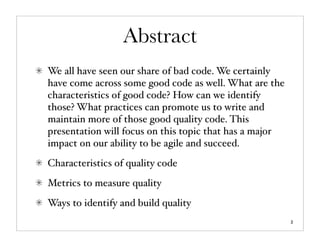
We all have seen our share of bad code. We certainly
have come across some good code as well. What are the
characteristics of good code? How can we identify
those? What practices can promote us to write and
maintain more of those good quality code. This
presentation will focus on this topic that has a major
impact on our ability to be agile and succeed.
Characteristics of quality code
Metrics to measure quality
Ways to identify and build quality
                                                         2
Why care about Code Quality?


  You can’t be Agile if your Code sucks


                                          3
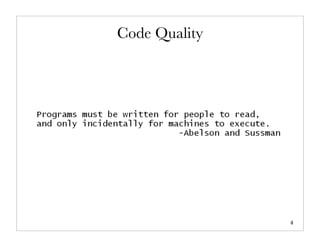
Code Quality


               4
Change in Requirements


[LARM03]
                         5
Cost of Defect

       100

 Cost
        80
  to
correct
   a    60
defect
       40


        20


        0
             Requirements   Design   Code   Test   Operation


 [BOEH01]
                                                               6
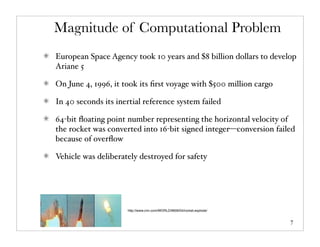
Magnitude of Computational Problem
European Space Agency took 10 years and $8 billion dollars to develop
Ariane 5

On June 4, 1996, it took its first voyage with $500 million cargo

In 40 seconds its inertial reference system failed

64-bit floating point number representing the horizontal velocity of
the rocket was converted into 16-bit signed integer—conversion failed
because of overflow

Vehicle was deliberately destroyed for safety


                     http://www.cnn.com/WORLD/9606/04/rocket.explode/


                                                                        7
Major Misfires
September 1999: Metric mishap causes loss of NASA
orbiter [CNN99]
March 2001: Nike i2 Forecast System found to be
inaccurate–Nike takes inventory write-off [CIO03]
August 2004: NASA: DOS Glitch Nearly Killed Mars
Rover–Story on Spirit: “...The flaw, since fixed, was only discovered after days of
agonizingly slow tests...“ [EXTR04]


June 2007: United flights grounded by computer glitch
[COMP07]
...

                                                                              8
Software Defect Reduction Top 10 List


  Finding, fixing problem in production is 100 times more
  expensive than during requirements/design phase.
  40-50% of effort on projects is on avoidable rework.
  ~80% of avoidable rework comes from 20% of defects.
  ~80% of defects come from 20% of modules; about half
  the modules are defect free.
  ~90% of downtime comes from at most 10% of defects.


[BOEH01]                                                9
Software Defect Reduction Top 10 List


   Peer reviews catch 60% of defects.
   Perspective-based reviews catch 35% more defects than
   nondirected reviews.
   Disciplined personal practices can reduce defect
   introduction rates by up to 75%.
  ...it costs 50% more per source instruction to develop
  high-dependability software product...
   ~40-50% of user programs have nontrivial defects.


[BOEH01]                                                   10
But, Still...


The evidence is overwhelming, but still...
We never seem to have time to do it, but always seem
find time to redo it?!


                                                       11
What’s Quality?


Measure of how well the software is designed and
implemented


Quality is subjective


                                                   12
Why care, there’s QA?!
  Can’t QA take care of quality, why should developers
  care?
  QA shouldn’t care about quality of design and
  implementation
  They should care about acceptance, performance,
  usage, and relevance of the application
  Give them a better quality software so they can really
  focus on that


“Lowering Quality Lengthens Development Time”
—First Law of Programming        http://c2.com/cgi/wiki?FirstLawOfProgramming   13
More Maintenance...

    You’ll do more maintenance if quality is better
    Why? It’s easier to accommodate change, so you can
    be flexible and relevant
    “Maintenance is a solution, not a problem”
    “Better methods lead to more maintenance, not less”


[GLAS03]                                                 14
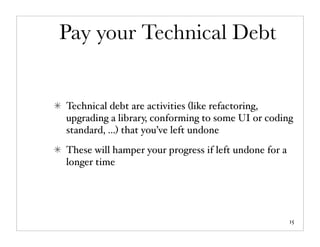
Pay your Technical Debt


Technical debt are activities (like refactoring,
upgrading a library, conforming to some UI or coding
standard, ...) that you’ve left undone
These will hamper your progress if left undone for a
longer time


                                                       15
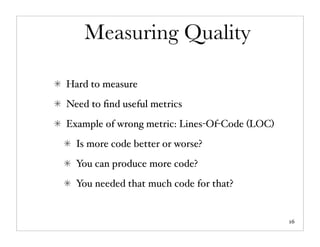
Measuring Quality

Hard to measure
Need to find useful metrics
Example of wrong metric: Lines-Of-Code (LOC)
  Is more code better or worse?
  You can produce more code?
  You needed that much code for that?


                                               16
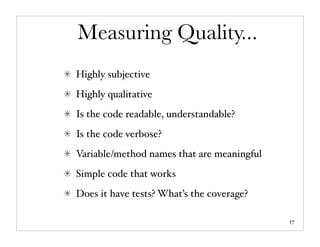
Measuring Quality...
Highly subjective
Highly qualitative
Is the code readable, understandable?
Is the code verbose?
Variable/method names that are meaningful
Simple code that works
Does it have tests? What’s the coverage?

                                            17
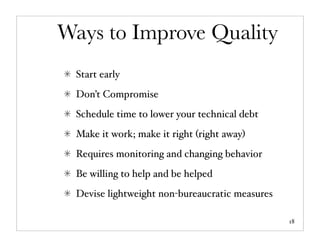
Ways to Improve Quality
 Start early
 Don’t Compromise
 Schedule time to lower your technical debt
 Make it work; make it right (right away)
 Requires monitoring and changing behavior
 Be willing to help and be helped
 Devise lightweight non-bureaucratic measures

                                                18
Individual Efforts
What can you do?

Care about design of your code

  Good names for variables, methods, ...

  Short methods, smaller classes, ...

  Learn by reading good code

Keep it Simple

Write tests with high coverage

Run all your tests before checkin

Checkin Frequently
                                           19
Individual Efforts

Learn your language
If you’re switching languages or using multiple
languages, know the differences
Avoid Cargo cult programming–following rituals, styles,
principles, or structure that serves no real purpose
Court feedback and criticism


                                                          20
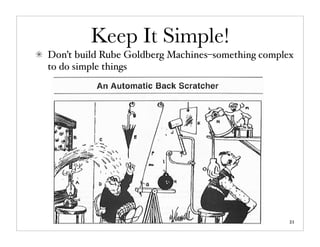
Keep It Simple!
Don’t build Rube Goldberg Machines–something complex
to do simple things


                                                   21
Keep It Simple!


“There are two ways of constructing a software
design. One way is to make it so simple that there
are obviously no deficiencies. And the other way is
to make it so complicated that there are no obvious
deficiencies,”–C.A.R. Hoare.


                                                      22
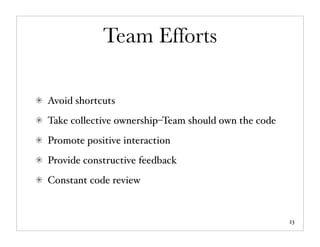
Team Efforts

Avoid shortcuts
Take collective ownership–Team should own the code
Promote positive interaction
Provide constructive feedback
Constant code review


                                                     23
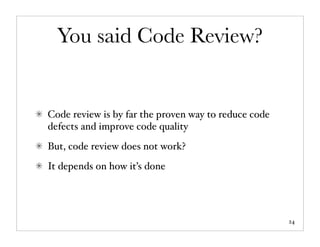
You said Code Review?


Code review is by far the proven way to reduce code
defects and improve code quality
But, code review does not work?
It depends on how it’s done


                                                      24
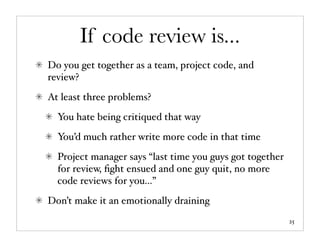
If code review is...
Do you get together as a team, project code, and
review?
At least three problems?
  You hate being critiqued that way
  You’d much rather write more code in that time
  Project manager says “last time you guys got together
  for review, fight ensued and one guy quit, no more
  code reviews for you...”
Don’t make it an emotionally draining
                                                          25
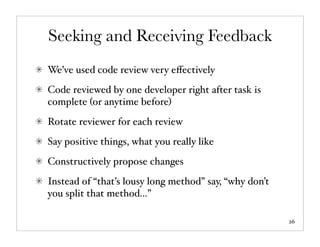
Seeking and Receiving Feedback
We’ve used code review very effectively
Code reviewed by one developer right after task is
complete (or anytime before)
Rotate reviewer for each review
Say positive things, what you really like
Constructively propose changes
Instead of “that’s lousy long method” say, “why don’t
you split that method...”

                                                        26
Tactical Continuous Review
Review not only code, but also tests
Do not get picky on style, instead focus on correctness,
readability, design, ...


“Code Review makes me a Hero or makes me Smarter,”–
                    Brian C.


                                                           27
Value of Review


“Rigorous inspection can remove up to 90 percent of
errors before the first test case is run.”
“Reviews are both technical and sociological, and both
factors must be accommodated.”
[GLAS03]


                                                         28
Broken Window Problem

 Study shows broken windows lead to vandalism
 Code that no one cares for deteriorates quickly
 Do not tolerate your code being trashed
 Fix code that’s not elegant or looks broken
 Keep your code always releasable [SUBR06]


[FIBW, THOM99]                                     29
Treat Warning as Errors


Don’t say “that’s only a warning”
Warnings may have hidden problems
They’re annoying and distracting
Use compiler options to treat warnings as errors
If unavoidable, suppress (selectively)


                                                   30
Cohesion
The code is focused, narrow, small
It does one thing and one thing well
Single Responsibility Principle
Higher cohesion -> Lower Cyclomatic Complexity (see
later)
Strive for higher cohesion
  At method, class, component, subsystem level


                                                      31
Extensibility and Flexibility

  You build abstraction, hierarchy, ... to make your code
  extensible
  Extensibility is an anticipation
  What if the requirement does not meet what you
  anticipated?
  You have more code to work with and it is hard to
  extend in the new direction because of that
  Predicting is hard
                                                       32
Triangulation
      Postpone generalization
      Wait for code to evolve a bit
      You see evidence of what’s needed and generalize
      based on real use
      But, won’t that be expensive?
      Changes will require less work since you have lesser
      code to deal with


[Beck02]                                                     33
Cohesion and Cost of Change

 Code that’s doing too many things is hard to maintain
 Developer who must make change has to understand
 lots of things
 Code is complex, has higher cyclomatic complexity
 Your change likely will break something else
 Smaller, cohesive code is less expensive to maintain


                                                        34
Code Coverage
How much (%) of your code is covered by test?
How about paths through your code
Is there code that deserve not to be tested?
Instrumentation tools can tell you which and how much
code is covered
Tools: [Java] JCover, Cobertura, ... [.NET] NCover,... [C
++] C++ Test Coverage Tool, Bullseye Coverage, CTC++,
Visual Studio, ...
Tools like Guantanamo and Ashcroft delete code that
have no test!
                                                       35
Code Coverage


Code Test Coverage
  Tells you how much of your code’s exercised
  Does not tell you about test quality, however


                                                  36
Complexity

Long methods cause pain
Paths in code
Unnecessary and stale comments cause confusion
Large classes are hard to maintain
...


                                                 37
Cyclomatic Complexity
Thomas McCabe’s

Counts distinct paths through code

Number of decision points + 1

# of edges - # of nodes + 2

Cyclomatic Complexity Number (CCN) > 10 is risky

Strive for lower count

Consider refactoring and fortify your tests

Tools: [Java] JavaNCSS, PMD, CheckStyle, ... [.NET] FxCop,
Visual Studio Code Analyzer, Resharper, NDepend, ... [C++]
Code Counter, CMT++, Cyclo, ...
                                                        38
Cyclomatic Complexity


For your tests to have reasonable code coverage:
# of tests > CCN


                                                   39
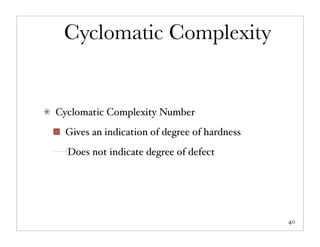
Cyclomatic Complexity


Cyclomatic Complexity Number
 Gives an indication of degree of hardness
  Does not indicate degree of defect


                                             40
Code Size


Addresses problems arising from large, low cohesive
code
Code Size Rules check for the size of code and flags if it
exceeds
How small is small
Code must fit into a screen (without lowering font size)
[about 15 to 20 statements per method]


                                                       41
Code Duplication

Duplicated code is expensive to maintain
Hard to fix bugs, hard to make enhancements
Why do we duplication code then?
Path of least resistance–you’re not breaking existing
code, right?
What to do? Identify and extract methods
Tools: [Java] PMD, ... [.NET] Simian, ... [C++] ...
Tools: Simian, StrictDuplicateCode, ...
                                                        42
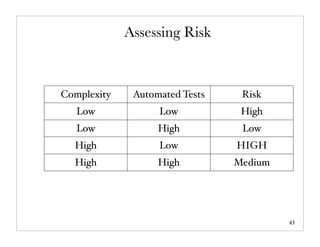
Assessing Risk


Complexity    Automated Tests    Risk
   Low             Low           High
   Low             High          Low
  High             Low          HIGH
  High             High         Medium


                                         43
C.R.A.P Metric
Change Risk Analysis and Prediction (CRAP)

     Experimental metrics and tool

Measures effort and risk to maintain legacy code

Uses Cyclomatic Complexity (comp) and code coverage (cov)

Created by Bob Evans and Alberto Savoia of Agitar [SAVO07]

For a method m, Version 0.1 of the formula is

CRAP(m) = comp(m)^2 * (1-cov(m)/100)^3 + comp(m)

Lower value => low change and maintenance risk

Lowest value 1. With no tests, risk increases as square of
complexity
                                                             44
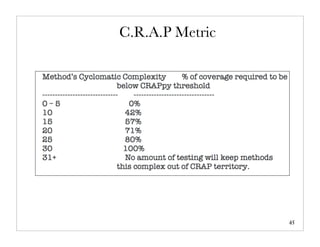
C.R.A.P Metric


                 45
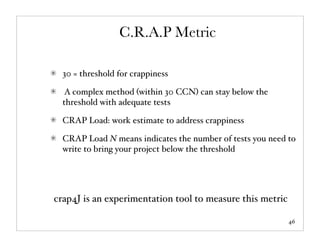
C.R.A.P Metric

  30 = threshold for crappiness

   A complex method (within 30 CCN) can stay below the
  threshold with adequate tests

  CRAP Load: work estimate to address crappiness

  CRAP Load N means indicates the number of tests you need to
  write to bring your project below the threshold


crap4J is an experimentation tool to measure this metric

                                                           46
Test Quality
Low coverage indicates inadequate test

Higher coverage does not mean adequate test, however

How good is the quality of test?

Did you cover different conditions, boundaries, ...

Mutating testers can help determine that

[Java] Jester

[.NET] Nester

[C++] ?

                                                       47
Code Duplication

Code duplication is common

Increases maintenance cost

Makes it hard to fix bugs and make enhancements

[Java] Simian, PMD (Copy Paste Detector), ...

[.NET] Simian, ...

[C++] Simian, ...


                                                 48
Code Analysis

Analyzing code to find bugs

Look for logic errors, coding guidelines violations,
synchronization problems, data flow analysis, ...

[Java] PMD, FindBugs, JLint, ...

[.NET] VS, FxCop, ...

[C++] VS, Lint, ...


                                                       49
Identifying Problem

 "It was on one of my journeys between the EDSAC room
  and the punching equipment that…the realization came
over me with full force that a good part of the remainder of
 my life was going to be spent in finding errors in my own
 programs,"—Maurice V. Wilkes, pioneer in early machine
              design and microprogramming.


                                                           50
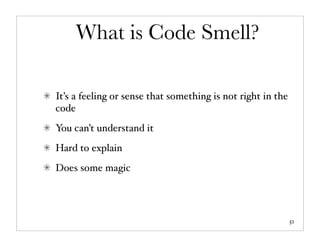
What is Code Smell?

It’s a feeling or sense that something is not right in the
code
You can’t understand it
Hard to explain
Does some magic


                                                             51
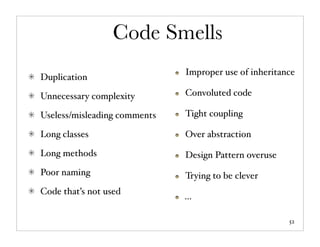
Code Smells
                              Improper use of inheritance
Duplication

Unnecessary complexity        Convoluted code

Useless/misleading comments   Tight coupling

Long classes                  Over abstraction

Long methods                  Design Pattern overuse
Poor naming                   Trying to be clever
Code that’s not used
                              ...

                                                       52
What?


        53
Dealing with Code Smell

Keep an eye on it
Indicates code that needs either refactoring or some
serious redesign
Technical Debt
Take effort to clear the air–frequently


                                                       54
From Writing to Coding…

William Zinsser Wrote “On Writing Well” 25 years
ago!

He gives good principles for writing well

These principles apply to programming as much as
writing non-fiction

  Simplicity

  Clarity

  Brevity

  Humanity
                                                   55
Clear, not Clever

       Don’t be clever, instead be clear


“I never make stupid mistakes. Only very, very clever ones,”—Dr Who


                                                                  56
No Rush
Don’t code in a Hurry—”Haste is Waste”
Take time to read the code and see if is what you meant
Take the time to write tests—make sure the code does
what you meant, not what you typed
Code defensively


“Act in haste and repent at leisure: Code too soon and
       debug forever,”—Raymond Kennington.


                                                         57
Commenting and Self-Documenting Code

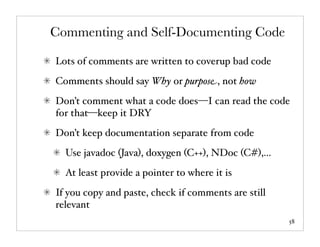
Lots of comments are written to coverup bad code
Comments should say Why or purpose, not how
Don’t comment what a code does—I can read the code
for that—keep it DRY
Don’t keep documentation separate from code
  Use javadoc (Java), doxygen (C++), NDoc (C#),...
  At least provide a pointer to where it is
If you copy and paste, check if comments are still
relevant
                                                     58
Commenting and Self-Documenting Code


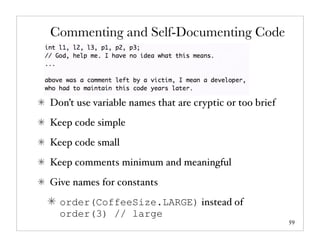
Don’t use variable names that are cryptic or too brief
Keep code simple
Keep code small
Keep comments minimum and meaningful
Give names for constants
  order(CoffeeSize.LARGE) instead of
  order(3) // large
                                                         59
Commenting and Self-Documenting Code


Use Assertions to document assumptions
Document unique, special, or unexpected conditions
Keep them short and clear, however
Don’t pour emotions and arguments
Keep an eye for stale comments


                                                     60
Code for Clarity—self-documenting...

Can someone who does not know English still understand
your code?
Can someone who does not speak your language still
understand your code?


Some languages and frameworks are being created by
experts who don’t speak English as their first language
Ruby - Japan
Groovy - European and US collaborators
                                                         61
Comments on Commenting

Justify violation of good programming practices or styles

  If you’ve to use some convoluted logic, unroll a loop, ...
  drop a comments to say why

  Will avoid unnecessary refactoring attempt only to
  discover that it has to stay that way

  Will help check if the assumptions stated are still valid

Don’t comment clever code, rewrite it

If everyone stumbles on a particular problem, don’t comment
to caution, instead fix it

                                                               62
Error In Your Face


Raise exceptions so they’re in your face
Don’t let problems slip by
Also, if it is hard to locate problems during
development, it will only get worse for your support
Find easy ways to identify what’s wrong
Log is good, but provide a code to easily located the
relevant message in it


                                                        63
Summary
Practice tactical peer code review
Consider untested code is unfinished code
Make your code coverage and metrics visible
Don’t tolerate anyone trashing your code
Write self documenting code and comment whys
Use tools to check code quality
Use tools continuously—that is automated
Treat warnings as errors
Keep it small
Keep it simple                                 64
References
[Beck02] "Test Driven Development: By Example," by Kent Beck, Addison Wesley, 2002.

[BLOC05] "Java Puzzlers: Traps, Pitfalls, and Corner Cases," by Joshua Bloch, Neal Gafter,
Addison Wesley, 2005.

[BOEH01] "Software Defect Reduction Top 10 List," by Barry Boehm and Victor R. Basili,
IEEE Computer, January 2001. (http://www.cebase.org/www/resources/reports/usc/
usccse2001-515.pdf).

[GLAS03] "Facts and Fallacies of Software Engineering," by Robert L. Glass, Addison-
Wesley, 2003.

[FIBW] "Fixing Broken Windows," on Wikipedia (http://en.wikipedia.org/wiki/
Fixing_Broken_Windows).

[THOM99] "The Pragmatic Programmer: From Journeyman to Master," by Andy Hunt
and Dave Thomas, Addison-Wesley, 2000 (Excerpt on Software Entropy and Broken
Window Problem can be found at http://www.pragprog.com/the-pragmatic-programmer/
extracts/software-entropy).
         You can download examples and slides from
          http://www.agiledeveloper.com - download
                                                                                             65

Caring about Code Quality

  • 1.
    CARING ABOUT CODE QUALITY speaker.identity { name 'Venkat Subramaniam' company 'Agile Developer, Inc.' credentials 'Programmer', 'Author', 'Trainer' blog 'http://agiledeveloper.com/blog' email 'venkats@agiledeveloper.com' }
  • 2.
    Abstract We all haveseen our share of bad code. We certainly have come across some good code as well. What are the characteristics of good code? How can we identify those? What practices can promote us to write and maintain more of those good quality code. This presentation will focus on this topic that has a major impact on our ability to be agile and succeed. Characteristics of quality code Metrics to measure quality Ways to identify and build quality 2
  • 3.
    Why care aboutCode Quality? You can’t be Agile if your Code sucks 3
  • 4.
  • 5.
  • 6.
    Cost of Defect 100 Cost 80 to correct a 60 defect 40 20 0 Requirements Design Code Test Operation [BOEH01] 6
  • 7.
    Magnitude of ComputationalProblem European Space Agency took 10 years and $8 billion dollars to develop Ariane 5 On June 4, 1996, it took its first voyage with $500 million cargo In 40 seconds its inertial reference system failed 64-bit floating point number representing the horizontal velocity of the rocket was converted into 16-bit signed integer—conversion failed because of overflow Vehicle was deliberately destroyed for safety http://www.cnn.com/WORLD/9606/04/rocket.explode/ 7
  • 8.
    Major Misfires September 1999:Metric mishap causes loss of NASA orbiter [CNN99] March 2001: Nike i2 Forecast System found to be inaccurate–Nike takes inventory write-off [CIO03] August 2004: NASA: DOS Glitch Nearly Killed Mars Rover–Story on Spirit: “...The flaw, since fixed, was only discovered after days of agonizingly slow tests...“ [EXTR04] June 2007: United flights grounded by computer glitch [COMP07] ... 8
  • 9.
    Software Defect ReductionTop 10 List Finding, fixing problem in production is 100 times more expensive than during requirements/design phase. 40-50% of effort on projects is on avoidable rework. ~80% of avoidable rework comes from 20% of defects. ~80% of defects come from 20% of modules; about half the modules are defect free. ~90% of downtime comes from at most 10% of defects. [BOEH01] 9
  • 10.
    Software Defect ReductionTop 10 List Peer reviews catch 60% of defects. Perspective-based reviews catch 35% more defects than nondirected reviews. Disciplined personal practices can reduce defect introduction rates by up to 75%. ...it costs 50% more per source instruction to develop high-dependability software product... ~40-50% of user programs have nontrivial defects. [BOEH01] 10
  • 11.
    But, Still... The evidenceis overwhelming, but still... We never seem to have time to do it, but always seem find time to redo it?! 11
  • 12.
    What’s Quality? Measure ofhow well the software is designed and implemented Quality is subjective 12
  • 13.
    Why care, there’sQA?! Can’t QA take care of quality, why should developers care? QA shouldn’t care about quality of design and implementation They should care about acceptance, performance, usage, and relevance of the application Give them a better quality software so they can really focus on that “Lowering Quality Lengthens Development Time” —First Law of Programming http://c2.com/cgi/wiki?FirstLawOfProgramming 13
  • 14.
    More Maintenance... You’ll do more maintenance if quality is better Why? It’s easier to accommodate change, so you can be flexible and relevant “Maintenance is a solution, not a problem” “Better methods lead to more maintenance, not less” [GLAS03] 14
  • 15.
    Pay your TechnicalDebt Technical debt are activities (like refactoring, upgrading a library, conforming to some UI or coding standard, ...) that you’ve left undone These will hamper your progress if left undone for a longer time 15
  • 16.
    Measuring Quality Hard tomeasure Need to find useful metrics Example of wrong metric: Lines-Of-Code (LOC) Is more code better or worse? You can produce more code? You needed that much code for that? 16
  • 17.
    Measuring Quality... Highly subjective Highlyqualitative Is the code readable, understandable? Is the code verbose? Variable/method names that are meaningful Simple code that works Does it have tests? What’s the coverage? 17
  • 18.
    Ways to ImproveQuality Start early Don’t Compromise Schedule time to lower your technical debt Make it work; make it right (right away) Requires monitoring and changing behavior Be willing to help and be helped Devise lightweight non-bureaucratic measures 18
  • 19.
    Individual Efforts What canyou do? Care about design of your code Good names for variables, methods, ... Short methods, smaller classes, ... Learn by reading good code Keep it Simple Write tests with high coverage Run all your tests before checkin Checkin Frequently 19
  • 20.
    Individual Efforts Learn yourlanguage If you’re switching languages or using multiple languages, know the differences Avoid Cargo cult programming–following rituals, styles, principles, or structure that serves no real purpose Court feedback and criticism 20
  • 21.
    Keep It Simple! Don’tbuild Rube Goldberg Machines–something complex to do simple things 21
  • 22.
    Keep It Simple! “Thereare two ways of constructing a software design. One way is to make it so simple that there are obviously no deficiencies. And the other way is to make it so complicated that there are no obvious deficiencies,”–C.A.R. Hoare. 22
  • 23.
    Team Efforts Avoid shortcuts Takecollective ownership–Team should own the code Promote positive interaction Provide constructive feedback Constant code review 23
  • 24.
    You said CodeReview? Code review is by far the proven way to reduce code defects and improve code quality But, code review does not work? It depends on how it’s done 24
  • 25.
    If code reviewis... Do you get together as a team, project code, and review? At least three problems? You hate being critiqued that way You’d much rather write more code in that time Project manager says “last time you guys got together for review, fight ensued and one guy quit, no more code reviews for you...” Don’t make it an emotionally draining 25
  • 26.
    Seeking and ReceivingFeedback We’ve used code review very effectively Code reviewed by one developer right after task is complete (or anytime before) Rotate reviewer for each review Say positive things, what you really like Constructively propose changes Instead of “that’s lousy long method” say, “why don’t you split that method...” 26
  • 27.
    Tactical Continuous Review Reviewnot only code, but also tests Do not get picky on style, instead focus on correctness, readability, design, ... “Code Review makes me a Hero or makes me Smarter,”– Brian C. 27
  • 28.
    Value of Review “Rigorousinspection can remove up to 90 percent of errors before the first test case is run.” “Reviews are both technical and sociological, and both factors must be accommodated.” [GLAS03] 28
  • 29.
    Broken Window Problem Study shows broken windows lead to vandalism Code that no one cares for deteriorates quickly Do not tolerate your code being trashed Fix code that’s not elegant or looks broken Keep your code always releasable [SUBR06] [FIBW, THOM99] 29
  • 30.
    Treat Warning asErrors Don’t say “that’s only a warning” Warnings may have hidden problems They’re annoying and distracting Use compiler options to treat warnings as errors If unavoidable, suppress (selectively) 30
  • 31.
    Cohesion The code isfocused, narrow, small It does one thing and one thing well Single Responsibility Principle Higher cohesion -> Lower Cyclomatic Complexity (see later) Strive for higher cohesion At method, class, component, subsystem level 31
  • 32.
    Extensibility and Flexibility You build abstraction, hierarchy, ... to make your code extensible Extensibility is an anticipation What if the requirement does not meet what you anticipated? You have more code to work with and it is hard to extend in the new direction because of that Predicting is hard 32
  • 33.
    Triangulation Postpone generalization Wait for code to evolve a bit You see evidence of what’s needed and generalize based on real use But, won’t that be expensive? Changes will require less work since you have lesser code to deal with [Beck02] 33
  • 34.
    Cohesion and Costof Change Code that’s doing too many things is hard to maintain Developer who must make change has to understand lots of things Code is complex, has higher cyclomatic complexity Your change likely will break something else Smaller, cohesive code is less expensive to maintain 34
  • 35.
    Code Coverage How much(%) of your code is covered by test? How about paths through your code Is there code that deserve not to be tested? Instrumentation tools can tell you which and how much code is covered Tools: [Java] JCover, Cobertura, ... [.NET] NCover,... [C ++] C++ Test Coverage Tool, Bullseye Coverage, CTC++, Visual Studio, ... Tools like Guantanamo and Ashcroft delete code that have no test! 35
  • 36.
    Code Coverage Code TestCoverage Tells you how much of your code’s exercised Does not tell you about test quality, however 36
  • 37.
    Complexity Long methods causepain Paths in code Unnecessary and stale comments cause confusion Large classes are hard to maintain ... 37
  • 38.
    Cyclomatic Complexity Thomas McCabe’s Countsdistinct paths through code Number of decision points + 1 # of edges - # of nodes + 2 Cyclomatic Complexity Number (CCN) > 10 is risky Strive for lower count Consider refactoring and fortify your tests Tools: [Java] JavaNCSS, PMD, CheckStyle, ... [.NET] FxCop, Visual Studio Code Analyzer, Resharper, NDepend, ... [C++] Code Counter, CMT++, Cyclo, ... 38
  • 39.
    Cyclomatic Complexity For yourtests to have reasonable code coverage: # of tests > CCN 39
  • 40.
    Cyclomatic Complexity Cyclomatic ComplexityNumber Gives an indication of degree of hardness Does not indicate degree of defect 40
  • 41.
    Code Size Addresses problemsarising from large, low cohesive code Code Size Rules check for the size of code and flags if it exceeds How small is small Code must fit into a screen (without lowering font size) [about 15 to 20 statements per method] 41
  • 42.
    Code Duplication Duplicated codeis expensive to maintain Hard to fix bugs, hard to make enhancements Why do we duplication code then? Path of least resistance–you’re not breaking existing code, right? What to do? Identify and extract methods Tools: [Java] PMD, ... [.NET] Simian, ... [C++] ... Tools: Simian, StrictDuplicateCode, ... 42
  • 43.
    Assessing Risk Complexity Automated Tests Risk Low Low High Low High Low High Low HIGH High High Medium 43
  • 44.
    C.R.A.P Metric Change RiskAnalysis and Prediction (CRAP) Experimental metrics and tool Measures effort and risk to maintain legacy code Uses Cyclomatic Complexity (comp) and code coverage (cov) Created by Bob Evans and Alberto Savoia of Agitar [SAVO07] For a method m, Version 0.1 of the formula is CRAP(m) = comp(m)^2 * (1-cov(m)/100)^3 + comp(m) Lower value => low change and maintenance risk Lowest value 1. With no tests, risk increases as square of complexity 44
  • 45.
  • 46.
    C.R.A.P Metric 30 = threshold for crappiness A complex method (within 30 CCN) can stay below the threshold with adequate tests CRAP Load: work estimate to address crappiness CRAP Load N means indicates the number of tests you need to write to bring your project below the threshold crap4J is an experimentation tool to measure this metric 46
  • 47.
    Test Quality Low coverageindicates inadequate test Higher coverage does not mean adequate test, however How good is the quality of test? Did you cover different conditions, boundaries, ... Mutating testers can help determine that [Java] Jester [.NET] Nester [C++] ? 47
  • 48.
    Code Duplication Code duplicationis common Increases maintenance cost Makes it hard to fix bugs and make enhancements [Java] Simian, PMD (Copy Paste Detector), ... [.NET] Simian, ... [C++] Simian, ... 48
  • 49.
    Code Analysis Analyzing codeto find bugs Look for logic errors, coding guidelines violations, synchronization problems, data flow analysis, ... [Java] PMD, FindBugs, JLint, ... [.NET] VS, FxCop, ... [C++] VS, Lint, ... 49
  • 50.
    Identifying Problem "Itwas on one of my journeys between the EDSAC room and the punching equipment that…the realization came over me with full force that a good part of the remainder of my life was going to be spent in finding errors in my own programs,"—Maurice V. Wilkes, pioneer in early machine design and microprogramming. 50
  • 51.
    What is CodeSmell? It’s a feeling or sense that something is not right in the code You can’t understand it Hard to explain Does some magic 51
  • 52.
    Code Smells Improper use of inheritance Duplication Unnecessary complexity Convoluted code Useless/misleading comments Tight coupling Long classes Over abstraction Long methods Design Pattern overuse Poor naming Trying to be clever Code that’s not used ... 52
  • 53.
  • 54.
    Dealing with CodeSmell Keep an eye on it Indicates code that needs either refactoring or some serious redesign Technical Debt Take effort to clear the air–frequently 54
  • 55.
    From Writing toCoding… William Zinsser Wrote “On Writing Well” 25 years ago! He gives good principles for writing well These principles apply to programming as much as writing non-fiction Simplicity Clarity Brevity Humanity 55
  • 56.
    Clear, not Clever Don’t be clever, instead be clear “I never make stupid mistakes. Only very, very clever ones,”—Dr Who 56
  • 57.
    No Rush Don’t codein a Hurry—”Haste is Waste” Take time to read the code and see if is what you meant Take the time to write tests—make sure the code does what you meant, not what you typed Code defensively “Act in haste and repent at leisure: Code too soon and debug forever,”—Raymond Kennington. 57
  • 58.
    Commenting and Self-DocumentingCode Lots of comments are written to coverup bad code Comments should say Why or purpose, not how Don’t comment what a code does—I can read the code for that—keep it DRY Don’t keep documentation separate from code Use javadoc (Java), doxygen (C++), NDoc (C#),... At least provide a pointer to where it is If you copy and paste, check if comments are still relevant 58
  • 59.
    Commenting and Self-DocumentingCode Don’t use variable names that are cryptic or too brief Keep code simple Keep code small Keep comments minimum and meaningful Give names for constants order(CoffeeSize.LARGE) instead of order(3) // large 59
  • 60.
    Commenting and Self-DocumentingCode Use Assertions to document assumptions Document unique, special, or unexpected conditions Keep them short and clear, however Don’t pour emotions and arguments Keep an eye for stale comments 60
  • 61.
    Code for Clarity—self-documenting... Cansomeone who does not know English still understand your code? Can someone who does not speak your language still understand your code? Some languages and frameworks are being created by experts who don’t speak English as their first language Ruby - Japan Groovy - European and US collaborators 61
  • 62.
    Comments on Commenting Justifyviolation of good programming practices or styles If you’ve to use some convoluted logic, unroll a loop, ... drop a comments to say why Will avoid unnecessary refactoring attempt only to discover that it has to stay that way Will help check if the assumptions stated are still valid Don’t comment clever code, rewrite it If everyone stumbles on a particular problem, don’t comment to caution, instead fix it 62
  • 63.
    Error In YourFace Raise exceptions so they’re in your face Don’t let problems slip by Also, if it is hard to locate problems during development, it will only get worse for your support Find easy ways to identify what’s wrong Log is good, but provide a code to easily located the relevant message in it 63
  • 64.
    Summary Practice tactical peercode review Consider untested code is unfinished code Make your code coverage and metrics visible Don’t tolerate anyone trashing your code Write self documenting code and comment whys Use tools to check code quality Use tools continuously—that is automated Treat warnings as errors Keep it small Keep it simple 64
  • 65.
    References [Beck02] "Test DrivenDevelopment: By Example," by Kent Beck, Addison Wesley, 2002. [BLOC05] "Java Puzzlers: Traps, Pitfalls, and Corner Cases," by Joshua Bloch, Neal Gafter, Addison Wesley, 2005. [BOEH01] "Software Defect Reduction Top 10 List," by Barry Boehm and Victor R. Basili, IEEE Computer, January 2001. (http://www.cebase.org/www/resources/reports/usc/ usccse2001-515.pdf). [GLAS03] "Facts and Fallacies of Software Engineering," by Robert L. Glass, Addison- Wesley, 2003. [FIBW] "Fixing Broken Windows," on Wikipedia (http://en.wikipedia.org/wiki/ Fixing_Broken_Windows). [THOM99] "The Pragmatic Programmer: From Journeyman to Master," by Andy Hunt and Dave Thomas, Addison-Wesley, 2000 (Excerpt on Software Entropy and Broken Window Problem can be found at http://www.pragprog.com/the-pragmatic-programmer/ extracts/software-entropy). You can download examples and slides from http://www.agiledeveloper.com - download 65