




SolCal
                 CodeCamp


Clean Code I
  Design Patterns
 and Best Practices
    San Diego, June 24rd 2012
Theo Jungeblut
• Senior Software Developer at
  AppDynamics in San Francisco
• architects decoupled solutions
  tailored to business needs and crafts
  maintainable code to last
• worked in healthcare and factory
  automation, building mission critical
  applications, framework &
  platforms for 8+ years
• degree in Software Engineering
  and Network Communications              theo@designitright.net
• enjoys cycling, running and eating      www.designitright.net
                                          www.speakerrate.com/theoj
Overview
•   Why Clean Code
•   Clean Code Developer Initiative
•   Principles and Practices
•   Code Comparison
•   Q&A
Does writing Clean Code
make us more efficient?
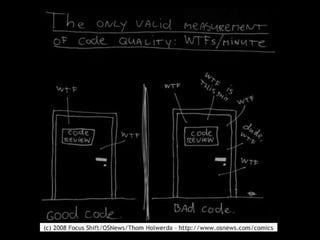
The only valid Measurement of Code
               Quality
What is Clean Code?
Clean Code is maintainable

     Source code must be:
     • readable & well structured
     • extensible
     • testable
Software
 Engineering
      vs.
Craftsmanship
Software
 Engineering
     AND
Craftsmanship
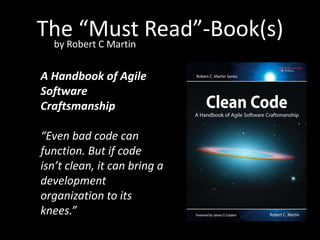
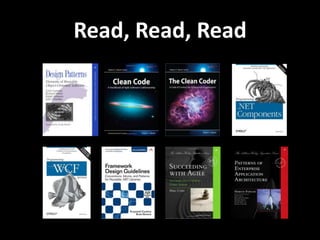
The “Must Read”-Book(s)
 by Robert C Martin


A Handbook of Agile
Software
Craftsmanship

“Even bad code can
function. But if code
isn’t clean, it can bring a
development
organization to its
knees.”
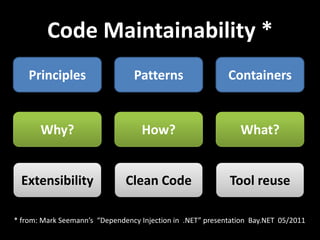
Code Maintainability *
    Principles                   Patterns                   Containers


       Why?                        How?                        What?


  Extensibility                Clean Code                   Tool reuse

* from: Mark Seemann’s “Dependency Injection in .NET” presentation Bay.NET 05/2011
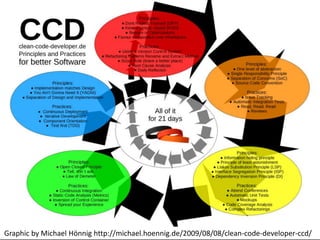
Clean Code Developer


Graphic by Michael Hönnig http://michael.hoennig.de/2009/08/08/clean-code-developer-ccd/
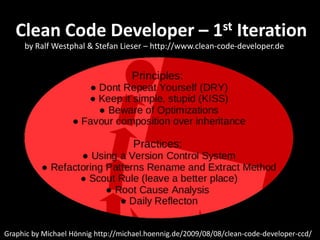
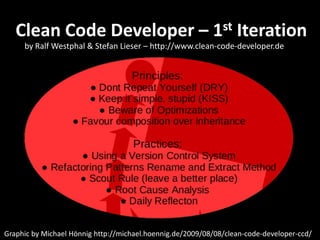
Clean Code Developer – 1st Iteration
     by Ralf Westphal & Stefan Lieser – http://www.clean-code-developer.de


Graphic by Michael Hönnig http://michael.hoennig.de/2009/08/08/clean-code-developer-ccd/
Keep it simple, stupid
        (KISS)
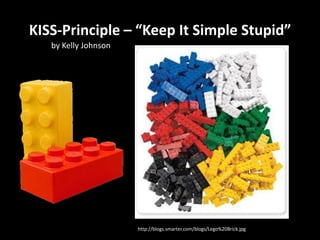
KISS-Principle – “Keep It Simple Stupid”
   by Kelly Johnson


                      http://blogs.smarter.com/blogs/Lego%20Brick.jpg
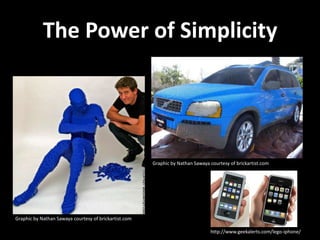
The Power of Simplicity


                                                       Graphic by Nathan Sawaya courtesy of brickartist.com


Graphic by Nathan Sawaya courtesy of brickartist.com

                                                                                http://www.geekalerts.com/lego-iphone/
Chaos build from simplicity


Graphic by Nathan Sawaya courtesy of brickartist.com
Don’t repeat yourself
        (DRY)
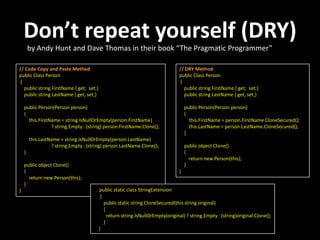
Don’t repeat yourself (DRY)
        by Andy Hunt and Dave Thomas in their book “The Pragmatic Programmer”

// Code Copy and Paste Method                                                    // DRY Method
public Class Person                                                              public Class Person
 {                                                                                {
   public string FirstName { get; set;}                                             public string FirstName { get; set;}
   public string LastName { get; set;}                                              public string LastName { get; set;}

    public Person(Person person)                                                     public Person(Person person)
    {                                                                                {
      this.FirstName = string.IsNullOrEmpty(person.FirstName)                          this.FirstName = person.FirstName.CloneSecured();
                 ? string.Empty : (string) person.FirstName.Clone();                   this.LastName = person.LastName.CloneSecured();
                                                                                     }
        this.LastName = string.IsNullOrEmpty(person.LastName)
                  ? string.Empty : (string) person.LastName.Clone();                 public object Clone()
    }                                                                                {
                                                                                       return new Person(this);
    public object Clone()                                                            }
    {                                                                            }
      return new Person(this);
    }
}                                         public static class StringExtension
                                           {
                                             public static string CloneSecured(this string original)
                                             {
                                               return string.IsNullOrEmpty(original) ? string.Empty : (string)original.Clone();
                                             }
                                          }
Clean Code Developer – 1st Iteration
     by Ralf Westphal & Stefan Lieser – http://www.clean-code-developer.de


Graphic by Michael Hönnig http://michael.hoennig.de/2009/08/08/clean-code-developer-ccd/
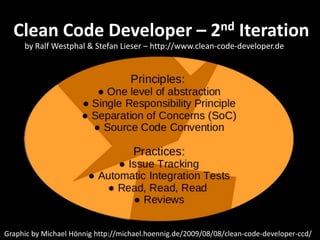
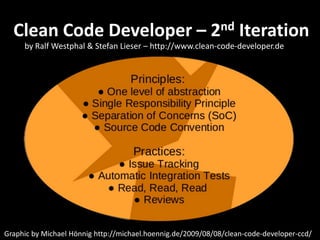
Clean Code Developer – 2nd Iteration
     by Ralf Westphal & Stefan Lieser – http://www.clean-code-developer.de


Graphic by Michael Hönnig http://michael.hoennig.de/2009/08/08/clean-code-developer-ccd/
Separation of Concerns
         (SoC)

 Single Responsibility
       Principle
         (SRP)
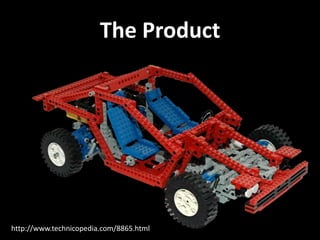
The Product


http://www.technicopedia.com/8865.html
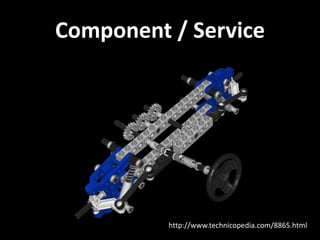
Component / Service


          http://www.technicopedia.com/8865.html
Class, Struct, Enum etc.


http://technicbricks.blogspot.com/2009/06/tbs-techpoll-12-results-2009-1st.html
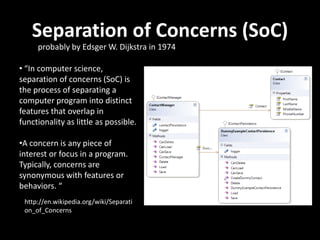
Separation of Concerns (SoC)
     probably by Edsger W. Dijkstra in 1974

• “In computer science,
separation of concerns (SoC) is
the process of separating a
computer program into distinct
features that overlap in
functionality as little as possible.

•A concern is any piece of
interest or focus in a program.
Typically, concerns are
synonymous with features or
behaviors. “
 http://en.wikipedia.org/wiki/Separati
 on_of_Concerns
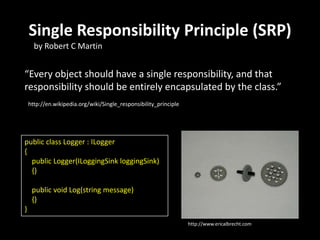
Single Responsibility Principle (SRP)
      by Robert C Martin


“Every object should have a single responsibility, and that
responsibility should be entirely encapsulated by the class.”
    http://en.wikipedia.org/wiki/Single_responsibility_principle


public class Logger : ILogger
{
  public Logger(ILoggingSink loggingSink)
  {}

     public void Log(string message)
     {}
}
                                                                   http://www.ericalbrecht.com
Read, Read, Read
Clean Code Developer – 2nd Iteration
     by Ralf Westphal & Stefan Lieser – http://www.clean-code-developer.de


Graphic by Michael Hönnig http://michael.hoennig.de/2009/08/08/clean-code-developer-ccd/
SolCal
                 CodeCamp


Clean Code III
      Software
   Craftsmanship
    San Diego, June 23rd 2012
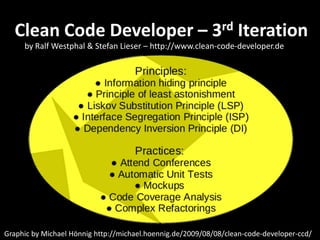
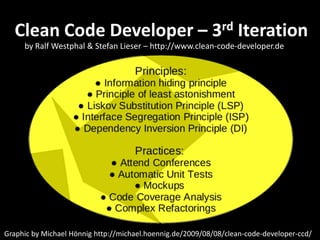
Clean Code Developer – 3rd Iteration
     by Ralf Westphal & Stefan Lieser – http://www.clean-code-developer.de


Graphic by Michael Hönnig http://michael.hoennig.de/2009/08/08/clean-code-developer-ccd/
Information Hiding Principle
           (IHP)
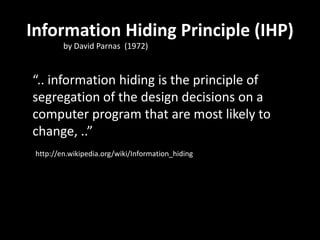
Information Hiding Principle (IHP)
         by David Parnas (1972)


“.. information hiding is the principle of
segregation of the design decisions on a
computer program that are most likely to
change, ..”
 http://en.wikipedia.org/wiki/Information_hiding
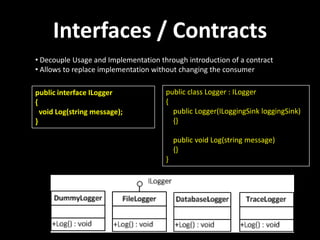
Interfaces / Contracts
• Decouple Usage and Implementation through introduction of a contract
• Allows to replace implementation without changing the consumer

public interface ILogger              public class Logger : ILogger
{                                     {
  void Log(string message);             public Logger(ILoggingSink loggingSink)
}                                       {}

                                          public void Log(string message)
                                          {}
                                      }
Liskov Substitution Principle
           (LSP)
Liskov Substitution Principle (LSP)
by Barbara Liskov, Jannette Wing (1994)


“Liskov’s notion of a behavioral subtype
defines a notion of substitutability for
mutable objects”
 http://en.wikipedia.org/wiki/Liskov_substitution_principle
Dependency Inversion Principle
           (DIP)
Dependency Inversion Principle (DIP)
  by Robert C. Martin


• “High-level modules should not depend on
  low-level modules. Both should depend on
  abstractions.
• Abstractions should not depend upon details.
  Details should depend upon abstractions.”
  http://en.wikipedia.org/wiki/Dependency_inversion_principle
Clean Code Developer – 3rd Iteration
     by Ralf Westphal & Stefan Lieser – http://www.clean-code-developer.de


Graphic by Michael Hönnig http://michael.hoennig.de/2009/08/08/clean-code-developer-ccd/
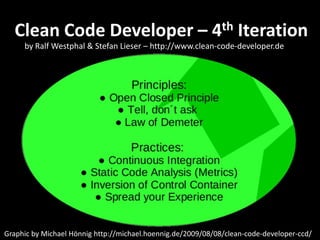
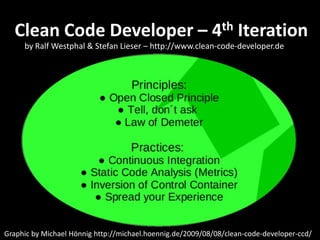
Clean Code Developer – 4th Iteration
     by Ralf Westphal & Stefan Lieser – http://www.clean-code-developer.de


Graphic by Michael Hönnig http://michael.hoennig.de/2009/08/08/clean-code-developer-ccd/
Open Closed Principle
       (OCP)
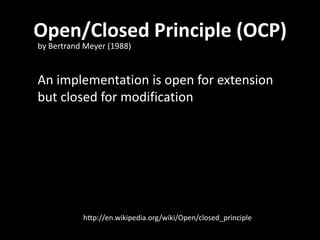
Open/Closed Principle (OCP)
by Bertrand Meyer (1988)


An implementation is open for extension
but closed for modification


           http://en.wikipedia.org/wiki/Open/closed_principle
Law of Demeter
     (LoD)
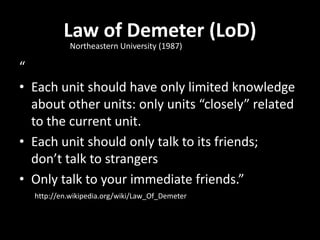
Law of Demeter (LoD)
           Northeastern University (1987)

“
• Each unit should have only limited knowledge
  about other units: only units “closely” related
  to the current unit.
• Each unit should only talk to its friends;
  don’t talk to strangers
• Only talk to your immediate friends.”
  http://en.wikipedia.org/wiki/Law_Of_Demeter
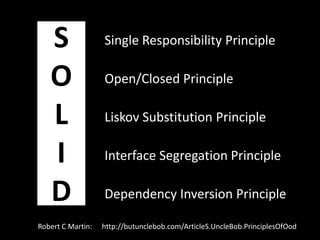
S               Single Responsibility Principle

   O               Open/Closed Principle

   L               Liskov Substitution Principle

   I               Interface Segregation Principle

   D               Dependency Inversion Principle

Robert C Martin:   http://butunclebob.com/ArticleS.UncleBob.PrinciplesOfOod
Clean Code Developer – 4th Iteration
     by Ralf Westphal & Stefan Lieser – http://www.clean-code-developer.de


Graphic by Michael Hönnig http://michael.hoennig.de/2009/08/08/clean-code-developer-ccd/
Silicon Valley Code Camp Oct. 6th – 7th


http://www.siliconvalley-codecamp.com
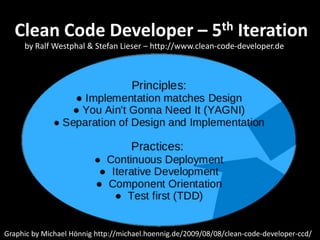
Clean Code Developer – 5th Iteration
     by Ralf Westphal & Stefan Lieser – http://www.clean-code-developer.de


Graphic by Michael Hönnig http://michael.hoennig.de/2009/08/08/clean-code-developer-ccd/
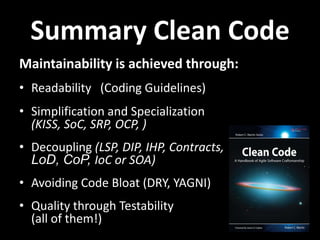
Summary Clean Code
Maintainability is achieved through:
• Readability (Coding Guidelines)
• Simplification and Specialization
  (KISS, SoC, SRP, OCP, )
• Decoupling (LSP, DIP, IHP, Contracts,
  LoD, CoP, IoC or SOA)
• Avoiding Code Bloat (DRY, YAGNI)
• Quality through Testability
  (all of them!)
Q&A
                                         Downloads,
                                         Feedback & Comments:
                                                   theo@designitright.net
                                                   www.designitright.net
                                                   www.speakerrate.com/theoj
Graphic by Nathan Sawaya courtesy of brickartist.com
http://clean-code-developer.com
                                          References…
http://michael.hoennig.de/2009/08/08/clean-code-developer-ccd/
http://butunclebob.com/ArticleS.UncleBob.PrinciplesOfOod
http://www.manning.com/seemann/
http://en.wikipedia.org/wiki/Keep_it_simple_stupid
http://picocontainer.org/patterns.html
http://en.wikipedia.org/wiki/Separation_of_concerns
http://en.wikipedia.org/wiki/Single_responsibility_principle
http://en.wikipedia.org/wiki/Information_hiding
http://en.wikipedia.org/wiki/Liskov_substitution_principle
http://en.wikipedia.org/wiki/Dependency_inversion_principle
http://en.wikipedia.org/wiki/Open/closed_principle
http://en.wikipedia.org/wiki/Law_Of_Demeter
http://en.wikipedia.org/wiki/Don't_repeat_yourself
http://en.wikipedia.org/wiki/You_ain't_gonna_need_it
http://en.wikipedia.org/wiki/Component-oriented_programming
http://en.wikipedia.org/wiki/Service-oriented_architecture
http://www.martinfowler.com/articles/injection.html
http://www.codeproject.com/KB/aspnet/IOCDI.aspx
http://msdn.microsoft.com/en-us/magazine/cc163739.aspx
http://msdn.microsoft.com/en-us/library/ff650320.aspx
http://msdn.microsoft.com/en-us/library/aa973811.aspx
http://msdn.microsoft.com/en-us/library/ff647976.aspx
http://msdn.microsoft.com/en-us/library/cc707845.aspx
http://msdn.microsoft.com/en-us/library/bb833022.aspx
http://unity.codeplex.com/
http://www.idesign.net/idesign/DesktopDefault.aspx?tabindex=5&tabid=11
… more References
Resharper
http://www.jetbrains.com/resharper/

FxCop / Code Analysis
http://msdn.microsoft.com/en-us/library/bb429476(VS.80).aspx
http://blogs.msdn.com/b/codeanalysis/
http://www.binarycoder.net/fxcop/index.html

Code Contracts
http://msdn.microsoft.com/en-us/devlabs/dd491992
http://research.microsoft.com/en-us/projects/contracts/

Pex & Mole
http://research.microsoft.com/en-us/projects/pex/

StyleCop
http://stylecop.codeplex.com/

Ghostdoc
http://submain.com/products/ghostdoc.aspx

Spellchecker
http://visualstudiogallery.msdn.microsoft.com/
7c8341f1-ebac-40c8-92c2-476db8d523ce//
                                                               Lego (trademarked in capitals as LEGO)
Please fill out the
feedback, and…
                          www.speakerrate.com/theoj


… thanks for you attention!
            And visit and support the

                      www.sandiegodotnet.com

Clean Code Part I - Design Patterns at SoCal Code Camp

  • 1.
    SolCal CodeCamp Clean Code I Design Patterns and Best Practices San Diego, June 24rd 2012
  • 2.
    Theo Jungeblut • SeniorSoftware Developer at AppDynamics in San Francisco • architects decoupled solutions tailored to business needs and crafts maintainable code to last • worked in healthcare and factory automation, building mission critical applications, framework & platforms for 8+ years • degree in Software Engineering and Network Communications theo@designitright.net • enjoys cycling, running and eating www.designitright.net www.speakerrate.com/theoj
  • 3.
    Overview • Why Clean Code • Clean Code Developer Initiative • Principles and Practices • Code Comparison • Q&A
  • 4.
    Does writing CleanCode make us more efficient?
  • 5.
    The only validMeasurement of Code Quality
  • 6.
  • 7.
    Clean Code ismaintainable Source code must be: • readable & well structured • extensible • testable
  • 8.
    Software Engineering vs. Craftsmanship
  • 9.
    Software Engineering AND Craftsmanship
  • 10.
    The “Must Read”-Book(s) by Robert C Martin A Handbook of Agile Software Craftsmanship “Even bad code can function. But if code isn’t clean, it can bring a development organization to its knees.”
  • 11.
    Code Maintainability * Principles Patterns Containers Why? How? What? Extensibility Clean Code Tool reuse * from: Mark Seemann’s “Dependency Injection in .NET” presentation Bay.NET 05/2011
  • 12.
    Clean Code Developer Graphicby Michael Hönnig http://michael.hoennig.de/2009/08/08/clean-code-developer-ccd/
  • 13.
    Clean Code Developer– 1st Iteration by Ralf Westphal & Stefan Lieser – http://www.clean-code-developer.de Graphic by Michael Hönnig http://michael.hoennig.de/2009/08/08/clean-code-developer-ccd/
  • 14.
    Keep it simple,stupid (KISS)
  • 15.
    KISS-Principle – “KeepIt Simple Stupid” by Kelly Johnson http://blogs.smarter.com/blogs/Lego%20Brick.jpg
  • 16.
    The Power ofSimplicity Graphic by Nathan Sawaya courtesy of brickartist.com Graphic by Nathan Sawaya courtesy of brickartist.com http://www.geekalerts.com/lego-iphone/
  • 17.
    Chaos build fromsimplicity Graphic by Nathan Sawaya courtesy of brickartist.com
  • 18.
  • 19.
    Don’t repeat yourself(DRY) by Andy Hunt and Dave Thomas in their book “The Pragmatic Programmer” // Code Copy and Paste Method // DRY Method public Class Person public Class Person { { public string FirstName { get; set;} public string FirstName { get; set;} public string LastName { get; set;} public string LastName { get; set;} public Person(Person person) public Person(Person person) { { this.FirstName = string.IsNullOrEmpty(person.FirstName) this.FirstName = person.FirstName.CloneSecured(); ? string.Empty : (string) person.FirstName.Clone(); this.LastName = person.LastName.CloneSecured(); } this.LastName = string.IsNullOrEmpty(person.LastName) ? string.Empty : (string) person.LastName.Clone(); public object Clone() } { return new Person(this); public object Clone() } { } return new Person(this); } } public static class StringExtension { public static string CloneSecured(this string original) { return string.IsNullOrEmpty(original) ? string.Empty : (string)original.Clone(); } }
  • 20.
    Clean Code Developer– 1st Iteration by Ralf Westphal & Stefan Lieser – http://www.clean-code-developer.de Graphic by Michael Hönnig http://michael.hoennig.de/2009/08/08/clean-code-developer-ccd/
  • 21.
    Clean Code Developer– 2nd Iteration by Ralf Westphal & Stefan Lieser – http://www.clean-code-developer.de Graphic by Michael Hönnig http://michael.hoennig.de/2009/08/08/clean-code-developer-ccd/
  • 22.
    Separation of Concerns (SoC) Single Responsibility Principle (SRP)
  • 23.
  • 24.
    Component / Service http://www.technicopedia.com/8865.html
  • 25.
    Class, Struct, Enumetc. http://technicbricks.blogspot.com/2009/06/tbs-techpoll-12-results-2009-1st.html
  • 26.
    Separation of Concerns(SoC) probably by Edsger W. Dijkstra in 1974 • “In computer science, separation of concerns (SoC) is the process of separating a computer program into distinct features that overlap in functionality as little as possible. •A concern is any piece of interest or focus in a program. Typically, concerns are synonymous with features or behaviors. “ http://en.wikipedia.org/wiki/Separati on_of_Concerns
  • 27.
    Single Responsibility Principle(SRP) by Robert C Martin “Every object should have a single responsibility, and that responsibility should be entirely encapsulated by the class.” http://en.wikipedia.org/wiki/Single_responsibility_principle public class Logger : ILogger { public Logger(ILoggingSink loggingSink) {} public void Log(string message) {} } http://www.ericalbrecht.com
  • 28.
  • 29.
    Clean Code Developer– 2nd Iteration by Ralf Westphal & Stefan Lieser – http://www.clean-code-developer.de Graphic by Michael Hönnig http://michael.hoennig.de/2009/08/08/clean-code-developer-ccd/
  • 30.
    SolCal CodeCamp Clean Code III Software Craftsmanship San Diego, June 23rd 2012
  • 31.
    Clean Code Developer– 3rd Iteration by Ralf Westphal & Stefan Lieser – http://www.clean-code-developer.de Graphic by Michael Hönnig http://michael.hoennig.de/2009/08/08/clean-code-developer-ccd/
  • 32.
  • 33.
    Information Hiding Principle(IHP) by David Parnas (1972) “.. information hiding is the principle of segregation of the design decisions on a computer program that are most likely to change, ..” http://en.wikipedia.org/wiki/Information_hiding
  • 34.
    Interfaces / Contracts •Decouple Usage and Implementation through introduction of a contract • Allows to replace implementation without changing the consumer public interface ILogger public class Logger : ILogger { { void Log(string message); public Logger(ILoggingSink loggingSink) } {} public void Log(string message) {} }
  • 35.
  • 36.
    Liskov Substitution Principle(LSP) by Barbara Liskov, Jannette Wing (1994) “Liskov’s notion of a behavioral subtype defines a notion of substitutability for mutable objects” http://en.wikipedia.org/wiki/Liskov_substitution_principle
  • 37.
  • 38.
    Dependency Inversion Principle(DIP) by Robert C. Martin • “High-level modules should not depend on low-level modules. Both should depend on abstractions. • Abstractions should not depend upon details. Details should depend upon abstractions.” http://en.wikipedia.org/wiki/Dependency_inversion_principle
  • 39.
    Clean Code Developer– 3rd Iteration by Ralf Westphal & Stefan Lieser – http://www.clean-code-developer.de Graphic by Michael Hönnig http://michael.hoennig.de/2009/08/08/clean-code-developer-ccd/
  • 40.
    Clean Code Developer– 4th Iteration by Ralf Westphal & Stefan Lieser – http://www.clean-code-developer.de Graphic by Michael Hönnig http://michael.hoennig.de/2009/08/08/clean-code-developer-ccd/
  • 41.
  • 42.
    Open/Closed Principle (OCP) byBertrand Meyer (1988) An implementation is open for extension but closed for modification http://en.wikipedia.org/wiki/Open/closed_principle
  • 43.
  • 44.
    Law of Demeter(LoD) Northeastern University (1987) “ • Each unit should have only limited knowledge about other units: only units “closely” related to the current unit. • Each unit should only talk to its friends; don’t talk to strangers • Only talk to your immediate friends.” http://en.wikipedia.org/wiki/Law_Of_Demeter
  • 45.
    S Single Responsibility Principle O Open/Closed Principle L Liskov Substitution Principle I Interface Segregation Principle D Dependency Inversion Principle Robert C Martin: http://butunclebob.com/ArticleS.UncleBob.PrinciplesOfOod
  • 46.
    Clean Code Developer– 4th Iteration by Ralf Westphal & Stefan Lieser – http://www.clean-code-developer.de Graphic by Michael Hönnig http://michael.hoennig.de/2009/08/08/clean-code-developer-ccd/
  • 47.
    Silicon Valley CodeCamp Oct. 6th – 7th http://www.siliconvalley-codecamp.com
  • 48.
    Clean Code Developer– 5th Iteration by Ralf Westphal & Stefan Lieser – http://www.clean-code-developer.de Graphic by Michael Hönnig http://michael.hoennig.de/2009/08/08/clean-code-developer-ccd/
  • 49.
    Summary Clean Code Maintainabilityis achieved through: • Readability (Coding Guidelines) • Simplification and Specialization (KISS, SoC, SRP, OCP, ) • Decoupling (LSP, DIP, IHP, Contracts, LoD, CoP, IoC or SOA) • Avoiding Code Bloat (DRY, YAGNI) • Quality through Testability (all of them!)
  • 50.
    Q&A Downloads, Feedback & Comments: theo@designitright.net www.designitright.net www.speakerrate.com/theoj Graphic by Nathan Sawaya courtesy of brickartist.com
  • 51.
    http://clean-code-developer.com References… http://michael.hoennig.de/2009/08/08/clean-code-developer-ccd/ http://butunclebob.com/ArticleS.UncleBob.PrinciplesOfOod http://www.manning.com/seemann/ http://en.wikipedia.org/wiki/Keep_it_simple_stupid http://picocontainer.org/patterns.html http://en.wikipedia.org/wiki/Separation_of_concerns http://en.wikipedia.org/wiki/Single_responsibility_principle http://en.wikipedia.org/wiki/Information_hiding http://en.wikipedia.org/wiki/Liskov_substitution_principle http://en.wikipedia.org/wiki/Dependency_inversion_principle http://en.wikipedia.org/wiki/Open/closed_principle http://en.wikipedia.org/wiki/Law_Of_Demeter http://en.wikipedia.org/wiki/Don't_repeat_yourself http://en.wikipedia.org/wiki/You_ain't_gonna_need_it http://en.wikipedia.org/wiki/Component-oriented_programming http://en.wikipedia.org/wiki/Service-oriented_architecture http://www.martinfowler.com/articles/injection.html http://www.codeproject.com/KB/aspnet/IOCDI.aspx http://msdn.microsoft.com/en-us/magazine/cc163739.aspx http://msdn.microsoft.com/en-us/library/ff650320.aspx http://msdn.microsoft.com/en-us/library/aa973811.aspx http://msdn.microsoft.com/en-us/library/ff647976.aspx http://msdn.microsoft.com/en-us/library/cc707845.aspx http://msdn.microsoft.com/en-us/library/bb833022.aspx http://unity.codeplex.com/ http://www.idesign.net/idesign/DesktopDefault.aspx?tabindex=5&tabid=11
  • 52.
    … more References Resharper http://www.jetbrains.com/resharper/ FxCop/ Code Analysis http://msdn.microsoft.com/en-us/library/bb429476(VS.80).aspx http://blogs.msdn.com/b/codeanalysis/ http://www.binarycoder.net/fxcop/index.html Code Contracts http://msdn.microsoft.com/en-us/devlabs/dd491992 http://research.microsoft.com/en-us/projects/contracts/ Pex & Mole http://research.microsoft.com/en-us/projects/pex/ StyleCop http://stylecop.codeplex.com/ Ghostdoc http://submain.com/products/ghostdoc.aspx Spellchecker http://visualstudiogallery.msdn.microsoft.com/ 7c8341f1-ebac-40c8-92c2-476db8d523ce// Lego (trademarked in capitals as LEGO)
  • 53.
    Please fill outthe feedback, and… www.speakerrate.com/theoj … thanks for you attention! And visit and support the www.sandiegodotnet.com

Editor's Notes

  • #36 A object or any type implementing subtype or a certain interface can be replaced with another object implementing the same base type or interface.