CLASSROOM
ASSESSMENT
By
EKMAR J. SAKIB
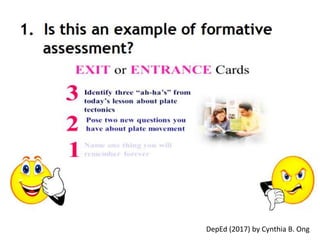
DepEd (2017) by Cynthia B. Ong
DepEd (2016) by Jimmie C. Eslabra
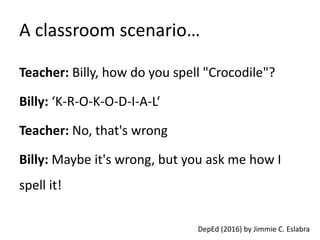
A classroom scenario…
Teacher: Billy, how do you spell "Crocodile"?
Billy: ‘K-R-O-K-O-D-I-A-L‘
Teacher: No, that's wrong
Billy: Maybe it's wrong, but you ask me how I
spell it!
DepEd (2016) by Jimmie C. Eslabra
DepEd (2017) by Cynthia B. Ong
DepEd (2016) by Jimmie C. Eslabra
THEORETICAL BASIS
It must recognize…
• the diversity of learners inside the classroom
• the need for multiple ways of measuring their
varying abilities and learning potentials
• the role of learners as co-participants in the
assessment process.
• the learners’ zone of proximal development
(Vygotsky, 1978).
• the unity of instruction and assessment.
DepEd Order No. 8, s. 2015
DepEd (2017) by Cynthia B. Ong
DEPARTMENT OF EDUCATION
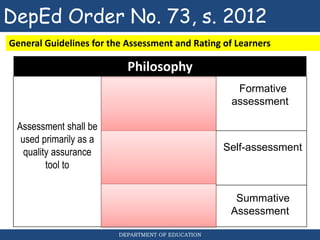
DepEd Order No. 73, s. 2012
General Guidelines for the Assessment and Rating of Learners
Philosophy
Assessment shall be
used primarily as a
quality assurance
tool to
track student progress in
the attainment of
standards (content and
performance),
promote self-reflection
and personal
accountability for one’s
learning
and provide a basis for
the profiling of student
performance.
Formative
assessment
Self-assessment
Summative
Assessment
DepEd Order No. 73, s. 2012
DEPARTMENT OF EDUCATION
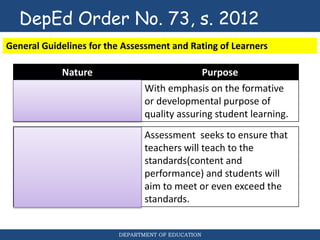
Nature Purpose
Assessment shall be
holistic.
With emphasis on the formative
or developmental purpose of
quality assuring student learning.
General Guidelines for the Assessment and Rating of Learners
Assessment is standards-
based.
Assessment seeks to ensure that
teachers will teach to the
standards(content and
performance) and students will
aim to meet or even exceed the
standards.
DepEd Order No. 73, s. 2012
DEPARTMENT OF EDUCATION
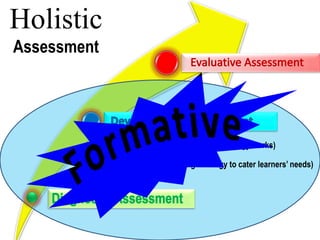
(analyzing which strategy works)
(modifying strategy to cater learners’ needs)
Holistic
Assessment
DEPARTMENT OF EDUCATION
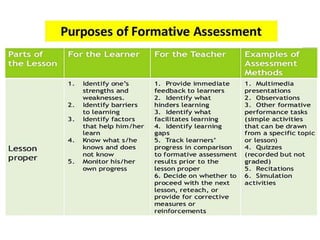
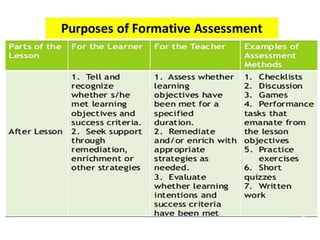
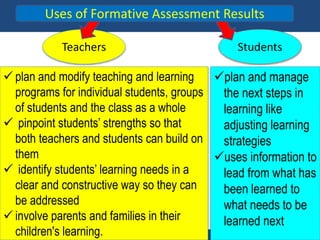
Students
Teachers
 plan and modify teaching and learning
programs for individual students, groups
of students and the class as a whole
 pinpoint students’ strengths so that
both teachers and students can build on
them
 identify students’ learning needs in a
clear and constructive way so they can
be addressed
 involve parents and families in their
children's learning.
Uses of Formative Assessment Results
plan and manage
the next steps in
learning like
adjusting learning
strategies
uses information to
lead from what has
been learned to
what needs to be
learned next
DEPARTMENT OF EDUCATION
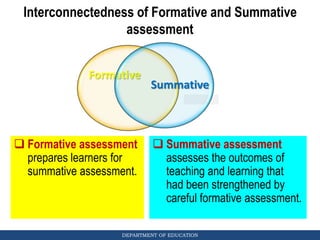
Interconnectedness of Formative and Summative
assessment
 Formative assessment
prepares learners for
summative assessment.
Formative
Summative
 Summative assessment
assesses the outcomes of
teaching and learning that
had been strengthened by
careful formative assessment.
41
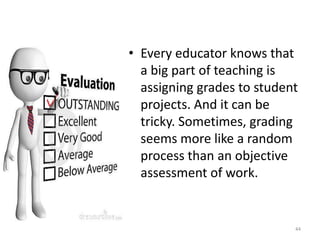
• Every educator knows that
a big part of teaching is
assigning grades to student
projects. And it can be
tricky. Sometimes, grading
seems more like a random
process than an objective
assessment of work.
44
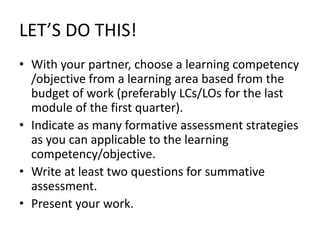
LET’S DO THIS!
• With your partner, choose a learning competency
/objective from a learning area based from the
budget of work (preferably LCs/LOs for the last
module of the first quarter).
• Indicate as many formative assessment strategies
as you can applicable to the learning
competency/objective.
• Write at least two questions for summative
assessment.
• Present your work.
CLASSROOM ASSESSMENT.pptx

CLASSROOM ASSESSMENT.pptx

  • 1.
  • 2.
    DepEd (2017) byCynthia B. Ong
  • 3.
    DepEd (2017) byCynthia B. Ong
  • 4.
    DepEd (2017) byCynthia B. Ong
  • 5.
    DepEd (2017) byCynthia B. Ong
  • 6.
    DepEd (2017) byCynthia B. Ong
  • 7.
    DepEd (2016) byJimmie C. Eslabra
  • 8.
    A classroom scenario… Teacher:Billy, how do you spell "Crocodile"? Billy: ‘K-R-O-K-O-D-I-A-L‘ Teacher: No, that's wrong Billy: Maybe it's wrong, but you ask me how I spell it! DepEd (2016) by Jimmie C. Eslabra
  • 9.
    DepEd (2016) byJimmie C. Eslabra
  • 10.
    DepEd (2017) byCynthia B. Ong
  • 11.
    DepEd (2017) byCynthia B. Ong
  • 12.
    DepEd (2016) byJimmie C. Eslabra
  • 13.
    DepEd (2016) byJimmie C. Eslabra
  • 14.
    DepEd (2016) byJimmie C. Eslabra
  • 15.
    THEORETICAL BASIS It mustrecognize… • the diversity of learners inside the classroom • the need for multiple ways of measuring their varying abilities and learning potentials • the role of learners as co-participants in the assessment process. • the learners’ zone of proximal development (Vygotsky, 1978). • the unity of instruction and assessment. DepEd Order No. 8, s. 2015
  • 16.
    DepEd (2017) byCynthia B. Ong
  • 17.
    DepEd (2017) byCynthia B. Ong
  • 20.
    DepEd (2017) byCynthia B. Ong
  • 21.
    DepEd (2017) byCynthia B. Ong
  • 22.
    DepEd (2017) byCynthia B. Ong
  • 23.
    DepEd (2017) byCynthia B. Ong
  • 24.
    DepEd (2017) byCynthia B. Ong
  • 25.
    DEPARTMENT OF EDUCATION DepEdOrder No. 73, s. 2012 General Guidelines for the Assessment and Rating of Learners Philosophy Assessment shall be used primarily as a quality assurance tool to track student progress in the attainment of standards (content and performance), promote self-reflection and personal accountability for one’s learning and provide a basis for the profiling of student performance. Formative assessment Self-assessment Summative Assessment
  • 26.
    DepEd Order No.73, s. 2012 DEPARTMENT OF EDUCATION Nature Purpose Assessment shall be holistic. With emphasis on the formative or developmental purpose of quality assuring student learning. General Guidelines for the Assessment and Rating of Learners Assessment is standards- based. Assessment seeks to ensure that teachers will teach to the standards(content and performance) and students will aim to meet or even exceed the standards. DepEd Order No. 73, s. 2012

  • 27.
    DEPARTMENT OF EDUCATION (analyzingwhich strategy works) (modifying strategy to cater learners’ needs) Holistic Assessment
  • 28.
    DEPARTMENT OF EDUCATION Students Teachers plan and modify teaching and learning programs for individual students, groups of students and the class as a whole  pinpoint students’ strengths so that both teachers and students can build on them  identify students’ learning needs in a clear and constructive way so they can be addressed  involve parents and families in their children's learning. Uses of Formative Assessment Results plan and manage the next steps in learning like adjusting learning strategies uses information to lead from what has been learned to what needs to be learned next
  • 36.
    DEPARTMENT OF EDUCATION Interconnectednessof Formative and Summative assessment  Formative assessment prepares learners for summative assessment. Formative Summative  Summative assessment assesses the outcomes of teaching and learning that had been strengthened by careful formative assessment.
  • 41.
  • 44.
    • Every educatorknows that a big part of teaching is assigning grades to student projects. And it can be tricky. Sometimes, grading seems more like a random process than an objective assessment of work. 44
  • 74.
    LET’S DO THIS! •With your partner, choose a learning competency /objective from a learning area based from the budget of work (preferably LCs/LOs for the last module of the first quarter). • Indicate as many formative assessment strategies as you can applicable to the learning competency/objective. • Write at least two questions for summative assessment. • Present your work.