Why is testing necessary
(Graham at al 2006)
Achmad Harpin Asrori (11453101803)
Program Studi S1 Sistem Informasi
Fakultas Sains dan Teknologi
Universitas Islam Negeri Sultan Syarif Kasim Riau
http://sif.uin-suska.ac.id/ http://fst.uin-suska.ac.id/ http://www.uin-suska.ac.id/
Causes of
software defects1
Causes of software defects
◉ If someone makes an error or mistake in using the software, this may
lead directly to a problem - the software is used incorrectly and so does
not behave as we expected. However, people also design and build the
software and they can make mistakes during the design and build. These
mistakes mean that there are flaws in the software itself. These are called
defects or sometimes bugs or faults. Remember, the software is not just
the code; check the definition of soft- ware again to remind yourself.
Role of testing in
software development,
maintenance and
operations1
Role of testing in software
development, maintenance
and operations
◉ We have seen that human errors can cause a defect or fault to be
introduced at any stage within the software development life cycle and,
depending upon the consequences of the mistake, the results can be
trivial or catastrophic. Rigorous testing is necessary during development
and maintenance to identify defects, in order to reduce failures in the
operational environment and increase the quality of the operational
system.
Testing and quality1
Testing and quality
◉Testing can give confidence in the quality of the software if it finds few
or no defects, provided we are happy that the testing is sufficiently
rigorous .
◉Projects aim to deliver software to specification. For the project to
deliver what the customer needs requires a correct specification.
Additionally, the delivered system must meet the specification.
How much testing is
enough?1
How much testing is enough?
◉Testing everything (all combinations of inputs and preconditions) is not
feasible except for trivial cases. Instead of exhaustive testing, we use
risks and priorities to focus testing efforts.
◉We've seen that testing helps us find defects and improve software
quality.
The driving test – an
analogy for software
testing1
The driving test – an analogy
for software testing
The format of the driving test and the conduct of the examiner are worth
considering:
◉The test is planned and prepared for.
◉The test has known goals – assessing whether the driver is sufficiently
safe to be allowed to drive by themselves without an instructor, without
endanger ing themselves or others.
◉The test is therefore carried out to show that the driver satisfies the
require ments for driving and to demonstrate that they are fit to drive.
◉As well as observing the driver actually driving
TESTING PRINCIPLES1
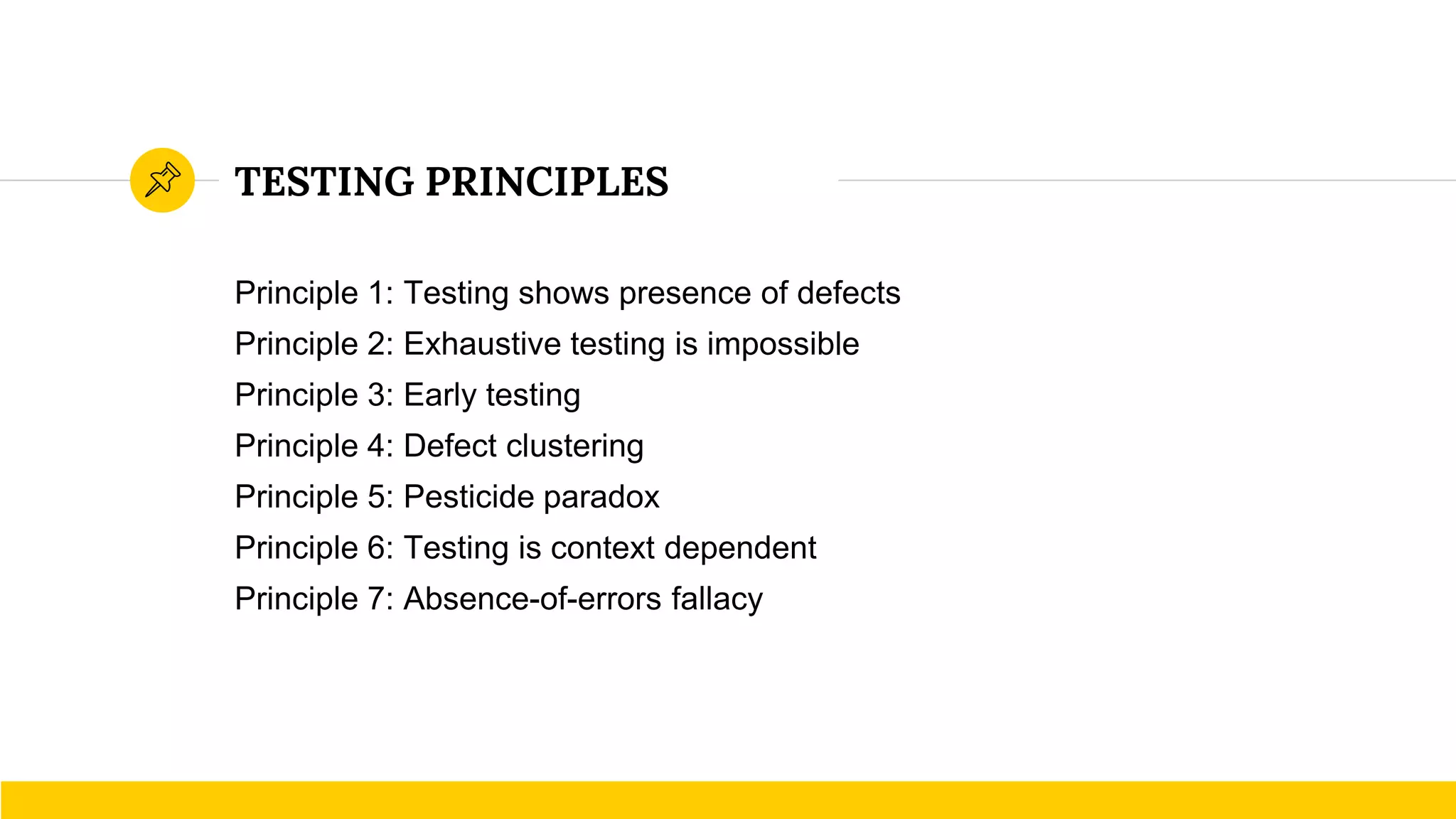
TESTING PRINCIPLES
Principle 1: Testing shows presence of defects
Principle 2: Exhaustive testing is impossible
Principle 3: Early testing
Principle 4: Defect clustering
Principle 5: Pesticide paradox
Principle 6: Testing is context dependent
Principle 7: Absence-of-errors fallacy
FUNDAMENTAL TEST
PROCESS1
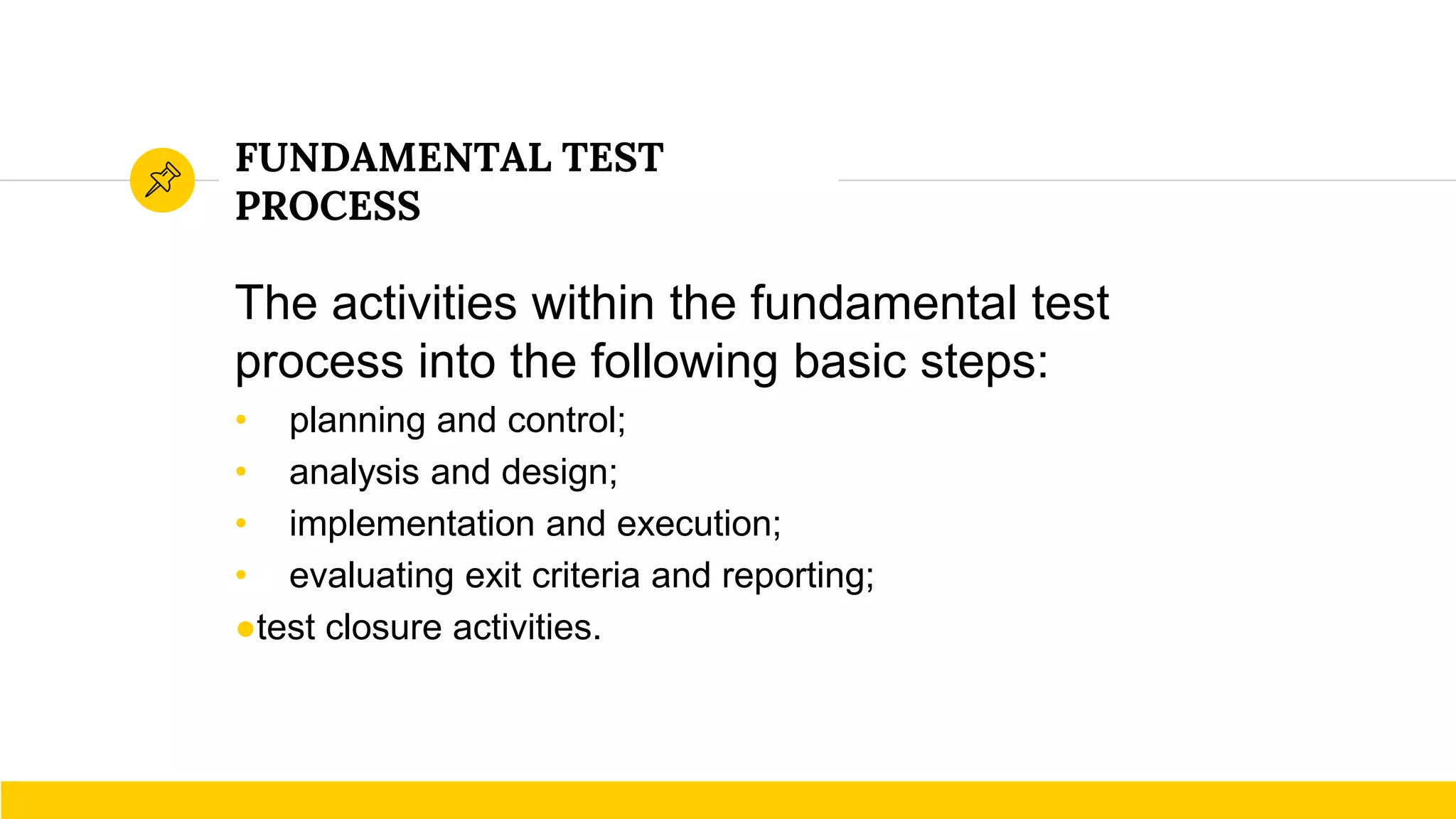
FUNDAMENTAL TEST
PROCESS
The activities within the fundamental test
process into the following basic steps:
• planning and control;
• analysis and design;
• implementation and execution;
• evaluating exit criteria and reporting;
●test closure activities.
Test planning and
control1
Test planning and control
During test planning, we make sure we
understand the goals and objectives of the
customers, stakeholders, and the project, and
the risks which testing is intended to address.
This will give us what is sometimes called the
mission of testing or the test assignment.
Test analysis and design1
Test analysis and design
Test analysis and design has the following major tasks, in
approximately the following order:
◉Review the test basis (such as the product risk analysis, requirements,
architecture, design specifications, and interfaces), examining the
specifications for the software we are testing.
◉Identify test conditions based on analysis of test items, their
specifications, and what we know about their behavior and structure.
◉Design the tests
◉Evaluate testability of the requirements and system.
Test analysis and design1
Test analysis and design
Test analysis and design has the following major tasks, in
approximately the following order:
◉Review the test basis (such as the product risk analysis, requirements,
architecture, design specifications, and interfaces), examining the
specifications for the software we are testing.
◉Identify test conditions based on analysis of test items, their
specifications, and what we know about their behavior and structure.
◉Design the tests
◉Evaluate testability of the requirements and system.
Any questions ?
Thanks!

Why testing is necessary

  • 1.
    Why is testingnecessary (Graham at al 2006) Achmad Harpin Asrori (11453101803) Program Studi S1 Sistem Informasi Fakultas Sains dan Teknologi Universitas Islam Negeri Sultan Syarif Kasim Riau http://sif.uin-suska.ac.id/ http://fst.uin-suska.ac.id/ http://www.uin-suska.ac.id/
  • 2.
  • 3.
    Causes of softwaredefects ◉ If someone makes an error or mistake in using the software, this may lead directly to a problem - the software is used incorrectly and so does not behave as we expected. However, people also design and build the software and they can make mistakes during the design and build. These mistakes mean that there are flaws in the software itself. These are called defects or sometimes bugs or faults. Remember, the software is not just the code; check the definition of soft- ware again to remind yourself.
  • 4.
    Role of testingin software development, maintenance and operations1
  • 5.
    Role of testingin software development, maintenance and operations ◉ We have seen that human errors can cause a defect or fault to be introduced at any stage within the software development life cycle and, depending upon the consequences of the mistake, the results can be trivial or catastrophic. Rigorous testing is necessary during development and maintenance to identify defects, in order to reduce failures in the operational environment and increase the quality of the operational system.
  • 6.
  • 7.
    Testing and quality ◉Testingcan give confidence in the quality of the software if it finds few or no defects, provided we are happy that the testing is sufficiently rigorous . ◉Projects aim to deliver software to specification. For the project to deliver what the customer needs requires a correct specification. Additionally, the delivered system must meet the specification.
  • 8.
    How much testingis enough?1
  • 9.
    How much testingis enough? ◉Testing everything (all combinations of inputs and preconditions) is not feasible except for trivial cases. Instead of exhaustive testing, we use risks and priorities to focus testing efforts. ◉We've seen that testing helps us find defects and improve software quality.
  • 10.
    The driving test– an analogy for software testing1
  • 11.
    The driving test– an analogy for software testing The format of the driving test and the conduct of the examiner are worth considering: ◉The test is planned and prepared for. ◉The test has known goals – assessing whether the driver is sufficiently safe to be allowed to drive by themselves without an instructor, without endanger ing themselves or others. ◉The test is therefore carried out to show that the driver satisfies the require ments for driving and to demonstrate that they are fit to drive. ◉As well as observing the driver actually driving
  • 12.
  • 13.
    TESTING PRINCIPLES Principle 1:Testing shows presence of defects Principle 2: Exhaustive testing is impossible Principle 3: Early testing Principle 4: Defect clustering Principle 5: Pesticide paradox Principle 6: Testing is context dependent Principle 7: Absence-of-errors fallacy
  • 14.
  • 15.
    FUNDAMENTAL TEST PROCESS The activitieswithin the fundamental test process into the following basic steps: • planning and control; • analysis and design; • implementation and execution; • evaluating exit criteria and reporting; ●test closure activities.
  • 16.
  • 17.
    Test planning andcontrol During test planning, we make sure we understand the goals and objectives of the customers, stakeholders, and the project, and the risks which testing is intended to address. This will give us what is sometimes called the mission of testing or the test assignment.
  • 18.
  • 19.
    Test analysis anddesign Test analysis and design has the following major tasks, in approximately the following order: ◉Review the test basis (such as the product risk analysis, requirements, architecture, design specifications, and interfaces), examining the specifications for the software we are testing. ◉Identify test conditions based on analysis of test items, their specifications, and what we know about their behavior and structure. ◉Design the tests ◉Evaluate testability of the requirements and system.
  • 20.
  • 21.
    Test analysis anddesign Test analysis and design has the following major tasks, in approximately the following order: ◉Review the test basis (such as the product risk analysis, requirements, architecture, design specifications, and interfaces), examining the specifications for the software we are testing. ◉Identify test conditions based on analysis of test items, their specifications, and what we know about their behavior and structure. ◉Design the tests ◉Evaluate testability of the requirements and system.
  • 22.