Classical Planning In Artificial Intelligence
SlideMake.com
Introduction to Classical Planning
Classical planning in AI involves the
process of generating a sequence of
actions to achieve specific goals.
It is a fundamental component of many
intelligent systems, including robotics
and automated problem-solving.
Understanding classical planning helps
in the development of efficient
algorithms and decision-making
processes.
Definition of Classical Planning
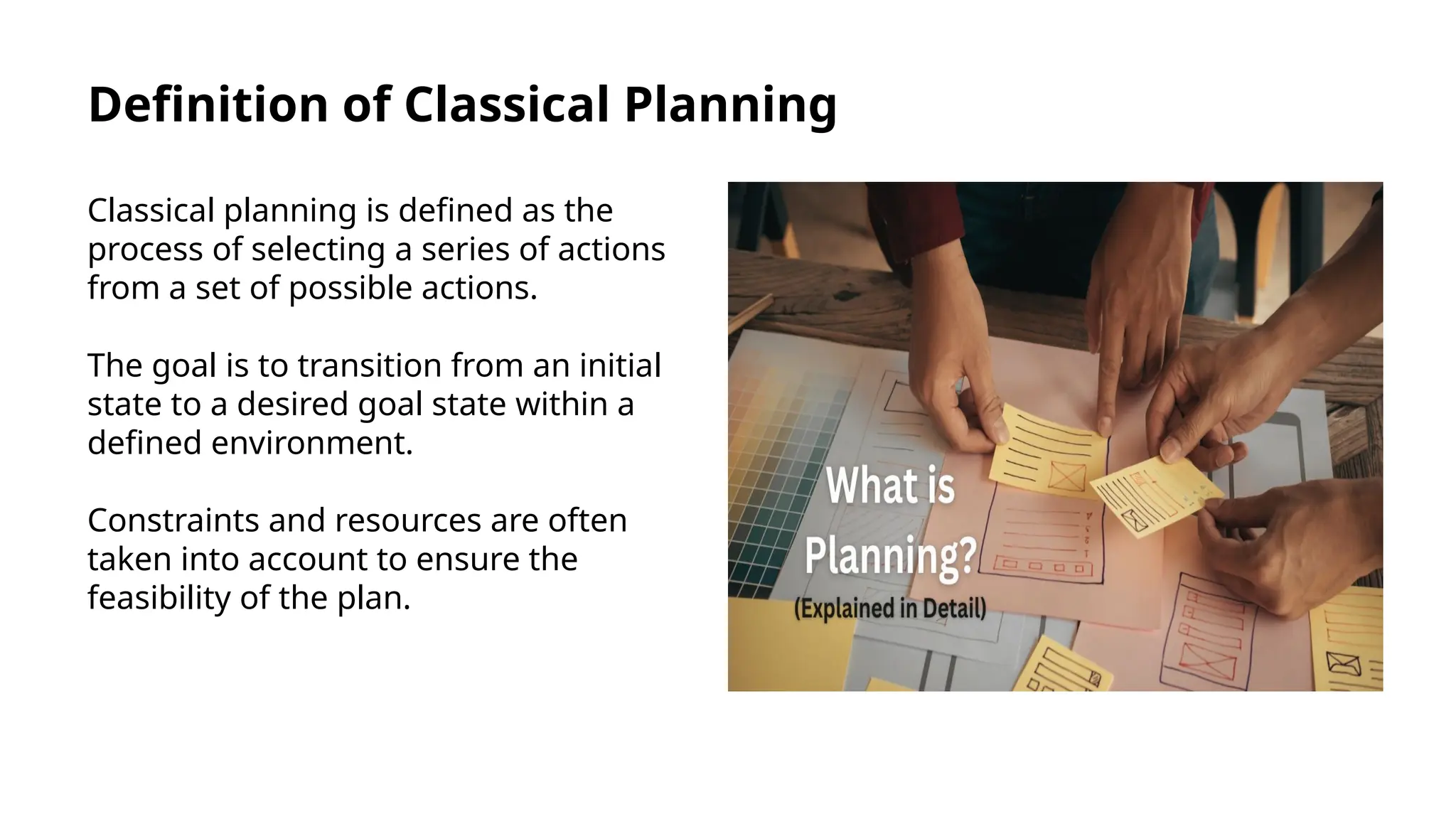
Classical planning is defined as the
process of selecting a series of actions
from a set of possible actions.
The goal is to transition from an initial
state to a desired goal state within a
defined environment.
Constraints and resources are often
taken into account to ensure the
feasibility of the plan.
Key Concepts in Classical Planning
States represent the current situation or
configuration of the world in planning
problems.
Actions are defined by their
preconditions and effects, which dictate
how they alter the state.
Goals are the target states that the
planner aims to achieve through the
execution of actions.
Planning Problem Formulation
A classical planning problem is typically
represented as a tuple consisting of
initial state, goal state, and action set.
The representation can be formalized
using various languages, such as PDDL
(Planning Domain Definition Language).
Accurate formulation is crucial for the
planner to generate a valid sequence of
actions.
Types of Classical Planners
There are several types of classical
planners, including state-space planners
and plan-space planners.
State-space planners explore the space
of states to find a sequence of actions
that leads to the goal.
Plan-space planners focus on refining
partial plans until a complete plan is
formed that satisfies the goals.
Search Strategies in Planning
Classical planners employ various search
strategies to navigate through the action
space effectively.
Depth-first search, breadth-first search,
and heuristic search are common
techniques used in planning.
The choice of search strategy can
significantly impact the efficiency and
effectiveness of the planning process.
Heuristics in Classical Planning
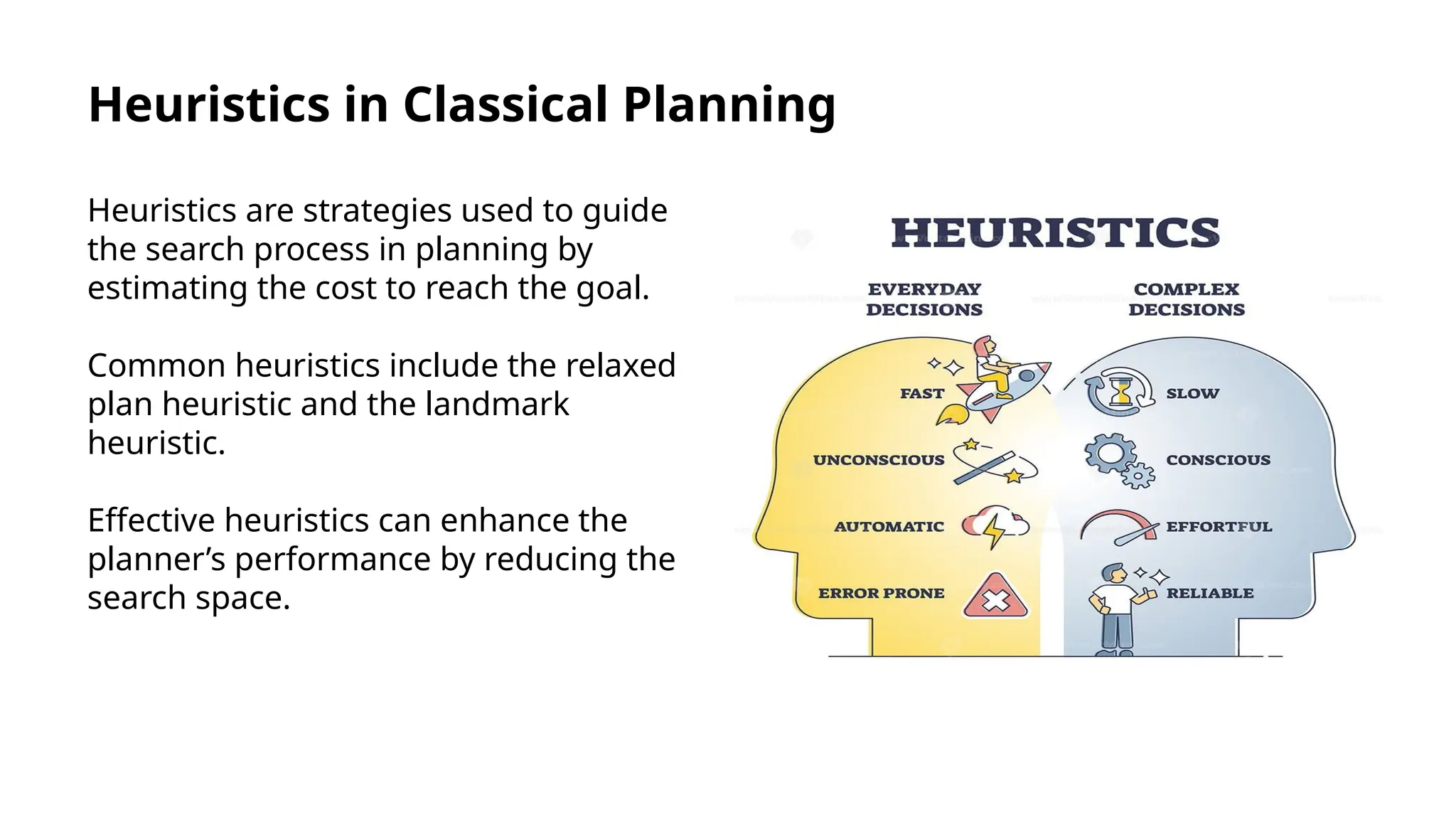
Heuristics are strategies used to guide
the search process in planning by
estimating the cost to reach the goal.
Common heuristics include the relaxed
plan heuristic and the landmark
heuristic.
Effective heuristics can enhance the
planner’s performance by reducing the
search space.
Challenges in Classical Planning
Classical planning faces challenges such
as the combinatorial explosion of
possible actions and states.
Handling uncertainty and dynamic
environments adds complexity to
classical planning frameworks.
Scalability and real-time decision-making
are ongoing challenges in the field.
Applications of Classical Planning
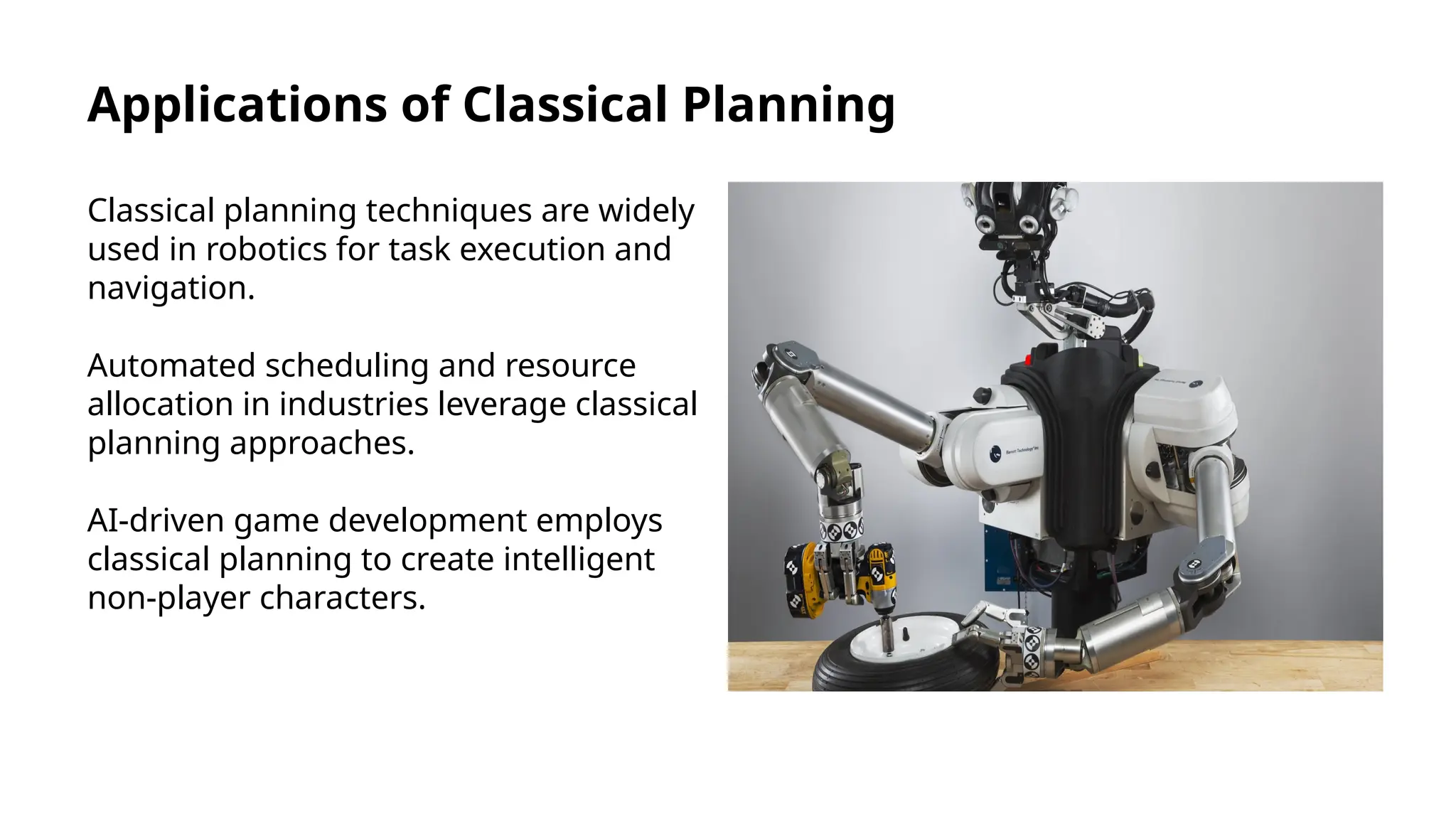
Classical planning techniques are widely
used in robotics for task execution and
navigation.
Automated scheduling and resource
allocation in industries leverage classical
planning approaches.
AI-driven game development employs
classical planning to create intelligent
non-player characters.
Future Directions in Classical Planning
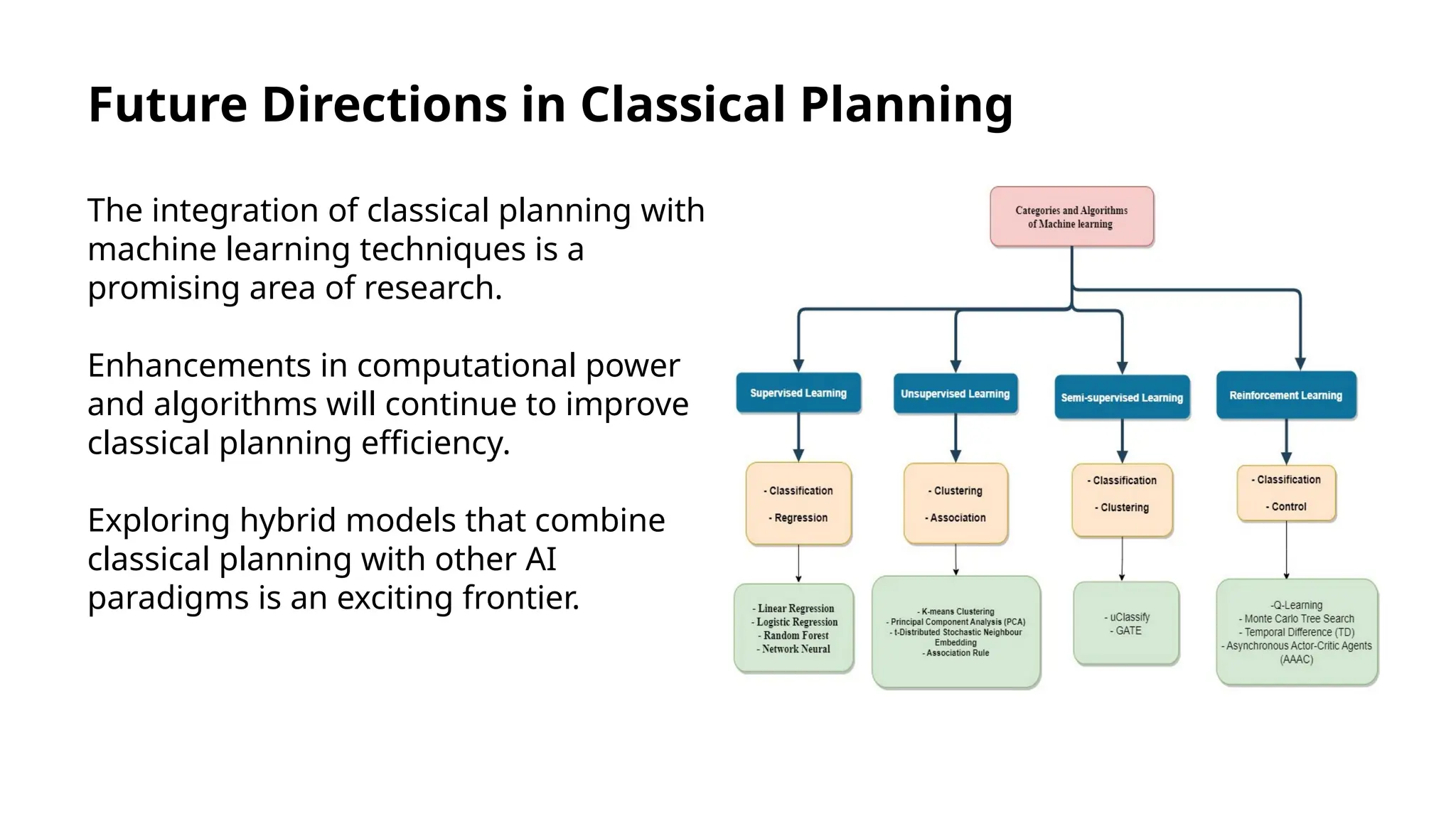
The integration of classical planning with
machine learning techniques is a
promising area of research.
Enhancements in computational power
and algorithms will continue to improve
classical planning efficiency.
Exploring hybrid models that combine
classical planning with other AI
paradigms is an exciting frontier.

Classical Planning In Artificial Intelligence.pptx

  • 1.
    Classical Planning InArtificial Intelligence SlideMake.com
  • 2.
    Introduction to ClassicalPlanning Classical planning in AI involves the process of generating a sequence of actions to achieve specific goals. It is a fundamental component of many intelligent systems, including robotics and automated problem-solving. Understanding classical planning helps in the development of efficient algorithms and decision-making processes.
  • 3.
    Definition of ClassicalPlanning Classical planning is defined as the process of selecting a series of actions from a set of possible actions. The goal is to transition from an initial state to a desired goal state within a defined environment. Constraints and resources are often taken into account to ensure the feasibility of the plan.
  • 4.
    Key Concepts inClassical Planning States represent the current situation or configuration of the world in planning problems. Actions are defined by their preconditions and effects, which dictate how they alter the state. Goals are the target states that the planner aims to achieve through the execution of actions.
  • 5.
    Planning Problem Formulation Aclassical planning problem is typically represented as a tuple consisting of initial state, goal state, and action set. The representation can be formalized using various languages, such as PDDL (Planning Domain Definition Language). Accurate formulation is crucial for the planner to generate a valid sequence of actions.
  • 6.
    Types of ClassicalPlanners There are several types of classical planners, including state-space planners and plan-space planners. State-space planners explore the space of states to find a sequence of actions that leads to the goal. Plan-space planners focus on refining partial plans until a complete plan is formed that satisfies the goals.
  • 7.
    Search Strategies inPlanning Classical planners employ various search strategies to navigate through the action space effectively. Depth-first search, breadth-first search, and heuristic search are common techniques used in planning. The choice of search strategy can significantly impact the efficiency and effectiveness of the planning process.
  • 8.
    Heuristics in ClassicalPlanning Heuristics are strategies used to guide the search process in planning by estimating the cost to reach the goal. Common heuristics include the relaxed plan heuristic and the landmark heuristic. Effective heuristics can enhance the planner’s performance by reducing the search space.
  • 9.
    Challenges in ClassicalPlanning Classical planning faces challenges such as the combinatorial explosion of possible actions and states. Handling uncertainty and dynamic environments adds complexity to classical planning frameworks. Scalability and real-time decision-making are ongoing challenges in the field.
  • 10.
    Applications of ClassicalPlanning Classical planning techniques are widely used in robotics for task execution and navigation. Automated scheduling and resource allocation in industries leverage classical planning approaches. AI-driven game development employs classical planning to create intelligent non-player characters.
  • 11.
    Future Directions inClassical Planning The integration of classical planning with machine learning techniques is a promising area of research. Enhancements in computational power and algorithms will continue to improve classical planning efficiency. Exploring hybrid models that combine classical planning with other AI paradigms is an exciting frontier.

Editor's Notes

  • #2 Image source: https://www.slidemake.com
  • #3 Image source: https://bokastutor.com
  • #4 Image source: https://www.usg.com
  • #5 Image source: https://www.researchgate.net
  • #6 Image source: https://i.pinimg.com
  • #7 Image source: https://www.slidemake.com
  • #8 Image source: https://i.pinimg.com
  • #9 Image source: https://img.dokumen.tips
  • #10 Image source: https://am.is.mpg.de
  • #11 Image source: https://www.mdpi.com