Final Glive_Learn 6 Science_Chapter 9 part 2_ KS (1).pdf
1.
The Living Organisms—
Characteristics and Habitats - 2
LEARN
SESSION
Class: 6/ Subject: Science
2.
Click the Q&Abutton to ask
any questions and for your
queries. The Mentor will
answer your question during
or at the end of the session
Click the button if Mentor
asks you to ‘raise your hand’.
Do not click this button to
ask questions
Done with the
session?
Click here to leave
the session
3.
Class 6
Subject Science
Chapter09, The Living Organisms —
Characteristics and Habitats - 2
Mentor Mr. Kartik Sharma
LEARN
SESSION
4.
LEARN
SESSION
To study morelog on to: www.geneo.in
Recommended Learning
Chapter : 9, The Living Organisms — Characteristics and Habitats
Textbook Page Number : 79-94
Video : Adaptation and Habitat, Different habitats and adaptations of
animals, Terrestrial Habitat- Dessert, Mountain, Grassland, Some aquatic
habitats, Nourishment in plants and animals, Intro to life processes, Living
things respire, Respiratory organs in plants and animals
5.
Q & A
POINTSFOR
DISCUSSION
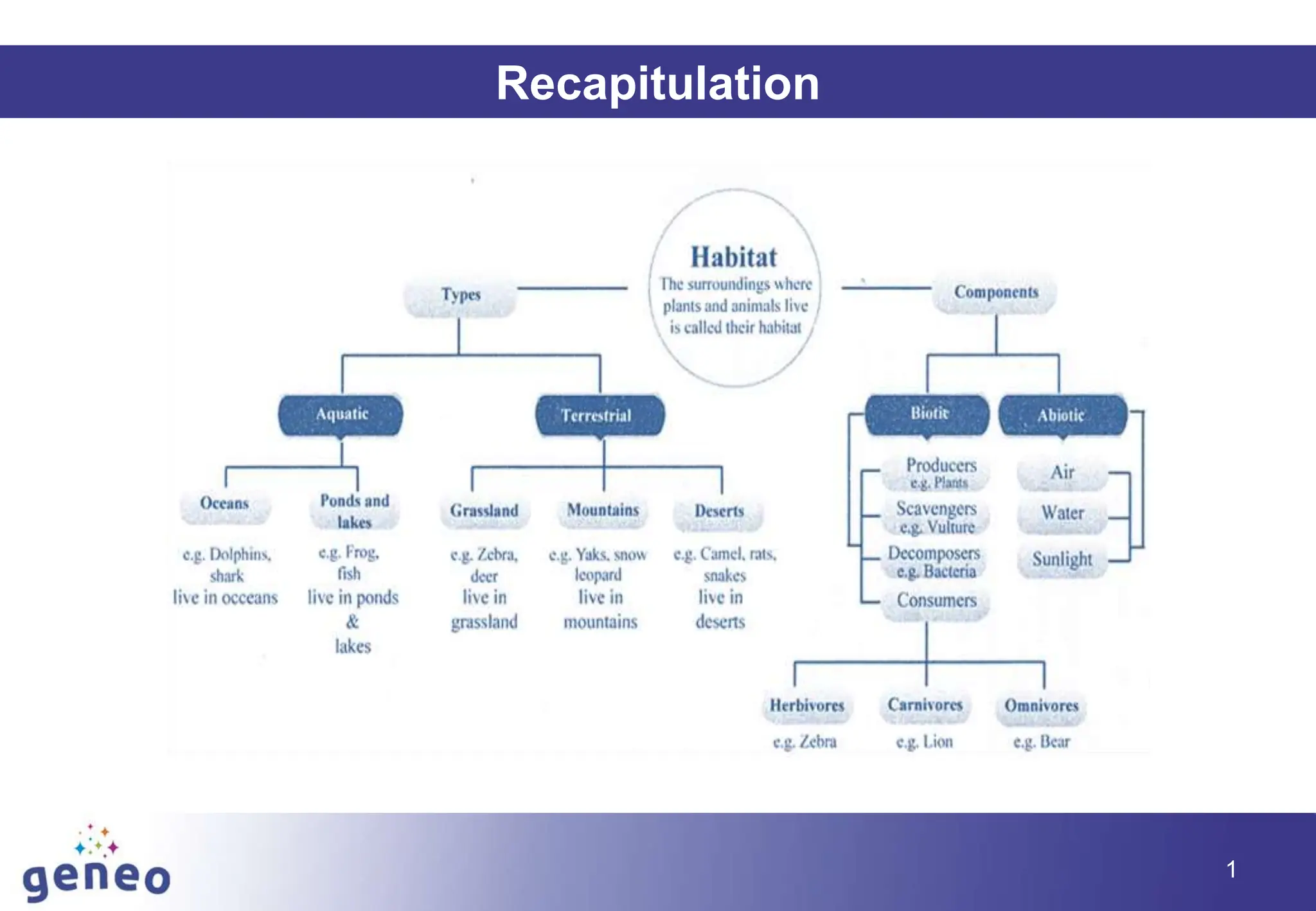
Recapitulation
Characteristics of Organisms
Growth, Food & Respiration
Excretion & Reproduction
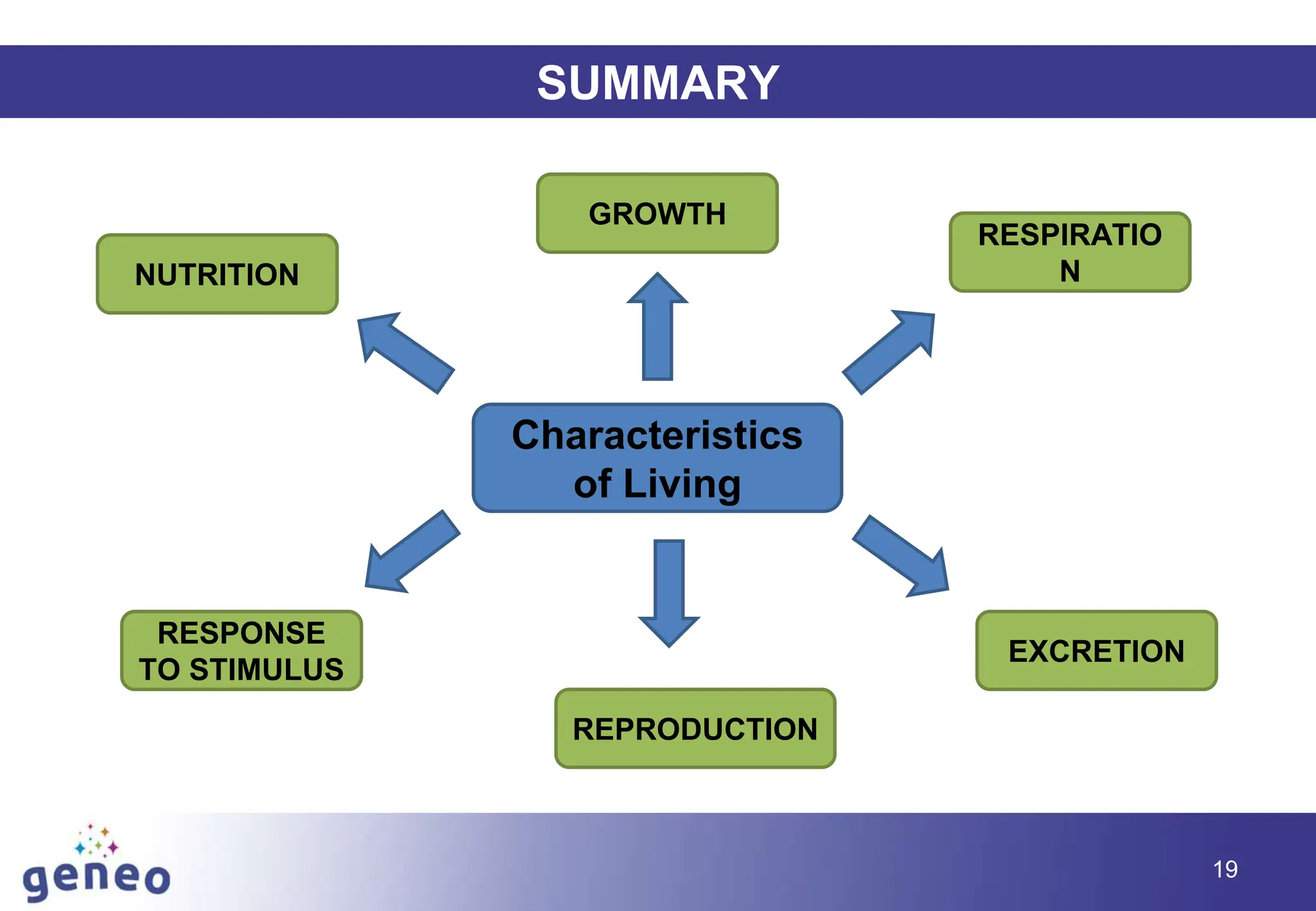
Summary
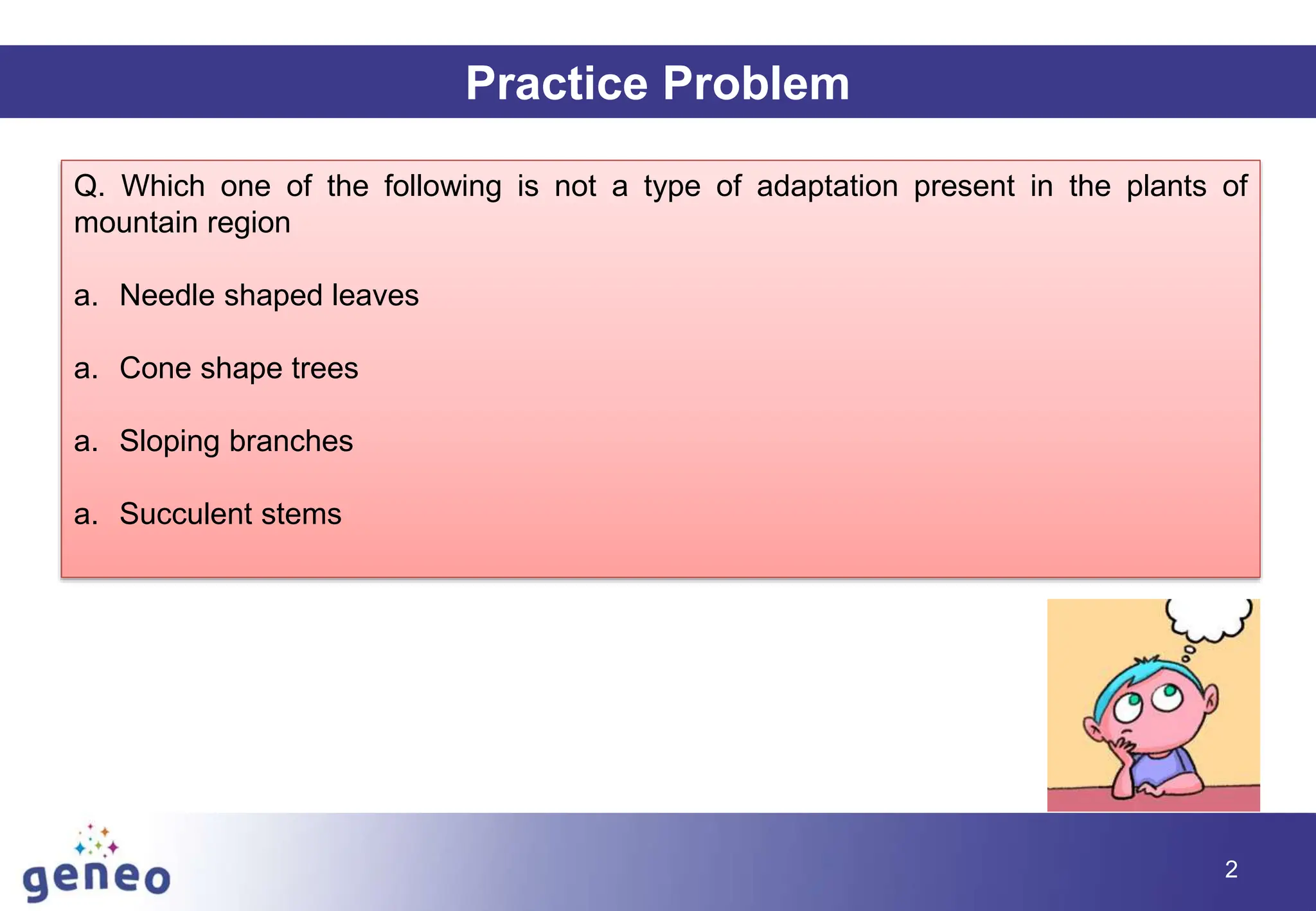
Practice Problem
Q. Whichone of the following is not a type of adaptation present in the plants of
mountain region
a. Needle shaped leaves
a. Cone shape trees
a. Sloping branches
a. Succulent stems
2
8.
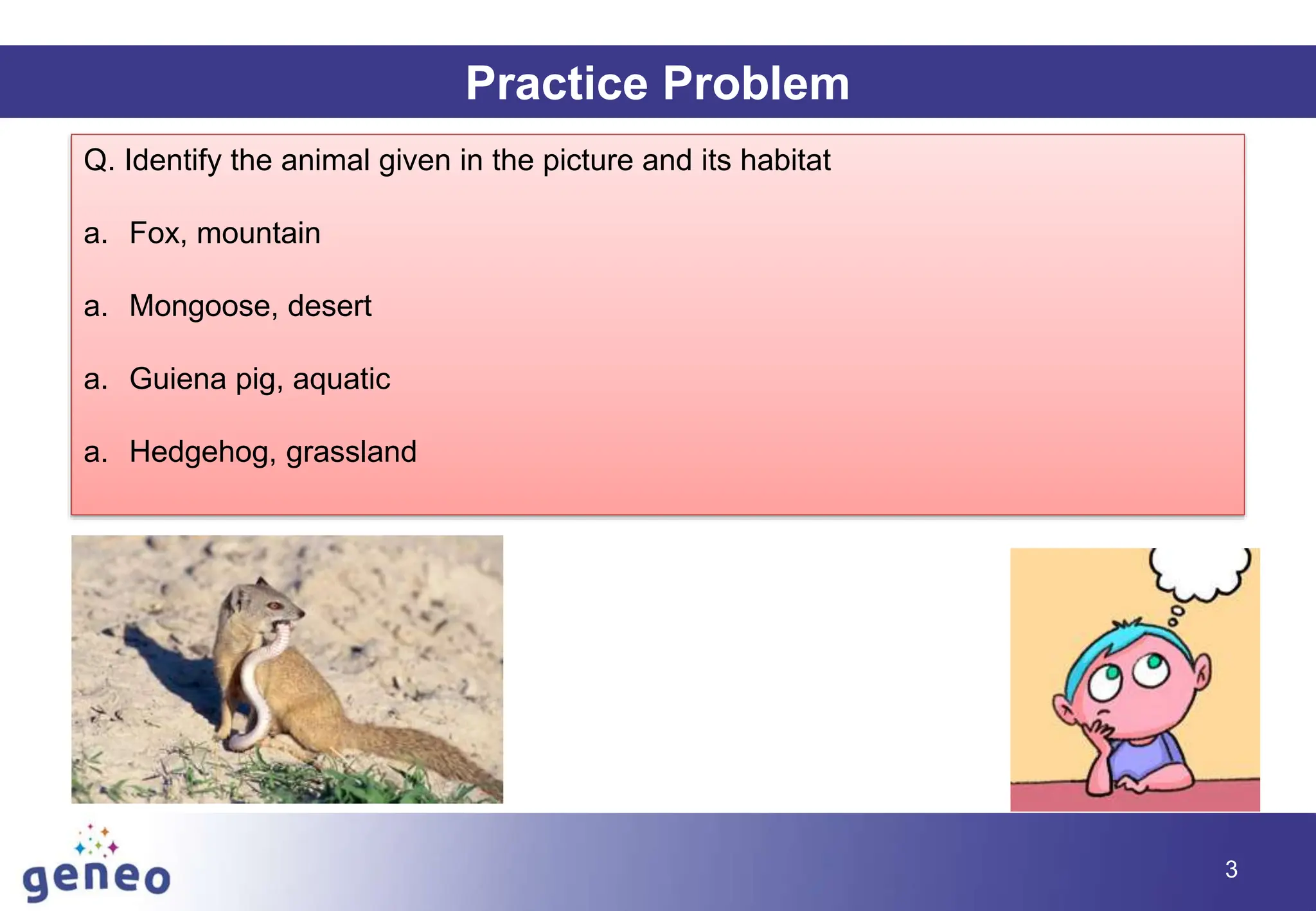
Practice Problem
Q. Identifythe animal given in the picture and its habitat
a. Fox, mountain
a. Mongoose, desert
a. Guiena pig, aquatic
a. Hedgehog, grassland
3
9.
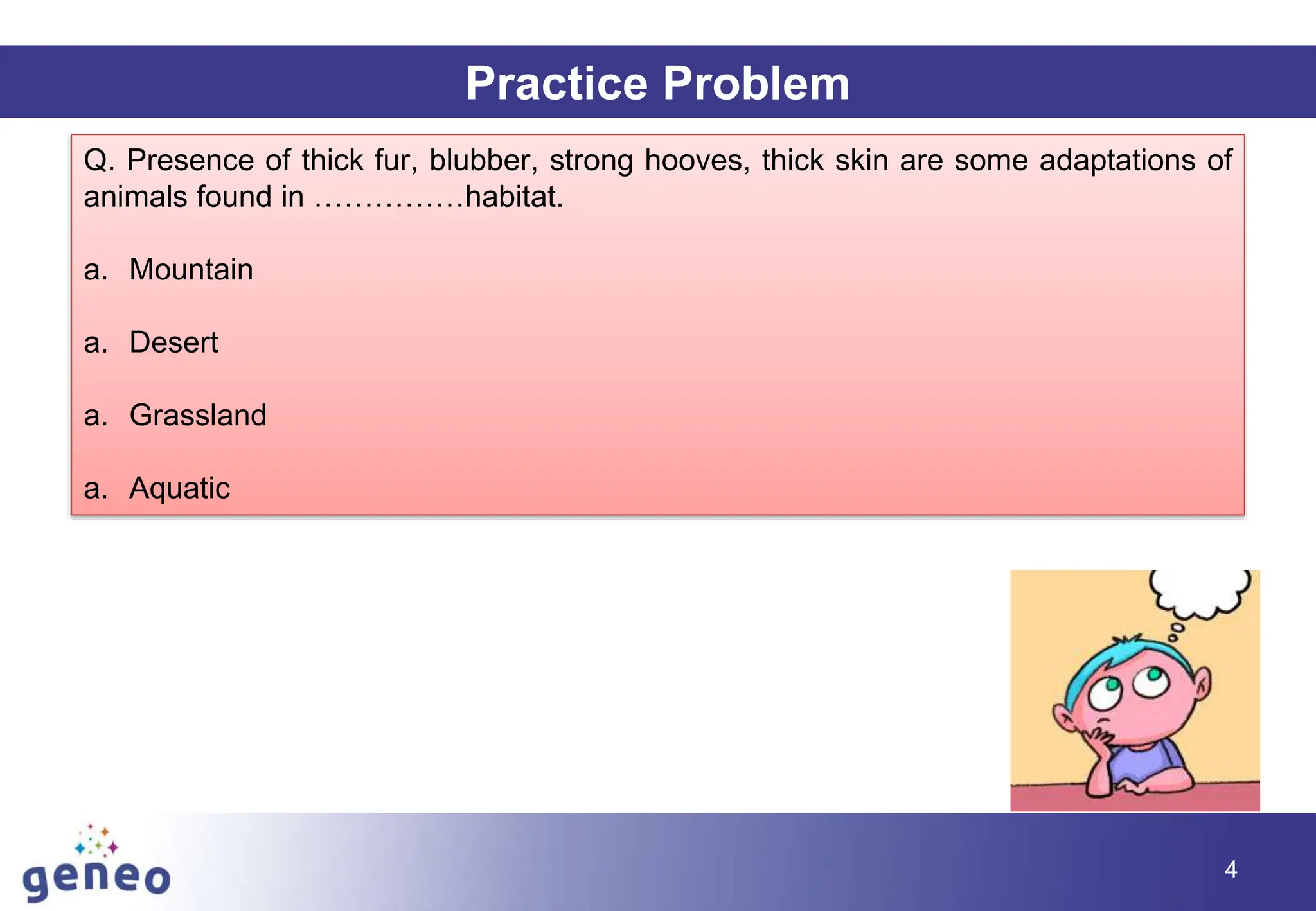
Practice Problem
Q. Presenceof thick fur, blubber, strong hooves, thick skin are some adaptations of
animals found in ……………habitat.
a. Mountain
a. Desert
a. Grassland
a. Aquatic
4
10.
5
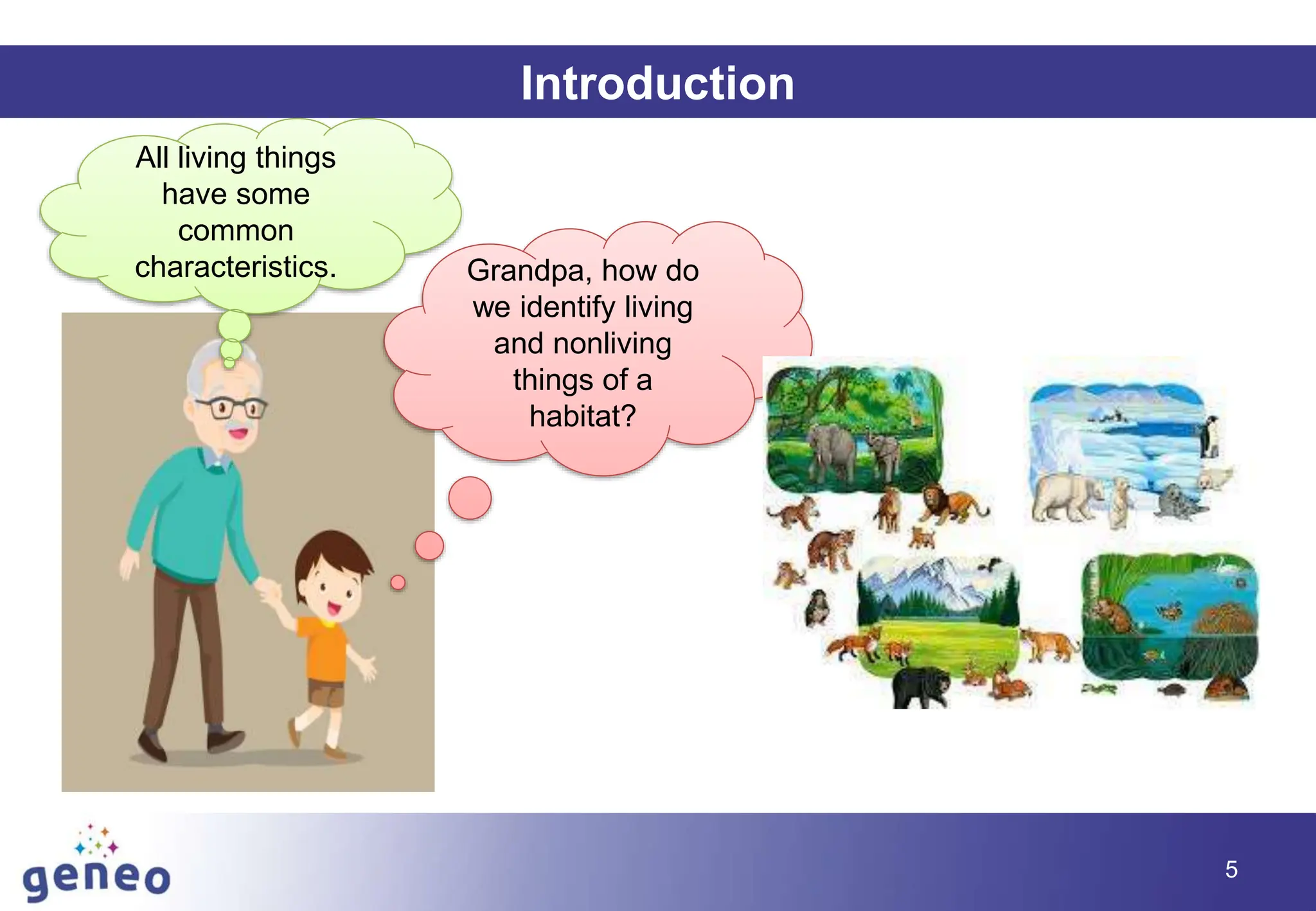
Introduction
Grandpa, how do
weidentify living
and nonliving
things of a
habitat?
All living things
have some
common
characteristics.
7
Characteristics of Organisms
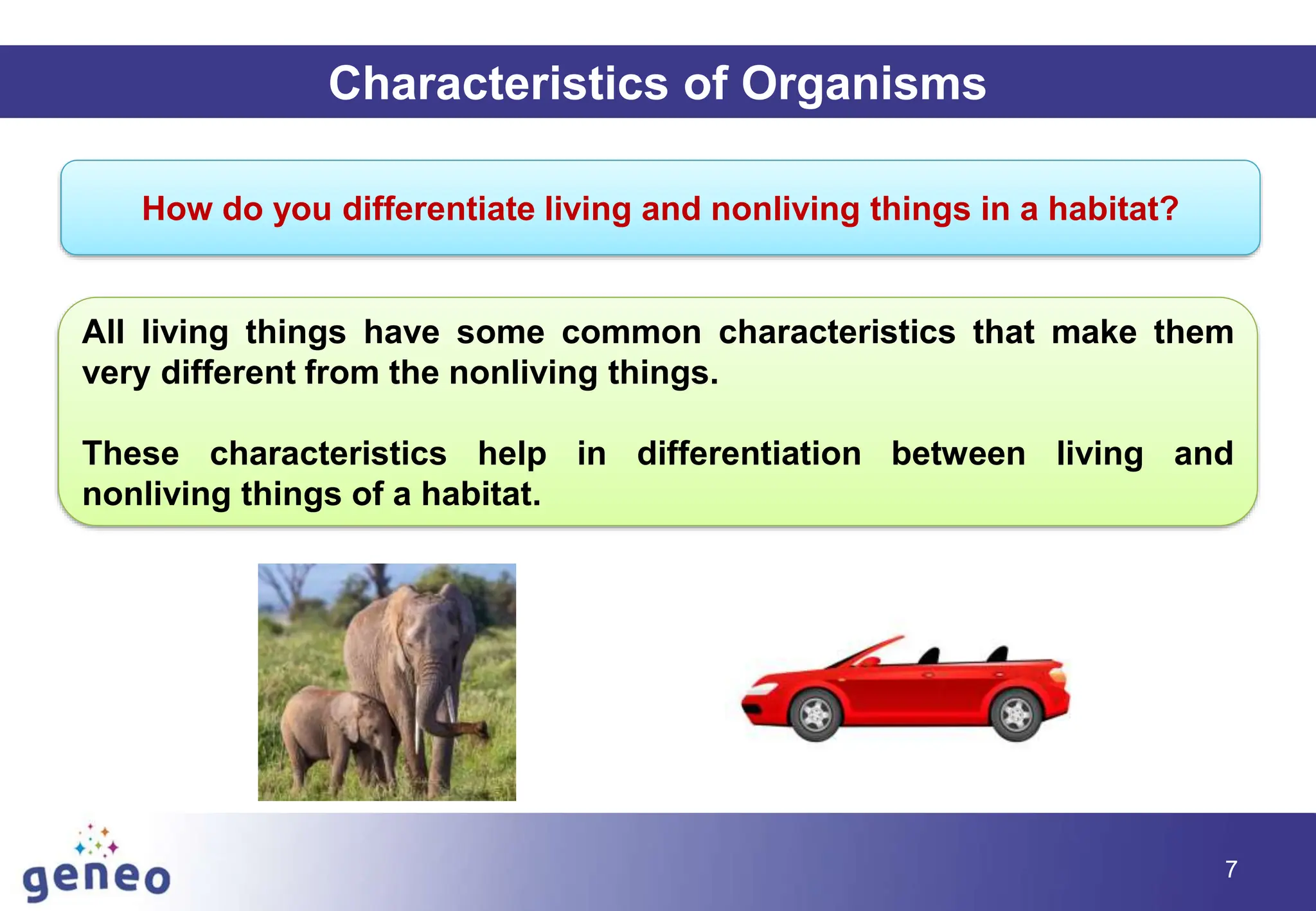
Allliving things have some common characteristics that make them
very different from the nonliving things.
These characteristics help in differentiation between living and
nonliving things of a habitat.
How do you differentiate living and nonliving things in a habitat?
13.
8
Characteristics of Organisms
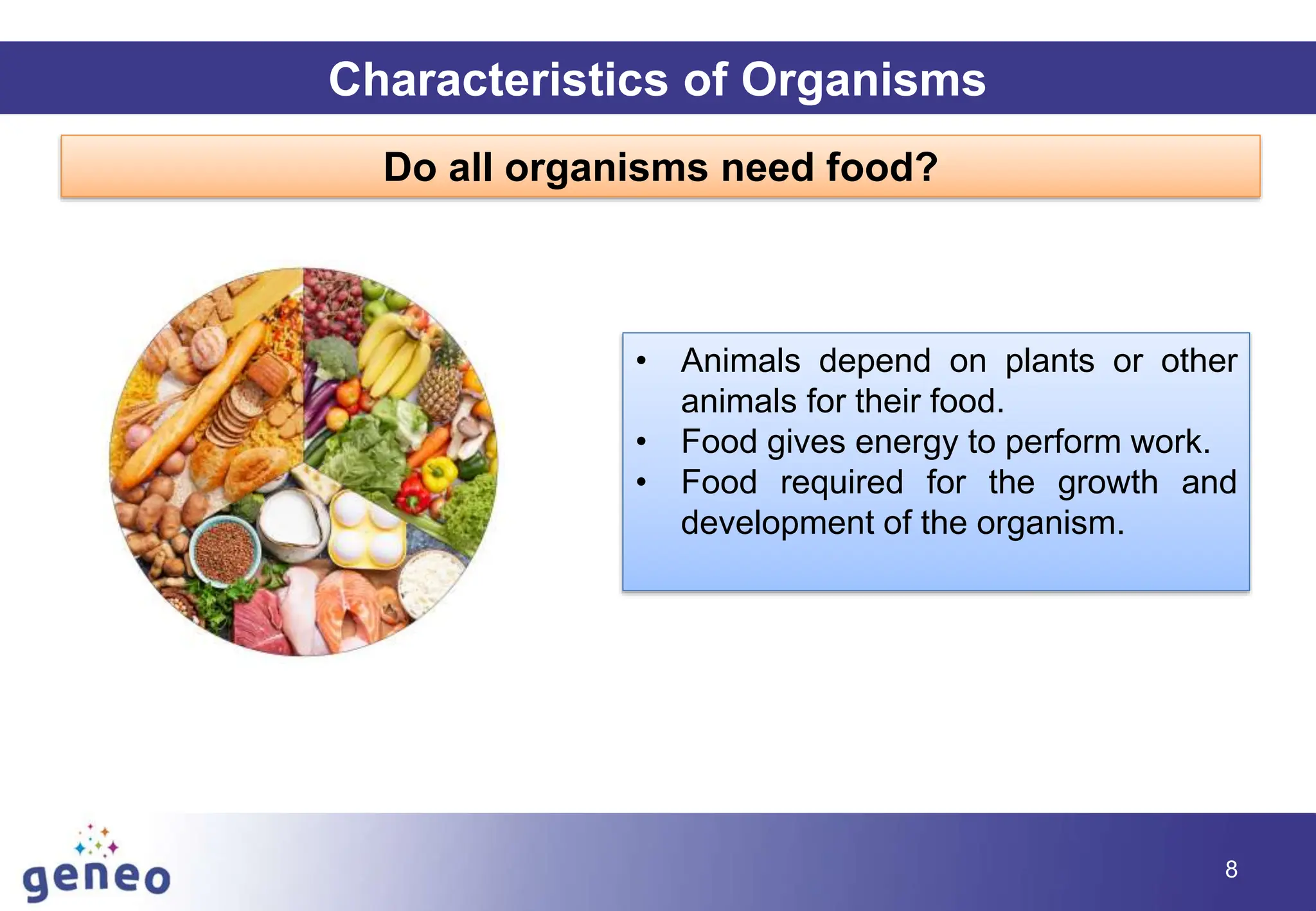
Doall organisms need food?
• Animals depend on plants or other
animals for their food.
• Food gives energy to perform work.
• Food required for the growth and
development of the organism.
14.
9
Characteristics of Organisms
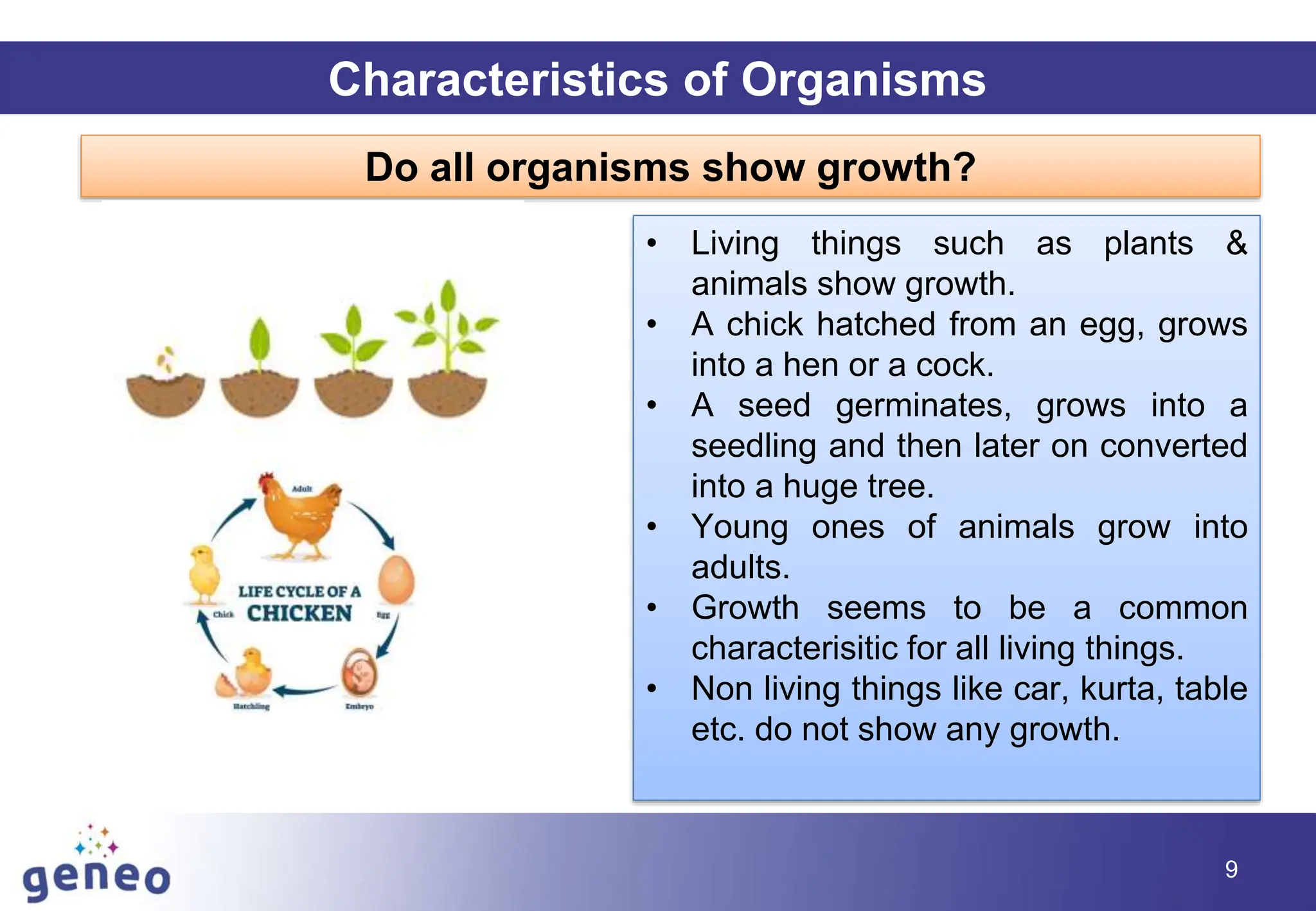
Doall organisms show growth?
• Living things such as plants &
animals show growth.
• A chick hatched from an egg, grows
into a hen or a cock.
• A seed germinates, grows into a
seedling and then later on converted
into a huge tree.
• Young ones of animals grow into
adults.
• Growth seems to be a common
characterisitic for all living things.
• Non living things like car, kurta, table
etc. do not show any growth.
15.
10
Characteristics of Organisms
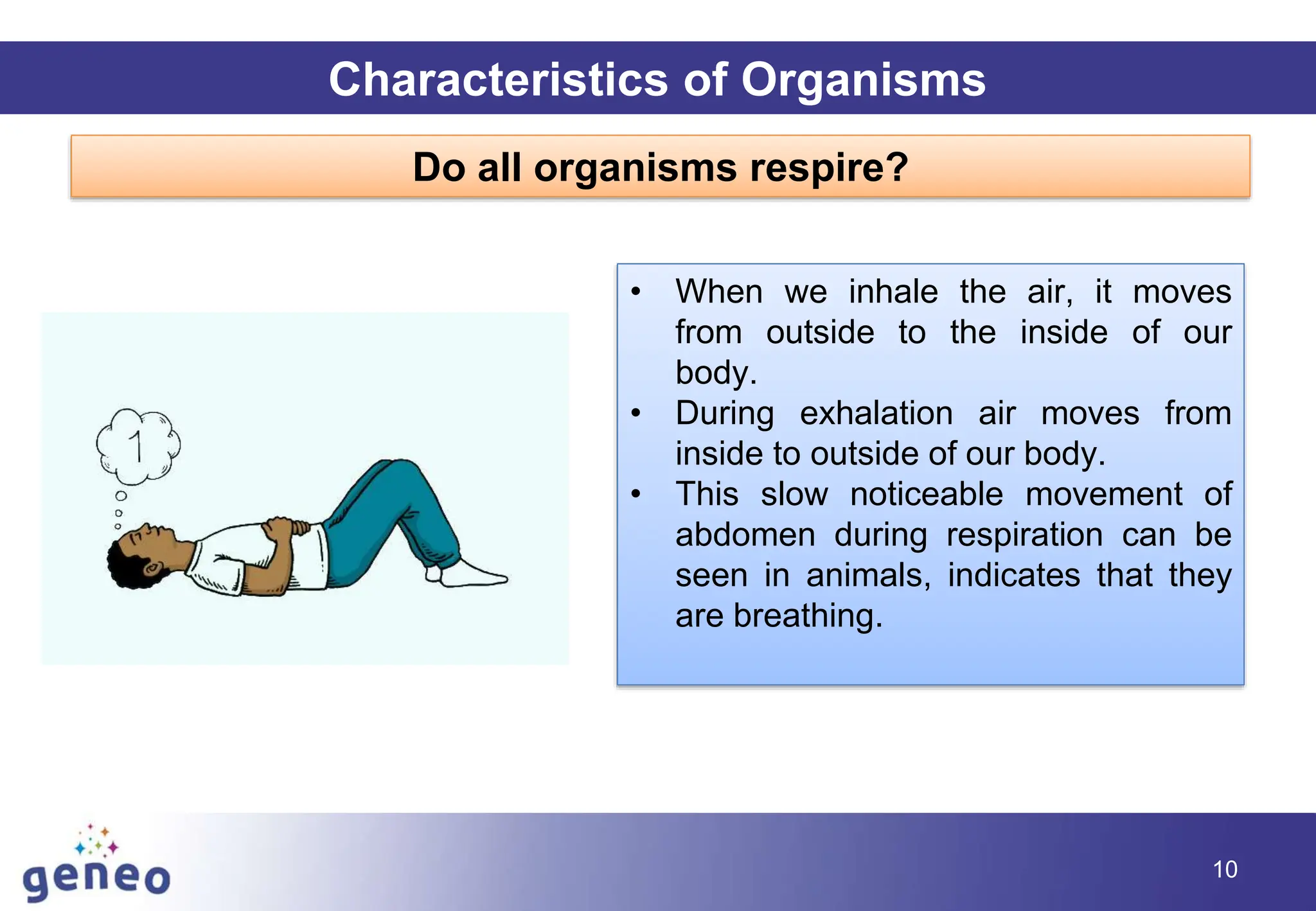
Doall organisms respire?
• When we inhale the air, it moves
from outside to the inside of our
body.
• During exhalation air moves from
inside to outside of our body.
• This slow noticeable movement of
abdomen during respiration can be
seen in animals, indicates that they
are breathing.
16.
11
Characteristics of Organisms
Respiration
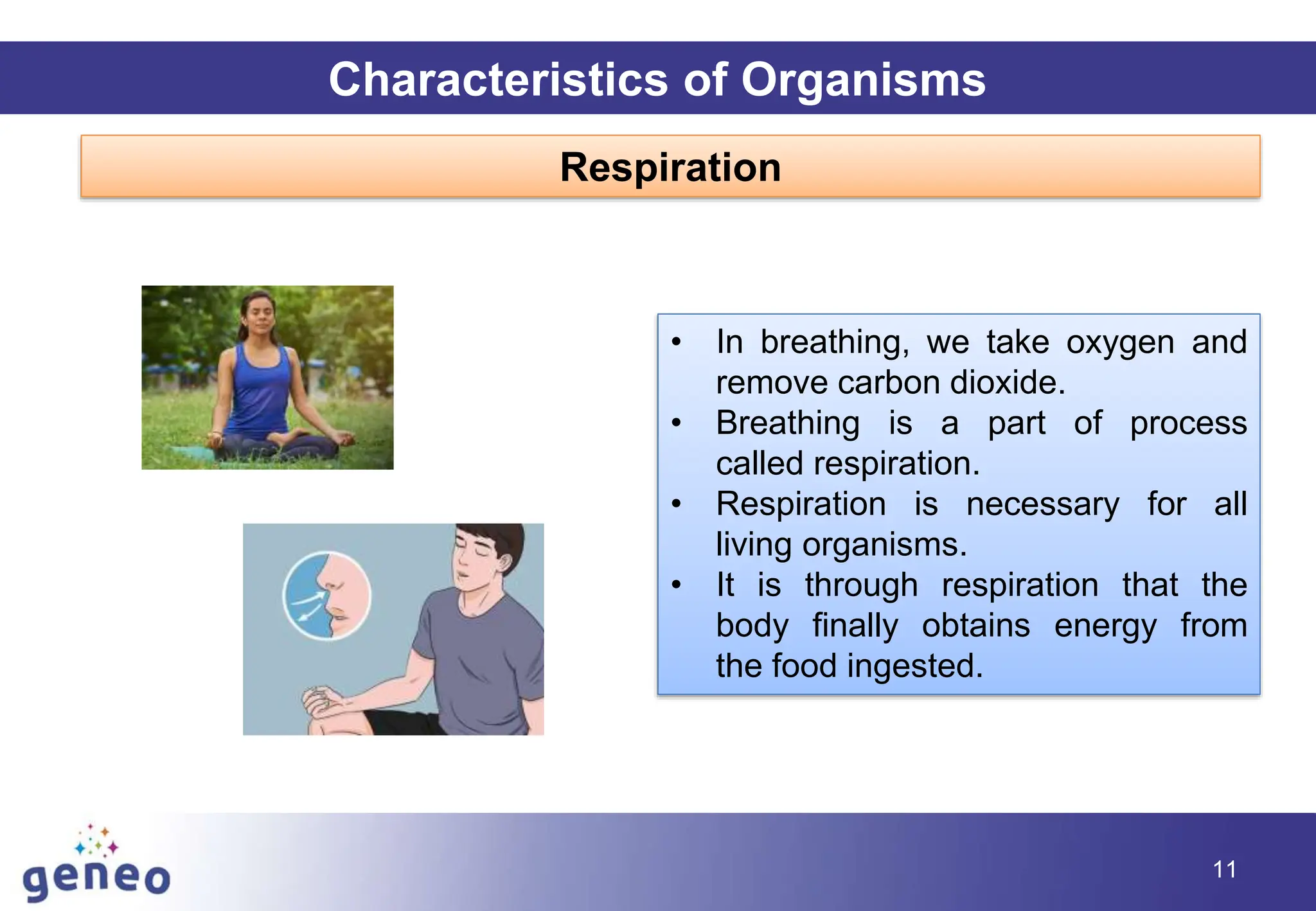
•In breathing, we take oxygen and
remove carbon dioxide.
• Breathing is a part of process
called respiration.
• Respiration is necessary for all
living organisms.
• It is through respiration that the
body finally obtains energy from
the food ingested.
17.
12
Characteristics of Organisms
DifferentMechanism of Respiration in Organisms
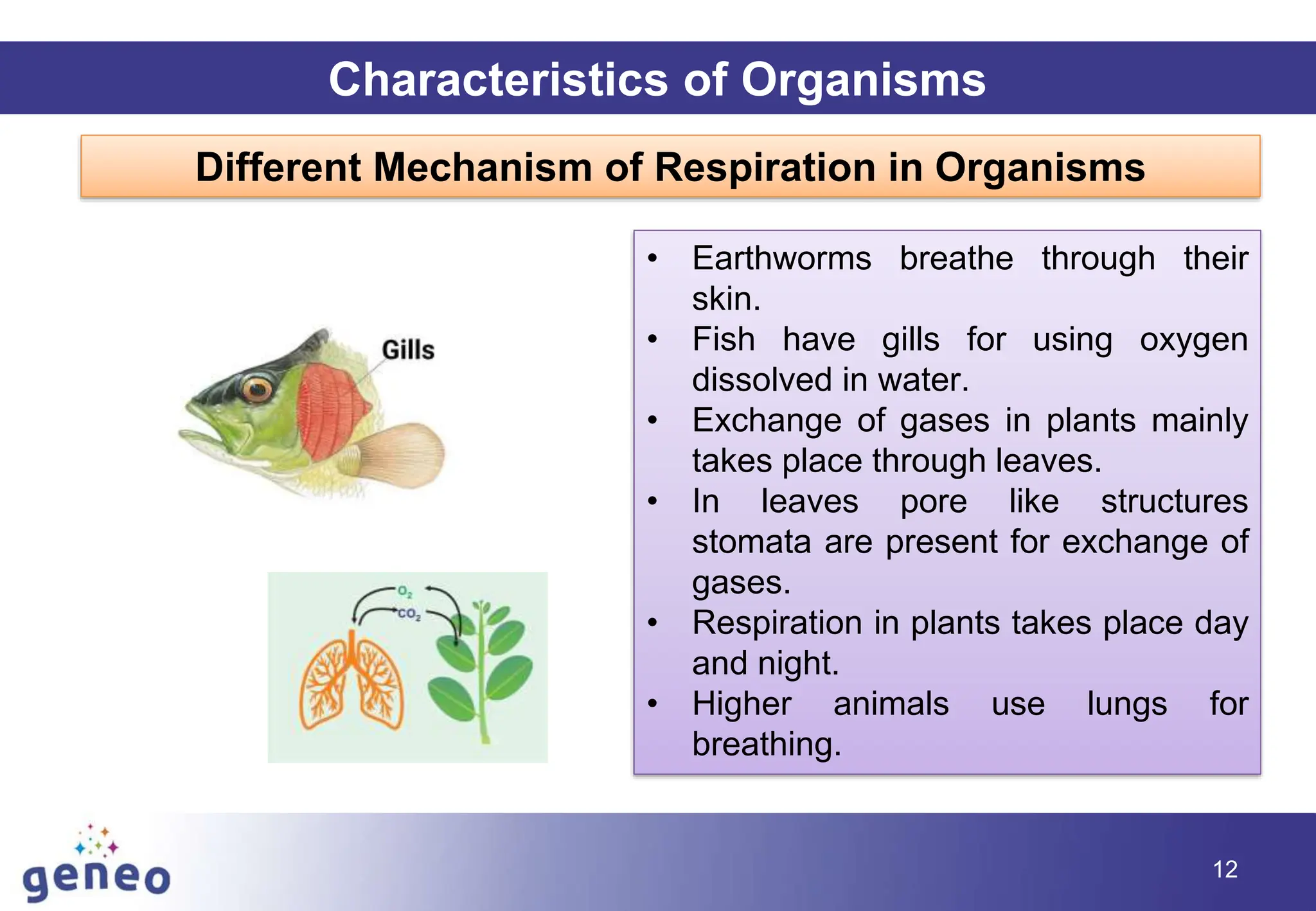
• Earthworms breathe through their
skin.
• Fish have gills for using oxygen
dissolved in water.
• Exchange of gases in plants mainly
takes place through leaves.
• In leaves pore like structures
stomata are present for exchange of
gases.
• Respiration in plants takes place day
and night.
• Higher animals use lungs for
breathing.
18.
13
Characteristics of Organisms
Doall organisms respond to stimuli?
• Changes in our surroundings that
makes us respond to them, are
called stimuli.
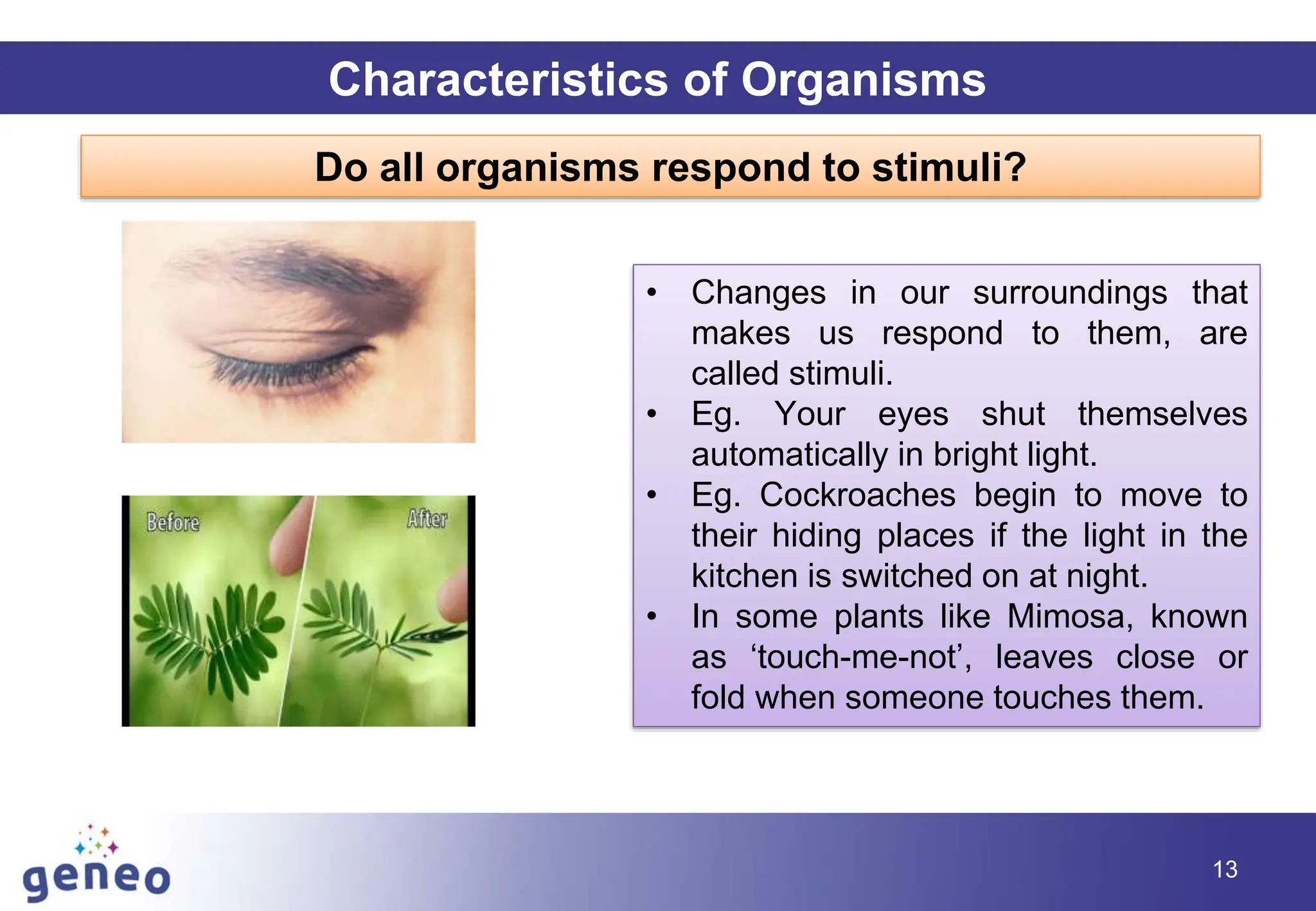
• Eg. Your eyes shut themselves
automatically in bright light.
• Eg. Cockroaches begin to move to
their hiding places if the light in the
kitchen is switched on at night.
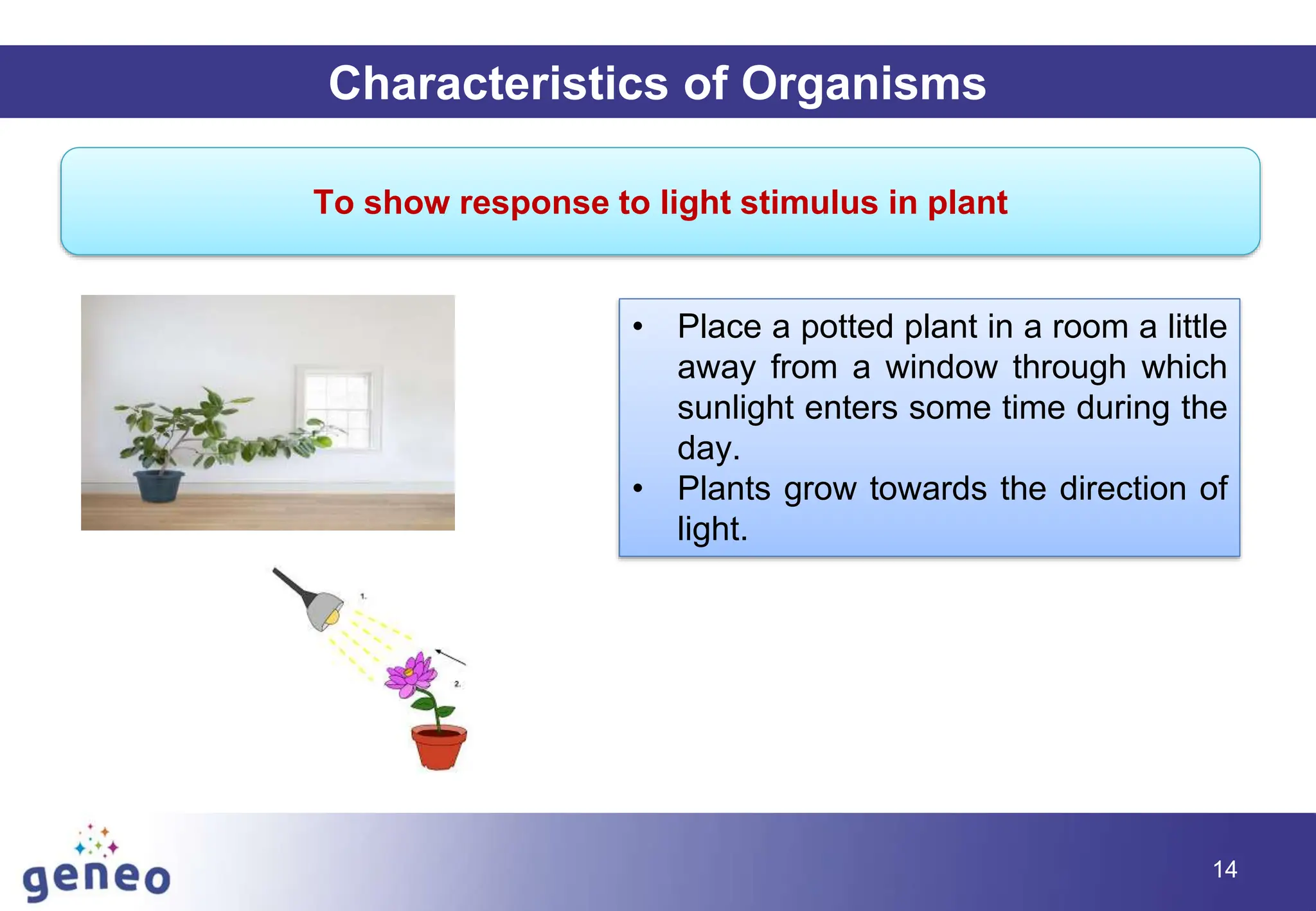
• In some plants like Mimosa, known
as ‘touch-me-not’, leaves close or
fold when someone touches them.
19.
14
Characteristics of Organisms
Toshow response to light stimulus in plant
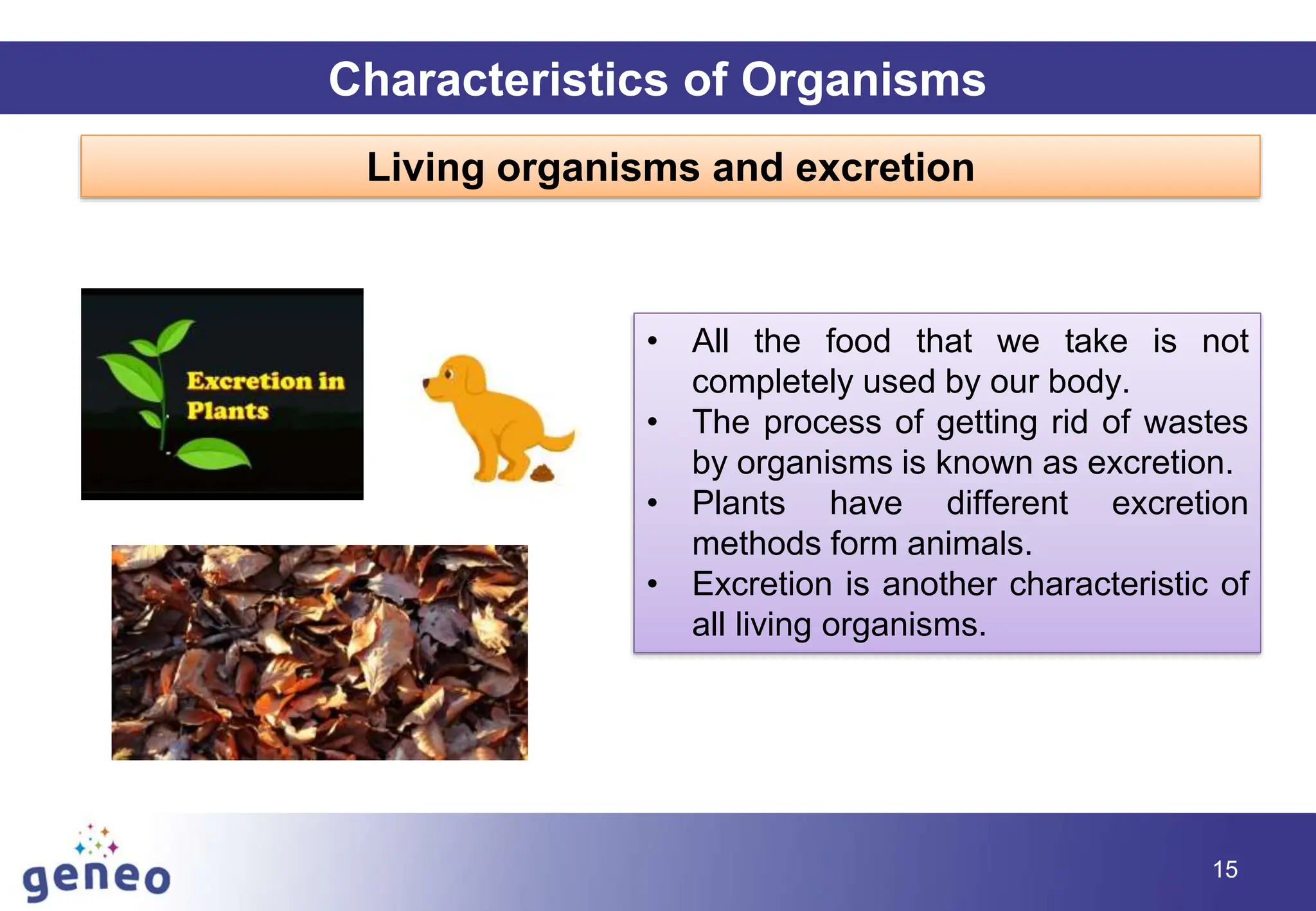
• Place a potted plant in a room a little
away from a window through which
sunlight enters some time during the
day.
• Plants grow towards the direction of
light.
20.
15
Characteristics of Organisms
Livingorganisms and excretion
• All the food that we take is not
completely used by our body.
• The process of getting rid of wastes
by organisms is known as excretion.
• Plants have different excretion
methods form animals.
• Excretion is another characteristic of
all living organisms.
21.
16
Characteristics of Organisms
Doall organisms reproduce their own kind?
• Living things produce more of their
own kind through reproduction.
• Animals reproduce their own kind.
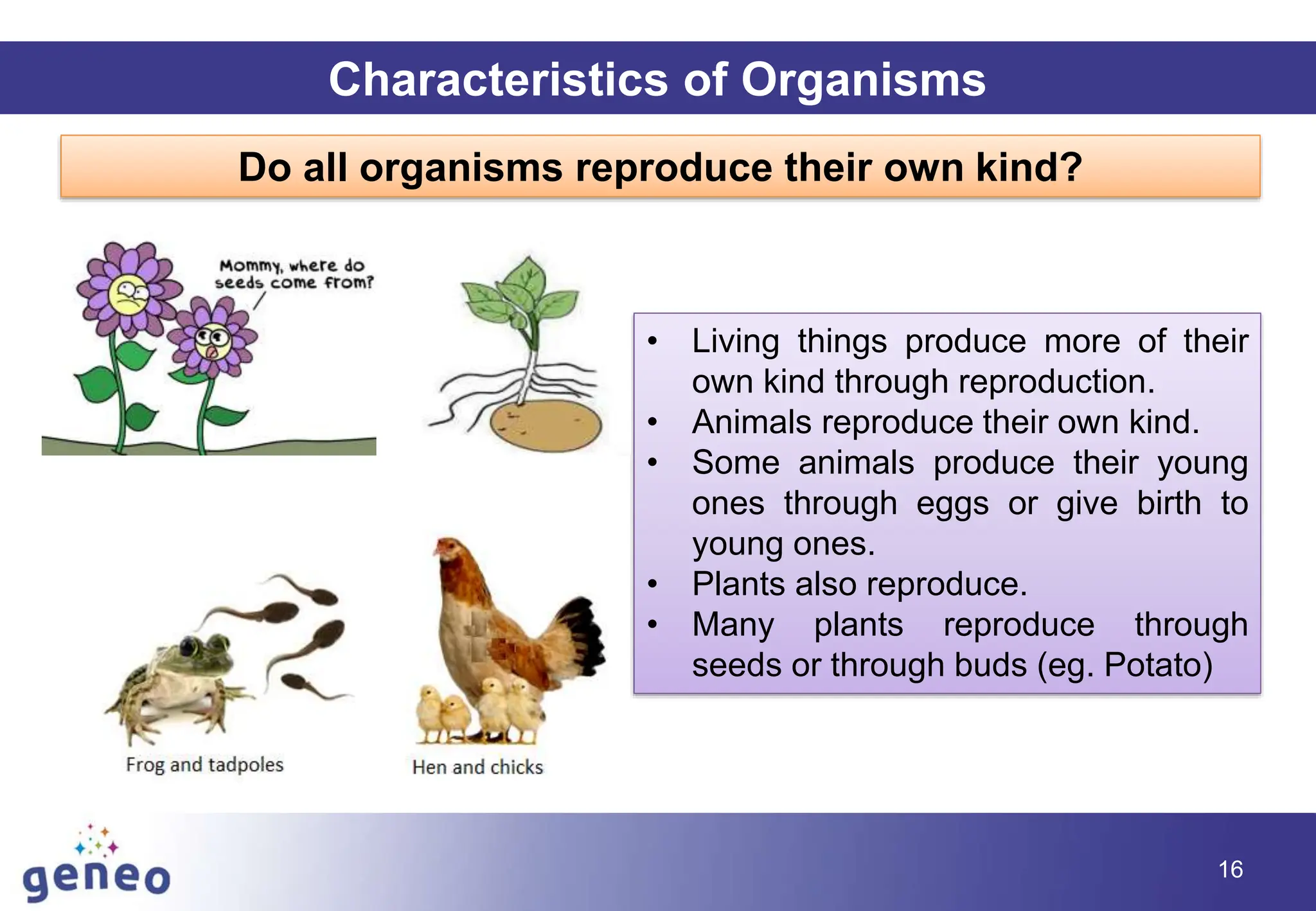
• Some animals produce their young
ones through eggs or give birth to
young ones.
• Plants also reproduce.
• Many plants reproduce through
seeds or through buds (eg. Potato)
22.
17
Characteristics of Organisms
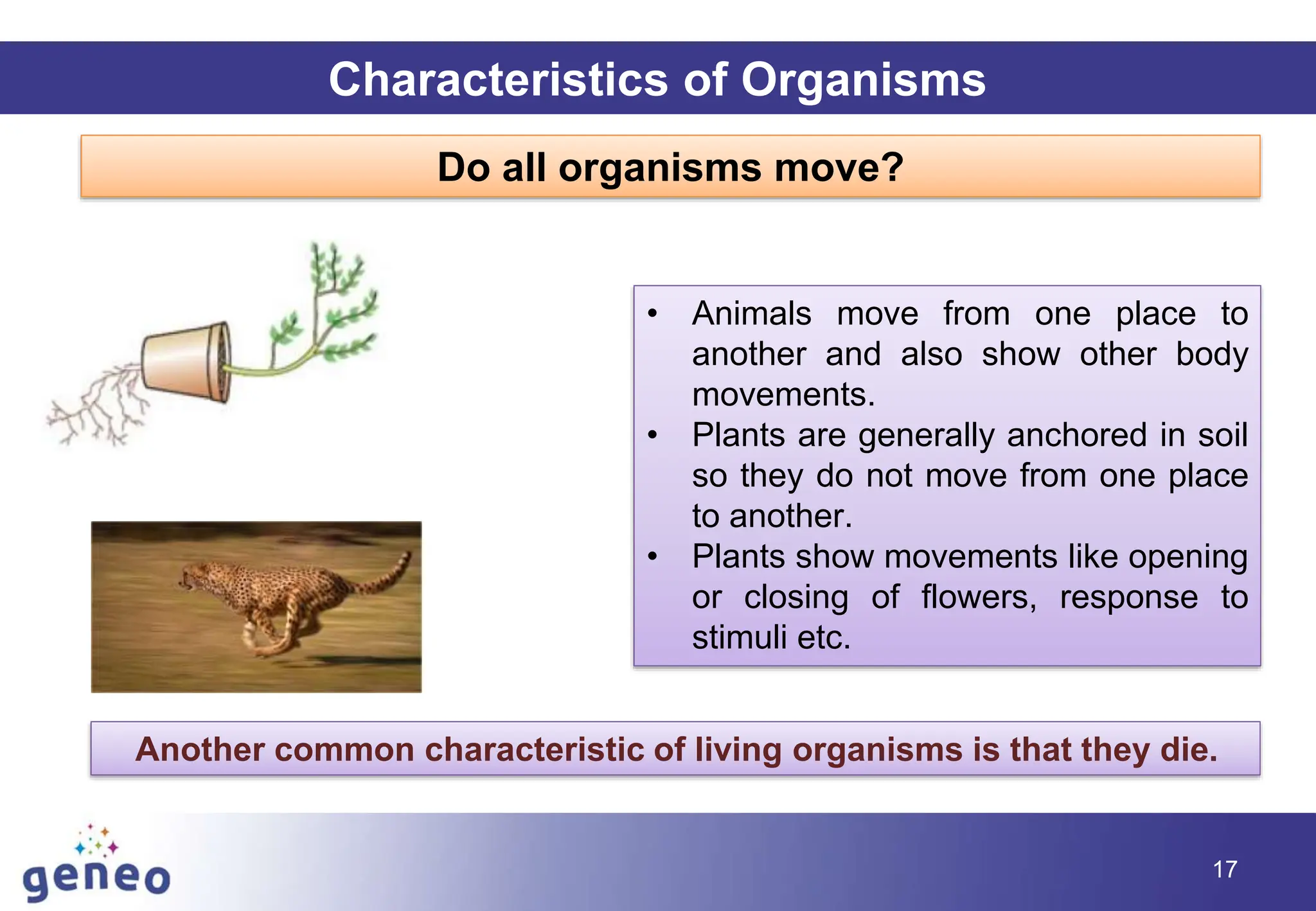
Doall organisms move?
• Animals move from one place to
another and also show other body
movements.
• Plants are generally anchored in soil
so they do not move from one place
to another.
• Plants show movements like opening
or closing of flowers, response to
stimuli etc.
Another common characteristic of living organisms is that they die.
23.
18
Characteristics of Organisms
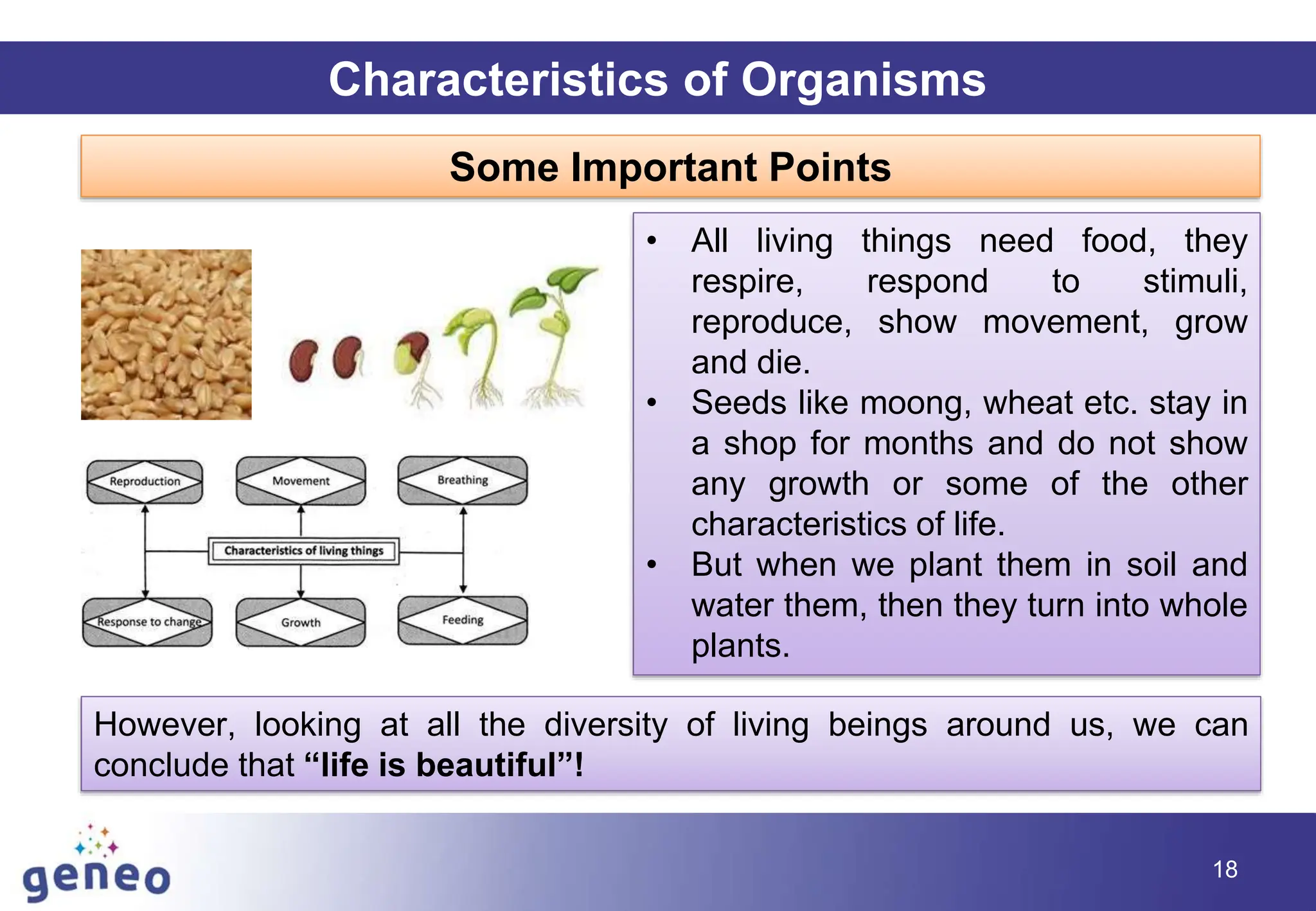
SomeImportant Points
• All living things need food, they
respire, respond to stimuli,
reproduce, show movement, grow
and die.
• Seeds like moong, wheat etc. stay in
a shop for months and do not show
any growth or some of the other
characteristics of life.
• But when we plant them in soil and
water them, then they turn into whole
plants.
However, looking at all the diversity of living beings around us, we can
conclude that “life is beautiful”!
Practice Problem
Q. Whichone of the following is not a characteristic of living organisms?
a. Growth
a. Reproduction
a. Response To Stimulus
a. Vibration
27.
Practice Problem
Q. Changesin our surroundings that make us respond to them, are called
a. Reproduction
a. Growth
a. Response To Stimulus
a. Death
Practice Problem
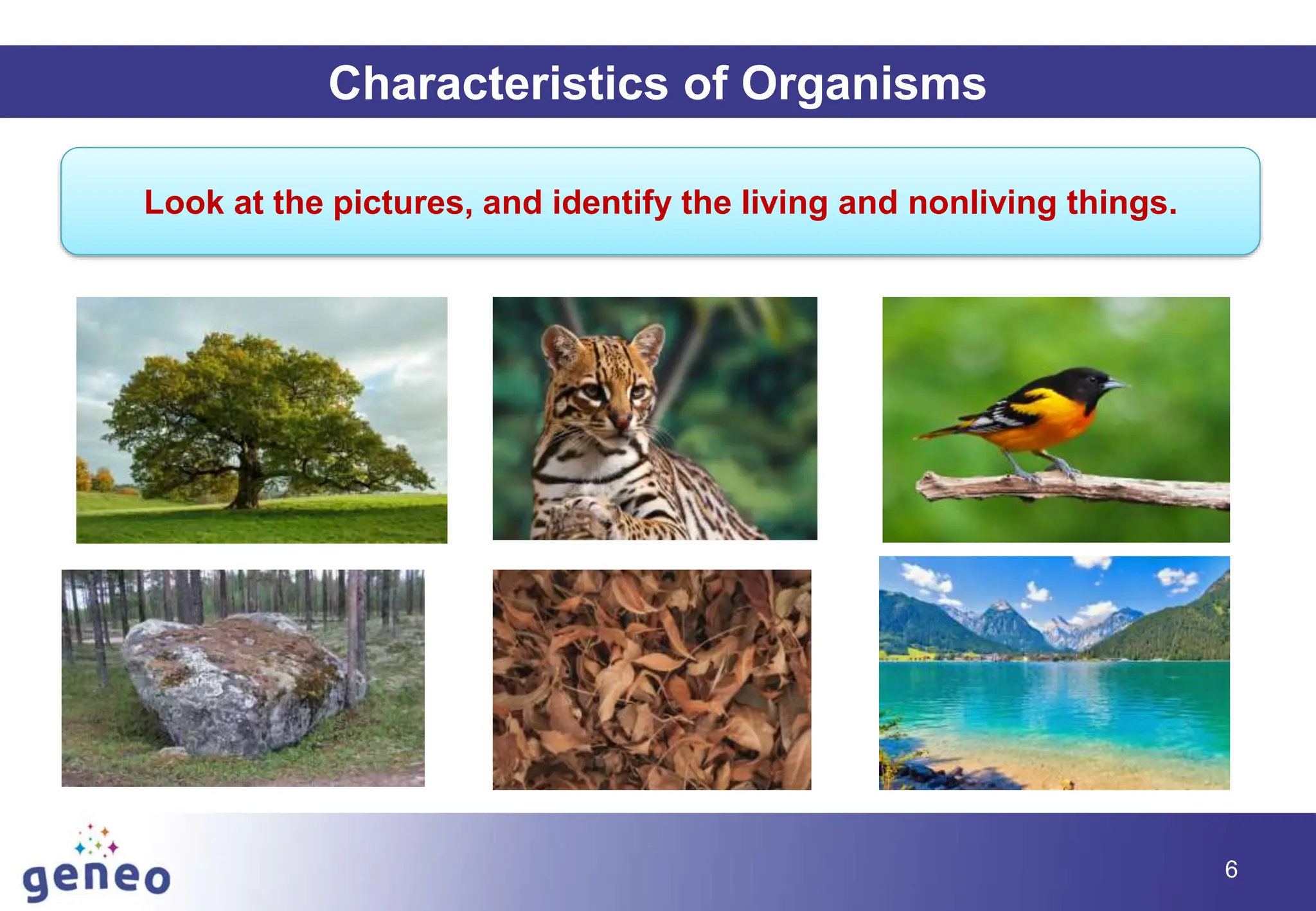
Q. Whichone of the following is a non iving part of the habitat ?
a. Microorganisms
a. Human
a. Dry Leaves
a. Trees
30.
LEARN
SESSION
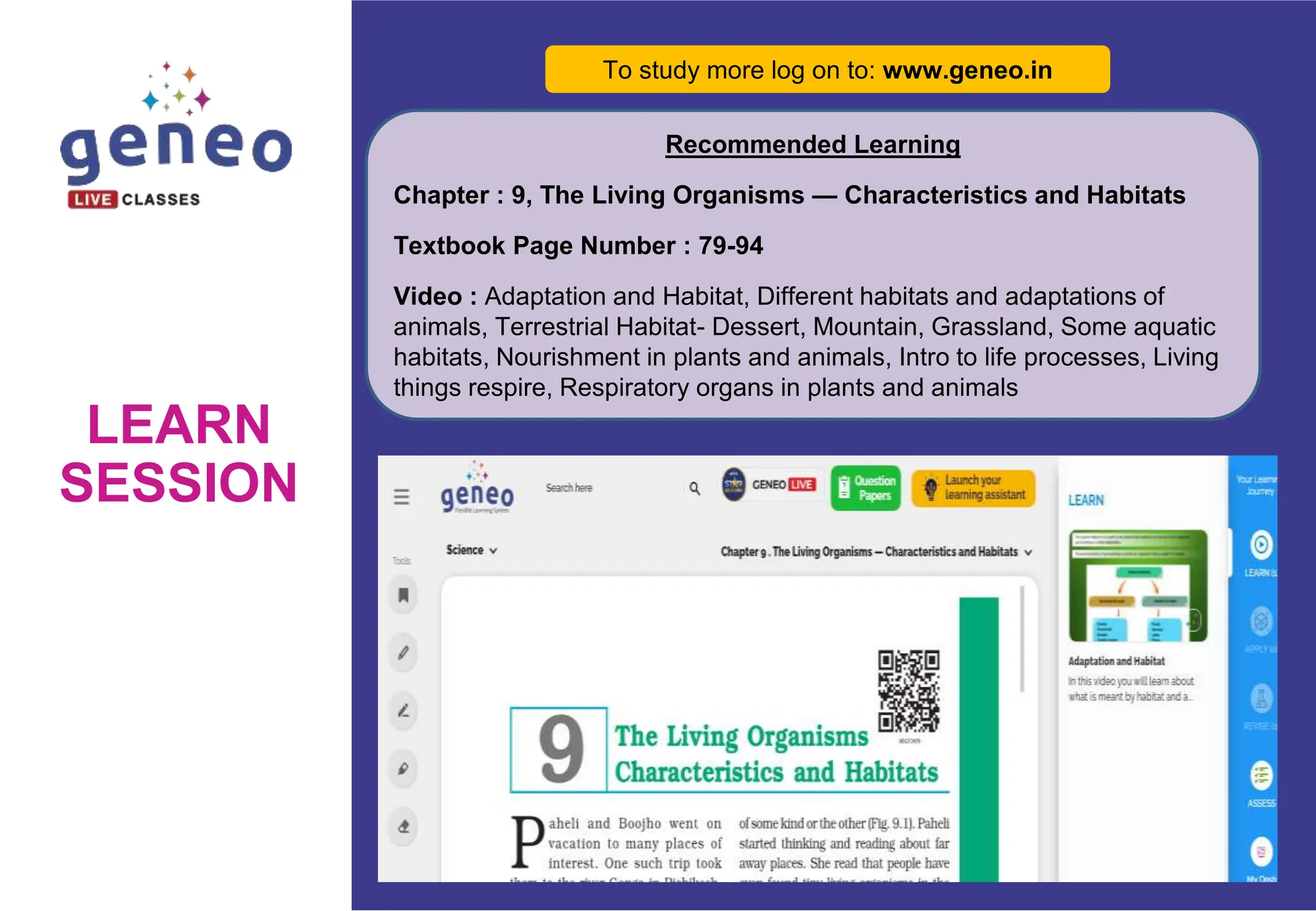
To study morelog on to: www.geneo.in
Recommended Learning
Chapter : 9, The Living Organisms — Characteristics and Habitats
Textbook Page Number : 79-94
Video : Adaptation and Habitat, Different habitats and adaptations of
animals, Terrestrial Habitat- Dessert, Mountain, Grassland, Some aquatic
habitats, Nourishment in plants and animals, Intro to life processes, Living
things respire, Respiratory organs in plants and animals
31.
LEARN
SESSION
Geneo LIVE ClassesSchedule
Class VII
Subject Chapter Time
19-10-2022
Mathematics Decimals-2 06:00 PM
20-10-2022
History What Books ad Burials Tell Us-2 06:00 PM
To study more log on to:
www.geneo.in