A LITERATE ENVIRONMENT ANALYSIS By Sandra  Verney Walden University Dr. Lori Duncan The Beginning Reader, Pre-K-3 EDUC 6706-R-7
GETTING TO KNOW LITERACY LEARNERS, P-3 Analysis By using the following assessments I can gain a better insight into what “makes my kids tick”: Elementary Reading Attitude Survey (ERAS); and State mandated assessment, the Texas Primary Reading Inventory (TPRI)
GETTING TO KNOW LITERACY LEARNERS, P-3 (Cont’d.) Research As we learned from Dr. Donald Bear, the four essential parts to the assessment process are:  observation, documentation, interpretation, and evaluation and planning.  He quoted Korchok who said, “A child is a butterfly over the seething whirlpool of life.  How can we give it steadiness without weighing down its flight?” (Laureate Education, Inc. (Executive Producer). (2010e). Assessing word knowledge. [Webcast]. Baltimore, MD: Bear, Donald).
SELECTING TEXTS Analysis By selecting books that provide rhyming, wonderful pictures, some good information in a fun and informative story, that engage my kids and match their literacy skills, will allow for in-depth discussions with my kids.
SELECTING TEXTS (Con’t.d) Research When we provide a variety of text choices, we are teaching our students about the importance of reading (Duke, N. (2004). The case for informational text. Education Leadership, 61(6), 40-44). Research has stated that students need knowledge in an assortment of text in order to be successful (Stephens, 2008).
LITERACY LESSON:  INTERACTIVE PERSPECTIVE Analysis My goal, as a teacher, is to provide my kids with a deep understanding of what they are reading by providing them the ability to infer, analyze, apply, and evaluate any and all types of texts.
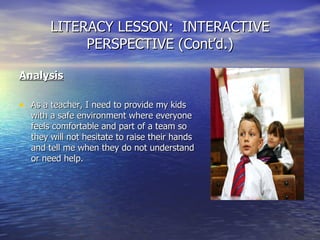
LITERACY LESSON:  INTERACTIVE PERSPECTIVE (Cont’d.) Analysis As a teacher, I need to provide my kids with a safe environment where everyone feels comfortable and part of a team so they will not hesitate to raise their hands and tell me when they do not understand or need help.
LITERACY LESSON:  INTERACTIVE PERSPECTIVE (Cont’d.) Research By setting a purpose for using strategies we can help students to become self-regulators so that they can explore the world of reading more independently (Laureate Education, Inc. (Executive Producer). (2010a). Interactive Perspective: Strategic processing. [Webcast]. The Beginning Reader, PreK-3. Baltimore, MD: Almasi, J.).
LITERACY LESSON:  CRITICAL AND RESPONSE PERSPECTIVES Analysis To provide  critical perspective  for literacy instruction, which requires judging, evaluating, and thinking critically about a text, students need to: Examine every text from multiple perspectives; Critically evaluate text; and Judge the validity of the text.
LITERACY LESSON:  CRITICAL AND RESPONSE PERSPECTIVES (Cont’d.) Analysis The  response perspective  for literacy instruction involves reading, reacting, and responding to text in a variety of meaningful ways.  Providing texts that engage the students and allows them the opportunities to respond to texts in life changing ways.
LITERACY LESSON:  CRITICAL AND RESPONSE PERSPECTIVES (Cont’d.) Research Using critical literacy helps pull the power away from the author and makes it an equal relationship between the author and the reader by allowing us to see the texts from all angles, not just believing what is written down (Molden, K. (2007). Critical literacy, the right answer for the reading classroom: Strategies to move beyond comprehension for reading improvement. Reading Improvement, 44(1), 50-56).
LITERACY LESSON:  CRITICAL AND RESPONSE PERSPECTIVES (Cont’d.) Research It is not enough to teach students how to read, but they must be taught how to dig deeper and to be critical of the text they are reading (Laureate Education, Inc. (Executive Producer). (2010a). Response Perspective. [Webcast]. The beginning reader: PreK-3. Baltimore, MD: Author).
LITERACY LESSON:  CRITICAL AND RESPONSE PERSPECTIVES (Cont’d.) Research The Response Perspective is a strategy that students use to discover the transformation of text and become engaged lifelong readers (Laureate Education, Inc. (Executive Producer). (2010b). Response Perspective. [Webcast]. The beginning reader: PreK-3. Baltimore, MD: Author).
THOUGHTS OR COMMENTS? Please provide any suggestions, ideas, or feelings about this presentation.
THANK YOU!

Class 6706 a literate environment analysis

  • 1.
    A LITERATE ENVIRONMENTANALYSIS By Sandra Verney Walden University Dr. Lori Duncan The Beginning Reader, Pre-K-3 EDUC 6706-R-7
  • 2.
    GETTING TO KNOWLITERACY LEARNERS, P-3 Analysis By using the following assessments I can gain a better insight into what “makes my kids tick”: Elementary Reading Attitude Survey (ERAS); and State mandated assessment, the Texas Primary Reading Inventory (TPRI)
  • 3.
    GETTING TO KNOWLITERACY LEARNERS, P-3 (Cont’d.) Research As we learned from Dr. Donald Bear, the four essential parts to the assessment process are: observation, documentation, interpretation, and evaluation and planning. He quoted Korchok who said, “A child is a butterfly over the seething whirlpool of life. How can we give it steadiness without weighing down its flight?” (Laureate Education, Inc. (Executive Producer). (2010e). Assessing word knowledge. [Webcast]. Baltimore, MD: Bear, Donald).
  • 4.
    SELECTING TEXTS AnalysisBy selecting books that provide rhyming, wonderful pictures, some good information in a fun and informative story, that engage my kids and match their literacy skills, will allow for in-depth discussions with my kids.
  • 5.
    SELECTING TEXTS (Con’t.d)Research When we provide a variety of text choices, we are teaching our students about the importance of reading (Duke, N. (2004). The case for informational text. Education Leadership, 61(6), 40-44). Research has stated that students need knowledge in an assortment of text in order to be successful (Stephens, 2008).
  • 6.
    LITERACY LESSON: INTERACTIVE PERSPECTIVE Analysis My goal, as a teacher, is to provide my kids with a deep understanding of what they are reading by providing them the ability to infer, analyze, apply, and evaluate any and all types of texts.
  • 7.
    LITERACY LESSON: INTERACTIVE PERSPECTIVE (Cont’d.) Analysis As a teacher, I need to provide my kids with a safe environment where everyone feels comfortable and part of a team so they will not hesitate to raise their hands and tell me when they do not understand or need help.
  • 8.
    LITERACY LESSON: INTERACTIVE PERSPECTIVE (Cont’d.) Research By setting a purpose for using strategies we can help students to become self-regulators so that they can explore the world of reading more independently (Laureate Education, Inc. (Executive Producer). (2010a). Interactive Perspective: Strategic processing. [Webcast]. The Beginning Reader, PreK-3. Baltimore, MD: Almasi, J.).
  • 9.
    LITERACY LESSON: CRITICAL AND RESPONSE PERSPECTIVES Analysis To provide critical perspective for literacy instruction, which requires judging, evaluating, and thinking critically about a text, students need to: Examine every text from multiple perspectives; Critically evaluate text; and Judge the validity of the text.
  • 10.
    LITERACY LESSON: CRITICAL AND RESPONSE PERSPECTIVES (Cont’d.) Analysis The response perspective for literacy instruction involves reading, reacting, and responding to text in a variety of meaningful ways. Providing texts that engage the students and allows them the opportunities to respond to texts in life changing ways.
  • 11.
    LITERACY LESSON: CRITICAL AND RESPONSE PERSPECTIVES (Cont’d.) Research Using critical literacy helps pull the power away from the author and makes it an equal relationship between the author and the reader by allowing us to see the texts from all angles, not just believing what is written down (Molden, K. (2007). Critical literacy, the right answer for the reading classroom: Strategies to move beyond comprehension for reading improvement. Reading Improvement, 44(1), 50-56).
  • 12.
    LITERACY LESSON: CRITICAL AND RESPONSE PERSPECTIVES (Cont’d.) Research It is not enough to teach students how to read, but they must be taught how to dig deeper and to be critical of the text they are reading (Laureate Education, Inc. (Executive Producer). (2010a). Response Perspective. [Webcast]. The beginning reader: PreK-3. Baltimore, MD: Author).
  • 13.
    LITERACY LESSON: CRITICAL AND RESPONSE PERSPECTIVES (Cont’d.) Research The Response Perspective is a strategy that students use to discover the transformation of text and become engaged lifelong readers (Laureate Education, Inc. (Executive Producer). (2010b). Response Perspective. [Webcast]. The beginning reader: PreK-3. Baltimore, MD: Author).
  • 14.
    THOUGHTS OR COMMENTS?Please provide any suggestions, ideas, or feelings about this presentation.
  • 15.