Class 21
EWRT 1B
AGENDA
 Terms test 1-3 (You may take one)
 Terms for exam 4
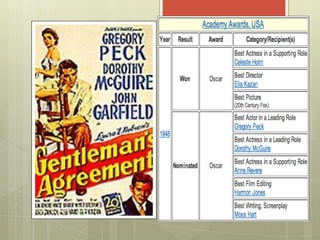
 Discussion: Gentleman’s Agreement
 Grades
Terms’ Exam
 You   have 20 minutes to take your exam.
Terms:
17. Scenario: an outline of the plot of a dramatic work,
which provides particulars about characters, settings,
and situation. The term is most often used for the
detailed script of a film or a treatment setting forth the
action in the sequence it is to follow with detailed
descriptions of scenes and characters, and actual
works. Sometimes the plot of a film or television show is
loosely called a scenario.

18. Simile: a figure of speech in which two things,
19. Style: a manner of putting thoughts into words or the
characteristic mode of construction and expression in
writing and speaking. The term is also used for the
characteristics of a literary selection that concern the
form of expression rather than the thought conveyed.
Style is usually defined by the writer’s choice of words,
figures of speech, devices, and the shaping of the
sentences and paragraphs. Sometimes, styles are
classified according to time period or individual writers.

20. Theme : the central and dominating idea in a literary
work. A theme may also be a short essay such as a
composition. In addition, the term means a message or
moral implicit in any work of art.
In this movie, the main
character both reverse
passes and refuses to
pass. How is this possible?
How does his behavior
affect his identity, his
family, and his intimate
relationship?
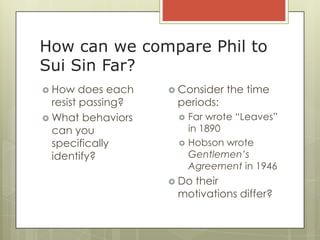
How can we compare Phil to
Sui Sin Far?
 How    does each    Consider   the time
  resist passing?     periods:
 What behaviors         Far wrote “Leaves”
  can you                 in 1890
  specifically           Hobson wrote
  identify?               Gentlemen’s
                          Agreement in 1946
                      Do
                        their
                      motivations differ?
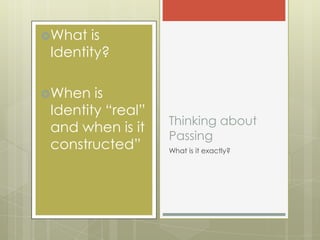
What  is
 Identity?

When   is
 Identity “real”
                   Thinking about
 and when is it
                   Passing
 constructed”      What is it exactly?
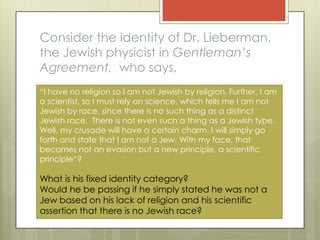
Consider the identity of Dr. Lieberman,
the Jewish physicist in Gentleman’s
Agreement, who says,
“I have no religion so I am not Jewish by religion. Further, I am
a scientist, so I must rely on science, which tells me I am not
Jewish by race, since there is no such thing as a distinct
Jewish race. There is not even such a thing as a Jewish type.
Well, my crusade will have a certain charm. I will simply go
forth and state that I am not a Jew. With my face, that
becomes not an evasion but a new principle, a scientific
principle“?

What is his fixed identity category?
Would he be passing if he simply stated he was not a
Jew based on his lack of religion and his scientific
assertion that there is no Jewish race?
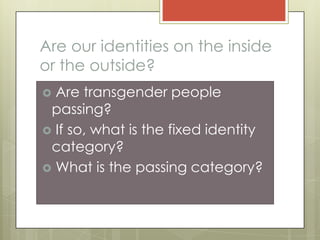
Are our identities on the inside
or the outside?
 Are transgender people
 passing?
 If so, what is the fixed identity
 category?
 What is the passing category?
Can a bio male or female
person have the identity of
“trans” without being called
a passer?
How, then, can we parallel this trans identity and
trans passing scenario to racial identity and racial
passing?


   Is a person who looks white but is of African
   American lineage, also “trans”? When can
   this person be “white” without being called
   a passer? OR should he or she identify as
   trans (racial)?
Is Race “Real” or Constructed?
• If race is constructed, is Jack
  passing?

• Is Coleman Silk?

• Can Sui Sin Far refuse to pass if
  race is constructed?
Disruption or Stabilization?

 Doesthis ability to identify as trans (sexual,
 gender, racial, ethnic)and pass or not
 pass disrupt identity categories? How?
Talking about Grades
Groan……
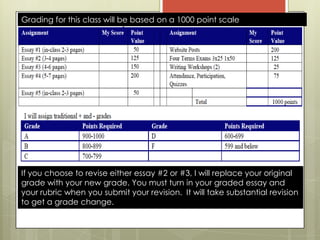
Grading for this class will be based on a 1000 point scale


If you choose to revise either essay #2 or #3, I will replace your original
grade with your new grade. You must turn in your graded essay and
your rubric when you submit your revision. It will take substantial revision
to get a grade change.
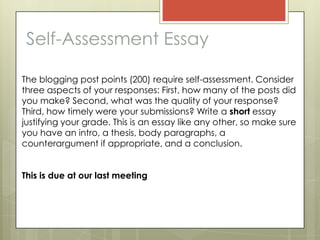
Self-Assessment Essay

The blogging post points (200) require self-assessment. Consider
three aspects of your responses: First, how many of the posts did
you make? Second, what was the quality of your response?
Third, how timely were your submissions? Write a short essay
justifying your grade. This is an essay like any other, so make sure
you have an intro, a thesis, body paragraphs, a
counterargument if appropriate, and a conclusion.


This is due at our last meeting
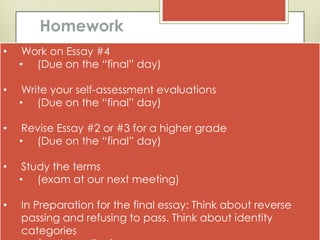
Homework
•    Work on Essay #4
    • (Due on the “final” day)

•    Write your self-assessment evaluations
    • (Due on the “final” day)

•    Revise Essay #2 or #3 for a higher grade
    • (Due on the “final” day)

•    Study the terms
    • (exam at our next meeting)

•   In Preparation for the final essay: Think about reverse
    passing and refusing to pass. Think about identity
    categories

Class 21 1 b

  • 1.
  • 2.
    AGENDA  Terms test1-3 (You may take one)  Terms for exam 4  Discussion: Gentleman’s Agreement  Grades
  • 3.
    Terms’ Exam  You have 20 minutes to take your exam.
  • 4.
    Terms: 17. Scenario: anoutline of the plot of a dramatic work, which provides particulars about characters, settings, and situation. The term is most often used for the detailed script of a film or a treatment setting forth the action in the sequence it is to follow with detailed descriptions of scenes and characters, and actual works. Sometimes the plot of a film or television show is loosely called a scenario.
 18. Simile: a figure of speech in which two things,
  • 5.
    19. Style: amanner of putting thoughts into words or the characteristic mode of construction and expression in writing and speaking. The term is also used for the characteristics of a literary selection that concern the form of expression rather than the thought conveyed. Style is usually defined by the writer’s choice of words, figures of speech, devices, and the shaping of the sentences and paragraphs. Sometimes, styles are classified according to time period or individual writers.
 20. Theme : the central and dominating idea in a literary work. A theme may also be a short essay such as a composition. In addition, the term means a message or moral implicit in any work of art.
  • 7.
    In this movie,the main character both reverse passes and refuses to pass. How is this possible?
  • 8.
    How does hisbehavior affect his identity, his family, and his intimate relationship?
  • 9.
    How can wecompare Phil to Sui Sin Far?  How does each  Consider the time resist passing? periods:  What behaviors  Far wrote “Leaves” can you in 1890 specifically  Hobson wrote identify? Gentlemen’s Agreement in 1946  Do their motivations differ?
  • 10.
    What is Identity? When is Identity “real” Thinking about and when is it Passing constructed” What is it exactly?
  • 11.
    Consider the identityof Dr. Lieberman, the Jewish physicist in Gentleman’s Agreement, who says, “I have no religion so I am not Jewish by religion. Further, I am a scientist, so I must rely on science, which tells me I am not Jewish by race, since there is no such thing as a distinct Jewish race. There is not even such a thing as a Jewish type. Well, my crusade will have a certain charm. I will simply go forth and state that I am not a Jew. With my face, that becomes not an evasion but a new principle, a scientific principle“? What is his fixed identity category? Would he be passing if he simply stated he was not a Jew based on his lack of religion and his scientific assertion that there is no Jewish race?
  • 12.
    Are our identitieson the inside or the outside?  Are transgender people passing?  If so, what is the fixed identity category?  What is the passing category?
  • 13.
    Can a biomale or female person have the identity of “trans” without being called a passer?
  • 14.
    How, then, canwe parallel this trans identity and trans passing scenario to racial identity and racial passing? Is a person who looks white but is of African American lineage, also “trans”? When can this person be “white” without being called a passer? OR should he or she identify as trans (racial)?
  • 15.
    Is Race “Real”or Constructed? • If race is constructed, is Jack passing? • Is Coleman Silk? • Can Sui Sin Far refuse to pass if race is constructed?
  • 16.
    Disruption or Stabilization? Doesthis ability to identify as trans (sexual, gender, racial, ethnic)and pass or not pass disrupt identity categories? How?
  • 17.
  • 18.
    Grading for thisclass will be based on a 1000 point scale If you choose to revise either essay #2 or #3, I will replace your original grade with your new grade. You must turn in your graded essay and your rubric when you submit your revision. It will take substantial revision to get a grade change.
  • 19.
    Self-Assessment Essay The bloggingpost points (200) require self-assessment. Consider three aspects of your responses: First, how many of the posts did you make? Second, what was the quality of your response? Third, how timely were your submissions? Write a short essay justifying your grade. This is an essay like any other, so make sure you have an intro, a thesis, body paragraphs, a counterargument if appropriate, and a conclusion. This is due at our last meeting
  • 20.
    Homework • Work on Essay #4 • (Due on the “final” day) • Write your self-assessment evaluations • (Due on the “final” day) • Revise Essay #2 or #3 for a higher grade • (Due on the “final” day) • Study the terms • (exam at our next meeting) • In Preparation for the final essay: Think about reverse passing and refusing to pass. Think about identity categories