GREEN PAPER
Unlocking
Housing
Wealth
– options to meet
retirement needs
Unlocking Housing Wealth – options to meet retirement needs • Actuaries Institute GREEN Paper – March 2016
About the Actuaries Institute
The Actuaries Institute is the sole professional body
for Actuaries in Australia. The Institute provides expert
comment on public policy issues where there is
uncertainty of future financial outcomes.
Actuaries have a reputation for a high level of technical
financial expertise and integrity. They apply their risk
management expertise to allocate capital efficiently,
identify and mitigate emerging risks and to help
maintain system integrity across multiple segments of
the financial and other sectors. This unrivalled expertise
enables the profession to comment on a wide range of
issues including retirement income policy, enterprise risk
management and prudential regulation, finance and
investment, general insurance, life insurance, health
financing and data analytics.
This White Paper was written by the Actuaries Institute’s
Housing Working Group, convened by Catherine Nance,
PwC.
This report is provisional for discussion purposes only, and
does not constitute consulting advice on which to base
decisions. No liability to any party will be accepted for
the consequence of relying on its contents.
© Institute of Actuaries of Australia 2016
All rights reserved
Photography: Shutterstock.com
1Unlocking Housing Wealth – options to meet retirement needs • Actuaries Institute GREEN Paper – March 2016
Contents
Executive Summary	 3
1	 Reform options for discussion	 4
2	background	 6
3	 Needs in retirement	 8
4	 Attitudes to accessing housing wealth	 10
5	Principles	 11
6	 Reform options	 13
Appendix A
Issues table	 19
Appendix B
International comparisons – Canada, UK, US	 21
Appendix C
Consumer protection and regulatory framework	 22
2Unlocking Housing Wealth – options to meet retirement needs • Actuaries Institute GREEN Paper – March 2016
This paper aims to continue
the discussion commenced
by our earlier research on
longevity risk and raise
policy options that could help
mitigate that risk and improve
retirees’ living standards.
3Unlocking Housing Wealth – options to meet retirement needs • Actuaries Institute GREEN Paper – March 2016
T
he Actuaries Institute has produced several papers in recent
years investigating the potential impact of Australia’s changing
demographics on the financing of retirement incomes, aged health
care and related issues of intergenerational equity. A common
finding of our research is that for current retirees the family home is not
only a place to live, but also a store of considerable, though relatively
untapped, wealth.
The Productivity Commission has stated, “Most older Australian home
owners on low incomes could achieve a modest retirement living standard
over the remainder of their lives by drawing on their home equity”1
.
This paper continues the discussion commenced by our earlier research
on longevity risk and raises policy options that could help mitigate that risk
and improve retirees’ living standards. It quantifies the value of Australian
retirees’ housing wealth; identifies the costs associated with retirees’
accommodation, aged care and health care needs; and, proposes policy
options that would facilitate the release of part or all of the equity stored in
family homes, for those who choose to do so, to defray ageing costs and
enhance retirees’ living standards.
Like superannuation, housing wealth enjoys significant tax and other
concessions (e.g. tax free capital gains on sale and exemption from the
means test for access to the age pension). However, given the public and
private costs attached to an ageing population, retirees, who wish to enjoy
at least a modest lifestyle, should be encouraged to consider a range of
methods to access part or all of their stored housing wealth if they want
increased income to cover their personal expenditure, accommodation
and aged care needs.
Although this paper focuses on the benefits for current retirees accessing
their housing wealth, it is recognised that retirees may choose not to do
so. They may have their own personal reasons for electing to live a more
modest lifestyle and self-insure against longevity risk. Next generation
retirees are expected to build their wealth through longer exposure to the
superannuation system over their working lives.
This paper is not primarily concerned with reducing government
expenditure on age related services though that is likely to be an outcome.
The proposed policy changes aim to remove the biases that constrain older
Australians from accessing part or all of their housing wealth, if and when
they require it, to improve their standard of living in retirement.
Executive Summary
1
	 Housing Decisions of Older
Australians Productivity
Commission Research Paper
2015
For current retirees
the family home is
not only a place to
live, but also a store
of considerable,
though relatively
untapped, wealth.
4Unlocking Housing Wealth – options to meet retirement needs • Actuaries Institute GREEN Paper – March 2016
Policy reform options to improve access to home equity are listed below
and contained in Appendix A.
Options for facilitating increased access to home equity wealth include:
	 Age Pension
	 Partial protection (up to a cap) from the Age Pension Means
Test for amounts released under home equity release schemes
or downsizing.
	 Private equity release schemes – regulation and
consumer protection
	 Government should consider reviewing the regulation/
legislation relating to all equity release schemes and develop a
principles based approach to regulation which ensures security
of tenure, applies to all types of schemes and providers, and
facilitates standard and simpler disclosures.
	 Home equity release schemes (such as shared equity schemes)
are complicated due to the fact that property law in Australia
is State based. The solution would be for all regulation for home
equity release schemes to be at the Commonwealth level;
however, we recognise the difficulties achieving this.
	 The complexity of these schemes necessitates advisors and
distributors to be highly trained. The Government should
consider the level of independent financial advice required
by the retiree, and the licensing requirements for third party
distributors and advisors.
	 Financial abuse of older Australians
	 Regulatory protective measures need to be established to
guard against the risk of financial abuse of older Australians
given the significant quantum of their housing wealth and
potential vulnerability due to diminished cognitive facilities.
	Downsizing
	 Where home downsizing is viable, some form of stamp duty
relief could be applied to retirees’ property transactions to
reduce friction costs.
	 Review bank lending rules and practices to reduce any friction
from downsizing transactions especially in relation to the
availability of bridging finance.
Reform options for discussion
Government should
consider reviewing
the regulation/
legislation relating
to all equity release
schemes in order to
develop a principles
based approach to
regulation which
ensures security of
tenure, applies to
all types of schemes
and providers, and
facilitates standard
and simpler
disclosures.
1
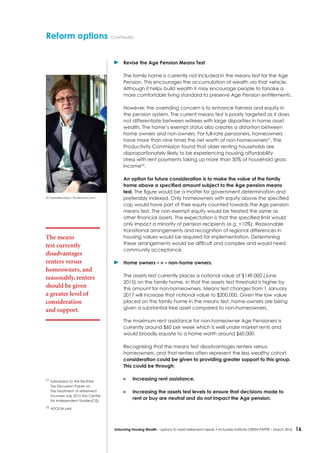
© Nils Versemann / Shutterstock.com
5Unlocking Housing Wealth – options to meet retirement needs • Actuaries Institute GREEN Paper – March 2016
	 Home owners v non – home owners
	 Revise the Age Pension means test for home owners – v – non-
home owners to improve fairness in the system
	 Introduce a $ cap for the exempt family home under the
Age Pension Means Test. This is a fairness measure and aimed
at a relatively small proportion of ‘asset rich’ retirees who
currently receive a full or part-pension. Reasonable transitional
arrangements and recognition of regional differences in
housing values would be required for implementation.
	 Government measures
	 Government could consider a range of measures to facilitate
access to home equity release including financial literacy
measures, measures to encourage supply of schemes by
private providers and if necessary, the supply of schemes by
Government such as extension of the current Pensions Loan
Scheme.
Reform options for discussion continued
6Unlocking Housing Wealth – options to meet retirement needs • Actuaries Institute GREEN Paper – March 2016
Australia’s retirement incomes system today is primarily based on:
	 A publicly funded, means tested age pension
	 Superannuation, both compulsory and voluntary; and
	 Savings outside the superannuation system.
For many Australians, particularly those who commenced work before
superannuation became mainstream, their main form of lifetime savings
is their home. This form of savings is also consistent with existing policies
exempting capital gains tax and age pension means testing. Despite this,
housing wealth has not often been considered in the context of retirement
funding. However, the significant increases in the value of housing and the
economics of financing an ageing population have drawn the attention of
policymakers. Housing wealth has some unique features and it is important
that these be taken into account in policy formation.
For a retiree, savings held in the form of the ‘family home’ provide both:
	 A place to live, with security of tenure. This security of tenure is a major
advantage of home ownership over renting, regardless of financial
considerations; and
	 A store of wealth.
For those who could benefit from tapping into this wealth there are
complex reasons which constrain or discourage access, including:
a)	 Public policy settings, in particular:
	 the family home exemption from the age pension means test;
	 the Capital Gains Tax free status of the family home.
b)	 The difficulties in accessing housing wealth to fund retirement combined
with a natural aversion to debt in retirement. Owner-occupied
residential property is a unique asset in that it is both a home and an
illiquid and concentrated store of value.
c)	 A strong emotional attachment to the family home, community
and family networks, can impact retirees’ thinking beyond financial
considerations.
d)	 Decline in cognitive capacity or willingness to undertake major financial
transactions
Background
Housing wealth
has some unique
features and it is
important that
these be taken into
account in policy
formation.
2
7Unlocking Housing Wealth – options to meet retirement needs • Actuaries Institute GREEN Paper – March 2016
Background continued
Housing Wealth is Significant
Around 85% of older Australians own their own homes2
and for many senior
homeowners their home is the single largest source of wealth with the age
pension being their only source of income. The total value of Australians’
residential property is estimated to be $5.76 trillion3
. The share owned by
older Australians is estimated to be $926 billion4
.
The Actuaries Institute Retirement Income White Paper5
revealed that
currently, 60 year old couples of median wealth have a significant
proportion of their wealth (49%) in home equity. For those in the 25th wealth
percentile that share of home equity of the couple’s total wealth is even
higher (66%)
A key finding of the analysis is that older cohorts are projected to retire
with a higher proportion of assets in home equity. These cohorts have
experienced a doubling of the real value of their home equity over the
last twenty years. Compared with almost $1 trillion of unencumbered
retiree housing wealth at end 2014 the size of reverse mortgage debt was
$3.7bn6
, there is clearly potential for housing wealth to play a greater role in
retirement funding.
2
	 PC HDOOA Fig 3.15 p 62
3
	 ABS key Figures: June 2015
4
	 PC HDOOA p25
5
	AIRIWP) For Richer, For
Poorer, (August 2015)
6
	 Deloitte: 2015 Reverse
Mortgage Survey
8Unlocking Housing Wealth – options to meet retirement needs • Actuaries Institute GREEN Paper – March 2016
Individuals have various needs in retirement including the costs associated
with aged accommodation and care, health care and other personal
expenditure. Superannuation and voluntary savings may not be able to
provide adequate retirement resources to meet all these needs for most
people, in particular for the current generation approaching retirement
that has not had the opportunity to accumulate sufficient superannuation
savings.
The age pension will supplement their retirement resources, but it will not
be enough for many people. The OECD (2015) estimates Australians over
65 have the second highest income poverty rate after Korea of all OECD
countries. In short our retirees are asset rich but income poor7
. As a result,
accessing part or all of their housing wealth will assist many individuals to
meet their retirement needs, which could include:
	 Personal expenditure – in September 2015, ASFA found that couples
aged around 65 wanting to live a comfortable retirement would need
to spend around $58,915 p.a., while singles would need to spend
around $42,962 p.a.8
The Actuaries Institute Retirement Income White
Paper (RIWP) For Richer, For Poorer, showed that couples in the median
household wealth cohort would not be able to fund a ‘comfortable’
retirement to life expectancy without being supplemented by the
age pension. Lower wealth cohorts would not be able to sustain a
‘comfortable’ retirement even with the Age Pension. This is particularly
true for older cohorts.
	 Accommodation – There is a high level of home ownership amongst
older retirees with around 85% owning their own homes (82% mortgage
free)9
. Although the home provides accommodation for retirees, a
significant proportion of senior Australians’ wealth is tied up in their
homes. It is estimated that housing wealth is around 55% of total
wealth for those aged 75 and over10
. For non-home owners, the cost of
accommodation can increase retirement expenditure for low income
couples by up to 30%11
. This adds further strain on retirement resources
for non-home owners.
Needs in retirement
7
	 Pensions at a glance 2015:
OECD & G20 indicators 2015
8
	 ASFA retirement standard
September 2015 for
homeowners aged 65-85
9
	 PC HDOOA Fig 3.16 p63
10
	PC HDOOA Fig 3.28 p77
11
	For Richer, For Poorer –
Retirement Incomes Actuaries
Institute White Paper August
2015 p7
The OECD (2015)
estimates Australians
over 65 have the
second highest
income poverty rate
after Korea of all
OECD countries.
In short our retirees
are asset rich but
income poor.
3
9Unlocking Housing Wealth – options to meet retirement needs • Actuaries Institute GREEN Paper – March 2016
Needs in retirement continued
	 Aged care – aged care is another potential need at later stages of life.
Research by The Centre for Excellence in Population Ageing Research
(CEPAR) on aged care in Australia in 201412
shows that half of men and
two thirds of women aged 65 will need some form of formal aged care
in their remaining lifetime.
	 The cost of aged care can be very expensive. There are two types
of care available, home care and residential care, depending on
individual circumstances and needs. The fees that people pay to
receive a means tested Home Care package range from $3,587 p.a.
to $13,587 p.a. for home care and from $17,424 p.a. to $112,000 p.a. for
residential care as at September 201513
. The Living Longer Living Better
aged care reform package puts greater emphasis on ‘user pays’ with
Government only providing a safety net. It means that there is a greater
need for individuals to manage their retirement resources to plan for
their age care costs.
	 Health care – Based on the ASFA Retirement Standard released in
September 2015 the health service cost for a healthy couple aged over
85 on a comfortable lifestyle is $200.95 per week ($10,449 per annum).
However, there can be considerable gap payments involved for some
medical procedures, and the incidence of these procedures increases
with age.
As the cost of aged care and most of the health care costs are likely to
occur at a later stage of life, older Australians need to better manage their
finances to meet those needs. People are starting to plan to use part of
their housing wealth to fund their transition into aged care. Part or all the
remainder of their home equity can also be used to meet other retirement
income needs. However, some people do not see the family home as an
available asset.
12
	Aged care in Australia: Part 1
CEPAR research brief 2014/01
p10
13
	The residential care
costs quoted include
accommodation fees of
$20,000 to $40,000 p.a. which
can also be met from a lump
sum payment typically in the
order of $300,000 to $550,000.
10Unlocking Housing Wealth – options to meet retirement needs • Actuaries Institute GREEN Paper – March 2016
Attitudes to accessing
housing wealth
The emotional connection to the family home makes older Australians less
willing to explore the financial opportunities of accessing housing wealth
to help meet their retirement needs. Some people spend less in early
retirement in order to have more wealth for costs at the later stages of
life. This may result in a lower standard of living during retirement as well as
larger than intended bequests due to an earlier than expected death.
Most older Australians are likely to be the recipients of some form of informal
care provided by families, friends or neighbours14
with much less cost. In
many cases, there is an implied cross-generational contract where housing
wealth is the reward for the provision of ongoing financial and social
support by family members and others. Housing wealth is therefore already
‘indirectly’ used as a part of their retirement resources by many Australians.
Some people want to leave part of their savings as a bequest to family
members and others. Other bequests can be as a result of unintended
bequests or a cross generational contract for service (e.g. informal care) as
mentioned above.
A recent survey conducted by the Productivity Commission15
showed that
76% of homeowners aged 60 and over wanted to see out their retirement
in their current home and 71% saw their home as a financial safety net.
Of these older Australians, 44% called out a bequest motive as their key
priority, only 40% saw their home as a potential retirement asset and 40%
were uncomfortable with the idea of having a mortgage in retirement.
However, retirement needs such as aged care, health care, and adequate
and sustainable incomes in retirement may become more important than
bequests for older Australians in future years. As most bequests are in the
form of the family home, it would be sensible to provide options for the
retirees to easily access part or all of their housing wealth to supplement
other retirement needs if they prefer, while still not imposing impediments for
individuals who want to leave bequests.
People can achieve a better standard of living in retirement if housing
wealth is considered as an integral part of their retirement plan.
76% of homeowners
aged 60 and over
wanted to see out
their retirement in
their current home
and 71% saw their
home as a financial
safety net.
4
14
	Aged care in Australia: Part 1
CEPAR research brief 2014/01
p21
15	
PC HDOOA Fig 11 p14
11Unlocking Housing Wealth – options to meet retirement needs • Actuaries Institute GREEN Paper – March 2016
The Institute proposes certain principles should underpin any policy changes
that provide increased access to home equity.
	Sustainability
	 A long-term policy outlook is required that focuses on both fiscal
affordability over time and providing retirees with reliable, secure and
reasonably adequate resources during all stages of retirement to
cover personal expenditure, accommodation and aged care needs.
However, it does require a shift in the current mindset of retirees (and
their family and advisors) to recognise their house as an asset and not
just a home.
	Flexibility
	 Regulation needs to reflect individuals’ different retirement income
needs and varying capacity to exercise choice. Critically, regulation
should not force people to stay in their homes too long nor leave too
early. Flexibility also requires the removal of impediments to desired
transactions. For example, the Henry Tax Review found that stamp
duty on property transactions discouraged people from changing
their place of residence as their personal circumstances change or
discouraged people from making lifestyle changes that involve a
change in residence.
	Equity
	 The combined cost to the taxpayer of the Age Pension and various tax
concessions (including the family home) and incentives need to be
balanced with intra- and inter-generational equity. Imbalances need
to be resolved so that the wealthy do not receive (pension) benefits
meant for the disadvantaged and distortions between asset classes are
removed – the important measure is the size of the retiree’s total pool of
wealth, not its individual investment components and whether they are
shares, superannuation, bonds or housing.
Principles
Regulation needs to
reflect individuals’
different retirement
income needs and
varying capacity to
exercise choice.
5
12Unlocking Housing Wealth – options to meet retirement needs • Actuaries Institute GREEN Paper – March 2016
	 Efficiency
	 Public expenditure should aim to efficiently meet the core objective of
providing reasonably adequate retirement: resources to cover personal
expenditure; accommodation and aged care needs.
	Simplicity
	 Retirees should be able to optimise their position without necessarily
seeking financial advice but where advice is sought, the system should
not be so complex that advice is unaffordable.
	 Supportive regulatory frameworks
	 Policy reforms should support competition and foster consumer
protection but not unreasonably impede innovation, including an
appropriate balance between the social objectives of regulation and
the implications for industry including the cost of compliance.
	 It is recognised that there needs to be strong consumer protection
measures against financial abuse of older Australians given that the
home is often the last store of wealth and cognitive decline increases
the vulnerability of the aged.
Principles continued
Policy reforms
should support
competition and
foster consumer
protection but
not unreasonably
impede innovation,
but equally
there needs to be
strong consumer
protection measures
against financial
abuse of older
Australians.
13Unlocking Housing Wealth – options to meet retirement needs • Actuaries Institute GREEN Paper – March 2016
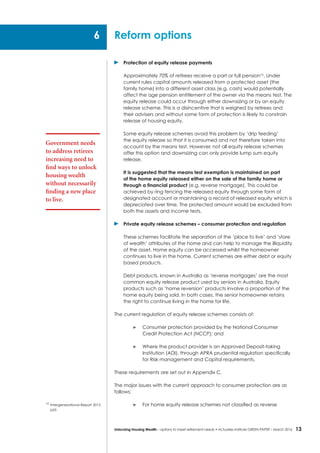
	 Protection of equity release payments
Approximately 70% of retirees receive a part or full pension16
. Under
current rules capital amounts released from a protected asset (the
family home) into a different asset class (e.g. cash) would potentially
affect the age pension entitlement of the owner via the means test. The
equity release could occur through either downsizing or by an equity
release scheme. This is a disincentive that is weighed by retirees and
their advisers and without some form of protection is likely to constrain
release of housing equity.
Some equity release schemes avoid this problem by ‘drip feeding’
the equity release so that it is consumed and not therefore taken into
account by the means test. However, not all equity release schemes
offer this option and downsizing can only provide lump sum equity
release.
It is suggested that the means test exemption is maintained on part
of the home equity released either on the sale of the family home or
through a financial product (e.g. reverse mortgage). This could be
achieved by ring fencing the released equity through some form of
designated account or maintaining a record of released equity which is
depreciated over time. The protected amount would be excluded from
both the assets and income tests.
	 Private equity release schemes – consumer protection and regulation
These schemes facilitate the separation of the ‘place to live’ and ‘store
of wealth’ attributes of the home and can help to manage the illiquidity
of the asset. Home equity can be accessed whilst the homeowner
continues to live in the home. Current schemes are either debt or equity
based products.
Debt products, known in Australia as ‘reverse mortgages’ are the most
common equity release product used by seniors in Australia. Equity
products such as ‘home reversion’ products involve a proportion of the
home equity being sold. In both cases, the senior homeowner retains
the right to continue living in the home for life.
The current regulation of equity release schemes consists of:
	 Consumer protection provided by the National Consumer
Credit Protection Act (NCCP); and
	 Where the product provider is an Approved Deposit-taking
Institution (ADI), through APRA prudential regulation specifically
for Risk management and Capital requirements.
These requirements are set out in Appendix C.
The major issues with the current approach to consumer protection are as
follows:
	 For home equity release schemes not classified as reverse
Reform options6
Government needs
to address retirees
increasing need to
find ways to unlock
housing wealth
without necessarily
finding a new place
to live.
16
	Intergenerational Report 2015
p65
14Unlocking Housing Wealth – options to meet retirement needs • Actuaries Institute GREEN Paper – March 2016
mortgages, such as shared equity schemes, there is no
overarching consumer protection legislation. So whereas
reverse mortgages are heavily regulated, new forms of
equity release schemes could be developed virtually free of
regulation; and
	 The current regulation is complex and further guidance is
required regarding how credit licence holders can practically
satisfy requirements for equity release under NCCP, Responsible
Lending and Unfair Contact Terms.
The major issues with the current approach to APRA regulation in
regards to risk and capital are as follows:
	 These requirements only apply to Approved Deposit-taking
Institutions (ADIs) not to other entities which can also provide
equity release schemes; and
	 The economic impact on lenders of the capital treatment
needs to be further considered.
Given the significant amount of home equity owned by retirees and a
likelihood of an increase in their need to find ways to unlock housing wealth
without necessarily finding a new place to live, government should review
the regulation/legislation relating to all home equity release schemes in
order to develop a principles based approach to regulation which ensures
security of tenure, applies to all types of schemes and providers, and
facilitates standard, simple disclosures.
Some equity release schemes (such as shared equity schemes) are
complicated due to the fact that property law in Australia is State based.
The solution would be for all regulation in relation to home equity release
schemes to be at the Commonwealth level; however we recognise the
difficulties that would be faced in achieving this outcome.
The complexity of these schemes necessitates advisors and distributors
to be highly trained. The Government should also consider the level of
independent financial and legal advice required by the borrower; and/or
the licensing requirements for third party distributors and/or advisors.
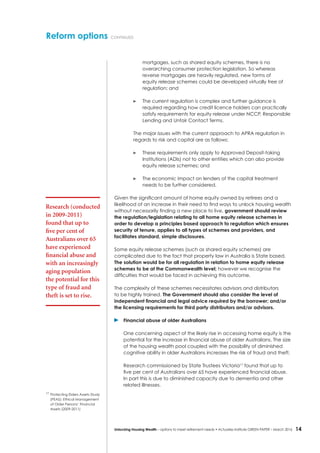
	 Financial abuse of older Australians
One concerning aspect of the likely rise in accessing home equity is the
potential for the increase in financial abuse of older Australians. The size
of the housing wealth pool coupled with the possibility of diminished
cognitive ability in older Australians increases the risk of fraud and theft.
Research commissioned by State Trustees Victoria17
found that up to
five per cent of Australians over 65 have experienced financial abuse.
In part this is due to diminished capacity due to dementia and other
related illnesses.
Reform options continued
Research (conducted
in 2009-2011)
found that up to
five per cent of
Australians over 65
have experienced
financial abuse and
with an increasingly
aging population
the potential for this
type of fraud and
theft is set to rise.
17
	Protecting Elders Assets Study
(PEAS): Ethical Management
of Older Persons’ Financial
Assets (2009-2011)
15Unlocking Housing Wealth – options to meet retirement needs • Actuaries Institute GREEN Paper – March 2016
According to Alzheimer’s Australia there are more than 342,800
Australians living with dementia. Without a medical breakthrough, the
number of people with dementia is expected to be almost 900,000 by
205018
.
Clearly the combination of easier access to a large pool of wealth and
the vulnerability of older Australians creates a significant risk that needs
to be managed. Equity release schemes will require sensible consumer
safeguards to protect the older home owner. Given the multiple
policy considerations in this emerging market the Council of Financial
Regulators could be best placed to determine the most appropriate
regulator to oversee equity release schemes.
Regulatory protective measures need to be established to guard
against the risk of financial abuse of older Australians given the
significant quantum of their housing wealth and potential vulnerability
due to diminished cognitive facilities.
	Downsizing
This is an option often put forward as the solution for retirees who are
asset rich and cash poor. The Productivity Commission concluded
that there is a general lack of affordable downsizing options for older
Australians due in large part to ‘red tape’ and inconsistencies within
state and territory land planning regimes19
. Moreover, whilst this is a
suitable option for some retirees, it is not a solution for others, for a range
of reasons. The costs of downsizing can be significant – stamp duty is
particularly problematic and there are other costs such as sale and
relocation costs. Older Australians often wish to remain a part of their
community; there may not be suitable housing stock in the vicinity of
the family home to downsize into.
Governments provide support to first home buyers but not to retirees.
Removing friction costs such as stamp duty could facilitate an increase
in downsizing
The Henry Tax Review concluded:20
“Conveyance stamp duty is highly inefficient and inequitable. It
discourages transactions of commercial and residential property
and, through this, its allocation to its most valuable use. Conveyance
stamp duty can also discourage people from changing their place
of residence as their personal circumstances change or discourage
people from making lifestyle changes that involve a change in
residence. It is also inequitable, as people who need to move more
frequently bear more tax, irrespective of their income or wealth.”
The Henry Review proposed replacing conveyancing duties with the
more efficient land tax. Such a change and stamp duty options could
be considered within the context of a broader tax review.
Reform options continued
18
	Dementia across Australia
2001-2050: Deloitte Access
Economics 2011
19
	PC HDOOA p2
20
	Australia’s Future Tax System
2010 p49
16Unlocking Housing Wealth – options to meet retirement needs • Actuaries Institute GREEN Paper – March 2016
Reform options continued
	 Revise the Age Pension Means Test
The family home is currently not included in the means test for the Age
Pension. This encourages the accumulation of wealth via that vehicle.
Although it helps build wealth it may encourage people to forsake a
more comfortable living standard to preserve Age Pension entitlements.
However, the overriding concern is to enhance fairness and equity in
the pension system. The current means test is poorly targeted as it does
not differentiate between retirees with large disparities in home asset
wealth. The home’s exempt status also creates a distortion between
home owners and non-owners. For full-rate pensioners, homeowners
have more than nine times the net worth of non-homeowners21
. The
Productivity Commission found that older renting households are
disproportionately likely to be experiencing housing affordability
stress with rent payments taking up more than 30% of household gross
income22
.
An option for future consideration is to make the value of the family
home above a specified amount subject to the Age pension means
test. The figure would be a matter for government determination and
preferably indexed. Only homeowners with equity above the specified
cap would have part of their equity counted towards the Age pension
means test. The non-exempt equity would be treated the same as
other financial assets. The expectation is that the specified limit would
only impact a minority of pension recipients (e.g. <10%). Reasonable
transitional arrangements and recognition of regional differences in
housing values would be required for implementation. Determining
these arrangements would be difficult and complex and would need
community acceptance.
	 Home owners – v – non-home owners.
The assets test currently places a notional value of $149,000 (June
2015) on the family home, in that the assets test threshold is higher by
this amount for non-homeowners. Means test changes from 1 January
2017 will increase that notional value to $200,000. Given the low value
placed on the family home in the means test, home-owners are being
given a substantial free asset compared to non-homeowners.
The maximum rent assistance for non-homeowner Age Pensioners is
currently around $60 per week which is well under market rents and
would broadly equate to a home worth around $60,000.
Recognising that the means test disadvantages renters versus
homeowners, and that renters often represent the less wealthy cohort
consideration could be given to providing greater support to this group.
This could be through:
	 Increasing rent assistance.
	 Increasing the assets test levels to ensure that decisions made to
rent or buy are neutral and do not impact the Age pension.
The means
test currently
disadvantages
renters versus
homeowners, and
reasonably, renters
should be given
a greater level of
consideration
and support.
21
	Submission to the Re:think
Tax Discussion Paper on
the treatment of retirement
incomes July 2015 The Centre
for Independent Studies(CIS)
22
	HDOOA p64
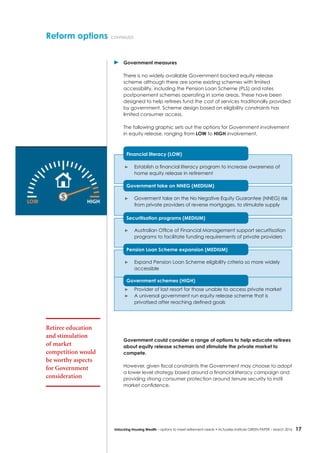
© ChameleonsEye / Shutterstock.com
17Unlocking Housing Wealth – options to meet retirement needs • Actuaries Institute GREEN Paper – March 2016
Reform options continued
	 Government measures
There is no widely available Government backed equity release
scheme although there are some existing schemes with limited
accessibility, including the Pension Loan Scheme (PLS) and rates
postponement schemes operating in some areas. These have been
designed to help retirees fund the cost of services traditionally provided
by government. Scheme design based on eligibility constraints has
limited consumer access.
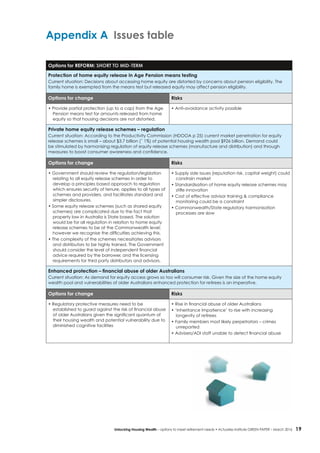
The following graphic sets out the options for Government involvement
in equity release, ranging from LOW to HIGH involvement.
Government could consider a range of options to help educate retirees
about equity release schemes and stimulate the private market to
compete.
However, given fiscal constraints the Government may choose to adopt
a lower level strategy based around a financial literacy campaign and
providing strong consumer protection around tenure security to instil
market confidence.
Retiree education
and stimulation
of market
competition would
be worthy aspects
for Government
consideration
	 Establish a financial literacy program to increase awareness of
home equity release in retirement
	 Goverment take on the No Negative Equity Guarantee (NNEG) risk
from private providers of reverse mortgages, to stimulate supply
	 Australian Office of Financial Management support securitisation
programs to facilitate funding requirements of private providers
	 Expand Pension Loan Scheme eligibility criteria so more widely
accessible
	 Provider of last resort for those unable to access private market
	 A universal government run equity release scheme that is
privatised after reaching defined goals
Financial literacy (LOW)
Government take on NNEG (MEDIUM)
Securitisation programs (MEDIUM)
Pension Loan Scheme expansion (MEDIUM)
Government schemes (HIGH)
Unlocking Housing Wealth – options to meet retirement needs • Actuaries Institute GREEN Paper – March 2016 18Unlocking Housing Wealth – options to meet retirement needs • Actuaries Institute GREEN Paper – March 2016
Appendices
19Unlocking Housing Wealth – options to meet retirement needs • Actuaries Institute GREEN Paper – March 2016
Appendix A	 Issues table
Options for REFORM: short to mid-term
Protection of home equity release in Age Pension means testing
Current situation: Decisions about accessing home equity are distorted by concerns about pension eligibility. The
family home is exempted from the means test but released equity may affect pension eligibility.
Options for change Risks
• Provide partial protection (up to a cap) from the Age
Pension means test for amounts released from home
equity so that housing decisions are not distorted.
• Anti-avoidance activity possible
Private home equity release schemes – regulation
Current situation: According to the Productivity Commission (HDOOA p 25) current market penetration for equity
release schemes is small – about $3.7 billion (˜ 1%) of potential housing wealth pool $926 billion. Demand could
be stimulated by harmonising regulation of equity release schemes (manufacture and distribution) and through
measures to boost consumer awareness and confidence.
Options for change Risks
• Government should review the regulation/legislation
relating to all equity release schemes in order to
develop a principles based approach to regulation
which ensures security of tenure, applies to all types of
schemes and providers, and facilitates standard and
simpler disclosures.
• Some equity release schemes (such as shared equity
schemes) are complicated due to the fact that
property law in Australia is State based. The solution
would be for all regulation in relation to home equity
release schemes to be at the Commonwealth level;
however we recognise the difficulties achieving this.
• The complexity of the schemes necessitates advisors
and distributors to be highly trained. The Government
should consider the level of independent financial
advice required by the borrower, and the licensing
requirements for third party distributors and advisors.
• Supply side issues (reputation risk, capital weight) could
constrain market
• Standardisation of home equity release schemes may
stifle innovation
• Cost of effective advisor training & compliance
monitoring could be a constraint
• Commonwealth/State regulatory harmonisation
processes are slow
Enhanced protection – financial abuse of older Australians
Current situation: As demand for equity access grows so too will consumer risk. Given the size of the home equity
wealth pool and vulnerabilities of older Australians enhanced protection for retirees is an imperative.
Options for change Risks
• Regulatory protective measures need to be
established to guard against the risk of financial abuse
of older Australians given the significant quantum of
their housing wealth and potential vulnerability due to
diminished cognitive facilities
• Rise in financial abuse of older Australians
• ‘Inheritance Impatience’ to rise with increasing
longevity of retirees
• Family members most likely perpetrators – crimes
unreported
• Advisers/ADI staff unable to detect financial abuse
20Unlocking Housing Wealth – options to meet retirement needs • Actuaries Institute GREEN Paper – March 2016
Appendix A	 Issues table continued
OPTIONS for REFORM: mid to long term
Downsizing
Current situation: Downsizing is a solution for some retirees who are asset rich but income poor. Commercial frictions
such as stamp duty and bank lending practices constrain demand.
Options for change Risks
• Where downsizing is viable, some form of stamp duty
relief could be applied to sales of retirees’ properties
to reduce transaction friction costs.
• Review bank lending rules and practices to reduce
any friction from downsizing transactions especially in
relation to the availability of bridging finance.
• Potential impact on State revenue.
• Political aversion to tax changes.
Home owners v non–home owners
Current situation: The family home is not included in the means testing for the Age Pension (AP). Decisions about
accessing home equity are distorted by concerns about pension eligibility. Means testing is poorly targeted
because of disparities in housing wealth. Non-home owners are under-compensated with rental assistance. Reform
is required to improve fairness of the pension system and improve retiree lifestyles.
Options for change Risks
• Revise the Age Pension means test for home owners –v
– non-home owners to improve fairness in the system
• Introduce a cap for the exempt family home
under the Age Pension Means Test. This is a fairness
measure and aimed at ‘asset rich’ retirees that
currently receive a full or part-pension. Reasonable
transitional arrangements and recognition of regional
differences in housing values would be required for
implementation.
• Reduce incentives to increase wealth through housing
• Anti-avoidance activity possible.
• Asset price volatility could impact Age Pension flows.
• Setting appropriate cap for contrasting geographic
markets.
• That any demand increase for home equity release
schemes as a result of the change to the Age Pension
means test cannot be met from private market.
Government measures
Current situation: Government could consider a range of measures to facilitate access to home equity release
including financial literacy measures, measures to encourage supply of schemes by private providers, and if
necessary, the supply of schemes by Government such as by extension of the current Pensions Loan Scheme.
Options for change Risks
From low to high Involvement
• Establish a financial literacy program around home
equity release to increase awareness amongst
homeowner retirees that this is an option available
to them in retirement, and to make the concept
‘acceptable’.
• Government to assume the No Negative Equity
Guarantee for reverse mortgages written by private
providers with the aim of increasing capacity.
• Australian Office of Financial Management (AOFM) to
support securitisation programs to facilitate funding
requirements of private providers.
• Expand the current Pension Loan Schemes to have
wider availability.
• Offer a scheme alongside the private market as a
‘provider of last resort’ for those wishing to source a
scheme but unable to do so.
• Universally available government-run reverse
mortgage scheme. This might be in conjunction with
changes to the pension eligibility tests.
• Financial literacy programs may not be as effective for
older cohorts.
•	 It would be important to ensure that capital
requirements for providers fully allow for the fact that
the No Negative Equity Guarantee risk has been
removed. US experience perhaps suggests that it
will take more than taking on the NNEG to have a
meaningful impact on supply.
•	 Government aversion to underwriting private scheme
providers.
•	 Government reluctance to compete with private
sector.
•	 Government provision could crowd out private market
providers.
21Unlocking Housing Wealth – options to meet retirement needs • Actuaries Institute GREEN Paper – March 2016
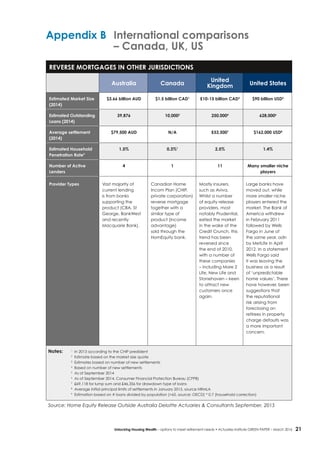
Reverse mortgages in other jurisdictions
Australia Canada
United
Kingdom United States
Estimated Market Size
(2014)
$3.66 billion AUD $1.5 billion CAD1
£10-15 billion CAD3
$90 billion USD5
Estimated Outstanding
Loans (2014)
39,876 10,0002
250,0004
628,0006
Average settlement
(2014)
$79,500 AUD N/A £53,5007
$162,000 USD8
Estimated Household
Penetration Rate9
1.5% 0.3%1
2.5% 1.4%
Number of Active
Lenders
4 1 11 Many smaller niche
players
Provider Types Vast majority of
current lending
is from banks
supporting the
product (CBA, St
George, BankWest
and recently
Macquarie Bank).
Canadian Home
Incom Plan (CHIP,
private corporation)
reverse mortgage
together with a
similar type of
product (income
advantage)
sold through the
HomEquity bank.
Mostly insurers,
such as Aviva.
Whilst a number
of equity release
providers, most
notably Prudential,
exited the market
in the wake of the
Credit Crunch, this
trend has been
reversed since
the end of 2010,
with a number of
these companies
– including More 2
Life, New Life and
Stonehaven – keen
to attract new
customers once
again.
Large banks have
moved out, while
more smaller niche
players entered the
market. The Bank of
America withdrew
in February 2011
followed by Wells
Fargo in June of
the same year, adn
by MetLife in April
2012. In a statement
Wells Fargo said
it was leaving the
business as a result
of ‘unpredictable
home values’. There
have however, been
suggestions that
the reputational
risk arising from
foreclosing on
retirees in property
charge defaults was
a more important
concern.
Notes: 	 1
In 2013 according to the CHIP predident
2
Estimate based on the market size quote
3
Estimates based on number of new settlements
4
Based on number of new settlements
5
As of September 2014
6
As of September 2014, Consumer Financial Protection Bureau (CFPB)
7
£69,118 for lump sum and £46,356 for drawdown type of loans
8
Average initial principal limits of settlements in January 2015, source NRMLA
9
Estimation based on # loans divided by population (>65, source: OECD) * 0.7 (household correction)
Source: Home Equity Release Outside Australia Deloitte Actuaries & Consultants September, 2015
Appendix B	 International comparisons
	 – Canada, UK, US
22Unlocking Housing Wealth – options to meet retirement needs • Actuaries Institute GREEN Paper – March 2016
Appendix C	 Consumer protection and
	 regulatory framework
Consumer Protection
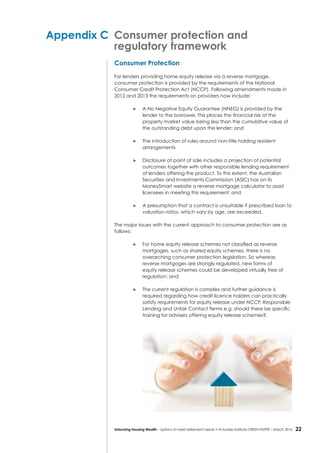
For lenders providing home equity release via a reverse mortgage,
consumer protection is provided by the requirements of the National
Consumer Credit Protection Act (NCCP). Following amendments made in
2012 and 2013 the requirements on providers now include:
	 A No Negative Equity Guarantee (NNEG) is provided by the
lender to the borrower. This places the financial risk of the
property market value being less than the cumulative value of
the outstanding debt upon the lender; and
	 The introduction of rules around non-title holding resident
arrangements
	 Disclosure at point of sale includes a projection of potential
outcomes together with other responsible lending requirement
of lenders offering the product. To this extent, the Australian
Securities and Investments Commission (ASIC) has on its
MoneySmart website a reverse mortgage calculator to assist
licensees in meeting this requirement; and
	 A presumption that a contract is unsuitable if prescribed loan to
valuation ratios, which vary by age, are exceeded.
The major issues with the current approach to consumer protection are as
follows:
	 For home equity release schemes not classified as reverse
mortgages, such as shared equity schemes, there is no
overarching consumer protection legislation. So whereas
reverse mortgages are strongly regulated, new forms of
equity release schemes could be developed virtually free of
regulation; and
	 The current regulation is complex and further guidance is
required regarding how credit licence holders can practically
satisfy requirements for equity release under NCCP, Responsible
Lending and Unfair Contact Terms e.g. should there be specific
training for advisers offering equity release schemes?.
23Unlocking Housing Wealth – options to meet retirement needs • Actuaries Institute GREEN Paper – March 2016
Appendix C	 Consumer protection and
	 regulatory framework continued
APRA regulation
Approved Deposit-taking Institutions (ADIs) which provide equity
release schemes are also subject to APRA requirements in relation to risk
management and capital. These additional requirements are set out
below.
Prudential Regulation – Risk Management
APRA’s Prudential Practice Guide APG 223 covers the risk governance
expected by APRA in respect to lending and ongoing management of
residential mortgage portfolios. Key aspects in relation to reverse mortgages
include:
	 Reverse mortgages are identified as ‘Specific Loan Types’
and APRA expect an ADI to consider the portfolio risk limits
given that such loans may have more vulnerability to possible
material decreases in property value;
	 Responsibility is placed on lenders to consider the operational,
legal and reputational risk of such reverse mortgages and have
clear measures to address these risks; and
	 On the grounds that APRA capital standards are intended for
amortising mortgages rather than capitalising mortgages (like
reverse mortgages), an ADI could be subject to supervisory
discretion of additional capital if this portfolio becomes a
material volume of business.
Prudential Regulation – Capital Treatment
In July 2010, APRA clarified the capital treatment for ADIs holding reverse
mortgages and shared equity mortgages on their balance sheets. Under
Basel II, standardised risk weightings of 50%/100% are applied for reverse
mortgages with loan to valuation ratios under/over 60% and a risk weighting
of 100% applies for shared equity contracts as these are viewed by APRA
as akin to a direct property investment. Internal rating processes are not
allowed on these assets due to the lack of a meaningful probability of
default estimate.
As noted above, if reverse mortgages become material on an ADI’s
balance sheet, APRA could require additional capital to be held.
The major issues with the current approach to APRA regulation in regards to
risk and capital are as follows:
	 These requirements only apply to ADIs not to other entities
which can also provide equity release schemes, resulting in
regulatory arbitrage; and
	 The economic impact on lenders of the capital treatment, may
be affecting the supply side of equity release schemes and
needs to be further considered.
24Unlocking Housing Wealth – options to meet retirement needs • Actuaries Institute GREEN Paper – March 2016
Appendix C	 Consumer protection and
	 regulatory framework continued
State versus Federal regulation
Operating in the home equity release market today is complicated due
to the fact that property law in Australia is State based. This can create
inefficiencies for some equity release (such as shared equity) scheme
providers seeking to offer products in multiple jurisdictions. Issues impacting
shared equity scheme providers include stamp duty and differences in the
structure of real estate contracts. For some providers, this means they only
offer products in certain States due to the significant additional resources
required to offer product across multiple States.
The solution would be for all regulation in relation to home equity release
schemes to be at the Commonwealth level. However, we recognise the
difficulties in achieving this.
Principles based regulation
One of the main aims of regulatory and policy frameworks for home equity
release schemes should be to ensure that the homeowner has the legal
right to remain in their home for the remainder of their life, i.e. absolute
security of tenure. In this way, one of significant reservations of homeowners
considering home equity release would be removed.
Rather than legislation on a ‘scheme / product’ basis as is the case now, a
framework which appropriately covered all home equity release schemes
should include protection measures such as legislating security of tenure.
This would help prevent new schemes being introduced to the private
market which do not provide adequate consumer protection.
Simplified consumer disclosure
The complexity of equity release schemes for the typical older customer
demographic is an issue.
If all schemes were to come under the same clear principles based
legislation, then standardised, simple consumer disclosures would be
possible and potentially should be mandated.
Licensed third party distributors/advisers
The complexity of the scheme necessitates that advisors and distributors be
highly trained. The Government should consider:
	 The level of independent financial advice required by the
borrower; and
	 The licensing requirements for third party distributors and
advisers.
One of the main
aims of regulatory
and policy
frameworks for
home equity release
schemes should be
to ensure that the
homeowner has the
legal right to remain
in their home for
the remainder of
their life.
Institute of Actuaries of Australia
ABN 69 000 423 656
Level 2, 50 Carrington Street,
Sydney NSW Australia 2000
t 	 +61 (0) 2 9239 6100
f	 +61 (0) 2 9239 6170
e	actuaries@actuaries.asn.au
w	www.actuaries.asn.au

AIHOUSINGGPwebLres

  • 1.
  • 2.
    Unlocking Housing Wealth– options to meet retirement needs • Actuaries Institute GREEN Paper – March 2016 About the Actuaries Institute The Actuaries Institute is the sole professional body for Actuaries in Australia. The Institute provides expert comment on public policy issues where there is uncertainty of future financial outcomes. Actuaries have a reputation for a high level of technical financial expertise and integrity. They apply their risk management expertise to allocate capital efficiently, identify and mitigate emerging risks and to help maintain system integrity across multiple segments of the financial and other sectors. This unrivalled expertise enables the profession to comment on a wide range of issues including retirement income policy, enterprise risk management and prudential regulation, finance and investment, general insurance, life insurance, health financing and data analytics. This White Paper was written by the Actuaries Institute’s Housing Working Group, convened by Catherine Nance, PwC. This report is provisional for discussion purposes only, and does not constitute consulting advice on which to base decisions. No liability to any party will be accepted for the consequence of relying on its contents. © Institute of Actuaries of Australia 2016 All rights reserved Photography: Shutterstock.com
  • 3.
    1Unlocking Housing Wealth– options to meet retirement needs • Actuaries Institute GREEN Paper – March 2016 Contents Executive Summary 3 1 Reform options for discussion 4 2 background 6 3 Needs in retirement 8 4 Attitudes to accessing housing wealth 10 5 Principles 11 6 Reform options 13 Appendix A Issues table 19 Appendix B International comparisons – Canada, UK, US 21 Appendix C Consumer protection and regulatory framework 22
  • 4.
    2Unlocking Housing Wealth– options to meet retirement needs • Actuaries Institute GREEN Paper – March 2016 This paper aims to continue the discussion commenced by our earlier research on longevity risk and raise policy options that could help mitigate that risk and improve retirees’ living standards.
  • 5.
    3Unlocking Housing Wealth– options to meet retirement needs • Actuaries Institute GREEN Paper – March 2016 T he Actuaries Institute has produced several papers in recent years investigating the potential impact of Australia’s changing demographics on the financing of retirement incomes, aged health care and related issues of intergenerational equity. A common finding of our research is that for current retirees the family home is not only a place to live, but also a store of considerable, though relatively untapped, wealth. The Productivity Commission has stated, “Most older Australian home owners on low incomes could achieve a modest retirement living standard over the remainder of their lives by drawing on their home equity”1 . This paper continues the discussion commenced by our earlier research on longevity risk and raises policy options that could help mitigate that risk and improve retirees’ living standards. It quantifies the value of Australian retirees’ housing wealth; identifies the costs associated with retirees’ accommodation, aged care and health care needs; and, proposes policy options that would facilitate the release of part or all of the equity stored in family homes, for those who choose to do so, to defray ageing costs and enhance retirees’ living standards. Like superannuation, housing wealth enjoys significant tax and other concessions (e.g. tax free capital gains on sale and exemption from the means test for access to the age pension). However, given the public and private costs attached to an ageing population, retirees, who wish to enjoy at least a modest lifestyle, should be encouraged to consider a range of methods to access part or all of their stored housing wealth if they want increased income to cover their personal expenditure, accommodation and aged care needs. Although this paper focuses on the benefits for current retirees accessing their housing wealth, it is recognised that retirees may choose not to do so. They may have their own personal reasons for electing to live a more modest lifestyle and self-insure against longevity risk. Next generation retirees are expected to build their wealth through longer exposure to the superannuation system over their working lives. This paper is not primarily concerned with reducing government expenditure on age related services though that is likely to be an outcome. The proposed policy changes aim to remove the biases that constrain older Australians from accessing part or all of their housing wealth, if and when they require it, to improve their standard of living in retirement. Executive Summary 1 Housing Decisions of Older Australians Productivity Commission Research Paper 2015 For current retirees the family home is not only a place to live, but also a store of considerable, though relatively untapped, wealth.
  • 6.
    4Unlocking Housing Wealth– options to meet retirement needs • Actuaries Institute GREEN Paper – March 2016 Policy reform options to improve access to home equity are listed below and contained in Appendix A. Options for facilitating increased access to home equity wealth include: Age Pension Partial protection (up to a cap) from the Age Pension Means Test for amounts released under home equity release schemes or downsizing. Private equity release schemes – regulation and consumer protection Government should consider reviewing the regulation/ legislation relating to all equity release schemes and develop a principles based approach to regulation which ensures security of tenure, applies to all types of schemes and providers, and facilitates standard and simpler disclosures. Home equity release schemes (such as shared equity schemes) are complicated due to the fact that property law in Australia is State based. The solution would be for all regulation for home equity release schemes to be at the Commonwealth level; however, we recognise the difficulties achieving this. The complexity of these schemes necessitates advisors and distributors to be highly trained. The Government should consider the level of independent financial advice required by the retiree, and the licensing requirements for third party distributors and advisors. Financial abuse of older Australians Regulatory protective measures need to be established to guard against the risk of financial abuse of older Australians given the significant quantum of their housing wealth and potential vulnerability due to diminished cognitive facilities. Downsizing Where home downsizing is viable, some form of stamp duty relief could be applied to retirees’ property transactions to reduce friction costs. Review bank lending rules and practices to reduce any friction from downsizing transactions especially in relation to the availability of bridging finance. Reform options for discussion Government should consider reviewing the regulation/ legislation relating to all equity release schemes in order to develop a principles based approach to regulation which ensures security of tenure, applies to all types of schemes and providers, and facilitates standard and simpler disclosures. 1 © Nils Versemann / Shutterstock.com
  • 7.
    5Unlocking Housing Wealth– options to meet retirement needs • Actuaries Institute GREEN Paper – March 2016 Home owners v non – home owners Revise the Age Pension means test for home owners – v – non- home owners to improve fairness in the system Introduce a $ cap for the exempt family home under the Age Pension Means Test. This is a fairness measure and aimed at a relatively small proportion of ‘asset rich’ retirees who currently receive a full or part-pension. Reasonable transitional arrangements and recognition of regional differences in housing values would be required for implementation. Government measures Government could consider a range of measures to facilitate access to home equity release including financial literacy measures, measures to encourage supply of schemes by private providers and if necessary, the supply of schemes by Government such as extension of the current Pensions Loan Scheme. Reform options for discussion continued
  • 8.
    6Unlocking Housing Wealth– options to meet retirement needs • Actuaries Institute GREEN Paper – March 2016 Australia’s retirement incomes system today is primarily based on: A publicly funded, means tested age pension Superannuation, both compulsory and voluntary; and Savings outside the superannuation system. For many Australians, particularly those who commenced work before superannuation became mainstream, their main form of lifetime savings is their home. This form of savings is also consistent with existing policies exempting capital gains tax and age pension means testing. Despite this, housing wealth has not often been considered in the context of retirement funding. However, the significant increases in the value of housing and the economics of financing an ageing population have drawn the attention of policymakers. Housing wealth has some unique features and it is important that these be taken into account in policy formation. For a retiree, savings held in the form of the ‘family home’ provide both: A place to live, with security of tenure. This security of tenure is a major advantage of home ownership over renting, regardless of financial considerations; and A store of wealth. For those who could benefit from tapping into this wealth there are complex reasons which constrain or discourage access, including: a) Public policy settings, in particular: the family home exemption from the age pension means test; the Capital Gains Tax free status of the family home. b) The difficulties in accessing housing wealth to fund retirement combined with a natural aversion to debt in retirement. Owner-occupied residential property is a unique asset in that it is both a home and an illiquid and concentrated store of value. c) A strong emotional attachment to the family home, community and family networks, can impact retirees’ thinking beyond financial considerations. d) Decline in cognitive capacity or willingness to undertake major financial transactions Background Housing wealth has some unique features and it is important that these be taken into account in policy formation. 2
  • 9.
    7Unlocking Housing Wealth– options to meet retirement needs • Actuaries Institute GREEN Paper – March 2016 Background continued Housing Wealth is Significant Around 85% of older Australians own their own homes2 and for many senior homeowners their home is the single largest source of wealth with the age pension being their only source of income. The total value of Australians’ residential property is estimated to be $5.76 trillion3 . The share owned by older Australians is estimated to be $926 billion4 . The Actuaries Institute Retirement Income White Paper5 revealed that currently, 60 year old couples of median wealth have a significant proportion of their wealth (49%) in home equity. For those in the 25th wealth percentile that share of home equity of the couple’s total wealth is even higher (66%) A key finding of the analysis is that older cohorts are projected to retire with a higher proportion of assets in home equity. These cohorts have experienced a doubling of the real value of their home equity over the last twenty years. Compared with almost $1 trillion of unencumbered retiree housing wealth at end 2014 the size of reverse mortgage debt was $3.7bn6 , there is clearly potential for housing wealth to play a greater role in retirement funding. 2 PC HDOOA Fig 3.15 p 62 3 ABS key Figures: June 2015 4 PC HDOOA p25 5 AIRIWP) For Richer, For Poorer, (August 2015) 6 Deloitte: 2015 Reverse Mortgage Survey
  • 10.
    8Unlocking Housing Wealth– options to meet retirement needs • Actuaries Institute GREEN Paper – March 2016 Individuals have various needs in retirement including the costs associated with aged accommodation and care, health care and other personal expenditure. Superannuation and voluntary savings may not be able to provide adequate retirement resources to meet all these needs for most people, in particular for the current generation approaching retirement that has not had the opportunity to accumulate sufficient superannuation savings. The age pension will supplement their retirement resources, but it will not be enough for many people. The OECD (2015) estimates Australians over 65 have the second highest income poverty rate after Korea of all OECD countries. In short our retirees are asset rich but income poor7 . As a result, accessing part or all of their housing wealth will assist many individuals to meet their retirement needs, which could include: Personal expenditure – in September 2015, ASFA found that couples aged around 65 wanting to live a comfortable retirement would need to spend around $58,915 p.a., while singles would need to spend around $42,962 p.a.8 The Actuaries Institute Retirement Income White Paper (RIWP) For Richer, For Poorer, showed that couples in the median household wealth cohort would not be able to fund a ‘comfortable’ retirement to life expectancy without being supplemented by the age pension. Lower wealth cohorts would not be able to sustain a ‘comfortable’ retirement even with the Age Pension. This is particularly true for older cohorts. Accommodation – There is a high level of home ownership amongst older retirees with around 85% owning their own homes (82% mortgage free)9 . Although the home provides accommodation for retirees, a significant proportion of senior Australians’ wealth is tied up in their homes. It is estimated that housing wealth is around 55% of total wealth for those aged 75 and over10 . For non-home owners, the cost of accommodation can increase retirement expenditure for low income couples by up to 30%11 . This adds further strain on retirement resources for non-home owners. Needs in retirement 7 Pensions at a glance 2015: OECD & G20 indicators 2015 8 ASFA retirement standard September 2015 for homeowners aged 65-85 9 PC HDOOA Fig 3.16 p63 10 PC HDOOA Fig 3.28 p77 11 For Richer, For Poorer – Retirement Incomes Actuaries Institute White Paper August 2015 p7 The OECD (2015) estimates Australians over 65 have the second highest income poverty rate after Korea of all OECD countries. In short our retirees are asset rich but income poor. 3
  • 11.
    9Unlocking Housing Wealth– options to meet retirement needs • Actuaries Institute GREEN Paper – March 2016 Needs in retirement continued Aged care – aged care is another potential need at later stages of life. Research by The Centre for Excellence in Population Ageing Research (CEPAR) on aged care in Australia in 201412 shows that half of men and two thirds of women aged 65 will need some form of formal aged care in their remaining lifetime. The cost of aged care can be very expensive. There are two types of care available, home care and residential care, depending on individual circumstances and needs. The fees that people pay to receive a means tested Home Care package range from $3,587 p.a. to $13,587 p.a. for home care and from $17,424 p.a. to $112,000 p.a. for residential care as at September 201513 . The Living Longer Living Better aged care reform package puts greater emphasis on ‘user pays’ with Government only providing a safety net. It means that there is a greater need for individuals to manage their retirement resources to plan for their age care costs. Health care – Based on the ASFA Retirement Standard released in September 2015 the health service cost for a healthy couple aged over 85 on a comfortable lifestyle is $200.95 per week ($10,449 per annum). However, there can be considerable gap payments involved for some medical procedures, and the incidence of these procedures increases with age. As the cost of aged care and most of the health care costs are likely to occur at a later stage of life, older Australians need to better manage their finances to meet those needs. People are starting to plan to use part of their housing wealth to fund their transition into aged care. Part or all the remainder of their home equity can also be used to meet other retirement income needs. However, some people do not see the family home as an available asset. 12 Aged care in Australia: Part 1 CEPAR research brief 2014/01 p10 13 The residential care costs quoted include accommodation fees of $20,000 to $40,000 p.a. which can also be met from a lump sum payment typically in the order of $300,000 to $550,000.
  • 12.
    10Unlocking Housing Wealth– options to meet retirement needs • Actuaries Institute GREEN Paper – March 2016 Attitudes to accessing housing wealth The emotional connection to the family home makes older Australians less willing to explore the financial opportunities of accessing housing wealth to help meet their retirement needs. Some people spend less in early retirement in order to have more wealth for costs at the later stages of life. This may result in a lower standard of living during retirement as well as larger than intended bequests due to an earlier than expected death. Most older Australians are likely to be the recipients of some form of informal care provided by families, friends or neighbours14 with much less cost. In many cases, there is an implied cross-generational contract where housing wealth is the reward for the provision of ongoing financial and social support by family members and others. Housing wealth is therefore already ‘indirectly’ used as a part of their retirement resources by many Australians. Some people want to leave part of their savings as a bequest to family members and others. Other bequests can be as a result of unintended bequests or a cross generational contract for service (e.g. informal care) as mentioned above. A recent survey conducted by the Productivity Commission15 showed that 76% of homeowners aged 60 and over wanted to see out their retirement in their current home and 71% saw their home as a financial safety net. Of these older Australians, 44% called out a bequest motive as their key priority, only 40% saw their home as a potential retirement asset and 40% were uncomfortable with the idea of having a mortgage in retirement. However, retirement needs such as aged care, health care, and adequate and sustainable incomes in retirement may become more important than bequests for older Australians in future years. As most bequests are in the form of the family home, it would be sensible to provide options for the retirees to easily access part or all of their housing wealth to supplement other retirement needs if they prefer, while still not imposing impediments for individuals who want to leave bequests. People can achieve a better standard of living in retirement if housing wealth is considered as an integral part of their retirement plan. 76% of homeowners aged 60 and over wanted to see out their retirement in their current home and 71% saw their home as a financial safety net. 4 14 Aged care in Australia: Part 1 CEPAR research brief 2014/01 p21 15 PC HDOOA Fig 11 p14
  • 13.
    11Unlocking Housing Wealth– options to meet retirement needs • Actuaries Institute GREEN Paper – March 2016 The Institute proposes certain principles should underpin any policy changes that provide increased access to home equity. Sustainability A long-term policy outlook is required that focuses on both fiscal affordability over time and providing retirees with reliable, secure and reasonably adequate resources during all stages of retirement to cover personal expenditure, accommodation and aged care needs. However, it does require a shift in the current mindset of retirees (and their family and advisors) to recognise their house as an asset and not just a home. Flexibility Regulation needs to reflect individuals’ different retirement income needs and varying capacity to exercise choice. Critically, regulation should not force people to stay in their homes too long nor leave too early. Flexibility also requires the removal of impediments to desired transactions. For example, the Henry Tax Review found that stamp duty on property transactions discouraged people from changing their place of residence as their personal circumstances change or discouraged people from making lifestyle changes that involve a change in residence. Equity The combined cost to the taxpayer of the Age Pension and various tax concessions (including the family home) and incentives need to be balanced with intra- and inter-generational equity. Imbalances need to be resolved so that the wealthy do not receive (pension) benefits meant for the disadvantaged and distortions between asset classes are removed – the important measure is the size of the retiree’s total pool of wealth, not its individual investment components and whether they are shares, superannuation, bonds or housing. Principles Regulation needs to reflect individuals’ different retirement income needs and varying capacity to exercise choice. 5
  • 14.
    12Unlocking Housing Wealth– options to meet retirement needs • Actuaries Institute GREEN Paper – March 2016 Efficiency Public expenditure should aim to efficiently meet the core objective of providing reasonably adequate retirement: resources to cover personal expenditure; accommodation and aged care needs. Simplicity Retirees should be able to optimise their position without necessarily seeking financial advice but where advice is sought, the system should not be so complex that advice is unaffordable. Supportive regulatory frameworks Policy reforms should support competition and foster consumer protection but not unreasonably impede innovation, including an appropriate balance between the social objectives of regulation and the implications for industry including the cost of compliance. It is recognised that there needs to be strong consumer protection measures against financial abuse of older Australians given that the home is often the last store of wealth and cognitive decline increases the vulnerability of the aged. Principles continued Policy reforms should support competition and foster consumer protection but not unreasonably impede innovation, but equally there needs to be strong consumer protection measures against financial abuse of older Australians.
  • 15.
    13Unlocking Housing Wealth– options to meet retirement needs • Actuaries Institute GREEN Paper – March 2016 Protection of equity release payments Approximately 70% of retirees receive a part or full pension16 . Under current rules capital amounts released from a protected asset (the family home) into a different asset class (e.g. cash) would potentially affect the age pension entitlement of the owner via the means test. The equity release could occur through either downsizing or by an equity release scheme. This is a disincentive that is weighed by retirees and their advisers and without some form of protection is likely to constrain release of housing equity. Some equity release schemes avoid this problem by ‘drip feeding’ the equity release so that it is consumed and not therefore taken into account by the means test. However, not all equity release schemes offer this option and downsizing can only provide lump sum equity release. It is suggested that the means test exemption is maintained on part of the home equity released either on the sale of the family home or through a financial product (e.g. reverse mortgage). This could be achieved by ring fencing the released equity through some form of designated account or maintaining a record of released equity which is depreciated over time. The protected amount would be excluded from both the assets and income tests. Private equity release schemes – consumer protection and regulation These schemes facilitate the separation of the ‘place to live’ and ‘store of wealth’ attributes of the home and can help to manage the illiquidity of the asset. Home equity can be accessed whilst the homeowner continues to live in the home. Current schemes are either debt or equity based products. Debt products, known in Australia as ‘reverse mortgages’ are the most common equity release product used by seniors in Australia. Equity products such as ‘home reversion’ products involve a proportion of the home equity being sold. In both cases, the senior homeowner retains the right to continue living in the home for life. The current regulation of equity release schemes consists of: Consumer protection provided by the National Consumer Credit Protection Act (NCCP); and Where the product provider is an Approved Deposit-taking Institution (ADI), through APRA prudential regulation specifically for Risk management and Capital requirements. These requirements are set out in Appendix C. The major issues with the current approach to consumer protection are as follows: For home equity release schemes not classified as reverse Reform options6 Government needs to address retirees increasing need to find ways to unlock housing wealth without necessarily finding a new place to live. 16 Intergenerational Report 2015 p65
  • 16.
    14Unlocking Housing Wealth– options to meet retirement needs • Actuaries Institute GREEN Paper – March 2016 mortgages, such as shared equity schemes, there is no overarching consumer protection legislation. So whereas reverse mortgages are heavily regulated, new forms of equity release schemes could be developed virtually free of regulation; and The current regulation is complex and further guidance is required regarding how credit licence holders can practically satisfy requirements for equity release under NCCP, Responsible Lending and Unfair Contact Terms. The major issues with the current approach to APRA regulation in regards to risk and capital are as follows: These requirements only apply to Approved Deposit-taking Institutions (ADIs) not to other entities which can also provide equity release schemes; and The economic impact on lenders of the capital treatment needs to be further considered. Given the significant amount of home equity owned by retirees and a likelihood of an increase in their need to find ways to unlock housing wealth without necessarily finding a new place to live, government should review the regulation/legislation relating to all home equity release schemes in order to develop a principles based approach to regulation which ensures security of tenure, applies to all types of schemes and providers, and facilitates standard, simple disclosures. Some equity release schemes (such as shared equity schemes) are complicated due to the fact that property law in Australia is State based. The solution would be for all regulation in relation to home equity release schemes to be at the Commonwealth level; however we recognise the difficulties that would be faced in achieving this outcome. The complexity of these schemes necessitates advisors and distributors to be highly trained. The Government should also consider the level of independent financial and legal advice required by the borrower; and/or the licensing requirements for third party distributors and/or advisors. Financial abuse of older Australians One concerning aspect of the likely rise in accessing home equity is the potential for the increase in financial abuse of older Australians. The size of the housing wealth pool coupled with the possibility of diminished cognitive ability in older Australians increases the risk of fraud and theft. Research commissioned by State Trustees Victoria17 found that up to five per cent of Australians over 65 have experienced financial abuse. In part this is due to diminished capacity due to dementia and other related illnesses. Reform options continued Research (conducted in 2009-2011) found that up to five per cent of Australians over 65 have experienced financial abuse and with an increasingly aging population the potential for this type of fraud and theft is set to rise. 17 Protecting Elders Assets Study (PEAS): Ethical Management of Older Persons’ Financial Assets (2009-2011)
  • 17.
    15Unlocking Housing Wealth– options to meet retirement needs • Actuaries Institute GREEN Paper – March 2016 According to Alzheimer’s Australia there are more than 342,800 Australians living with dementia. Without a medical breakthrough, the number of people with dementia is expected to be almost 900,000 by 205018 . Clearly the combination of easier access to a large pool of wealth and the vulnerability of older Australians creates a significant risk that needs to be managed. Equity release schemes will require sensible consumer safeguards to protect the older home owner. Given the multiple policy considerations in this emerging market the Council of Financial Regulators could be best placed to determine the most appropriate regulator to oversee equity release schemes. Regulatory protective measures need to be established to guard against the risk of financial abuse of older Australians given the significant quantum of their housing wealth and potential vulnerability due to diminished cognitive facilities. Downsizing This is an option often put forward as the solution for retirees who are asset rich and cash poor. The Productivity Commission concluded that there is a general lack of affordable downsizing options for older Australians due in large part to ‘red tape’ and inconsistencies within state and territory land planning regimes19 . Moreover, whilst this is a suitable option for some retirees, it is not a solution for others, for a range of reasons. The costs of downsizing can be significant – stamp duty is particularly problematic and there are other costs such as sale and relocation costs. Older Australians often wish to remain a part of their community; there may not be suitable housing stock in the vicinity of the family home to downsize into. Governments provide support to first home buyers but not to retirees. Removing friction costs such as stamp duty could facilitate an increase in downsizing The Henry Tax Review concluded:20 “Conveyance stamp duty is highly inefficient and inequitable. It discourages transactions of commercial and residential property and, through this, its allocation to its most valuable use. Conveyance stamp duty can also discourage people from changing their place of residence as their personal circumstances change or discourage people from making lifestyle changes that involve a change in residence. It is also inequitable, as people who need to move more frequently bear more tax, irrespective of their income or wealth.” The Henry Review proposed replacing conveyancing duties with the more efficient land tax. Such a change and stamp duty options could be considered within the context of a broader tax review. Reform options continued 18 Dementia across Australia 2001-2050: Deloitte Access Economics 2011 19 PC HDOOA p2 20 Australia’s Future Tax System 2010 p49
  • 18.
    16Unlocking Housing Wealth– options to meet retirement needs • Actuaries Institute GREEN Paper – March 2016 Reform options continued Revise the Age Pension Means Test The family home is currently not included in the means test for the Age Pension. This encourages the accumulation of wealth via that vehicle. Although it helps build wealth it may encourage people to forsake a more comfortable living standard to preserve Age Pension entitlements. However, the overriding concern is to enhance fairness and equity in the pension system. The current means test is poorly targeted as it does not differentiate between retirees with large disparities in home asset wealth. The home’s exempt status also creates a distortion between home owners and non-owners. For full-rate pensioners, homeowners have more than nine times the net worth of non-homeowners21 . The Productivity Commission found that older renting households are disproportionately likely to be experiencing housing affordability stress with rent payments taking up more than 30% of household gross income22 . An option for future consideration is to make the value of the family home above a specified amount subject to the Age pension means test. The figure would be a matter for government determination and preferably indexed. Only homeowners with equity above the specified cap would have part of their equity counted towards the Age pension means test. The non-exempt equity would be treated the same as other financial assets. The expectation is that the specified limit would only impact a minority of pension recipients (e.g. <10%). Reasonable transitional arrangements and recognition of regional differences in housing values would be required for implementation. Determining these arrangements would be difficult and complex and would need community acceptance. Home owners – v – non-home owners. The assets test currently places a notional value of $149,000 (June 2015) on the family home, in that the assets test threshold is higher by this amount for non-homeowners. Means test changes from 1 January 2017 will increase that notional value to $200,000. Given the low value placed on the family home in the means test, home-owners are being given a substantial free asset compared to non-homeowners. The maximum rent assistance for non-homeowner Age Pensioners is currently around $60 per week which is well under market rents and would broadly equate to a home worth around $60,000. Recognising that the means test disadvantages renters versus homeowners, and that renters often represent the less wealthy cohort consideration could be given to providing greater support to this group. This could be through: Increasing rent assistance. Increasing the assets test levels to ensure that decisions made to rent or buy are neutral and do not impact the Age pension. The means test currently disadvantages renters versus homeowners, and reasonably, renters should be given a greater level of consideration and support. 21 Submission to the Re:think Tax Discussion Paper on the treatment of retirement incomes July 2015 The Centre for Independent Studies(CIS) 22 HDOOA p64 © ChameleonsEye / Shutterstock.com
  • 19.
    17Unlocking Housing Wealth– options to meet retirement needs • Actuaries Institute GREEN Paper – March 2016 Reform options continued Government measures There is no widely available Government backed equity release scheme although there are some existing schemes with limited accessibility, including the Pension Loan Scheme (PLS) and rates postponement schemes operating in some areas. These have been designed to help retirees fund the cost of services traditionally provided by government. Scheme design based on eligibility constraints has limited consumer access. The following graphic sets out the options for Government involvement in equity release, ranging from LOW to HIGH involvement. Government could consider a range of options to help educate retirees about equity release schemes and stimulate the private market to compete. However, given fiscal constraints the Government may choose to adopt a lower level strategy based around a financial literacy campaign and providing strong consumer protection around tenure security to instil market confidence. Retiree education and stimulation of market competition would be worthy aspects for Government consideration Establish a financial literacy program to increase awareness of home equity release in retirement Goverment take on the No Negative Equity Guarantee (NNEG) risk from private providers of reverse mortgages, to stimulate supply Australian Office of Financial Management support securitisation programs to facilitate funding requirements of private providers Expand Pension Loan Scheme eligibility criteria so more widely accessible Provider of last resort for those unable to access private market A universal government run equity release scheme that is privatised after reaching defined goals Financial literacy (LOW) Government take on NNEG (MEDIUM) Securitisation programs (MEDIUM) Pension Loan Scheme expansion (MEDIUM) Government schemes (HIGH)
  • 20.
    Unlocking Housing Wealth– options to meet retirement needs • Actuaries Institute GREEN Paper – March 2016 18Unlocking Housing Wealth – options to meet retirement needs • Actuaries Institute GREEN Paper – March 2016 Appendices
  • 21.
    19Unlocking Housing Wealth– options to meet retirement needs • Actuaries Institute GREEN Paper – March 2016 Appendix A Issues table Options for REFORM: short to mid-term Protection of home equity release in Age Pension means testing Current situation: Decisions about accessing home equity are distorted by concerns about pension eligibility. The family home is exempted from the means test but released equity may affect pension eligibility. Options for change Risks • Provide partial protection (up to a cap) from the Age Pension means test for amounts released from home equity so that housing decisions are not distorted. • Anti-avoidance activity possible Private home equity release schemes – regulation Current situation: According to the Productivity Commission (HDOOA p 25) current market penetration for equity release schemes is small – about $3.7 billion (˜ 1%) of potential housing wealth pool $926 billion. Demand could be stimulated by harmonising regulation of equity release schemes (manufacture and distribution) and through measures to boost consumer awareness and confidence. Options for change Risks • Government should review the regulation/legislation relating to all equity release schemes in order to develop a principles based approach to regulation which ensures security of tenure, applies to all types of schemes and providers, and facilitates standard and simpler disclosures. • Some equity release schemes (such as shared equity schemes) are complicated due to the fact that property law in Australia is State based. The solution would be for all regulation in relation to home equity release schemes to be at the Commonwealth level; however we recognise the difficulties achieving this. • The complexity of the schemes necessitates advisors and distributors to be highly trained. The Government should consider the level of independent financial advice required by the borrower, and the licensing requirements for third party distributors and advisors. • Supply side issues (reputation risk, capital weight) could constrain market • Standardisation of home equity release schemes may stifle innovation • Cost of effective advisor training & compliance monitoring could be a constraint • Commonwealth/State regulatory harmonisation processes are slow Enhanced protection – financial abuse of older Australians Current situation: As demand for equity access grows so too will consumer risk. Given the size of the home equity wealth pool and vulnerabilities of older Australians enhanced protection for retirees is an imperative. Options for change Risks • Regulatory protective measures need to be established to guard against the risk of financial abuse of older Australians given the significant quantum of their housing wealth and potential vulnerability due to diminished cognitive facilities • Rise in financial abuse of older Australians • ‘Inheritance Impatience’ to rise with increasing longevity of retirees • Family members most likely perpetrators – crimes unreported • Advisers/ADI staff unable to detect financial abuse
  • 22.
    20Unlocking Housing Wealth– options to meet retirement needs • Actuaries Institute GREEN Paper – March 2016 Appendix A Issues table continued OPTIONS for REFORM: mid to long term Downsizing Current situation: Downsizing is a solution for some retirees who are asset rich but income poor. Commercial frictions such as stamp duty and bank lending practices constrain demand. Options for change Risks • Where downsizing is viable, some form of stamp duty relief could be applied to sales of retirees’ properties to reduce transaction friction costs. • Review bank lending rules and practices to reduce any friction from downsizing transactions especially in relation to the availability of bridging finance. • Potential impact on State revenue. • Political aversion to tax changes. Home owners v non–home owners Current situation: The family home is not included in the means testing for the Age Pension (AP). Decisions about accessing home equity are distorted by concerns about pension eligibility. Means testing is poorly targeted because of disparities in housing wealth. Non-home owners are under-compensated with rental assistance. Reform is required to improve fairness of the pension system and improve retiree lifestyles. Options for change Risks • Revise the Age Pension means test for home owners –v – non-home owners to improve fairness in the system • Introduce a cap for the exempt family home under the Age Pension Means Test. This is a fairness measure and aimed at ‘asset rich’ retirees that currently receive a full or part-pension. Reasonable transitional arrangements and recognition of regional differences in housing values would be required for implementation. • Reduce incentives to increase wealth through housing • Anti-avoidance activity possible. • Asset price volatility could impact Age Pension flows. • Setting appropriate cap for contrasting geographic markets. • That any demand increase for home equity release schemes as a result of the change to the Age Pension means test cannot be met from private market. Government measures Current situation: Government could consider a range of measures to facilitate access to home equity release including financial literacy measures, measures to encourage supply of schemes by private providers, and if necessary, the supply of schemes by Government such as by extension of the current Pensions Loan Scheme. Options for change Risks From low to high Involvement • Establish a financial literacy program around home equity release to increase awareness amongst homeowner retirees that this is an option available to them in retirement, and to make the concept ‘acceptable’. • Government to assume the No Negative Equity Guarantee for reverse mortgages written by private providers with the aim of increasing capacity. • Australian Office of Financial Management (AOFM) to support securitisation programs to facilitate funding requirements of private providers. • Expand the current Pension Loan Schemes to have wider availability. • Offer a scheme alongside the private market as a ‘provider of last resort’ for those wishing to source a scheme but unable to do so. • Universally available government-run reverse mortgage scheme. This might be in conjunction with changes to the pension eligibility tests. • Financial literacy programs may not be as effective for older cohorts. • It would be important to ensure that capital requirements for providers fully allow for the fact that the No Negative Equity Guarantee risk has been removed. US experience perhaps suggests that it will take more than taking on the NNEG to have a meaningful impact on supply. • Government aversion to underwriting private scheme providers. • Government reluctance to compete with private sector. • Government provision could crowd out private market providers.
  • 23.
    21Unlocking Housing Wealth– options to meet retirement needs • Actuaries Institute GREEN Paper – March 2016 Reverse mortgages in other jurisdictions Australia Canada United Kingdom United States Estimated Market Size (2014) $3.66 billion AUD $1.5 billion CAD1 £10-15 billion CAD3 $90 billion USD5 Estimated Outstanding Loans (2014) 39,876 10,0002 250,0004 628,0006 Average settlement (2014) $79,500 AUD N/A £53,5007 $162,000 USD8 Estimated Household Penetration Rate9 1.5% 0.3%1 2.5% 1.4% Number of Active Lenders 4 1 11 Many smaller niche players Provider Types Vast majority of current lending is from banks supporting the product (CBA, St George, BankWest and recently Macquarie Bank). Canadian Home Incom Plan (CHIP, private corporation) reverse mortgage together with a similar type of product (income advantage) sold through the HomEquity bank. Mostly insurers, such as Aviva. Whilst a number of equity release providers, most notably Prudential, exited the market in the wake of the Credit Crunch, this trend has been reversed since the end of 2010, with a number of these companies – including More 2 Life, New Life and Stonehaven – keen to attract new customers once again. Large banks have moved out, while more smaller niche players entered the market. The Bank of America withdrew in February 2011 followed by Wells Fargo in June of the same year, adn by MetLife in April 2012. In a statement Wells Fargo said it was leaving the business as a result of ‘unpredictable home values’. There have however, been suggestions that the reputational risk arising from foreclosing on retirees in property charge defaults was a more important concern. Notes: 1 In 2013 according to the CHIP predident 2 Estimate based on the market size quote 3 Estimates based on number of new settlements 4 Based on number of new settlements 5 As of September 2014 6 As of September 2014, Consumer Financial Protection Bureau (CFPB) 7 £69,118 for lump sum and £46,356 for drawdown type of loans 8 Average initial principal limits of settlements in January 2015, source NRMLA 9 Estimation based on # loans divided by population (>65, source: OECD) * 0.7 (household correction) Source: Home Equity Release Outside Australia Deloitte Actuaries & Consultants September, 2015 Appendix B International comparisons – Canada, UK, US
  • 24.
    22Unlocking Housing Wealth– options to meet retirement needs • Actuaries Institute GREEN Paper – March 2016 Appendix C Consumer protection and regulatory framework Consumer Protection For lenders providing home equity release via a reverse mortgage, consumer protection is provided by the requirements of the National Consumer Credit Protection Act (NCCP). Following amendments made in 2012 and 2013 the requirements on providers now include: A No Negative Equity Guarantee (NNEG) is provided by the lender to the borrower. This places the financial risk of the property market value being less than the cumulative value of the outstanding debt upon the lender; and The introduction of rules around non-title holding resident arrangements Disclosure at point of sale includes a projection of potential outcomes together with other responsible lending requirement of lenders offering the product. To this extent, the Australian Securities and Investments Commission (ASIC) has on its MoneySmart website a reverse mortgage calculator to assist licensees in meeting this requirement; and A presumption that a contract is unsuitable if prescribed loan to valuation ratios, which vary by age, are exceeded. The major issues with the current approach to consumer protection are as follows: For home equity release schemes not classified as reverse mortgages, such as shared equity schemes, there is no overarching consumer protection legislation. So whereas reverse mortgages are strongly regulated, new forms of equity release schemes could be developed virtually free of regulation; and The current regulation is complex and further guidance is required regarding how credit licence holders can practically satisfy requirements for equity release under NCCP, Responsible Lending and Unfair Contact Terms e.g. should there be specific training for advisers offering equity release schemes?.
  • 25.
    23Unlocking Housing Wealth– options to meet retirement needs • Actuaries Institute GREEN Paper – March 2016 Appendix C Consumer protection and regulatory framework continued APRA regulation Approved Deposit-taking Institutions (ADIs) which provide equity release schemes are also subject to APRA requirements in relation to risk management and capital. These additional requirements are set out below. Prudential Regulation – Risk Management APRA’s Prudential Practice Guide APG 223 covers the risk governance expected by APRA in respect to lending and ongoing management of residential mortgage portfolios. Key aspects in relation to reverse mortgages include: Reverse mortgages are identified as ‘Specific Loan Types’ and APRA expect an ADI to consider the portfolio risk limits given that such loans may have more vulnerability to possible material decreases in property value; Responsibility is placed on lenders to consider the operational, legal and reputational risk of such reverse mortgages and have clear measures to address these risks; and On the grounds that APRA capital standards are intended for amortising mortgages rather than capitalising mortgages (like reverse mortgages), an ADI could be subject to supervisory discretion of additional capital if this portfolio becomes a material volume of business. Prudential Regulation – Capital Treatment In July 2010, APRA clarified the capital treatment for ADIs holding reverse mortgages and shared equity mortgages on their balance sheets. Under Basel II, standardised risk weightings of 50%/100% are applied for reverse mortgages with loan to valuation ratios under/over 60% and a risk weighting of 100% applies for shared equity contracts as these are viewed by APRA as akin to a direct property investment. Internal rating processes are not allowed on these assets due to the lack of a meaningful probability of default estimate. As noted above, if reverse mortgages become material on an ADI’s balance sheet, APRA could require additional capital to be held. The major issues with the current approach to APRA regulation in regards to risk and capital are as follows: These requirements only apply to ADIs not to other entities which can also provide equity release schemes, resulting in regulatory arbitrage; and The economic impact on lenders of the capital treatment, may be affecting the supply side of equity release schemes and needs to be further considered.
  • 26.
    24Unlocking Housing Wealth– options to meet retirement needs • Actuaries Institute GREEN Paper – March 2016 Appendix C Consumer protection and regulatory framework continued State versus Federal regulation Operating in the home equity release market today is complicated due to the fact that property law in Australia is State based. This can create inefficiencies for some equity release (such as shared equity) scheme providers seeking to offer products in multiple jurisdictions. Issues impacting shared equity scheme providers include stamp duty and differences in the structure of real estate contracts. For some providers, this means they only offer products in certain States due to the significant additional resources required to offer product across multiple States. The solution would be for all regulation in relation to home equity release schemes to be at the Commonwealth level. However, we recognise the difficulties in achieving this. Principles based regulation One of the main aims of regulatory and policy frameworks for home equity release schemes should be to ensure that the homeowner has the legal right to remain in their home for the remainder of their life, i.e. absolute security of tenure. In this way, one of significant reservations of homeowners considering home equity release would be removed. Rather than legislation on a ‘scheme / product’ basis as is the case now, a framework which appropriately covered all home equity release schemes should include protection measures such as legislating security of tenure. This would help prevent new schemes being introduced to the private market which do not provide adequate consumer protection. Simplified consumer disclosure The complexity of equity release schemes for the typical older customer demographic is an issue. If all schemes were to come under the same clear principles based legislation, then standardised, simple consumer disclosures would be possible and potentially should be mandated. Licensed third party distributors/advisers The complexity of the scheme necessitates that advisors and distributors be highly trained. The Government should consider: The level of independent financial advice required by the borrower; and The licensing requirements for third party distributors and advisers. One of the main aims of regulatory and policy frameworks for home equity release schemes should be to ensure that the homeowner has the legal right to remain in their home for the remainder of their life.
  • 28.
    Institute of Actuariesof Australia ABN 69 000 423 656 Level 2, 50 Carrington Street, Sydney NSW Australia 2000 t +61 (0) 2 9239 6100 f +61 (0) 2 9239 6170 e actuaries@actuaries.asn.au w www.actuaries.asn.au