







KDIGO Clinical Practice Guideline 
Diagnosis, Evaluation, 
Prevention, and Treatment of 
Chronic Kidney Disease - Mineral 
and Bone Disorder (CKD-MBD)
Kidney Disease: Improving Global Outcomes 
An independently incorporated nonprofit 
foundation, governed by an international 
board with the stated mission to: 
‘Improve the care and outcomes of kidney 
disease patients worldwide through 
promoting coordination, collaboration, and 
integration of initiatives to develop and 
implement clinical practice guidelines.’
KDIGO CKD-MBD Guideline Work Group Members 
• Sharon M. Moe, MD, FASN, FAHA, FACP 
(Co-chair) 
United States 
• Geoffrey A. Block, MD 
United States 
• Jorge B. Cannata-Andía, MD, PhD 
Spain 
• Grahame J. Elder, MB, BS, PhD, FRACP 
Australia 
• Masafumi Fukagawa, MD, PhD, FASN 
Japan 
• Vanda Jorgetti, MD, PhD 
Brazil 
• Markus Ketteler, MD 
Germany 
• Craig B. Langman, MD 
United States 
• Adeera Levin, MD, FRCPC 
Canada 
• Tilman B. Drüeke, MD, FRCP (Co-chair) 
France 
• Alison M. MacLeod, MBChB, MD, FRCP 
United Kingdom 
• Linda McCann, RD, CSR, LD 
United States 
• Peter A. McCullough, MD, MPH, FACC, 
FACP, FCCP, FAHA 
United States 
• Susan M. Ott, MD 
United States 
• Angela Yee-Moon Wang, MD, PhD, FRCP 
Hong Kong 
• José R. Weisinger, MD, FACP 
Venezuela & United States 
• David C. Wheeler, MD, FRCP 
United Kingdom
CKD-MBD Guideline Evidence Review Team 
Tufts Medical Center ERT 
• Katrin Uhlig, MD, MS 
Project Director; 
Director, Guideline Development 
• Ranjani Moorthi, MD, MPH, MS 
Assistant Project Director 
• Amy Earley, BS 
Project Coordinator 
• Rebecca Persson, BA 
Research Assistant 
International Methods Consultant 
• Alison M. MacLeod, MBChB, MD, FRCP 
United Kingdom
Guideline Outline 
• Chapter 1: Introduction and Definition of 
CKD-MBD and the Development of the 
Guideline Statements 
• Chapter 2: Methodological Approach 
• Chapter 3.1: Diagnosis of CKD-MBD: 
Biochemical Abnormalities 
• Chapter 3.2: Diagnosis of CKD-MBD: 
Bone 
• Chapter 3.3: Diagnosis of CKD-MBD: 
Vascular Calcification
Guideline Outline 
• Chapter 4.1: Treatment of CKD-MBD 
Targeted at Lowering High Serum 
Phosphorus and Maintaining Serum 
Calcium 
• Chapter 4.2: Treatment of Abnormal PTH 
Levels in CKD-MBD 
• Chapter 4.3: Treatment of Bone with 
Bisphosphonates, other Osteoporosis 
Medications, and Growth Hormone 
• Chapter 5: Evaluation and Treatment of 
Kidney Transplant Bone Disease 
• Chapter 6: Summary and Research
Chapter 1 
Introduction and Definition of 
CKD-MBD 
and the Development of the 
Guideline Statements
Definition of 
CKD-Mineral and Bone Disorder 
A systemic disorder of mineral and bone 
metabolism due to CKD manifested by 
either one or a combination of the 
following: 
– Abnormalities of calcium, phosphorus, PTH, 
or vitamin D metabolism 
– Abnormalities in bone turnover, 
mineralization, volume, linear growth, or 
strength 
– Vascular or other soft tissue calcification 
Moe S, et al. Kidney Int 69: 1945, 2006
Definition of Renal Osteodystrophy 
• Renal osteodystrophy is an alteration of 
bone morphology in patients with CKD. 
• It is one measure of the skeletal 
component of the systemic disorder of 
CKD-MBD that is quantifiable by 
histomorphometry of bone biopsy. 
Moe S, et al. Kidney Int 69: 1945, 2006
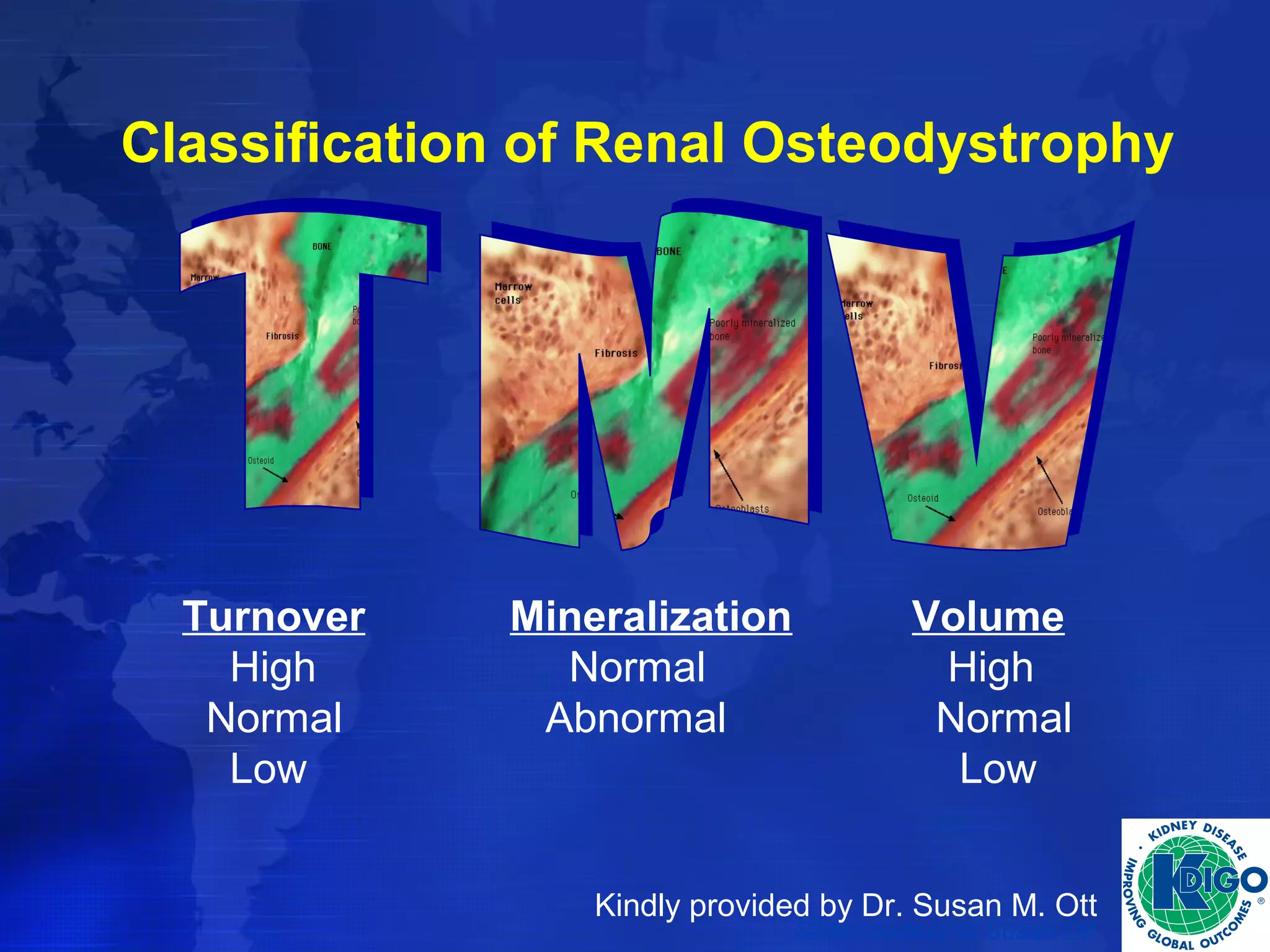
Classification of Renal Osteodystrophy 
Turnover 
High 
Normal 
Low 
Mineralization 
Normal 
Abnormal 
Volume 
High 
Normal 
Low 
Kindly provided by Dr. Susan M. Ott 
Slide courtesy of Susan Ott
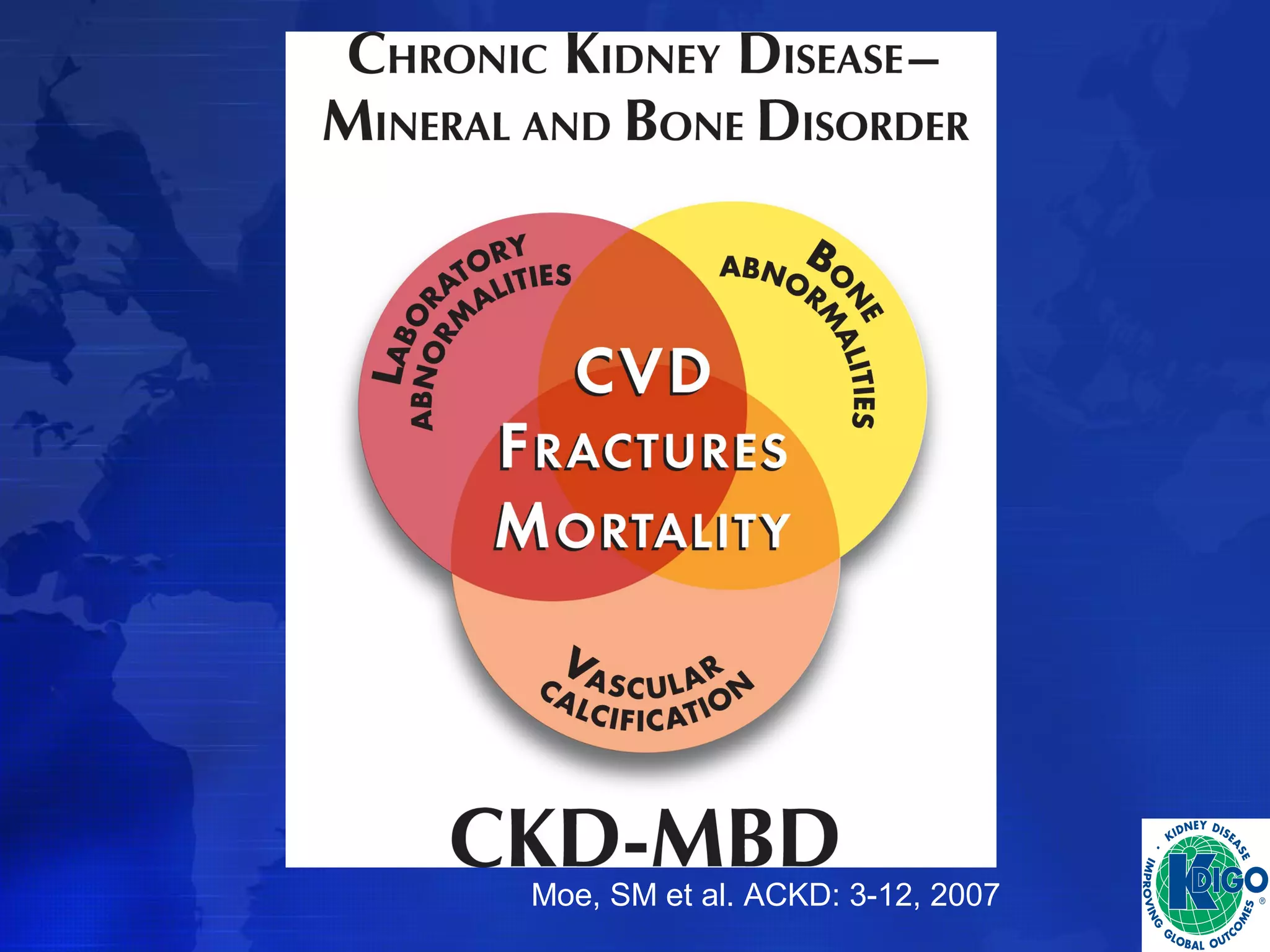
Moe, SM et al. ACKD: 3-12, 2007
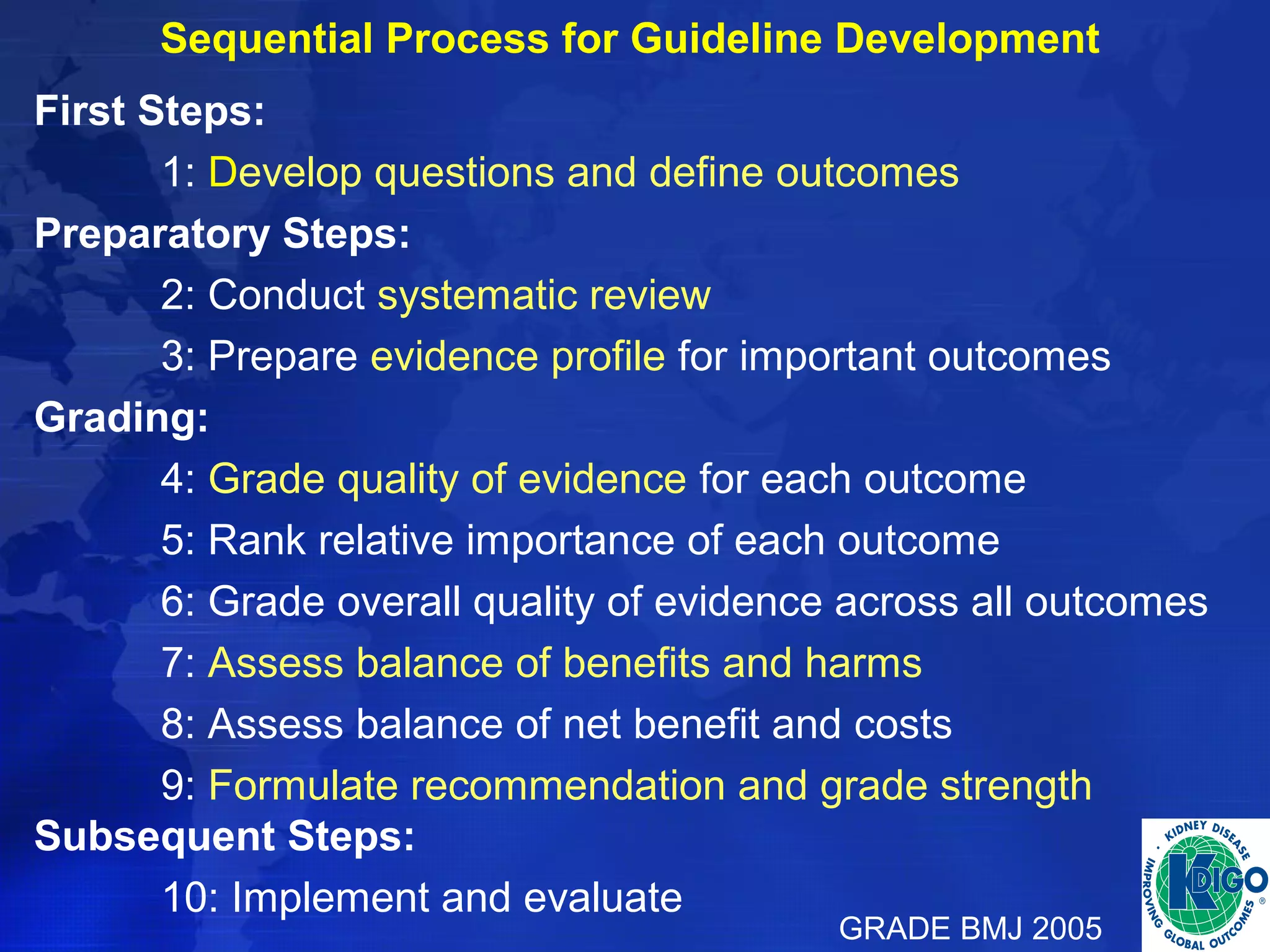
Sequential Process for Guideline Development 
First Steps: 
1: Develop questions and define outcomes 
Preparatory Steps: 
2: Conduct systematic review 
3: Prepare evidence profile for important outcomes 
Grading: 
4: Grade quality of evidence for each outcome 
5: Rank relative importance of each outcome 
6: Grade overall quality of evidence across all outcomes 
7: Assess balance of benefits and harms 
8: Assess balance of net benefit and costs 
9: Formulate recommendation and grade strength 
Subsequent Steps: 
10: Implement and evaluate 
GRADE BMJ 2005
Extensive Guideline Review Process 
• KDIGO Executive Committee and Board 
• Representatives of Five International 
Guideline Development Groups 
• Organizational, Stakeholder, and Public 
Review 
• All comments submitted at each phase of 
the review process are carefully reviewed 
and considered by the Work Group prior 
to publication of the final guideline
Chapter 2 
Methodological 
Approach
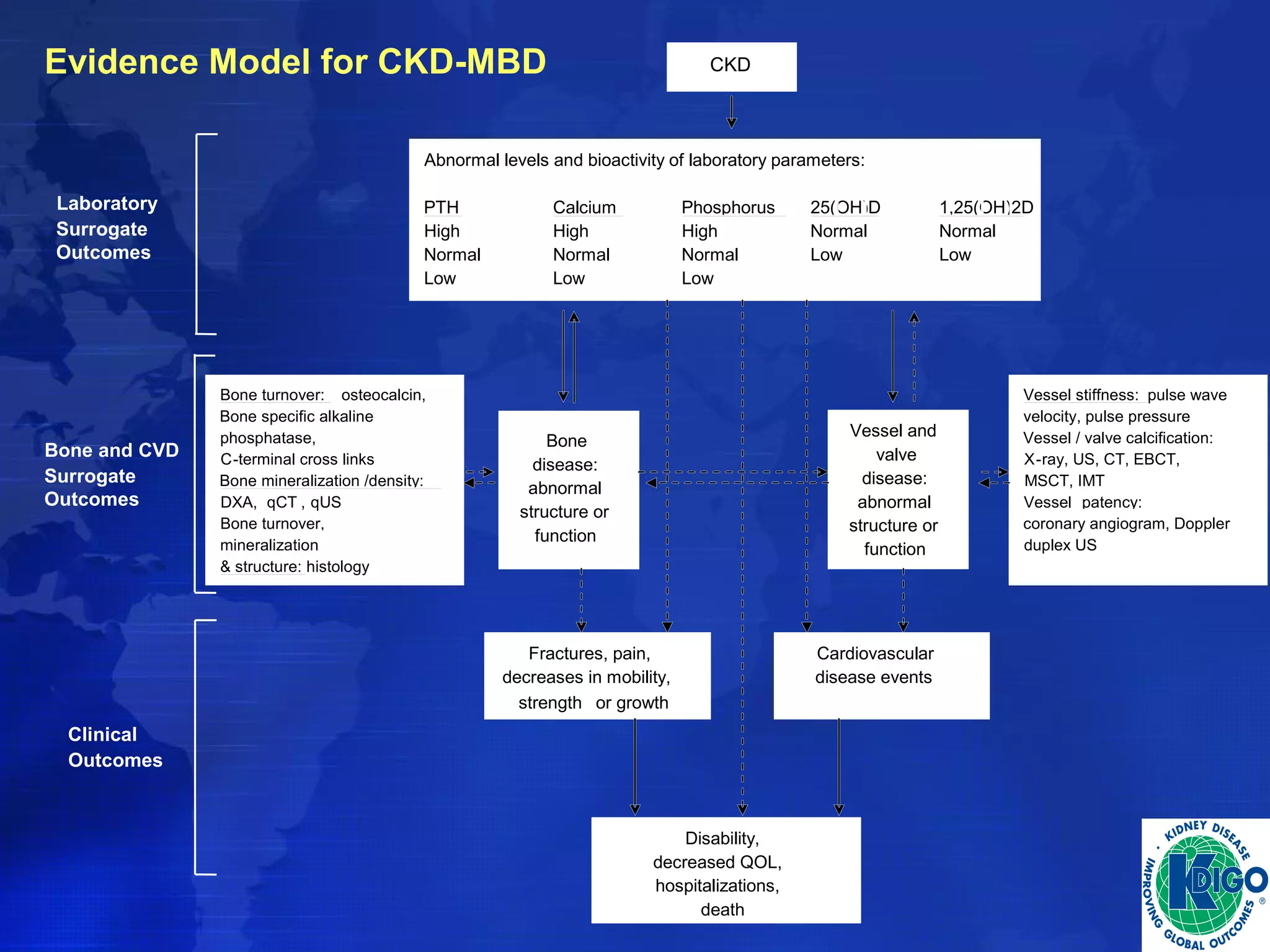
CKD 
Abnormal levels and bioactivity of laboratory parameters: 
PTH Calcium Phosphorus 25(OH)D 1,25(OH)2D 
High High High Normal Normal 
Normal Normal Normal Low Low 
Low Low Low 
Bone 
disease: 
abnormal 
structure or 
function 
Fractures, pain, 
decreases in mobility, 
strength or growth 
Cardiovascular 
disease events 
Disability, 
decreased QOL, 
hospitalizations, 
death 
Laboratory 
Surrogate 
Outcomes 
Bone and CVD 
Surrogate 
Outcomes 
Clinical 
Outcomes 
Vessel and 
valve 
disease: 
abnormal 
structure or 
function 
Bone turnover: osteocalcin, 
Bone specific alkaline 
phosphatase, 
C-terminal cross links 
Bone mineralization /density: 
DXA, qCT , qUS 
Bone turnover, 
mineralization 
& structure: histology 
Vessel stiffness: pulse wave 
velocity, pulse pressure 
Vessel / valve calcification: 
X-ray, US, CT, EBCT, 
MSCT, IMT 
Vessel patency: 
coronary angiogram, Doppler 
duplex US 
Evidence Model for CKD-MBD
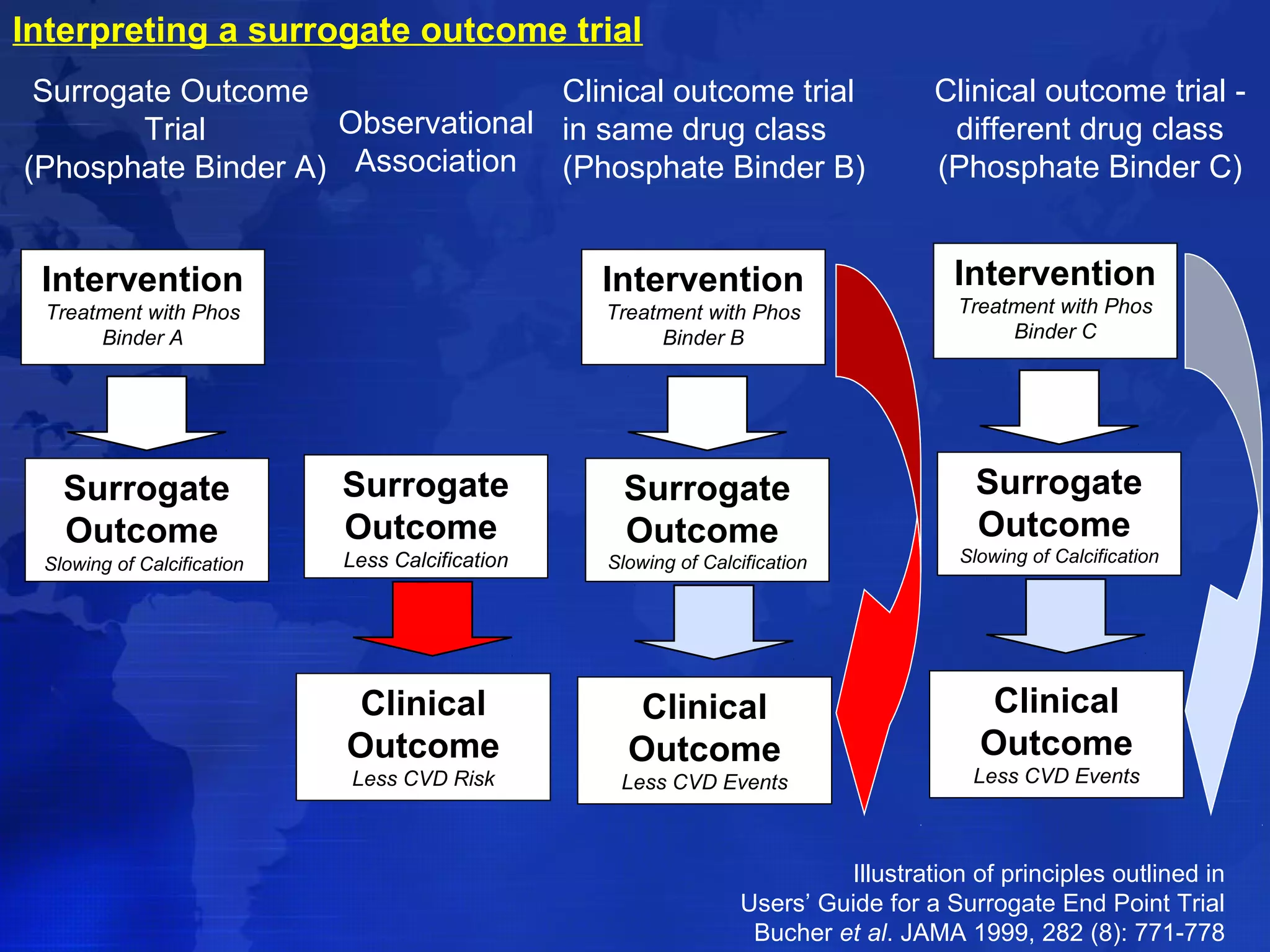
Intervention 
Treatment with Phos 
Binder B 
Surrogate 
Outcome 
Slowing of Calcification 
Clinical 
Outcome 
Less CVD Events 
Surrogate Outcome 
Trial 
(Phosphate Binder A) 
Intervention 
Treatment with Phos 
Binder A 
Surrogate 
Outcome 
Slowing of Calcification 
Clinical outcome trial 
in same drug class 
(Phosphate Binder B) 
Clinical outcome trial - 
different drug class 
(Phosphate Binder C) 
Intervention 
Treatment with Phos 
Binder C 
Surrogate 
Outcome 
Slowing of Calcification 
Clinical 
Outcome 
Less CVD Events 
Observational 
Association 
Surrogate 
Outcome 
Less Calcification 
Clinical 
Outcome 
Less CVD Risk 
Illustration of principles outlined in 
Users’ Guide for a Surrogate End Point Trial 
Bucher et al. JAMA 1999, 282 (8): 771-778 
Interpreting a surrogate outcome trial
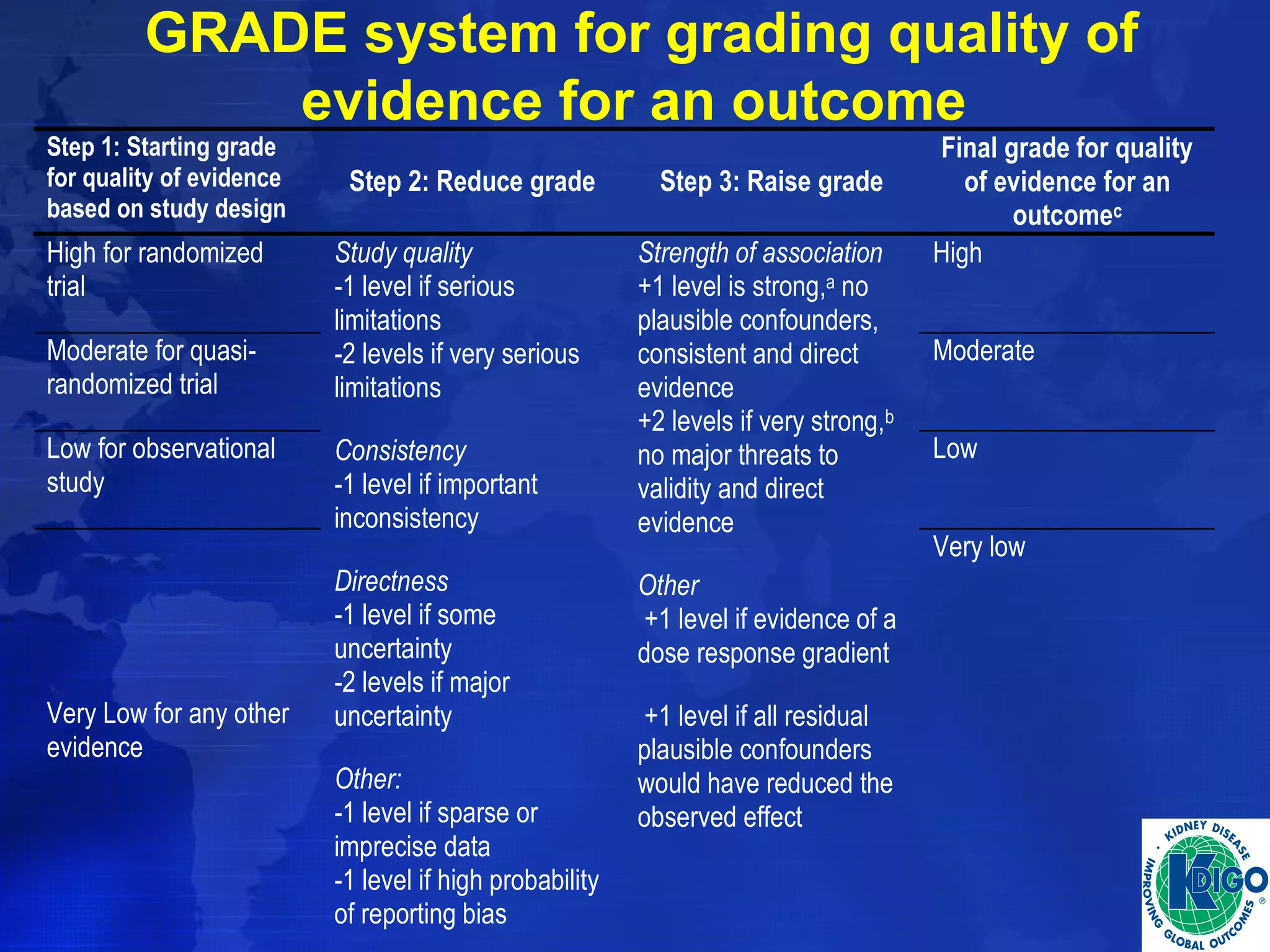
GRADE system for grading quality of 
evidence for an outcome 
Step 1: Starting grade 
for quality of evidence 
based on study design 
Step 2: Reduce grade Step 3: Raise grade 
Final grade for quality 
of evidence for an 
outcomec 
High for randomized 
trial 
High 
Moderate for quasi-randomized 
trial 
Moderate 
Low for observational 
study 
Low 
Very Low for any other 
evidence 
Study quality 
-1 level if serious 
limitations 
-2 levels if very serious 
limitations 
Consistency 
-1 level if important 
inconsistency 
Directness 
-1 level if some 
uncertainty 
-2 levels if major 
uncertainty 
Other: 
-1 level if sparse or 
imprecise data 
-1 level if high probability 
of reporting bias 
Strength of association 
+1 level is strong,a no 
plausible confounders, 
consistent and direct 
evidence 
+2 levels if very strong,b 
no major threats to 
validity and direct 
evidence 
Other 
+1 level if evidence of a 
dose response gradient 
+1 level if all residual 
plausible confounders 
would have reduced the 
observed effect 
Very low
Final grade for overall quality of evidence 
Grade 
Quality 
of 
Evidence 
Meaning 
A High We are confident that the true effect lies close to 
that of the estimate of the effect. 
B 
Moderate The true effect is likely to be close to the estimate of 
the effect, but there is a possibility that it is 
substantially different. 
C Low The true effect may be substantially different from 
the estimate of the effect. 
D Very low The estimate of effect is very uncertain, and often 
will be far from the truth. 
Guyatt GH, et al. BMJ 336: 1049, 2008
Nomenclature and Description for Rating Guideline 
Recommendations 
Grade 
Implications 
Patients Clinicians Policy 
Level 1 
“We recommend” 
Most people in your 
situation would want the 
recommended course of 
action and only a small 
proportion would not. 
Most patients should 
receive the 
recommended course 
of action. 
The recommendation 
can be adopted as a 
policy in most 
situations. 
Level 2 
“We suggest” 
The majority of people in 
your situation would 
want the recommended 
course of action, but 
many would not. 
Different choices will 
be appropriate for 
different patients. Each 
patient needs help to 
arrive at a 
management decision 
consistent with her or 
his values and 
preferences. 
The recommendation is 
likely to require debate 
and involvement of 
stakeholders before 
policy can be 
determined.
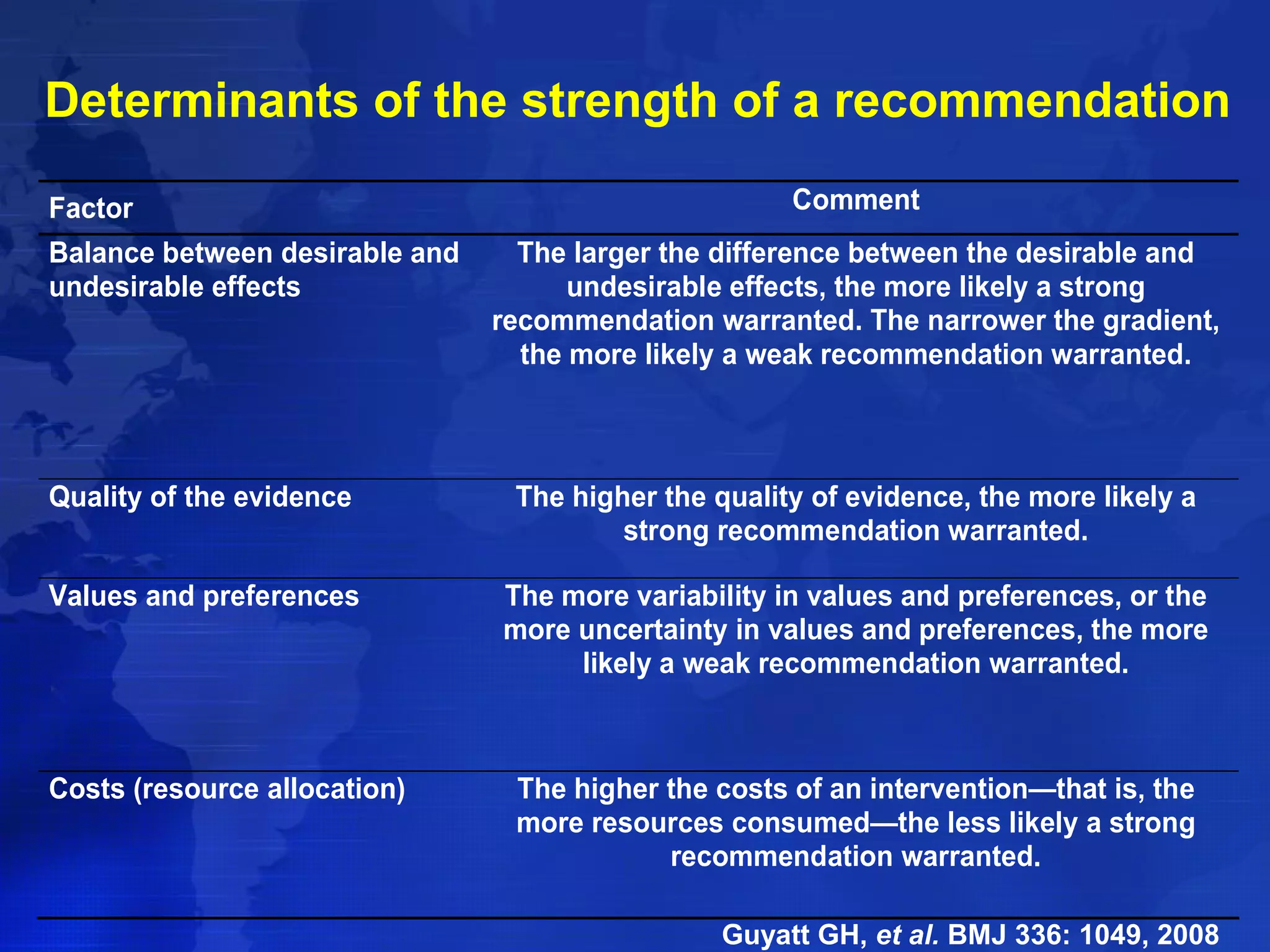
Determinants of the strength of a recommendation 
Factor Comment 
Balance between desirable and 
undesirable effects 
The larger the difference between the desirable and 
undesirable effects, the more likely a strong 
recommendation warranted. The narrower the gradient, 
the more likely a weak recommendation warranted. 
Quality of the evidence The higher the quality of evidence, the more likely a 
strong recommendation warranted. 
Values and preferences The more variability in values and preferences, or the 
more uncertainty in values and preferences, the more 
likely a weak recommendation warranted. 
Costs (resource allocation) The higher the costs of an intervention—that is, the 
more resources consumed—the less likely a strong 
recommendation warranted. 
Guyatt GH, et al. BMJ 336: 1049, 2008
Final KDIGO Grading of Recommendations 
Grade for 
Strength of 
Recommendation Strength Wording 
Grade for 
Quality of 
Evidence 
Quality of 
Evidence 
Level 1 Strong “We A High 
recommend… 
should” B Moderate 
Level 2 Weak “We suggest… C Low 
might” 
D Very low 
Grading Options: 1A, 1B, 1C, 1D, 2A, 2B, 2C, 2D, or “not graded”
Chapter 3.1 
Diagnosis of CKD-MBD: 
Biochemical 
Abnormalities
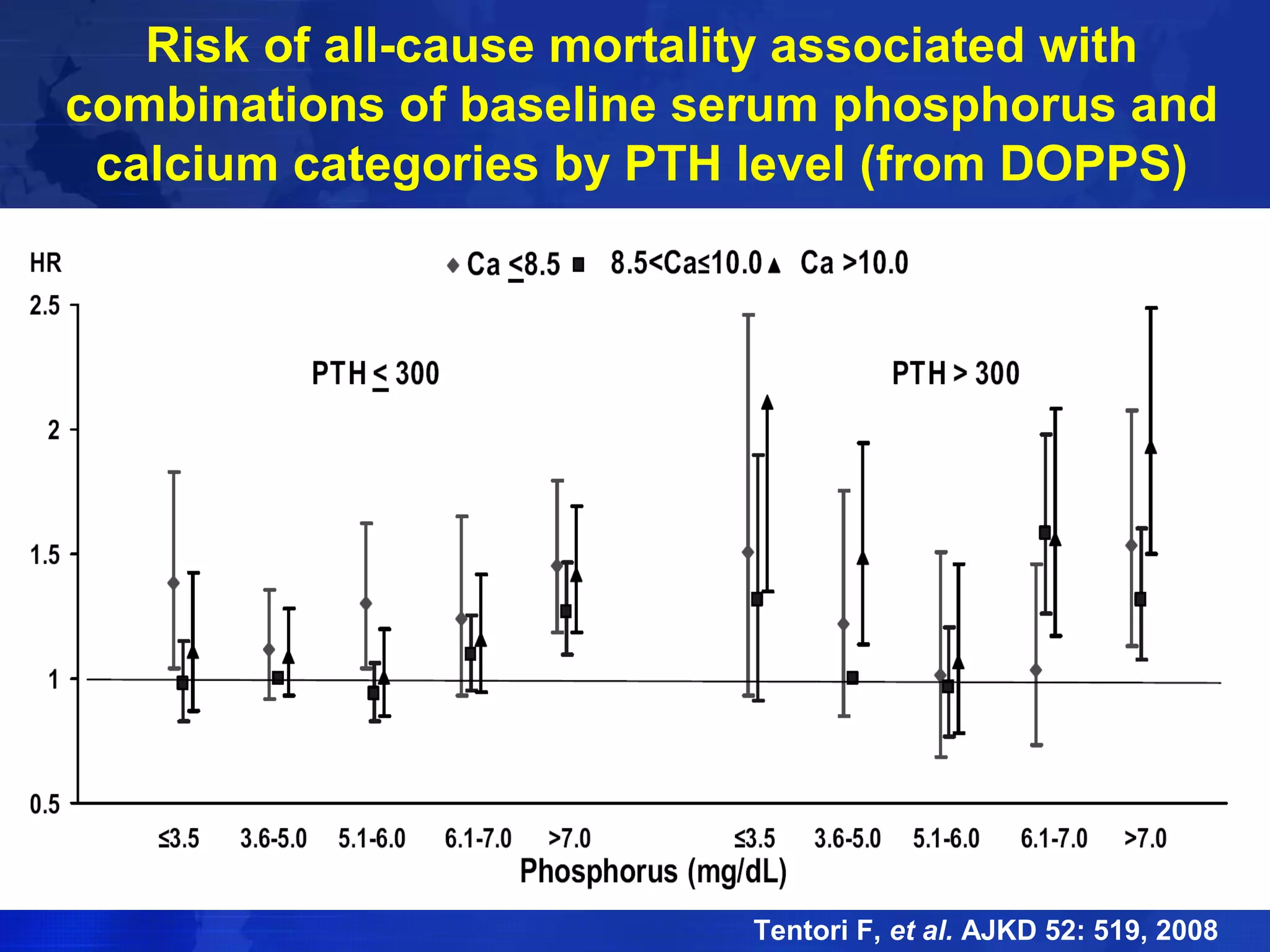
Risk of all-cause mortality associated with 
combinations of baseline serum phosphorus and 
calcium categories by PTH level (from DOPPS) 
Tentori F, et al. AJKD 52: 519, 2008
Diagnosis of CKD-MBD: 
Biochemical Abnormalities 
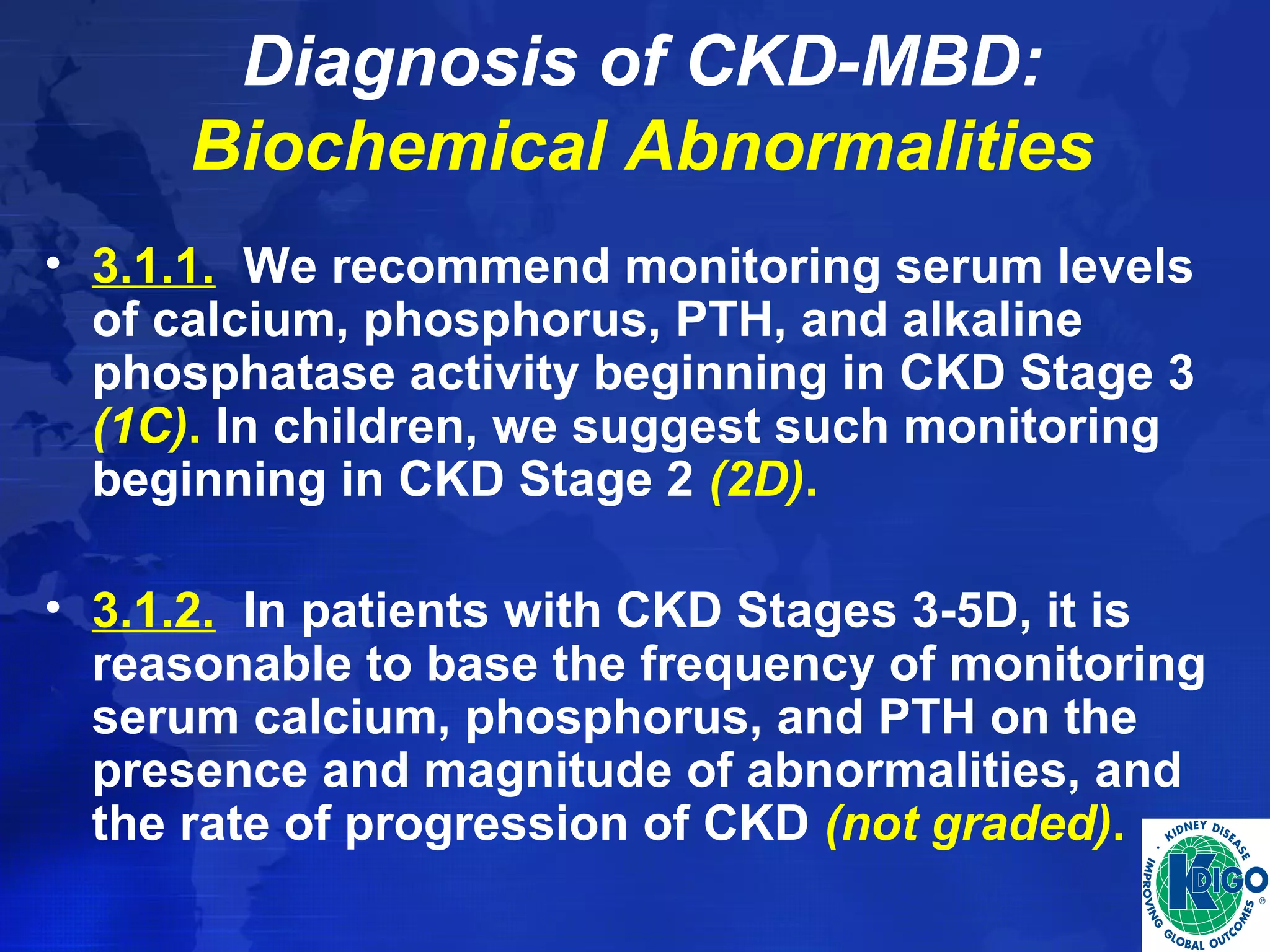
• 3.1.1. We recommend monitoring serum levels 
of calcium, phosphorus, PTH, and alkaline 
phosphatase activity beginning in CKD Stage 3 
(1C). In children, we suggest such monitoring 
beginning in CKD Stage 2 (2D). 
• 3.1.2. In patients with CKD Stages 3-5D, it is 
reasonable to base the frequency of monitoring 
serum calcium, phosphorus, and PTH on the 
presence and magnitude of abnormalities, and 
the rate of progression of CKD (not graded).
Diagnosis of CKD-MBD: 
Biochemical Abnormalities 
3.1.2: Reasonable monitoring intervals would be: 
• In CKD stage 3: for serum calcium and 
phosphorus, every 6-12 months; and for PTH, 
based on baseline level and CKD progression. 
• In CKD stage 4: for serum calcium and 
phosphorus, every 3-6 months; and for PTH, 
every 6-12 months. 
• In CKD stages 5, including 5D: for serum 
calcium and phosphorus, every 1-3 months; 
and for PTH, every 3-6 months.
Diagnosis of CKD-MBD: 
Biochemical Abnormalities 
3.1.2: Reasonable monitoring intervals would be: 
• In CKD stages 4-5D: for alkaline phosphatase 
activity, every 12 months, or more frequently in the 
presence of elevated PTH (see Chapter 3.2). 
In CKD patients receiving treatments for CKD-MBD, 
or in whom biochemical abnormalities are identified, 
it is reasonable to increase the frequency of 
measurements to monitor for trends and treatment 
efficacy and side-effects (not graded).
Diagnosis of CKD-MBD: 
Biochemical Abnormalities 
• 3.1.3. In patients with CKD stages 3–5D, we suggest 
that 25(OH)D (calcidiol) levels might be measured, 
and repeated testing determined by baseline values 
and therapeutic interventions (2C). We suggest that 
vitamin D deficiency and insufficiency be corrected 
using treatment strategies recommended for the 
general population (2C). 
• 3.1.4. In patients with CKD stages 3–5D, we 
recommend that therapeutic decisions be based on 
trends rather than on a single laboratory value, 
taking into account all available CKD–MBD 
assessments (1C).
Diagnosis of CKD-MBD: 
Biochemical Abnormalities 
• 3.1.5. In patients with CKD stages 3–5D, we suggest 
that individual values of serum calcium and 
phosphorus, evaluated together, be used to guide 
clinical practice rather than the mathematical 
construct of calcium-phosphorus product (Ca X P) 
(2D). 
• 3.1.6. In reports of laboratory tests for patients with 
CKD stages 3–5D, we recommend that clinical 
laboratories inform clinicians of the actual assay 
method in use and report any change in methods, 
sample source (plasma or serum), and handling 
specifications to facilitate the appropriate 
interpretation of biochemistry data (1B).
Chapter 3.2 
Diagnosis of CKD-MBD: 
Bone
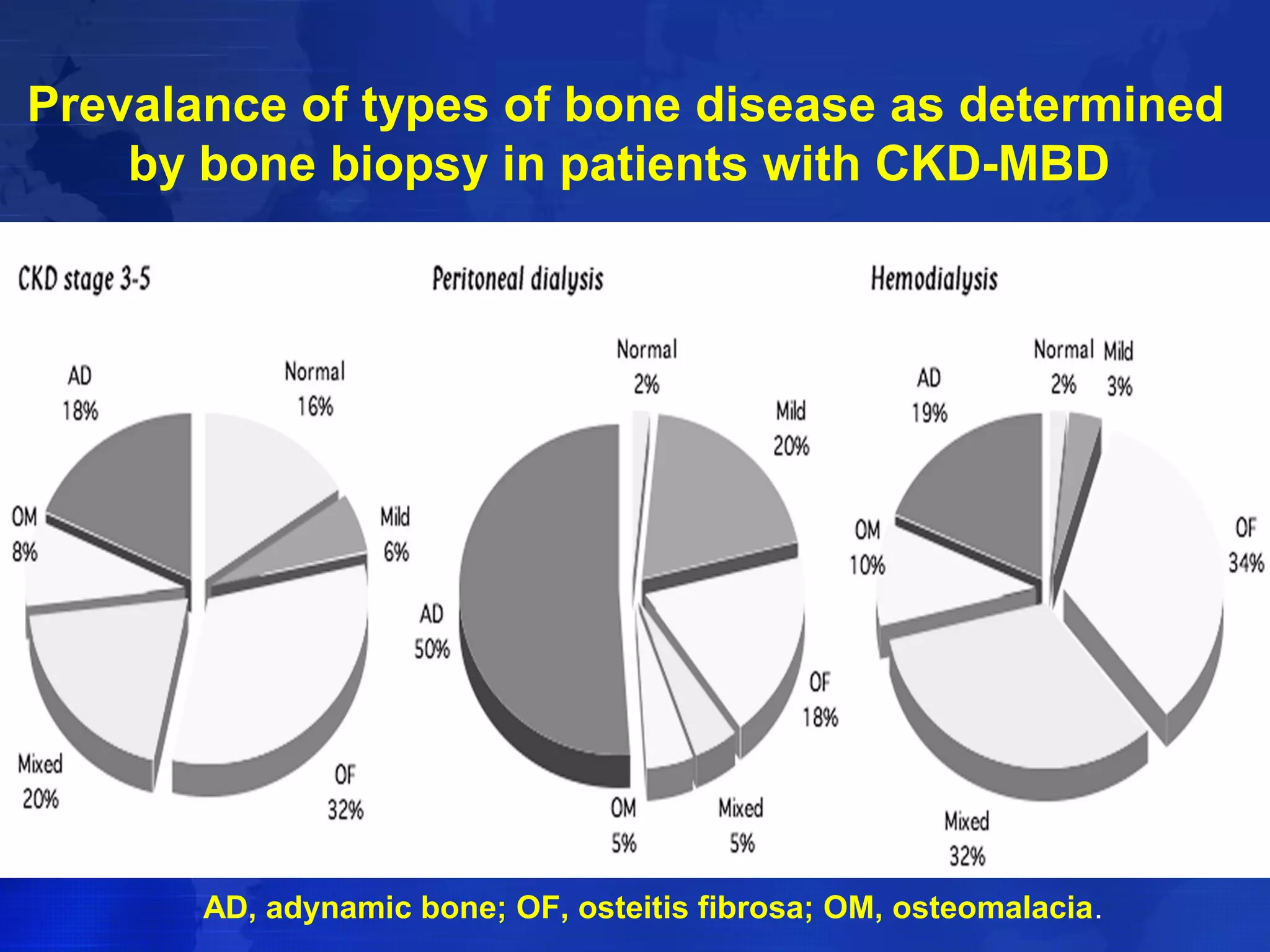
Prevalance of types of bone disease as determined 
by bone biopsy in patients with CKD-MBD 
AD, adynamic bone; OF, osteitis fibrosa; OM, osteomalacia.
Diagnosis of CKD-MBD: Bone 
• 3.2.1. In patients with CKD stages 3–5D, it is 
reasonable to perform a bone biopsy in various 
settings including, but not limited to: unexplained 
fractures, persistent bone pain, unexplained 
hypercalcemia, unexplained hypophosphatemia, 
possible aluminum toxicity, and prior to therapy 
with bisphosphonates in patients with CKD–MBD 
(not graded). 
• 3.2.2. In patients with CKD stages 3–5D with 
evidence of CKD–MBD, we suggest that BMD 
testing not be performed routinely, because BMD 
does not predict fracture risk as it does in the 
general population, and BMD does not predict the 
type of renal osteodystrophy (2B).
Diagnosis of CKD-MBD: Bone 
• 3.2.3. In patients with CKD stages 3–5D, we 
suggest that measurements of serum PTH or bone-specific 
alkaline phosphatase can be used to 
evaluate bone disease because markedly high or 
low values predict underlying bone turnover (2B). 
• 3.2.4. In patients with CKD stages 3–5D, we 
suggest not to routinely measure bone-derived 
turnover markers of collagen synthesis (such as 
procollagen type I C-terminal propeptide) and 
breakdown (such as type I collagen cross-linked 
telopeptide, cross-laps, pyridinoline, or 
deoxypyridinoline) (2C).
Diagnosis of CKD-MBD: Bone 
• 3.2.5. We recommend that infants with 
CKD stages 2–5D should have their length 
measured at least quarterly, while children 
with CKD stages 2–5D should be 
assessed for linear growth at least 
annually (1B).
Chapter 3.3 
Diagnosis of CKD-MBD: 
Vascular Calcification
Diagnosis of CKD-MBD: 
Vascular Calcification 
• 3.3.1. In patients with CKD stages 3–5D, we suggest 
that a lateral abdominal radiograph can be used to 
detect the presence or absence of vascular 
calcification, and an echocardiogram can be used to 
detect the presence or absence of valvular 
calcification, as reasonable alternatives to computed 
tomography-based imaging (2C). 
• 3.3.2. We suggest that patients with CKD stages 3–5D 
with known vascular/valvular calcification be 
considered at highest cardiovascular risk (2A). It is 
reasonable to use this information to guide the 
management of CKD–MBD (not graded).
Chapter 4.1 
Treatment of CKD-MBD Targeted at 
Lowering High Serum 
Phosphorus and Maintaining 
Serum Calcium
Treatment of CKD-MBD: 
Phosphorus and Calcium 
• 4.1.1. In patients with CKD stages 3–5, we 
suggest maintaining serum phosphorus in the 
normal range (2C). In patients with CKD stage 
5D, we suggest lowering elevated phosphorus 
levels toward the normal range (2C). 
• 4.1.2. In patients with CKD stages 3–5D, we 
suggest maintaining serum calcium in the 
normal range (2D).
Treatment of CKD-MBD: 
Phosphorus and Calcium 
• 4.1.3. In patients with CKD stage 5D, we suggest 
using a dialysate calcium concentration between 
1.25 and 1.50 mmol/l (2.5 and 3.0 mEq/l) (2D). 
• 4.1.4. In patients with CKD stages 3–5 (2D) and 
5D (2B), we suggest using phosphate-binding 
agents in the treatment of hyperphosphatemia. It 
is reasonable that the choice of phosphate 
binder takes into account CKD stage, presence 
of other components of CKD–MBD, concomitant 
therapies, and side-effect profile (not graded).
Treatment of CKD-MBD: 
Phosphorus and Calcium 
• 4.1.5. In patients with CKD stages 3–5D and 
hyperphosphatemia, we recommend restricting 
the dose of calcium-based phosphate binders 
and/or the dose of calcitriol or vitamin D analog 
in the presence of persistent or recurrent 
hypercalcemia (1B). 
• In patients with CKD stages 3–5D and 
hyperphosphatemia, we suggest restricting the 
dose of calcium based phosphate binders in the 
presence of arterial calcification (2C) and/or 
adynamic bone disease (2C) and/or if serum PTH 
levels are persistently low (2C).
Treatment of CKD-MBD: 
Phosphorus and Calcium 
• 4.1.6. In patients with CKD stages 3–5D, we 
recommend avoiding the long-term use of 
aluminum-containing phosphate binders and, in 
patients with CKD stage 5D, avoiding dialysate 
aluminum contamination to prevent aluminum 
intoxication (1C). 
• 4.1.7. In patients with CKD stages 3–5D, we suggest 
limiting dietary phosphate intake in the treatment of 
hyperphosphatemia alone or in combination with 
other treatments (2D). 
• 4.1.8. In patients with CKD stage 5D, we suggest 
increasing dialytic phosphate removal in the 
treatment of persistent hyperphosphatemia (2C).
Chapter 4.2 
Treatment of Abnormal PTH 
Levels in CKD-MBD
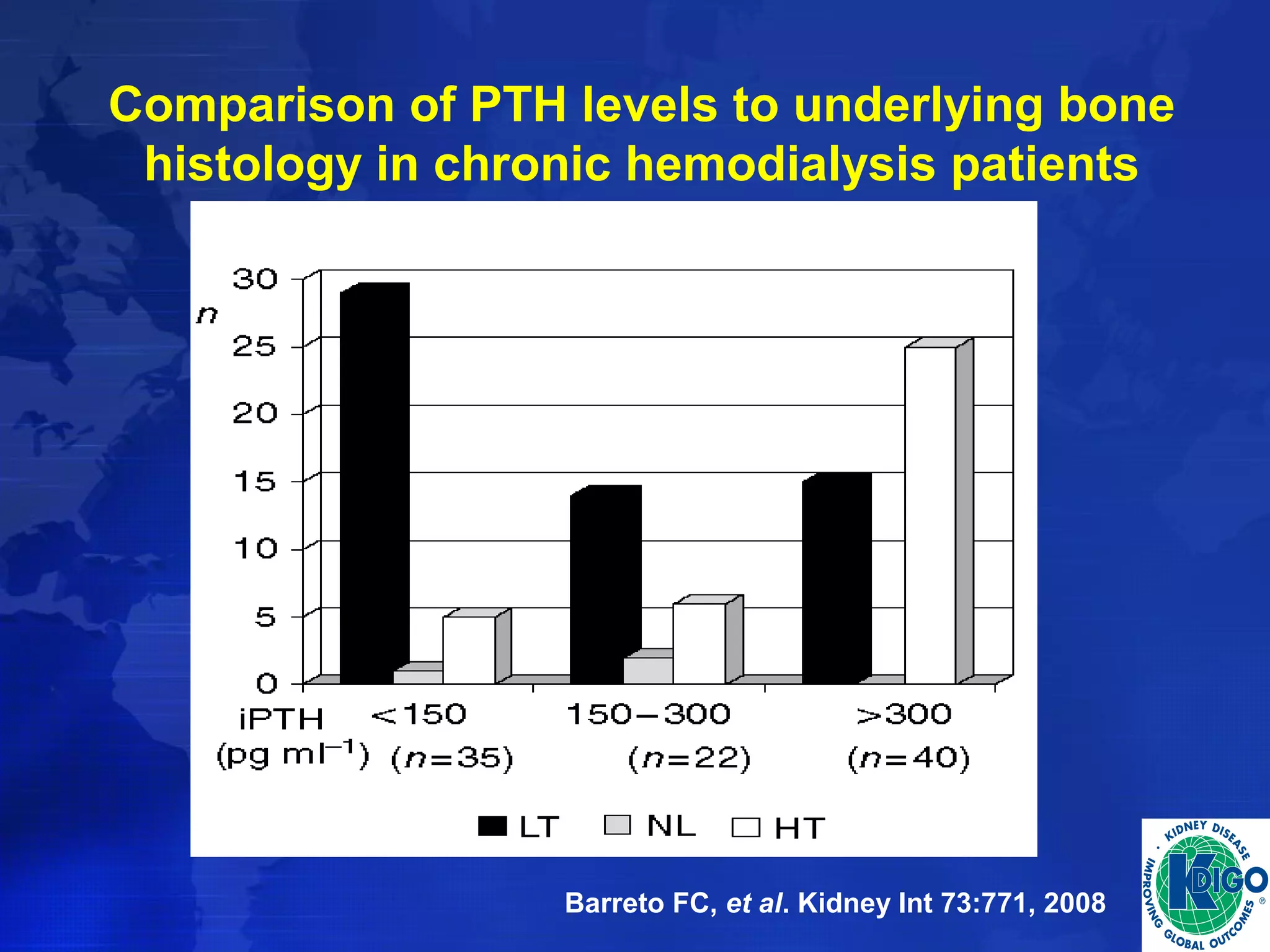
Comparison of PTH levels to underlying bone 
histology in chronic hemodialysis patients 
Barreto FC, et al. Kidney Int 73:771, 2008
Treatment of CKD-MBD: 
Abnormal PTH Levels 
• 4.2.1. In patients with CKD stages 3–5 not on 
dialysis, the optimal PTH level is not known. 
However, we suggest that patients with levels of 
intact PTH (iPTH) above the upper normal limit of 
the assay are first evaluated for 
hyperphosphatemia, hypocalcemia, and vitamin D 
deficiency (2C). 
It is reasonable to correct these abnormalities with 
any or all of the following: reducing dietary 
phosphate intake and administering phosphate 
binders, calcium supplements, and/or native 
vitamin D (not graded).
Treatment of CKD-MBD: 
Abnormal PTH Levels 
• 4.2.2. In patients with CKD stages 3–5 not on 
dialysis, in whom serum PTH is progressively 
rising and remains persistently above the 
upper limit of normal for the assay despite 
correction of modifiable factors, we suggest 
treatment with calcitriol or vitamin D analogs 
(2C).
Treatment of CKD-MBD: 
Abnormal PTH Levels 
• 4.2.3. In patients with CKD stage 5D, we 
suggest maintaining iPTH levels in the range 
of approximately two to nine times the upper 
normal limit for the assay (2C). 
We suggest that marked changes in PTH 
levels in either direction within this range 
prompt an initiation or change in therapy to 
avoid progression to levels outside of this 
range (2C).
Treatment of CKD-MBD: 
Abnormal PTH Levels 
• 4.2.4. In patients with CKD stage 5D and elevated or 
rising PTH, we suggest calcitriol, or vitamin D 
analogs, or calcimimetics, or a combination of 
calcimimetics and calcitriol or vitamin D analogs be 
used to lower PTH (2B). 
• It is reasonable that the initial drug selection for the 
treatment of elevated PTH be based on serum 
calcium and phosphorus levels and other aspects 
of CKD–MBD (not graded). 
• It is reasonable that calcium or non-calcium-based 
phosphate binder dosage be adjusted so that 
treatments to control PTH do not compromise 
levels of phosphorus and calcium (not graded).
Treatment of CKD-MBD: 
Abnormal PTH Levels 
• 4.2.4. (Continued) 
• We recommend that, in patients with 
hypercalcemia, calcitriol or another vitamin D 
sterol be reduced or stopped (1B). 
• We suggest that, in patients with 
hyperphosphatemia, calcitriol or another vitamin 
D sterol be reduced or stopped (2D). 
• We suggest that, in patients with hypocalcemia, 
calcimimetics be reduced or stopped depending 
on severity, concomitant medications, and 
clinical signs and symptoms (2D).
Treatment of CKD-MBD: 
Abnormal PTH Levels 
• 4.2.4. (Continued): 
• We suggest that, if the intact PTH levels fall 
below two times the upper limit of normal for the 
assay, calcitriol, vitamin D analogs, and/or 
calcimimetics be reduced or stopped (2C). 
• 4.2.5. In patients with CKD stages 3–5D with severe 
hyperparathyroidism (HPT) who fail to respond 
to medical/pharmacological therapy, we suggest 
parathyroidectomy (2B).
Chapter 4.3 
Treatment of Bone with 
Bisphosphonates, other 
Osteoporosis Medications, and 
Growth Hormone
Treatment of Bone: 
Osteoporosis Medications 
• 4.3.1. In patients with CKD stages 1–2 with 
osteoporosis and/or high risk of fracture, as 
identified by World Health Organization criteria, 
we recommend management as for the general 
population (1A). 
• 4.3.2. In patients with CKD stage 3 with PTH in 
the normal range and osteoporosis and/or high 
risk of fracture, as identified by World Health 
Organization criteria, we suggest treatment as 
for the general population (2B).
Treatment of Bone: 
Osteoporosis Medications 
• 4.3.3. In patients with CKD stage 3 with biochemical 
abnormalities of CKD–MBD and low BMD and/or 
fragility fractures, we suggest that treatment 
choices take into account the magnitude and 
reversibility of the biochemical abnormalities and 
the progression of CKD, with consideration of a 
bone biopsy (2D). 
• 4.3.4. In patients with CKD stages 4–5D having 
biochemical abnormalities of CKD–MBD, and low 
BMD and/or fragility fractures, we suggest 
additional investigation with bone biopsy prior 
to therapy with antiresorptive agents (2C).
Treatment of Bone: 
Growth Hormone 
• 4.3.5. In children and adolescents with 
CKD stages 2–5D and related height 
deficits, we recommend treatment with 
recombinant human growth hormone 
when additional growth is desired, after 
first addressing malnutrition and 
biochemical abnormalities of CKD–MBD 
(1A).
Chapter 5 
Evaluation and Treatment 
of Kidney Transplant 
Bone Disease
Kidney Transplant Bone Disease 
• 5.1. In patients in the immediate post–kidney-transplant 
period, we recommend measuring 
serum calcium and phosphorus at least weekly, 
until stable (1B). 
• 5.2. In patients after the immediate post–kidney 
transplant period, it is reasonable to base the 
frequency of monitoring serum calcium, 
phosphorus, and PTH on the presence and 
magnitude of abnormalities, and the rate of 
progression of CKD (not graded).
Kidney Transplant Bone Disease 
• 5.2. (Continued): 
Reasonable monitoring intervals would be: 
• In CKD stages 1–3T, for serum calcium and 
phosphorus, every 6–12 months; and for 
PTH, once, with subsequent intervals 
depending on baseline level and CKD 
progression. 
• In CKD stage 4T, for serum calcium and 
phosphorus, every 3–6 months; and for 
PTH, every 6–12 months.
Kidney Transplant Bone Disease 
• 5.2. (Continued): 
Reasonable monitoring intervals would be: 
• In CKD stage 5T, for serum calcium and 
phosphorus, every 1–3 months; and for 
PTH, every 3–6 months. 
• In CKD stages 3–5T, measurement of 
alkaline phosphatases annually, or more 
frequently in the presence of elevated PTH 
(see Chapter 3.2).
Kidney Transplant Bone Disease 
• 5.2. (Continued) 
In CKD patients receiving treatments for CKD– 
MBD, or in whom biochemical abnormalities are 
identified, it is reasonable to increase the 
frequency of measurements to monitor for 
efficacy and side-effects (not graded). 
It is reasonable to manage these abnormalities 
as for patients with CKD stages 3–5 (not graded) 
(see Chapters 4.1 and 4.2).
Kidney Transplant Bone Disease 
• 5.3 In patients with CKD stages 1–5T, we suggest 
that 25(OH)D (calcidiol) levels might be measured, 
and repeated testing determined by baseline values 
and interventions (2C). 
• 5.4. In patients with CKD stages 1–5T, we suggest 
that vitamin D deficiency and insufficiency be 
corrected using treatment strategies recommended 
for the general population (2C). 
• 5.5. In patients with an estimated glomerular 
filtration rate greater than approximately 30 ml/min 
per 1.73m2, we suggest measuring BMD in the first 3 
months after kidney transplant if they receive 
corticosteroids, or have risk factors for 
osteoporosis as in the general population (2D).
Kidney Transplant Bone Disease 
• 5.6 In patients in the first 12 months after kidney 
transplant with an estimated glomerular filtration rate 
greater than approximately 30 ml/min per 1.73m2 and low 
BMD, we suggest that treatment with vitamin D, calcitriol 
/ alfacalcidol, or bisphosphonates be considered (2D). 
• We suggest that treatment choices be influenced by the 
presence of CKD–MBD, as indicated by abnormal levels of 
calcium, phosphorus, PTH, alkaline phosphatases, and 
25(OH)D (2C). 
• It is reasonable to consider a bone biopsy to guide 
treatment, specifically before the use of bisphosphonates 
due to the high incidence of adynamic bone disease (not 
graded). 
There are insufficient data to guide treatment after 
the first 12 months.
Kidney Transplant Bone Disease 
• 5.7. In patients with CKD stages 4–5T, we 
suggest that BMD testing not be performed 
routinely, because BMD does not predict 
fracture risk as it does in the general population 
and BMD does not predict the type of kidney 
transplant bone disease (2B). 
• 5.8. In patients with CKD stages 4–5T with 
known low BMD, we suggest management as for 
patients with CKD stages 4–5 not on dialysis, as 
detailed in Chapters 4.1 and 4.2 (2C).
Research Recommendations 
• Develop a risk-stratification tool based on CKD-MBD 
components and evaluate its predictive 
accuracy for clinical outcomes in patients with CKD 
stages 3-5, 5D, and 3-5T. 
• Determine if, in patients with CKD-MBD, a single 
measurement of BMD (measured by DXA or qCT) 
and serial changes in BMD predict fractures. 
• Determine if the presence or absence of 
vascular/valvular calcification in patients with CKD-MBD 
is an appropriate stratification and selection 
tool to identify individuals who may benefit from 
specific interventions.
Research Recommendations 
• Determine if the effect of an intensive CKD-MBD 
treatment approach (e.g., protocol-driven combination 
therapy to achieve specific serum phosphorus and PTH 
targets) vs. a less intensive treatment approach (e.g., 
protocol-driven combination therapy allowing higher 
serum phosphorus and PTH targets) vs. standard care 
improves clinical outcomes in patients with CKD stages 
3-5D. 
• Determine if treating down to normal serum phosphorus 
levels (as compared to phosphorus levels of 5.5-6.5 
mg/dL) with the use of combinations of different 
phosphate binders and other approaches improves 
clinical outcomes in patients with CKD stages 4-5D 
and 4-5T.
Research Recommendations 
• Determine if treatment to a lower vs. a higher serum 
PTH target improves or worsens clinical outcomes 
in patients with CKD stages 3-5, CKD stage 5D, and 
CKD stages 3-5T. 
• Determine if treatment with vitamin D (ergocalciferol 
or cholecalciferol) or calcidiol [25(OH)D], compared 
to calcitriol or vitamin D analogs, improves clinical 
outcomes in patients with CKD stages 3-5, CKD 
stage 5D, and CKD stages 1-5T. 
• Determine which phosphate binders and other 
serum phosphorus–lowering treatments are able to 
improve survival in patients with CKD 
stages 3-5D and CKD stages 3-5T.
Research Recommendations 
• Determine if treatment with bisphosphonates, 
teriparatide, or raloxifene reduces fractures or 
vascular calcification in patients with CKD stages 
3-5D and CKD stages 1-5T. 
• Determine if strategies to reverse adynamic bone 
disease by measures such as endogenous 
stimulation of PTH secretion (e.g., using low-calcium 
dialysate) or exogenous teriparatide 
administration impact clinical outcomes in patients 
with CKD stages 4-5D or CKD stages 1-5T, 
compared to placebo.
Questions

Ckd mbd guideline

  • 1.
    KDIGO Clinical PracticeGuideline Diagnosis, Evaluation, Prevention, and Treatment of Chronic Kidney Disease - Mineral and Bone Disorder (CKD-MBD)
  • 2.
    Kidney Disease: ImprovingGlobal Outcomes An independently incorporated nonprofit foundation, governed by an international board with the stated mission to: ‘Improve the care and outcomes of kidney disease patients worldwide through promoting coordination, collaboration, and integration of initiatives to develop and implement clinical practice guidelines.’
  • 3.
    KDIGO CKD-MBD GuidelineWork Group Members • Sharon M. Moe, MD, FASN, FAHA, FACP (Co-chair) United States • Geoffrey A. Block, MD United States • Jorge B. Cannata-Andía, MD, PhD Spain • Grahame J. Elder, MB, BS, PhD, FRACP Australia • Masafumi Fukagawa, MD, PhD, FASN Japan • Vanda Jorgetti, MD, PhD Brazil • Markus Ketteler, MD Germany • Craig B. Langman, MD United States • Adeera Levin, MD, FRCPC Canada • Tilman B. Drüeke, MD, FRCP (Co-chair) France • Alison M. MacLeod, MBChB, MD, FRCP United Kingdom • Linda McCann, RD, CSR, LD United States • Peter A. McCullough, MD, MPH, FACC, FACP, FCCP, FAHA United States • Susan M. Ott, MD United States • Angela Yee-Moon Wang, MD, PhD, FRCP Hong Kong • José R. Weisinger, MD, FACP Venezuela & United States • David C. Wheeler, MD, FRCP United Kingdom
  • 4.
    CKD-MBD Guideline EvidenceReview Team Tufts Medical Center ERT • Katrin Uhlig, MD, MS Project Director; Director, Guideline Development • Ranjani Moorthi, MD, MPH, MS Assistant Project Director • Amy Earley, BS Project Coordinator • Rebecca Persson, BA Research Assistant International Methods Consultant • Alison M. MacLeod, MBChB, MD, FRCP United Kingdom
  • 5.
    Guideline Outline •Chapter 1: Introduction and Definition of CKD-MBD and the Development of the Guideline Statements • Chapter 2: Methodological Approach • Chapter 3.1: Diagnosis of CKD-MBD: Biochemical Abnormalities • Chapter 3.2: Diagnosis of CKD-MBD: Bone • Chapter 3.3: Diagnosis of CKD-MBD: Vascular Calcification
  • 6.
    Guideline Outline •Chapter 4.1: Treatment of CKD-MBD Targeted at Lowering High Serum Phosphorus and Maintaining Serum Calcium • Chapter 4.2: Treatment of Abnormal PTH Levels in CKD-MBD • Chapter 4.3: Treatment of Bone with Bisphosphonates, other Osteoporosis Medications, and Growth Hormone • Chapter 5: Evaluation and Treatment of Kidney Transplant Bone Disease • Chapter 6: Summary and Research
  • 7.
    Chapter 1 Introductionand Definition of CKD-MBD and the Development of the Guideline Statements
  • 8.
    Definition of CKD-Mineraland Bone Disorder A systemic disorder of mineral and bone metabolism due to CKD manifested by either one or a combination of the following: – Abnormalities of calcium, phosphorus, PTH, or vitamin D metabolism – Abnormalities in bone turnover, mineralization, volume, linear growth, or strength – Vascular or other soft tissue calcification Moe S, et al. Kidney Int 69: 1945, 2006
  • 9.
    Definition of RenalOsteodystrophy • Renal osteodystrophy is an alteration of bone morphology in patients with CKD. • It is one measure of the skeletal component of the systemic disorder of CKD-MBD that is quantifiable by histomorphometry of bone biopsy. Moe S, et al. Kidney Int 69: 1945, 2006
  • 10.
    Classification of RenalOsteodystrophy Turnover High Normal Low Mineralization Normal Abnormal Volume High Normal Low Kindly provided by Dr. Susan M. Ott Slide courtesy of Susan Ott
  • 11.
    Moe, SM etal. ACKD: 3-12, 2007
  • 12.
    Sequential Process forGuideline Development First Steps: 1: Develop questions and define outcomes Preparatory Steps: 2: Conduct systematic review 3: Prepare evidence profile for important outcomes Grading: 4: Grade quality of evidence for each outcome 5: Rank relative importance of each outcome 6: Grade overall quality of evidence across all outcomes 7: Assess balance of benefits and harms 8: Assess balance of net benefit and costs 9: Formulate recommendation and grade strength Subsequent Steps: 10: Implement and evaluate GRADE BMJ 2005
  • 13.
    Extensive Guideline ReviewProcess • KDIGO Executive Committee and Board • Representatives of Five International Guideline Development Groups • Organizational, Stakeholder, and Public Review • All comments submitted at each phase of the review process are carefully reviewed and considered by the Work Group prior to publication of the final guideline
  • 14.
  • 15.
    CKD Abnormal levelsand bioactivity of laboratory parameters: PTH Calcium Phosphorus 25(OH)D 1,25(OH)2D High High High Normal Normal Normal Normal Normal Low Low Low Low Low Bone disease: abnormal structure or function Fractures, pain, decreases in mobility, strength or growth Cardiovascular disease events Disability, decreased QOL, hospitalizations, death Laboratory Surrogate Outcomes Bone and CVD Surrogate Outcomes Clinical Outcomes Vessel and valve disease: abnormal structure or function Bone turnover: osteocalcin, Bone specific alkaline phosphatase, C-terminal cross links Bone mineralization /density: DXA, qCT , qUS Bone turnover, mineralization & structure: histology Vessel stiffness: pulse wave velocity, pulse pressure Vessel / valve calcification: X-ray, US, CT, EBCT, MSCT, IMT Vessel patency: coronary angiogram, Doppler duplex US Evidence Model for CKD-MBD
  • 16.
    Intervention Treatment withPhos Binder B Surrogate Outcome Slowing of Calcification Clinical Outcome Less CVD Events Surrogate Outcome Trial (Phosphate Binder A) Intervention Treatment with Phos Binder A Surrogate Outcome Slowing of Calcification Clinical outcome trial in same drug class (Phosphate Binder B) Clinical outcome trial - different drug class (Phosphate Binder C) Intervention Treatment with Phos Binder C Surrogate Outcome Slowing of Calcification Clinical Outcome Less CVD Events Observational Association Surrogate Outcome Less Calcification Clinical Outcome Less CVD Risk Illustration of principles outlined in Users’ Guide for a Surrogate End Point Trial Bucher et al. JAMA 1999, 282 (8): 771-778 Interpreting a surrogate outcome trial
  • 17.
    GRADE system forgrading quality of evidence for an outcome Step 1: Starting grade for quality of evidence based on study design Step 2: Reduce grade Step 3: Raise grade Final grade for quality of evidence for an outcomec High for randomized trial High Moderate for quasi-randomized trial Moderate Low for observational study Low Very Low for any other evidence Study quality -1 level if serious limitations -2 levels if very serious limitations Consistency -1 level if important inconsistency Directness -1 level if some uncertainty -2 levels if major uncertainty Other: -1 level if sparse or imprecise data -1 level if high probability of reporting bias Strength of association +1 level is strong,a no plausible confounders, consistent and direct evidence +2 levels if very strong,b no major threats to validity and direct evidence Other +1 level if evidence of a dose response gradient +1 level if all residual plausible confounders would have reduced the observed effect Very low
  • 18.
    Final grade foroverall quality of evidence Grade Quality of Evidence Meaning A High We are confident that the true effect lies close to that of the estimate of the effect. B Moderate The true effect is likely to be close to the estimate of the effect, but there is a possibility that it is substantially different. C Low The true effect may be substantially different from the estimate of the effect. D Very low The estimate of effect is very uncertain, and often will be far from the truth. Guyatt GH, et al. BMJ 336: 1049, 2008
  • 19.
    Nomenclature and Descriptionfor Rating Guideline Recommendations Grade Implications Patients Clinicians Policy Level 1 “We recommend” Most people in your situation would want the recommended course of action and only a small proportion would not. Most patients should receive the recommended course of action. The recommendation can be adopted as a policy in most situations. Level 2 “We suggest” The majority of people in your situation would want the recommended course of action, but many would not. Different choices will be appropriate for different patients. Each patient needs help to arrive at a management decision consistent with her or his values and preferences. The recommendation is likely to require debate and involvement of stakeholders before policy can be determined.
  • 20.
    Determinants of thestrength of a recommendation Factor Comment Balance between desirable and undesirable effects The larger the difference between the desirable and undesirable effects, the more likely a strong recommendation warranted. The narrower the gradient, the more likely a weak recommendation warranted. Quality of the evidence The higher the quality of evidence, the more likely a strong recommendation warranted. Values and preferences The more variability in values and preferences, or the more uncertainty in values and preferences, the more likely a weak recommendation warranted. Costs (resource allocation) The higher the costs of an intervention—that is, the more resources consumed—the less likely a strong recommendation warranted. Guyatt GH, et al. BMJ 336: 1049, 2008
  • 21.
    Final KDIGO Gradingof Recommendations Grade for Strength of Recommendation Strength Wording Grade for Quality of Evidence Quality of Evidence Level 1 Strong “We A High recommend… should” B Moderate Level 2 Weak “We suggest… C Low might” D Very low Grading Options: 1A, 1B, 1C, 1D, 2A, 2B, 2C, 2D, or “not graded”
  • 22.
    Chapter 3.1 Diagnosisof CKD-MBD: Biochemical Abnormalities
  • 23.
    Risk of all-causemortality associated with combinations of baseline serum phosphorus and calcium categories by PTH level (from DOPPS) Tentori F, et al. AJKD 52: 519, 2008
  • 24.
    Diagnosis of CKD-MBD: Biochemical Abnormalities • 3.1.1. We recommend monitoring serum levels of calcium, phosphorus, PTH, and alkaline phosphatase activity beginning in CKD Stage 3 (1C). In children, we suggest such monitoring beginning in CKD Stage 2 (2D). • 3.1.2. In patients with CKD Stages 3-5D, it is reasonable to base the frequency of monitoring serum calcium, phosphorus, and PTH on the presence and magnitude of abnormalities, and the rate of progression of CKD (not graded).
  • 25.
    Diagnosis of CKD-MBD: Biochemical Abnormalities 3.1.2: Reasonable monitoring intervals would be: • In CKD stage 3: for serum calcium and phosphorus, every 6-12 months; and for PTH, based on baseline level and CKD progression. • In CKD stage 4: for serum calcium and phosphorus, every 3-6 months; and for PTH, every 6-12 months. • In CKD stages 5, including 5D: for serum calcium and phosphorus, every 1-3 months; and for PTH, every 3-6 months.
  • 26.
    Diagnosis of CKD-MBD: Biochemical Abnormalities 3.1.2: Reasonable monitoring intervals would be: • In CKD stages 4-5D: for alkaline phosphatase activity, every 12 months, or more frequently in the presence of elevated PTH (see Chapter 3.2). In CKD patients receiving treatments for CKD-MBD, or in whom biochemical abnormalities are identified, it is reasonable to increase the frequency of measurements to monitor for trends and treatment efficacy and side-effects (not graded).
  • 27.
    Diagnosis of CKD-MBD: Biochemical Abnormalities • 3.1.3. In patients with CKD stages 3–5D, we suggest that 25(OH)D (calcidiol) levels might be measured, and repeated testing determined by baseline values and therapeutic interventions (2C). We suggest that vitamin D deficiency and insufficiency be corrected using treatment strategies recommended for the general population (2C). • 3.1.4. In patients with CKD stages 3–5D, we recommend that therapeutic decisions be based on trends rather than on a single laboratory value, taking into account all available CKD–MBD assessments (1C).
  • 28.
    Diagnosis of CKD-MBD: Biochemical Abnormalities • 3.1.5. In patients with CKD stages 3–5D, we suggest that individual values of serum calcium and phosphorus, evaluated together, be used to guide clinical practice rather than the mathematical construct of calcium-phosphorus product (Ca X P) (2D). • 3.1.6. In reports of laboratory tests for patients with CKD stages 3–5D, we recommend that clinical laboratories inform clinicians of the actual assay method in use and report any change in methods, sample source (plasma or serum), and handling specifications to facilitate the appropriate interpretation of biochemistry data (1B).
  • 29.
    Chapter 3.2 Diagnosisof CKD-MBD: Bone
  • 30.
    Prevalance of typesof bone disease as determined by bone biopsy in patients with CKD-MBD AD, adynamic bone; OF, osteitis fibrosa; OM, osteomalacia.
  • 31.
    Diagnosis of CKD-MBD:Bone • 3.2.1. In patients with CKD stages 3–5D, it is reasonable to perform a bone biopsy in various settings including, but not limited to: unexplained fractures, persistent bone pain, unexplained hypercalcemia, unexplained hypophosphatemia, possible aluminum toxicity, and prior to therapy with bisphosphonates in patients with CKD–MBD (not graded). • 3.2.2. In patients with CKD stages 3–5D with evidence of CKD–MBD, we suggest that BMD testing not be performed routinely, because BMD does not predict fracture risk as it does in the general population, and BMD does not predict the type of renal osteodystrophy (2B).
  • 32.
    Diagnosis of CKD-MBD:Bone • 3.2.3. In patients with CKD stages 3–5D, we suggest that measurements of serum PTH or bone-specific alkaline phosphatase can be used to evaluate bone disease because markedly high or low values predict underlying bone turnover (2B). • 3.2.4. In patients with CKD stages 3–5D, we suggest not to routinely measure bone-derived turnover markers of collagen synthesis (such as procollagen type I C-terminal propeptide) and breakdown (such as type I collagen cross-linked telopeptide, cross-laps, pyridinoline, or deoxypyridinoline) (2C).
  • 33.
    Diagnosis of CKD-MBD:Bone • 3.2.5. We recommend that infants with CKD stages 2–5D should have their length measured at least quarterly, while children with CKD stages 2–5D should be assessed for linear growth at least annually (1B).
  • 34.
    Chapter 3.3 Diagnosisof CKD-MBD: Vascular Calcification
  • 35.
    Diagnosis of CKD-MBD: Vascular Calcification • 3.3.1. In patients with CKD stages 3–5D, we suggest that a lateral abdominal radiograph can be used to detect the presence or absence of vascular calcification, and an echocardiogram can be used to detect the presence or absence of valvular calcification, as reasonable alternatives to computed tomography-based imaging (2C). • 3.3.2. We suggest that patients with CKD stages 3–5D with known vascular/valvular calcification be considered at highest cardiovascular risk (2A). It is reasonable to use this information to guide the management of CKD–MBD (not graded).
  • 36.
    Chapter 4.1 Treatmentof CKD-MBD Targeted at Lowering High Serum Phosphorus and Maintaining Serum Calcium
  • 37.
    Treatment of CKD-MBD: Phosphorus and Calcium • 4.1.1. In patients with CKD stages 3–5, we suggest maintaining serum phosphorus in the normal range (2C). In patients with CKD stage 5D, we suggest lowering elevated phosphorus levels toward the normal range (2C). • 4.1.2. In patients with CKD stages 3–5D, we suggest maintaining serum calcium in the normal range (2D).
  • 38.
    Treatment of CKD-MBD: Phosphorus and Calcium • 4.1.3. In patients with CKD stage 5D, we suggest using a dialysate calcium concentration between 1.25 and 1.50 mmol/l (2.5 and 3.0 mEq/l) (2D). • 4.1.4. In patients with CKD stages 3–5 (2D) and 5D (2B), we suggest using phosphate-binding agents in the treatment of hyperphosphatemia. It is reasonable that the choice of phosphate binder takes into account CKD stage, presence of other components of CKD–MBD, concomitant therapies, and side-effect profile (not graded).
  • 39.
    Treatment of CKD-MBD: Phosphorus and Calcium • 4.1.5. In patients with CKD stages 3–5D and hyperphosphatemia, we recommend restricting the dose of calcium-based phosphate binders and/or the dose of calcitriol or vitamin D analog in the presence of persistent or recurrent hypercalcemia (1B). • In patients with CKD stages 3–5D and hyperphosphatemia, we suggest restricting the dose of calcium based phosphate binders in the presence of arterial calcification (2C) and/or adynamic bone disease (2C) and/or if serum PTH levels are persistently low (2C).
  • 40.
    Treatment of CKD-MBD: Phosphorus and Calcium • 4.1.6. In patients with CKD stages 3–5D, we recommend avoiding the long-term use of aluminum-containing phosphate binders and, in patients with CKD stage 5D, avoiding dialysate aluminum contamination to prevent aluminum intoxication (1C). • 4.1.7. In patients with CKD stages 3–5D, we suggest limiting dietary phosphate intake in the treatment of hyperphosphatemia alone or in combination with other treatments (2D). • 4.1.8. In patients with CKD stage 5D, we suggest increasing dialytic phosphate removal in the treatment of persistent hyperphosphatemia (2C).
  • 41.
    Chapter 4.2 Treatmentof Abnormal PTH Levels in CKD-MBD
  • 42.
    Comparison of PTHlevels to underlying bone histology in chronic hemodialysis patients Barreto FC, et al. Kidney Int 73:771, 2008
  • 43.
    Treatment of CKD-MBD: Abnormal PTH Levels • 4.2.1. In patients with CKD stages 3–5 not on dialysis, the optimal PTH level is not known. However, we suggest that patients with levels of intact PTH (iPTH) above the upper normal limit of the assay are first evaluated for hyperphosphatemia, hypocalcemia, and vitamin D deficiency (2C). It is reasonable to correct these abnormalities with any or all of the following: reducing dietary phosphate intake and administering phosphate binders, calcium supplements, and/or native vitamin D (not graded).
  • 44.
    Treatment of CKD-MBD: Abnormal PTH Levels • 4.2.2. In patients with CKD stages 3–5 not on dialysis, in whom serum PTH is progressively rising and remains persistently above the upper limit of normal for the assay despite correction of modifiable factors, we suggest treatment with calcitriol or vitamin D analogs (2C).
  • 45.
    Treatment of CKD-MBD: Abnormal PTH Levels • 4.2.3. In patients with CKD stage 5D, we suggest maintaining iPTH levels in the range of approximately two to nine times the upper normal limit for the assay (2C). We suggest that marked changes in PTH levels in either direction within this range prompt an initiation or change in therapy to avoid progression to levels outside of this range (2C).
  • 46.
    Treatment of CKD-MBD: Abnormal PTH Levels • 4.2.4. In patients with CKD stage 5D and elevated or rising PTH, we suggest calcitriol, or vitamin D analogs, or calcimimetics, or a combination of calcimimetics and calcitriol or vitamin D analogs be used to lower PTH (2B). • It is reasonable that the initial drug selection for the treatment of elevated PTH be based on serum calcium and phosphorus levels and other aspects of CKD–MBD (not graded). • It is reasonable that calcium or non-calcium-based phosphate binder dosage be adjusted so that treatments to control PTH do not compromise levels of phosphorus and calcium (not graded).
  • 47.
    Treatment of CKD-MBD: Abnormal PTH Levels • 4.2.4. (Continued) • We recommend that, in patients with hypercalcemia, calcitriol or another vitamin D sterol be reduced or stopped (1B). • We suggest that, in patients with hyperphosphatemia, calcitriol or another vitamin D sterol be reduced or stopped (2D). • We suggest that, in patients with hypocalcemia, calcimimetics be reduced or stopped depending on severity, concomitant medications, and clinical signs and symptoms (2D).
  • 48.
    Treatment of CKD-MBD: Abnormal PTH Levels • 4.2.4. (Continued): • We suggest that, if the intact PTH levels fall below two times the upper limit of normal for the assay, calcitriol, vitamin D analogs, and/or calcimimetics be reduced or stopped (2C). • 4.2.5. In patients with CKD stages 3–5D with severe hyperparathyroidism (HPT) who fail to respond to medical/pharmacological therapy, we suggest parathyroidectomy (2B).
  • 49.
    Chapter 4.3 Treatmentof Bone with Bisphosphonates, other Osteoporosis Medications, and Growth Hormone
  • 50.
    Treatment of Bone: Osteoporosis Medications • 4.3.1. In patients with CKD stages 1–2 with osteoporosis and/or high risk of fracture, as identified by World Health Organization criteria, we recommend management as for the general population (1A). • 4.3.2. In patients with CKD stage 3 with PTH in the normal range and osteoporosis and/or high risk of fracture, as identified by World Health Organization criteria, we suggest treatment as for the general population (2B).
  • 51.
    Treatment of Bone: Osteoporosis Medications • 4.3.3. In patients with CKD stage 3 with biochemical abnormalities of CKD–MBD and low BMD and/or fragility fractures, we suggest that treatment choices take into account the magnitude and reversibility of the biochemical abnormalities and the progression of CKD, with consideration of a bone biopsy (2D). • 4.3.4. In patients with CKD stages 4–5D having biochemical abnormalities of CKD–MBD, and low BMD and/or fragility fractures, we suggest additional investigation with bone biopsy prior to therapy with antiresorptive agents (2C).
  • 52.
    Treatment of Bone: Growth Hormone • 4.3.5. In children and adolescents with CKD stages 2–5D and related height deficits, we recommend treatment with recombinant human growth hormone when additional growth is desired, after first addressing malnutrition and biochemical abnormalities of CKD–MBD (1A).
  • 53.
    Chapter 5 Evaluationand Treatment of Kidney Transplant Bone Disease
  • 54.
    Kidney Transplant BoneDisease • 5.1. In patients in the immediate post–kidney-transplant period, we recommend measuring serum calcium and phosphorus at least weekly, until stable (1B). • 5.2. In patients after the immediate post–kidney transplant period, it is reasonable to base the frequency of monitoring serum calcium, phosphorus, and PTH on the presence and magnitude of abnormalities, and the rate of progression of CKD (not graded).
  • 55.
    Kidney Transplant BoneDisease • 5.2. (Continued): Reasonable monitoring intervals would be: • In CKD stages 1–3T, for serum calcium and phosphorus, every 6–12 months; and for PTH, once, with subsequent intervals depending on baseline level and CKD progression. • In CKD stage 4T, for serum calcium and phosphorus, every 3–6 months; and for PTH, every 6–12 months.
  • 56.
    Kidney Transplant BoneDisease • 5.2. (Continued): Reasonable monitoring intervals would be: • In CKD stage 5T, for serum calcium and phosphorus, every 1–3 months; and for PTH, every 3–6 months. • In CKD stages 3–5T, measurement of alkaline phosphatases annually, or more frequently in the presence of elevated PTH (see Chapter 3.2).
  • 57.
    Kidney Transplant BoneDisease • 5.2. (Continued) In CKD patients receiving treatments for CKD– MBD, or in whom biochemical abnormalities are identified, it is reasonable to increase the frequency of measurements to monitor for efficacy and side-effects (not graded). It is reasonable to manage these abnormalities as for patients with CKD stages 3–5 (not graded) (see Chapters 4.1 and 4.2).
  • 58.
    Kidney Transplant BoneDisease • 5.3 In patients with CKD stages 1–5T, we suggest that 25(OH)D (calcidiol) levels might be measured, and repeated testing determined by baseline values and interventions (2C). • 5.4. In patients with CKD stages 1–5T, we suggest that vitamin D deficiency and insufficiency be corrected using treatment strategies recommended for the general population (2C). • 5.5. In patients with an estimated glomerular filtration rate greater than approximately 30 ml/min per 1.73m2, we suggest measuring BMD in the first 3 months after kidney transplant if they receive corticosteroids, or have risk factors for osteoporosis as in the general population (2D).
  • 59.
    Kidney Transplant BoneDisease • 5.6 In patients in the first 12 months after kidney transplant with an estimated glomerular filtration rate greater than approximately 30 ml/min per 1.73m2 and low BMD, we suggest that treatment with vitamin D, calcitriol / alfacalcidol, or bisphosphonates be considered (2D). • We suggest that treatment choices be influenced by the presence of CKD–MBD, as indicated by abnormal levels of calcium, phosphorus, PTH, alkaline phosphatases, and 25(OH)D (2C). • It is reasonable to consider a bone biopsy to guide treatment, specifically before the use of bisphosphonates due to the high incidence of adynamic bone disease (not graded). There are insufficient data to guide treatment after the first 12 months.
  • 60.
    Kidney Transplant BoneDisease • 5.7. In patients with CKD stages 4–5T, we suggest that BMD testing not be performed routinely, because BMD does not predict fracture risk as it does in the general population and BMD does not predict the type of kidney transplant bone disease (2B). • 5.8. In patients with CKD stages 4–5T with known low BMD, we suggest management as for patients with CKD stages 4–5 not on dialysis, as detailed in Chapters 4.1 and 4.2 (2C).
  • 61.
    Research Recommendations •Develop a risk-stratification tool based on CKD-MBD components and evaluate its predictive accuracy for clinical outcomes in patients with CKD stages 3-5, 5D, and 3-5T. • Determine if, in patients with CKD-MBD, a single measurement of BMD (measured by DXA or qCT) and serial changes in BMD predict fractures. • Determine if the presence or absence of vascular/valvular calcification in patients with CKD-MBD is an appropriate stratification and selection tool to identify individuals who may benefit from specific interventions.
  • 62.
    Research Recommendations •Determine if the effect of an intensive CKD-MBD treatment approach (e.g., protocol-driven combination therapy to achieve specific serum phosphorus and PTH targets) vs. a less intensive treatment approach (e.g., protocol-driven combination therapy allowing higher serum phosphorus and PTH targets) vs. standard care improves clinical outcomes in patients with CKD stages 3-5D. • Determine if treating down to normal serum phosphorus levels (as compared to phosphorus levels of 5.5-6.5 mg/dL) with the use of combinations of different phosphate binders and other approaches improves clinical outcomes in patients with CKD stages 4-5D and 4-5T.
  • 63.
    Research Recommendations •Determine if treatment to a lower vs. a higher serum PTH target improves or worsens clinical outcomes in patients with CKD stages 3-5, CKD stage 5D, and CKD stages 3-5T. • Determine if treatment with vitamin D (ergocalciferol or cholecalciferol) or calcidiol [25(OH)D], compared to calcitriol or vitamin D analogs, improves clinical outcomes in patients with CKD stages 3-5, CKD stage 5D, and CKD stages 1-5T. • Determine which phosphate binders and other serum phosphorus–lowering treatments are able to improve survival in patients with CKD stages 3-5D and CKD stages 3-5T.
  • 64.
    Research Recommendations •Determine if treatment with bisphosphonates, teriparatide, or raloxifene reduces fractures or vascular calcification in patients with CKD stages 3-5D and CKD stages 1-5T. • Determine if strategies to reverse adynamic bone disease by measures such as endogenous stimulation of PTH secretion (e.g., using low-calcium dialysate) or exogenous teriparatide administration impact clinical outcomes in patients with CKD stages 4-5D or CKD stages 1-5T, compared to placebo.
  • 65.

Editor's Notes

  • #12 Venn Diagram developed to depict the new paradigm of CKD-MBD