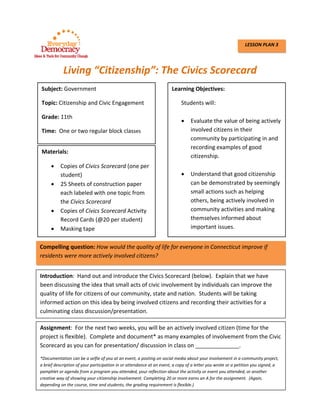
Living “Citizenship”: The Civics Scorecard 


LESSON PLAN 3
Subject: Government
Topic: Citizenship and Civic Engagement 
Grade: 11th 
Time:  One or two regular block classes 
Learning Objectives:   
Students will: 
 
 Evaluate the value of being actively 
involved citizens in their 
community by participating in and 
recording examples of good 
citizenship. 
 
 Understand that good citizenship 
can be demonstrated by seemingly 
small actions such as helping 
others, being actively involved in 
community activities and making 
themselves informed about 
important issues. 
Materials: 
 Copies of Civics Scorecard (one per 
student) 
 25 Sheets of construction paper 
each labeled with one topic from 
the Civics Scorecard 
 Copies of Civics Scorecard Activity 
Record Cards (@20 per student) 
 Masking tape 
Compelling question: How would the quality of life for everyone in Connecticut improve if 
residents were more actively involved citizens?   
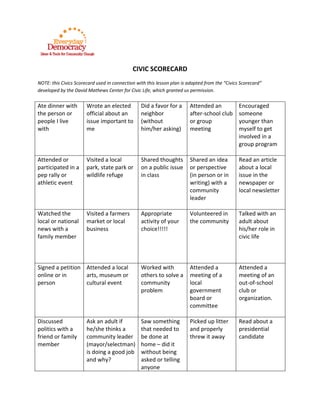
Introduction:  Hand out and introduce the Civics Scorecard (below).  Explain that we have 
been discussing the idea that small acts of civic involvement by individuals can improve the 
quality of life for citizens of our community, state and nation.  Students will be taking 
informed action on this idea by being involved citizens and recording their activities for a 
culminating class discussion/presentation.     
Assignment:  For the next two weeks, you will be an actively involved citizen (time for the 
project is flexible).  Complete and document* as many examples of involvement from the Civic 
Scorecard as you can for presentation/ discussion in class on ______________. 
*Documentation can be a selfie of you at an event, a posting on social media about your involvement in a community project, 
a brief description of your participation in or attendance at an event, a copy of a letter you wrote or a petition you signed, a 
pamphlet or agenda from a program you attended, your reflection about the activity or event you attended, or another 
creative way of showing your citizenship involvement. Completing 20 or more earns an A for the assignment.  (Again, 
depending on the course, time and students, the grading requirement is flexible.) 
 
 
CIVIC SCORECARD 
NOTE: this Civics Scorecard used in connection with this lesson plan is adapted from the “Civics Scorecard” 
developed by the David Mathews Center for Civic Life, which granted us permission. 
Ate dinner with 
the person or 
people I live 
with 
Wrote an elected 
official about an 
issue important to 
me 
Did a favor for a 
neighbor 
(without 
him/her asking) 
Attended an 
after‐school club 
or group 
meeting 
Encouraged 
someone 
younger than 
myself to get 
involved in a 
group program 
 
Attended or 
participated in a 
pep rally or 
athletic event 
Visited a local 
park, state park or 
wildlife refuge 
Shared thoughts 
on a public issue 
in class 
Shared an idea 
or perspective 
(in person or in 
writing) with a 
community 
leader 
 
Read an article 
about a local 
issue in the 
newspaper or 
local newsletter 
Watched the 
local or national 
news with a 
family member 
Visited a farmers 
market or local 
business 
Appropriate  
activity of your 
choice!!!!! 
Volunteered in 
the community 
Talked with an 
adult about 
his/her role in 
civic life 


Signed a petition 
online or in 
person 
Attended a local 
arts, museum or 
cultural event 
Worked with 
others to solve a 
community 
problem 
Attended a 
meeting of a 
local 
government 
board or 
committee 
 
Attended a 
meeting of an 
out‐of‐school 
club or 
organization. 
Discussed 
politics with a 
friend or family 
member 
Ask an adult if 
he/she thinks a 
community leader 
(mayor/selectman) 
is doing a good job 
and why? 
Saw something 
that needed to 
be done at 
home – did it 
without being 
asked or telling 
anyone  
Picked up litter 
and properly 
threw it away 
Read about a 
presidential 
candidate 
 
 
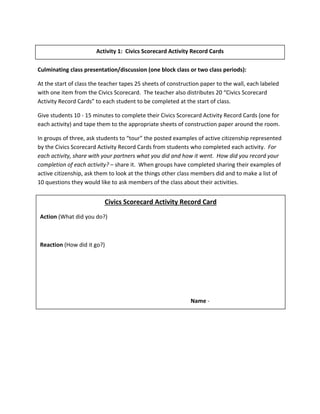
Culminating class presentation/discussion (one block class or two class periods): 
At the start of class the teacher tapes 25 sheets of construction paper to the wall, each labeled 
with one item from the Civics Scorecard.  The teacher also distributes 20 “Civics Scorecard 
Activity Record Cards” to each student to be completed at the start of class. 
Give students 10 ‐ 15 minutes to complete their Civics Scorecard Activity Record Cards (one for 
each activity) and tape them to the appropriate sheets of construction paper around the room. 
In groups of three, ask students to “tour” the posted examples of active citizenship represented 
by the Civics Scorecard Activity Record Cards from students who completed each activity.  For 
each activity, share with your partners what you did and how it went.  How did you record your 
completion of each activity? – share it.  When groups have completed sharing their examples of 
active citizenship, ask them to look at the things other class members did and to make a list of 
10 questions they would like to ask members of the class about their activities. 


Civics Scorecard Activity Record Card
Action (What did you do?) 
 
Reaction (How did it go?) 


                Name ‐  
Activity 1:  Civics Scorecard Activity Record Cards
 
 
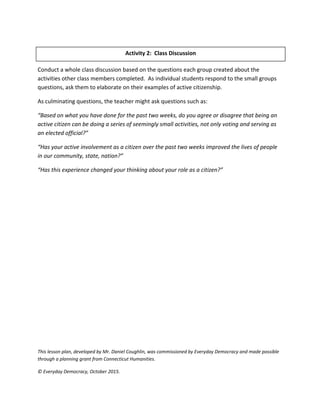
Conduct a whole class discussion based on the questions each group created about the 
activities other class members completed.  As individual students respond to the small groups 
questions, ask them to elaborate on their examples of active citizenship.   
As culminating questions, the teacher might ask questions such as: 
“Based on what you have done for the past two weeks, do you agree or disagree that being an 
active citizen can be doing a series of seemingly small activities, not only voting and serving as 
an elected official?” 
“Has your active involvement as a citizen over the past two weeks improved the lives of people 
in our community, state, nation?” 
“Has this experience changed your thinking about your role as a citizen?” 


This lesson plan, developed by Mr. Daniel Coughlin, was commissioned by Everyday Democracy and made possible 
through a planning grant from Connecticut Humanities.  
© Everyday Democracy, October 2015.  
Activity 2:  Class Discussion

Civic Engagement Lesson Plan (Part 3)