Citations & Works Cited
Using outside sources to support your writing
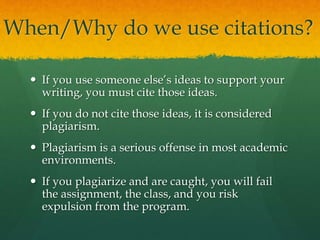
When/Why do we use citations?
 If you use someone else’s ideas to support your
writing, you must cite those ideas.
 If you do not cite those ideas, it is considered
plagiarism.
 Plagiarism is a serious offense in most academic
environments.
 If you plagiarize and are caught, you will fail
the assignment, the class, and you risk
expulsion from the program.
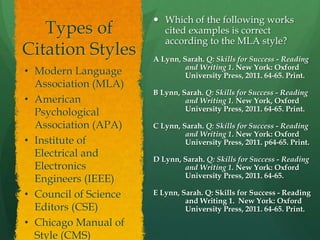
Types of
Citation Styles
 Which of the following works
cited examples is correct
according to the MLA style?
A Lynn, Sarah. Q: Skills for Success - Reading
and Writing 1. New York: Oxford
University Press, 2011. 64-65. Print.
B Lynn, Sarah. Q: Skills for Success - Reading
and Writing 1. New York, Oxford
University Press, 2011. 64-65. Print.
C Lynn, Sarah. Q: Skills for Success - Reading
and Writing 1. New York: Oxford
University Press, 2011. p64-65. Print.
D Lynn, Sarah. Q: Skills for Success - Reading
and Writing 1. New York: Oxford
University Press, 2011. 64-65.
E Lynn, Sarah. Q: Skills for Success - Reading
and Writing 1. New York: Oxford
University Press, 2011. 64-65. Print.
• Modern Language
Association (MLA)
• American
Psychological
Association (APA)
• Institute of
Electrical and
Electronics
Engineers (IEEE)
• Council of Science
Editors (CSE)
• Chicago Manual of
Style (CMS)
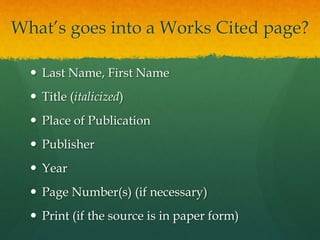
What’s goes into a Works Cited page?
 Last Name, First Name
 Title (italicized)
 Place of Publication
 Publisher
 Year
 Page Number(s) (if necessary)
 Print (if the source is in paper form)
Book Citation Format
Tamim Ansary
Destiny Disrupted: A History of the World
Through Islamic Eyes
New York
PublicAffairs
2009
Ansary, Tamim. Destiny Disrupted: A History
of the World Through Islamic Eyes. New York:
PublicAffairs, 2009.
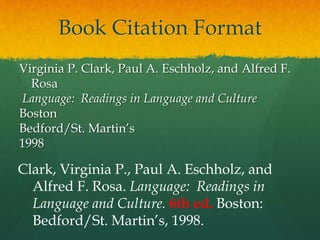
Book Citation Format
Virginia P. Clark, Paul A. Eschholz, and Alfred F.
Rosa
Language: Readings in Language and Culture
Boston
Bedford/St. Martin’s
1998
Clark, Virginia P., Paul A. Eschholz, and
Alfred F. Rosa. Language: Readings in
Language and Culture. 6th ed. Boston:
Bedford/St. Martin’s, 1998.
Internet Article Format
•Author Name.
•Article name in quotation marks.
•Title of the Web site in italics.
•Publisher name (Use n.p. if no publishing name is
given), followed by Publication date (Use n.d. if no
publishing date is given).
•Medium of publication (Web).
•Date of access.
•URL (if required, or for your own information.
MLA does not require a URL
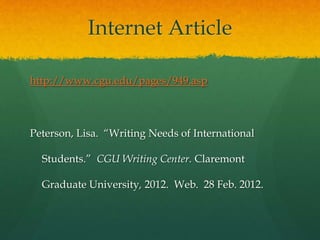
Internet Article
http://www.cgu.edu/pages/949.asp
Peterson, Lisa. “Writing Needs of International
Students.” CGU Writing Center. Claremont
Graduate University, 2012. Web. 28 Feb. 2012.
Internet Article
 http://www.heacademy.ac.uk/resources/detail/in
ternationalisation/ISL_Plagiarism
“Addressing Plagiarism.” The Higher Education
Academy. n.p., 2012. Web. 28 Feb. 2012.
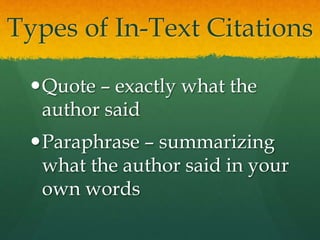
Types of In-Text Citations
Quote – exactly what the
author said
Paraphrase – summarizing
what the author said in your
own words
Uses, Rules, and Strategies
for Using Quotes
 Used to support a specific idea.
 Used for important phrases or sentences that
are best left in the original form.
 A quotation cannot stand alone in your writing.
You must integrate it into your writing.
 Do NOT quote more than one sentence.
 Do NOT quote more than 10 words.
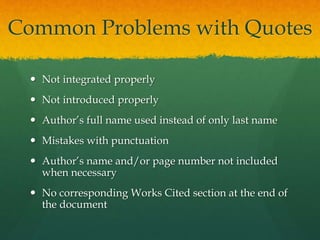
Common Problems with Quotes
 Not integrated properly
 Not introduced properly
 Author’s full name used instead of only last name
 Mistakes with punctuation
 Author’s name and/or page number not included
when necessary
 No corresponding Works Cited section at the end of
the document
Examples of Quotes
A poll conducted by US News and World Report found that
90% of students believe that cheaters are either never
caught or have never been appropriately disciplined.
According to US News and World Report, “90% of students
believe that cheaters are either never caught or have never been
appropriately disciplined.”
Examples of Quotes
The expression of original ideas is considered intellectual
property, and is protected by copyright laws, just like
original inventions. Original idea by Tim Smith from
page 20.
A. Smith says that someone’s original ideas are “protected by
copyright laws, just like original inventions” (20).
B. Smith says “The expression of original ideas is considered
intellectual property, and is protected by copyright laws, just
like original inventions “ (20).
Examples of Quotes
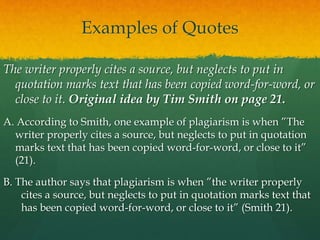
The writer properly cites a source, but neglects to put in
quotation marks text that has been copied word-for-word, or
close to it. Original idea by Tim Smith on page 21.
A. According to Smith, one example of plagiarism is when ”The
writer properly cites a source, but neglects to put in quotation
marks text that has been copied word-for-word, or close to it”
(21).
B. The author says that plagiarism is when ”the writer properly
cites a source, but neglects to put in quotation marks text that
has been copied word-for-word, or close to it” (Smith 21).
Uses, Rules, and Strategies
for Using Paraphrases
 MUST be in your own words
 Conveys the same meaning of the original sentence
 MUST be integrated into your writing
 Should be about the same length as the original sentence
Common Problems with Paraphrases
 Not integrated properly
 Not introduced properly
 Too many paraphrases. Not enough original ideas.
 Author’s full name used instead of only last name
 Author’s name and/or page number not included
when necessary
 No corresponding Works Cited section at the end of
the document
Examples of Paraphrases
Students may be intimidated by the quality of work in the
original article, thinking their own work cannot compare.
Original idea by John Webster.
A. Webster says, students might be intimidated by the level of
work found in the original and they might think their own
work is not good enough.
B. Webster says that the original article may intimidate students
where they feel that their paraphrase will not be as good as
the original.
Examples of Paraphrases
Students are under enormous pressure from family, peers, and
instructors to compete for scholarships, admissions, and, of
course, grades. Original idea by John Webster.
A. Webster says that students have a lot of pressure and may not
have time to adequately work on assignments.
B. Webster says that students feel stressed to get good grades
because of their teachers and parents and because of the
competitiveness of getting a scholarship or college admission.
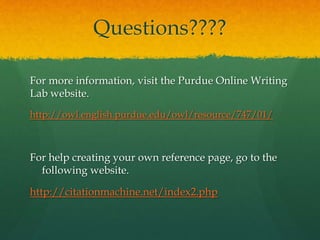
Questions????
For more information, visit the Purdue Online Writing
Lab website.
http://owl.english.purdue.edu/owl/resource/747/01/
For help creating your own reference page, go to the
following website.
http://citationmachine.net/index2.php

Citation PowerPoint.pptx

  • 1.
    Citations & WorksCited Using outside sources to support your writing
  • 2.
    When/Why do weuse citations?  If you use someone else’s ideas to support your writing, you must cite those ideas.  If you do not cite those ideas, it is considered plagiarism.  Plagiarism is a serious offense in most academic environments.  If you plagiarize and are caught, you will fail the assignment, the class, and you risk expulsion from the program.
  • 3.
    Types of Citation Styles Which of the following works cited examples is correct according to the MLA style? A Lynn, Sarah. Q: Skills for Success - Reading and Writing 1. New York: Oxford University Press, 2011. 64-65. Print. B Lynn, Sarah. Q: Skills for Success - Reading and Writing 1. New York, Oxford University Press, 2011. 64-65. Print. C Lynn, Sarah. Q: Skills for Success - Reading and Writing 1. New York: Oxford University Press, 2011. p64-65. Print. D Lynn, Sarah. Q: Skills for Success - Reading and Writing 1. New York: Oxford University Press, 2011. 64-65. E Lynn, Sarah. Q: Skills for Success - Reading and Writing 1. New York: Oxford University Press, 2011. 64-65. Print. • Modern Language Association (MLA) • American Psychological Association (APA) • Institute of Electrical and Electronics Engineers (IEEE) • Council of Science Editors (CSE) • Chicago Manual of Style (CMS)
  • 4.
    What’s goes intoa Works Cited page?  Last Name, First Name  Title (italicized)  Place of Publication  Publisher  Year  Page Number(s) (if necessary)  Print (if the source is in paper form)
  • 5.
    Book Citation Format TamimAnsary Destiny Disrupted: A History of the World Through Islamic Eyes New York PublicAffairs 2009 Ansary, Tamim. Destiny Disrupted: A History of the World Through Islamic Eyes. New York: PublicAffairs, 2009.
  • 6.
    Book Citation Format VirginiaP. Clark, Paul A. Eschholz, and Alfred F. Rosa Language: Readings in Language and Culture Boston Bedford/St. Martin’s 1998 Clark, Virginia P., Paul A. Eschholz, and Alfred F. Rosa. Language: Readings in Language and Culture. 6th ed. Boston: Bedford/St. Martin’s, 1998.
  • 7.
    Internet Article Format •AuthorName. •Article name in quotation marks. •Title of the Web site in italics. •Publisher name (Use n.p. if no publishing name is given), followed by Publication date (Use n.d. if no publishing date is given). •Medium of publication (Web). •Date of access. •URL (if required, or for your own information. MLA does not require a URL
  • 8.
    Internet Article http://www.cgu.edu/pages/949.asp Peterson, Lisa.“Writing Needs of International Students.” CGU Writing Center. Claremont Graduate University, 2012. Web. 28 Feb. 2012.
  • 9.
  • 10.
    Types of In-TextCitations Quote – exactly what the author said Paraphrase – summarizing what the author said in your own words
  • 11.
    Uses, Rules, andStrategies for Using Quotes  Used to support a specific idea.  Used for important phrases or sentences that are best left in the original form.  A quotation cannot stand alone in your writing. You must integrate it into your writing.  Do NOT quote more than one sentence.  Do NOT quote more than 10 words.
  • 12.
    Common Problems withQuotes  Not integrated properly  Not introduced properly  Author’s full name used instead of only last name  Mistakes with punctuation  Author’s name and/or page number not included when necessary  No corresponding Works Cited section at the end of the document
  • 13.
    Examples of Quotes Apoll conducted by US News and World Report found that 90% of students believe that cheaters are either never caught or have never been appropriately disciplined. According to US News and World Report, “90% of students believe that cheaters are either never caught or have never been appropriately disciplined.”
  • 14.
    Examples of Quotes Theexpression of original ideas is considered intellectual property, and is protected by copyright laws, just like original inventions. Original idea by Tim Smith from page 20. A. Smith says that someone’s original ideas are “protected by copyright laws, just like original inventions” (20). B. Smith says “The expression of original ideas is considered intellectual property, and is protected by copyright laws, just like original inventions “ (20).
  • 15.
    Examples of Quotes Thewriter properly cites a source, but neglects to put in quotation marks text that has been copied word-for-word, or close to it. Original idea by Tim Smith on page 21. A. According to Smith, one example of plagiarism is when ”The writer properly cites a source, but neglects to put in quotation marks text that has been copied word-for-word, or close to it” (21). B. The author says that plagiarism is when ”the writer properly cites a source, but neglects to put in quotation marks text that has been copied word-for-word, or close to it” (Smith 21).
  • 16.
    Uses, Rules, andStrategies for Using Paraphrases  MUST be in your own words  Conveys the same meaning of the original sentence  MUST be integrated into your writing  Should be about the same length as the original sentence
  • 17.
    Common Problems withParaphrases  Not integrated properly  Not introduced properly  Too many paraphrases. Not enough original ideas.  Author’s full name used instead of only last name  Author’s name and/or page number not included when necessary  No corresponding Works Cited section at the end of the document
  • 18.
    Examples of Paraphrases Studentsmay be intimidated by the quality of work in the original article, thinking their own work cannot compare. Original idea by John Webster. A. Webster says, students might be intimidated by the level of work found in the original and they might think their own work is not good enough. B. Webster says that the original article may intimidate students where they feel that their paraphrase will not be as good as the original.
  • 19.
    Examples of Paraphrases Studentsare under enormous pressure from family, peers, and instructors to compete for scholarships, admissions, and, of course, grades. Original idea by John Webster. A. Webster says that students have a lot of pressure and may not have time to adequately work on assignments. B. Webster says that students feel stressed to get good grades because of their teachers and parents and because of the competitiveness of getting a scholarship or college admission.
  • 20.
    Questions???? For more information,visit the Purdue Online Writing Lab website. http://owl.english.purdue.edu/owl/resource/747/01/ For help creating your own reference page, go to the following website. http://citationmachine.net/index2.php