© 2008 Cisco Systems, Inc. All rights reserved. Cisco ConfidentialPresentation_ID 1
Securing Site-to-Site
Connectivity
Connecting Networks
© 2008 Cisco Systems, Inc. All rights reserved. Cisco ConfidentialPresentation_ID 2
VPNs
Presentation_ID 3© 2008 Cisco Systems, Inc. All rights reserved. Cisco Confidential
Fundamentals of VPNs
Introducing VPNs
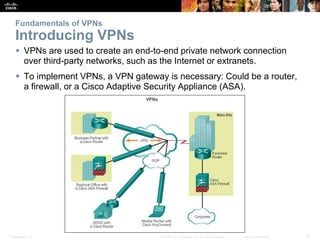
ď‚§ VPNs are used to create an end-to-end private network connection
over third-party networks, such as the Internet or extranets.
ď‚§ To implement VPNs, a VPN gateway is necessary: Could be a router,
a firewall, or a Cisco Adaptive Security Appliance (ASA).
Presentation_ID 4© 2008 Cisco Systems, Inc. All rights reserved. Cisco Confidential
Fundamentals of VPNs
Benefits of VPNs
ď‚§ Cost savings
• Enable organizations to use cost-effective, third-party Internet
transport to connect remote offices and remote users to the
main site.
ď‚§ Scalability
• Enable organizations to use the Internet infrastructure within
ISPs and devices, which makes it easy to add new users.
Presentation_ID 5© 2008 Cisco Systems, Inc. All rights reserved. Cisco Confidential
Fundamentals of VPNs
Benefits of VPNs (cont.)
ď‚§ Compatibility with broadband technology
• Allow mobile workers and telecommuters to take advantage of
high-speed, broadband connectivity, such as DSL and cable, to
gain access to the networks of their organization, providing
workers flexibility and efficiency.
• Provide a cost-effective solution for connecting remote offices.
ď‚§ Security
• Can include security mechanisms that provide the highest level
of security by using advanced encryption and authentication
protocols that protect data from unauthorized access.
Presentation_ID 6© 2008 Cisco Systems, Inc. All rights reserved. Cisco Confidential
Types of VPNs
Site-to-Site VPNs
ď‚§ Connect entire networks to each other, in the past, a leased line or
Frame Relay connection was required to connect sites, but because
most corporations now have Internet access, these connections can
be replaced with site-to-site VPNs.
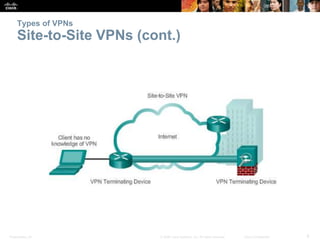
ď‚§ Internal hosts have no knowledge that a VPN exists.
ď‚§ Created when devices on both sides of the VPN connection are aware
of the VPN configuration in advance.
Presentation_ID 7© 2008 Cisco Systems, Inc. All rights reserved. Cisco Confidential
Types of VPNs
Site-to-Site VPNs (cont.)
ď‚§ End hosts send and receive normal TCP/IP traffic through a VPN
gateway.
ď‚§ The VPN gateway is responsible for encapsulating and encrypting
outbound traffic for all traffic from a particular site
ď‚§ The VPN gateway then sends it through a VPN tunnel over the
Internet to a peer VPN gateway at the target site.
ď‚§ Upon receipt, the peer VPN gateway strips the headers, decrypts the
content, and relays the packet toward the target host inside its
private network.
Presentation_ID 8© 2008 Cisco Systems, Inc. All rights reserved. Cisco Confidential
Types of VPNs
Site-to-Site VPNs (cont.)
Presentation_ID 9© 2008 Cisco Systems, Inc. All rights reserved. Cisco Confidential
Types of VPNs
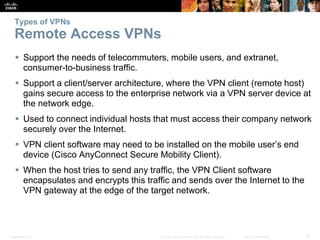
Remote Access VPNs
ď‚§ Support the needs of telecommuters, mobile users, and extranet,
consumer-to-business traffic.
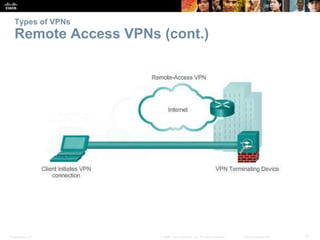
ď‚§ Support a client/server architecture, where the VPN client (remote host)
gains secure access to the enterprise network via a VPN server device at
the network edge.
ď‚§ Used to connect individual hosts that must access their company network
securely over the Internet.
 VPN client software may need to be installed on the mobile user’s end
device (Cisco AnyConnect Secure Mobility Client).
ď‚§ When the host tries to send any traffic, the VPN Client software
encapsulates and encrypts this traffic and sends over the Internet to the
VPN gateway at the edge of the target network.
Presentation_ID 10© 2008 Cisco Systems, Inc. All rights reserved. Cisco Confidential
Types of VPNs
Remote Access VPNs (cont.)
© 2008 Cisco Systems, Inc. All rights reserved. Cisco ConfidentialPresentation_ID 11
Introducing IPsec
Presentation_ID 12© 2008 Cisco Systems, Inc. All rights reserved. Cisco Confidential
Internet Protocol Security
IPsec VPNs
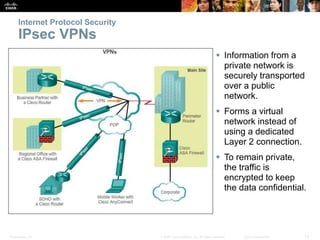
ď‚§ Information from a
private network is
securely transported
over a public
network.
ď‚§ Forms a virtual
network instead of
using a dedicated
Layer 2 connection.
ď‚§ To remain private,
the traffic is
encrypted to keep
the data confidential.
Presentation_ID 13© 2008 Cisco Systems, Inc. All rights reserved. Cisco Confidential
Internet Protocol Security
IPsec Functions
ď‚§ Defines how a VPN can be configured in a secure manner using IP.
ď‚§ Framework of open standards that spells out the rules for secure
communications.
ď‚§ Not bound to any specific encryption, authentication, security
algorithms, or keying technology.
ď‚§ Relies on existing algorithms to implement secure communications.
ď‚§ Works at the network layer, protecting and authenticating IP packets
between participating IPsec devices.
ď‚§ Secures a path between a pair of gateways, a pair of hosts, or a
gateway and host.
ď‚§ All implementations of IPsec have a plaintext Layer 3 header, so there
are no issues with routing.
ď‚§ Functions over all Layer 2 protocols, such as Ethernet, ATM, or Frame
Relay.
Presentation_ID 14© 2008 Cisco Systems, Inc. All rights reserved. Cisco Confidential
Internet Protocol Security
IPsec Characteristics
IPsec characteristics can be summarized as follows:
ď‚§ IPsec is a framework of open standards that is algorithm-independent.
ď‚§ IPsec provides data confidentiality, data integrity, and origin
authentication.
ď‚§ IPsec acts at the network layer, protecting and authenticating IP
packets.
Presentation_ID 15© 2008 Cisco Systems, Inc. All rights reserved. Cisco Confidential
Internet Protocol Security
IPsec Security Services
 Confidentiality (encryption) – encrypt the data before transmitting
across the network
 Data integrity – verify that data has not been changed while in
transit, if tampering is detected, the packet is dropped
 Authentication – verify the identity of the source of the data that is
sent, ensures that the connection is made with the desired
communication partner, IPsec uses Internet Key Exchange (IKE) to
authenticate users and devices that can carry out communication
independently.
 Anti-Replay Protection – detect and reject replayed packets and
helps prevent spoofing
CIA: confidentiality, integrity, and authentication
Presentation_ID 16© 2008 Cisco Systems, Inc. All rights reserved. Cisco Confidential
IPsec Framework
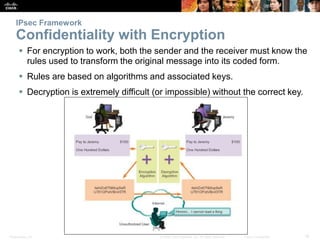
Confidentiality with Encryption
ď‚§ For encryption to work, both the sender and the receiver must know the
rules used to transform the original message into its coded form.
ď‚§ Rules are based on algorithms and associated keys.
ď‚§ Decryption is extremely difficult (or impossible) without the correct key.
Presentation_ID 17© 2008 Cisco Systems, Inc. All rights reserved. Cisco Confidential
IPsec Framework
Encryption Algorithms
ď‚§ As key length increases, it becomes more difficult to break the
encryption. However, a longer key requires more processor
resources when encrypting and decrypting data.
ď‚§ Two main types of encryption are:
ď‚§ Symmetric Encryption
ď‚§ Asymmetric Encryption
Presentation_ID 18© 2008 Cisco Systems, Inc. All rights reserved. Cisco Confidential
IPsec Framework
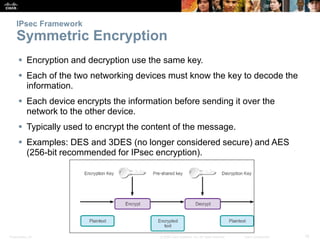
Symmetric Encryption
ď‚§ Encryption and decryption use the same key.
ď‚§ Each of the two networking devices must know the key to decode the
information.
ď‚§ Each device encrypts the information before sending it over the
network to the other device.
ď‚§ Typically used to encrypt the content of the message.
ď‚§ Examples: DES and 3DES (no longer considered secure) and AES
(256-bit recommended for IPsec encryption).
Presentation_ID 19© 2008 Cisco Systems, Inc. All rights reserved. Cisco Confidential
IPsec Framework
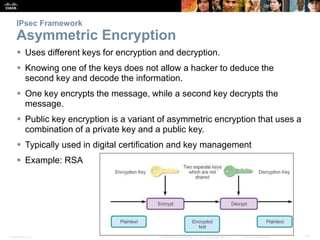
Asymmetric Encryption
ď‚§ Uses different keys for encryption and decryption.
ď‚§ Knowing one of the keys does not allow a hacker to deduce the
second key and decode the information.
ď‚§ One key encrypts the message, while a second key decrypts the
message.
ď‚§ Public key encryption is a variant of asymmetric encryption that uses a
combination of a private key and a public key.
ď‚§ Typically used in digital certification and key management
ď‚§ Example: RSA
Presentation_ID 20© 2008 Cisco Systems, Inc. All rights reserved. Cisco Confidential
IPsec Framework
Diffie-Hellman Key Exchange
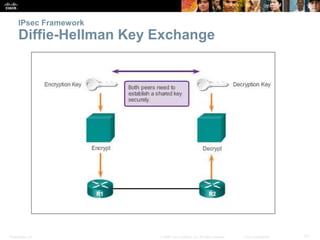
ď‚§ Diffie-Hellman (DH) is not an encryption mechanism and is not
typically used to encrypt data.
ď‚§ DH is a method to securely exchange the keys that encrypt data.
ď‚§ DH algorithms allow two parties to establish a shared secret key
used by encryption and hash algorithms.
ď‚§ DH is part of the IPsec standard.
ď‚§ Encryption algorithms, such as DES, 3DES, and AES, as well as
the MD5 and SHA-1 hashing algorithms, require a symmetric,
shared secret key to perform encryption and decryption.
ď‚§ DH algorithm specifies a public key exchange method that provides
a way for two peers to establish a shared secret key that only they
know, although they are communicating over an insecure channel.
Presentation_ID 21© 2008 Cisco Systems, Inc. All rights reserved. Cisco Confidential
IPsec Framework
Diffie-Hellman Key Exchange
Presentation_ID 22© 2008 Cisco Systems, Inc. All rights reserved. Cisco Confidential
IPsec Framework
Integrity with Hash Algorithms
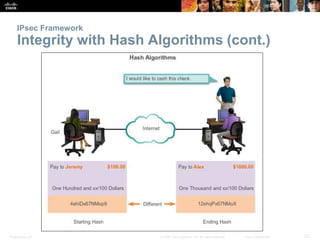
ď‚§ The original sender generates a hash of the message and sends it
with the message itself.
ď‚§ The recipient parses the message and the hash, produces another
hash from the received message, and compares the two hashes.
ď‚§ If they are the same, the recipient can be reasonably sure of the
integrity of the original message.
Presentation_ID 23© 2008 Cisco Systems, Inc. All rights reserved. Cisco Confidential
IPsec Framework
Integrity with Hash Algorithms (cont.)
Presentation_ID 24© 2008 Cisco Systems, Inc. All rights reserved. Cisco Confidential
IPsec Framework
Integrity with Hash Algorithms (cont.)
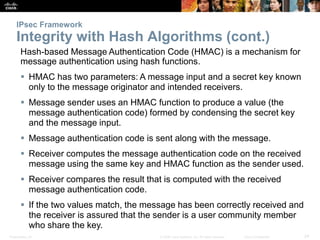
Hash-based Message Authentication Code (HMAC) is a mechanism for
message authentication using hash functions.
ď‚§ HMAC has two parameters: A message input and a secret key known
only to the message originator and intended receivers.
ď‚§ Message sender uses an HMAC function to produce a value (the
message authentication code) formed by condensing the secret key
and the message input.
ď‚§ Message authentication code is sent along with the message.
ď‚§ Receiver computes the message authentication code on the received
message using the same key and HMAC function as the sender used.
ď‚§ Receiver compares the result that is computed with the received
message authentication code.
ď‚§ If the two values match, the message has been correctly received and
the receiver is assured that the sender is a user community member
who share the key.
Presentation_ID 25© 2008 Cisco Systems, Inc. All rights reserved. Cisco Confidential
IPsec Framework
Integrity with Hash Algorithms (cont.)
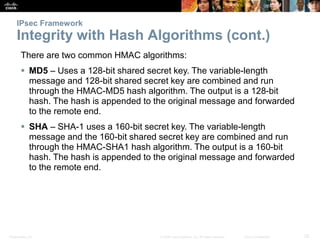
There are two common HMAC algorithms:
 MD5 – Uses a 128-bit shared secret key. The variable-length
message and 128-bit shared secret key are combined and run
through the HMAC-MD5 hash algorithm. The output is a 128-bit
hash. The hash is appended to the original message and forwarded
to the remote end.
 SHA – SHA-1 uses a 160-bit secret key. The variable-length
message and the 160-bit shared secret key are combined and run
through the HMAC-SHA1 hash algorithm. The output is a 160-bit
hash. The hash is appended to the original message and forwarded
to the remote end.
Presentation_ID 26© 2008 Cisco Systems, Inc. All rights reserved. Cisco Confidential
IPsec Framework
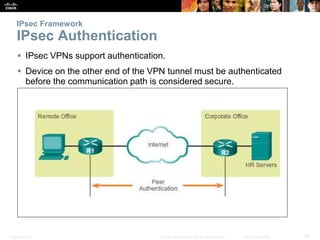
IPsec Authentication
ď‚§ IPsec VPNs support authentication.
ď‚§ Device on the other end of the VPN tunnel must be authenticated
before the communication path is considered secure.
© 2008 Cisco Systems, Inc. All rights reserved. Cisco ConfidentialPresentation_ID 27
Troubleshooting the
Network
Connecting Networks
Presentation_ID 28© 2008 Cisco Systems, Inc. All rights reserved. Cisco Confidential
Network Documentation
Documenting the Network
Network documentation is a complete set of accurate and current
network documentation. This documentation includes:
ď‚§ Configuration files, including network configuration files and end-
system configuration files
ď‚§ Physical and logical topology diagrams
ď‚§ A baseline performance level
Presentation_ID 29© 2008 Cisco Systems, Inc. All rights reserved. Cisco Confidential
Network Documentation
Network Topology Diagrams
ď‚§ Physical Topology
Device type
Model and manufacturer
Operating system version
Cable type and identifier
Cable specification
Connector type
Cabling endpoints
ď‚§ Logical Topology
Device identifiers
IP address and prefix lengths
Interface identifiers
Connection type
DLCI for virtual circuits
Site-to-site VPNs
Routing protocols
Static routes
Data-link protocols
WAN technologies used
Presentation_ID 30© 2008 Cisco Systems, Inc. All rights reserved. Cisco Confidential
Network Documentation
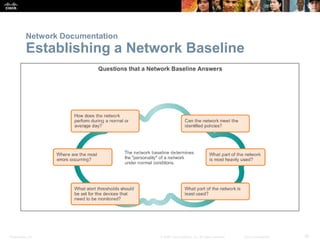
Establishing a Network Baseline
Presentation_ID 31© 2008 Cisco Systems, Inc. All rights reserved. Cisco Confidential
Network Documentation
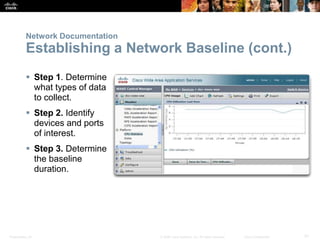
Establishing a Network Baseline (cont.)
ď‚§ Step 1. Determine
what types of data
to collect.
ď‚§ Step 2. Identify
devices and ports
of interest.
ď‚§ Step 3. Determine
the baseline
duration.
Presentation_ID 32© 2008 Cisco Systems, Inc. All rights reserved. Cisco Confidential
Network Documentation
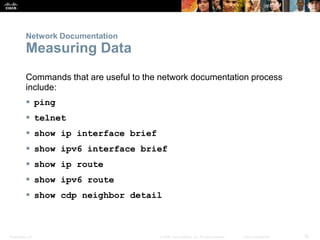
Measuring Data
Commands that are useful to the network documentation process
include:
ď‚§ ping
ď‚§ telnet
ď‚§ show ip interface brief
ď‚§ show ipv6 interface brief
ď‚§ show ip route
ď‚§ show ipv6 route
ď‚§ show cdp neighbor detail
Presentation_ID 33© 2008 Cisco Systems, Inc. All rights reserved. Cisco Confidential
Troubleshooting Process
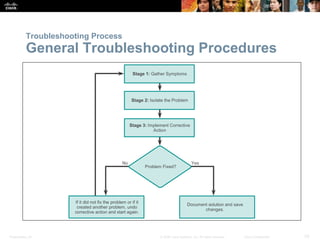
General Troubleshooting Procedures
Presentation_ID 34© 2008 Cisco Systems, Inc. All rights reserved. Cisco Confidential
Troubleshooting Process
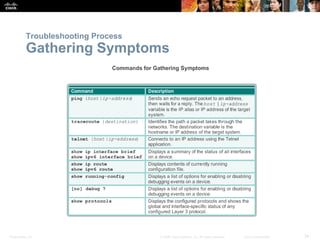
Gathering Symptoms
Presentation_ID 35© 2008 Cisco Systems, Inc. All rights reserved. Cisco Confidential
Troubleshooting Process
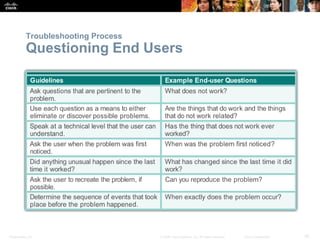
Questioning End Users
Presentation_ID 36© 2008 Cisco Systems, Inc. All rights reserved. Cisco Confidential
Isolating the Issue Using Layered Models
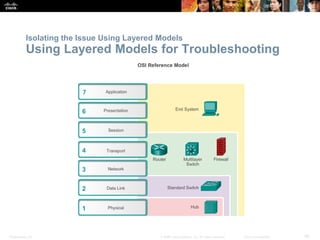
Using Layered Models for Troubleshooting
Presentation_ID 37© 2008 Cisco Systems, Inc. All rights reserved. Cisco Confidential
Isolating the Issue Using Layered Models
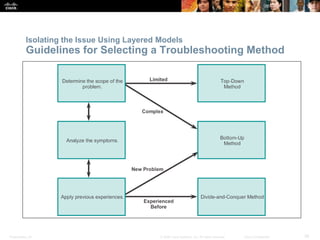
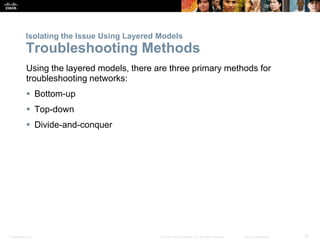
Troubleshooting Methods
Using the layered models, there are three primary methods for
troubleshooting networks:
ď‚§ Bottom-up
ď‚§ Top-down
ď‚§ Divide-and-conquer
Presentation_ID 38© 2008 Cisco Systems, Inc. All rights reserved. Cisco Confidential
Isolating the Issue Using Layered Models
Troubleshooting Methods (cont.)
In addition to the systematic, layered approach to troubleshooting,
there are also, less-structured troubleshooting approaches:
ď‚§ One troubleshooting approach is based on an educated guess by
the network administrator, based on the symptoms of the problem.
ď‚§ Another approach involves comparing a working and nonworking
situation, and spotting significant differences.
ď‚§ Swapping the problematic device with a known, working one is a
quick way to troubleshoot.
Presentation_ID 39© 2008 Cisco Systems, Inc. All rights reserved. Cisco Confidential
Isolating the Issue Using Layered Models
Guidelines for Selecting a Troubleshooting Method
© 2008 Cisco Systems, Inc. All rights reserved. Cisco ConfidentialPresentation_ID 40
Network Troubleshooting
Presentation_ID 41© 2008 Cisco Systems, Inc. All rights reserved. Cisco Confidential
Symptoms and Causes of Network Troubleshooting
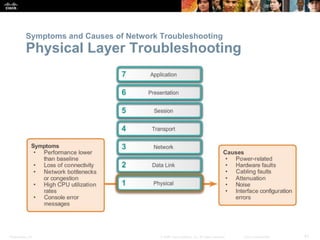
Physical Layer Troubleshooting
Presentation_ID 42© 2008 Cisco Systems, Inc. All rights reserved. Cisco Confidential
Symptoms and Causes of Network Troubleshooting
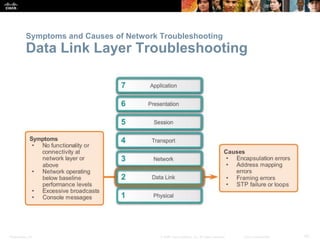
Data Link Layer Troubleshooting
Presentation_ID 43© 2008 Cisco Systems, Inc. All rights reserved. Cisco Confidential
Symptoms and Causes of Network Troubleshooting
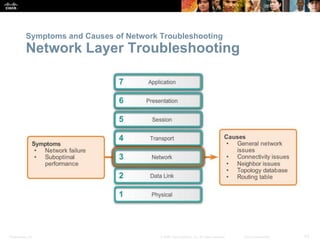
Network Layer Troubleshooting
Presentation_ID 44© 2008 Cisco Systems, Inc. All rights reserved. Cisco Confidential
Symptoms and Causes of Network Troubleshooting
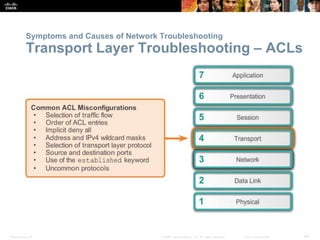
Transport Layer Troubleshooting – ACLs
Presentation_ID 45© 2008 Cisco Systems, Inc. All rights reserved. Cisco Confidential
Symptoms and Causes of Network Troubleshooting
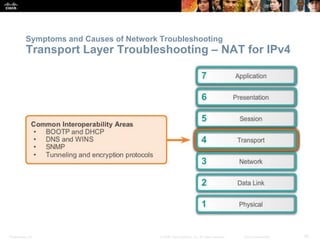
Transport Layer Troubleshooting – NAT for IPv4
Presentation_ID 46© 2008 Cisco Systems, Inc. All rights reserved. Cisco Confidential
Symptoms and Causes of Network Troubleshooting
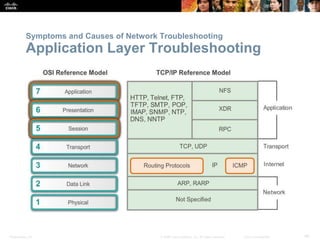
Application Layer Troubleshooting
Presentation_ID 47© 2008 Cisco Systems, Inc. All rights reserved. Cisco Confidential

cisco-nti-Day20

  • 1.
    © 2008 CiscoSystems, Inc. All rights reserved. Cisco ConfidentialPresentation_ID 1 Securing Site-to-Site Connectivity Connecting Networks
  • 2.
    © 2008 CiscoSystems, Inc. All rights reserved. Cisco ConfidentialPresentation_ID 2 VPNs
  • 3.
    Presentation_ID 3© 2008Cisco Systems, Inc. All rights reserved. Cisco Confidential Fundamentals of VPNs Introducing VPNs  VPNs are used to create an end-to-end private network connection over third-party networks, such as the Internet or extranets.  To implement VPNs, a VPN gateway is necessary: Could be a router, a firewall, or a Cisco Adaptive Security Appliance (ASA).
  • 4.
    Presentation_ID 4© 2008Cisco Systems, Inc. All rights reserved. Cisco Confidential Fundamentals of VPNs Benefits of VPNs  Cost savings • Enable organizations to use cost-effective, third-party Internet transport to connect remote offices and remote users to the main site.  Scalability • Enable organizations to use the Internet infrastructure within ISPs and devices, which makes it easy to add new users.
  • 5.
    Presentation_ID 5© 2008Cisco Systems, Inc. All rights reserved. Cisco Confidential Fundamentals of VPNs Benefits of VPNs (cont.)  Compatibility with broadband technology • Allow mobile workers and telecommuters to take advantage of high-speed, broadband connectivity, such as DSL and cable, to gain access to the networks of their organization, providing workers flexibility and efficiency. • Provide a cost-effective solution for connecting remote offices.  Security • Can include security mechanisms that provide the highest level of security by using advanced encryption and authentication protocols that protect data from unauthorized access.
  • 6.
    Presentation_ID 6© 2008Cisco Systems, Inc. All rights reserved. Cisco Confidential Types of VPNs Site-to-Site VPNs  Connect entire networks to each other, in the past, a leased line or Frame Relay connection was required to connect sites, but because most corporations now have Internet access, these connections can be replaced with site-to-site VPNs.  Internal hosts have no knowledge that a VPN exists.  Created when devices on both sides of the VPN connection are aware of the VPN configuration in advance.
  • 7.
    Presentation_ID 7© 2008Cisco Systems, Inc. All rights reserved. Cisco Confidential Types of VPNs Site-to-Site VPNs (cont.)  End hosts send and receive normal TCP/IP traffic through a VPN gateway.  The VPN gateway is responsible for encapsulating and encrypting outbound traffic for all traffic from a particular site  The VPN gateway then sends it through a VPN tunnel over the Internet to a peer VPN gateway at the target site.  Upon receipt, the peer VPN gateway strips the headers, decrypts the content, and relays the packet toward the target host inside its private network.
  • 8.
    Presentation_ID 8© 2008Cisco Systems, Inc. All rights reserved. Cisco Confidential Types of VPNs Site-to-Site VPNs (cont.)
  • 9.
    Presentation_ID 9© 2008Cisco Systems, Inc. All rights reserved. Cisco Confidential Types of VPNs Remote Access VPNs  Support the needs of telecommuters, mobile users, and extranet, consumer-to-business traffic.  Support a client/server architecture, where the VPN client (remote host) gains secure access to the enterprise network via a VPN server device at the network edge.  Used to connect individual hosts that must access their company network securely over the Internet.  VPN client software may need to be installed on the mobile user’s end device (Cisco AnyConnect Secure Mobility Client).  When the host tries to send any traffic, the VPN Client software encapsulates and encrypts this traffic and sends over the Internet to the VPN gateway at the edge of the target network.
  • 10.
    Presentation_ID 10© 2008Cisco Systems, Inc. All rights reserved. Cisco Confidential Types of VPNs Remote Access VPNs (cont.)
  • 11.
    © 2008 CiscoSystems, Inc. All rights reserved. Cisco ConfidentialPresentation_ID 11 Introducing IPsec
  • 12.
    Presentation_ID 12© 2008Cisco Systems, Inc. All rights reserved. Cisco Confidential Internet Protocol Security IPsec VPNs  Information from a private network is securely transported over a public network.  Forms a virtual network instead of using a dedicated Layer 2 connection.  To remain private, the traffic is encrypted to keep the data confidential.
  • 13.
    Presentation_ID 13© 2008Cisco Systems, Inc. All rights reserved. Cisco Confidential Internet Protocol Security IPsec Functions  Defines how a VPN can be configured in a secure manner using IP.  Framework of open standards that spells out the rules for secure communications.  Not bound to any specific encryption, authentication, security algorithms, or keying technology.  Relies on existing algorithms to implement secure communications.  Works at the network layer, protecting and authenticating IP packets between participating IPsec devices.  Secures a path between a pair of gateways, a pair of hosts, or a gateway and host.  All implementations of IPsec have a plaintext Layer 3 header, so there are no issues with routing.  Functions over all Layer 2 protocols, such as Ethernet, ATM, or Frame Relay.
  • 14.
    Presentation_ID 14© 2008Cisco Systems, Inc. All rights reserved. Cisco Confidential Internet Protocol Security IPsec Characteristics IPsec characteristics can be summarized as follows:  IPsec is a framework of open standards that is algorithm-independent.  IPsec provides data confidentiality, data integrity, and origin authentication.  IPsec acts at the network layer, protecting and authenticating IP packets.
  • 15.
    Presentation_ID 15© 2008Cisco Systems, Inc. All rights reserved. Cisco Confidential Internet Protocol Security IPsec Security Services  Confidentiality (encryption) – encrypt the data before transmitting across the network  Data integrity – verify that data has not been changed while in transit, if tampering is detected, the packet is dropped  Authentication – verify the identity of the source of the data that is sent, ensures that the connection is made with the desired communication partner, IPsec uses Internet Key Exchange (IKE) to authenticate users and devices that can carry out communication independently.  Anti-Replay Protection – detect and reject replayed packets and helps prevent spoofing CIA: confidentiality, integrity, and authentication
  • 16.
    Presentation_ID 16© 2008Cisco Systems, Inc. All rights reserved. Cisco Confidential IPsec Framework Confidentiality with Encryption  For encryption to work, both the sender and the receiver must know the rules used to transform the original message into its coded form.  Rules are based on algorithms and associated keys.  Decryption is extremely difficult (or impossible) without the correct key.
  • 17.
    Presentation_ID 17© 2008Cisco Systems, Inc. All rights reserved. Cisco Confidential IPsec Framework Encryption Algorithms  As key length increases, it becomes more difficult to break the encryption. However, a longer key requires more processor resources when encrypting and decrypting data.  Two main types of encryption are:  Symmetric Encryption  Asymmetric Encryption
  • 18.
    Presentation_ID 18© 2008Cisco Systems, Inc. All rights reserved. Cisco Confidential IPsec Framework Symmetric Encryption  Encryption and decryption use the same key.  Each of the two networking devices must know the key to decode the information.  Each device encrypts the information before sending it over the network to the other device.  Typically used to encrypt the content of the message.  Examples: DES and 3DES (no longer considered secure) and AES (256-bit recommended for IPsec encryption).
  • 19.
    Presentation_ID 19© 2008Cisco Systems, Inc. All rights reserved. Cisco Confidential IPsec Framework Asymmetric Encryption  Uses different keys for encryption and decryption.  Knowing one of the keys does not allow a hacker to deduce the second key and decode the information.  One key encrypts the message, while a second key decrypts the message.  Public key encryption is a variant of asymmetric encryption that uses a combination of a private key and a public key.  Typically used in digital certification and key management  Example: RSA
  • 20.
    Presentation_ID 20© 2008Cisco Systems, Inc. All rights reserved. Cisco Confidential IPsec Framework Diffie-Hellman Key Exchange  Diffie-Hellman (DH) is not an encryption mechanism and is not typically used to encrypt data.  DH is a method to securely exchange the keys that encrypt data.  DH algorithms allow two parties to establish a shared secret key used by encryption and hash algorithms.  DH is part of the IPsec standard.  Encryption algorithms, such as DES, 3DES, and AES, as well as the MD5 and SHA-1 hashing algorithms, require a symmetric, shared secret key to perform encryption and decryption.  DH algorithm specifies a public key exchange method that provides a way for two peers to establish a shared secret key that only they know, although they are communicating over an insecure channel.
  • 21.
    Presentation_ID 21© 2008Cisco Systems, Inc. All rights reserved. Cisco Confidential IPsec Framework Diffie-Hellman Key Exchange
  • 22.
    Presentation_ID 22© 2008Cisco Systems, Inc. All rights reserved. Cisco Confidential IPsec Framework Integrity with Hash Algorithms  The original sender generates a hash of the message and sends it with the message itself.  The recipient parses the message and the hash, produces another hash from the received message, and compares the two hashes.  If they are the same, the recipient can be reasonably sure of the integrity of the original message.
  • 23.
    Presentation_ID 23© 2008Cisco Systems, Inc. All rights reserved. Cisco Confidential IPsec Framework Integrity with Hash Algorithms (cont.)
  • 24.
    Presentation_ID 24© 2008Cisco Systems, Inc. All rights reserved. Cisco Confidential IPsec Framework Integrity with Hash Algorithms (cont.) Hash-based Message Authentication Code (HMAC) is a mechanism for message authentication using hash functions.  HMAC has two parameters: A message input and a secret key known only to the message originator and intended receivers.  Message sender uses an HMAC function to produce a value (the message authentication code) formed by condensing the secret key and the message input.  Message authentication code is sent along with the message.  Receiver computes the message authentication code on the received message using the same key and HMAC function as the sender used.  Receiver compares the result that is computed with the received message authentication code.  If the two values match, the message has been correctly received and the receiver is assured that the sender is a user community member who share the key.
  • 25.
    Presentation_ID 25© 2008Cisco Systems, Inc. All rights reserved. Cisco Confidential IPsec Framework Integrity with Hash Algorithms (cont.) There are two common HMAC algorithms:  MD5 – Uses a 128-bit shared secret key. The variable-length message and 128-bit shared secret key are combined and run through the HMAC-MD5 hash algorithm. The output is a 128-bit hash. The hash is appended to the original message and forwarded to the remote end.  SHA – SHA-1 uses a 160-bit secret key. The variable-length message and the 160-bit shared secret key are combined and run through the HMAC-SHA1 hash algorithm. The output is a 160-bit hash. The hash is appended to the original message and forwarded to the remote end.
  • 26.
    Presentation_ID 26© 2008Cisco Systems, Inc. All rights reserved. Cisco Confidential IPsec Framework IPsec Authentication  IPsec VPNs support authentication.  Device on the other end of the VPN tunnel must be authenticated before the communication path is considered secure.
  • 27.
    © 2008 CiscoSystems, Inc. All rights reserved. Cisco ConfidentialPresentation_ID 27 Troubleshooting the Network Connecting Networks
  • 28.
    Presentation_ID 28© 2008Cisco Systems, Inc. All rights reserved. Cisco Confidential Network Documentation Documenting the Network Network documentation is a complete set of accurate and current network documentation. This documentation includes:  Configuration files, including network configuration files and end- system configuration files  Physical and logical topology diagrams  A baseline performance level
  • 29.
    Presentation_ID 29© 2008Cisco Systems, Inc. All rights reserved. Cisco Confidential Network Documentation Network Topology Diagrams  Physical Topology Device type Model and manufacturer Operating system version Cable type and identifier Cable specification Connector type Cabling endpoints  Logical Topology Device identifiers IP address and prefix lengths Interface identifiers Connection type DLCI for virtual circuits Site-to-site VPNs Routing protocols Static routes Data-link protocols WAN technologies used
  • 30.
    Presentation_ID 30© 2008Cisco Systems, Inc. All rights reserved. Cisco Confidential Network Documentation Establishing a Network Baseline
  • 31.
    Presentation_ID 31© 2008Cisco Systems, Inc. All rights reserved. Cisco Confidential Network Documentation Establishing a Network Baseline (cont.)  Step 1. Determine what types of data to collect.  Step 2. Identify devices and ports of interest.  Step 3. Determine the baseline duration.
  • 32.
    Presentation_ID 32© 2008Cisco Systems, Inc. All rights reserved. Cisco Confidential Network Documentation Measuring Data Commands that are useful to the network documentation process include:  ping  telnet  show ip interface brief  show ipv6 interface brief  show ip route  show ipv6 route  show cdp neighbor detail
  • 33.
    Presentation_ID 33© 2008Cisco Systems, Inc. All rights reserved. Cisco Confidential Troubleshooting Process General Troubleshooting Procedures
  • 34.
    Presentation_ID 34© 2008Cisco Systems, Inc. All rights reserved. Cisco Confidential Troubleshooting Process Gathering Symptoms
  • 35.
    Presentation_ID 35© 2008Cisco Systems, Inc. All rights reserved. Cisco Confidential Troubleshooting Process Questioning End Users
  • 36.
    Presentation_ID 36© 2008Cisco Systems, Inc. All rights reserved. Cisco Confidential Isolating the Issue Using Layered Models Using Layered Models for Troubleshooting
  • 37.
    Presentation_ID 37© 2008Cisco Systems, Inc. All rights reserved. Cisco Confidential Isolating the Issue Using Layered Models Troubleshooting Methods Using the layered models, there are three primary methods for troubleshooting networks:  Bottom-up  Top-down  Divide-and-conquer
  • 38.
    Presentation_ID 38© 2008Cisco Systems, Inc. All rights reserved. Cisco Confidential Isolating the Issue Using Layered Models Troubleshooting Methods (cont.) In addition to the systematic, layered approach to troubleshooting, there are also, less-structured troubleshooting approaches:  One troubleshooting approach is based on an educated guess by the network administrator, based on the symptoms of the problem.  Another approach involves comparing a working and nonworking situation, and spotting significant differences.  Swapping the problematic device with a known, working one is a quick way to troubleshoot.
  • 39.
    Presentation_ID 39© 2008Cisco Systems, Inc. All rights reserved. Cisco Confidential Isolating the Issue Using Layered Models Guidelines for Selecting a Troubleshooting Method
  • 40.
    © 2008 CiscoSystems, Inc. All rights reserved. Cisco ConfidentialPresentation_ID 40 Network Troubleshooting
  • 41.
    Presentation_ID 41© 2008Cisco Systems, Inc. All rights reserved. Cisco Confidential Symptoms and Causes of Network Troubleshooting Physical Layer Troubleshooting
  • 42.
    Presentation_ID 42© 2008Cisco Systems, Inc. All rights reserved. Cisco Confidential Symptoms and Causes of Network Troubleshooting Data Link Layer Troubleshooting
  • 43.
    Presentation_ID 43© 2008Cisco Systems, Inc. All rights reserved. Cisco Confidential Symptoms and Causes of Network Troubleshooting Network Layer Troubleshooting
  • 44.
    Presentation_ID 44© 2008Cisco Systems, Inc. All rights reserved. Cisco Confidential Symptoms and Causes of Network Troubleshooting Transport Layer Troubleshooting – ACLs
  • 45.
    Presentation_ID 45© 2008Cisco Systems, Inc. All rights reserved. Cisco Confidential Symptoms and Causes of Network Troubleshooting Transport Layer Troubleshooting – NAT for IPv4
  • 46.
    Presentation_ID 46© 2008Cisco Systems, Inc. All rights reserved. Cisco Confidential Symptoms and Causes of Network Troubleshooting Application Layer Troubleshooting
  • 47.
    Presentation_ID 47© 2008Cisco Systems, Inc. All rights reserved. Cisco Confidential