May 2015
Cisco Visual Networking Index and VNI
Service Adoption
2014–2019
Gonzalo Valverde
Director Service Providers & Enterprise Argentina, Uruguay y Paraguay.
Cisco Visual Networking Index (VNI)
Global Service Adoption & IP Traffic Growth
Cisco VNI Forecasts are complementary and statistically aligned.
VNI
Service Adoption
Forecast
Fixed & Mobile
IP Traffic Forecast
FIXED MOBILE RESIDENTIAL MOBILE BUSINESS
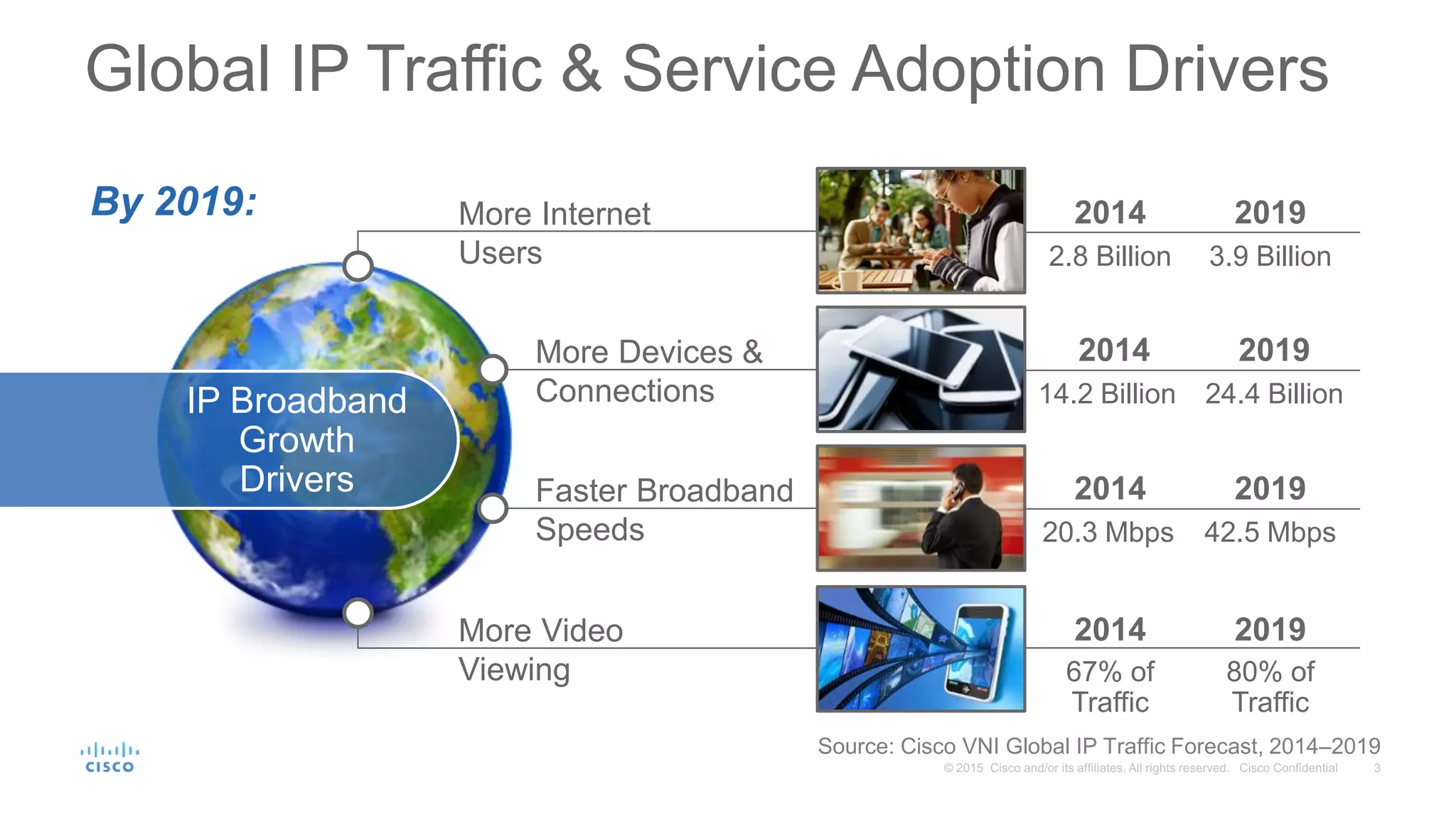
Global IP Traffic & Service Adoption Drivers
More Devices &
Connections
More Internet
Users
Faster Broadband
Speeds
More Video
Viewing
Source: Cisco VNI Global IP Traffic Forecast, 2014–2019
By 2019:
2014 2019
14.2 Billion 24.4 Billion
2014 2019
20.3 Mbps 42.5 Mbps
2014 2019
2.8 Billion 3.9 Billion
2014 2019
67% of
Traffic
80% of
Traffic
IP Broadband
Growth
Drivers
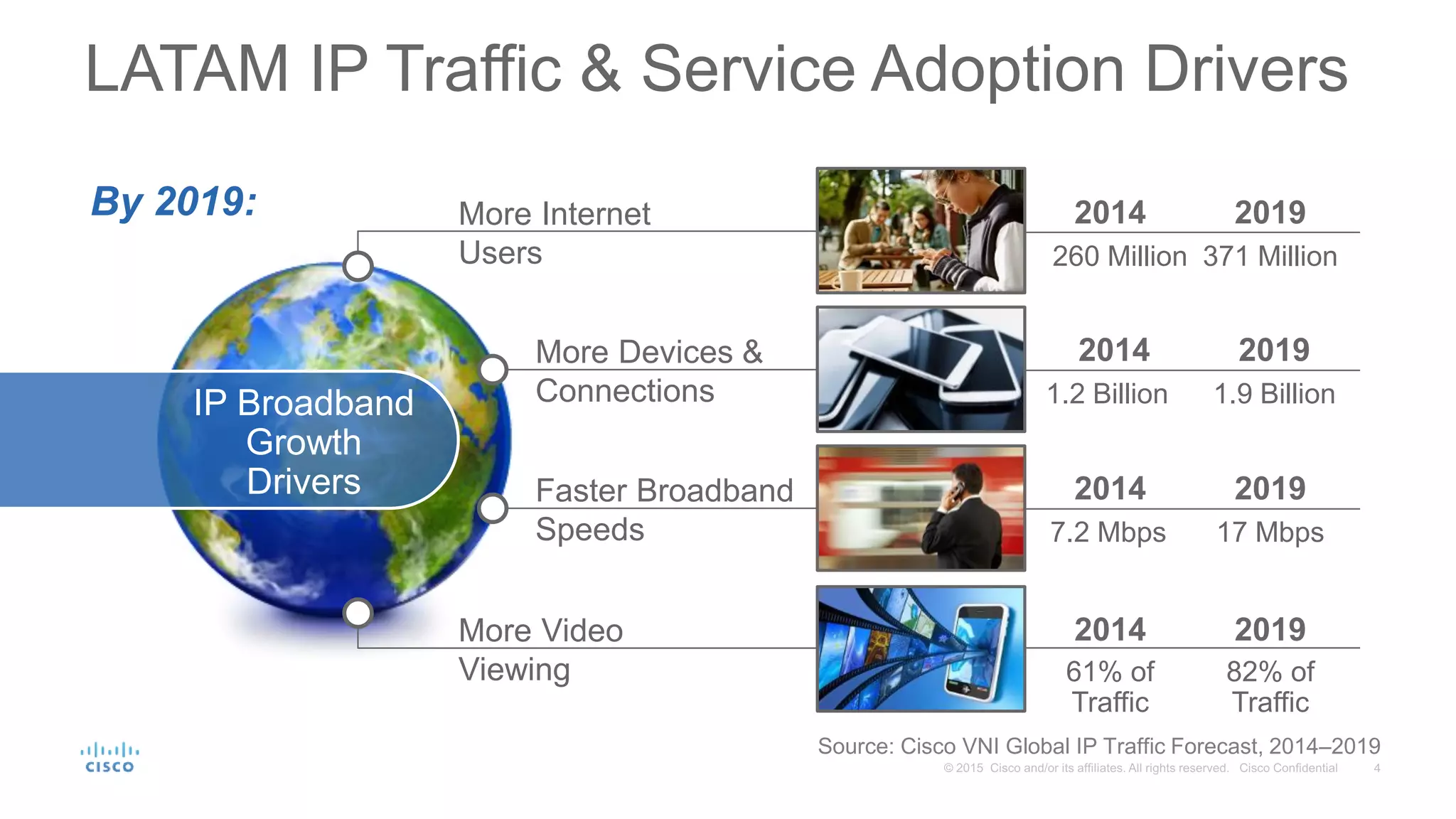
LATAM IP Traffic & Service Adoption Drivers
More Devices &
Connections
More Internet
Users
Faster Broadband
Speeds
More Video
Viewing
Source: Cisco VNI Global IP Traffic Forecast, 2014–2019
By 2019:
2014 2019
1.2 Billion 1.9 Billion
2014 2019
7.2 Mbps 17 Mbps
2014 2019
260 Million 371 Million
2014 2019
61% of
Traffic
82% of
Traffic
IP Broadband
Growth
Drivers
Overview
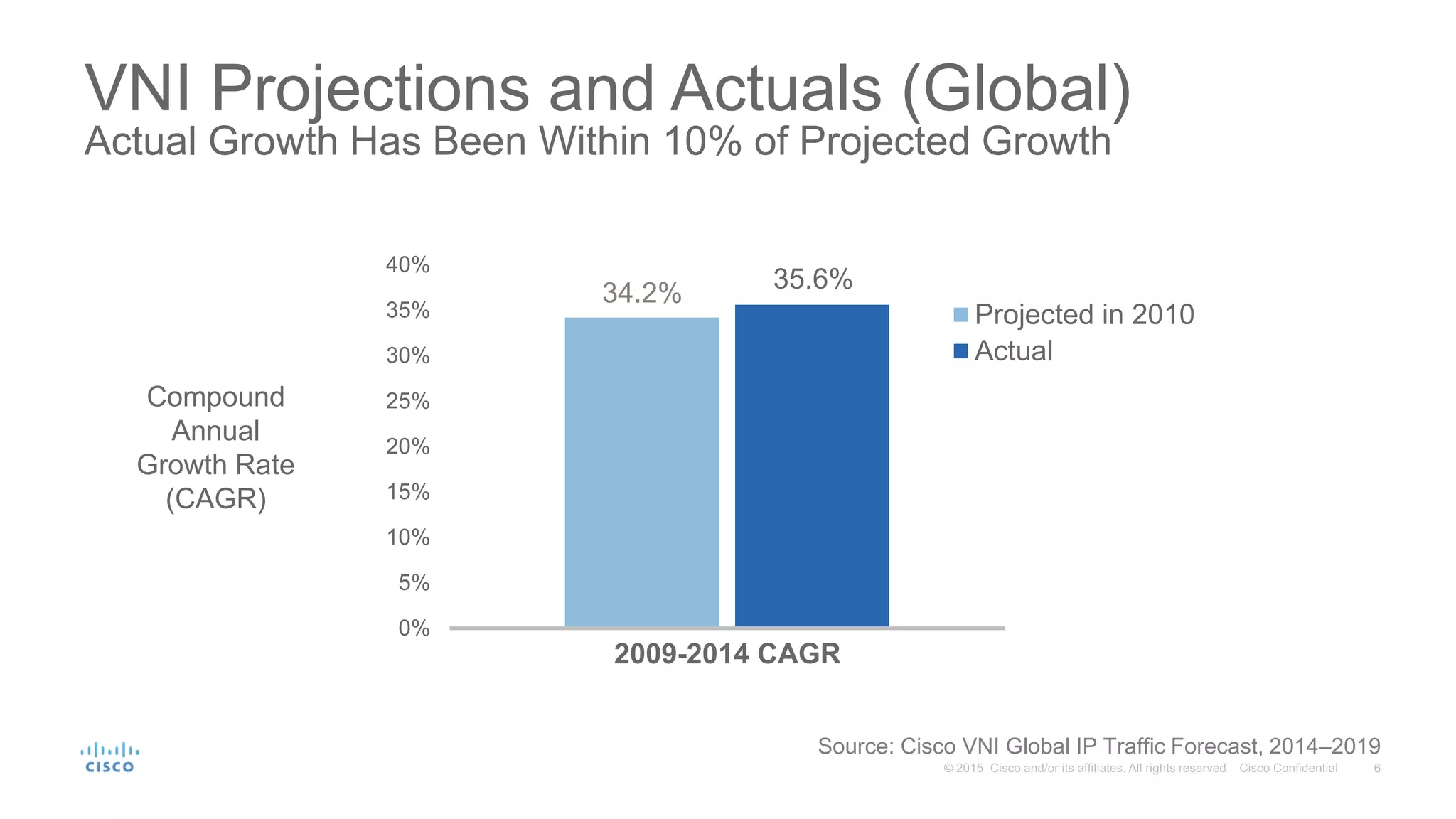
34.2%
0%
5%
10%
15%
20%
25%
30%
35%
40%
2009-2014 CAGR
Projected in 2010
Actual
35.6%
Source: Cisco VNI Global IP Traffic Forecast, 2014–2019
VNI Projections and Actuals (Global)
Actual Growth Has Been Within 10% of Projected Growth
Compound
Annual
Growth Rate
(CAGR)
Global IP Traffic Growth / Top-Line
Global IP Traffic will Increase 3-Fold from 2014─2019
23% CAGR 2014–2019
59.9
72.4
88.4
109.0
135.5
168.0
0
20
40
60
80
100
120
140
160
180
2014 2015 2016 2017 2018 2019
Exabytes
per Month
Source: Cisco VNI Global IP Traffic Forecast, 2014–2019
0
2
4
6
8
10
12
14
2014 2015 2016 2017 2018 2019
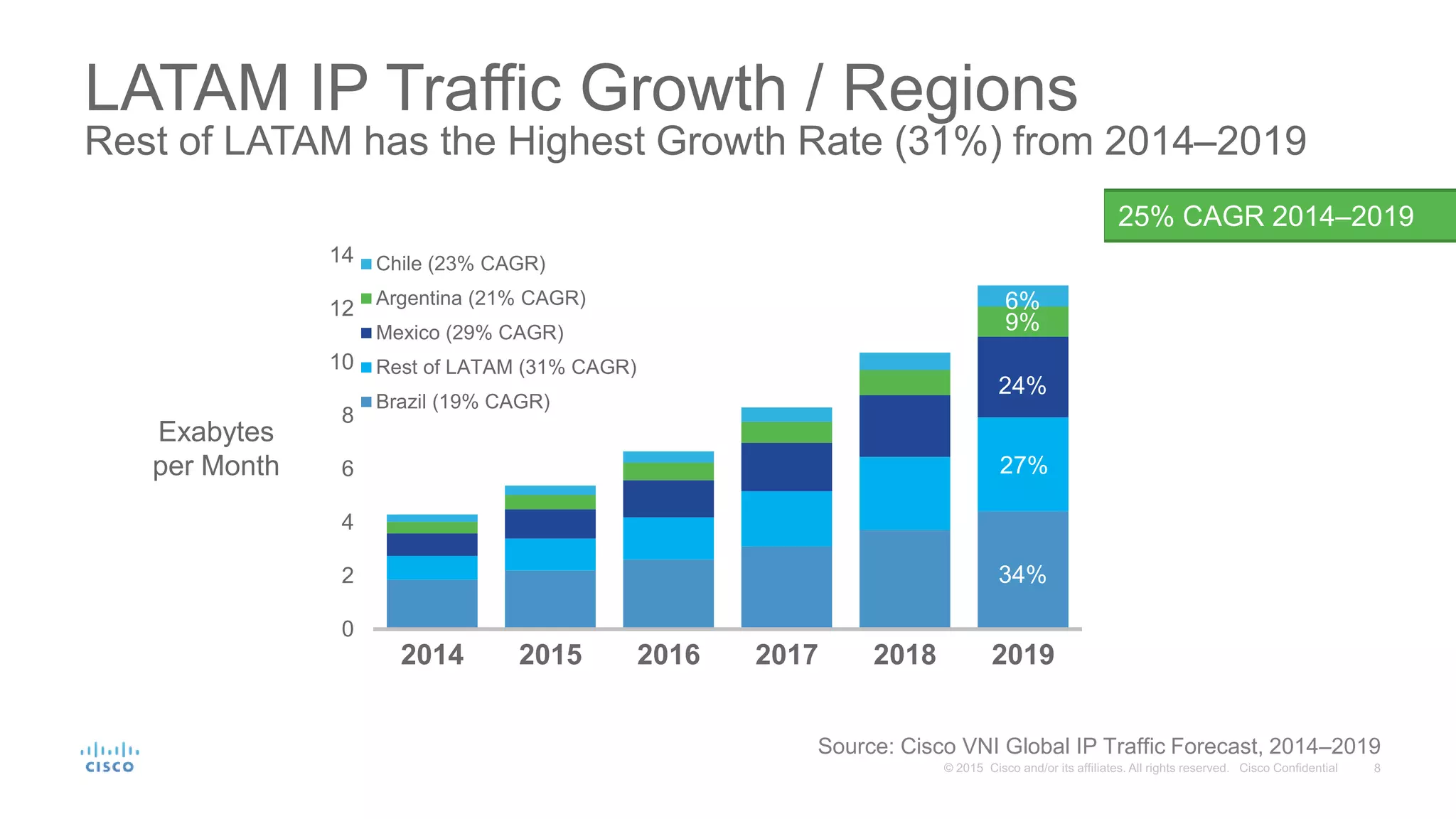
Chile (23% CAGR)
Argentina (21% CAGR)
Mexico (29% CAGR)
Rest of LATAM (31% CAGR)
Brazil (19% CAGR)
LATAM IP Traffic Growth / Regions
Rest of LATAM has the Highest Growth Rate (31%) from 2014–2019
Exabytes
per Month
Source: Cisco VNI Global IP Traffic Forecast, 2014–2019
25% CAGR 2014–2019
27%
34%
24%
9%
6%
0
20
40
60
80
100
120
140
160
180
2014 2015 2016 2017 2018 2019
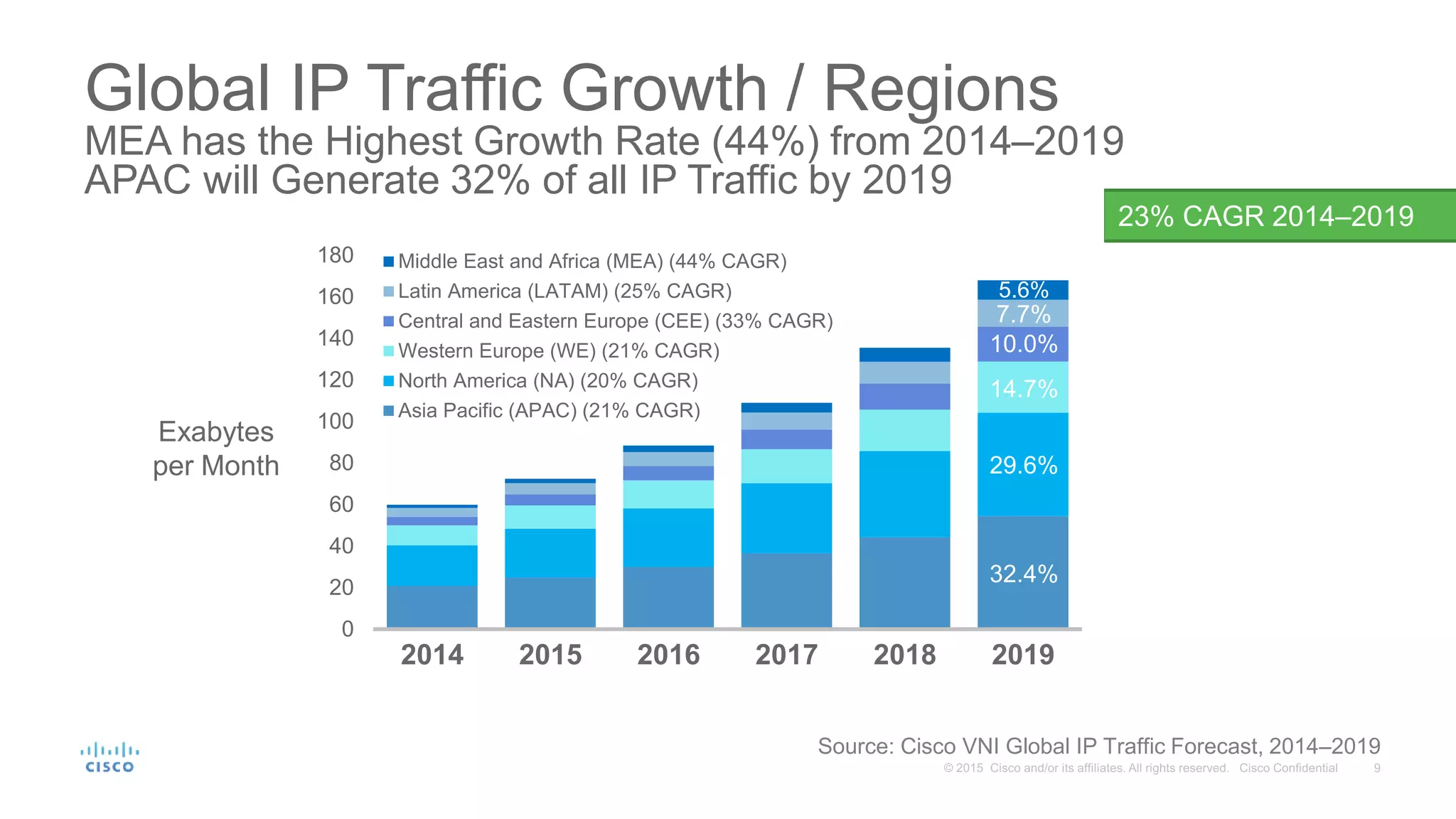
Middle East and Africa (MEA) (44% CAGR)
Latin America (LATAM) (25% CAGR)
Central and Eastern Europe (CEE) (33% CAGR)
Western Europe (WE) (21% CAGR)
North America (NA) (20% CAGR)
Asia Pacific (APAC) (21% CAGR)
Global IP Traffic Growth / Regions
MEA has the Highest Growth Rate (44%) from 2014–2019
APAC will Generate 32% of all IP Traffic by 2019
29.6%
32.4%
10.0%
5.6%
14.7%
Exabytes
per Month
7.7%
Source: Cisco VNI Global IP Traffic Forecast, 2014–2019
23% CAGR 2014–2019
Drivers
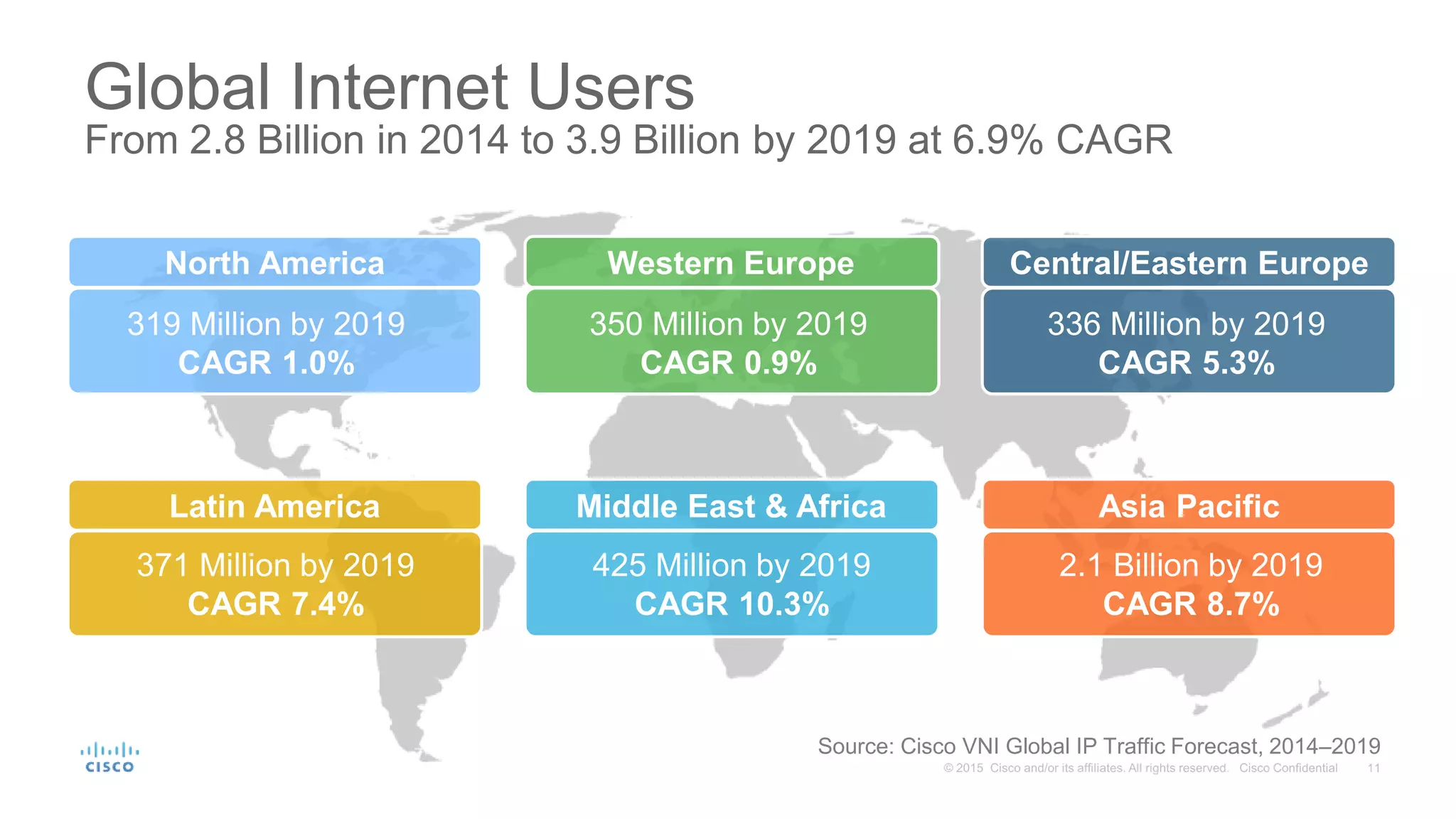
Global Internet Users
From 2.8 Billion in 2014 to 3.9 Billion by 2019 at 6.9% CAGR
North America Western Europe Central/Eastern Europe
Latin America Middle East & Africa Asia Pacific
319 Million by 2019
CAGR 1.0%
350 Million by 2019
CAGR 0.9%
336 Million by 2019
CAGR 5.3%
371 Million by 2019
CAGR 7.4%
425 Million by 2019
CAGR 10.3%
2.1 Billion by 2019
CAGR 8.7%
Source: Cisco VNI Global IP Traffic Forecast, 2014–2019
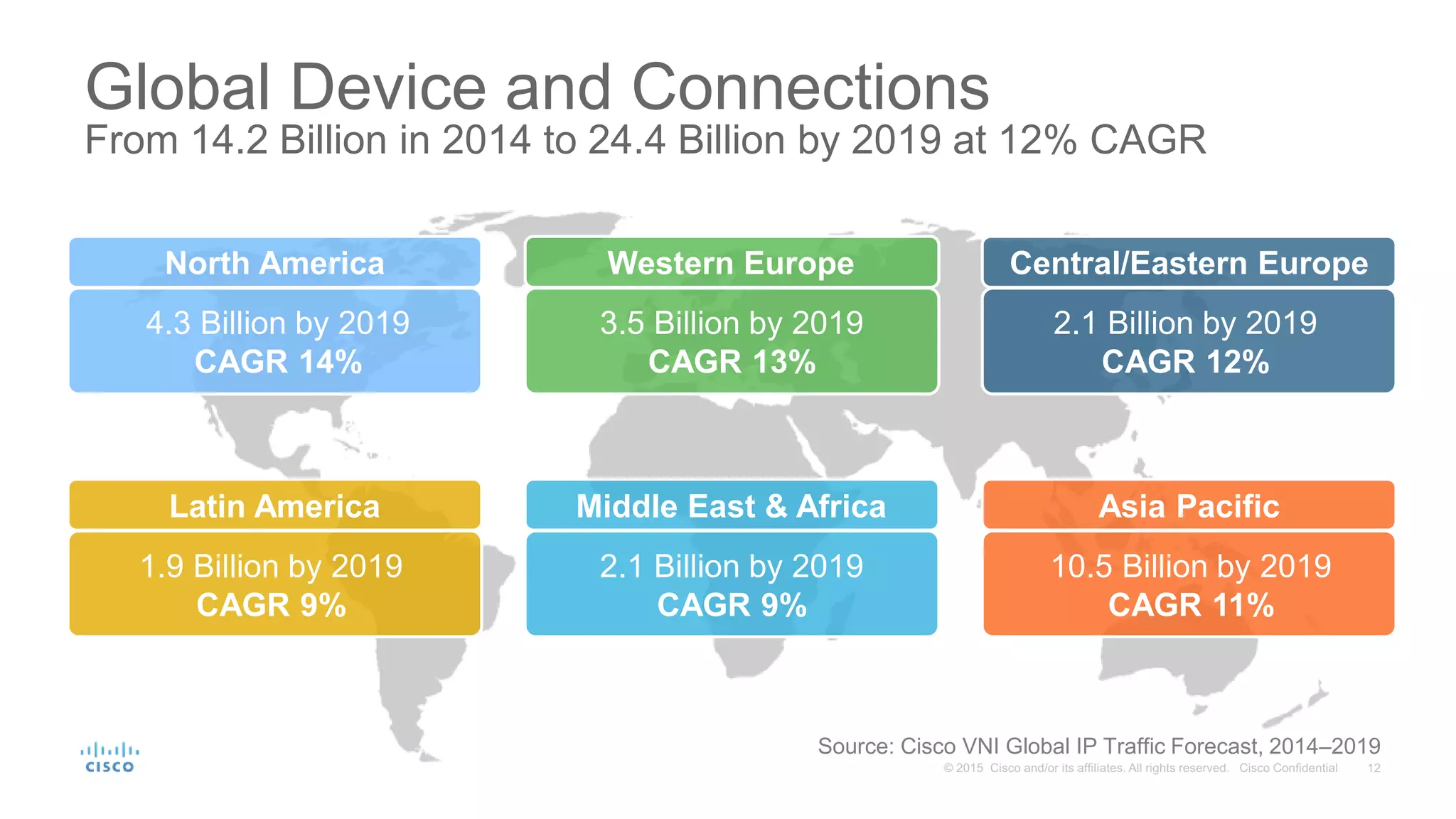
Global Device and Connections
From 14.2 Billion in 2014 to 24.4 Billion by 2019 at 12% CAGR
North America Western Europe Central/Eastern Europe
Latin America Middle East & Africa Asia Pacific
4.3 Billion by 2019
CAGR 14%
3.5 Billion by 2019
CAGR 13%
2.1 Billion by 2019
CAGR 12%
1.9 Billion by 2019
CAGR 9%
2.1 Billion by 2019
CAGR 9%
10.5 Billion by 2019
CAGR 11%
Source: Cisco VNI Global IP Traffic Forecast, 2014–2019
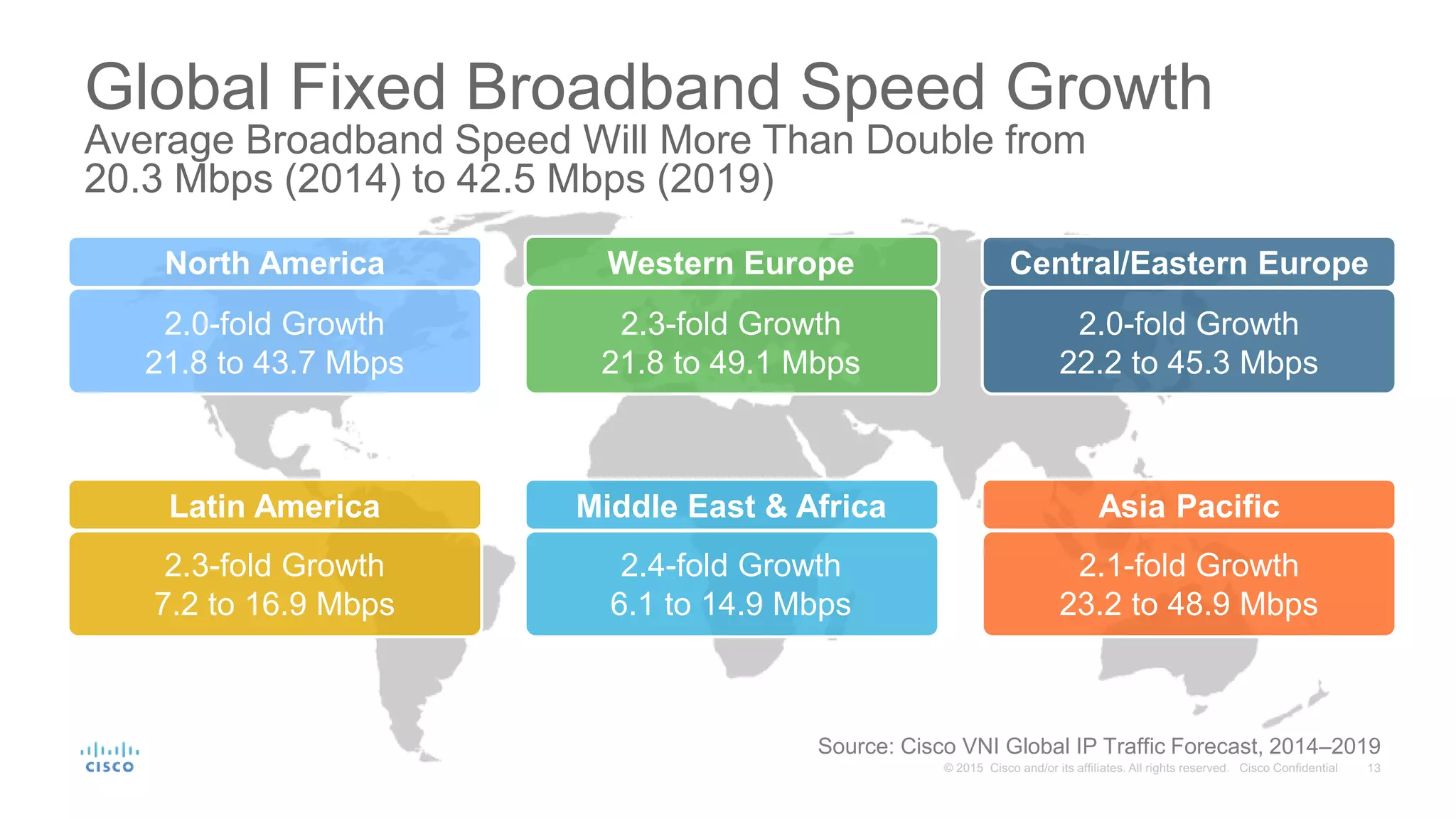
Global Fixed Broadband Speed Growth
Average Broadband Speed Will More Than Double from
20.3 Mbps (2014) to 42.5 Mbps (2019)
North America Western Europe Central/Eastern Europe
Latin America Middle East & Africa Asia Pacific
2.0-fold Growth
21.8 to 43.7 Mbps
2.3-fold Growth
21.8 to 49.1 Mbps
2.0-fold Growth
22.2 to 45.3 Mbps
2.3-fold Growth
7.2 to 16.9 Mbps
2.4-fold Growth
6.1 to 14.9 Mbps
2.1-fold Growth
23.2 to 48.9 Mbps
Source: Cisco VNI Global IP Traffic Forecast, 2014–2019
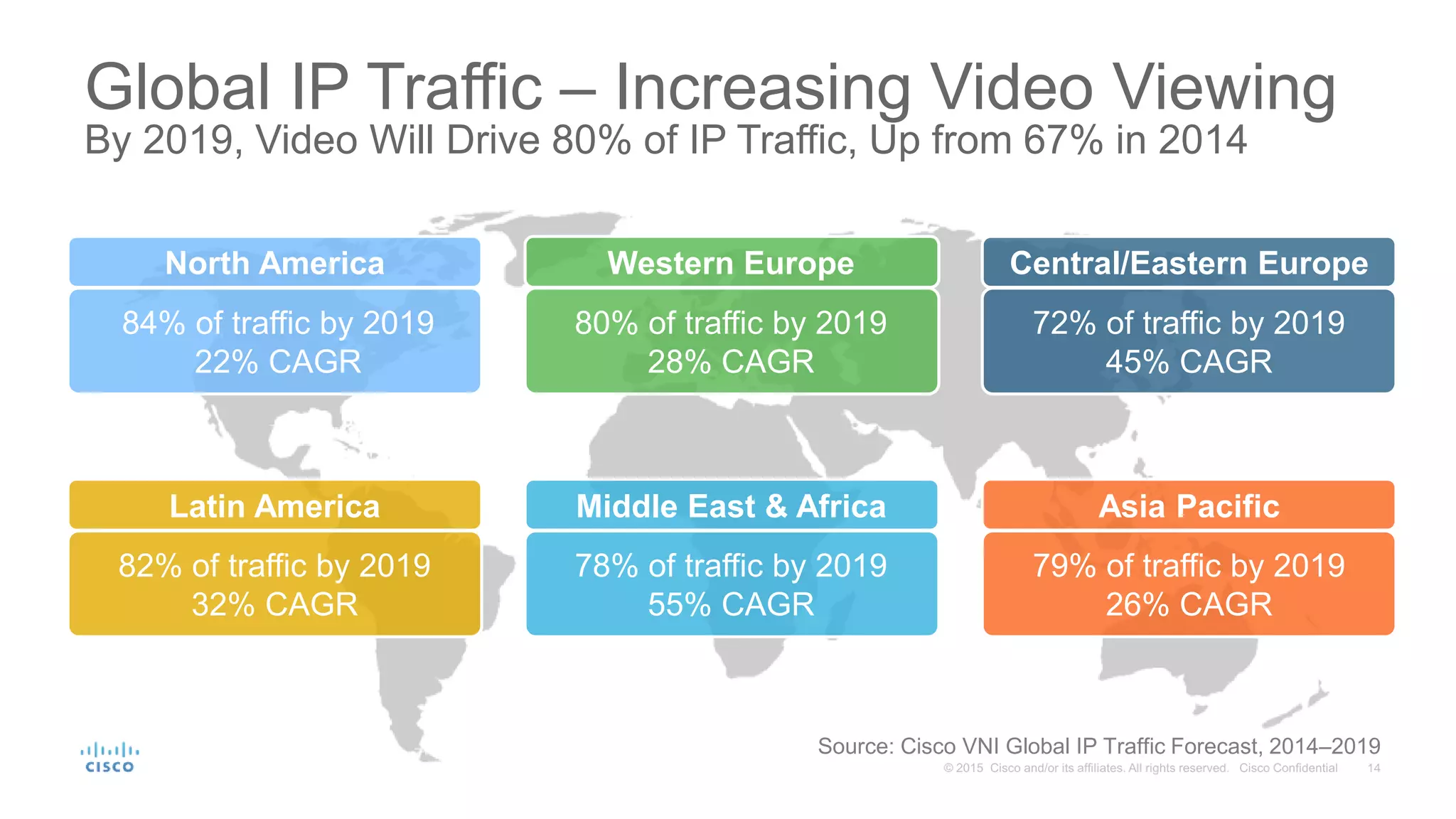
Global IP Traffic – Increasing Video Viewing
By 2019, Video Will Drive 80% of IP Traffic, Up from 67% in 2014
North America Western Europe Central/Eastern Europe
Latin America Middle East & Africa Asia Pacific
84% of traffic by 2019
22% CAGR
80% of traffic by 2019
28% CAGR
72% of traffic by 2019
45% CAGR
82% of traffic by 2019
32% CAGR
78% of traffic by 2019
55% CAGR
79% of traffic by 2019
26% CAGR
Source: Cisco VNI Global IP Traffic Forecast, 2014–2019
Top Trends
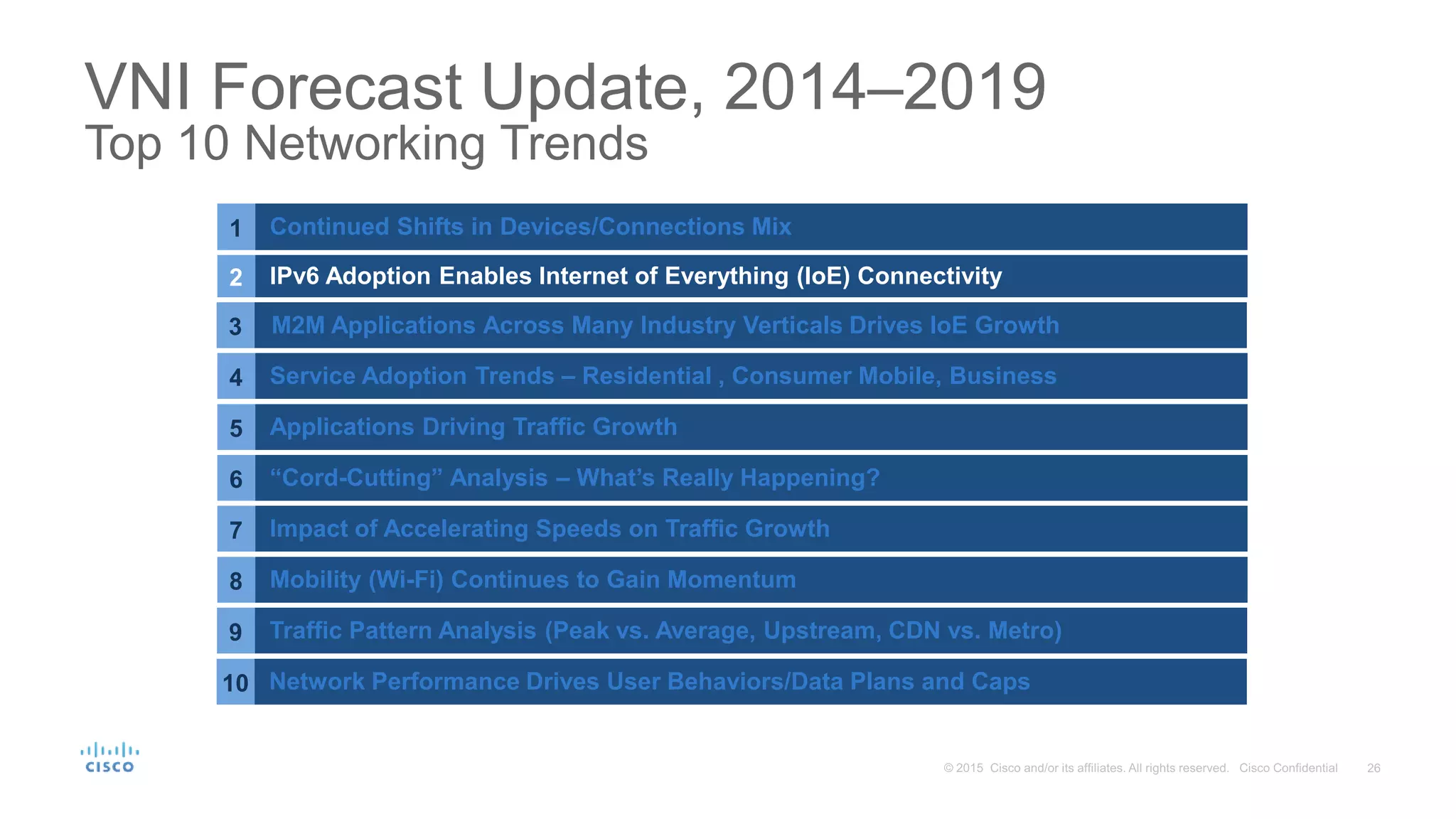
VNI Forecast Update, 2014–2019
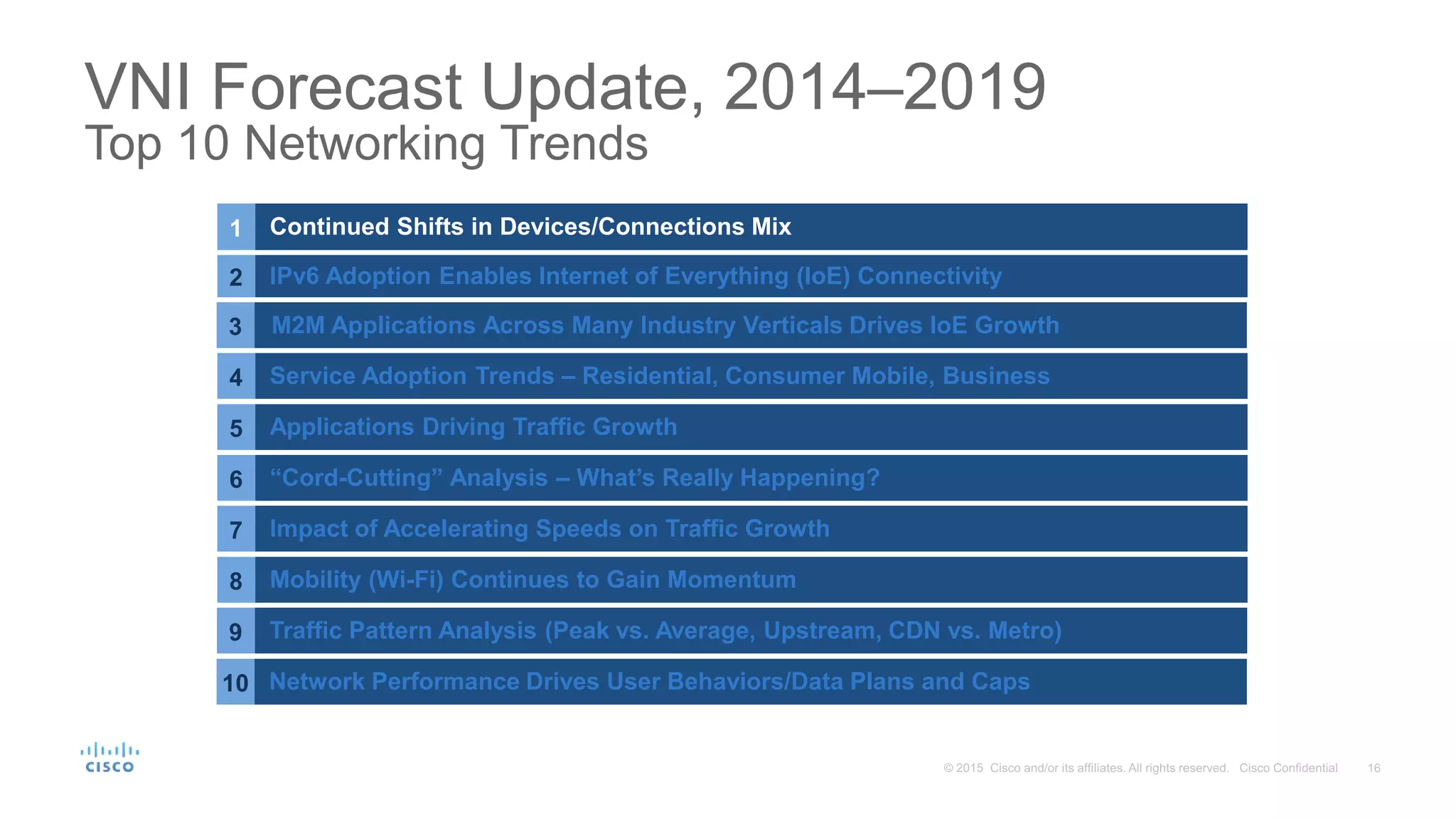
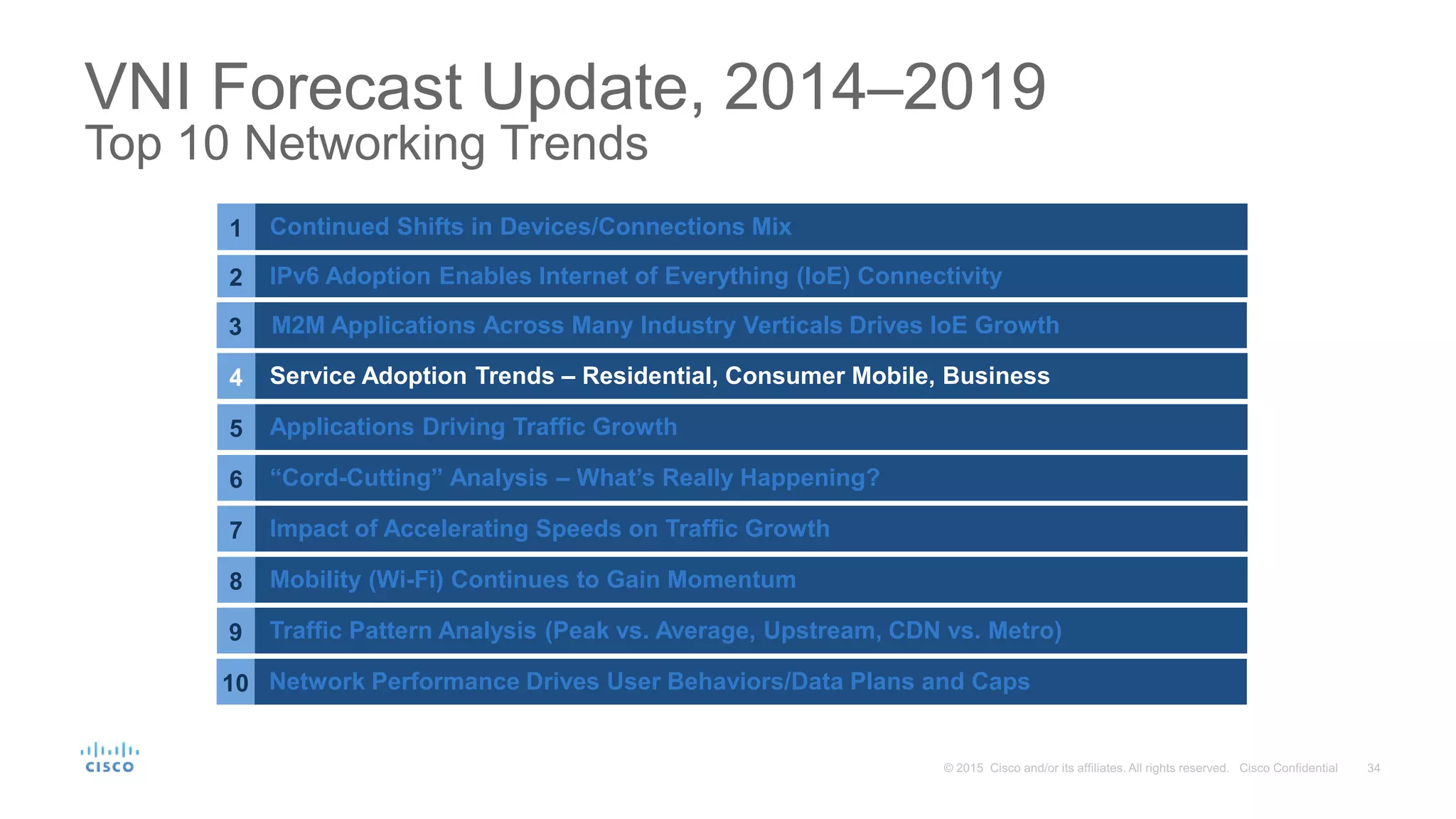
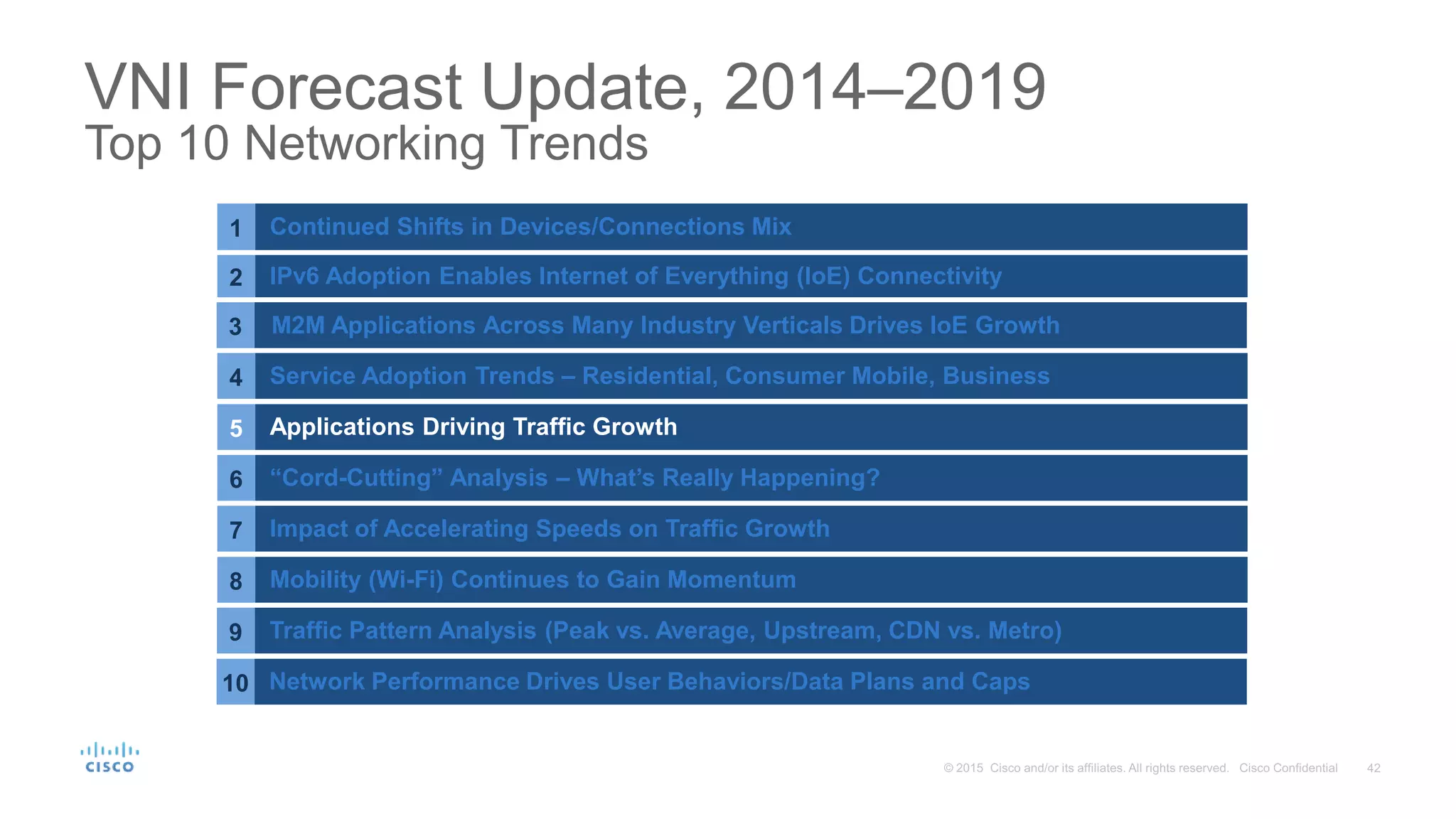
Top 10 Networking Trends
1 Continued Shifts in Devices/Connections Mix
2 IPv6 Adoption Enables Internet of Everything (IoE) Connectivity
3
4 Service Adoption Trends – Residential, Consumer Mobile, Business
5 Applications Driving Traffic Growth
6 “Cord-Cutting” Analysis – What’s Really Happening?
7 Impact of Accelerating Speeds on Traffic Growth
8 Mobility (Wi-Fi) Continues to Gain Momentum
9 Traffic Pattern Analysis (Peak vs. Average, Upstream, CDN vs. Metro)
10 Network Performance Drives User Behaviors/Data Plans and Caps
M2M Applications Across Many Industry Verticals Drives IoE Growth
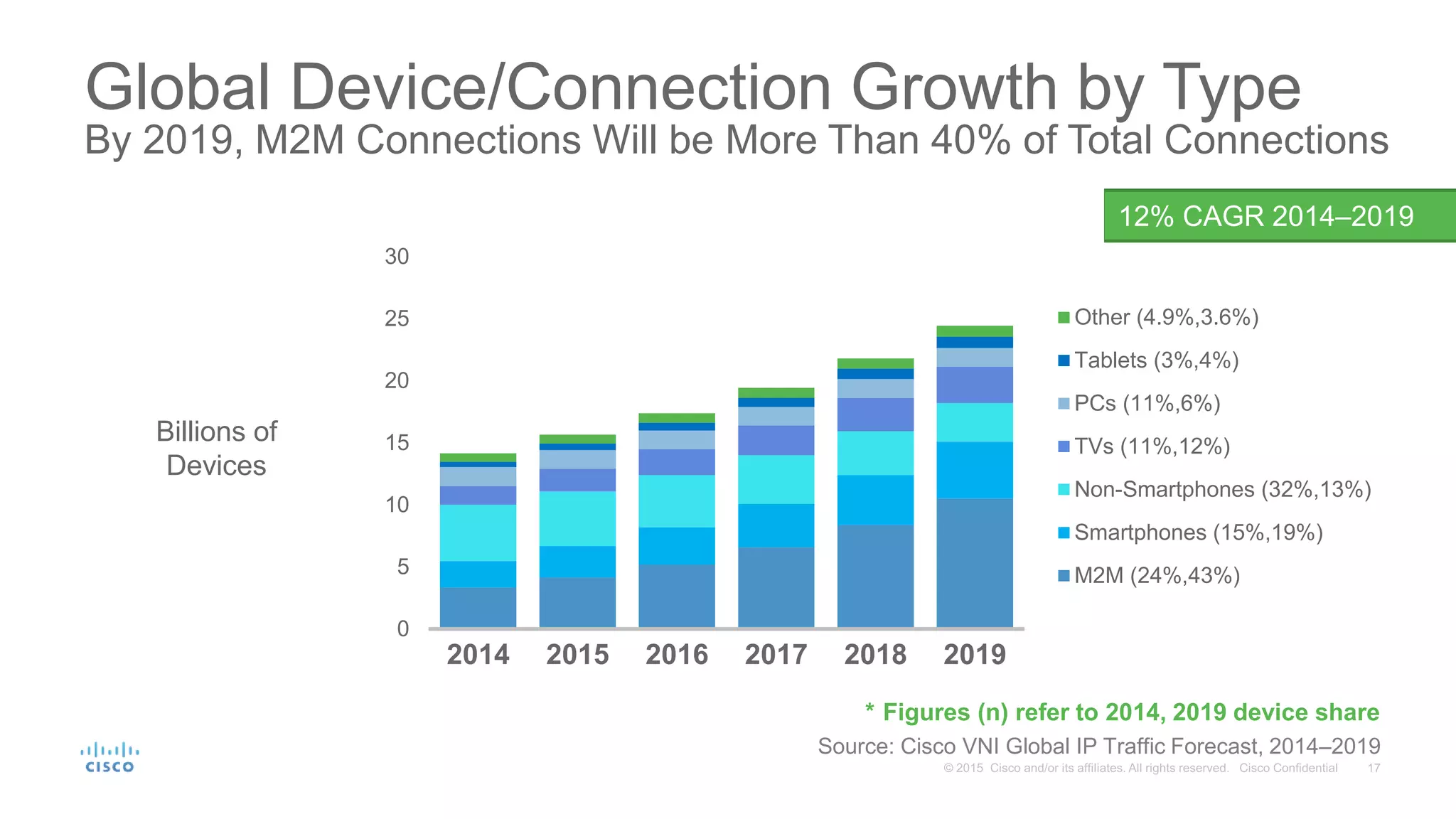
Global Device/Connection Growth by Type
By 2019, M2M Connections Will be More Than 40% of Total Connections
0
5
10
15
20
25
30
2014 2015 2016 2017 2018 2019
Other (4.9%,3.6%)
Tablets (3%,4%)
PCs (11%,6%)
TVs (11%,12%)
Non-Smartphones (32%,13%)
Smartphones (15%,19%)
M2M (24%,43%)
Billions of
Devices
* Figures (n) refer to 2014, 2019 device share
Source: Cisco VNI Global IP Traffic Forecast, 2014–2019
12% CAGR 2014–2019
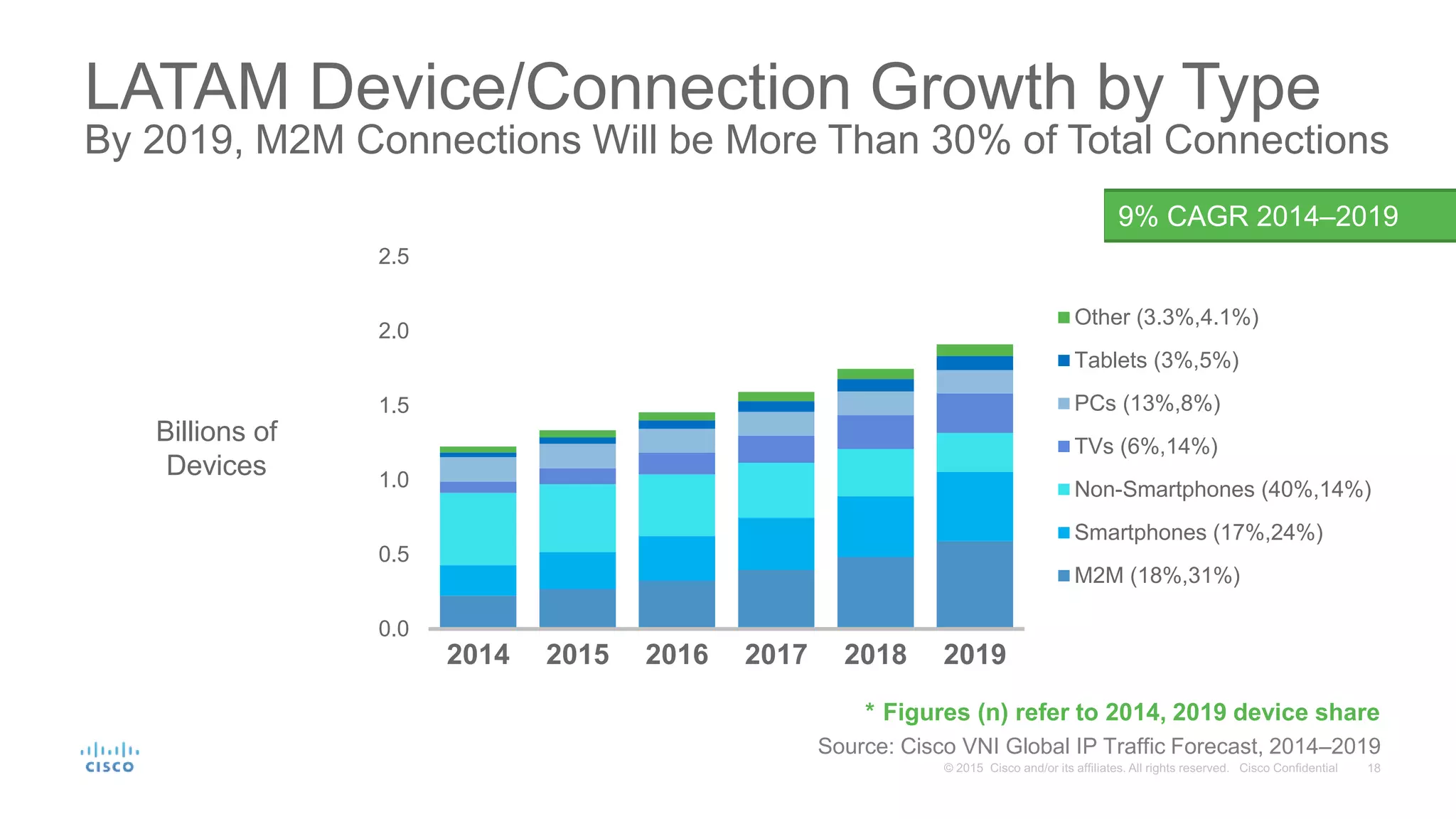
LATAM Device/Connection Growth by Type
By 2019, M2M Connections Will be More Than 30% of Total Connections
0.0
0.5
1.0
1.5
2.0
2.5
2014 2015 2016 2017 2018 2019
Other (3.3%,4.1%)
Tablets (3%,5%)
PCs (13%,8%)
TVs (6%,14%)
Non-Smartphones (40%,14%)
Smartphones (17%,24%)
M2M (18%,31%)
Billions of
Devices
* Figures (n) refer to 2014, 2019 device share
Source: Cisco VNI Global IP Traffic Forecast, 2014–2019
9% CAGR 2014–2019
SD 2 Mbps
HD 7.2 Mbps
UHD 18 Mbps
10
33
77
146
245
371
0
50
100
150
200
250
300
350
400
2014 2015 2016 2017 2018 2019
Connected
4K TV Sets
(M)
Source: Cisco VNI Global IP Traffic Forecast, 2014–2019
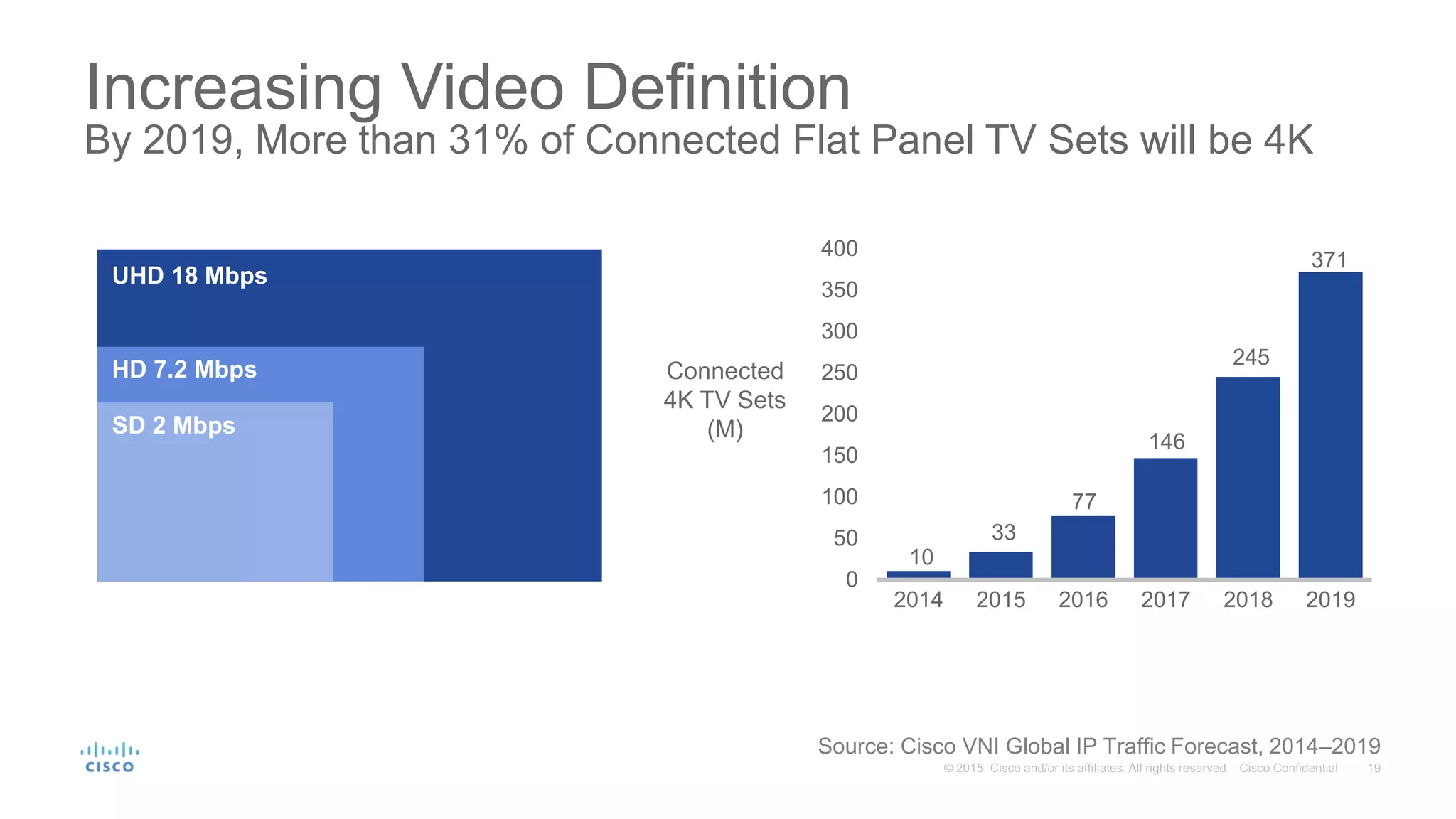
Increasing Video Definition
By 2019, More than 31% of Connected Flat Panel TV Sets will be 4K
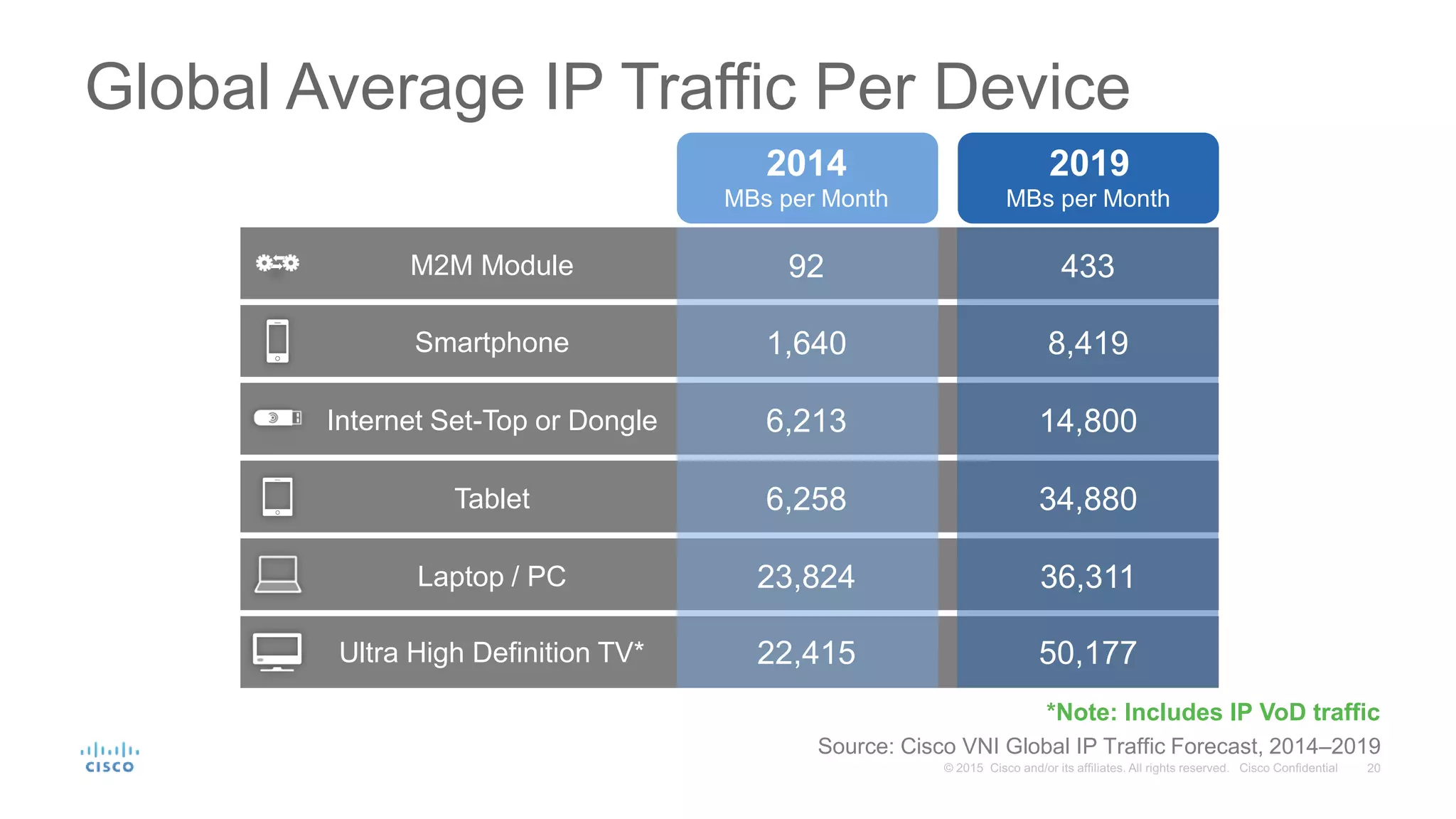
Global Average IP Traffic Per Device
2014 2019
Wearable Device
Smartphone
Tablet
MBs per Month MBs per Month
1,640 8,419
6,213 14,800
6,258 34,880
23,824 36,311
22,415 50,177
M2M Module
Internet Set-Top or Dongle
Smartphone
Tablet
Laptop / PC
92 433
Ultra High Definition TV*
Source: Cisco VNI Global IP Traffic Forecast, 2014–2019
*Note: Includes IP VoD traffic
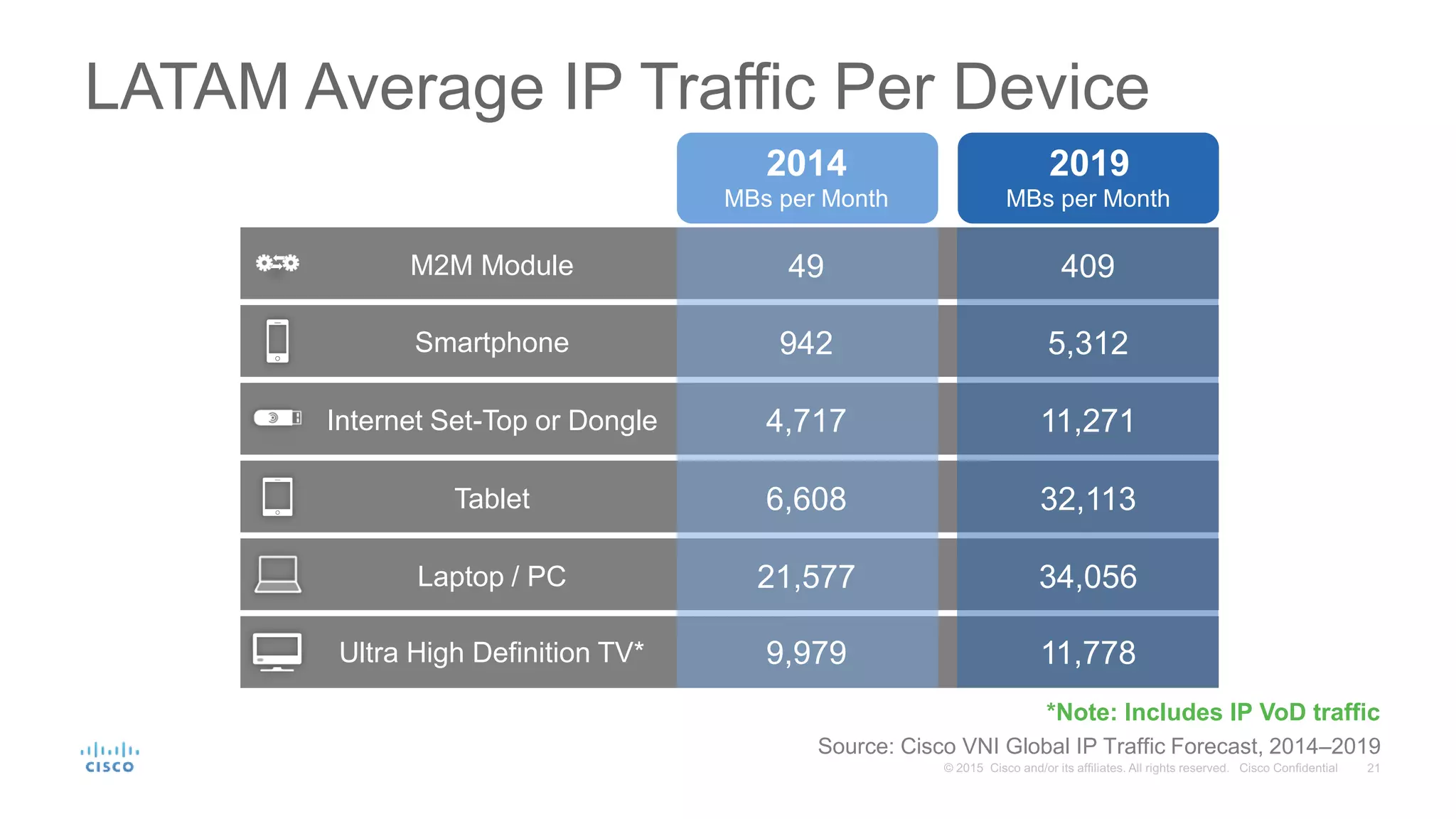
LATAM Average IP Traffic Per Device
2014 2019
Wearable Device
Smartphone
Tablet
MBs per Month MBs per Month
942 5,312
4,717 11,271
6,608 32,113
21,577 34,056
9,979 11,778
M2M Module
Internet Set-Top or Dongle
Smartphone
Tablet
Laptop / PC
49 409
Ultra High Definition TV*
Source: Cisco VNI Global IP Traffic Forecast, 2014–2019
*Note: Includes IP VoD traffic
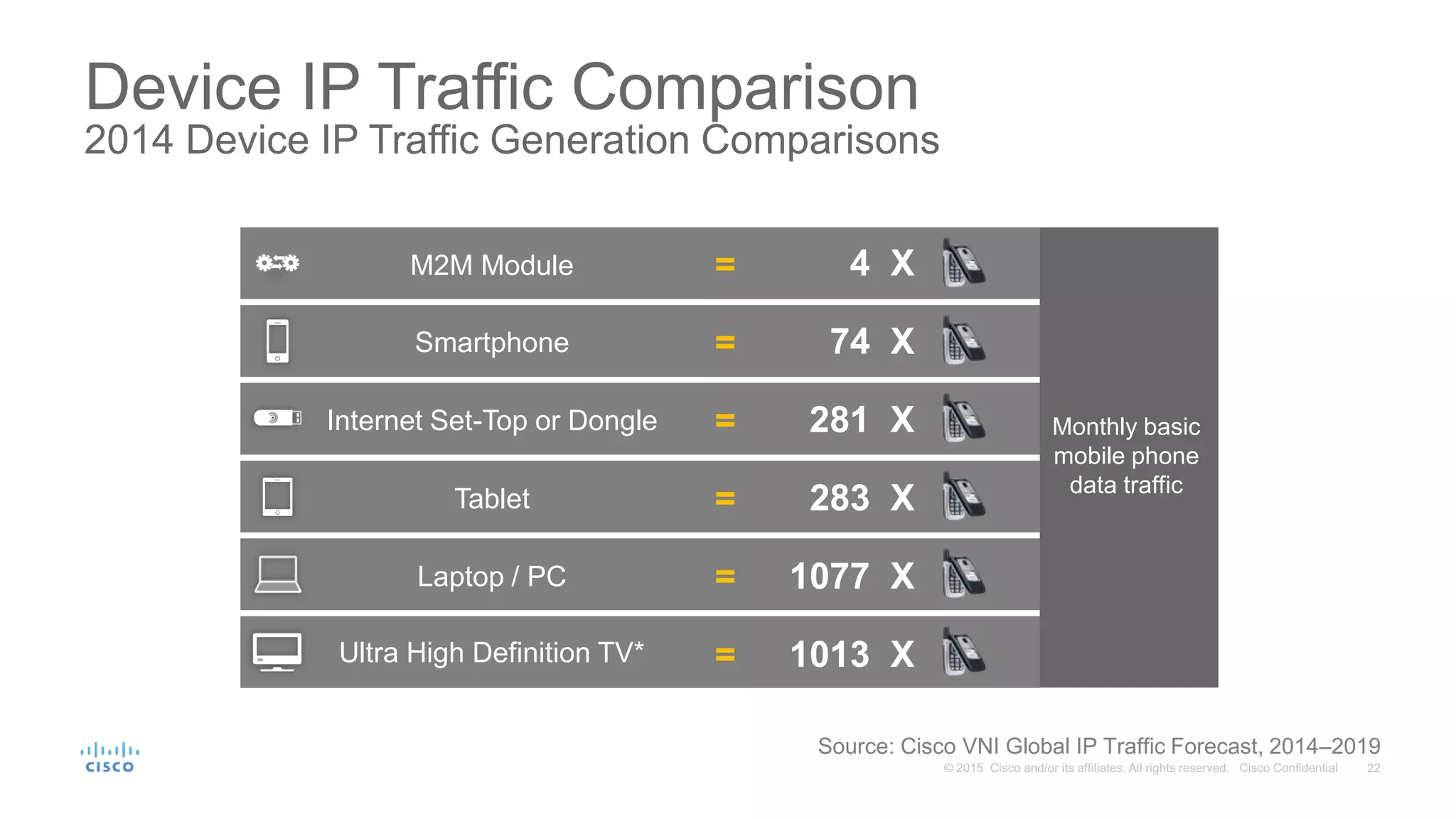
Device IP Traffic Comparison
2014 Device IP Traffic Generation Comparisons
Source: Cisco VNI Global IP Traffic Forecast, 2014–2019
Wearable Device
Smartphone
Tablet
M2M Module
Internet Set-Top or Dongle
Smartphone
Tablet
Laptop / PC
Ultra High Definition TV*
Monthly basic
mobile phone
data traffic
1077 X=
283 X=
281 X=
74 X=
4 X=
1013 X=
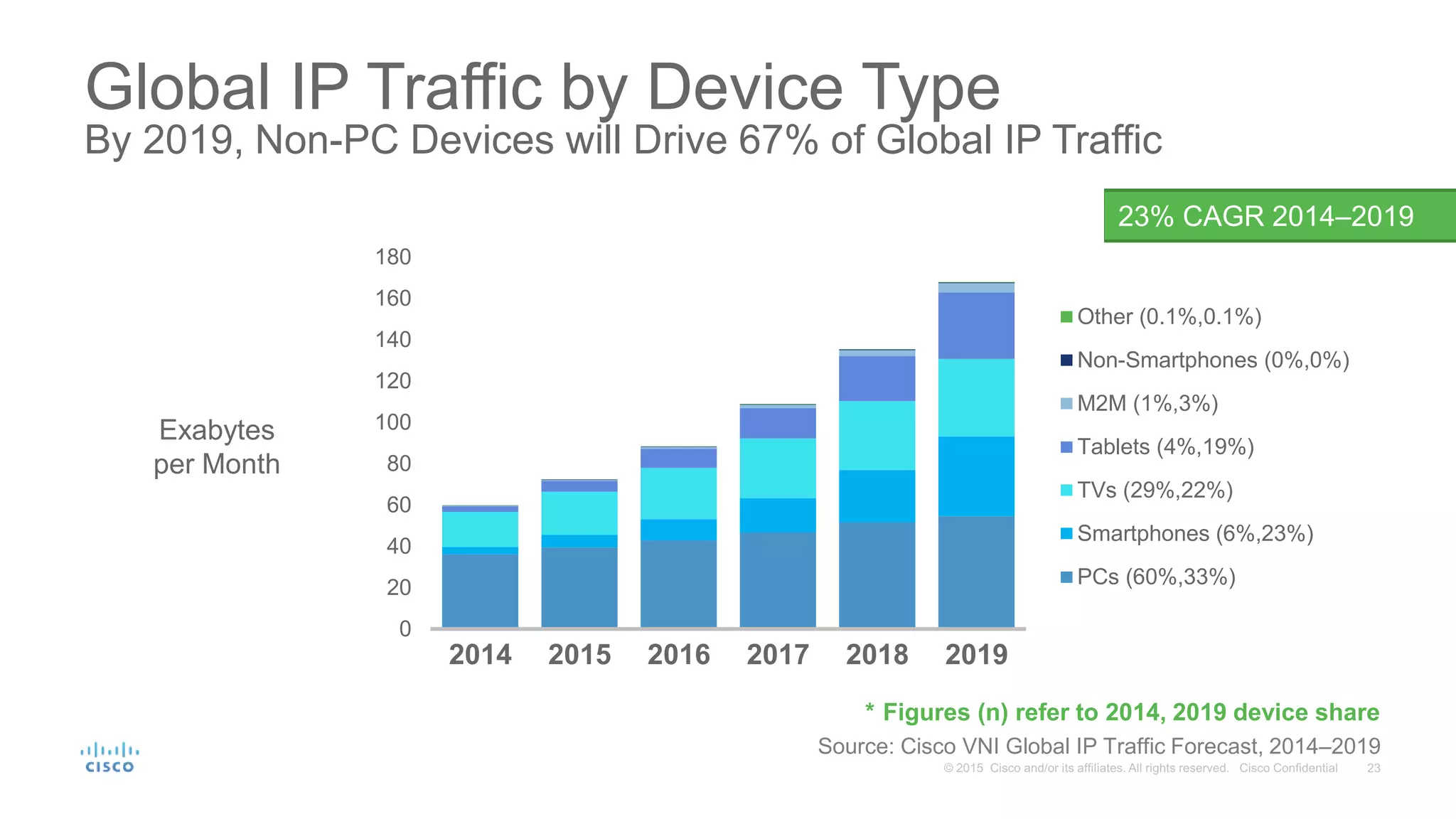
Global IP Traffic by Device Type
By 2019, Non-PC Devices will Drive 67% of Global IP Traffic
0
20
40
60
80
100
120
140
160
180
2014 2015 2016 2017 2018 2019
Other (0.1%,0.1%)
Non-Smartphones (0%,0%)
M2M (1%,3%)
Tablets (4%,19%)
TVs (29%,22%)
Smartphones (6%,23%)
PCs (60%,33%)
Source: Cisco VNI Global IP Traffic Forecast, 2014–2019
23% CAGR 2014–2019
Exabytes
per Month
* Figures (n) refer to 2014, 2019 device share
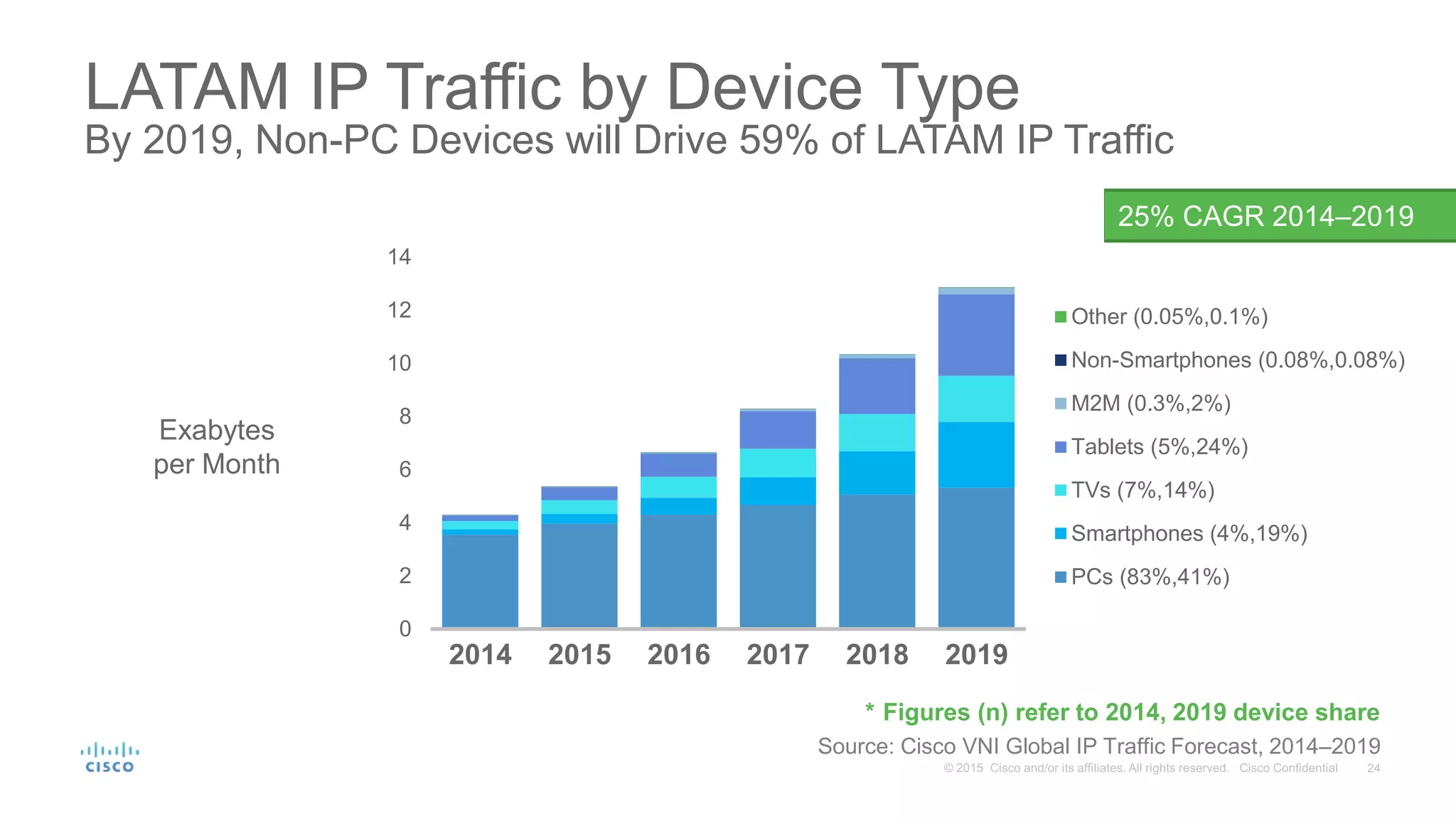
LATAM IP Traffic by Device Type
By 2019, Non-PC Devices will Drive 59% of LATAM IP Traffic
0
2
4
6
8
10
12
14
2014 2015 2016 2017 2018 2019
Other (0.05%,0.1%)
Non-Smartphones (0.08%,0.08%)
M2M (0.3%,2%)
Tablets (5%,24%)
TVs (7%,14%)
Smartphones (4%,19%)
PCs (83%,41%)
Source: Cisco VNI Global IP Traffic Forecast, 2014–2019
25% CAGR 2014–2019
Exabytes
per Month
* Figures (n) refer to 2014, 2019 device share
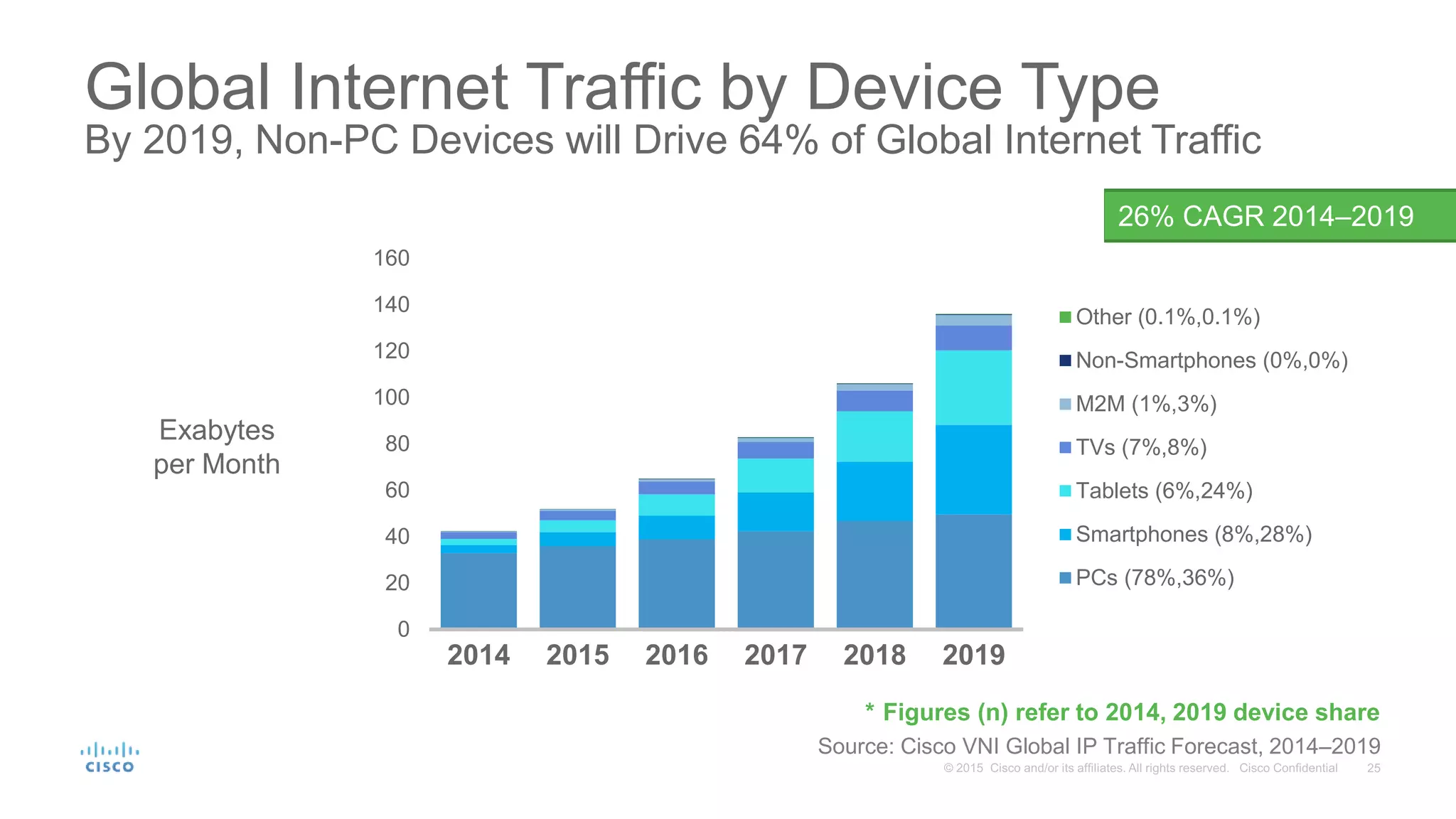
Global Internet Traffic by Device Type
By 2019, Non-PC Devices will Drive 64% of Global Internet Traffic
0
20
40
60
80
100
120
140
160
2014 2015 2016 2017 2018 2019
Other (0.1%,0.1%)
Non-Smartphones (0%,0%)
M2M (1%,3%)
TVs (7%,8%)
Tablets (6%,24%)
Smartphones (8%,28%)
PCs (78%,36%)
Source: Cisco VNI Global IP Traffic Forecast, 2014–2019
26% CAGR 2014–2019
* Figures (n) refer to 2014, 2019 device share
Exabytes
per Month
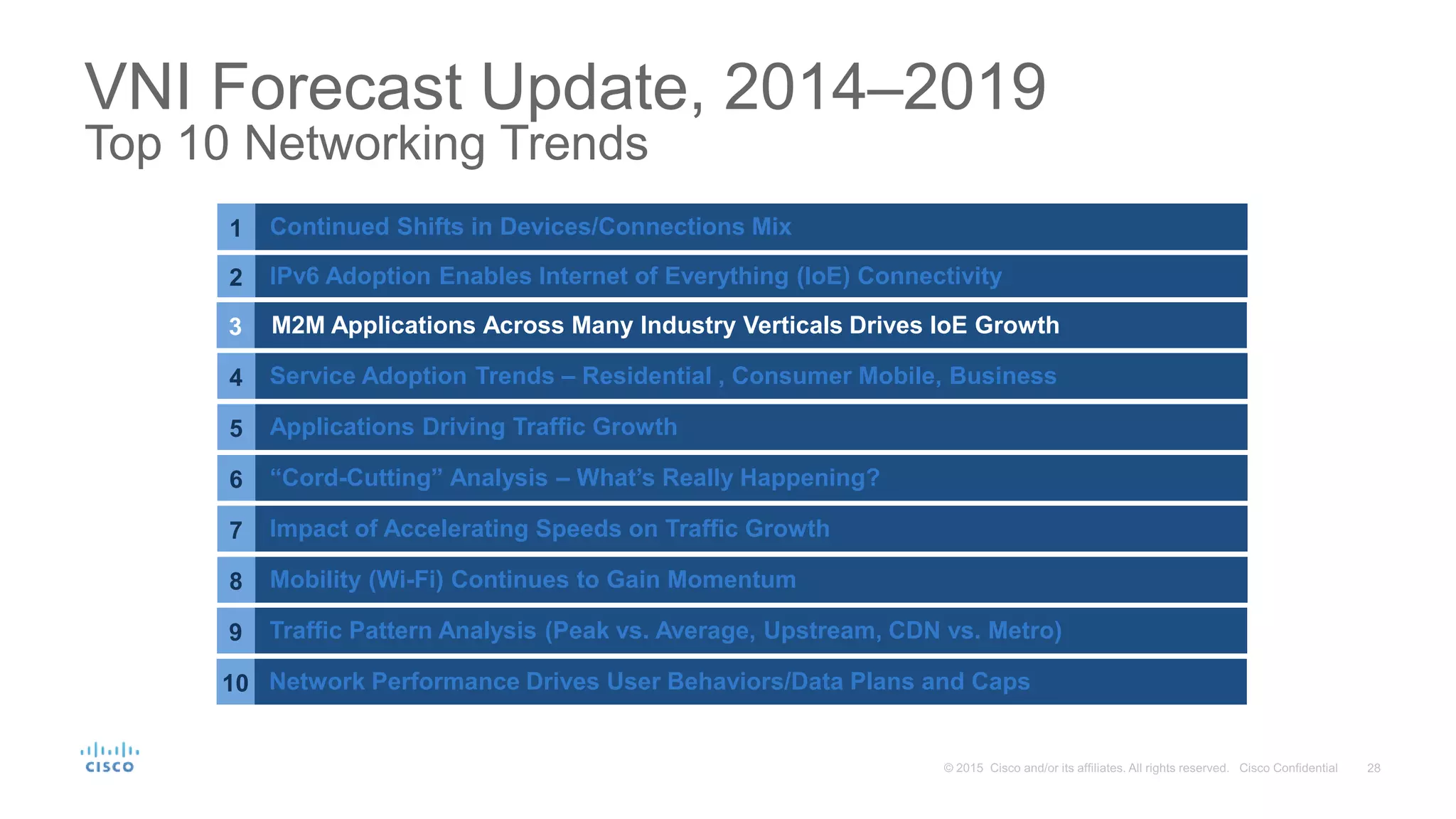
VNI Forecast Update, 2014–2019
Top 10 Networking Trends
1 Continued Shifts in Devices/Connections Mix
2 IPv6 Adoption Enables Internet of Everything (IoE) Connectivity
3
4 Service Adoption Trends – Residential , Consumer Mobile, Business
5 Applications Driving Traffic Growth
6 “Cord-Cutting” Analysis – What’s Really Happening?
7 Impact of Accelerating Speeds on Traffic Growth
8 Mobility (Wi-Fi) Continues to Gain Momentum
9 Traffic Pattern Analysis (Peak vs. Average, Upstream, CDN vs. Metro)
10 Network Performance Drives User Behaviors/Data Plans and Caps
M2M Applications Across Many Industry Verticals Drives IoE Growth
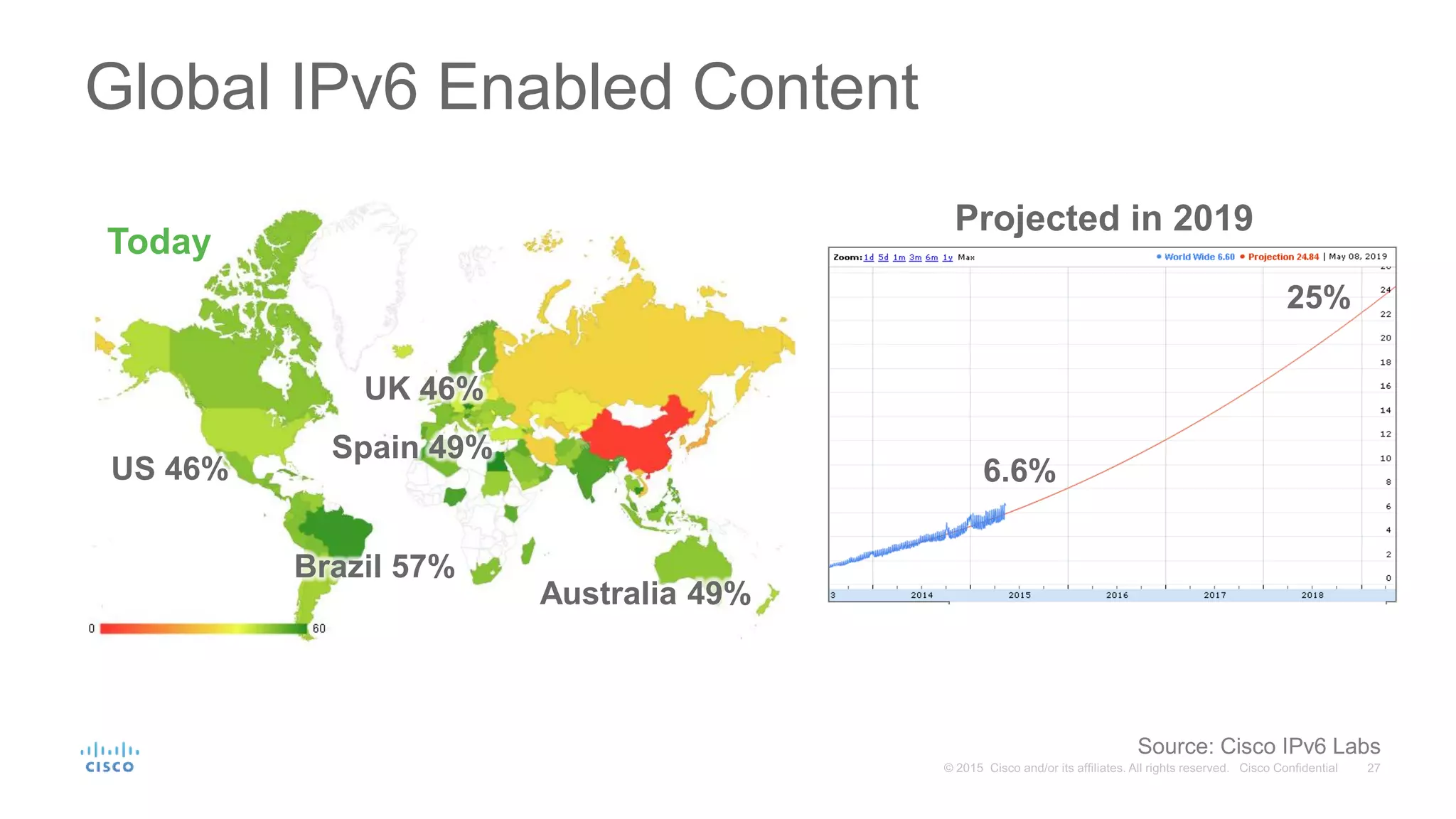
Global IPv6 Enabled Content
US 46%
Australia 49%
Brazil 57%
UK 46%
Spain 49%
Today
Projected in 2019
25%
6.6%
Source: Cisco IPv6 Labs
VNI Forecast Update, 2014–2019
Top 10 Networking Trends
1 Continued Shifts in Devices/Connections Mix
2 IPv6 Adoption Enables Internet of Everything (IoE) Connectivity
3
4 Service Adoption Trends – Residential , Consumer Mobile, Business
5 Applications Driving Traffic Growth
6 “Cord-Cutting” Analysis – What’s Really Happening?
7 Impact of Accelerating Speeds on Traffic Growth
8 Mobility (Wi-Fi) Continues to Gain Momentum
9 Traffic Pattern Analysis (Peak vs. Average, Upstream, CDN vs. Metro)
10 Network Performance Drives User Behaviors/Data Plans and Caps
M2M Applications Across Many Industry Verticals Drives IoE Growth
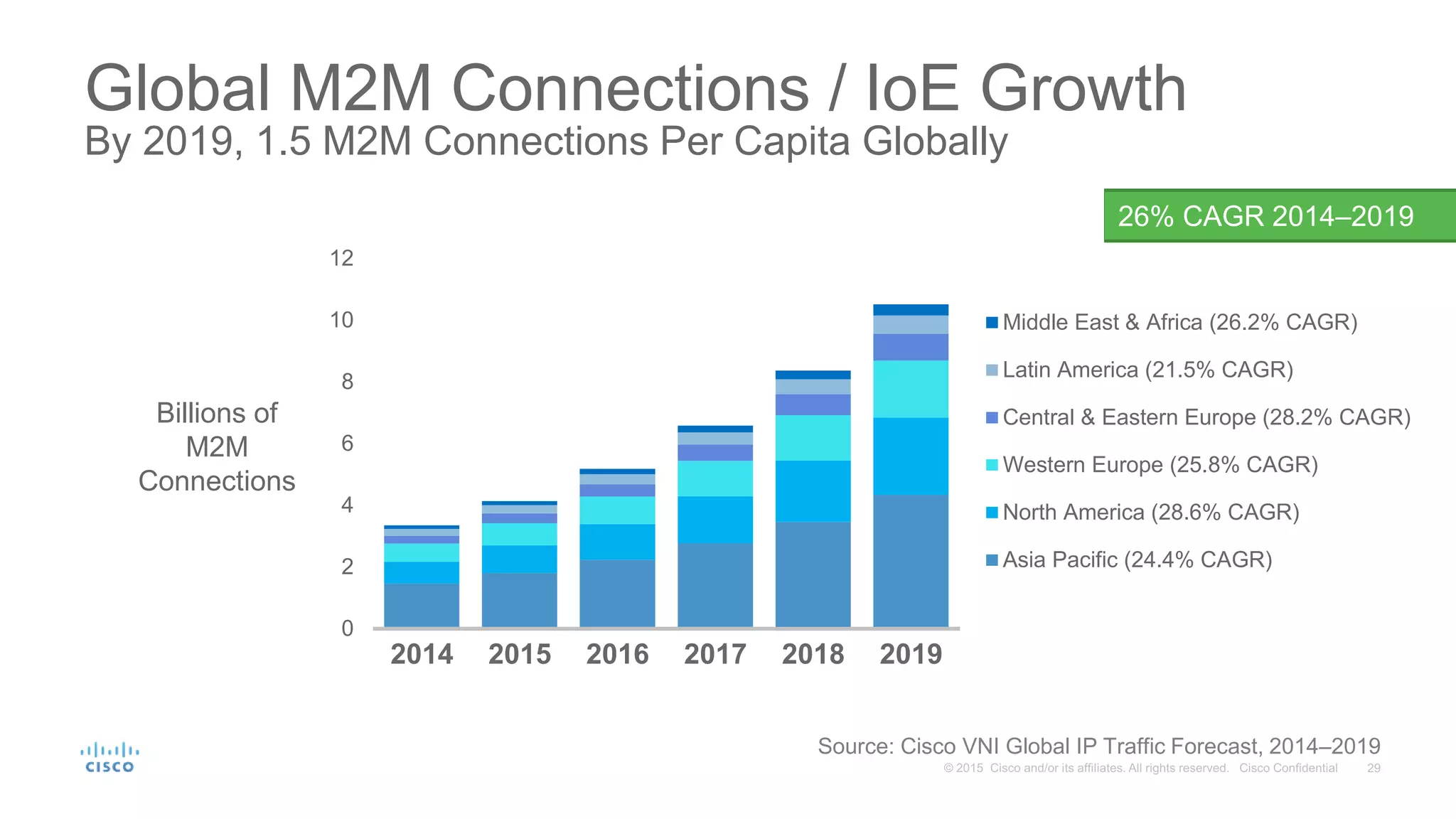
Global M2M Connections / IoE Growth
By 2019, 1.5 M2M Connections Per Capita Globally
0
2
4
6
8
10
12
2014 2015 2016 2017 2018 2019
Middle East & Africa (26.2% CAGR)
Latin America (21.5% CAGR)
Central & Eastern Europe (28.2% CAGR)
Western Europe (25.8% CAGR)
North America (28.6% CAGR)
Asia Pacific (24.4% CAGR)
Source: Cisco VNI Global IP Traffic Forecast, 2014–2019
26% CAGR 2014–2019
Billions of
M2M
Connections
Source: Cisco VNI Global IP Traffic Forecast, 2014–2019
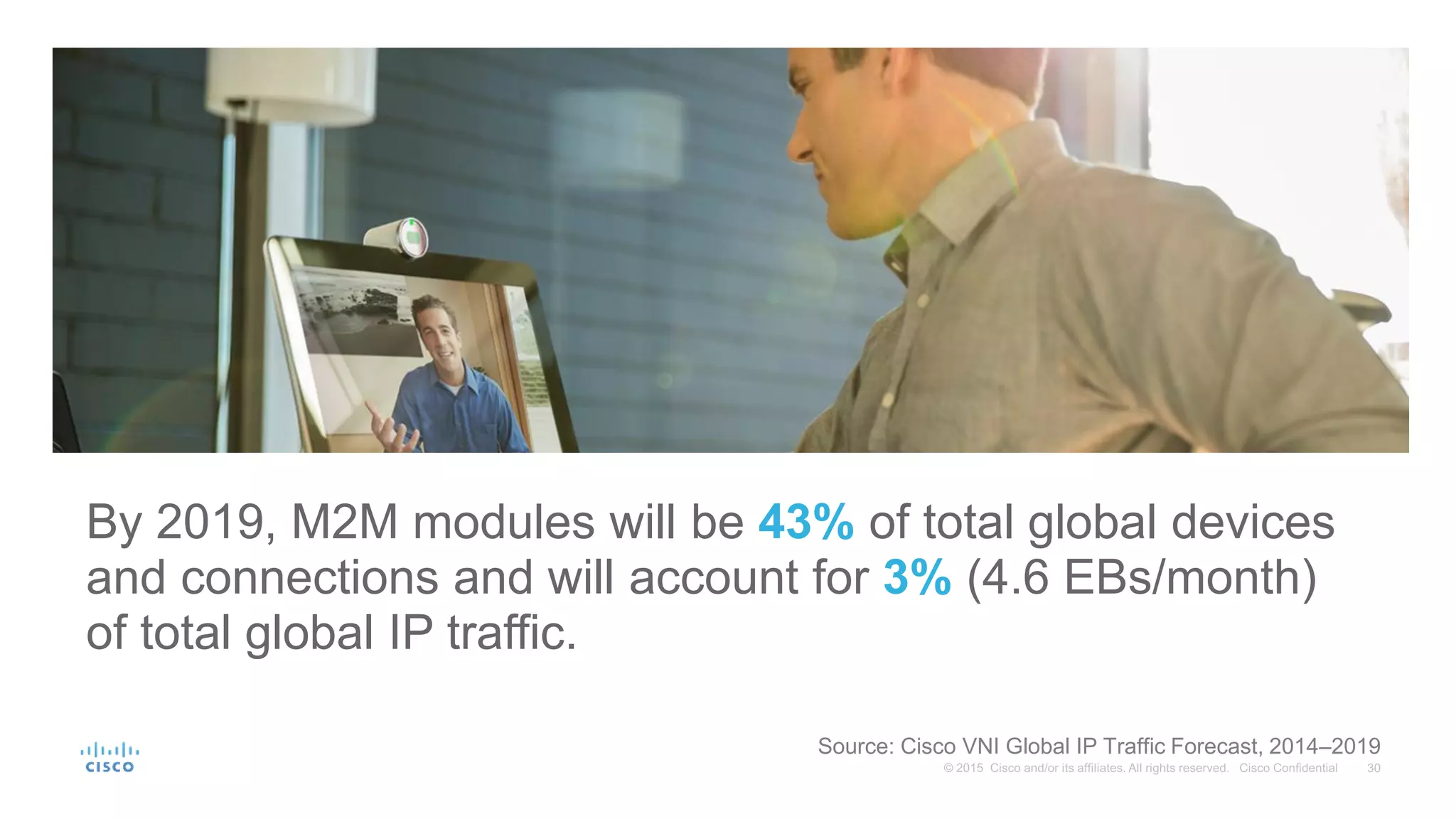
By 2019, M2M modules will be 43% of total global devices
and connections and will account for 3% (4.6 EBs/month)
of total global IP traffic.
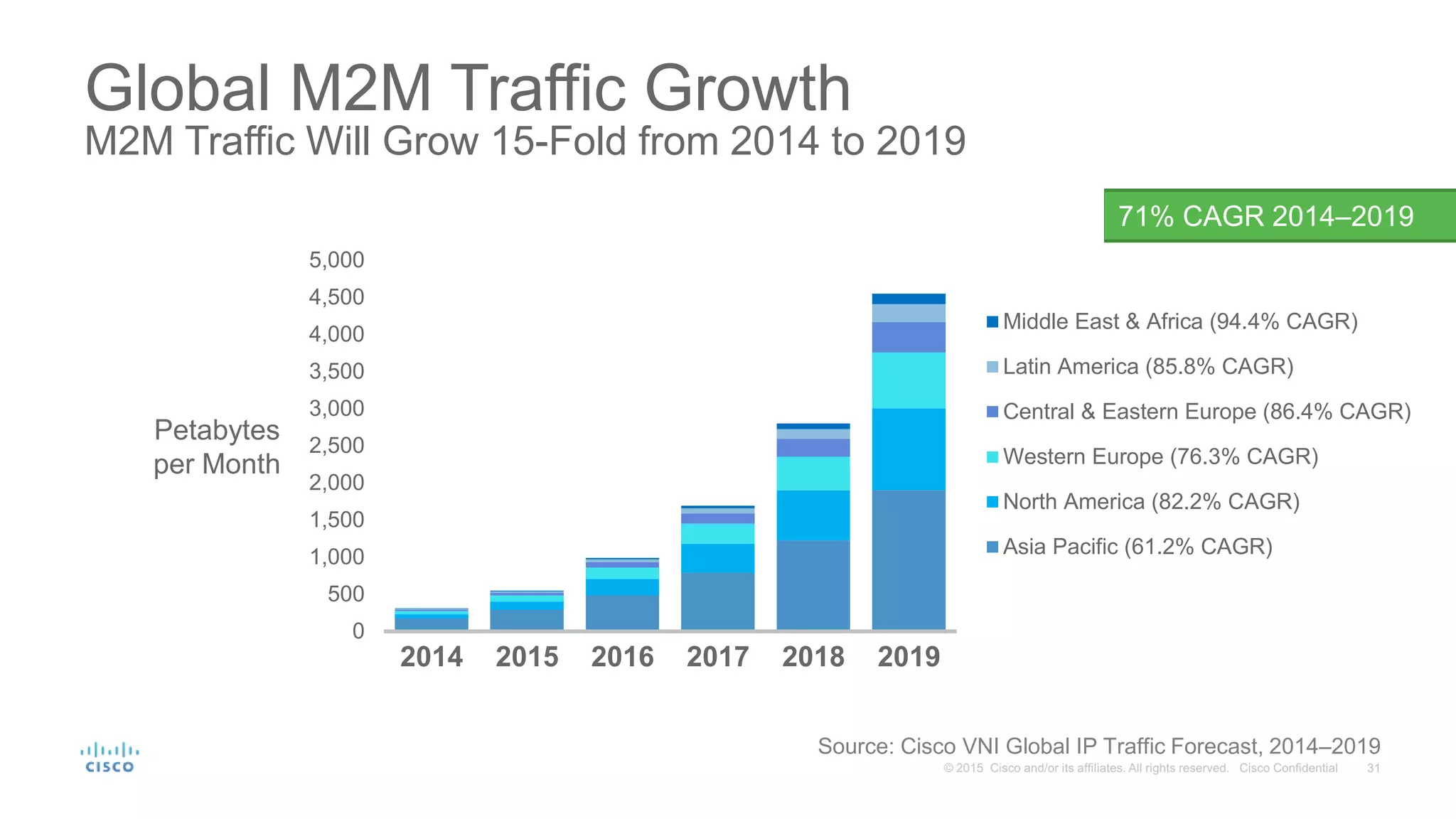
Global M2M Traffic Growth
M2M Traffic Will Grow 15-Fold from 2014 to 2019
0
500
1,000
1,500
2,000
2,500
3,000
3,500
4,000
4,500
5,000
2014 2015 2016 2017 2018 2019
Middle East & Africa (94.4% CAGR)
Latin America (85.8% CAGR)
Central & Eastern Europe (86.4% CAGR)
Western Europe (76.3% CAGR)
North America (82.2% CAGR)
Asia Pacific (61.2% CAGR)
Source: Cisco VNI Global IP Traffic Forecast, 2014–2019
71% CAGR 2014–2019
Petabytes
per Month
Source: Cisco VNI Global IP Traffic Forecast, 2014–2019
In LATAM, by 2019, M2M modules will be 31% of total devices
and connections and will account for 1.9% (0.2 EBs/month) of
total IP traffic.
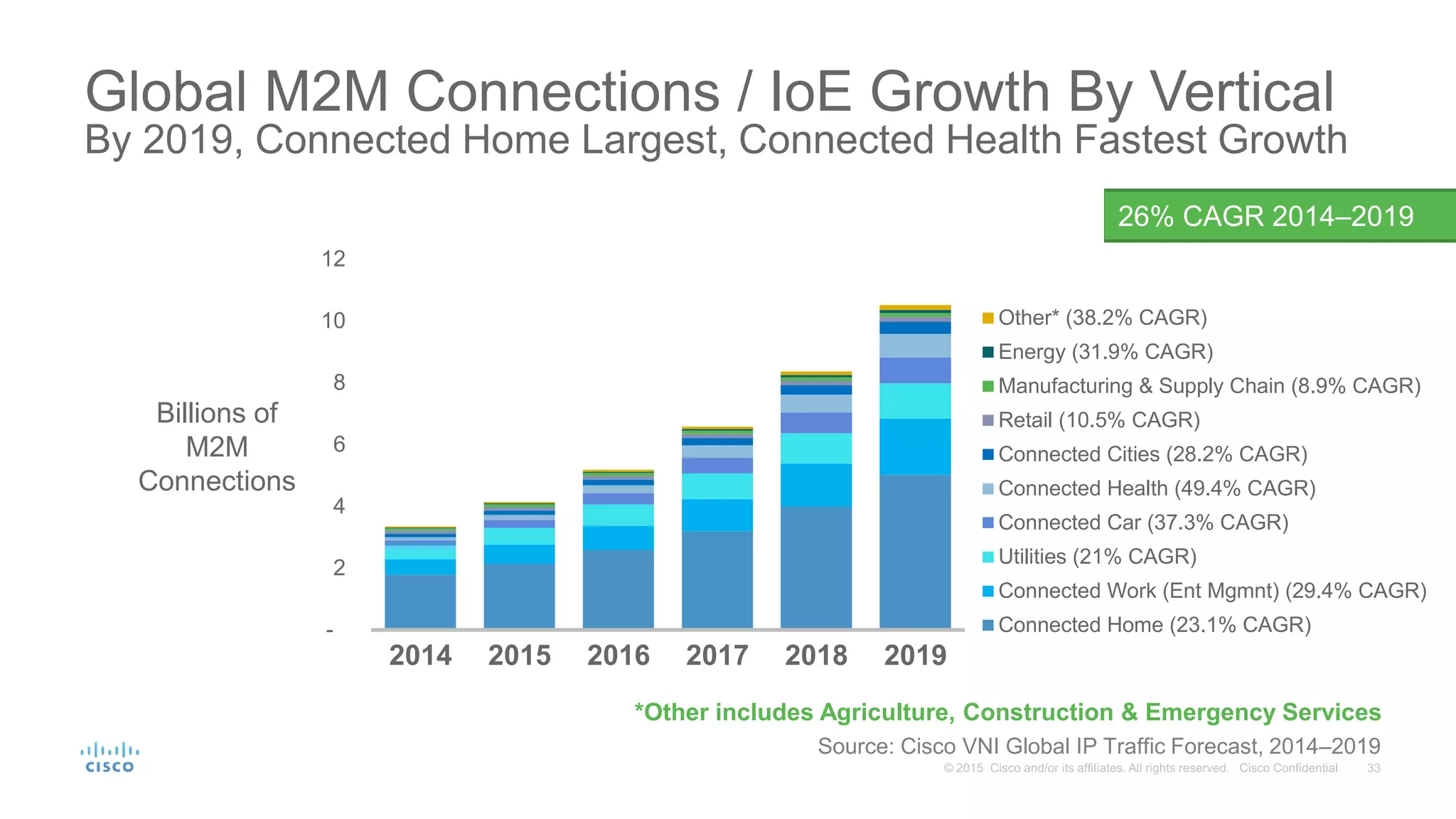
Global M2M Connections / IoE Growth By Vertical
By 2019, Connected Home Largest, Connected Health Fastest Growth
-
2
4
6
8
10
12
2014 2015 2016 2017 2018 2019
Other* (38.2% CAGR)
Energy (31.9% CAGR)
Manufacturing & Supply Chain (8.9% CAGR)
Retail (10.5% CAGR)
Connected Cities (28.2% CAGR)
Connected Health (49.4% CAGR)
Connected Car (37.3% CAGR)
Utilities (21% CAGR)
Connected Work (Ent Mgmnt) (29.4% CAGR)
Connected Home (23.1% CAGR)
Source: Cisco VNI Global IP Traffic Forecast, 2014–2019
26% CAGR 2014–2019
Billions of
M2M
Connections
*Other includes Agriculture, Construction & Emergency Services
VNI Forecast Update, 2014–2019
Top 10 Networking Trends
1 Continued Shifts in Devices/Connections Mix
2 IPv6 Adoption Enables Internet of Everything (IoE) Connectivity
3
4 Service Adoption Trends – Residential, Consumer Mobile, Business
5 Applications Driving Traffic Growth
6 “Cord-Cutting” Analysis – What’s Really Happening?
7 Impact of Accelerating Speeds on Traffic Growth
8 Mobility (Wi-Fi) Continues to Gain Momentum
9 Traffic Pattern Analysis (Peak vs. Average, Upstream, CDN vs. Metro)
10 Network Performance Drives User Behaviors/Data Plans and Caps
M2M Applications Across Many Industry Verticals Drives IoE Growth
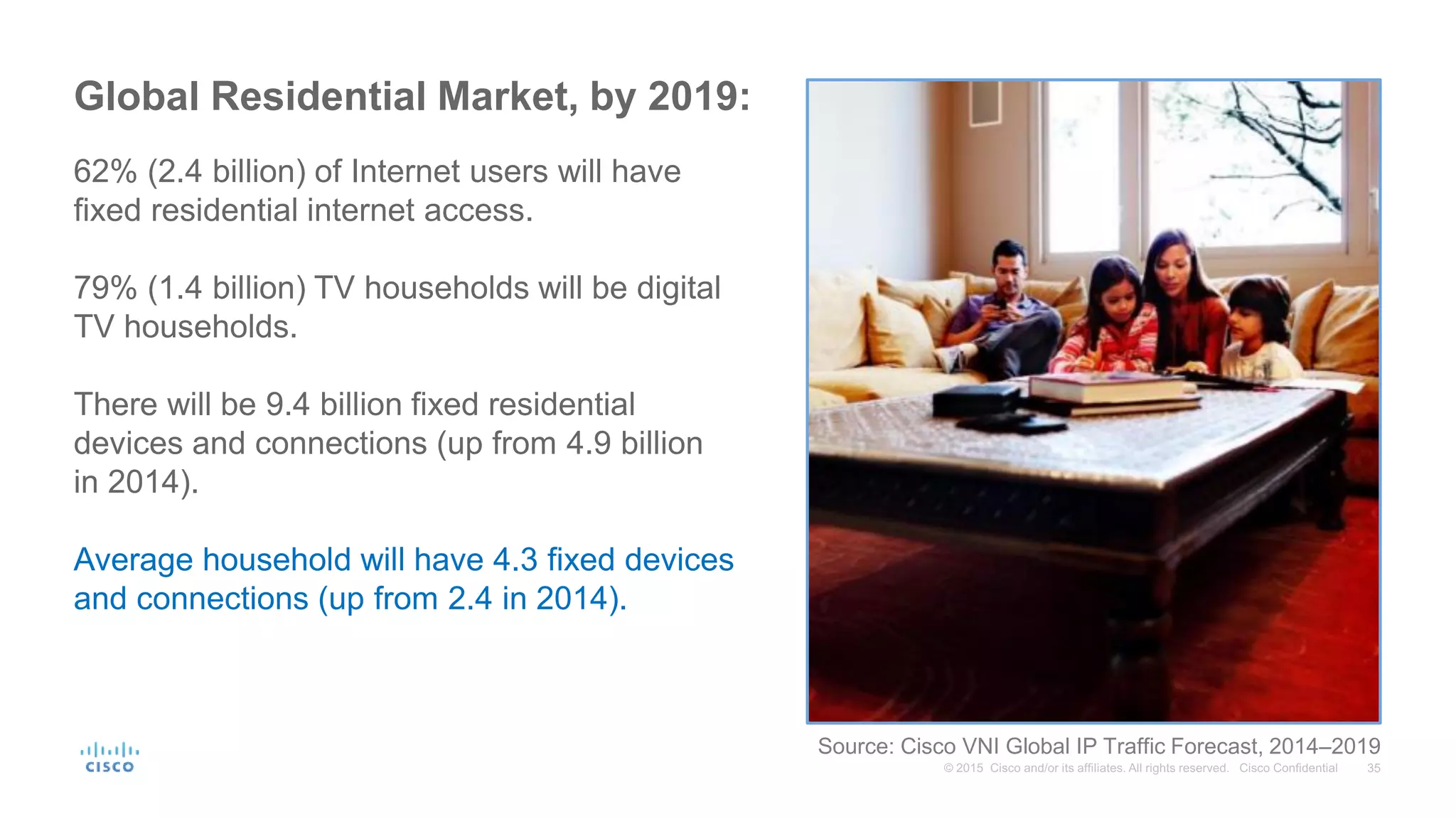
Global Residential Market, by 2019:
62% (2.4 billion) of Internet users will have
fixed residential internet access.
79% (1.4 billion) TV households will be digital
TV households.
There will be 9.4 billion fixed residential
devices and connections (up from 4.9 billion
in 2014).
Average household will have 4.3 fixed devices
and connections (up from 2.4 in 2014).
Source: Cisco VNI Global IP Traffic Forecast, 2014–2019
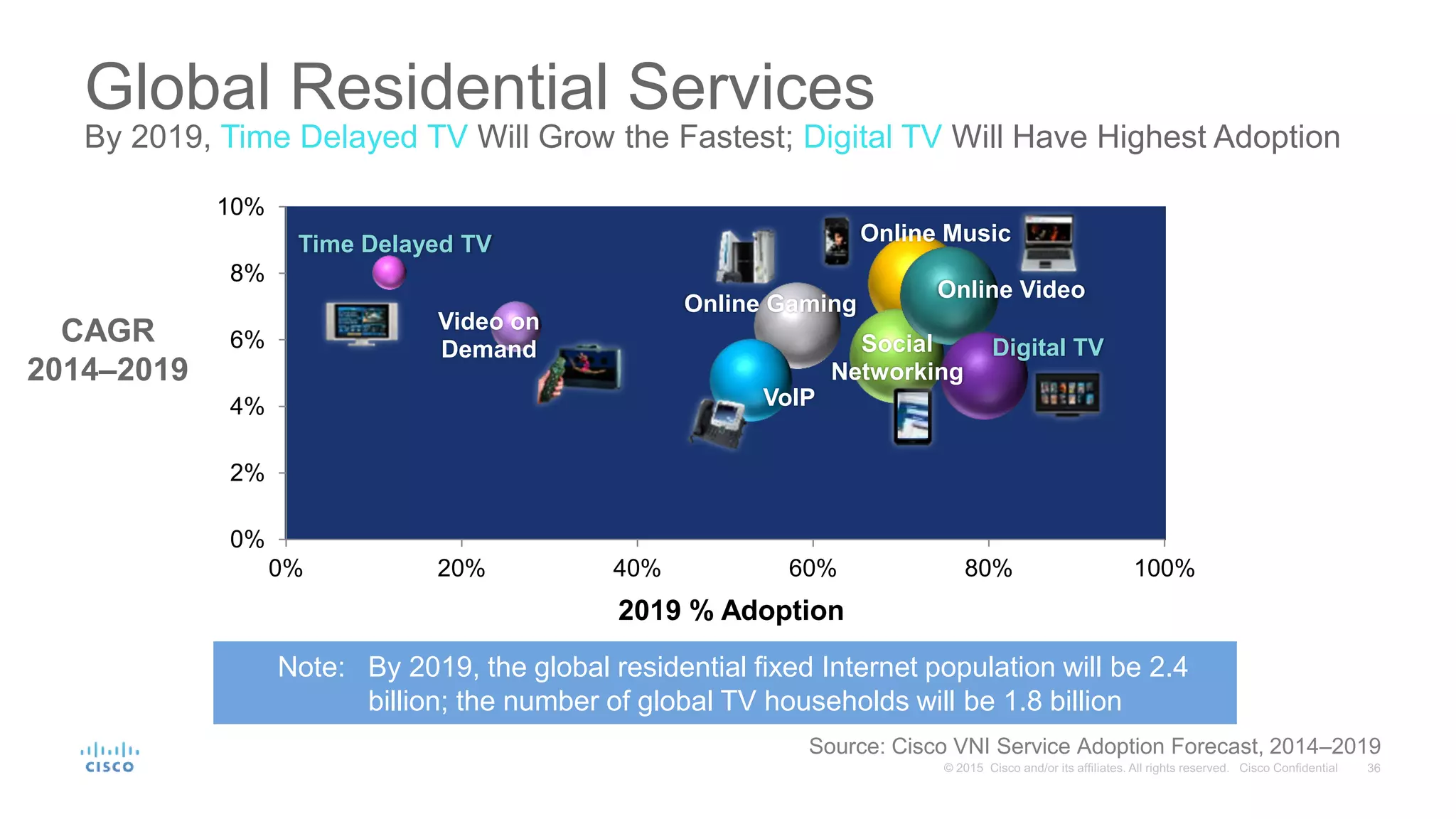
Note: By 2019, the global residential fixed Internet population will be 2.4
billion; the number of global TV households will be 1.8 billion
Global Residential Services
By 2019, Time Delayed TV Will Grow the Fastest; Digital TV Will Have Highest Adoption
CAGR
2014–2019
Online Music
Social
Networking
Online Video
Online Gaming
VoIP
Digital TV
Video on
Demand
Time Delayed TV
0%
2%
4%
6%
8%
10%
0% 20% 40% 60% 80% 100%
2019 % Adoption
Source: Cisco VNI Service Adoption Forecast, 2014–2019
Residential Services
Implications / Opportunities
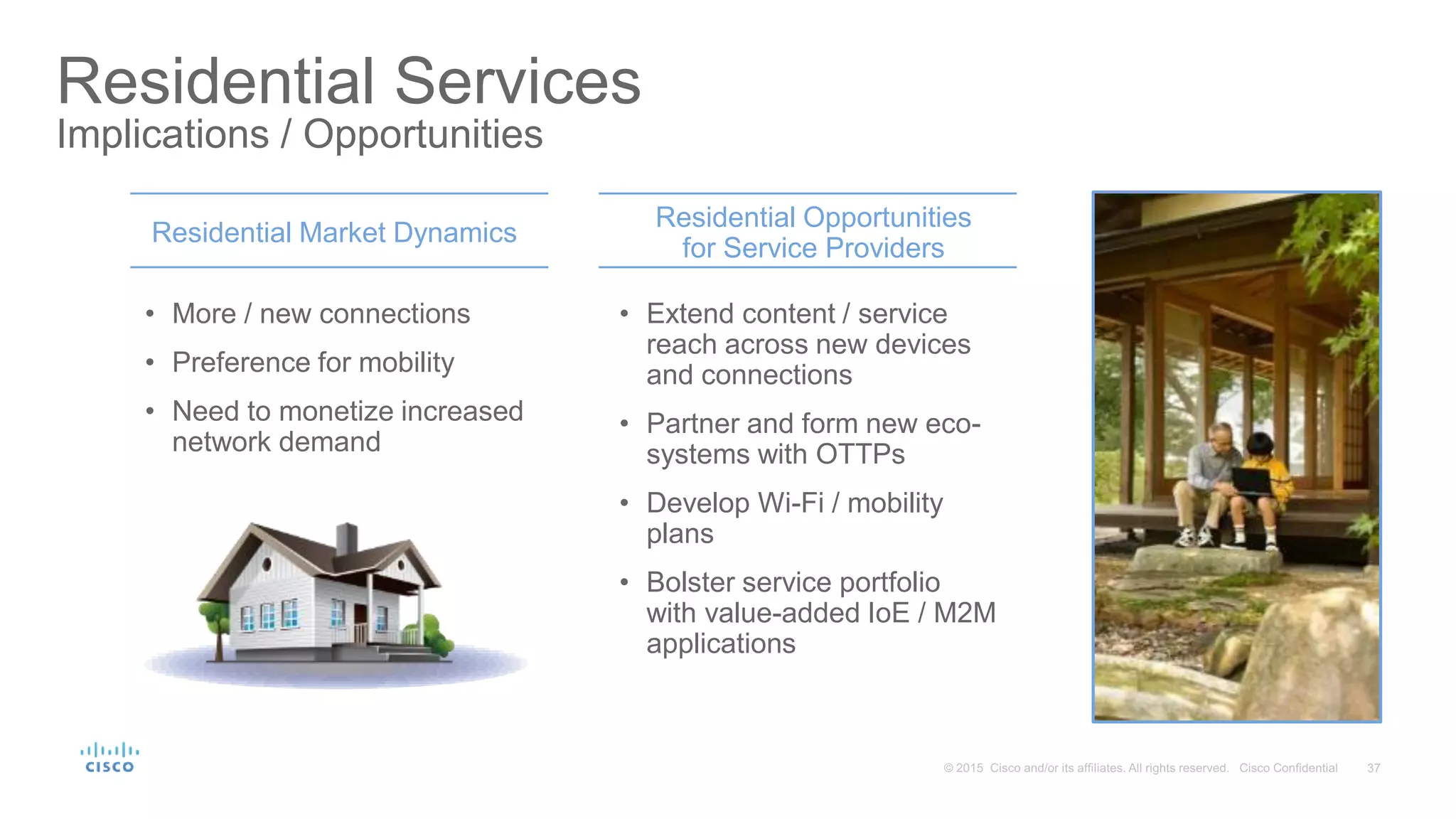
Residential Market Dynamics
Residential Opportunities
for Service Providers
• More / new connections
• Preference for mobility
• Need to monetize increased
network demand
• Extend content / service
reach across new devices
and connections
• Partner and form new eco-
systems with OTTPs
• Develop Wi-Fi / mobility
plans
• Bolster service portfolio
with value-added IoE / M2M
applications
Source: Cisco VNI Global IP Traffic Forecast, 2014–2019
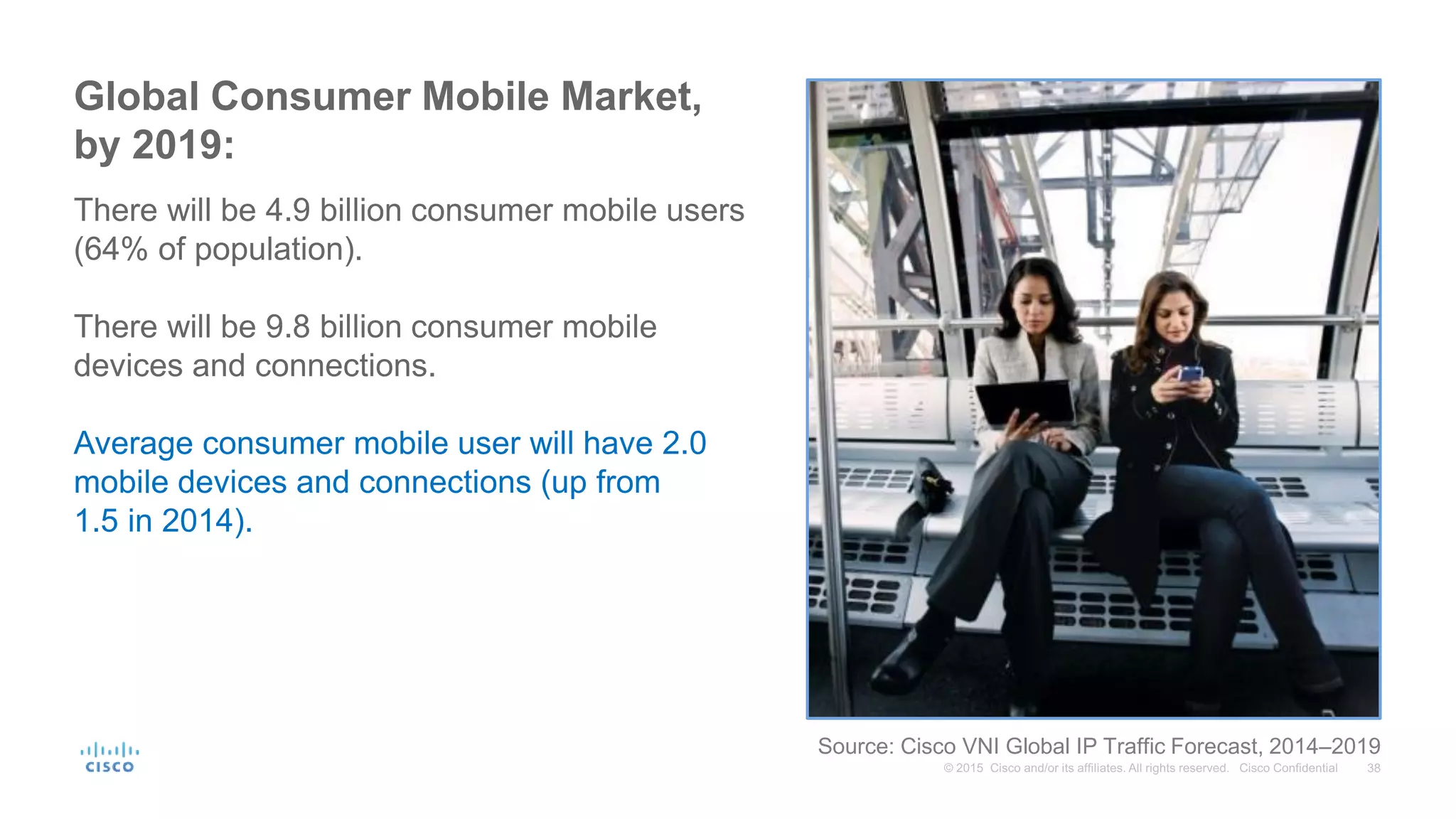
Global Consumer Mobile Market,
by 2019:
There will be 4.9 billion consumer mobile users
(64% of population).
There will be 9.8 billion consumer mobile
devices and connections.
Average consumer mobile user will have 2.0
mobile devices and connections (up from
1.5 in 2014).
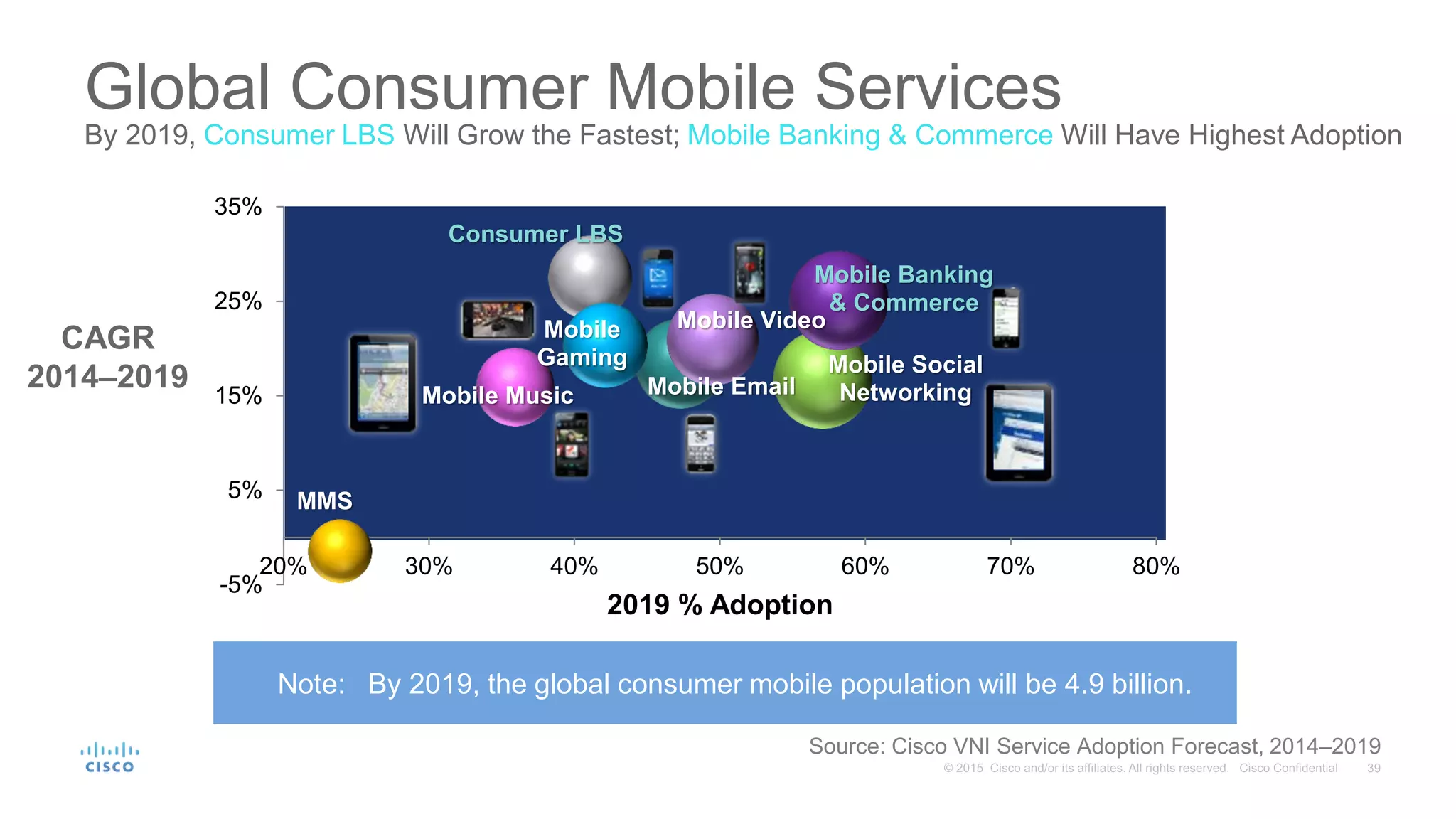
Note: By 2019, the global consumer mobile population will be 4.9 billion.
Global Consumer Mobile Services
By 2019, Consumer LBS Will Grow the Fastest; Mobile Banking & Commerce Will Have Highest Adoption
CAGR
2014–2019
Source: Cisco VNI Service Adoption Forecast, 2014–2019
MMS
Mobile Social
NetworkingMobile Email
Consumer LBS
Mobile
Gaming
Mobile Banking
& Commerce
Mobile Video
Mobile Music
-5%
5%
15%
25%
35%
20% 30% 40% 50% 60% 70% 80%
2019 % Adoption
Consumer Mobile
Implications / Opportunities
Consumer Mobile
Market Dynamics
Consumer Mobile Opportunities
for Service Providers
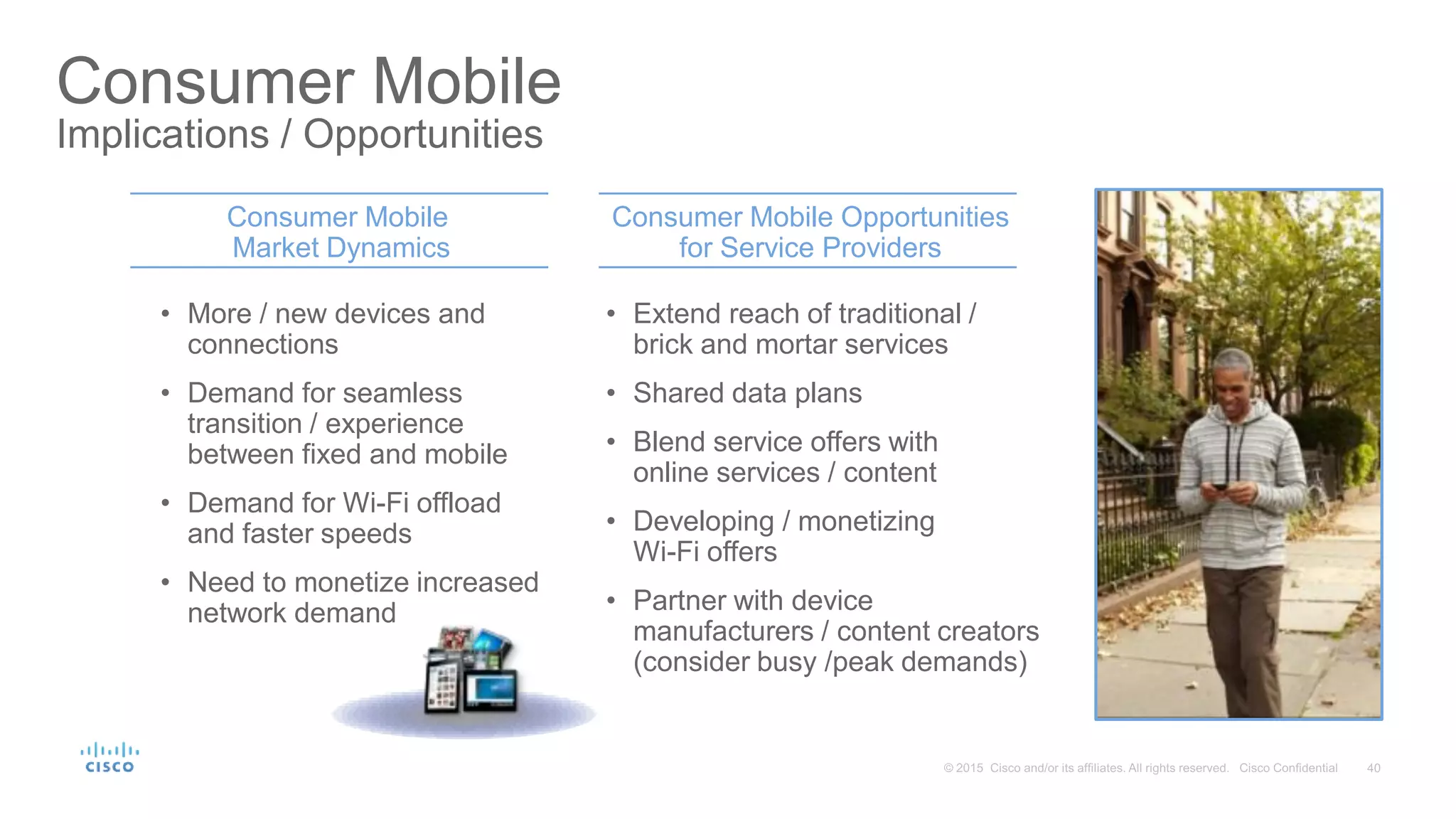
• More / new devices and
connections
• Demand for seamless
transition / experience
between fixed and mobile
• Demand for Wi-Fi offload
and faster speeds
• Need to monetize increased
network demand
• Extend reach of traditional /
brick and mortar services
• Shared data plans
• Blend service offers with
online services / content
• Developing / monetizing
Wi-Fi offers
• Partner with device
manufacturers / content creators
(consider busy /peak demands)
Source: Cisco VNI Global IP Traffic Forecast, 2014–2019
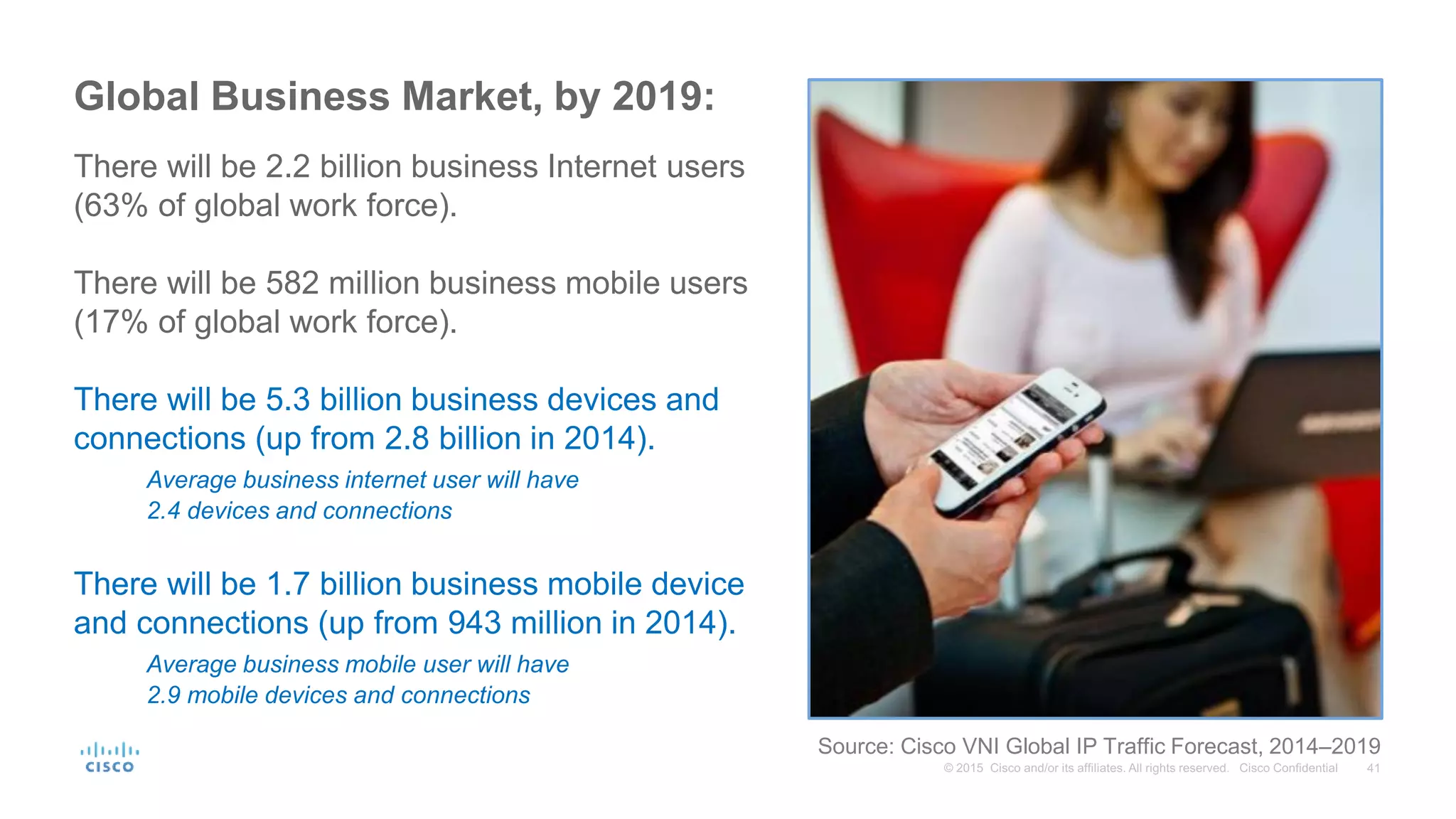
Global Business Market, by 2019:
There will be 2.2 billion business Internet users
(63% of global work force).
There will be 582 million business mobile users
(17% of global work force).
There will be 5.3 billion business devices and
connections (up from 2.8 billion in 2014).
Average business internet user will have
2.4 devices and connections
There will be 1.7 billion business mobile device
and connections (up from 943 million in 2014).
Average business mobile user will have
2.9 mobile devices and connections
VNI Forecast Update, 2014–2019
Top 10 Networking Trends
1 Continued Shifts in Devices/Connections Mix
2 IPv6 Adoption Enables Internet of Everything (IoE) Connectivity
3
4 Service Adoption Trends – Residential, Consumer Mobile, Business
5 Applications Driving Traffic Growth
6 “Cord-Cutting” Analysis – What’s Really Happening?
7 Impact of Accelerating Speeds on Traffic Growth
8 Mobility (Wi-Fi) Continues to Gain Momentum
9 Traffic Pattern Analysis (Peak vs. Average, Upstream, CDN vs. Metro)
10 Network Performance Drives User Behaviors/Data Plans and Caps
M2M Applications Across Many Industry Verticals Drives IoE Growth
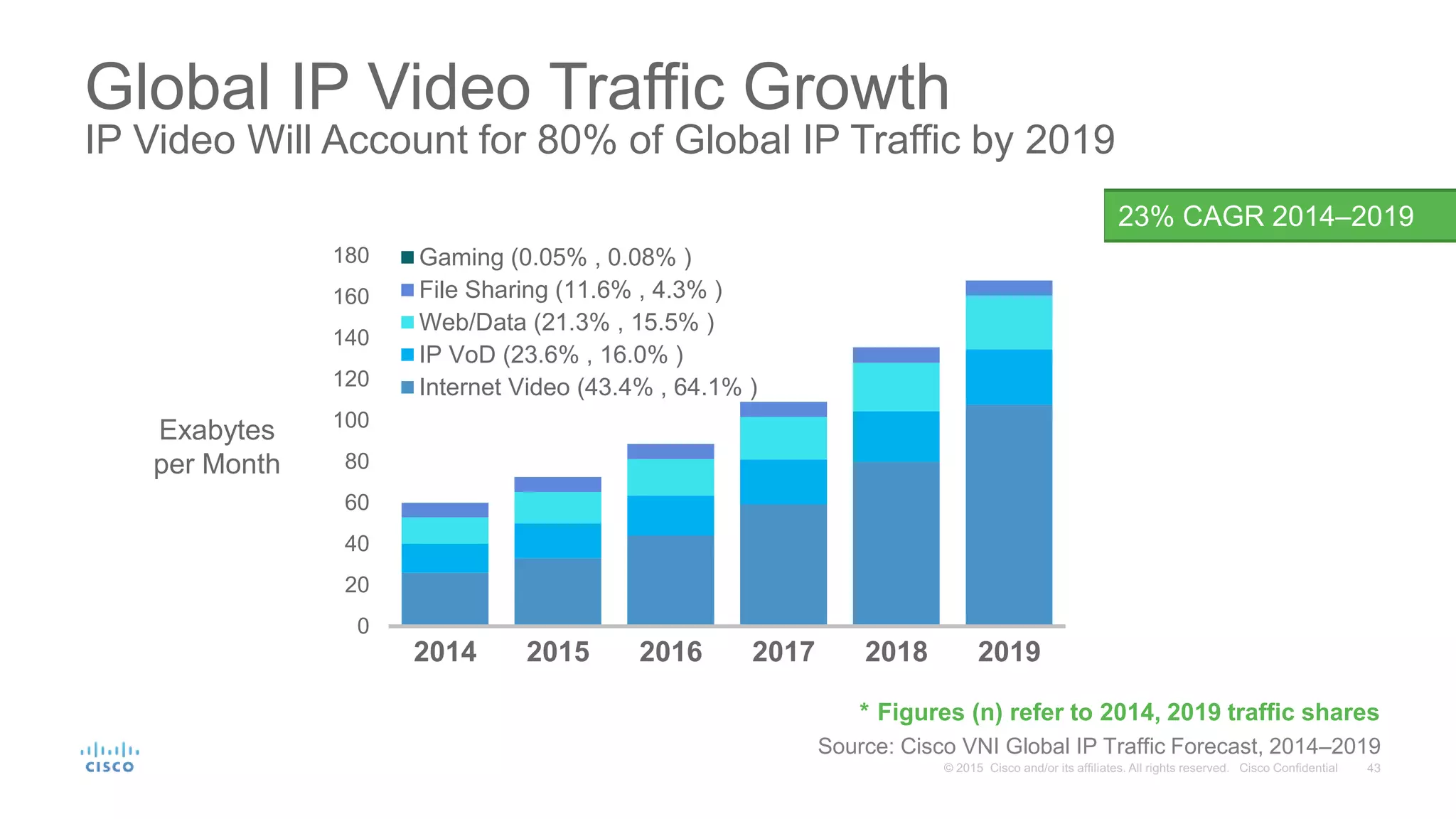
0
20
40
60
80
100
120
140
160
180
2014 2015 2016 2017 2018 2019
Gaming (0.05% , 0.08% )
File Sharing (11.6% , 4.3% )
Web/Data (21.3% , 15.5% )
IP VoD (23.6% , 16.0% )
Internet Video (43.4% , 64.1% )
Global IP Video Traffic Growth
IP Video Will Account for 80% of Global IP Traffic by 2019
Source: Cisco VNI Global IP Traffic Forecast, 2014–2019
23% CAGR 2014–2019
Exabytes
per Month
* Figures (n) refer to 2014, 2019 traffic shares
0
2
4
6
8
10
12
14
2014 2015 2016 2017 2018 2019
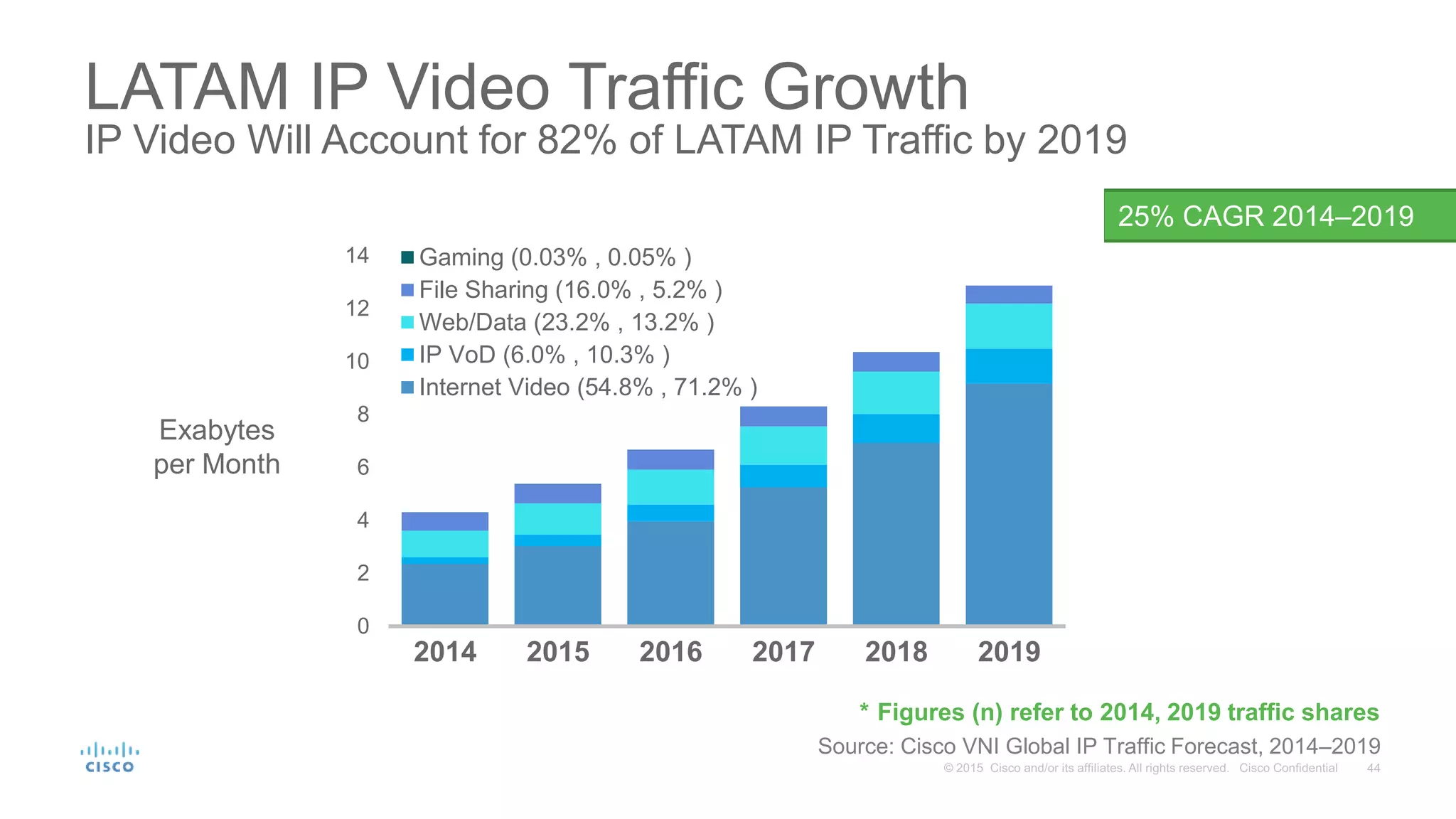
Gaming (0.03% , 0.05% )
File Sharing (16.0% , 5.2% )
Web/Data (23.2% , 13.2% )
IP VoD (6.0% , 10.3% )
Internet Video (54.8% , 71.2% )
LATAM IP Video Traffic Growth
IP Video Will Account for 82% of LATAM IP Traffic by 2019
Source: Cisco VNI Global IP Traffic Forecast, 2014–2019
25% CAGR 2014–2019
Exabytes
per Month
* Figures (n) refer to 2014, 2019 traffic shares
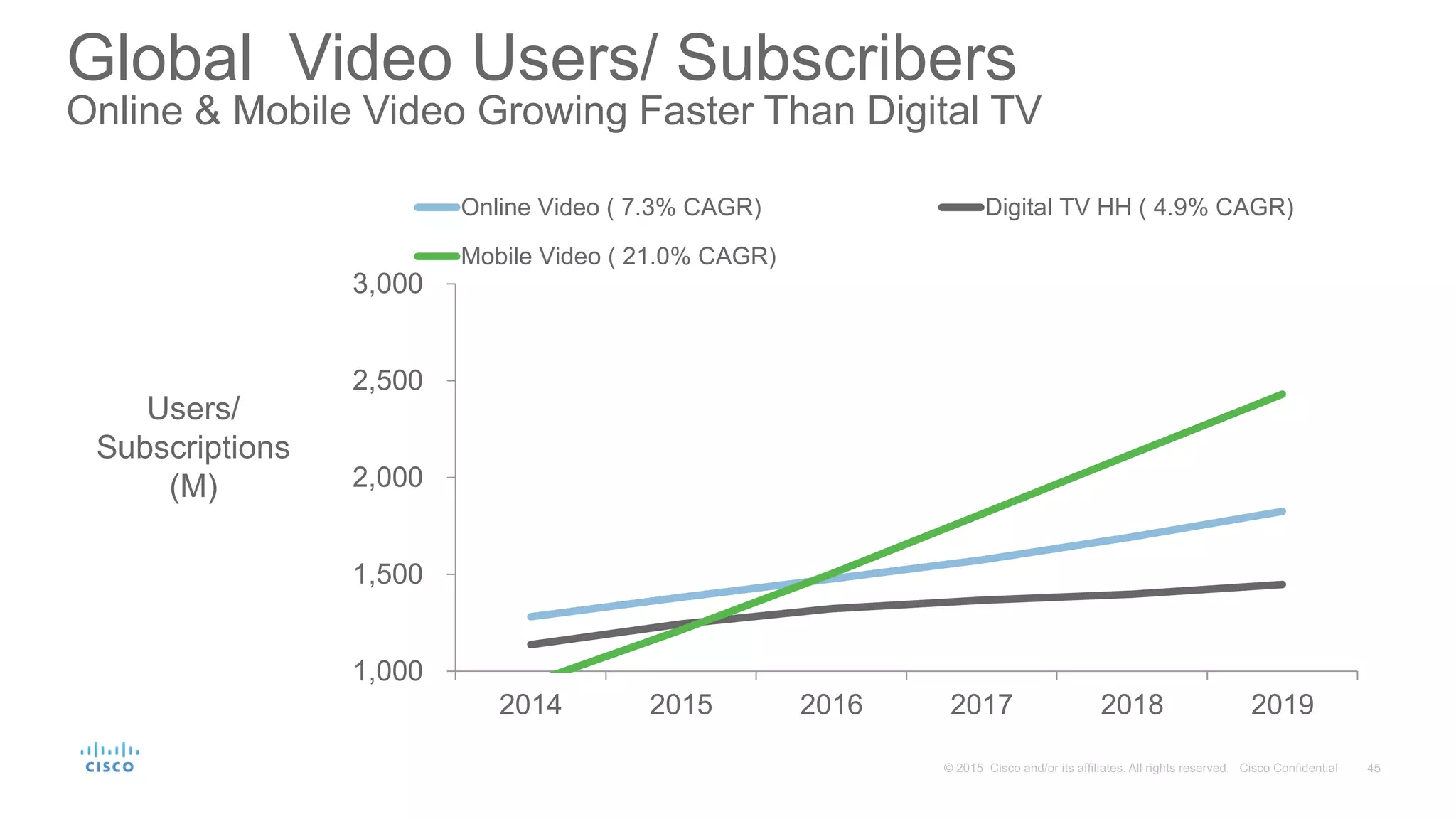
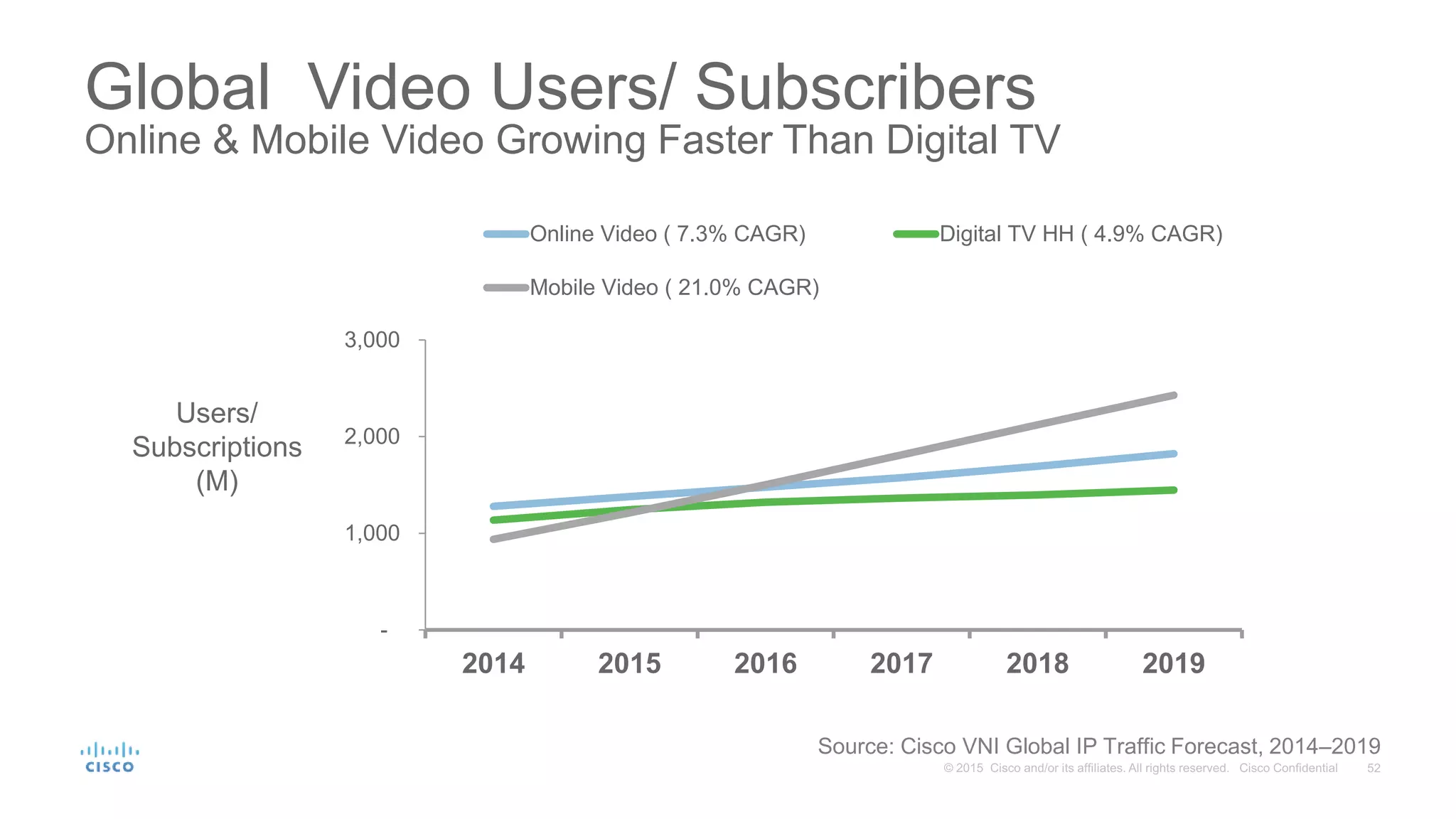
Global Video Users/ Subscribers
Online & Mobile Video Growing Faster Than Digital TV
1,000
1,500
2,000
2,500
3,000
2014 2015 2016 2017 2018 2019
Online Video ( 7.3% CAGR) Digital TV HH ( 4.9% CAGR)
Mobile Video ( 21.0% CAGR)
Users/
Subscriptions
(M)
0
20
40
60
80
100
120
140
160
2014 2015 2016 2017 2018 2019
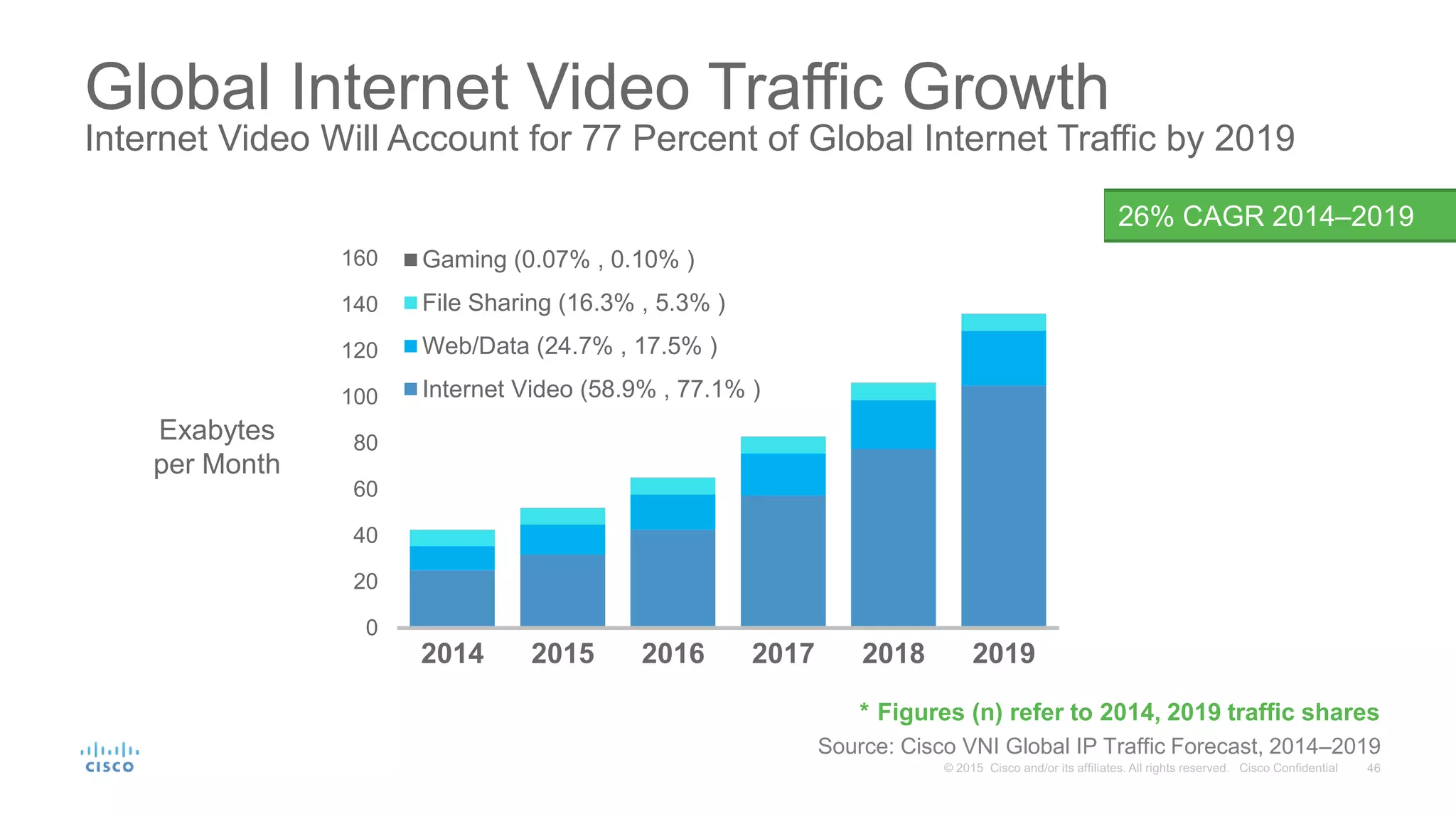
Gaming (0.07% , 0.10% )
File Sharing (16.3% , 5.3% )
Web/Data (24.7% , 17.5% )
Internet Video (58.9% , 77.1% )
Global Internet Video Traffic Growth
Internet Video Will Account for 77 Percent of Global Internet Traffic by 2019
Source: Cisco VNI Global IP Traffic Forecast, 2014–2019
* Figures (n) refer to 2014, 2019 traffic shares
Exabytes
per Month
26% CAGR 2014–2019
0
2
4
6
8
10
12
2014 2015 2016 2017 2018 2019
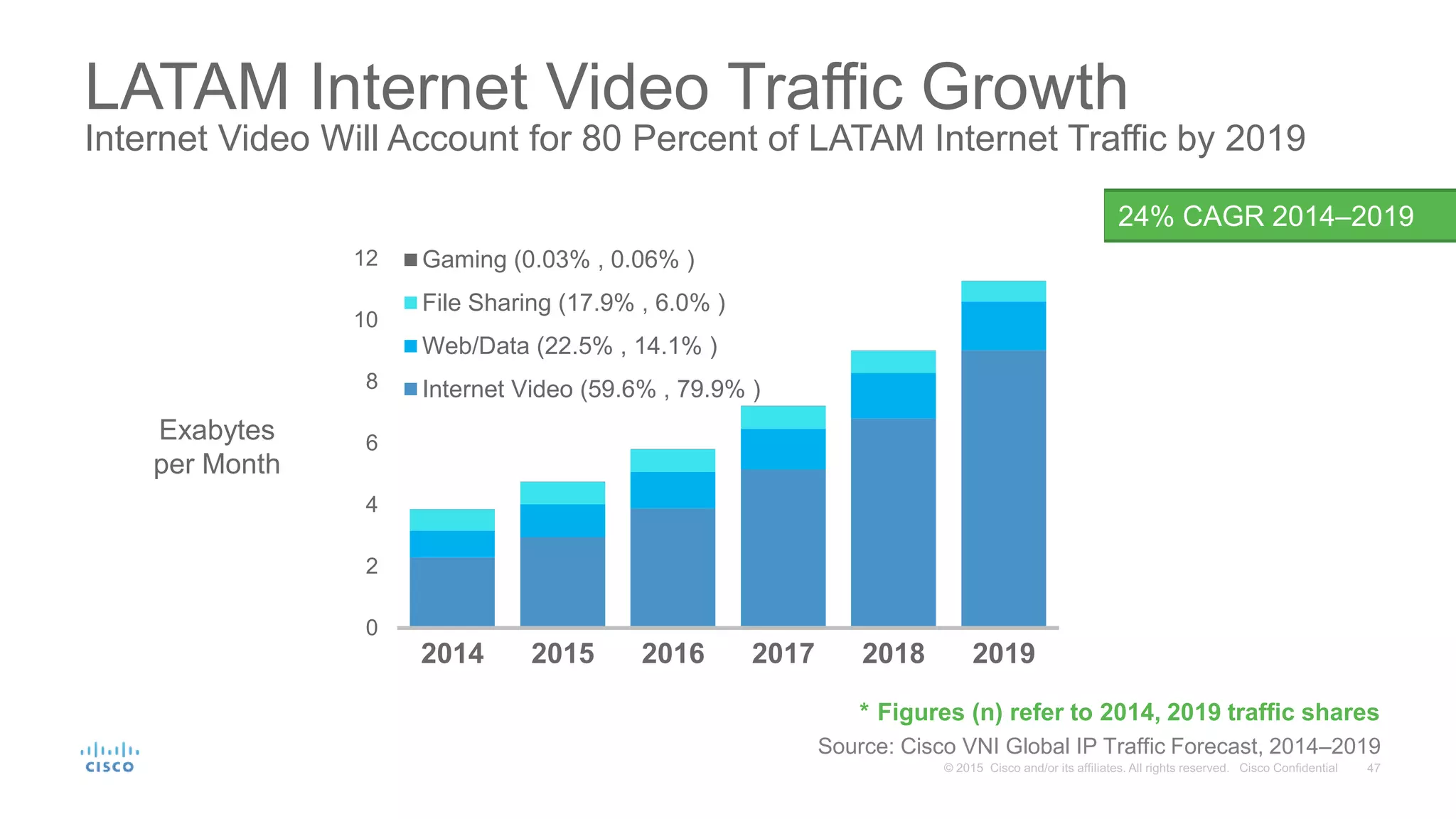
Gaming (0.03% , 0.06% )
File Sharing (17.9% , 6.0% )
Web/Data (22.5% , 14.1% )
Internet Video (59.6% , 79.9% )
LATAM Internet Video Traffic Growth
Internet Video Will Account for 80 Percent of LATAM Internet Traffic by 2019
Source: Cisco VNI Global IP Traffic Forecast, 2014–2019
* Figures (n) refer to 2014, 2019 traffic shares
Exabytes
per Month
24% CAGR 2014–2019
0
20
40
60
80
100
120
140
160
2014 2015 2016 2017 2018 2019
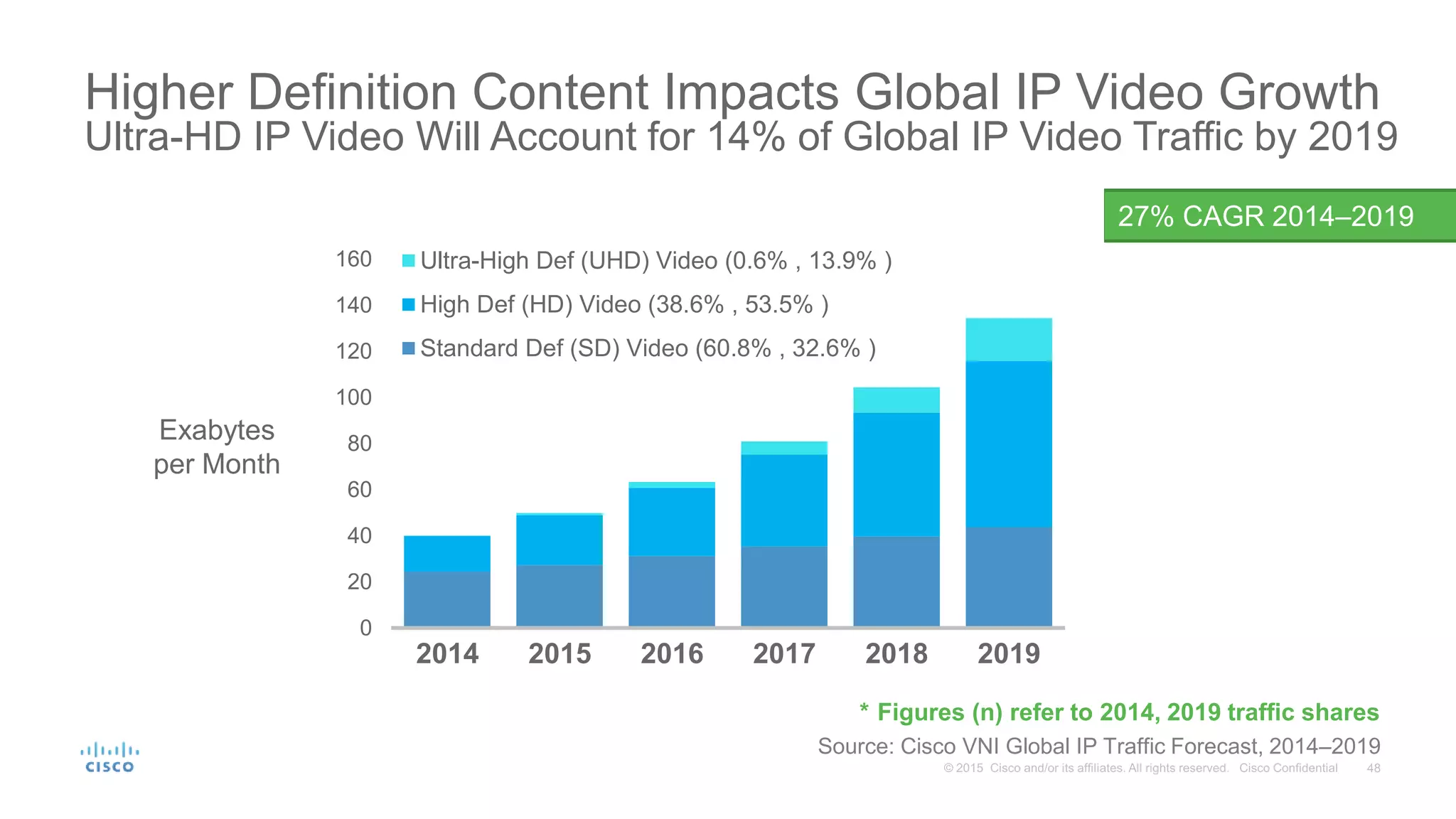
Ultra-High Def (UHD) Video (0.6% , 13.9% )
High Def (HD) Video (38.6% , 53.5% )
Standard Def (SD) Video (60.8% , 32.6% )
Higher Definition Content Impacts Global IP Video Growth
Ultra-HD IP Video Will Account for 14% of Global IP Video Traffic by 2019
Source: Cisco VNI Global IP Traffic Forecast, 2014–2019
27% CAGR 2014–2019
Exabytes
per Month
* Figures (n) refer to 2014, 2019 traffic shares
0
2
4
6
8
10
12
2014 2015 2016 2017 2018 2019
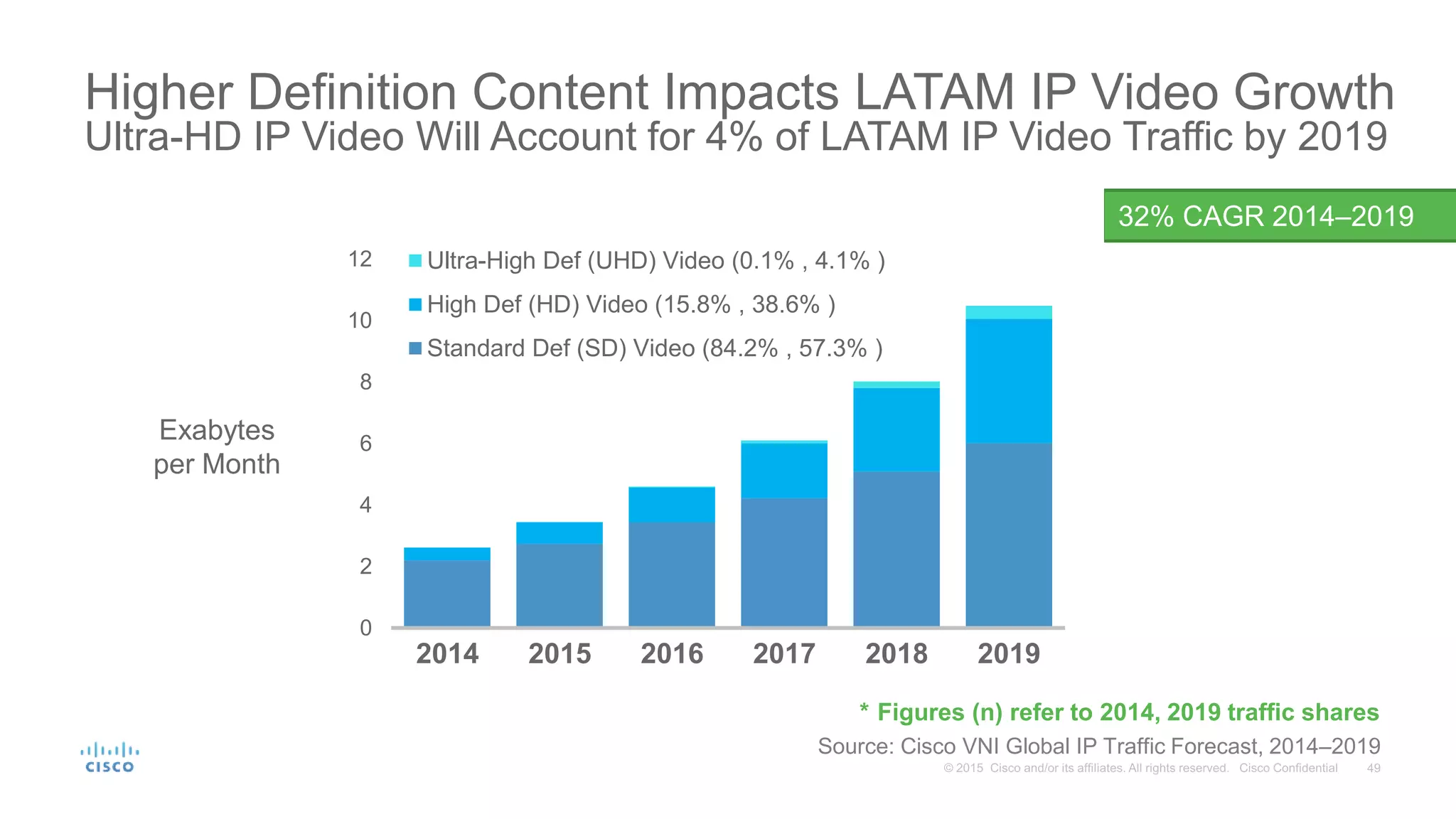
Ultra-High Def (UHD) Video (0.1% , 4.1% )
High Def (HD) Video (15.8% , 38.6% )
Standard Def (SD) Video (84.2% , 57.3% )
Higher Definition Content Impacts LATAM IP Video Growth
Ultra-HD IP Video Will Account for 4% of LATAM IP Video Traffic by 2019
Source: Cisco VNI Global IP Traffic Forecast, 2014–2019
32% CAGR 2014–2019
Exabytes
per Month
* Figures (n) refer to 2014, 2019 traffic shares
0
5
10
15
20
25
30
2014 2015 2016 2017 2018 2019
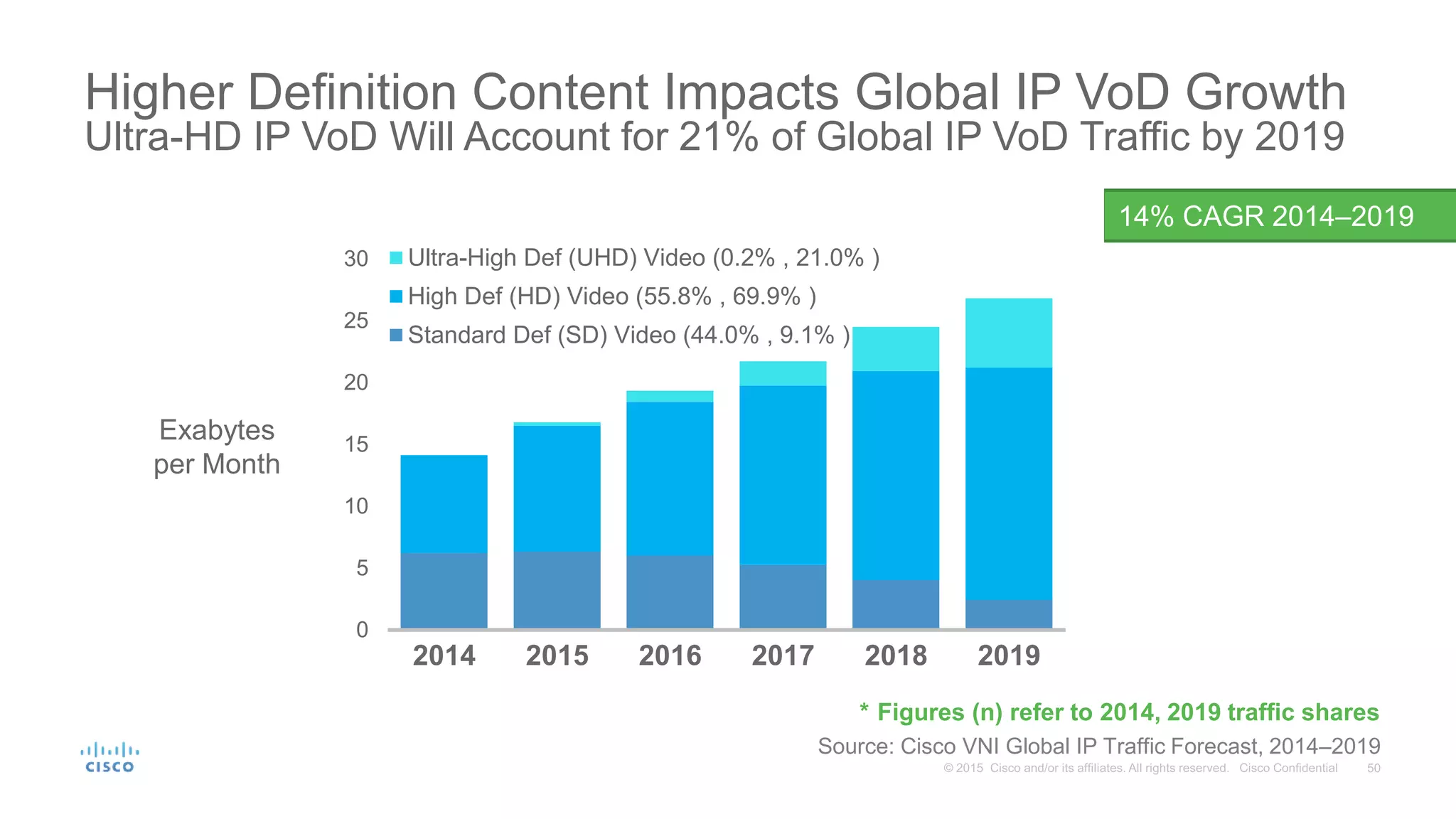
Ultra-High Def (UHD) Video (0.2% , 21.0% )
High Def (HD) Video (55.8% , 69.9% )
Standard Def (SD) Video (44.0% , 9.1% )
Higher Definition Content Impacts Global IP VoD Growth
Ultra-HD IP VoD Will Account for 21% of Global IP VoD Traffic by 2019
Source: Cisco VNI Global IP Traffic Forecast, 2014–2019
14% CAGR 2014–2019
Exabytes
per Month
* Figures (n) refer to 2014, 2019 traffic shares
VNI Forecast Update, 2014–2019
Top 10 Networking Trends
1 Continued Shifts in Devices/Connections Mix
2 IPv6 Adoption Enables Internet of Everything (IoE) Connectivity
3
4 Service Adoption Trends – Residential, Consumer Mobile, Business
5 Applications Driving Traffic Growth
6 “Cord-Cutting” Analysis – What’s Really Happening?
7 Impact of Accelerating Speeds on Traffic Growth
8 Mobility (Wi-Fi) Continues to Gain Momentum
9 Traffic Pattern Analysis (Peak vs. Average, Upstream, CDN vs. Metro)
10 Network Performance Drives User Behaviors/Data Plans and Caps
M2M Applications Across Many Industry Verticals Drives IoE Growth
Global Video Users/ Subscribers
Online & Mobile Video Growing Faster Than Digital TV
-
1,000
2,000
3,000
2014 2015 2016 2017 2018 2019
Online Video ( 7.3% CAGR) Digital TV HH ( 4.9% CAGR)
Mobile Video ( 21.0% CAGR)
Users/
Subscriptions
(M)
Source: Cisco VNI Global IP Traffic Forecast, 2014–2019
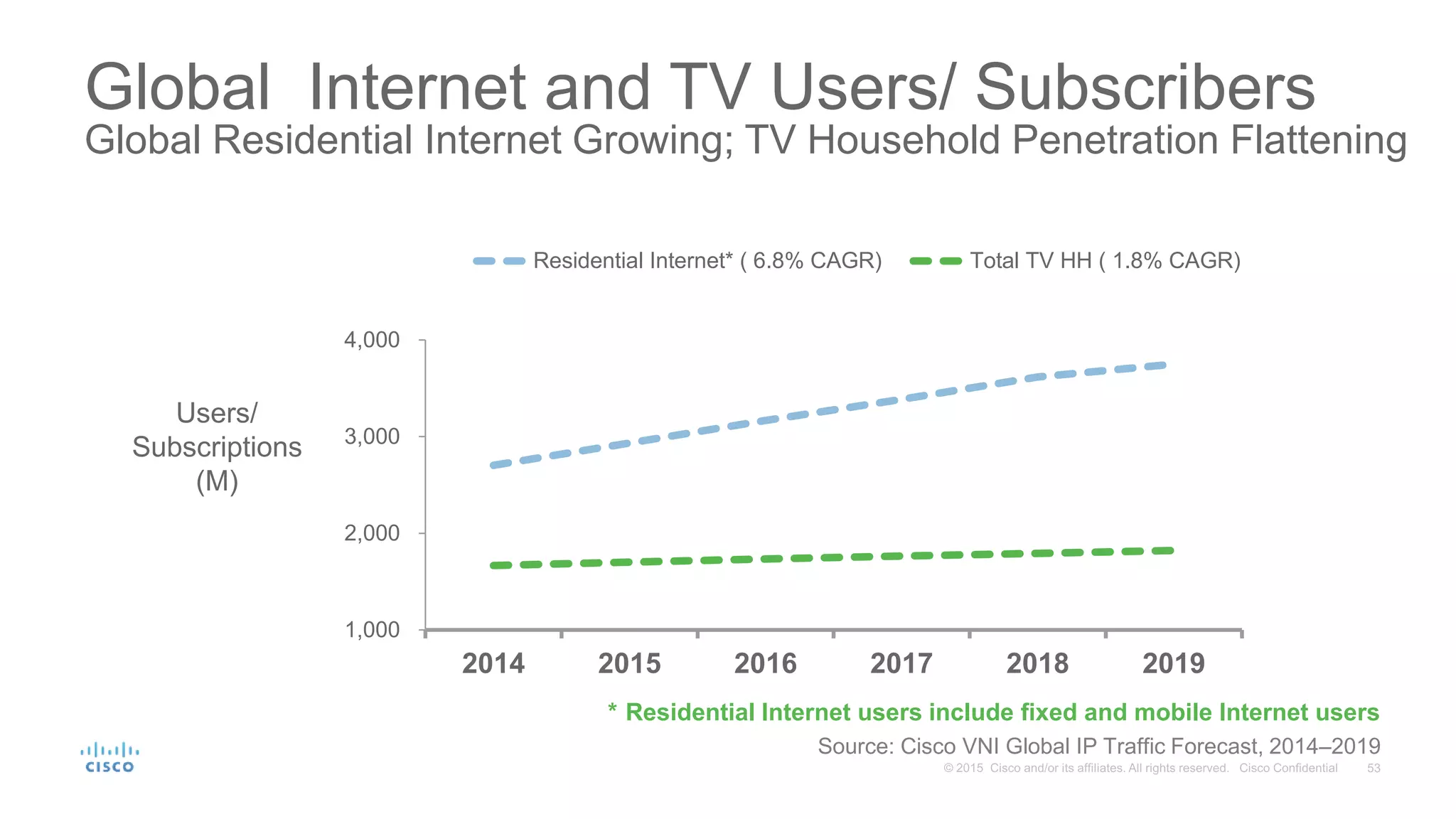
Global Internet and TV Users/ Subscribers
Global Residential Internet Growing; TV Household Penetration Flattening
1,000
2,000
3,000
4,000
2014 2015 2016 2017 2018 2019
Residential Internet* ( 6.8% CAGR) Total TV HH ( 1.8% CAGR)
Users/
Subscriptions
(M)
Source: Cisco VNI Global IP Traffic Forecast, 2014–2019
* Residential Internet users include fixed and mobile Internet users
VNI Forecast Update, 2014–2019
Top 10 Networking Trends
1 Continued Shifts in Devices/Connections Mix
2 IPv6 Adoption Enables Internet of Everything (IoE) Connectivity
3
4 Service Adoption Trends – Residential, Consumer Mobile, Business
5 Applications Driving Traffic Growth
6 “Cord-Cutting” Analysis – What’s Really Happening?
7 Impact of Accelerating Speeds on Traffic Growth
8 Mobility (Wi-Fi) Continues to Gain Momentum
9 Traffic Pattern Analysis (Peak vs. Average, Upstream, CDN vs. Metro)
10 Network Performance Drives User Behaviors/Data Plans and Caps
M2M Applications Across Many Industry Verticals Drives IoE Growth
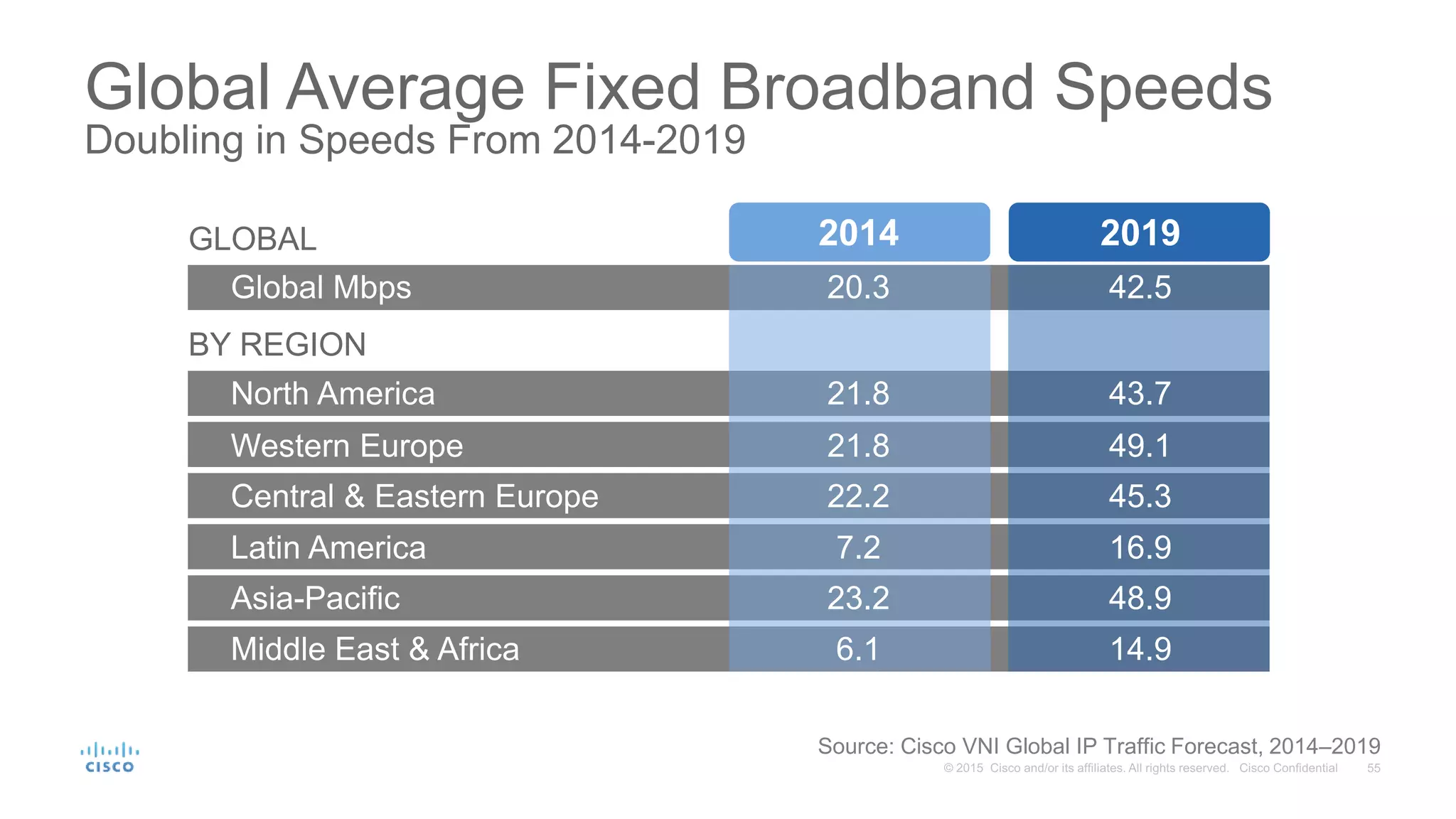
Global Average Fixed Broadband Speeds
Doubling in Speeds From 2014-2019
2014 2019
Global Mbps
BY REGION
North America
Western Europe
Asia-Pacific
Central & Eastern Europe
Middle East & Africa
20.3
21.8
21.8
7.2
23.2
22.2
6.1
42.5
43.7
49.1
16.9
48.9
45.3
14.9
Latin America
GLOBAL
Source: Cisco VNI Global IP Traffic Forecast, 2014–2019
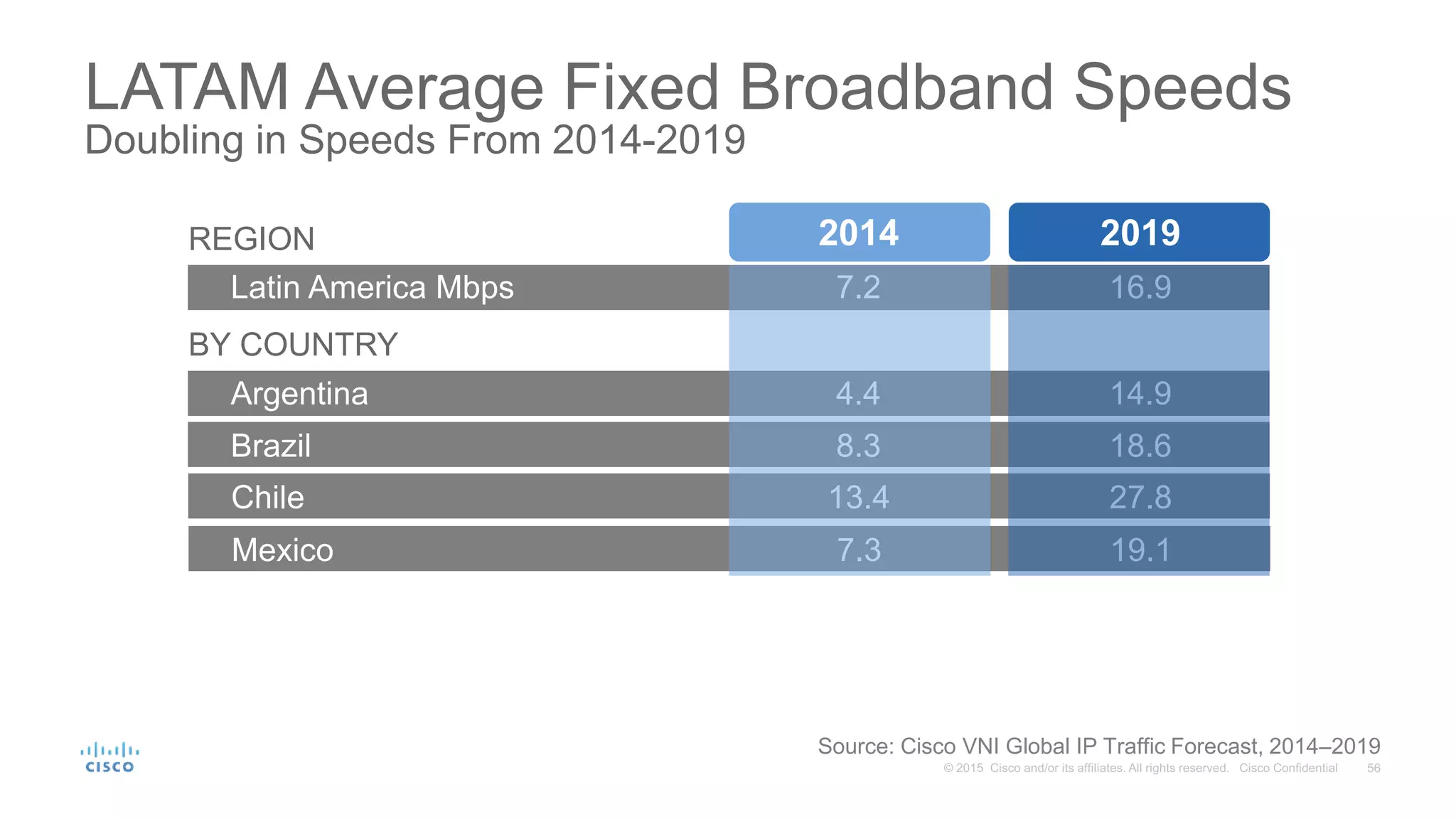
LATAM Average Fixed Broadband Speeds
Doubling in Speeds From 2014-2019
2014 2019
Latin America Mbps
BY COUNTRY
Argentina
Brazil
7.2
4.4
8.3
16.9
14.9
18.6
REGION
Source: Cisco VNI Global IP Traffic Forecast, 2014–2019
Chile 13.4 27.8
Mexico 7.3 19.1
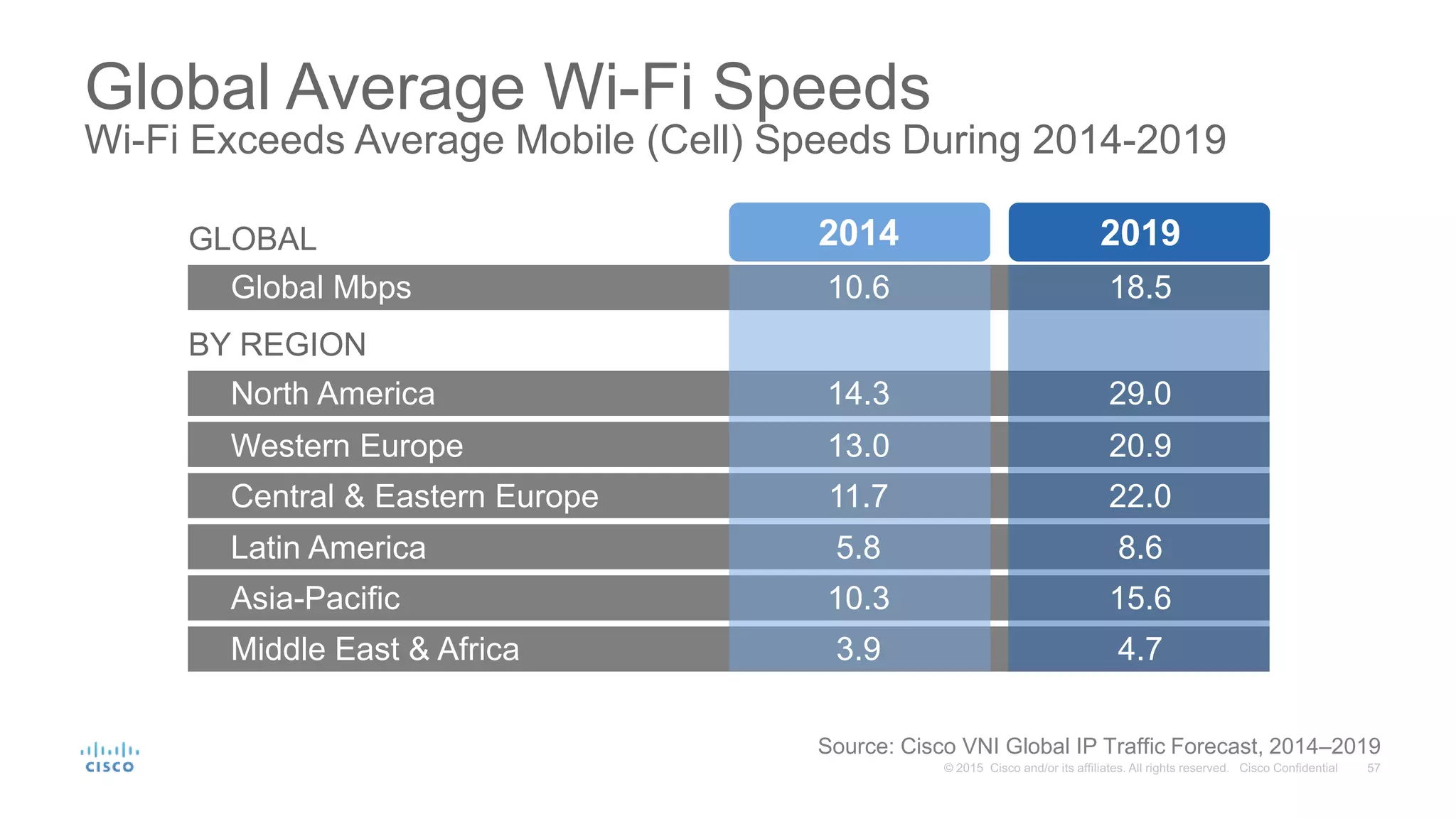
Global Average Wi-Fi Speeds
Wi-Fi Exceeds Average Mobile (Cell) Speeds During 2014-2019
2014 2019
Global Mbps
BY REGION
North America
Western Europe
Asia-Pacific
Central & Eastern Europe
Middle East & Africa
10.6
14.3
13.0
5.8
10.3
11.7
3.9
18.5
29.0
20.9
8.6
15.6
22.0
4.7
Latin America
GLOBAL
Source: Cisco VNI Global IP Traffic Forecast, 2014–2019
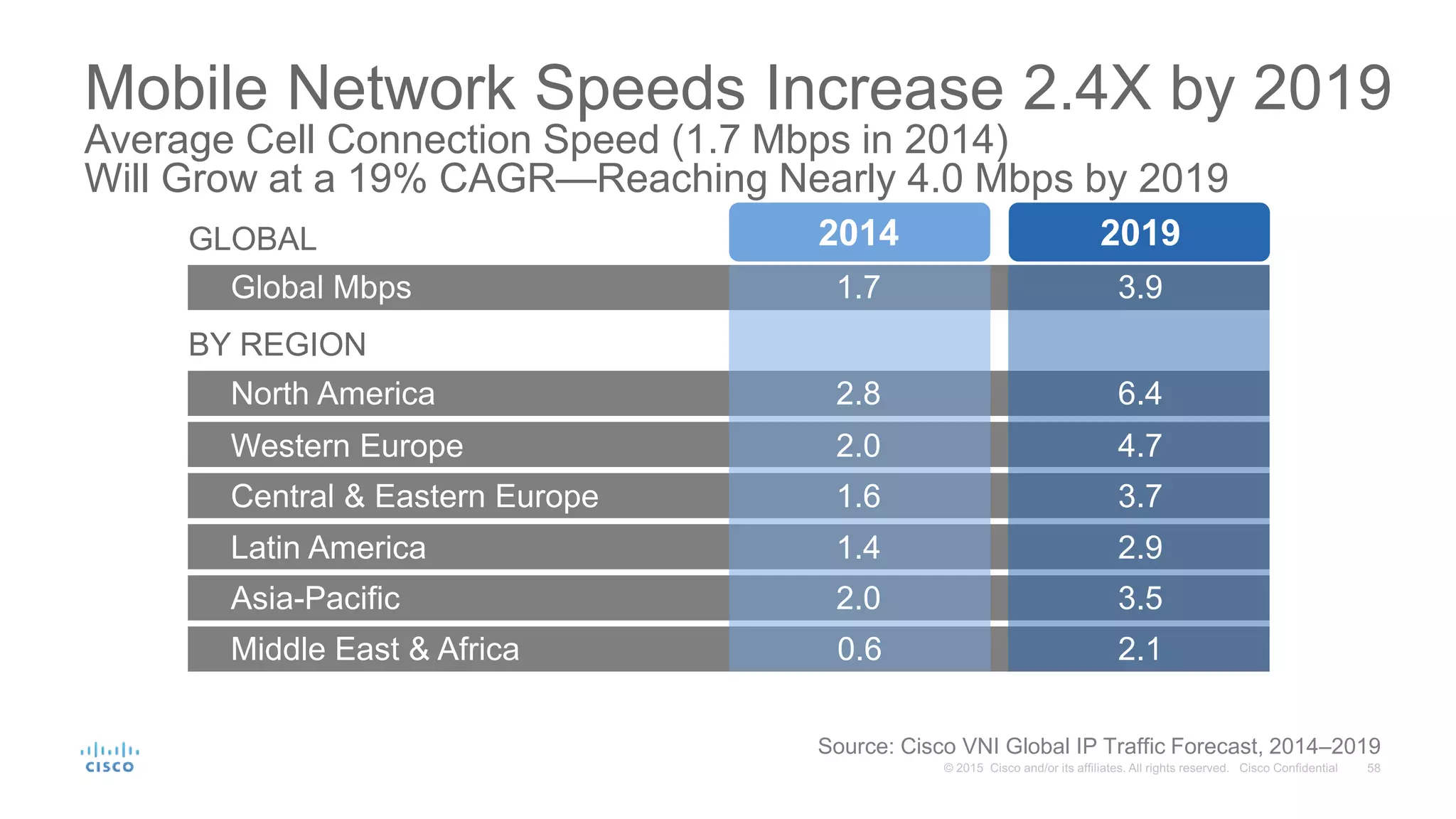
Mobile Network Speeds Increase 2.4X by 2019
Average Cell Connection Speed (1.7 Mbps in 2014)
Will Grow at a 19% CAGR—Reaching Nearly 4.0 Mbps by 2019
2014 2019
Global Mbps
BY REGION
North America
Western Europe
Asia-Pacific
Central & Eastern Europe
Middle East & Africa
1.7
2.8
2.0
1.4
2.0
1.6
0.6
3.9
6.4
4.7
2.9
3.5
3.7
2.1
Latin America
GLOBAL
Source: Cisco VNI Global IP Traffic Forecast, 2014–2019
VNI Forecast Update, 2014–2019
Top 10 Networking Trends
1 Continued Shifts in Devices/Connections Mix
2 IPv6 Adoption Enables Internet of Everything (IoE) Connectivity
3
4 Service Adoption Trends – Residential, Consumer Mobile, Business
5 Applications Driving Traffic Growth
6 “Cord-Cutting” Analysis – What’s Really Happening?
7 Impact of Accelerating Speeds on Traffic Growth
8 Mobility (Wi-Fi) Continues to Gain Momentum
9 Traffic Pattern Analysis (Peak vs. Average, Upstream, CDN vs. Metro)
10 Network Performance Drives User Behaviors/Data Plans and Caps
M2M Applications Across Many Industry Verticals Drives IoE Growth
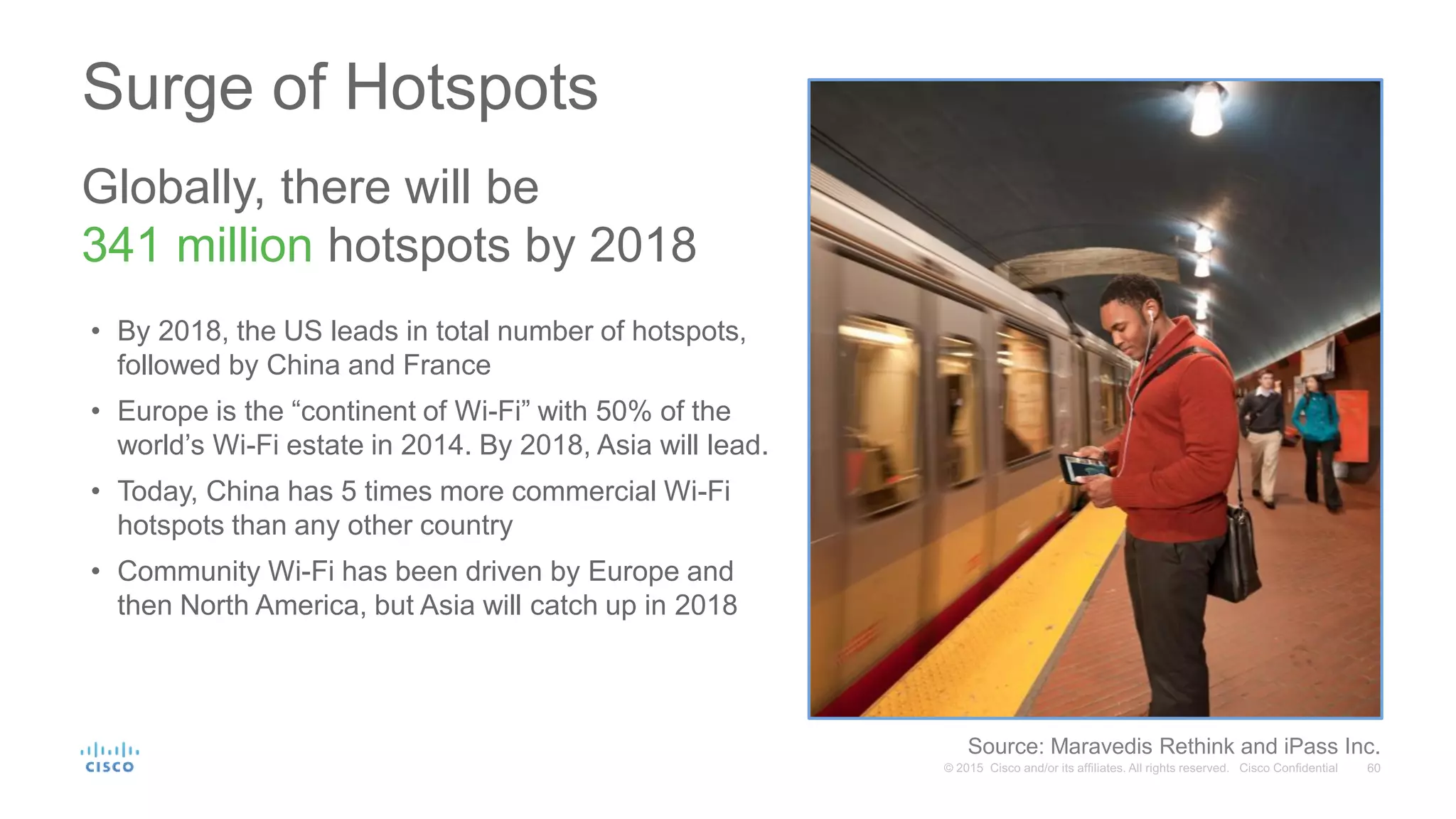
Surge of Hotspots
Globally, there will be
341 million hotspots by 2018
• By 2018, the US leads in total number of hotspots,
followed by China and France
• Europe is the “continent of Wi-Fi” with 50% of the
world’s Wi-Fi estate in 2014. By 2018, Asia will lead.
• Today, China has 5 times more commercial Wi-Fi
hotspots than any other country
• Community Wi-Fi has been driven by Europe and
then North America, but Asia will catch up in 2018
Source: Maravedis Rethink and iPass Inc.
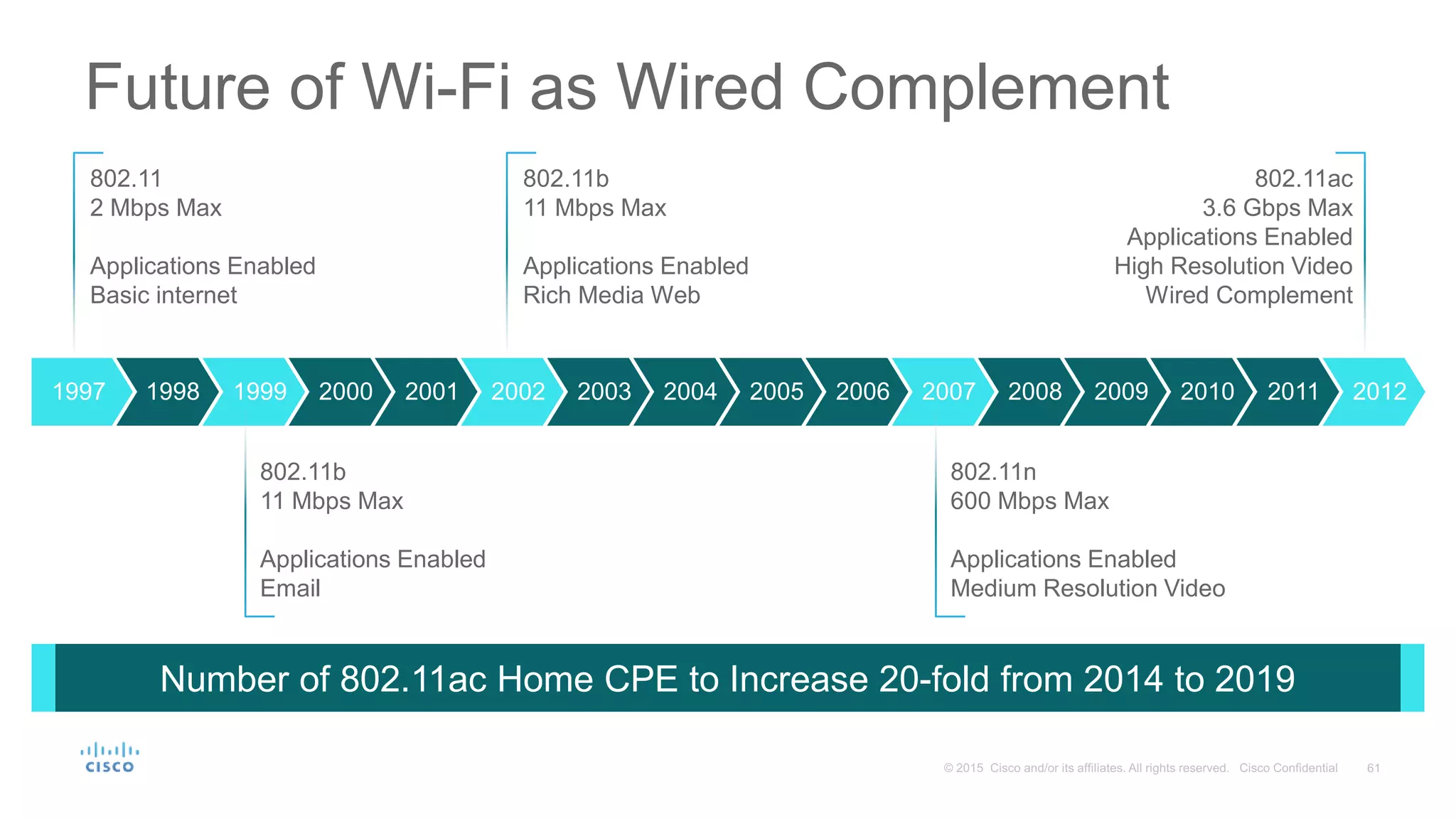
Future of Wi-Fi as Wired Complement
1997 1998 1999 2000 2001 2002 2003 2004 2005 2006 2007 2008 2009 2010 2011 2012
802.11
2 Mbps Max
Applications Enabled
Basic internet
802.11b
11 Mbps Max
Applications Enabled
Email
802.11b
11 Mbps Max
Applications Enabled
Rich Media Web
802.11ac
3.6 Gbps Max
Applications Enabled
High Resolution Video
Wired Complement
802.11n
600 Mbps Max
Applications Enabled
Medium Resolution Video
Number of 802.11ac Home CPE to Increase 20-fold from 2014 to 2019
0
20
40
60
80
100
120
140
160
180
2014 2015 2016 2017 2018 2019
Mobile Data (57.3% CAGR)
Fixed/Wired (11.4% CAGR)
Fixed/Wi-Fi from Mobile Devices (67.5% CAGR)
Fixed/Wi-Fi from Wi-Fi Only Devices (21.1% CAGR)
17%
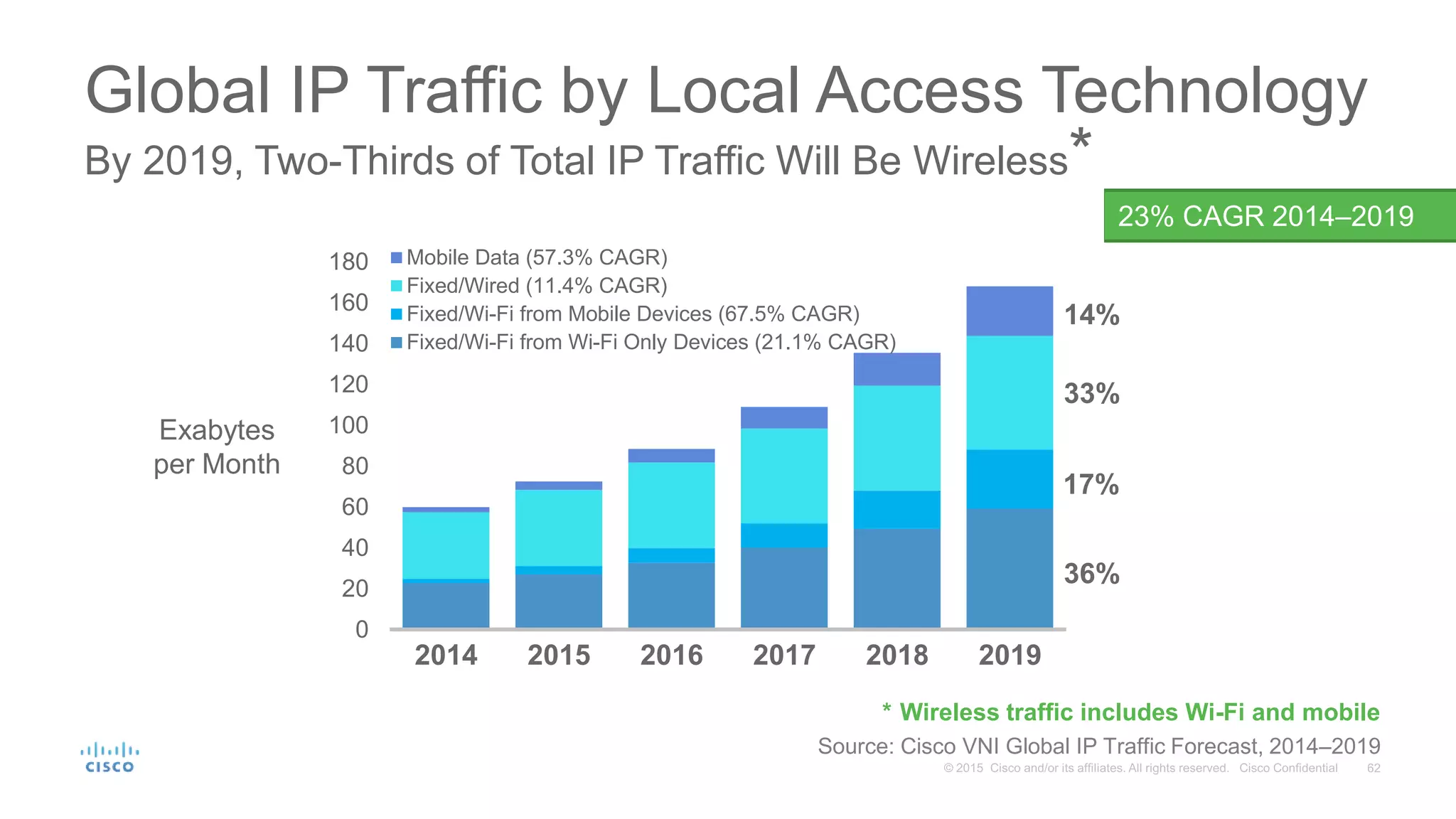
Global IP Traffic by Local Access Technology
By 2019, Two-Thirds of Total IP Traffic Will Be Wireless*
33%
36%
14%
Source: Cisco VNI Global IP Traffic Forecast, 2014–2019
23% CAGR 2014–2019
Exabytes
per Month
* Wireless traffic includes Wi-Fi and mobile
0
2
4
6
8
10
12
14
2014 2015 2016 2017 2018 2019
Mobile Data (58.9% CAGR)
Fixed/Wired (12.9% CAGR)
Fixed/Wi-Fi from Mobile Devices (74.5% CAGR)
Fixed/Wi-Fi from Wi-Fi Only Devices (20.8% CAGR)
14%
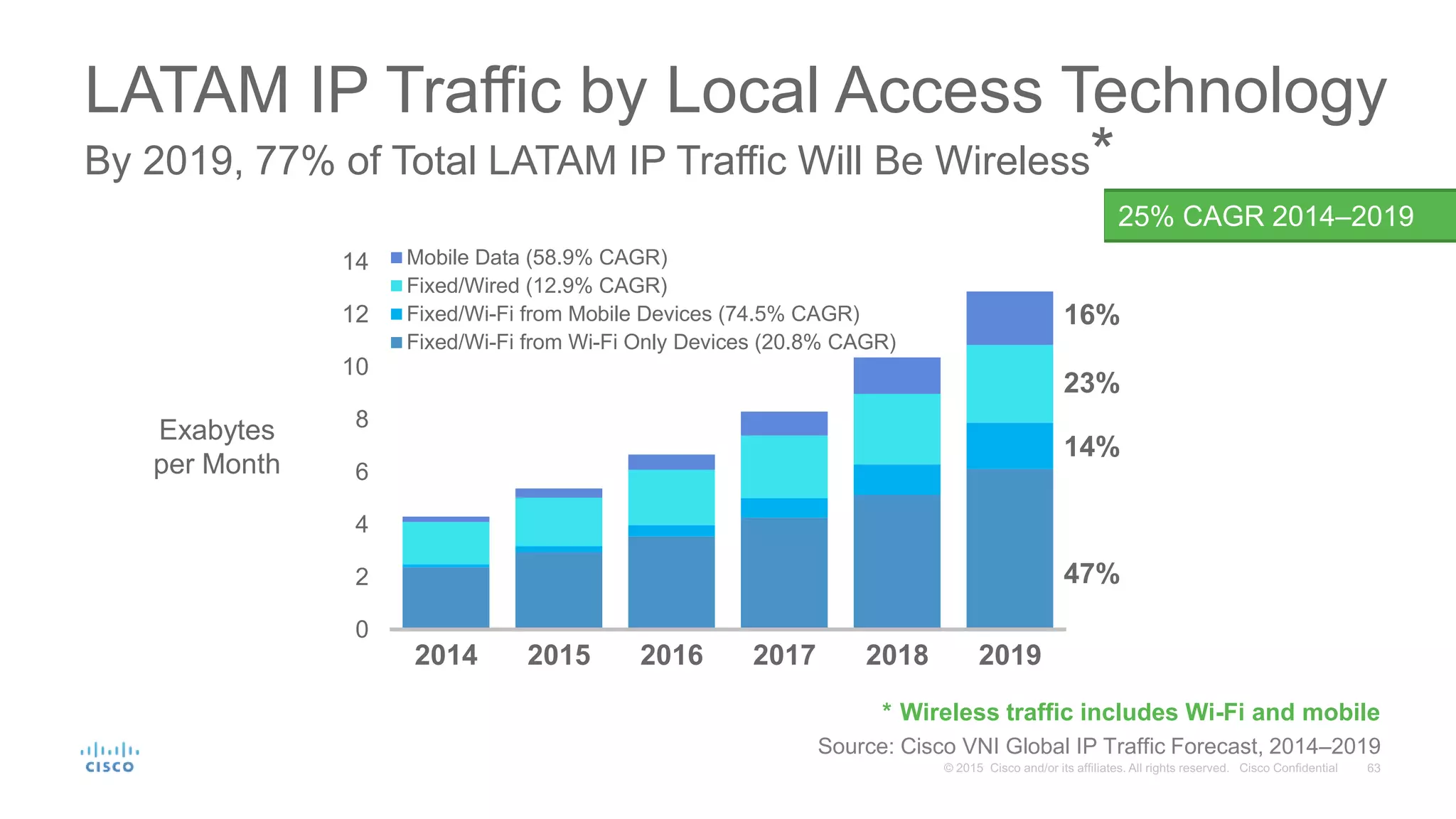
LATAM IP Traffic by Local Access Technology
By 2019, 77% of Total LATAM IP Traffic Will Be Wireless*
23%
47%
16%
Source: Cisco VNI Global IP Traffic Forecast, 2014–2019
25% CAGR 2014–2019
Exabytes
per Month
* Wireless traffic includes Wi-Fi and mobile
0
20
40
60
80
100
120
140
160
2014 2015 2016 2017 2018 2019
Mobile Data (57.3% CAGR)
Fixed/Wired (9.9% CAGR)
Fixed/Wi-Fi from Mobile Devices (67.5% CAGR)
Fixed/Wi-Fi from Wi-Fi Only Devices (21.7% CAGR)
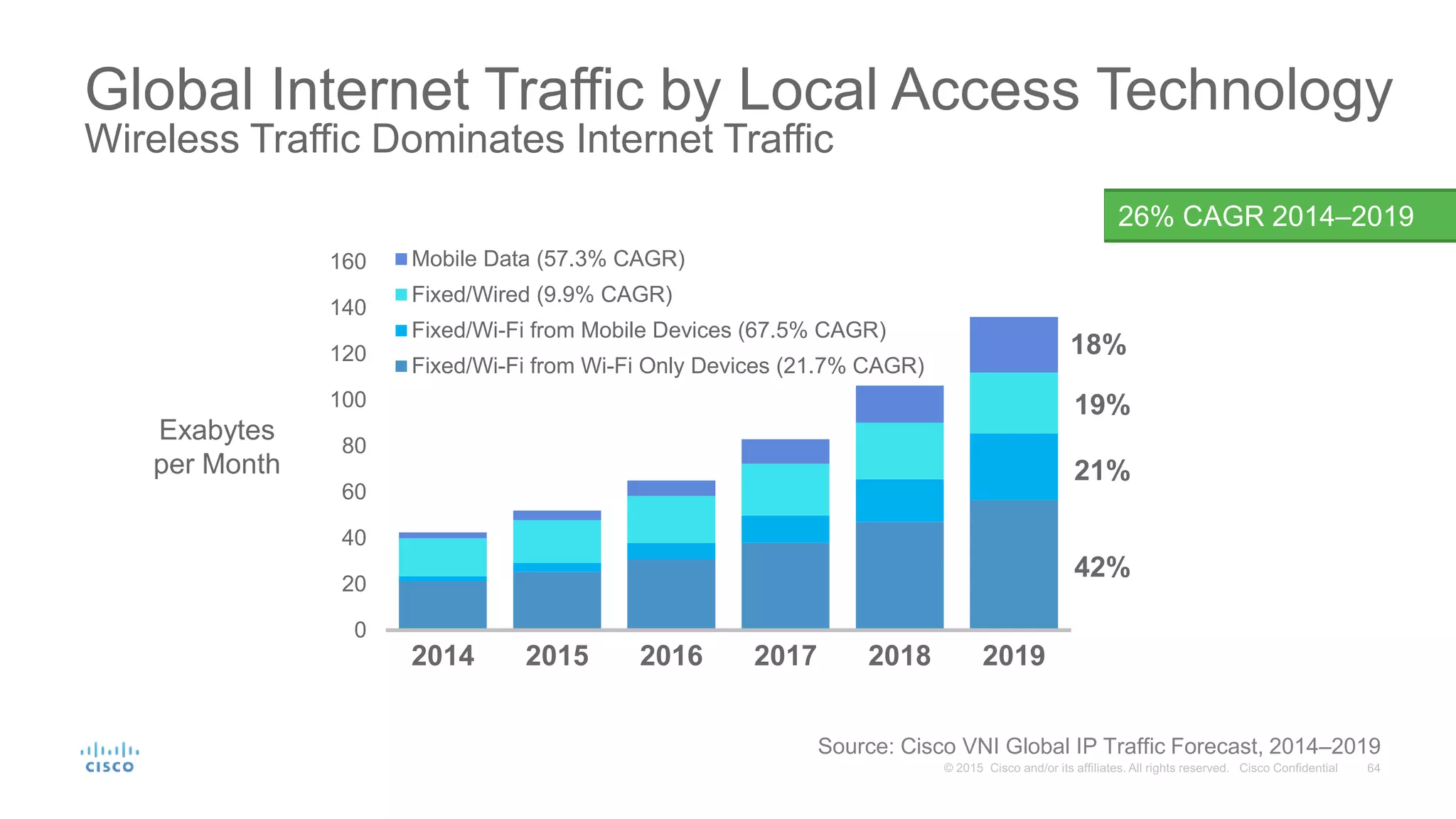
Global Internet Traffic by Local Access Technology
Wireless Traffic Dominates Internet Traffic
19%
42%
18%
21%
Source: Cisco VNI Global IP Traffic Forecast, 2014–2019
Exabytes
per Month
26% CAGR 2014–2019
VNI Forecast Update, 2014–2019
Top 10 Networking Trends
1 Continued Shifts in Devices/Connections Mix
2 IPv6 Adoption Enables Internet of Everything (IoE) Connectivity
3
4 Service Adoption Trends – Residential, Consumer Mobile, Business
5 Applications Driving Traffic Growth
6 “Cord-Cutting” Analysis – What’s Really Happening?
7 Impact of Accelerating Speeds on Traffic Growth
8 Mobility (Wi-Fi) Continues to Gain Momentum
9 Traffic Pattern Analysis (Peak vs. Average, Upstream, CDN vs. Metro)
10 Network Performance Drives User Behaviors/Data Plans and Caps
M2M Applications Across Many Industry Verticals Drives IoE Growth
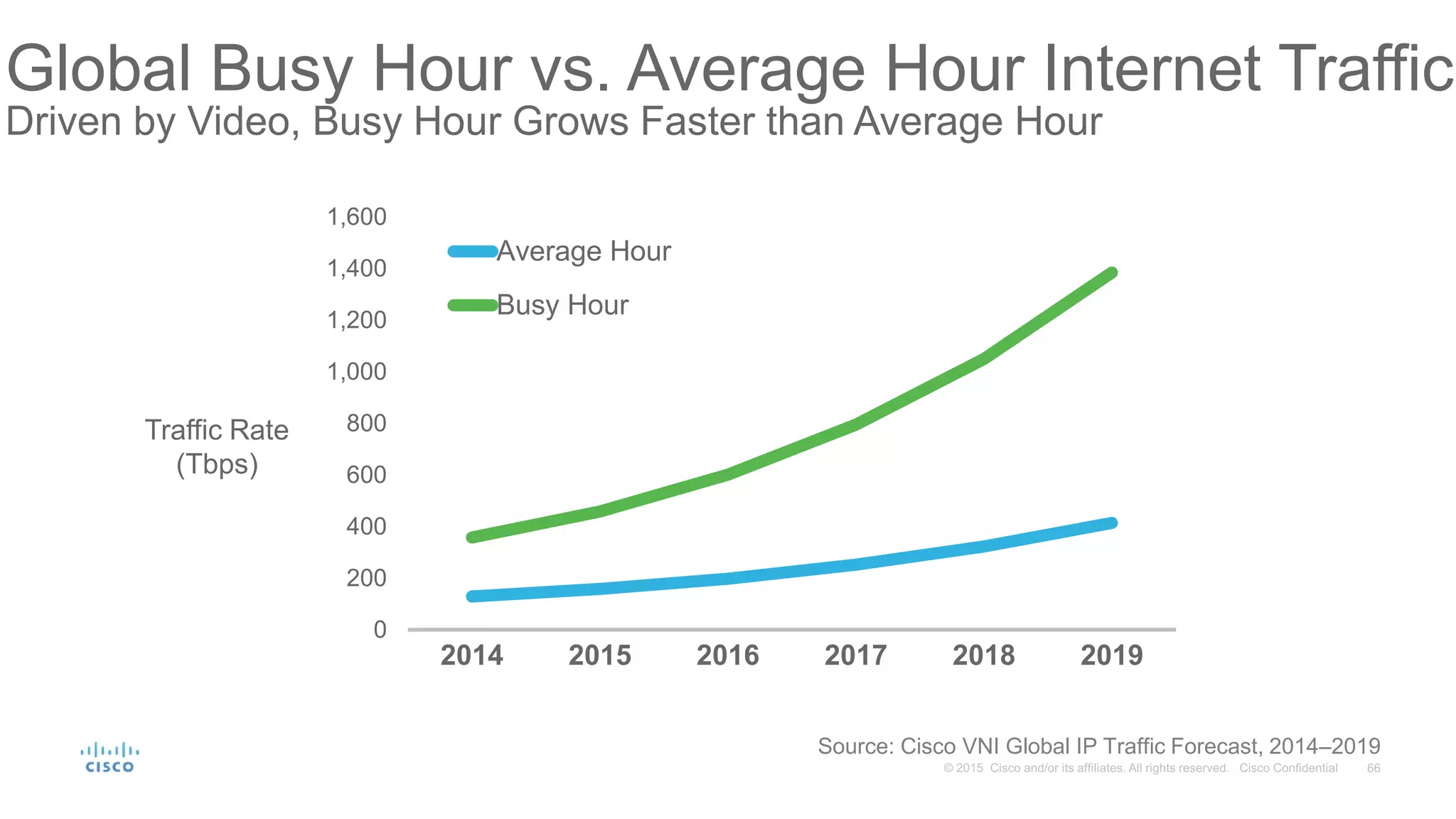
Global Busy Hour vs. Average Hour Internet Traffic
Driven by Video, Busy Hour Grows Faster than Average Hour
0
200
400
600
800
1,000
1,200
1,400
1,600
2014 2015 2016 2017 2018 2019
Average Hour
Busy Hour
Source: Cisco VNI Global IP Traffic Forecast, 2014–2019
Traffic Rate
(Tbps)
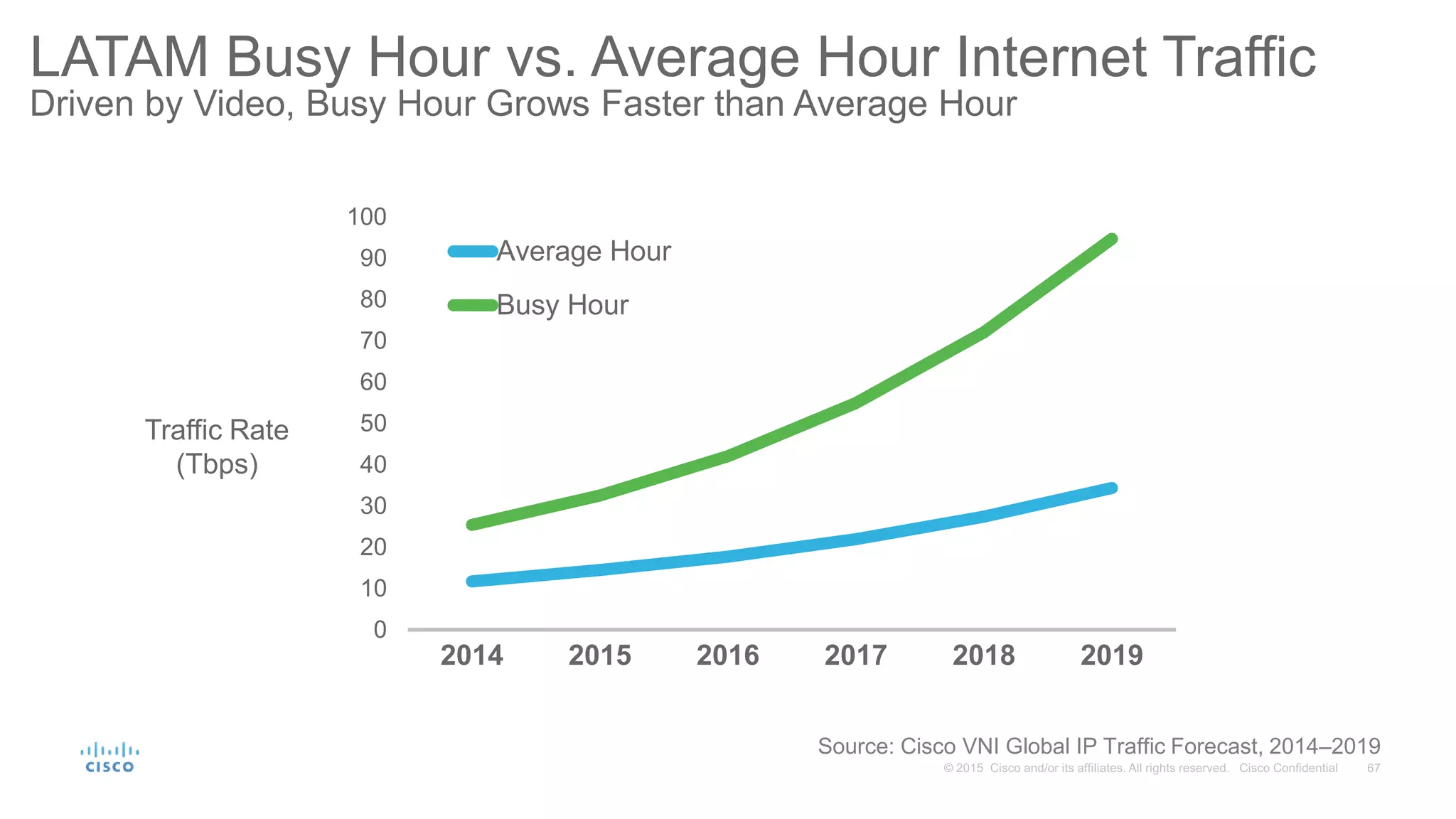
LATAM Busy Hour vs. Average Hour Internet Traffic
Driven by Video, Busy Hour Grows Faster than Average Hour
0
10
20
30
40
50
60
70
80
90
100
2014 2015 2016 2017 2018 2019
Average Hour
Busy Hour
Source: Cisco VNI Global IP Traffic Forecast, 2014–2019
Traffic Rate
(Tbps)
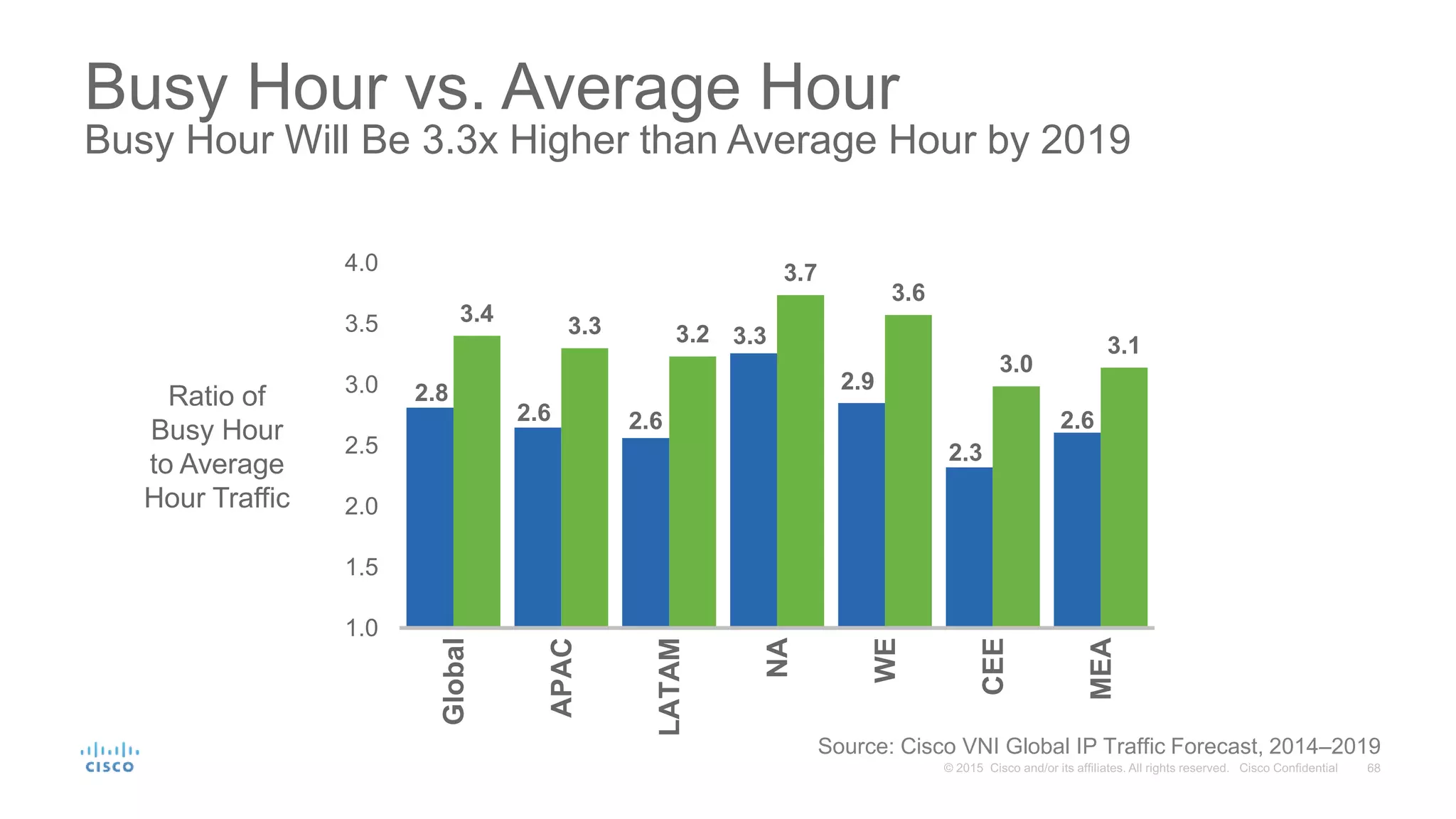
Busy Hour vs. Average Hour
Busy Hour Will Be 3.3x Higher than Average Hour by 2019
2.8
2.6 2.6
3.3
2.9
2.3
2.6
3.4
3.3 3.2
3.7
3.6
3.0
3.1
1.0
1.5
2.0
2.5
3.0
3.5
4.0
Global
APAC
LATAM
NA
WE
CEE
MEA
A
x
i
s
T
i
t
l
e
Source: Cisco VNI Global IP Traffic Forecast, 2014–2019
Ratio of
Busy Hour
to Average
Hour Traffic
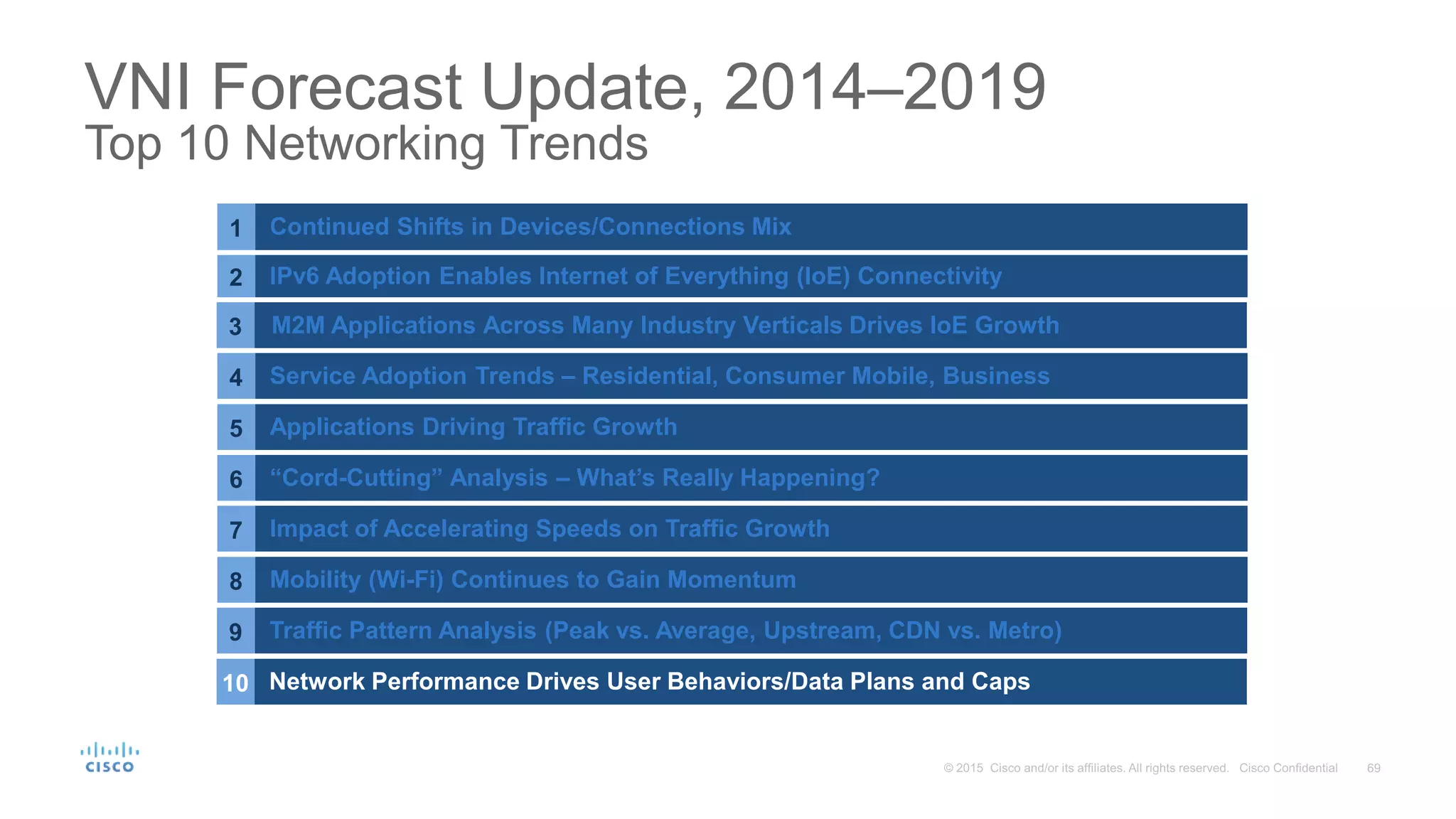
VNI Forecast Update, 2014–2019
Top 10 Networking Trends
1 Continued Shifts in Devices/Connections Mix
2 IPv6 Adoption Enables Internet of Everything (IoE) Connectivity
3
4 Service Adoption Trends – Residential, Consumer Mobile, Business
5 Applications Driving Traffic Growth
6 “Cord-Cutting” Analysis – What’s Really Happening?
7 Impact of Accelerating Speeds on Traffic Growth
8 Mobility (Wi-Fi) Continues to Gain Momentum
9 Traffic Pattern Analysis (Peak vs. Average, Upstream, CDN vs. Metro)
10 Network Performance Drives User Behaviors/Data Plans and Caps
M2M Applications Across Many Industry Verticals Drives IoE Growth
Source: Cisco VNI Global IP Traffic Forecast, 2014–2019
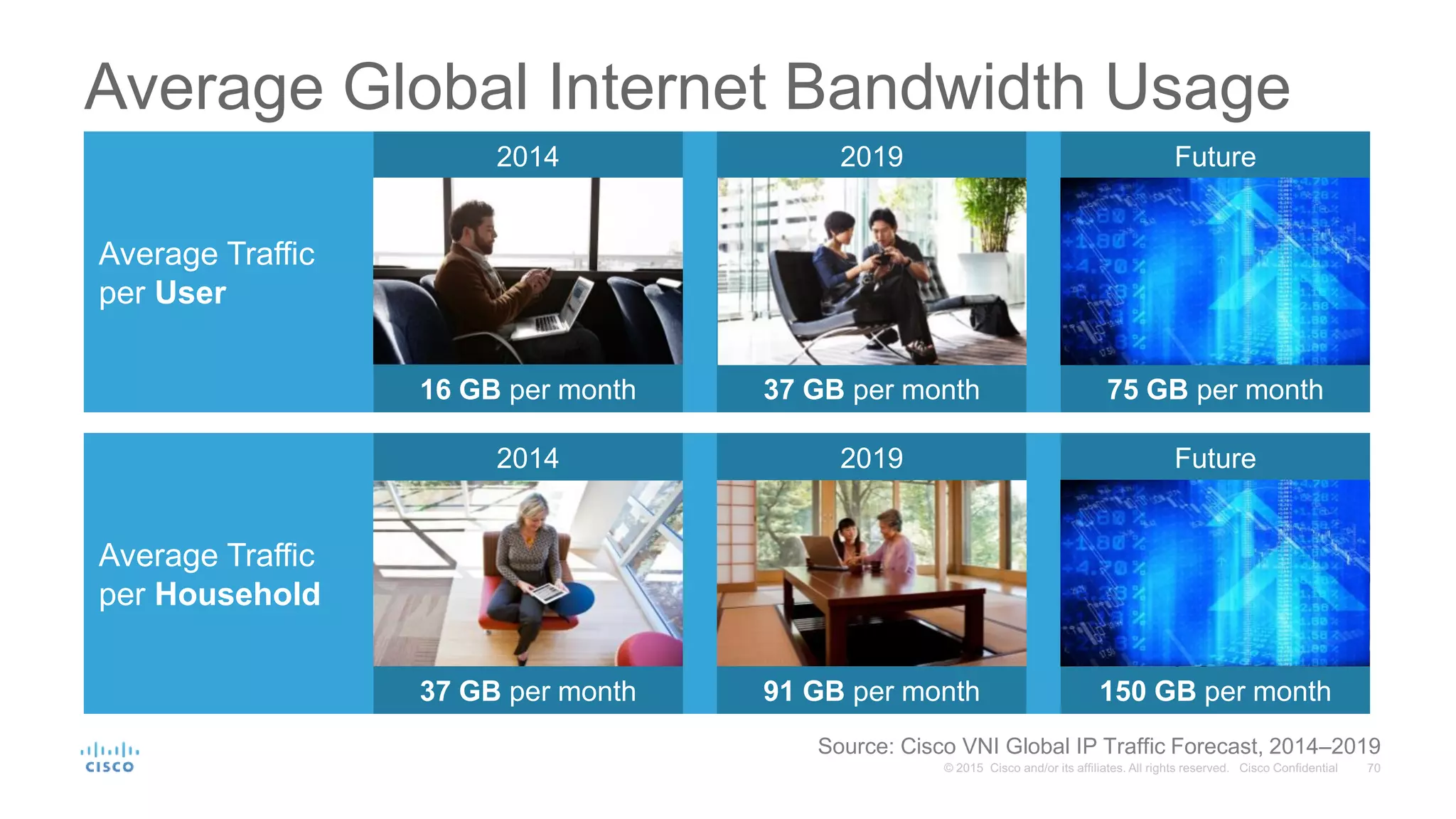
Average Global Internet Bandwidth Usage
Average Traffic
per User
2014
16 GB per month
2019
37 GB per month
Future
75 GB per month
Average Traffic
per Household
2014
37 GB per month
2019
91 GB per month
Future
150 GB per month
Source: Cisco VNI Global IP Traffic Forecast, 2014–2019
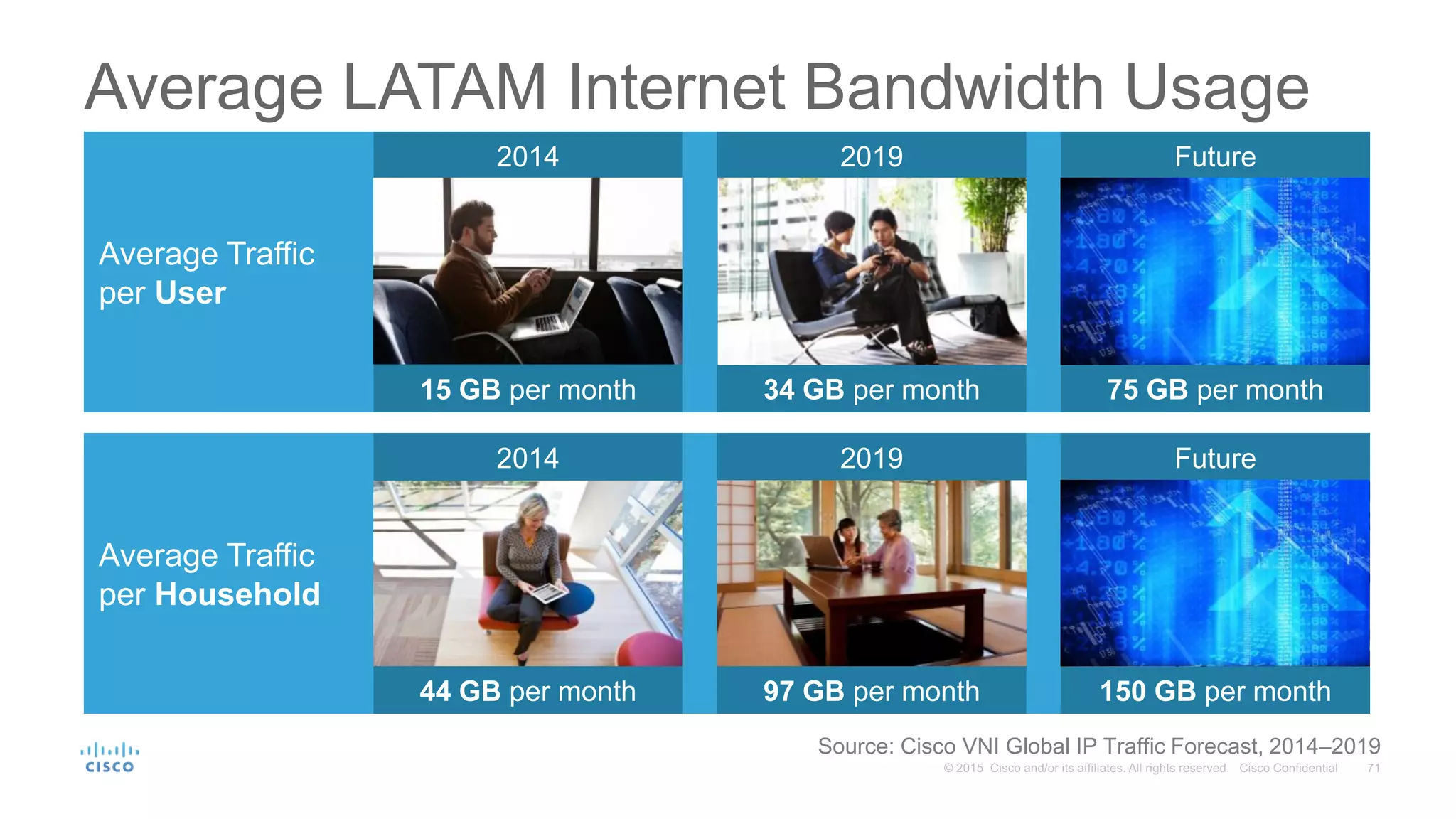
Average LATAM Internet Bandwidth Usage
Average Traffic
per User
2014
15 GB per month
2019
34 GB per month
Future
75 GB per month
Average Traffic
per Household
2014
44 GB per month
2019
97 GB per month
Future
150 GB per month
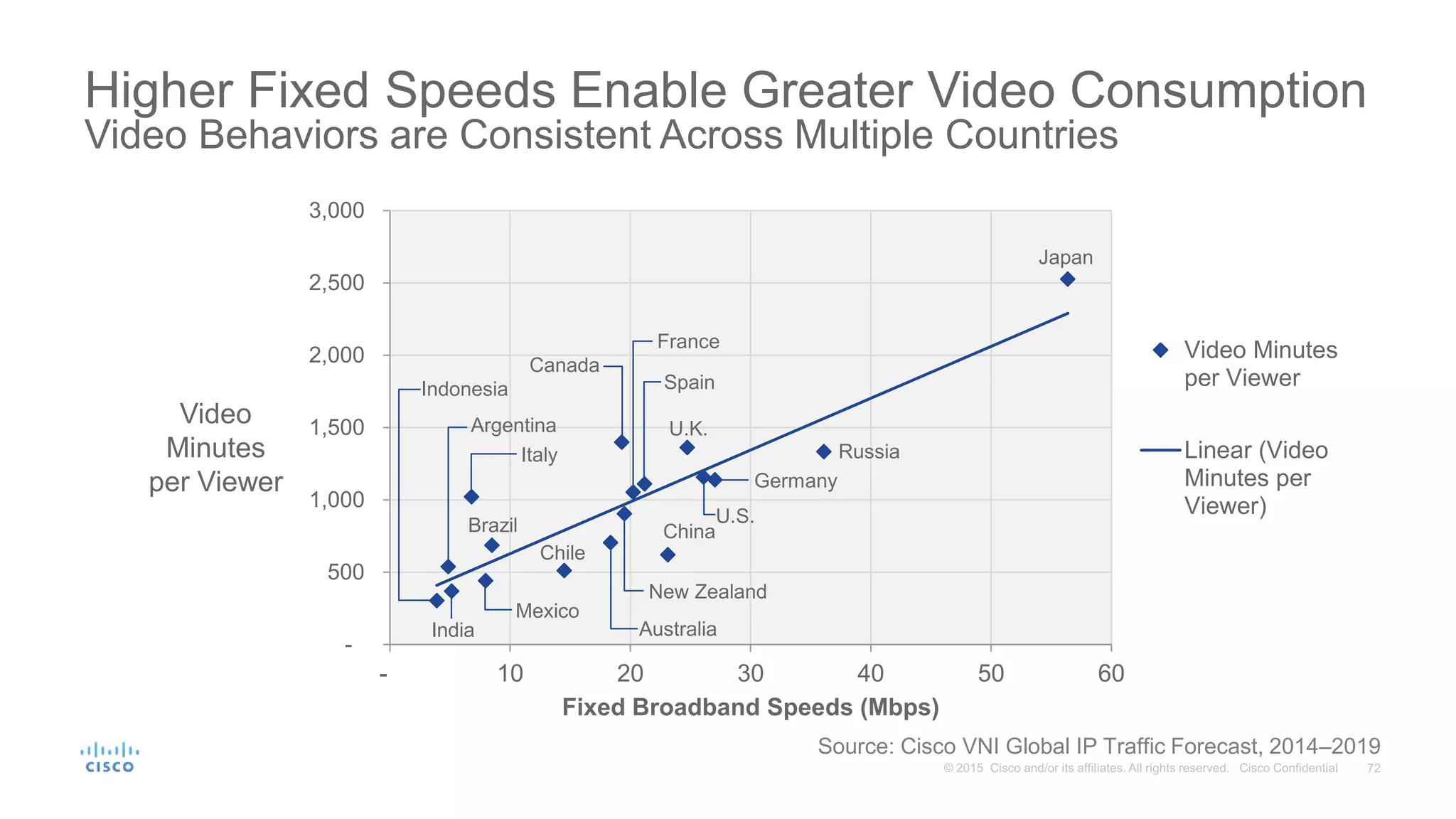
Higher Fixed Speeds Enable Greater Video Consumption
Video Behaviors are Consistent Across Multiple Countries
-
500
1,000
1,500
2,000
2,500
3,000
- 10 20 30 40 50 60
Fixed Broadband Speeds (Mbps)
Video Minutes
per Viewer
Linear (Video
Minutes per
Viewer)
Indonesia
India
Argentina
Italy
Mexico
Brazil
Australia
Chile
Russia
Canada
U.K.
Japan
Germany
China
New Zealand
France
Spain
U.S.
Source: Cisco VNI Global IP Traffic Forecast, 2014–2019
Video
Minutes
per Viewer
Argentina Forecast (2014-2019)
Cisco Confidential 74© 2013-2014 Cisco and/or its affiliates. All rights reserved.
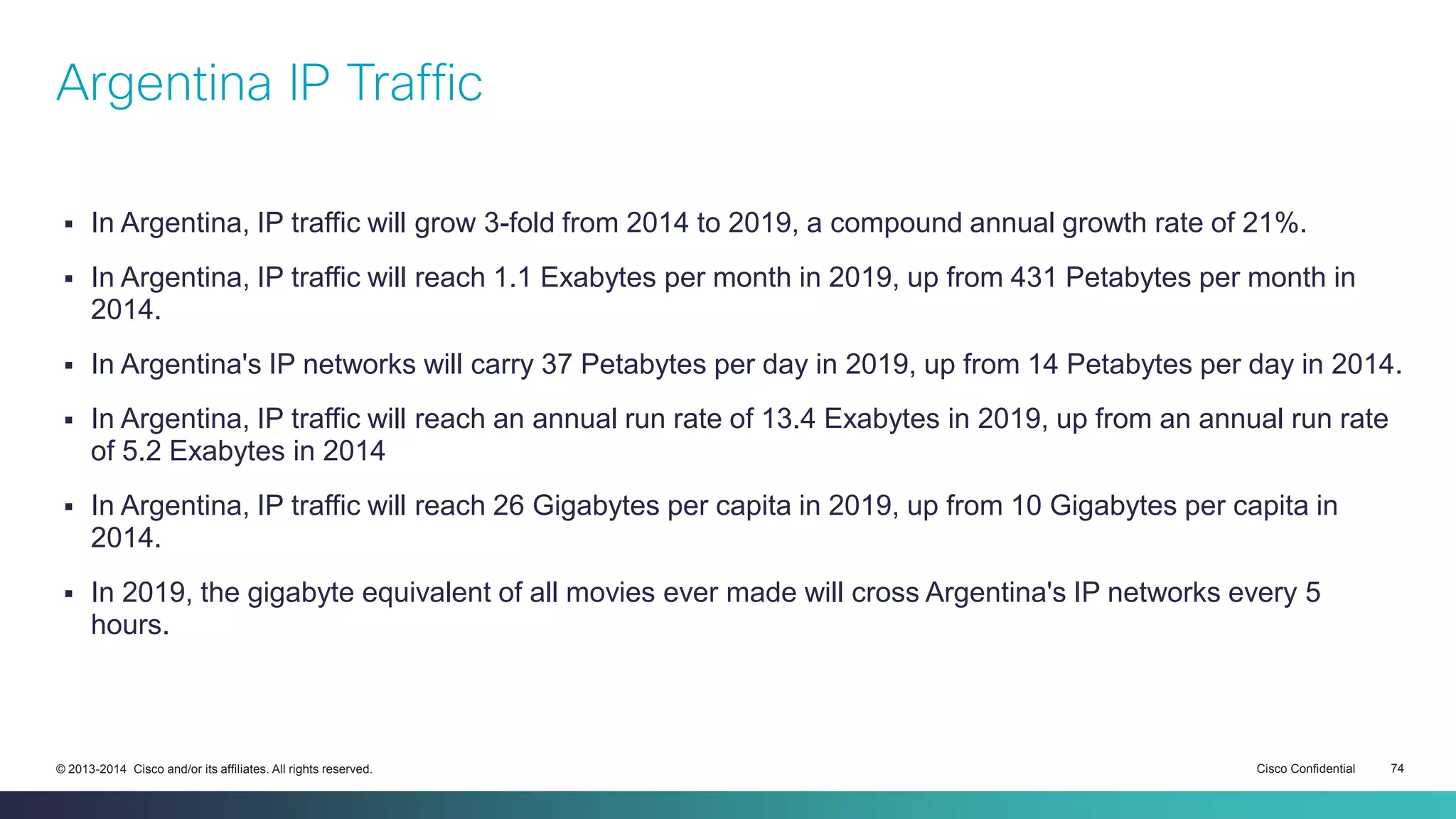
Argentina IP Traffic
 In Argentina, IP traffic will grow 3-fold from 2014 to 2019, a compound annual growth rate of 21%.
 In Argentina, IP traffic will reach 1.1 Exabytes per month in 2019, up from 431 Petabytes per month in
2014.
 In Argentina's IP networks will carry 37 Petabytes per day in 2019, up from 14 Petabytes per day in 2014.
 In Argentina, IP traffic will reach an annual run rate of 13.4 Exabytes in 2019, up from an annual run rate
of 5.2 Exabytes in 2014
 In Argentina, IP traffic will reach 26 Gigabytes per capita in 2019, up from 10 Gigabytes per capita in
2014.
 In 2019, the gigabyte equivalent of all movies ever made will cross Argentina's IP networks every 5
hours.
Cisco Confidential 75© 2013-2014 Cisco and/or its affiliates. All rights reserved.
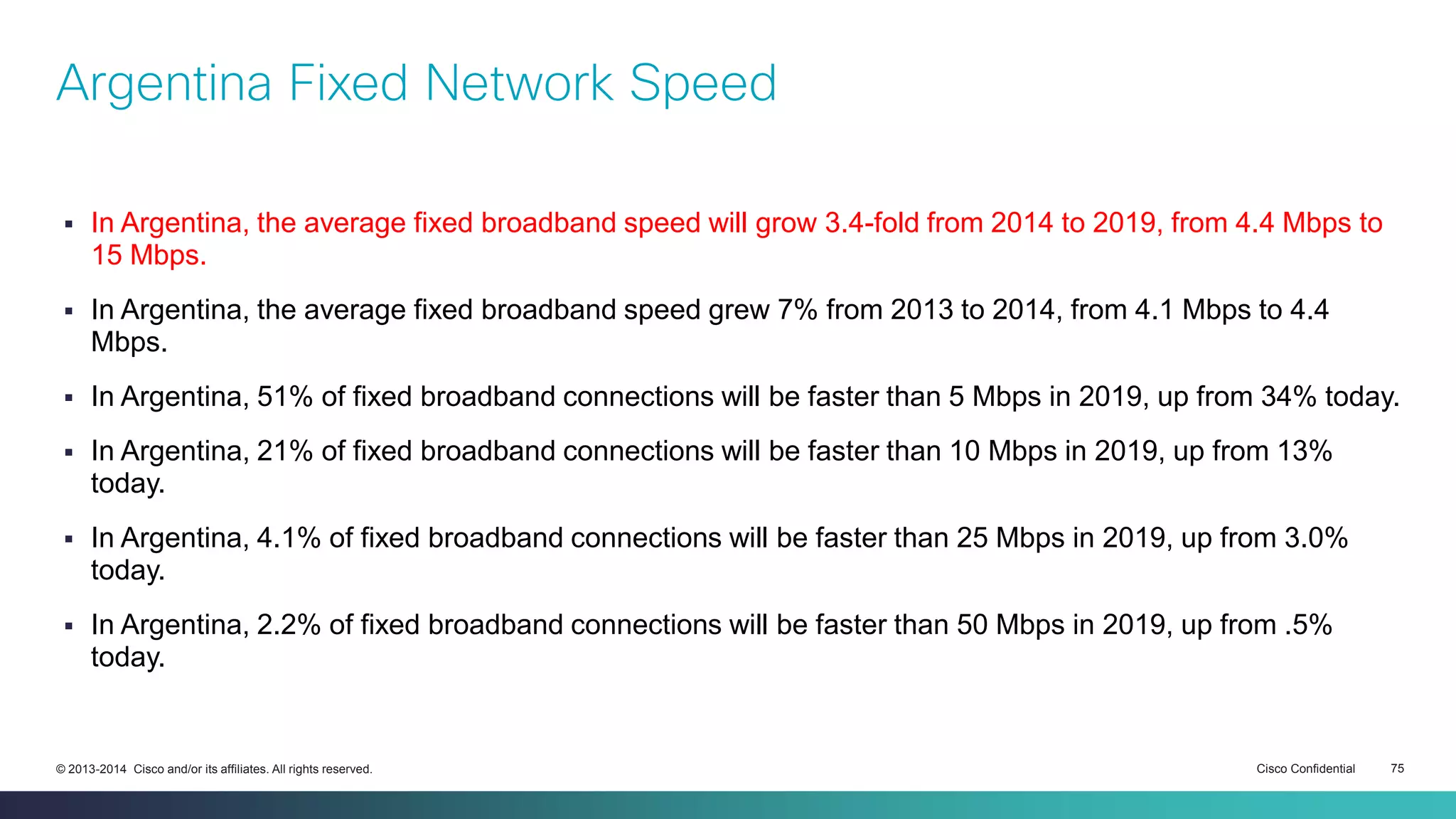
Argentina Fixed Network Speed
 In Argentina, the average fixed broadband speed will grow 3.4-fold from 2014 to 2019, from 4.4 Mbps to
15 Mbps.
 In Argentina, the average fixed broadband speed grew 7% from 2013 to 2014, from 4.1 Mbps to 4.4
Mbps.
 In Argentina, 51% of fixed broadband connections will be faster than 5 Mbps in 2019, up from 34% today.
 In Argentina, 21% of fixed broadband connections will be faster than 10 Mbps in 2019, up from 13%
today.
 In Argentina, 4.1% of fixed broadband connections will be faster than 25 Mbps in 2019, up from 3.0%
today.
 In Argentina, 2.2% of fixed broadband connections will be faster than 50 Mbps in 2019, up from .5%
today.
Cisco Confidential 76© 2013-2014 Cisco and/or its affiliates. All rights reserved.
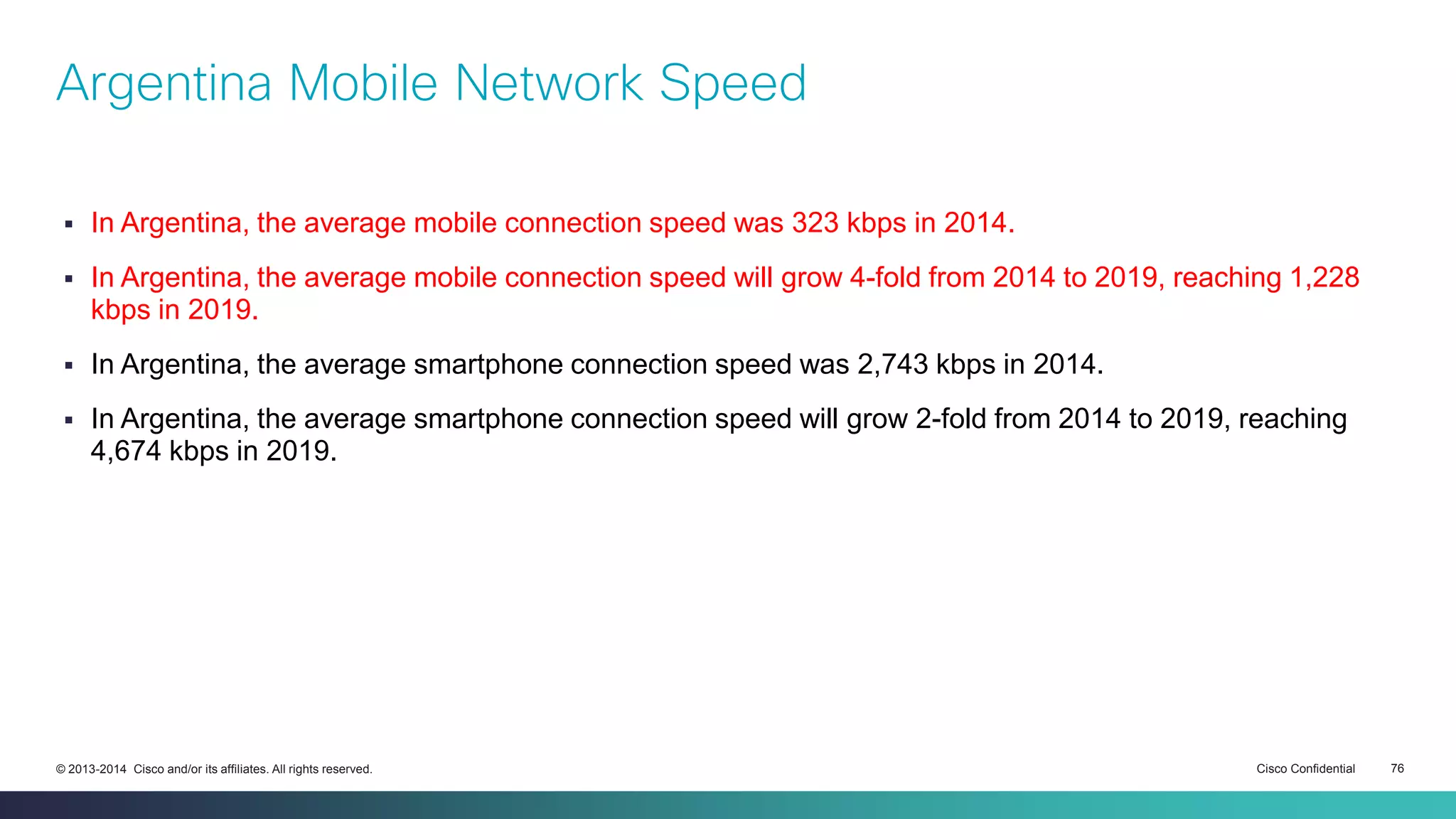
Argentina Mobile Network Speed
 In Argentina, the average mobile connection speed was 323 kbps in 2014.
 In Argentina, the average mobile connection speed will grow 4-fold from 2014 to 2019, reaching 1,228
kbps in 2019.
 In Argentina, the average smartphone connection speed was 2,743 kbps in 2014.
 In Argentina, the average smartphone connection speed will grow 2-fold from 2014 to 2019, reaching
4,674 kbps in 2019.
Cisco Confidential 77© 2013-2014 Cisco and/or its affiliates. All rights reserved.
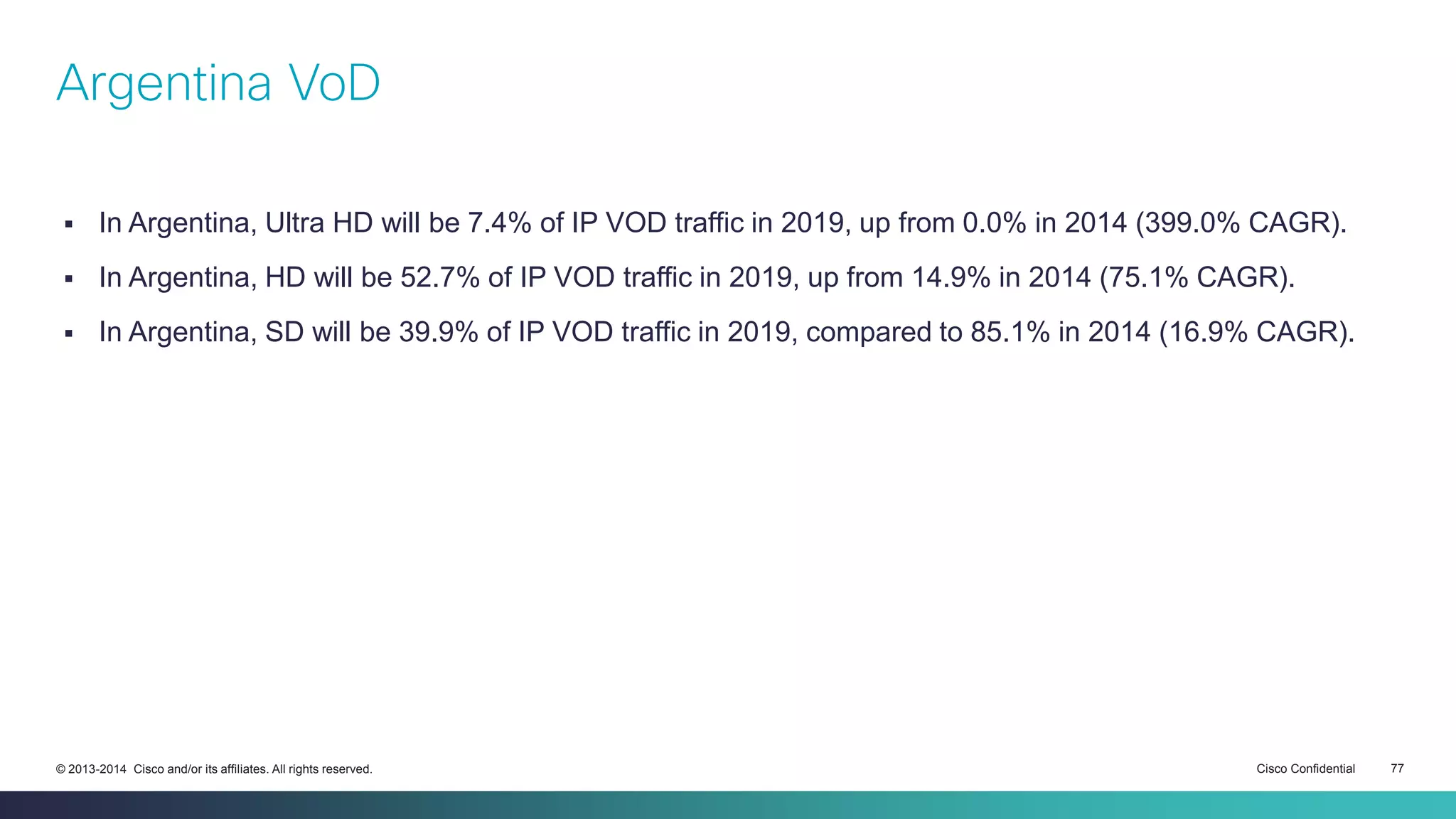
Argentina VoD
 In Argentina, Ultra HD will be 7.4% of IP VOD traffic in 2019, up from 0.0% in 2014 (399.0% CAGR).
 In Argentina, HD will be 52.7% of IP VOD traffic in 2019, up from 14.9% in 2014 (75.1% CAGR).
 In Argentina, SD will be 39.9% of IP VOD traffic in 2019, compared to 85.1% in 2014 (16.9% CAGR).
Cisco Confidential 78© 2013-2014 Cisco and/or its affiliates. All rights reserved.
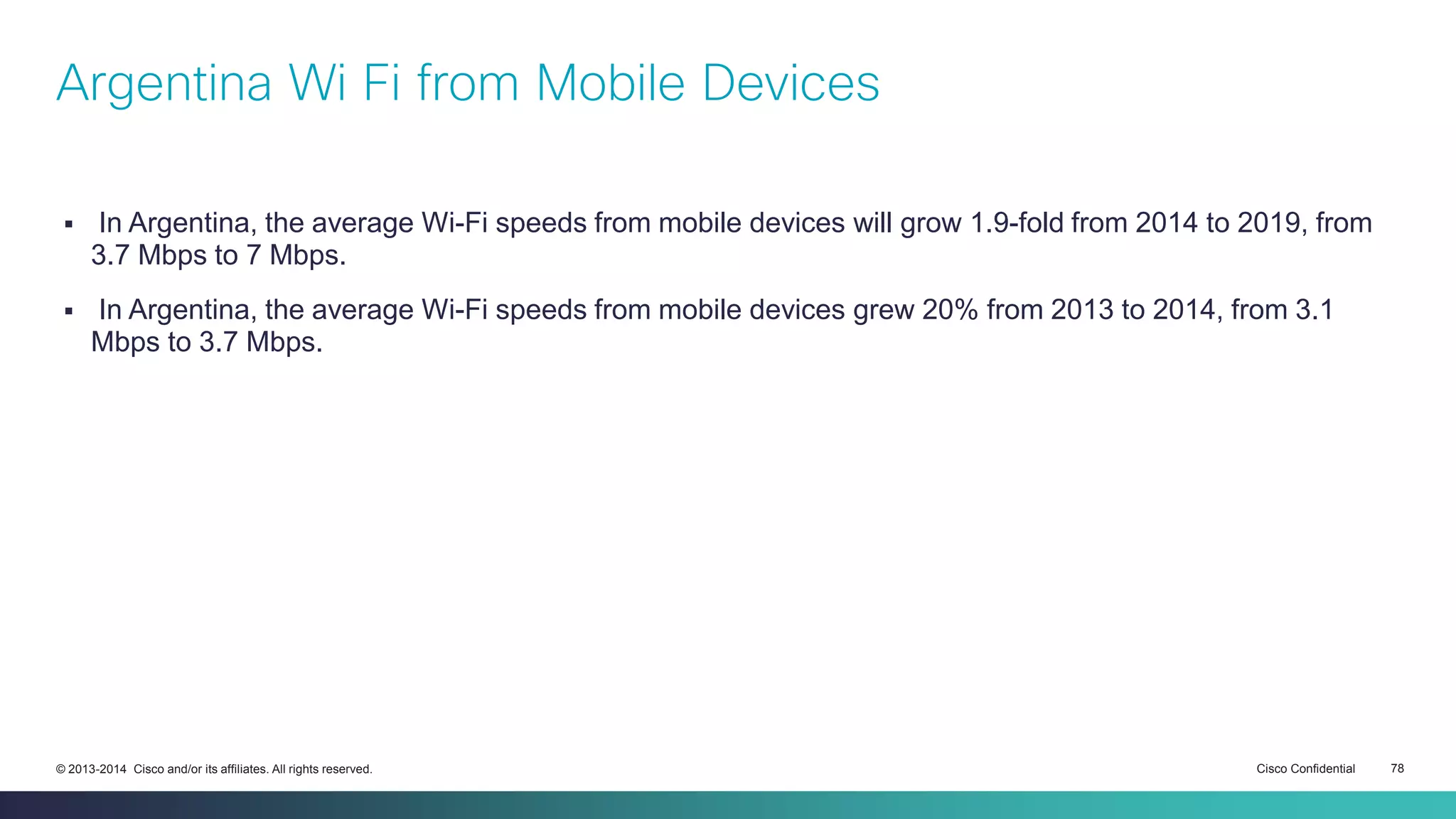
Argentina Wi Fi from Mobile Devices
 In Argentina, the average Wi-Fi speeds from mobile devices will grow 1.9-fold from 2014 to 2019, from
3.7 Mbps to 7 Mbps.
 In Argentina, the average Wi-Fi speeds from mobile devices grew 20% from 2013 to 2014, from 3.1
Mbps to 3.7 Mbps.
Cisco Confidential 79© 2013-2014 Cisco and/or its affiliates. All rights reserved.
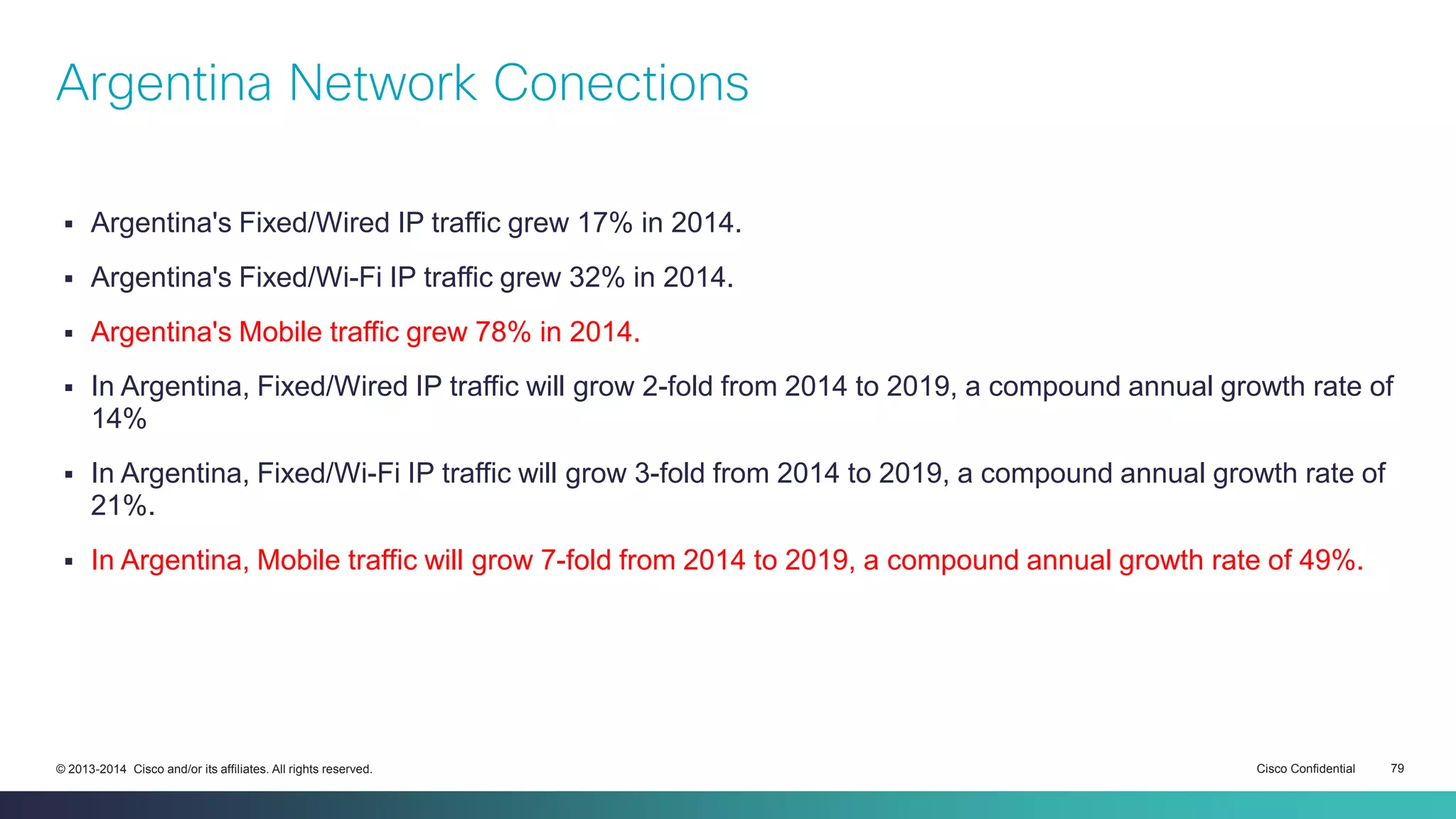
Argentina Network Conections
 Argentina's Fixed/Wired IP traffic grew 17% in 2014.
 Argentina's Fixed/Wi-Fi IP traffic grew 32% in 2014.
 Argentina's Mobile traffic grew 78% in 2014.
 In Argentina, Fixed/Wired IP traffic will grow 2-fold from 2014 to 2019, a compound annual growth rate of
14%
 In Argentina, Fixed/Wi-Fi IP traffic will grow 3-fold from 2014 to 2019, a compound annual growth rate of
21%.
 In Argentina, Mobile traffic will grow 7-fold from 2014 to 2019, a compound annual growth rate of 49%.
Conclusion
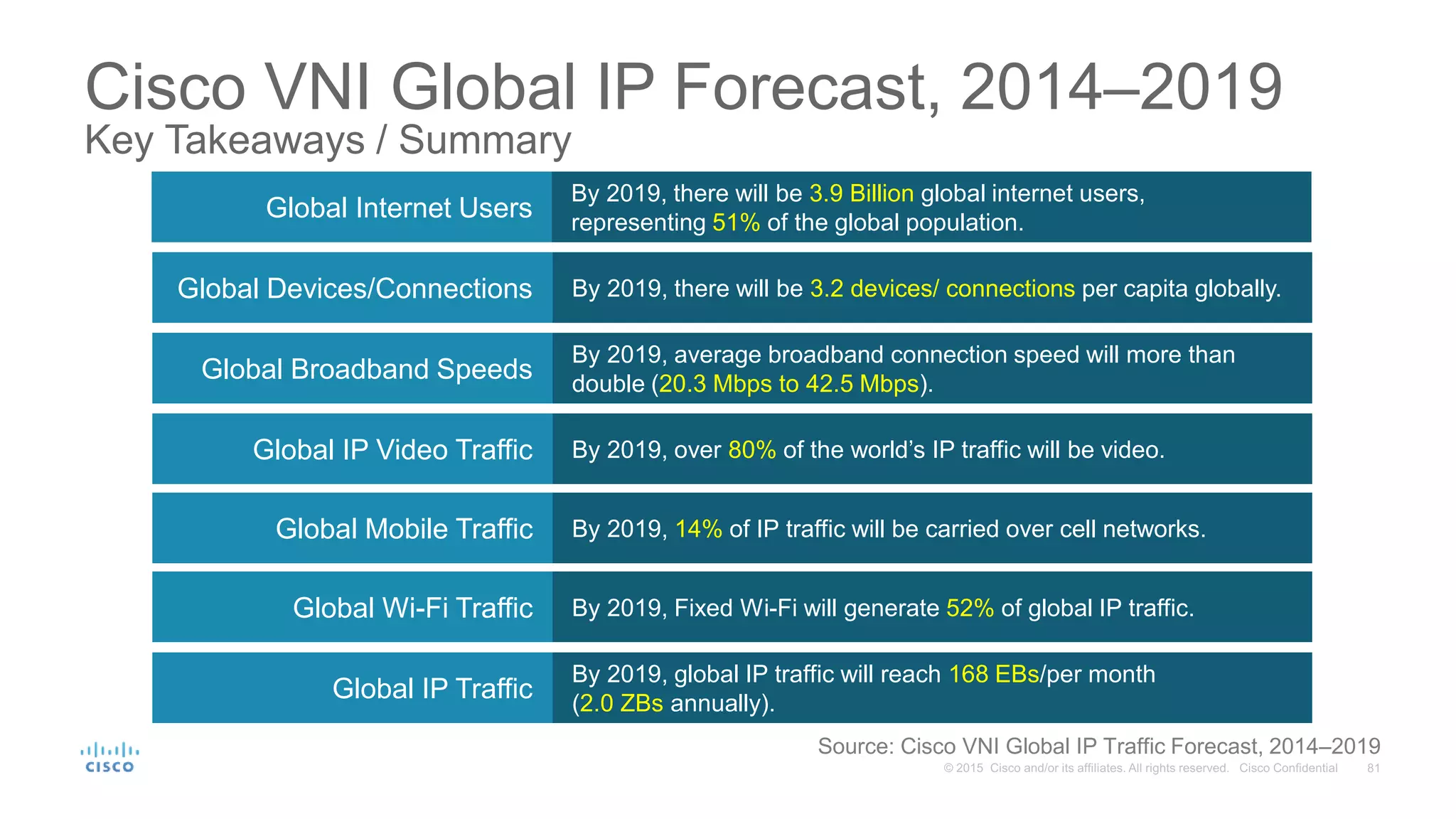
Cisco VNI Global IP Forecast, 2014–2019
Key Takeaways / Summary
Global IP Traffic
By 2019, global IP traffic will reach 168 EBs/per month
(2.0 ZBs annually).
Global Mobile Traffic By 2019, 14% of IP traffic will be carried over cell networks.
Global Wi-Fi Traffic By 2019, Fixed Wi-Fi will generate 52% of global IP traffic.
Global IP Video Traffic By 2019, over 80% of the world’s IP traffic will be video.
Global Broadband Speeds
By 2019, average broadband connection speed will more than
double (20.3 Mbps to 42.5 Mbps).
Global Devices/Connections By 2019, there will be 3.2 devices/ connections per capita globally.
Global Internet Users
By 2019, there will be 3.9 Billion global internet users,
representing 51% of the global population.
Source: Cisco VNI Global IP Traffic Forecast, 2014–2019
Cisco VNI LATAM IP Forecast, 2014–2019
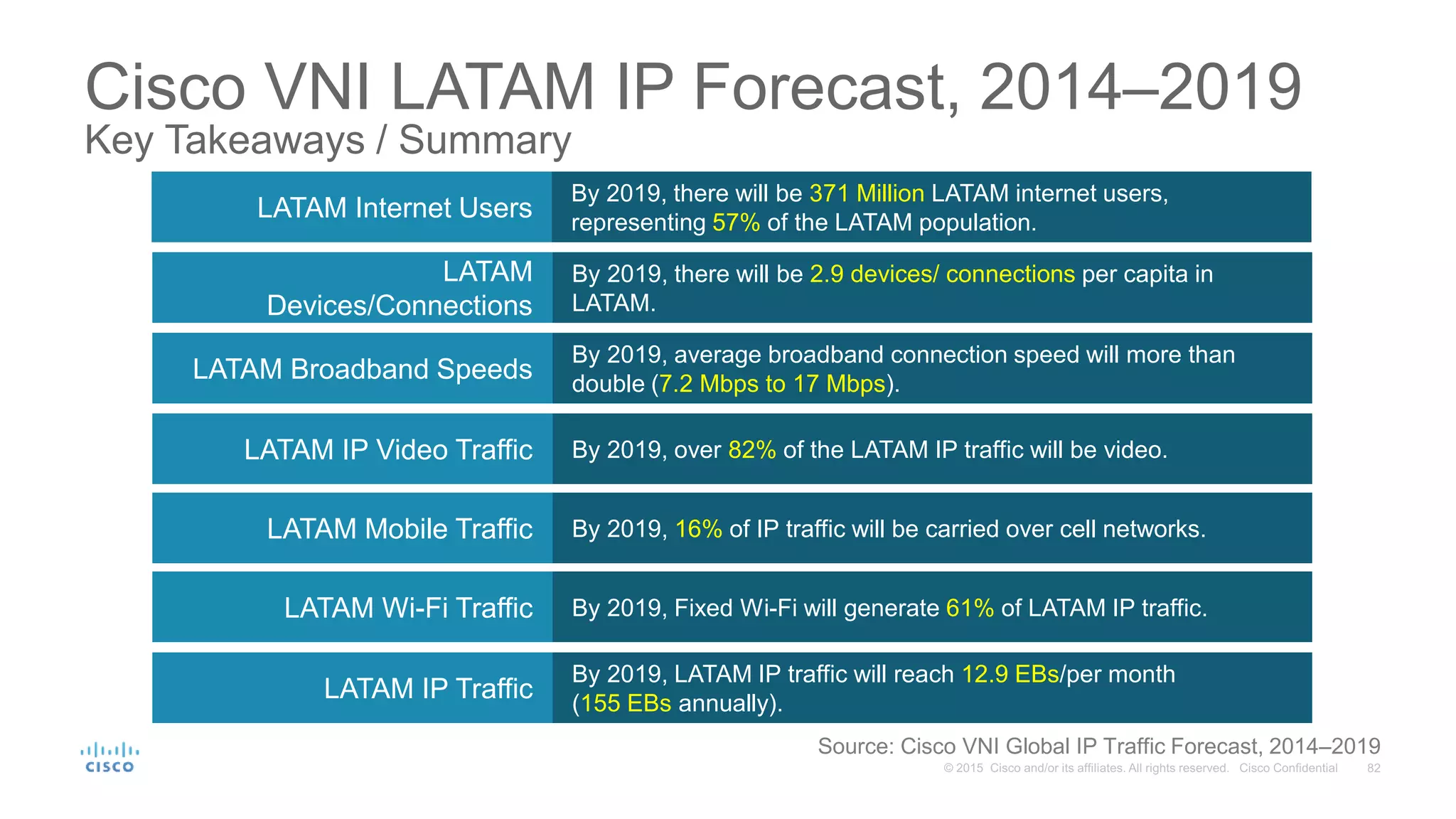
Key Takeaways / Summary
LATAM IP Traffic
By 2019, LATAM IP traffic will reach 12.9 EBs/per month
(155 EBs annually).
LATAM Mobile Traffic By 2019, 16% of IP traffic will be carried over cell networks.
LATAM Wi-Fi Traffic By 2019, Fixed Wi-Fi will generate 61% of LATAM IP traffic.
LATAM IP Video Traffic By 2019, over 82% of the LATAM IP traffic will be video.
LATAM Broadband Speeds
By 2019, average broadband connection speed will more than
double (7.2 Mbps to 17 Mbps).
LATAM
Devices/Connections
By 2019, there will be 2.9 devices/ connections per capita in
LATAM.
LATAM Internet Users
By 2019, there will be 371 Million LATAM internet users,
representing 57% of the LATAM population.
Source: Cisco VNI Global IP Traffic Forecast, 2014–2019
Cisco VNI ARG IP Forecast, 2014–2019
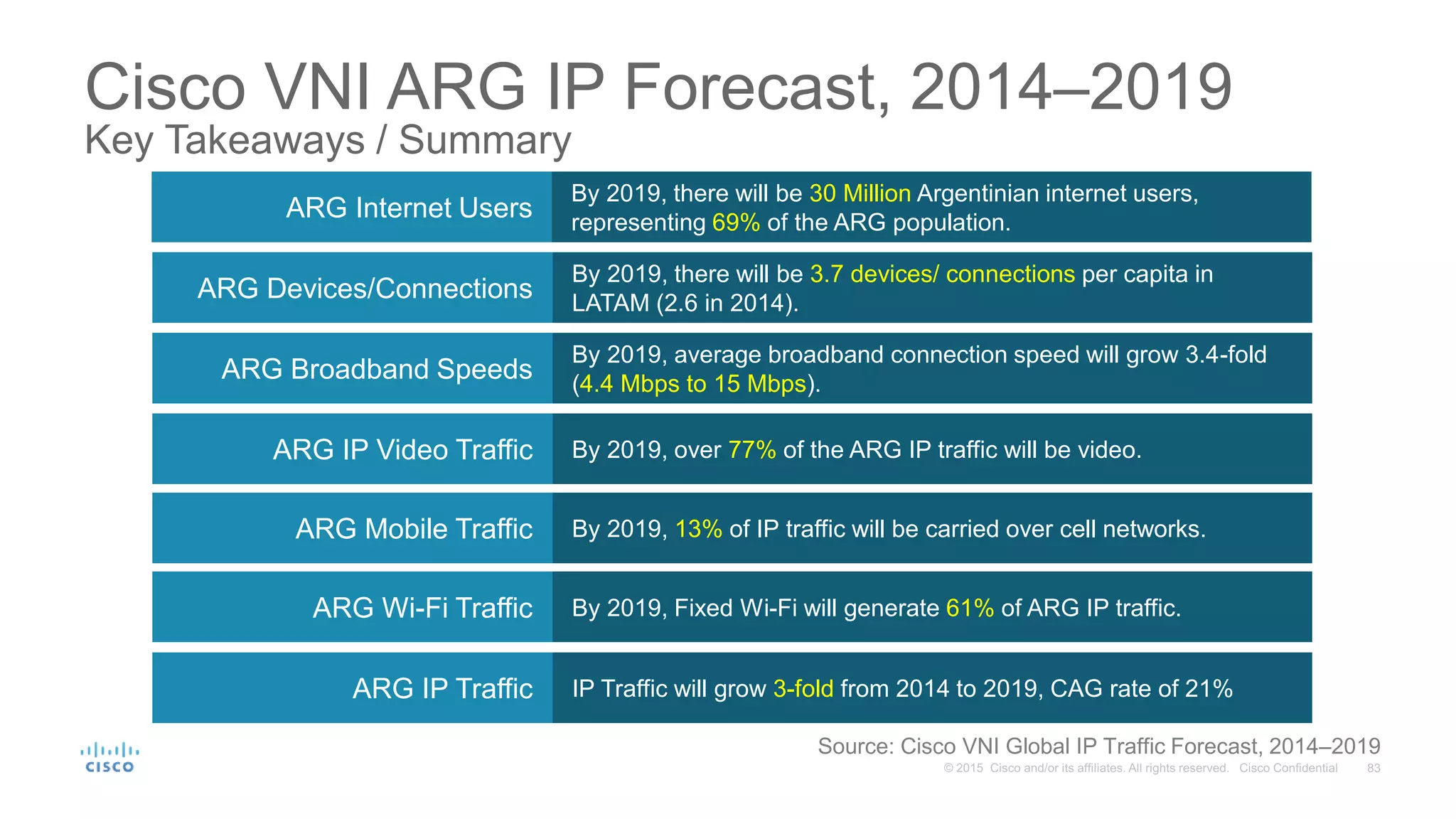
Key Takeaways / Summary
ARG IP Traffic IP Traffic will grow 3-fold from 2014 to 2019, CAG rate of 21%
ARG Mobile Traffic By 2019, 13% of IP traffic will be carried over cell networks.
ARG Wi-Fi Traffic By 2019, Fixed Wi-Fi will generate 61% of ARG IP traffic.
ARG IP Video Traffic By 2019, over 77% of the ARG IP traffic will be video.
ARG Broadband Speeds
By 2019, average broadband connection speed will grow 3.4-fold
(4.4 Mbps to 15 Mbps).
ARG Devices/Connections
By 2019, there will be 3.7 devices/ connections per capita in
LATAM (2.6 in 2014).
ARG Internet Users
By 2019, there will be 30 Million Argentinian internet users,
representing 69% of the ARG population.
Source: Cisco VNI Global IP Traffic Forecast, 2014–2019
Cisco VNI Web Sites
• Press Release
• White Papers / FAQs
• Cisco VNI Web-based Tools / Free Apps
IP Traffic Forecast inquiries: traffic-inquiries@cisco.com
Service Adoption Forecast inquiries: traffic-inquiries@cisco.com
IP Traffic Forecast: http://www.cisco.com/go/vni
Service Adoption Forecast: http://www.cisco.com/go/vnisa
Cisco Visual Networking Index and VNI Service Adoption 2014–2019 - Argentina

Cisco Visual Networking Index and VNI Service Adoption 2014–2019 - Argentina

  • 1.
    May 2015 Cisco VisualNetworking Index and VNI Service Adoption 2014–2019 Gonzalo Valverde Director Service Providers & Enterprise Argentina, Uruguay y Paraguay.
  • 2.
    Cisco Visual NetworkingIndex (VNI) Global Service Adoption & IP Traffic Growth Cisco VNI Forecasts are complementary and statistically aligned. VNI Service Adoption Forecast Fixed & Mobile IP Traffic Forecast FIXED MOBILE RESIDENTIAL MOBILE BUSINESS
  • 3.
    Global IP Traffic& Service Adoption Drivers More Devices & Connections More Internet Users Faster Broadband Speeds More Video Viewing Source: Cisco VNI Global IP Traffic Forecast, 2014–2019 By 2019: 2014 2019 14.2 Billion 24.4 Billion 2014 2019 20.3 Mbps 42.5 Mbps 2014 2019 2.8 Billion 3.9 Billion 2014 2019 67% of Traffic 80% of Traffic IP Broadband Growth Drivers
  • 4.
    LATAM IP Traffic& Service Adoption Drivers More Devices & Connections More Internet Users Faster Broadband Speeds More Video Viewing Source: Cisco VNI Global IP Traffic Forecast, 2014–2019 By 2019: 2014 2019 1.2 Billion 1.9 Billion 2014 2019 7.2 Mbps 17 Mbps 2014 2019 260 Million 371 Million 2014 2019 61% of Traffic 82% of Traffic IP Broadband Growth Drivers
  • 5.
  • 6.
    34.2% 0% 5% 10% 15% 20% 25% 30% 35% 40% 2009-2014 CAGR Projected in2010 Actual 35.6% Source: Cisco VNI Global IP Traffic Forecast, 2014–2019 VNI Projections and Actuals (Global) Actual Growth Has Been Within 10% of Projected Growth Compound Annual Growth Rate (CAGR)
  • 7.
    Global IP TrafficGrowth / Top-Line Global IP Traffic will Increase 3-Fold from 2014─2019 23% CAGR 2014–2019 59.9 72.4 88.4 109.0 135.5 168.0 0 20 40 60 80 100 120 140 160 180 2014 2015 2016 2017 2018 2019 Exabytes per Month Source: Cisco VNI Global IP Traffic Forecast, 2014–2019
  • 8.
    0 2 4 6 8 10 12 14 2014 2015 20162017 2018 2019 Chile (23% CAGR) Argentina (21% CAGR) Mexico (29% CAGR) Rest of LATAM (31% CAGR) Brazil (19% CAGR) LATAM IP Traffic Growth / Regions Rest of LATAM has the Highest Growth Rate (31%) from 2014–2019 Exabytes per Month Source: Cisco VNI Global IP Traffic Forecast, 2014–2019 25% CAGR 2014–2019 27% 34% 24% 9% 6%
  • 9.
    0 20 40 60 80 100 120 140 160 180 2014 2015 20162017 2018 2019 Middle East and Africa (MEA) (44% CAGR) Latin America (LATAM) (25% CAGR) Central and Eastern Europe (CEE) (33% CAGR) Western Europe (WE) (21% CAGR) North America (NA) (20% CAGR) Asia Pacific (APAC) (21% CAGR) Global IP Traffic Growth / Regions MEA has the Highest Growth Rate (44%) from 2014–2019 APAC will Generate 32% of all IP Traffic by 2019 29.6% 32.4% 10.0% 5.6% 14.7% Exabytes per Month 7.7% Source: Cisco VNI Global IP Traffic Forecast, 2014–2019 23% CAGR 2014–2019
  • 10.
  • 11.
    Global Internet Users From2.8 Billion in 2014 to 3.9 Billion by 2019 at 6.9% CAGR North America Western Europe Central/Eastern Europe Latin America Middle East & Africa Asia Pacific 319 Million by 2019 CAGR 1.0% 350 Million by 2019 CAGR 0.9% 336 Million by 2019 CAGR 5.3% 371 Million by 2019 CAGR 7.4% 425 Million by 2019 CAGR 10.3% 2.1 Billion by 2019 CAGR 8.7% Source: Cisco VNI Global IP Traffic Forecast, 2014–2019
  • 12.
    Global Device andConnections From 14.2 Billion in 2014 to 24.4 Billion by 2019 at 12% CAGR North America Western Europe Central/Eastern Europe Latin America Middle East & Africa Asia Pacific 4.3 Billion by 2019 CAGR 14% 3.5 Billion by 2019 CAGR 13% 2.1 Billion by 2019 CAGR 12% 1.9 Billion by 2019 CAGR 9% 2.1 Billion by 2019 CAGR 9% 10.5 Billion by 2019 CAGR 11% Source: Cisco VNI Global IP Traffic Forecast, 2014–2019
  • 13.
    Global Fixed BroadbandSpeed Growth Average Broadband Speed Will More Than Double from 20.3 Mbps (2014) to 42.5 Mbps (2019) North America Western Europe Central/Eastern Europe Latin America Middle East & Africa Asia Pacific 2.0-fold Growth 21.8 to 43.7 Mbps 2.3-fold Growth 21.8 to 49.1 Mbps 2.0-fold Growth 22.2 to 45.3 Mbps 2.3-fold Growth 7.2 to 16.9 Mbps 2.4-fold Growth 6.1 to 14.9 Mbps 2.1-fold Growth 23.2 to 48.9 Mbps Source: Cisco VNI Global IP Traffic Forecast, 2014–2019
  • 14.
    Global IP Traffic– Increasing Video Viewing By 2019, Video Will Drive 80% of IP Traffic, Up from 67% in 2014 North America Western Europe Central/Eastern Europe Latin America Middle East & Africa Asia Pacific 84% of traffic by 2019 22% CAGR 80% of traffic by 2019 28% CAGR 72% of traffic by 2019 45% CAGR 82% of traffic by 2019 32% CAGR 78% of traffic by 2019 55% CAGR 79% of traffic by 2019 26% CAGR Source: Cisco VNI Global IP Traffic Forecast, 2014–2019
  • 15.
  • 16.
    VNI Forecast Update,2014–2019 Top 10 Networking Trends 1 Continued Shifts in Devices/Connections Mix 2 IPv6 Adoption Enables Internet of Everything (IoE) Connectivity 3 4 Service Adoption Trends – Residential, Consumer Mobile, Business 5 Applications Driving Traffic Growth 6 “Cord-Cutting” Analysis – What’s Really Happening? 7 Impact of Accelerating Speeds on Traffic Growth 8 Mobility (Wi-Fi) Continues to Gain Momentum 9 Traffic Pattern Analysis (Peak vs. Average, Upstream, CDN vs. Metro) 10 Network Performance Drives User Behaviors/Data Plans and Caps M2M Applications Across Many Industry Verticals Drives IoE Growth
  • 17.
    Global Device/Connection Growthby Type By 2019, M2M Connections Will be More Than 40% of Total Connections 0 5 10 15 20 25 30 2014 2015 2016 2017 2018 2019 Other (4.9%,3.6%) Tablets (3%,4%) PCs (11%,6%) TVs (11%,12%) Non-Smartphones (32%,13%) Smartphones (15%,19%) M2M (24%,43%) Billions of Devices * Figures (n) refer to 2014, 2019 device share Source: Cisco VNI Global IP Traffic Forecast, 2014–2019 12% CAGR 2014–2019
  • 18.
    LATAM Device/Connection Growthby Type By 2019, M2M Connections Will be More Than 30% of Total Connections 0.0 0.5 1.0 1.5 2.0 2.5 2014 2015 2016 2017 2018 2019 Other (3.3%,4.1%) Tablets (3%,5%) PCs (13%,8%) TVs (6%,14%) Non-Smartphones (40%,14%) Smartphones (17%,24%) M2M (18%,31%) Billions of Devices * Figures (n) refer to 2014, 2019 device share Source: Cisco VNI Global IP Traffic Forecast, 2014–2019 9% CAGR 2014–2019
  • 19.
    SD 2 Mbps HD7.2 Mbps UHD 18 Mbps 10 33 77 146 245 371 0 50 100 150 200 250 300 350 400 2014 2015 2016 2017 2018 2019 Connected 4K TV Sets (M) Source: Cisco VNI Global IP Traffic Forecast, 2014–2019 Increasing Video Definition By 2019, More than 31% of Connected Flat Panel TV Sets will be 4K
  • 20.
    Global Average IPTraffic Per Device 2014 2019 Wearable Device Smartphone Tablet MBs per Month MBs per Month 1,640 8,419 6,213 14,800 6,258 34,880 23,824 36,311 22,415 50,177 M2M Module Internet Set-Top or Dongle Smartphone Tablet Laptop / PC 92 433 Ultra High Definition TV* Source: Cisco VNI Global IP Traffic Forecast, 2014–2019 *Note: Includes IP VoD traffic
  • 21.
    LATAM Average IPTraffic Per Device 2014 2019 Wearable Device Smartphone Tablet MBs per Month MBs per Month 942 5,312 4,717 11,271 6,608 32,113 21,577 34,056 9,979 11,778 M2M Module Internet Set-Top or Dongle Smartphone Tablet Laptop / PC 49 409 Ultra High Definition TV* Source: Cisco VNI Global IP Traffic Forecast, 2014–2019 *Note: Includes IP VoD traffic
  • 22.
    Device IP TrafficComparison 2014 Device IP Traffic Generation Comparisons Source: Cisco VNI Global IP Traffic Forecast, 2014–2019 Wearable Device Smartphone Tablet M2M Module Internet Set-Top or Dongle Smartphone Tablet Laptop / PC Ultra High Definition TV* Monthly basic mobile phone data traffic 1077 X= 283 X= 281 X= 74 X= 4 X= 1013 X=
  • 23.
    Global IP Trafficby Device Type By 2019, Non-PC Devices will Drive 67% of Global IP Traffic 0 20 40 60 80 100 120 140 160 180 2014 2015 2016 2017 2018 2019 Other (0.1%,0.1%) Non-Smartphones (0%,0%) M2M (1%,3%) Tablets (4%,19%) TVs (29%,22%) Smartphones (6%,23%) PCs (60%,33%) Source: Cisco VNI Global IP Traffic Forecast, 2014–2019 23% CAGR 2014–2019 Exabytes per Month * Figures (n) refer to 2014, 2019 device share
  • 24.
    LATAM IP Trafficby Device Type By 2019, Non-PC Devices will Drive 59% of LATAM IP Traffic 0 2 4 6 8 10 12 14 2014 2015 2016 2017 2018 2019 Other (0.05%,0.1%) Non-Smartphones (0.08%,0.08%) M2M (0.3%,2%) Tablets (5%,24%) TVs (7%,14%) Smartphones (4%,19%) PCs (83%,41%) Source: Cisco VNI Global IP Traffic Forecast, 2014–2019 25% CAGR 2014–2019 Exabytes per Month * Figures (n) refer to 2014, 2019 device share
  • 25.
    Global Internet Trafficby Device Type By 2019, Non-PC Devices will Drive 64% of Global Internet Traffic 0 20 40 60 80 100 120 140 160 2014 2015 2016 2017 2018 2019 Other (0.1%,0.1%) Non-Smartphones (0%,0%) M2M (1%,3%) TVs (7%,8%) Tablets (6%,24%) Smartphones (8%,28%) PCs (78%,36%) Source: Cisco VNI Global IP Traffic Forecast, 2014–2019 26% CAGR 2014–2019 * Figures (n) refer to 2014, 2019 device share Exabytes per Month
  • 26.
    VNI Forecast Update,2014–2019 Top 10 Networking Trends 1 Continued Shifts in Devices/Connections Mix 2 IPv6 Adoption Enables Internet of Everything (IoE) Connectivity 3 4 Service Adoption Trends – Residential , Consumer Mobile, Business 5 Applications Driving Traffic Growth 6 “Cord-Cutting” Analysis – What’s Really Happening? 7 Impact of Accelerating Speeds on Traffic Growth 8 Mobility (Wi-Fi) Continues to Gain Momentum 9 Traffic Pattern Analysis (Peak vs. Average, Upstream, CDN vs. Metro) 10 Network Performance Drives User Behaviors/Data Plans and Caps M2M Applications Across Many Industry Verticals Drives IoE Growth
  • 27.
    Global IPv6 EnabledContent US 46% Australia 49% Brazil 57% UK 46% Spain 49% Today Projected in 2019 25% 6.6% Source: Cisco IPv6 Labs
  • 28.
    VNI Forecast Update,2014–2019 Top 10 Networking Trends 1 Continued Shifts in Devices/Connections Mix 2 IPv6 Adoption Enables Internet of Everything (IoE) Connectivity 3 4 Service Adoption Trends – Residential , Consumer Mobile, Business 5 Applications Driving Traffic Growth 6 “Cord-Cutting” Analysis – What’s Really Happening? 7 Impact of Accelerating Speeds on Traffic Growth 8 Mobility (Wi-Fi) Continues to Gain Momentum 9 Traffic Pattern Analysis (Peak vs. Average, Upstream, CDN vs. Metro) 10 Network Performance Drives User Behaviors/Data Plans and Caps M2M Applications Across Many Industry Verticals Drives IoE Growth
  • 29.
    Global M2M Connections/ IoE Growth By 2019, 1.5 M2M Connections Per Capita Globally 0 2 4 6 8 10 12 2014 2015 2016 2017 2018 2019 Middle East & Africa (26.2% CAGR) Latin America (21.5% CAGR) Central & Eastern Europe (28.2% CAGR) Western Europe (25.8% CAGR) North America (28.6% CAGR) Asia Pacific (24.4% CAGR) Source: Cisco VNI Global IP Traffic Forecast, 2014–2019 26% CAGR 2014–2019 Billions of M2M Connections
  • 30.
    Source: Cisco VNIGlobal IP Traffic Forecast, 2014–2019 By 2019, M2M modules will be 43% of total global devices and connections and will account for 3% (4.6 EBs/month) of total global IP traffic.
  • 31.
    Global M2M TrafficGrowth M2M Traffic Will Grow 15-Fold from 2014 to 2019 0 500 1,000 1,500 2,000 2,500 3,000 3,500 4,000 4,500 5,000 2014 2015 2016 2017 2018 2019 Middle East & Africa (94.4% CAGR) Latin America (85.8% CAGR) Central & Eastern Europe (86.4% CAGR) Western Europe (76.3% CAGR) North America (82.2% CAGR) Asia Pacific (61.2% CAGR) Source: Cisco VNI Global IP Traffic Forecast, 2014–2019 71% CAGR 2014–2019 Petabytes per Month
  • 32.
    Source: Cisco VNIGlobal IP Traffic Forecast, 2014–2019 In LATAM, by 2019, M2M modules will be 31% of total devices and connections and will account for 1.9% (0.2 EBs/month) of total IP traffic.
  • 33.
    Global M2M Connections/ IoE Growth By Vertical By 2019, Connected Home Largest, Connected Health Fastest Growth - 2 4 6 8 10 12 2014 2015 2016 2017 2018 2019 Other* (38.2% CAGR) Energy (31.9% CAGR) Manufacturing & Supply Chain (8.9% CAGR) Retail (10.5% CAGR) Connected Cities (28.2% CAGR) Connected Health (49.4% CAGR) Connected Car (37.3% CAGR) Utilities (21% CAGR) Connected Work (Ent Mgmnt) (29.4% CAGR) Connected Home (23.1% CAGR) Source: Cisco VNI Global IP Traffic Forecast, 2014–2019 26% CAGR 2014–2019 Billions of M2M Connections *Other includes Agriculture, Construction & Emergency Services
  • 34.
    VNI Forecast Update,2014–2019 Top 10 Networking Trends 1 Continued Shifts in Devices/Connections Mix 2 IPv6 Adoption Enables Internet of Everything (IoE) Connectivity 3 4 Service Adoption Trends – Residential, Consumer Mobile, Business 5 Applications Driving Traffic Growth 6 “Cord-Cutting” Analysis – What’s Really Happening? 7 Impact of Accelerating Speeds on Traffic Growth 8 Mobility (Wi-Fi) Continues to Gain Momentum 9 Traffic Pattern Analysis (Peak vs. Average, Upstream, CDN vs. Metro) 10 Network Performance Drives User Behaviors/Data Plans and Caps M2M Applications Across Many Industry Verticals Drives IoE Growth
  • 35.
    Global Residential Market,by 2019: 62% (2.4 billion) of Internet users will have fixed residential internet access. 79% (1.4 billion) TV households will be digital TV households. There will be 9.4 billion fixed residential devices and connections (up from 4.9 billion in 2014). Average household will have 4.3 fixed devices and connections (up from 2.4 in 2014). Source: Cisco VNI Global IP Traffic Forecast, 2014–2019
  • 36.
    Note: By 2019,the global residential fixed Internet population will be 2.4 billion; the number of global TV households will be 1.8 billion Global Residential Services By 2019, Time Delayed TV Will Grow the Fastest; Digital TV Will Have Highest Adoption CAGR 2014–2019 Online Music Social Networking Online Video Online Gaming VoIP Digital TV Video on Demand Time Delayed TV 0% 2% 4% 6% 8% 10% 0% 20% 40% 60% 80% 100% 2019 % Adoption Source: Cisco VNI Service Adoption Forecast, 2014–2019
  • 37.
    Residential Services Implications /Opportunities Residential Market Dynamics Residential Opportunities for Service Providers • More / new connections • Preference for mobility • Need to monetize increased network demand • Extend content / service reach across new devices and connections • Partner and form new eco- systems with OTTPs • Develop Wi-Fi / mobility plans • Bolster service portfolio with value-added IoE / M2M applications
  • 38.
    Source: Cisco VNIGlobal IP Traffic Forecast, 2014–2019 Global Consumer Mobile Market, by 2019: There will be 4.9 billion consumer mobile users (64% of population). There will be 9.8 billion consumer mobile devices and connections. Average consumer mobile user will have 2.0 mobile devices and connections (up from 1.5 in 2014).
  • 39.
    Note: By 2019,the global consumer mobile population will be 4.9 billion. Global Consumer Mobile Services By 2019, Consumer LBS Will Grow the Fastest; Mobile Banking & Commerce Will Have Highest Adoption CAGR 2014–2019 Source: Cisco VNI Service Adoption Forecast, 2014–2019 MMS Mobile Social NetworkingMobile Email Consumer LBS Mobile Gaming Mobile Banking & Commerce Mobile Video Mobile Music -5% 5% 15% 25% 35% 20% 30% 40% 50% 60% 70% 80% 2019 % Adoption
  • 40.
    Consumer Mobile Implications /Opportunities Consumer Mobile Market Dynamics Consumer Mobile Opportunities for Service Providers • More / new devices and connections • Demand for seamless transition / experience between fixed and mobile • Demand for Wi-Fi offload and faster speeds • Need to monetize increased network demand • Extend reach of traditional / brick and mortar services • Shared data plans • Blend service offers with online services / content • Developing / monetizing Wi-Fi offers • Partner with device manufacturers / content creators (consider busy /peak demands)
  • 41.
    Source: Cisco VNIGlobal IP Traffic Forecast, 2014–2019 Global Business Market, by 2019: There will be 2.2 billion business Internet users (63% of global work force). There will be 582 million business mobile users (17% of global work force). There will be 5.3 billion business devices and connections (up from 2.8 billion in 2014). Average business internet user will have 2.4 devices and connections There will be 1.7 billion business mobile device and connections (up from 943 million in 2014). Average business mobile user will have 2.9 mobile devices and connections
  • 42.
    VNI Forecast Update,2014–2019 Top 10 Networking Trends 1 Continued Shifts in Devices/Connections Mix 2 IPv6 Adoption Enables Internet of Everything (IoE) Connectivity 3 4 Service Adoption Trends – Residential, Consumer Mobile, Business 5 Applications Driving Traffic Growth 6 “Cord-Cutting” Analysis – What’s Really Happening? 7 Impact of Accelerating Speeds on Traffic Growth 8 Mobility (Wi-Fi) Continues to Gain Momentum 9 Traffic Pattern Analysis (Peak vs. Average, Upstream, CDN vs. Metro) 10 Network Performance Drives User Behaviors/Data Plans and Caps M2M Applications Across Many Industry Verticals Drives IoE Growth
  • 43.
    0 20 40 60 80 100 120 140 160 180 2014 2015 20162017 2018 2019 Gaming (0.05% , 0.08% ) File Sharing (11.6% , 4.3% ) Web/Data (21.3% , 15.5% ) IP VoD (23.6% , 16.0% ) Internet Video (43.4% , 64.1% ) Global IP Video Traffic Growth IP Video Will Account for 80% of Global IP Traffic by 2019 Source: Cisco VNI Global IP Traffic Forecast, 2014–2019 23% CAGR 2014–2019 Exabytes per Month * Figures (n) refer to 2014, 2019 traffic shares
  • 44.
    0 2 4 6 8 10 12 14 2014 2015 20162017 2018 2019 Gaming (0.03% , 0.05% ) File Sharing (16.0% , 5.2% ) Web/Data (23.2% , 13.2% ) IP VoD (6.0% , 10.3% ) Internet Video (54.8% , 71.2% ) LATAM IP Video Traffic Growth IP Video Will Account for 82% of LATAM IP Traffic by 2019 Source: Cisco VNI Global IP Traffic Forecast, 2014–2019 25% CAGR 2014–2019 Exabytes per Month * Figures (n) refer to 2014, 2019 traffic shares
  • 45.
    Global Video Users/Subscribers Online & Mobile Video Growing Faster Than Digital TV 1,000 1,500 2,000 2,500 3,000 2014 2015 2016 2017 2018 2019 Online Video ( 7.3% CAGR) Digital TV HH ( 4.9% CAGR) Mobile Video ( 21.0% CAGR) Users/ Subscriptions (M)
  • 46.
    0 20 40 60 80 100 120 140 160 2014 2015 20162017 2018 2019 Gaming (0.07% , 0.10% ) File Sharing (16.3% , 5.3% ) Web/Data (24.7% , 17.5% ) Internet Video (58.9% , 77.1% ) Global Internet Video Traffic Growth Internet Video Will Account for 77 Percent of Global Internet Traffic by 2019 Source: Cisco VNI Global IP Traffic Forecast, 2014–2019 * Figures (n) refer to 2014, 2019 traffic shares Exabytes per Month 26% CAGR 2014–2019
  • 47.
    0 2 4 6 8 10 12 2014 2015 20162017 2018 2019 Gaming (0.03% , 0.06% ) File Sharing (17.9% , 6.0% ) Web/Data (22.5% , 14.1% ) Internet Video (59.6% , 79.9% ) LATAM Internet Video Traffic Growth Internet Video Will Account for 80 Percent of LATAM Internet Traffic by 2019 Source: Cisco VNI Global IP Traffic Forecast, 2014–2019 * Figures (n) refer to 2014, 2019 traffic shares Exabytes per Month 24% CAGR 2014–2019
  • 48.
    0 20 40 60 80 100 120 140 160 2014 2015 20162017 2018 2019 Ultra-High Def (UHD) Video (0.6% , 13.9% ) High Def (HD) Video (38.6% , 53.5% ) Standard Def (SD) Video (60.8% , 32.6% ) Higher Definition Content Impacts Global IP Video Growth Ultra-HD IP Video Will Account for 14% of Global IP Video Traffic by 2019 Source: Cisco VNI Global IP Traffic Forecast, 2014–2019 27% CAGR 2014–2019 Exabytes per Month * Figures (n) refer to 2014, 2019 traffic shares
  • 49.
    0 2 4 6 8 10 12 2014 2015 20162017 2018 2019 Ultra-High Def (UHD) Video (0.1% , 4.1% ) High Def (HD) Video (15.8% , 38.6% ) Standard Def (SD) Video (84.2% , 57.3% ) Higher Definition Content Impacts LATAM IP Video Growth Ultra-HD IP Video Will Account for 4% of LATAM IP Video Traffic by 2019 Source: Cisco VNI Global IP Traffic Forecast, 2014–2019 32% CAGR 2014–2019 Exabytes per Month * Figures (n) refer to 2014, 2019 traffic shares
  • 50.
    0 5 10 15 20 25 30 2014 2015 20162017 2018 2019 Ultra-High Def (UHD) Video (0.2% , 21.0% ) High Def (HD) Video (55.8% , 69.9% ) Standard Def (SD) Video (44.0% , 9.1% ) Higher Definition Content Impacts Global IP VoD Growth Ultra-HD IP VoD Will Account for 21% of Global IP VoD Traffic by 2019 Source: Cisco VNI Global IP Traffic Forecast, 2014–2019 14% CAGR 2014–2019 Exabytes per Month * Figures (n) refer to 2014, 2019 traffic shares
  • 51.
    VNI Forecast Update,2014–2019 Top 10 Networking Trends 1 Continued Shifts in Devices/Connections Mix 2 IPv6 Adoption Enables Internet of Everything (IoE) Connectivity 3 4 Service Adoption Trends – Residential, Consumer Mobile, Business 5 Applications Driving Traffic Growth 6 “Cord-Cutting” Analysis – What’s Really Happening? 7 Impact of Accelerating Speeds on Traffic Growth 8 Mobility (Wi-Fi) Continues to Gain Momentum 9 Traffic Pattern Analysis (Peak vs. Average, Upstream, CDN vs. Metro) 10 Network Performance Drives User Behaviors/Data Plans and Caps M2M Applications Across Many Industry Verticals Drives IoE Growth
  • 52.
    Global Video Users/Subscribers Online & Mobile Video Growing Faster Than Digital TV - 1,000 2,000 3,000 2014 2015 2016 2017 2018 2019 Online Video ( 7.3% CAGR) Digital TV HH ( 4.9% CAGR) Mobile Video ( 21.0% CAGR) Users/ Subscriptions (M) Source: Cisco VNI Global IP Traffic Forecast, 2014–2019
  • 53.
    Global Internet andTV Users/ Subscribers Global Residential Internet Growing; TV Household Penetration Flattening 1,000 2,000 3,000 4,000 2014 2015 2016 2017 2018 2019 Residential Internet* ( 6.8% CAGR) Total TV HH ( 1.8% CAGR) Users/ Subscriptions (M) Source: Cisco VNI Global IP Traffic Forecast, 2014–2019 * Residential Internet users include fixed and mobile Internet users
  • 54.
    VNI Forecast Update,2014–2019 Top 10 Networking Trends 1 Continued Shifts in Devices/Connections Mix 2 IPv6 Adoption Enables Internet of Everything (IoE) Connectivity 3 4 Service Adoption Trends – Residential, Consumer Mobile, Business 5 Applications Driving Traffic Growth 6 “Cord-Cutting” Analysis – What’s Really Happening? 7 Impact of Accelerating Speeds on Traffic Growth 8 Mobility (Wi-Fi) Continues to Gain Momentum 9 Traffic Pattern Analysis (Peak vs. Average, Upstream, CDN vs. Metro) 10 Network Performance Drives User Behaviors/Data Plans and Caps M2M Applications Across Many Industry Verticals Drives IoE Growth
  • 55.
    Global Average FixedBroadband Speeds Doubling in Speeds From 2014-2019 2014 2019 Global Mbps BY REGION North America Western Europe Asia-Pacific Central & Eastern Europe Middle East & Africa 20.3 21.8 21.8 7.2 23.2 22.2 6.1 42.5 43.7 49.1 16.9 48.9 45.3 14.9 Latin America GLOBAL Source: Cisco VNI Global IP Traffic Forecast, 2014–2019
  • 56.
    LATAM Average FixedBroadband Speeds Doubling in Speeds From 2014-2019 2014 2019 Latin America Mbps BY COUNTRY Argentina Brazil 7.2 4.4 8.3 16.9 14.9 18.6 REGION Source: Cisco VNI Global IP Traffic Forecast, 2014–2019 Chile 13.4 27.8 Mexico 7.3 19.1
  • 57.
    Global Average Wi-FiSpeeds Wi-Fi Exceeds Average Mobile (Cell) Speeds During 2014-2019 2014 2019 Global Mbps BY REGION North America Western Europe Asia-Pacific Central & Eastern Europe Middle East & Africa 10.6 14.3 13.0 5.8 10.3 11.7 3.9 18.5 29.0 20.9 8.6 15.6 22.0 4.7 Latin America GLOBAL Source: Cisco VNI Global IP Traffic Forecast, 2014–2019
  • 58.
    Mobile Network SpeedsIncrease 2.4X by 2019 Average Cell Connection Speed (1.7 Mbps in 2014) Will Grow at a 19% CAGR—Reaching Nearly 4.0 Mbps by 2019 2014 2019 Global Mbps BY REGION North America Western Europe Asia-Pacific Central & Eastern Europe Middle East & Africa 1.7 2.8 2.0 1.4 2.0 1.6 0.6 3.9 6.4 4.7 2.9 3.5 3.7 2.1 Latin America GLOBAL Source: Cisco VNI Global IP Traffic Forecast, 2014–2019
  • 59.
    VNI Forecast Update,2014–2019 Top 10 Networking Trends 1 Continued Shifts in Devices/Connections Mix 2 IPv6 Adoption Enables Internet of Everything (IoE) Connectivity 3 4 Service Adoption Trends – Residential, Consumer Mobile, Business 5 Applications Driving Traffic Growth 6 “Cord-Cutting” Analysis – What’s Really Happening? 7 Impact of Accelerating Speeds on Traffic Growth 8 Mobility (Wi-Fi) Continues to Gain Momentum 9 Traffic Pattern Analysis (Peak vs. Average, Upstream, CDN vs. Metro) 10 Network Performance Drives User Behaviors/Data Plans and Caps M2M Applications Across Many Industry Verticals Drives IoE Growth
  • 60.
    Surge of Hotspots Globally,there will be 341 million hotspots by 2018 • By 2018, the US leads in total number of hotspots, followed by China and France • Europe is the “continent of Wi-Fi” with 50% of the world’s Wi-Fi estate in 2014. By 2018, Asia will lead. • Today, China has 5 times more commercial Wi-Fi hotspots than any other country • Community Wi-Fi has been driven by Europe and then North America, but Asia will catch up in 2018 Source: Maravedis Rethink and iPass Inc.
  • 61.
    Future of Wi-Fias Wired Complement 1997 1998 1999 2000 2001 2002 2003 2004 2005 2006 2007 2008 2009 2010 2011 2012 802.11 2 Mbps Max Applications Enabled Basic internet 802.11b 11 Mbps Max Applications Enabled Email 802.11b 11 Mbps Max Applications Enabled Rich Media Web 802.11ac 3.6 Gbps Max Applications Enabled High Resolution Video Wired Complement 802.11n 600 Mbps Max Applications Enabled Medium Resolution Video Number of 802.11ac Home CPE to Increase 20-fold from 2014 to 2019
  • 62.
    0 20 40 60 80 100 120 140 160 180 2014 2015 20162017 2018 2019 Mobile Data (57.3% CAGR) Fixed/Wired (11.4% CAGR) Fixed/Wi-Fi from Mobile Devices (67.5% CAGR) Fixed/Wi-Fi from Wi-Fi Only Devices (21.1% CAGR) 17% Global IP Traffic by Local Access Technology By 2019, Two-Thirds of Total IP Traffic Will Be Wireless* 33% 36% 14% Source: Cisco VNI Global IP Traffic Forecast, 2014–2019 23% CAGR 2014–2019 Exabytes per Month * Wireless traffic includes Wi-Fi and mobile
  • 63.
    0 2 4 6 8 10 12 14 2014 2015 20162017 2018 2019 Mobile Data (58.9% CAGR) Fixed/Wired (12.9% CAGR) Fixed/Wi-Fi from Mobile Devices (74.5% CAGR) Fixed/Wi-Fi from Wi-Fi Only Devices (20.8% CAGR) 14% LATAM IP Traffic by Local Access Technology By 2019, 77% of Total LATAM IP Traffic Will Be Wireless* 23% 47% 16% Source: Cisco VNI Global IP Traffic Forecast, 2014–2019 25% CAGR 2014–2019 Exabytes per Month * Wireless traffic includes Wi-Fi and mobile
  • 64.
    0 20 40 60 80 100 120 140 160 2014 2015 20162017 2018 2019 Mobile Data (57.3% CAGR) Fixed/Wired (9.9% CAGR) Fixed/Wi-Fi from Mobile Devices (67.5% CAGR) Fixed/Wi-Fi from Wi-Fi Only Devices (21.7% CAGR) Global Internet Traffic by Local Access Technology Wireless Traffic Dominates Internet Traffic 19% 42% 18% 21% Source: Cisco VNI Global IP Traffic Forecast, 2014–2019 Exabytes per Month 26% CAGR 2014–2019
  • 65.
    VNI Forecast Update,2014–2019 Top 10 Networking Trends 1 Continued Shifts in Devices/Connections Mix 2 IPv6 Adoption Enables Internet of Everything (IoE) Connectivity 3 4 Service Adoption Trends – Residential, Consumer Mobile, Business 5 Applications Driving Traffic Growth 6 “Cord-Cutting” Analysis – What’s Really Happening? 7 Impact of Accelerating Speeds on Traffic Growth 8 Mobility (Wi-Fi) Continues to Gain Momentum 9 Traffic Pattern Analysis (Peak vs. Average, Upstream, CDN vs. Metro) 10 Network Performance Drives User Behaviors/Data Plans and Caps M2M Applications Across Many Industry Verticals Drives IoE Growth
  • 66.
    Global Busy Hourvs. Average Hour Internet Traffic Driven by Video, Busy Hour Grows Faster than Average Hour 0 200 400 600 800 1,000 1,200 1,400 1,600 2014 2015 2016 2017 2018 2019 Average Hour Busy Hour Source: Cisco VNI Global IP Traffic Forecast, 2014–2019 Traffic Rate (Tbps)
  • 67.
    LATAM Busy Hourvs. Average Hour Internet Traffic Driven by Video, Busy Hour Grows Faster than Average Hour 0 10 20 30 40 50 60 70 80 90 100 2014 2015 2016 2017 2018 2019 Average Hour Busy Hour Source: Cisco VNI Global IP Traffic Forecast, 2014–2019 Traffic Rate (Tbps)
  • 68.
    Busy Hour vs.Average Hour Busy Hour Will Be 3.3x Higher than Average Hour by 2019 2.8 2.6 2.6 3.3 2.9 2.3 2.6 3.4 3.3 3.2 3.7 3.6 3.0 3.1 1.0 1.5 2.0 2.5 3.0 3.5 4.0 Global APAC LATAM NA WE CEE MEA A x i s T i t l e Source: Cisco VNI Global IP Traffic Forecast, 2014–2019 Ratio of Busy Hour to Average Hour Traffic
  • 69.
    VNI Forecast Update,2014–2019 Top 10 Networking Trends 1 Continued Shifts in Devices/Connections Mix 2 IPv6 Adoption Enables Internet of Everything (IoE) Connectivity 3 4 Service Adoption Trends – Residential, Consumer Mobile, Business 5 Applications Driving Traffic Growth 6 “Cord-Cutting” Analysis – What’s Really Happening? 7 Impact of Accelerating Speeds on Traffic Growth 8 Mobility (Wi-Fi) Continues to Gain Momentum 9 Traffic Pattern Analysis (Peak vs. Average, Upstream, CDN vs. Metro) 10 Network Performance Drives User Behaviors/Data Plans and Caps M2M Applications Across Many Industry Verticals Drives IoE Growth
  • 70.
    Source: Cisco VNIGlobal IP Traffic Forecast, 2014–2019 Average Global Internet Bandwidth Usage Average Traffic per User 2014 16 GB per month 2019 37 GB per month Future 75 GB per month Average Traffic per Household 2014 37 GB per month 2019 91 GB per month Future 150 GB per month
  • 71.
    Source: Cisco VNIGlobal IP Traffic Forecast, 2014–2019 Average LATAM Internet Bandwidth Usage Average Traffic per User 2014 15 GB per month 2019 34 GB per month Future 75 GB per month Average Traffic per Household 2014 44 GB per month 2019 97 GB per month Future 150 GB per month
  • 72.
    Higher Fixed SpeedsEnable Greater Video Consumption Video Behaviors are Consistent Across Multiple Countries - 500 1,000 1,500 2,000 2,500 3,000 - 10 20 30 40 50 60 Fixed Broadband Speeds (Mbps) Video Minutes per Viewer Linear (Video Minutes per Viewer) Indonesia India Argentina Italy Mexico Brazil Australia Chile Russia Canada U.K. Japan Germany China New Zealand France Spain U.S. Source: Cisco VNI Global IP Traffic Forecast, 2014–2019 Video Minutes per Viewer
  • 73.
  • 74.
    Cisco Confidential 74©2013-2014 Cisco and/or its affiliates. All rights reserved. Argentina IP Traffic  In Argentina, IP traffic will grow 3-fold from 2014 to 2019, a compound annual growth rate of 21%.  In Argentina, IP traffic will reach 1.1 Exabytes per month in 2019, up from 431 Petabytes per month in 2014.  In Argentina's IP networks will carry 37 Petabytes per day in 2019, up from 14 Petabytes per day in 2014.  In Argentina, IP traffic will reach an annual run rate of 13.4 Exabytes in 2019, up from an annual run rate of 5.2 Exabytes in 2014  In Argentina, IP traffic will reach 26 Gigabytes per capita in 2019, up from 10 Gigabytes per capita in 2014.  In 2019, the gigabyte equivalent of all movies ever made will cross Argentina's IP networks every 5 hours.
  • 75.
    Cisco Confidential 75©2013-2014 Cisco and/or its affiliates. All rights reserved. Argentina Fixed Network Speed  In Argentina, the average fixed broadband speed will grow 3.4-fold from 2014 to 2019, from 4.4 Mbps to 15 Mbps.  In Argentina, the average fixed broadband speed grew 7% from 2013 to 2014, from 4.1 Mbps to 4.4 Mbps.  In Argentina, 51% of fixed broadband connections will be faster than 5 Mbps in 2019, up from 34% today.  In Argentina, 21% of fixed broadband connections will be faster than 10 Mbps in 2019, up from 13% today.  In Argentina, 4.1% of fixed broadband connections will be faster than 25 Mbps in 2019, up from 3.0% today.  In Argentina, 2.2% of fixed broadband connections will be faster than 50 Mbps in 2019, up from .5% today.
  • 76.
    Cisco Confidential 76©2013-2014 Cisco and/or its affiliates. All rights reserved. Argentina Mobile Network Speed  In Argentina, the average mobile connection speed was 323 kbps in 2014.  In Argentina, the average mobile connection speed will grow 4-fold from 2014 to 2019, reaching 1,228 kbps in 2019.  In Argentina, the average smartphone connection speed was 2,743 kbps in 2014.  In Argentina, the average smartphone connection speed will grow 2-fold from 2014 to 2019, reaching 4,674 kbps in 2019.
  • 77.
    Cisco Confidential 77©2013-2014 Cisco and/or its affiliates. All rights reserved. Argentina VoD  In Argentina, Ultra HD will be 7.4% of IP VOD traffic in 2019, up from 0.0% in 2014 (399.0% CAGR).  In Argentina, HD will be 52.7% of IP VOD traffic in 2019, up from 14.9% in 2014 (75.1% CAGR).  In Argentina, SD will be 39.9% of IP VOD traffic in 2019, compared to 85.1% in 2014 (16.9% CAGR).
  • 78.
    Cisco Confidential 78©2013-2014 Cisco and/or its affiliates. All rights reserved. Argentina Wi Fi from Mobile Devices  In Argentina, the average Wi-Fi speeds from mobile devices will grow 1.9-fold from 2014 to 2019, from 3.7 Mbps to 7 Mbps.  In Argentina, the average Wi-Fi speeds from mobile devices grew 20% from 2013 to 2014, from 3.1 Mbps to 3.7 Mbps.
  • 79.
    Cisco Confidential 79©2013-2014 Cisco and/or its affiliates. All rights reserved. Argentina Network Conections  Argentina's Fixed/Wired IP traffic grew 17% in 2014.  Argentina's Fixed/Wi-Fi IP traffic grew 32% in 2014.  Argentina's Mobile traffic grew 78% in 2014.  In Argentina, Fixed/Wired IP traffic will grow 2-fold from 2014 to 2019, a compound annual growth rate of 14%  In Argentina, Fixed/Wi-Fi IP traffic will grow 3-fold from 2014 to 2019, a compound annual growth rate of 21%.  In Argentina, Mobile traffic will grow 7-fold from 2014 to 2019, a compound annual growth rate of 49%.
  • 80.
  • 81.
    Cisco VNI GlobalIP Forecast, 2014–2019 Key Takeaways / Summary Global IP Traffic By 2019, global IP traffic will reach 168 EBs/per month (2.0 ZBs annually). Global Mobile Traffic By 2019, 14% of IP traffic will be carried over cell networks. Global Wi-Fi Traffic By 2019, Fixed Wi-Fi will generate 52% of global IP traffic. Global IP Video Traffic By 2019, over 80% of the world’s IP traffic will be video. Global Broadband Speeds By 2019, average broadband connection speed will more than double (20.3 Mbps to 42.5 Mbps). Global Devices/Connections By 2019, there will be 3.2 devices/ connections per capita globally. Global Internet Users By 2019, there will be 3.9 Billion global internet users, representing 51% of the global population. Source: Cisco VNI Global IP Traffic Forecast, 2014–2019
  • 82.
    Cisco VNI LATAMIP Forecast, 2014–2019 Key Takeaways / Summary LATAM IP Traffic By 2019, LATAM IP traffic will reach 12.9 EBs/per month (155 EBs annually). LATAM Mobile Traffic By 2019, 16% of IP traffic will be carried over cell networks. LATAM Wi-Fi Traffic By 2019, Fixed Wi-Fi will generate 61% of LATAM IP traffic. LATAM IP Video Traffic By 2019, over 82% of the LATAM IP traffic will be video. LATAM Broadband Speeds By 2019, average broadband connection speed will more than double (7.2 Mbps to 17 Mbps). LATAM Devices/Connections By 2019, there will be 2.9 devices/ connections per capita in LATAM. LATAM Internet Users By 2019, there will be 371 Million LATAM internet users, representing 57% of the LATAM population. Source: Cisco VNI Global IP Traffic Forecast, 2014–2019
  • 83.
    Cisco VNI ARGIP Forecast, 2014–2019 Key Takeaways / Summary ARG IP Traffic IP Traffic will grow 3-fold from 2014 to 2019, CAG rate of 21% ARG Mobile Traffic By 2019, 13% of IP traffic will be carried over cell networks. ARG Wi-Fi Traffic By 2019, Fixed Wi-Fi will generate 61% of ARG IP traffic. ARG IP Video Traffic By 2019, over 77% of the ARG IP traffic will be video. ARG Broadband Speeds By 2019, average broadband connection speed will grow 3.4-fold (4.4 Mbps to 15 Mbps). ARG Devices/Connections By 2019, there will be 3.7 devices/ connections per capita in LATAM (2.6 in 2014). ARG Internet Users By 2019, there will be 30 Million Argentinian internet users, representing 69% of the ARG population. Source: Cisco VNI Global IP Traffic Forecast, 2014–2019
  • 84.
    Cisco VNI WebSites • Press Release • White Papers / FAQs • Cisco VNI Web-based Tools / Free Apps IP Traffic Forecast inquiries: traffic-inquiries@cisco.com Service Adoption Forecast inquiries: traffic-inquiries@cisco.com IP Traffic Forecast: http://www.cisco.com/go/vni Service Adoption Forecast: http://www.cisco.com/go/vnisa