THE CIRCULATORY SYSTEM
(Cardiovascular System)
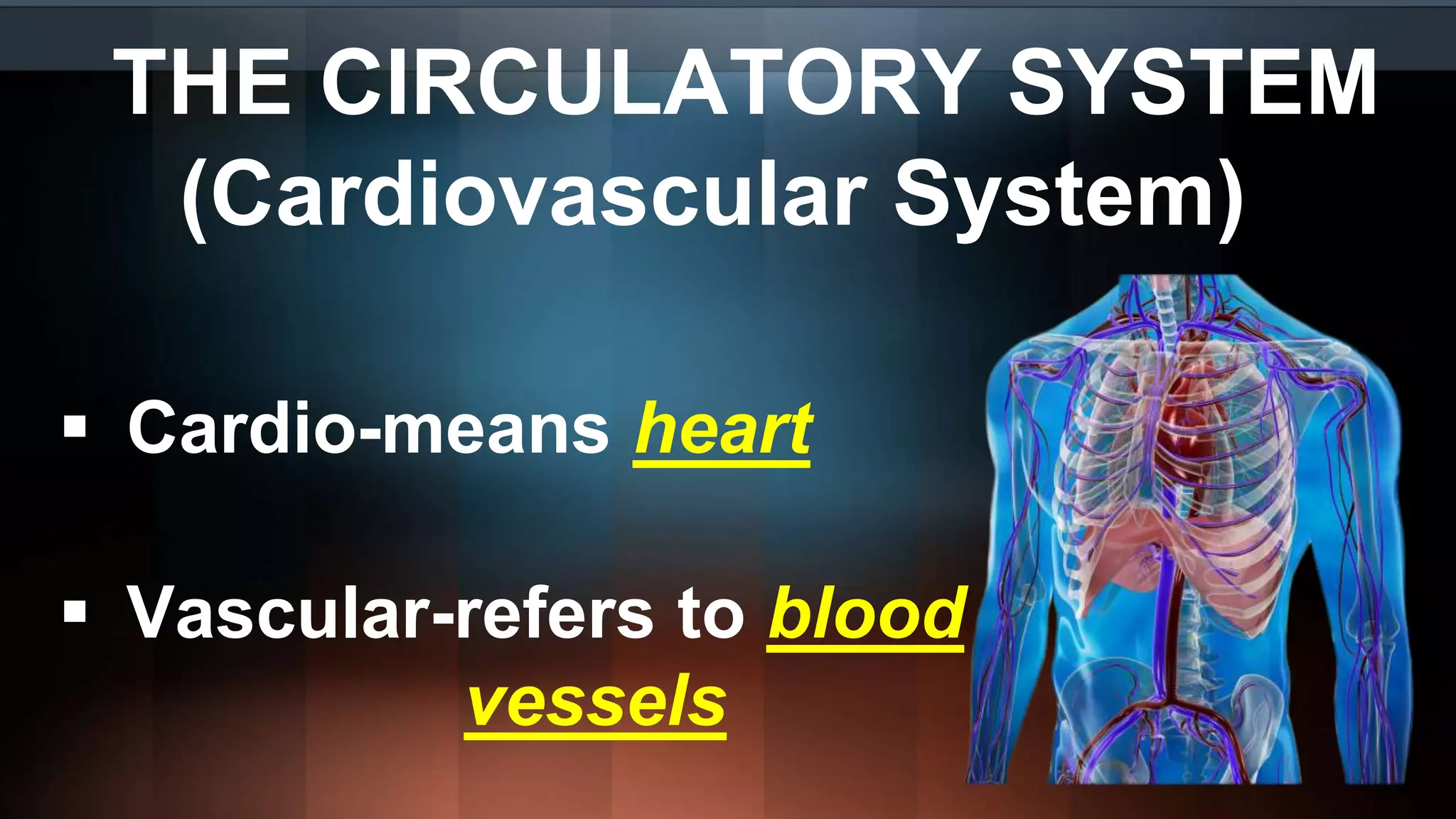
 Cardio-means heart
 Vascular-refers to blood
vessels
THE CIRCULATORY SYSTEM
• is considered as the main
transport system of the body
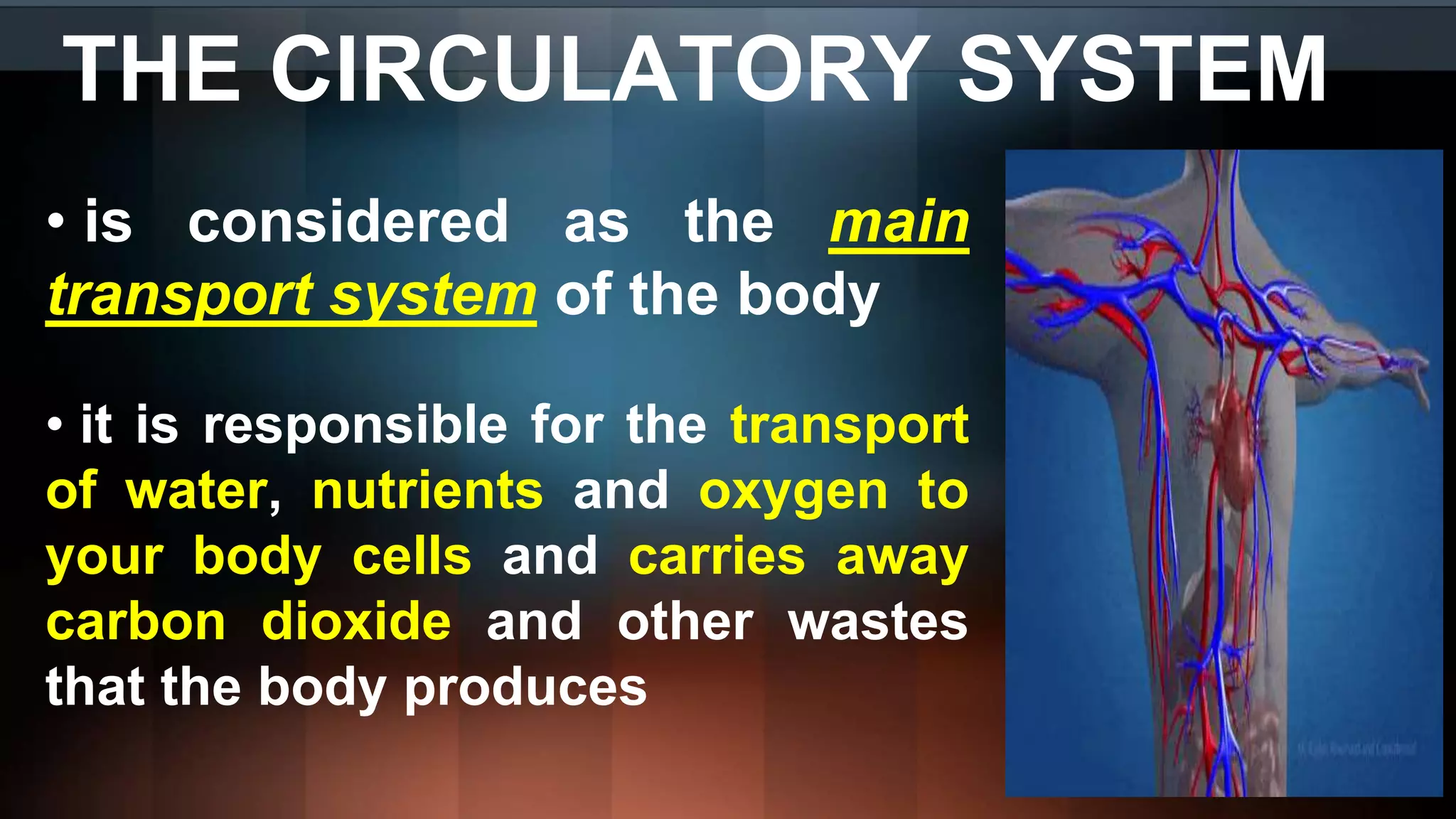
• it is responsible for the transport
of water, nutrients and oxygen to
your body cells and carries away
carbon dioxide and other wastes
that the body produces
The Circulatory System
It consists of three major parts namely;
HEART
BLOOD
BLOOD VESSELS
• that work together to provide food and oxygen
to the body cells.
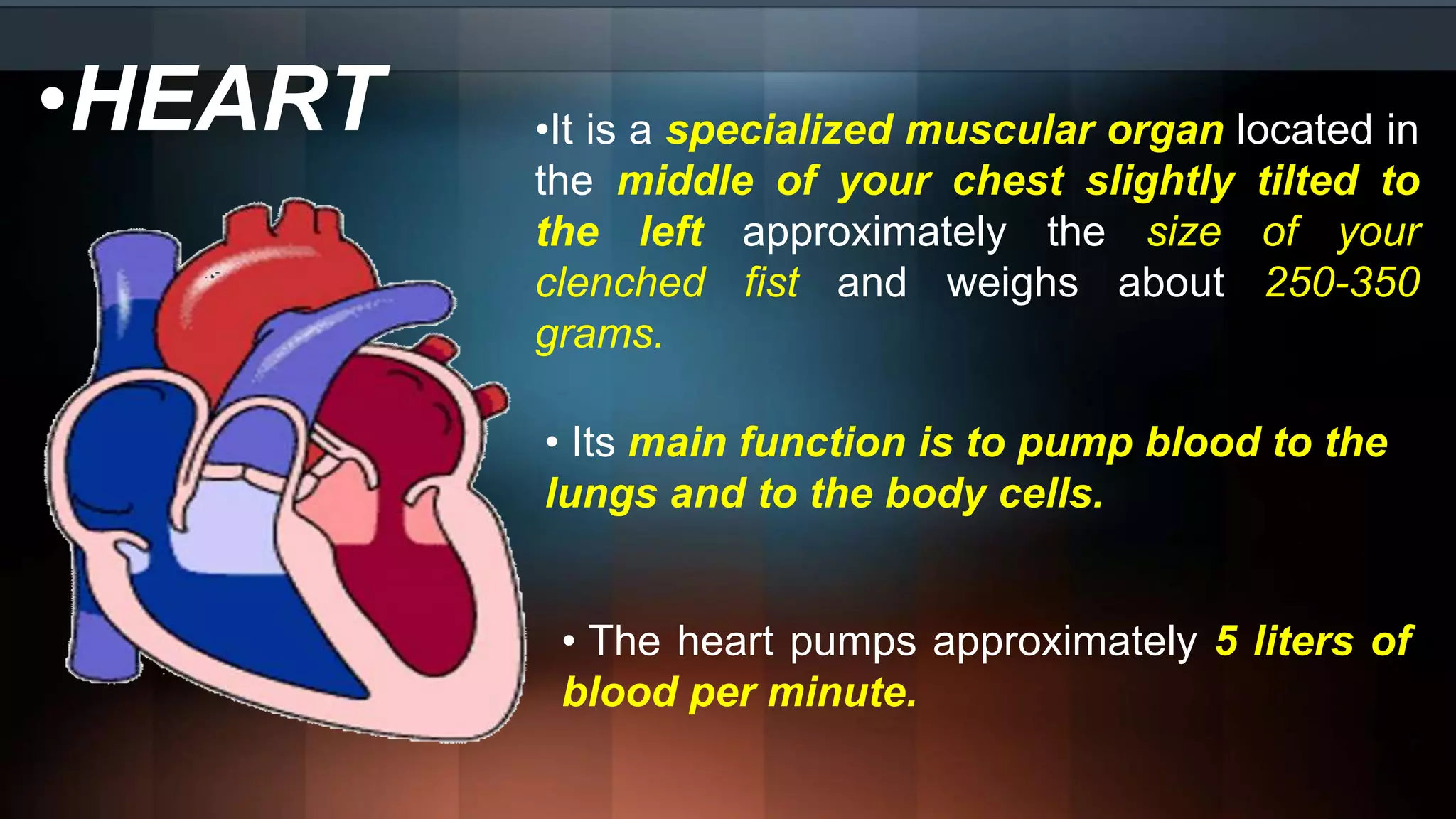
•HEART •It is a specialized muscular organ located in
the middle of your chest slightly tilted to
the left approximately the size of your
clenched fist and weighs about 250-350
grams.
• Its main function is to pump blood to the
lungs and to the body cells.
• The heart pumps approximately 5 liters of
blood per minute.
•BLOOD
• The human body contains approximately 5 liters of
blood depending on the size of the body
• It is about 9% of the body’s weight
• It consists of 4 components:
• Red Blood Cells
• White Blood Cells
• Platelets
• Plasma
- referred as the red river of life
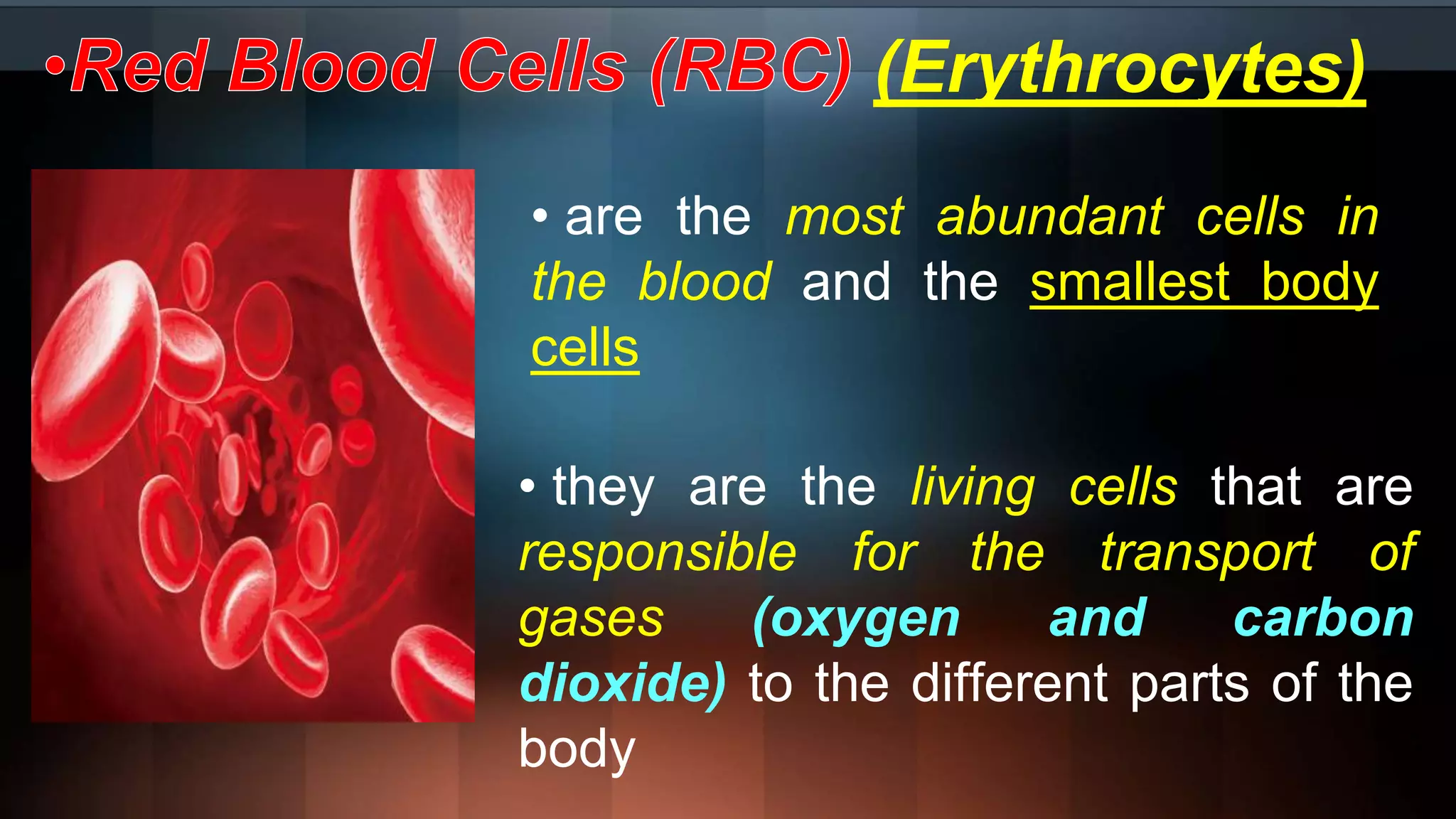
(Erythrocytes)
• are the most abundant cells in
the blood and the smallest body
cells
• they are the living cells that are
responsible for the transport of
gases (oxygen and carbon
dioxide) to the different parts of the
body
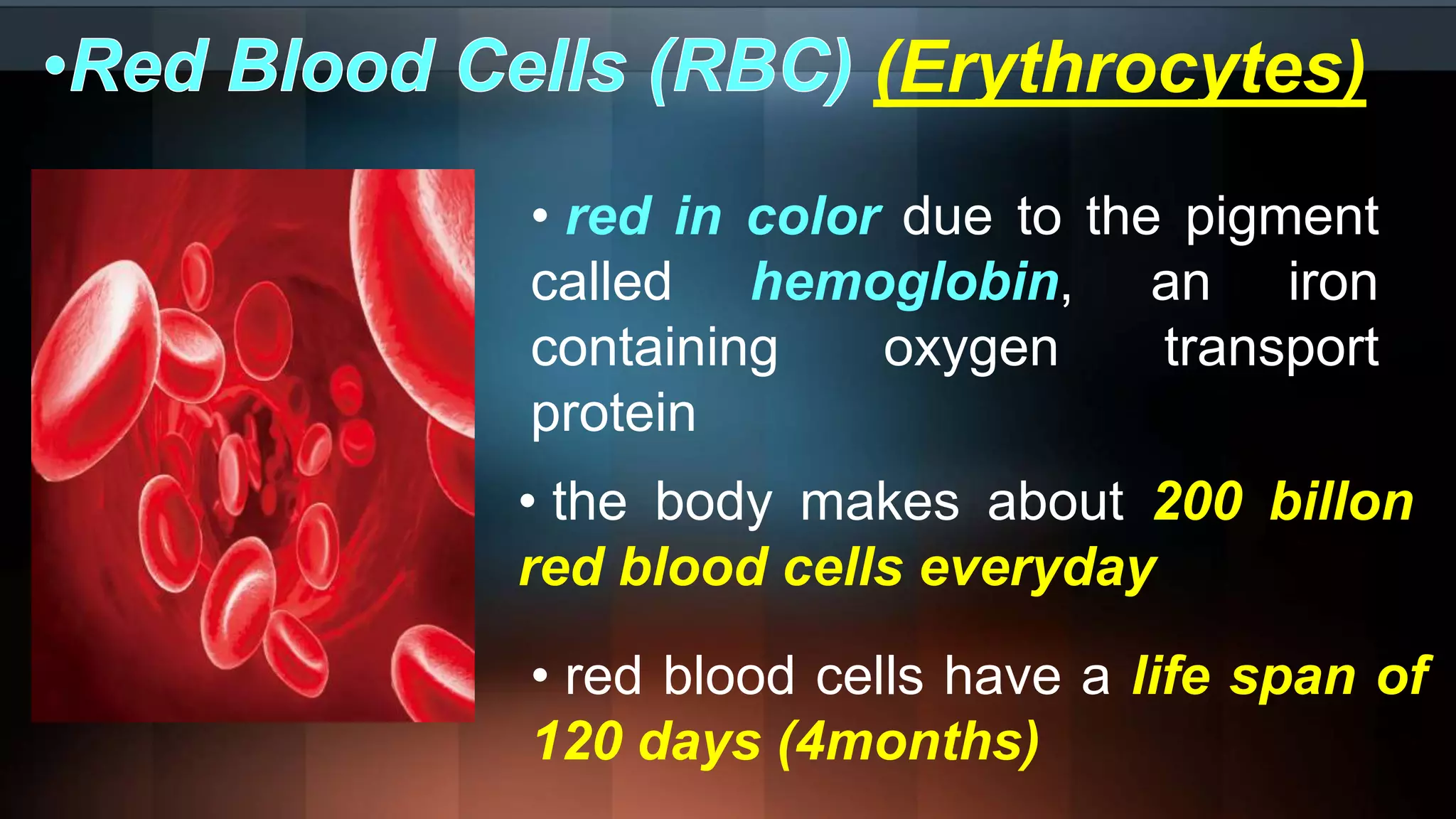
(Erythrocytes)
• red in color due to the pigment
called hemoglobin, an iron
containing oxygen transport
protein
• the body makes about 200 billon
red blood cells everyday
• red blood cells have a life span of
120 days (4months)
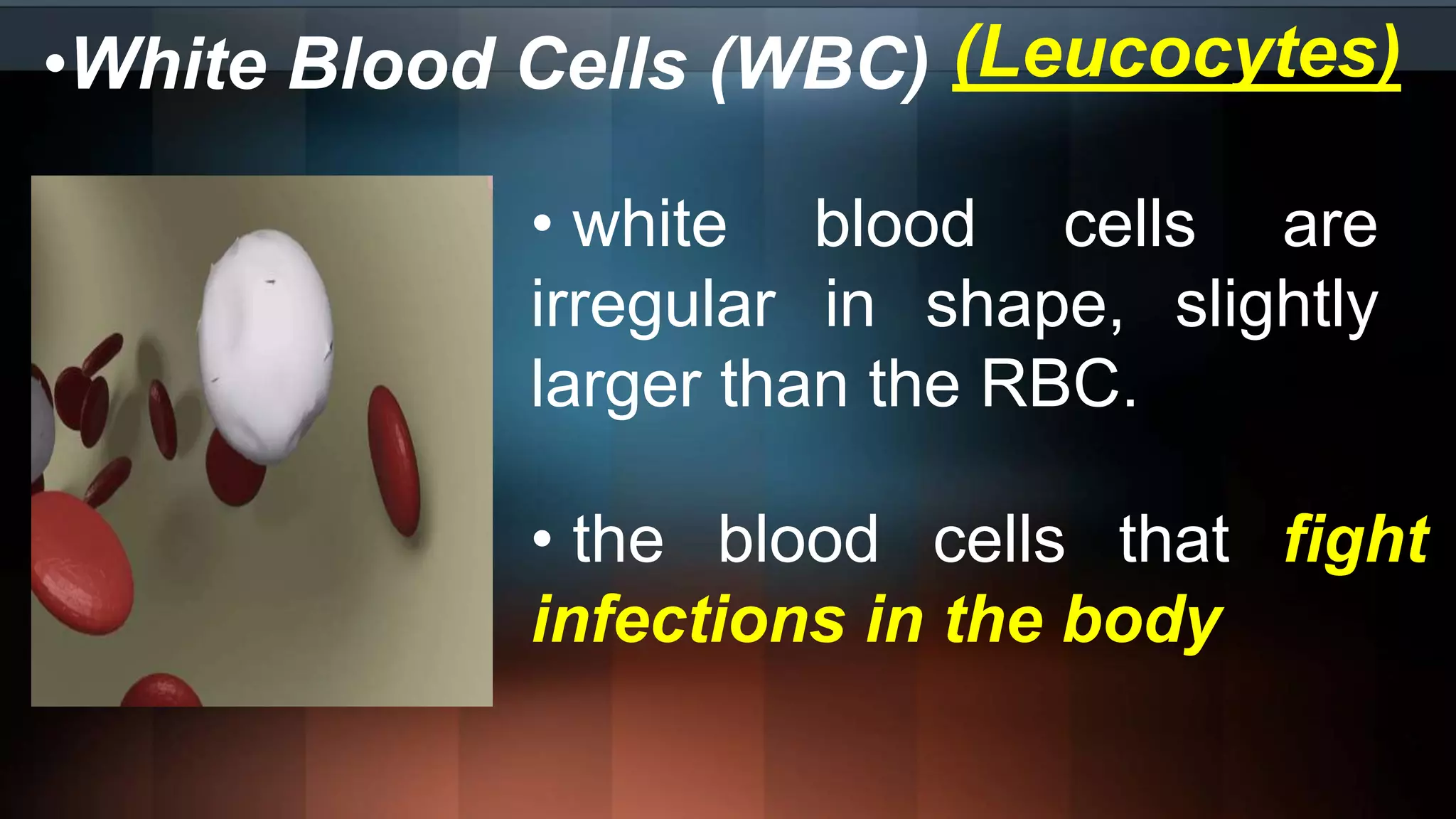
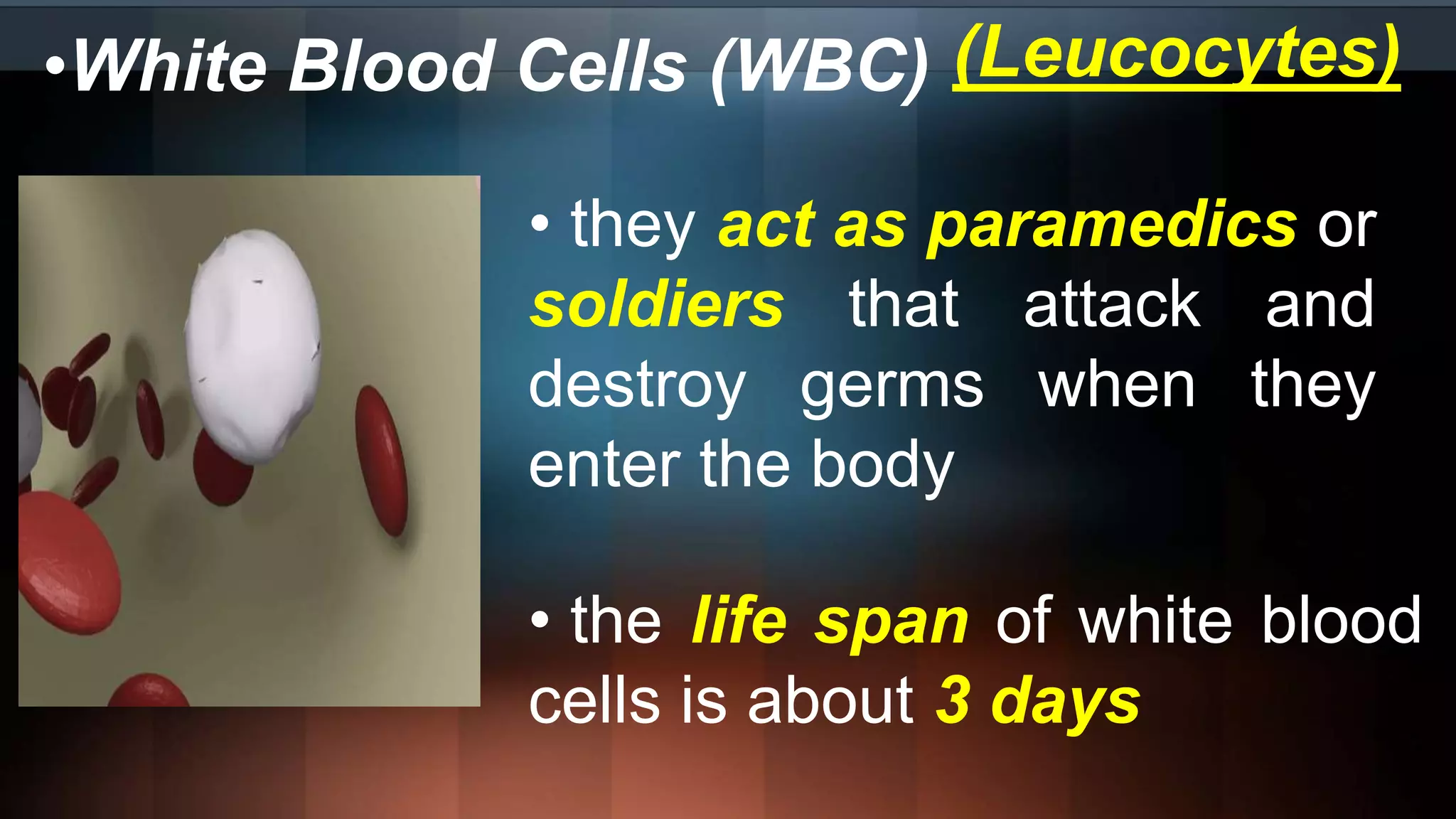
•White Blood Cells (WBC) (Leucocytes)
• white blood cells are
irregular in shape, slightly
larger than the RBC.
• the blood cells that fight
infections in the body
•White Blood Cells (WBC) (Leucocytes)
• they act as paramedics or
soldiers that attack and
destroy germs when they
enter the body
• the life span of white blood
cells is about 3 days
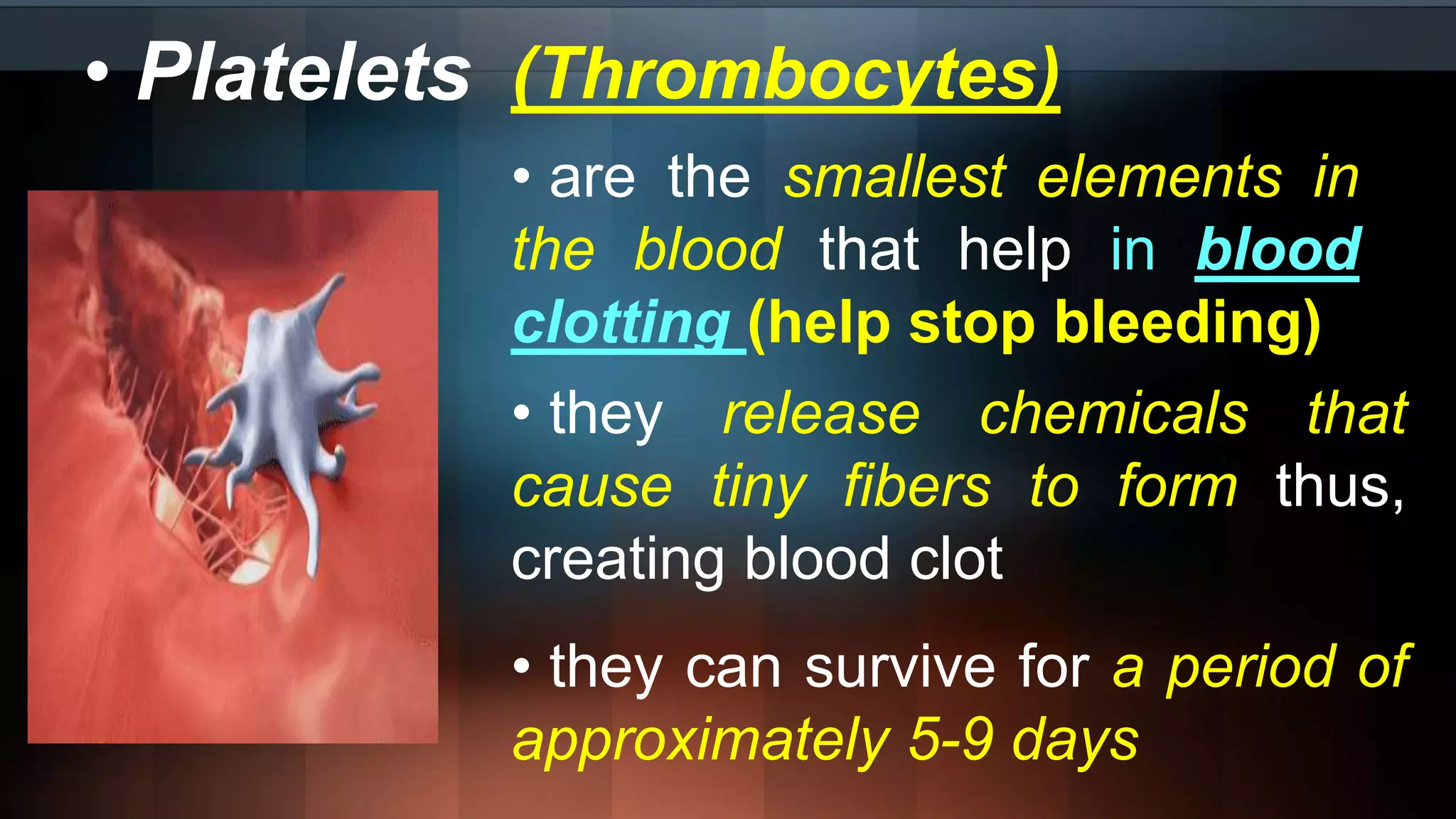
• Platelets (Thrombocytes)
• are the smallest elements in
the blood that help in blood
clotting (help stop bleeding)
• they release chemicals that
cause tiny fibers to form thus,
creating blood clot
• they can survive for a period of
approximately 5-9 days
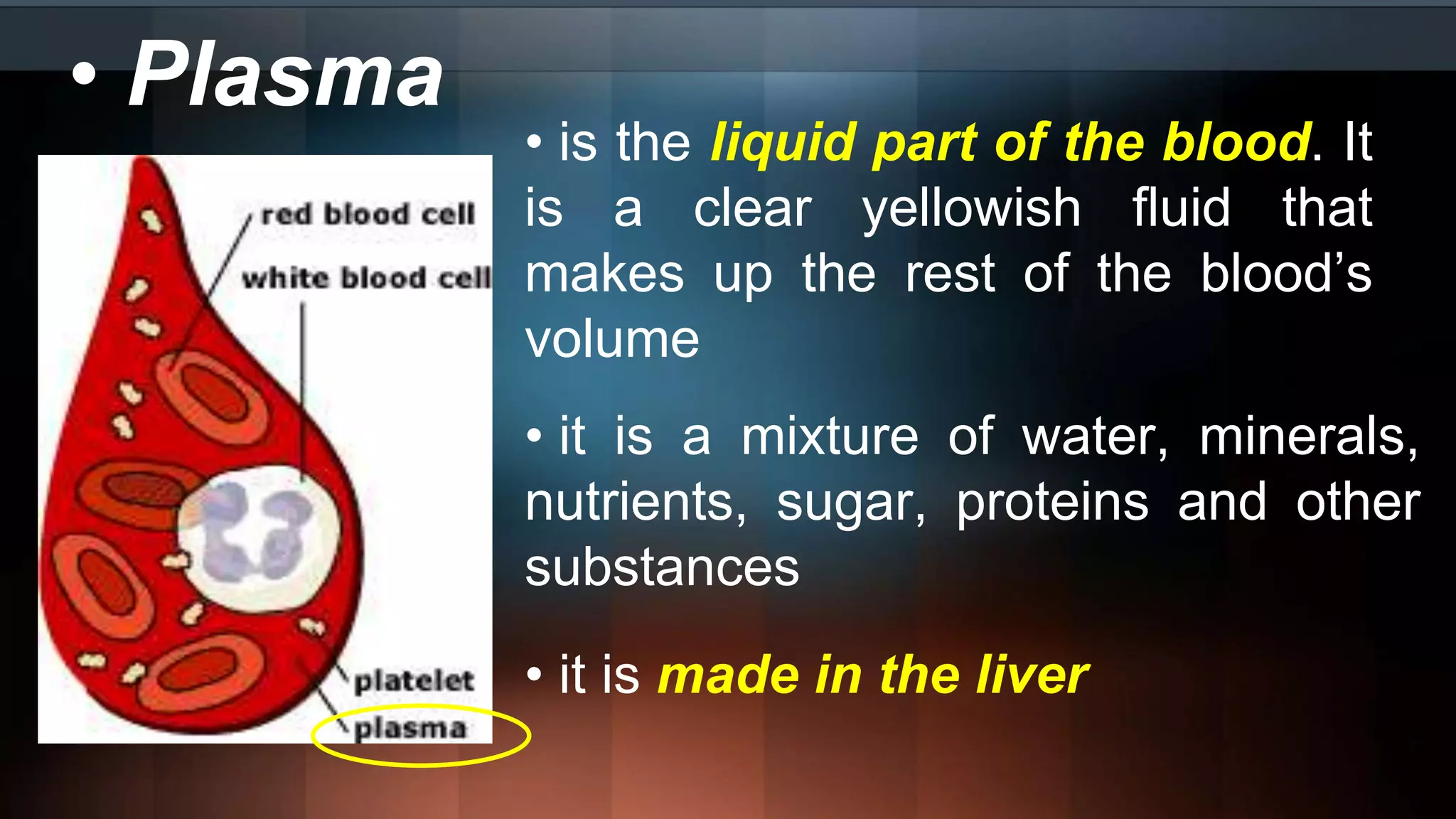
• Plasma
• is the liquid part of the blood. It
is a clear yellowish fluid that
makes up the rest of the blood’s
volume
• it is made in the liver
• it is a mixture of water, minerals,
nutrients, sugar, proteins and other
substances
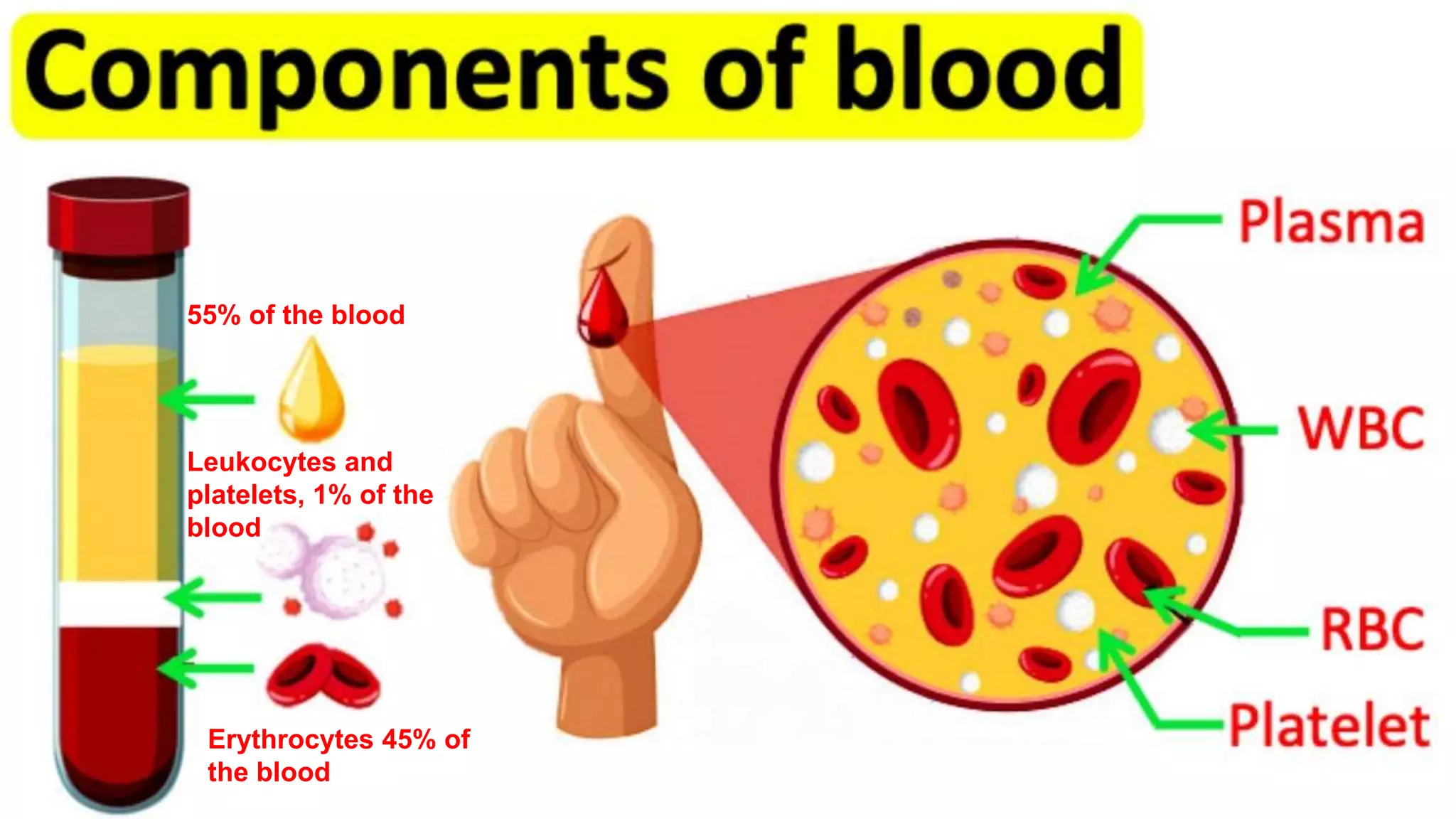
55% of the blood
Leukocytes and
platelets, 1% of the
blood
Erythrocytes 45% of
the blood
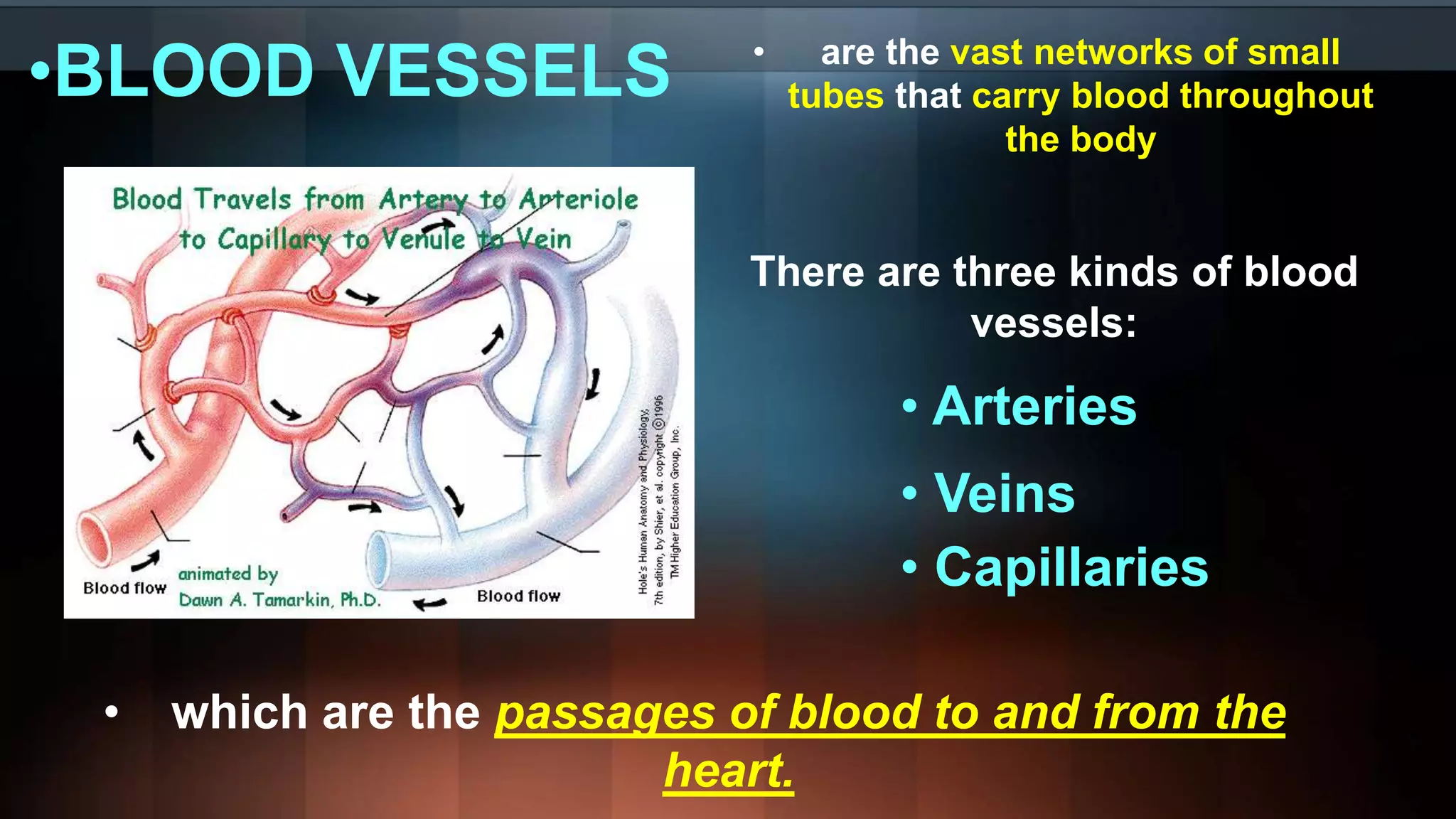
There are three kinds of blood
vessels:
•BLOOD VESSELS
• Arteries
• Veins
• Capillaries
• which are the passages of blood to and from the
heart.
• are the vast networks of small
tubes that carry blood throughout
the body
TYPE OF BLOOD VESSELS
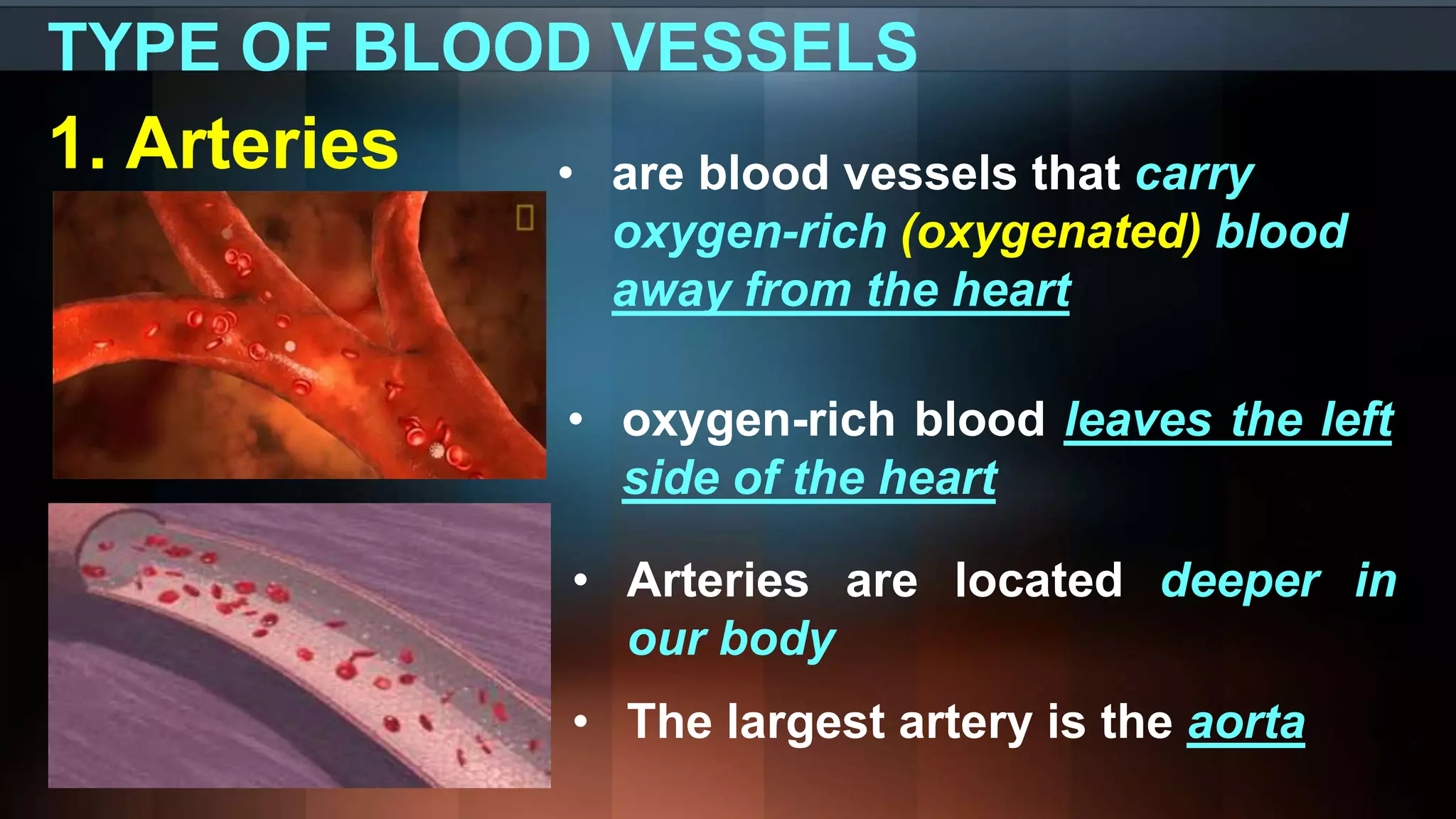
1. Arteries • are blood vessels that carry
oxygen-rich (oxygenated) blood
away from the heart
• oxygen-rich blood leaves the left
side of the heart
• Arteries are located deeper in
our body
• The largest artery is the aorta
TYPE OF BLOOD VESSELS
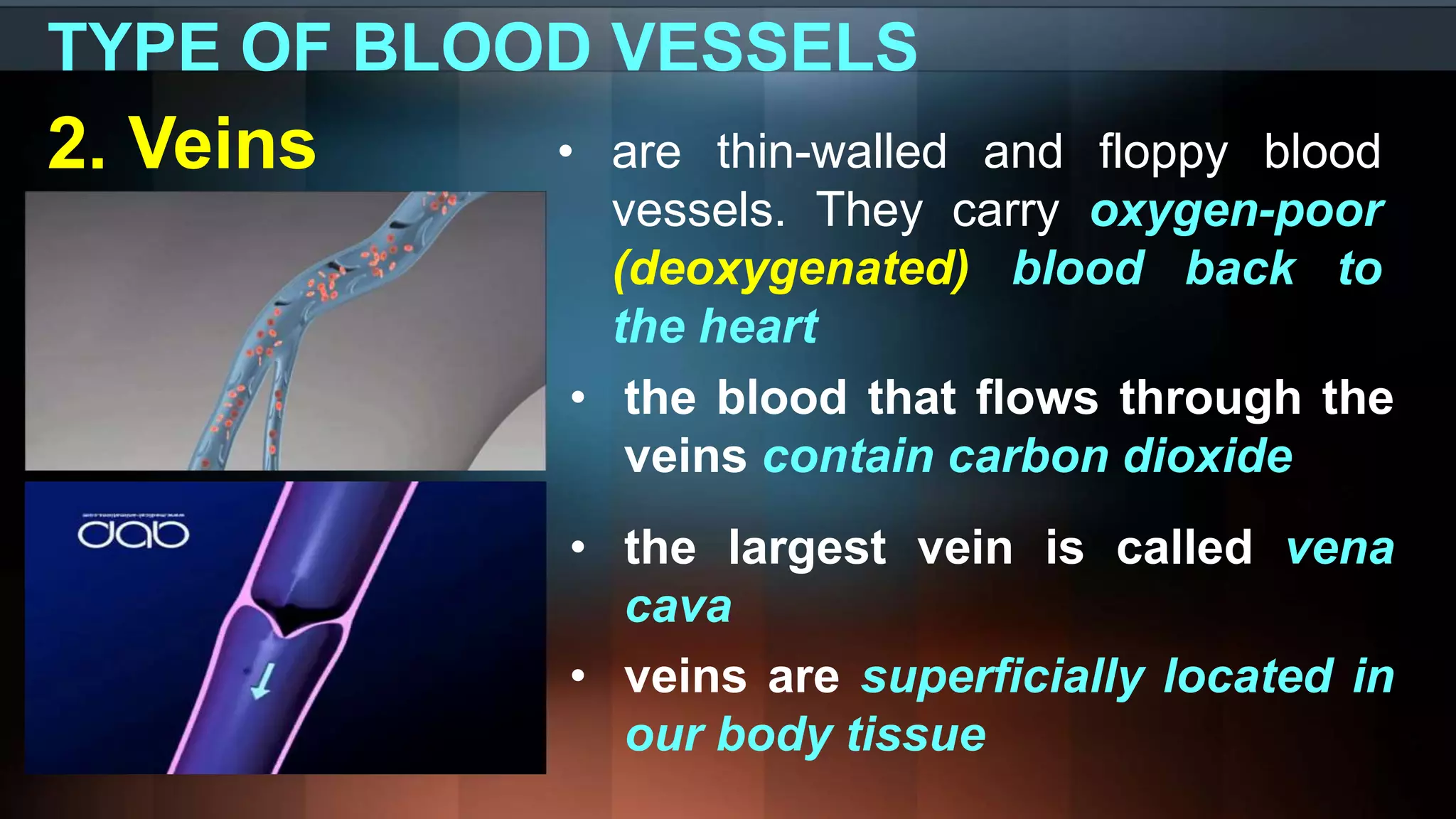
2. Veins • are thin-walled and floppy blood
vessels. They carry oxygen-poor
(deoxygenated) blood back to
the heart
• the blood that flows through the
veins contain carbon dioxide
• the largest vein is called vena
cava
• veins are superficially located in
our body tissue
TYPE OF BLOOD VESSELS
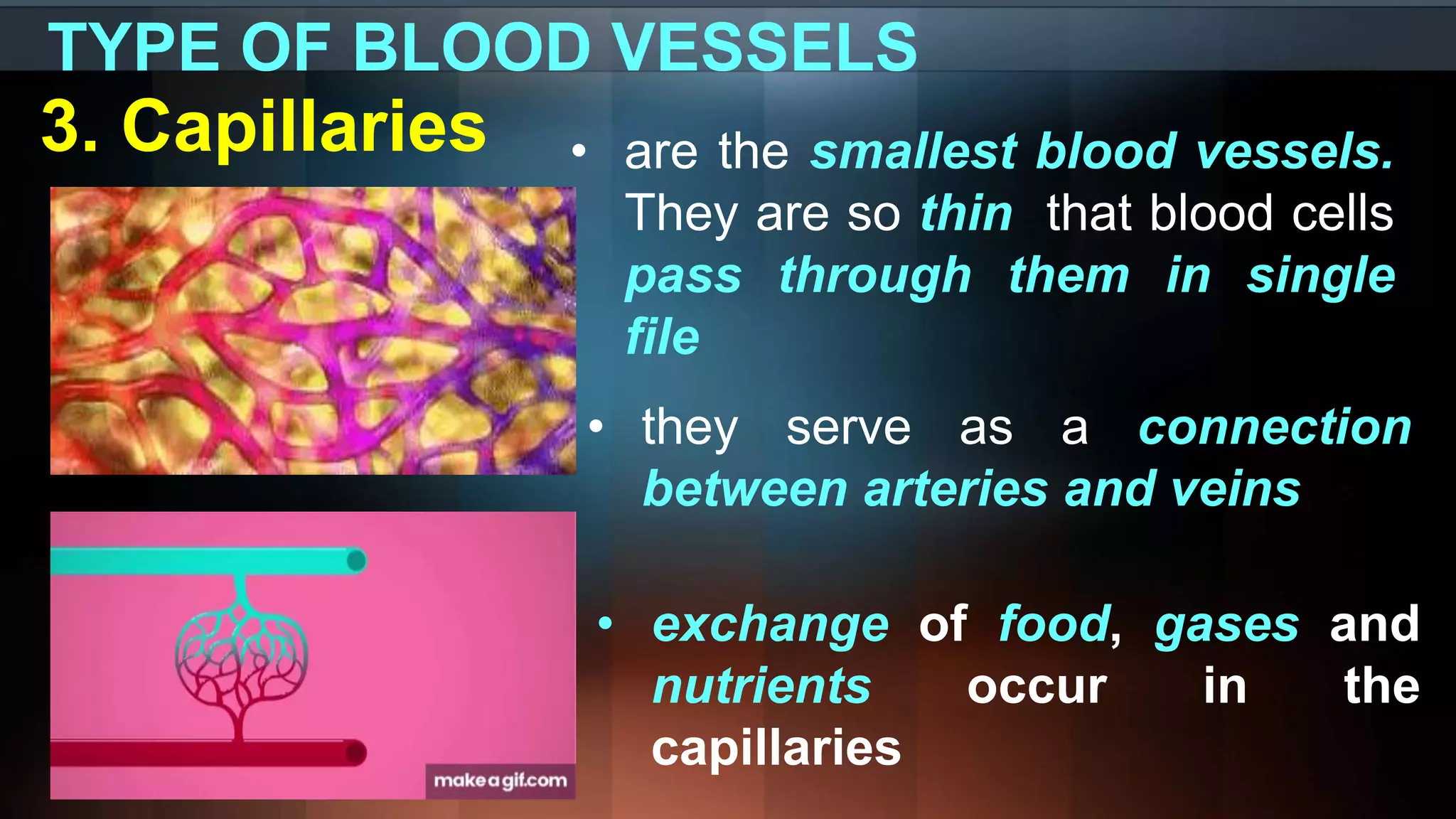
3. Capillaries • are the smallest blood vessels.
They are so thin that blood cells
pass through them in single
file
• they serve as a connection
between arteries and veins
• exchange of food, gases and
nutrients occur in the
capillaries
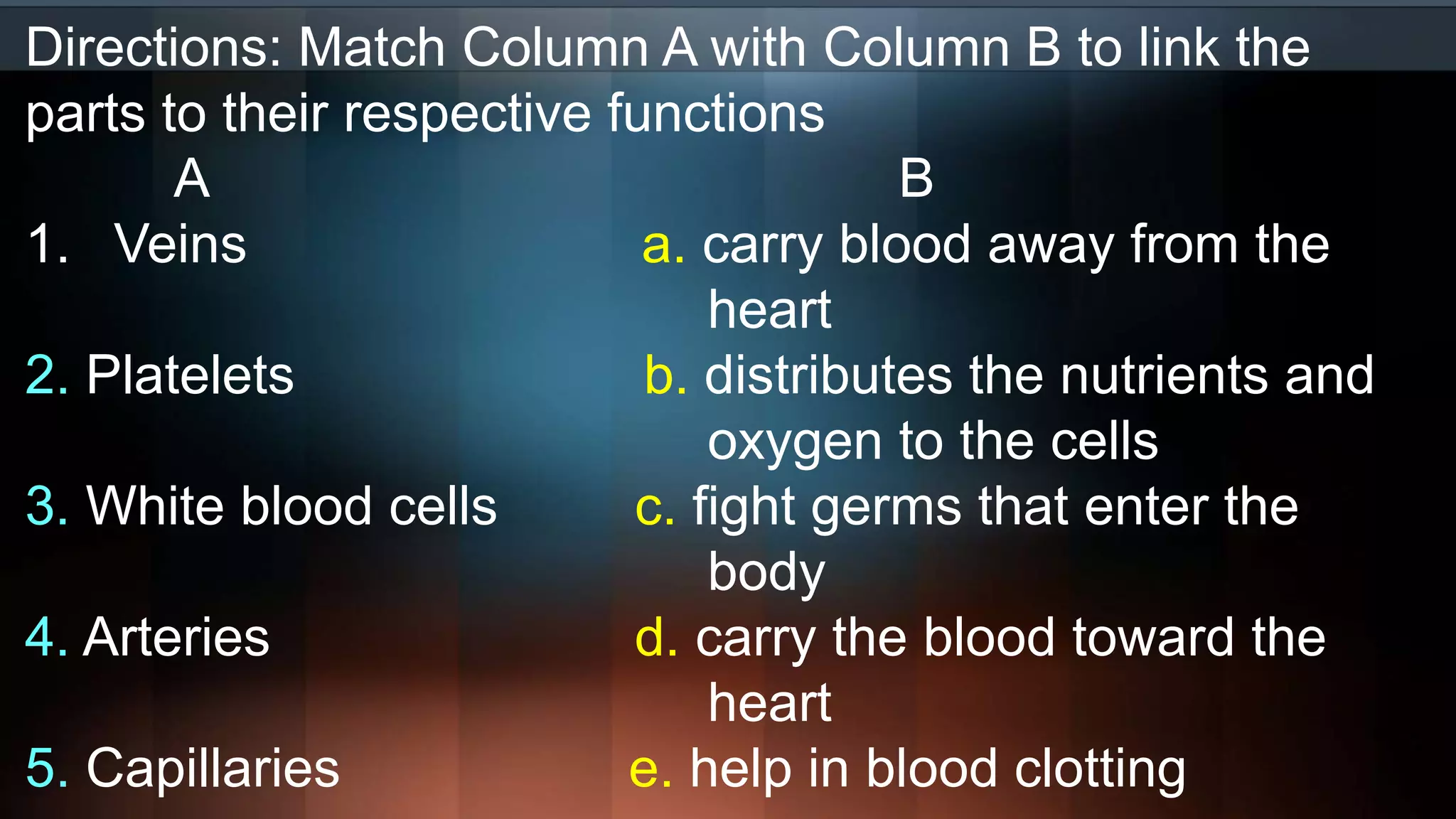
Directions: Match Column A with Column B to link the
parts to their respective functions
A B
1. Veins a. carry blood away from the
heart
2. Platelets b. distributes the nutrients and
oxygen to the cells
3. White blood cells c. fight germs that enter the
body
4. Arteries d. carry the blood toward the
heart
5. Capillaries e. help in blood clotting
Assignment:
What are the types of blood
circulation?
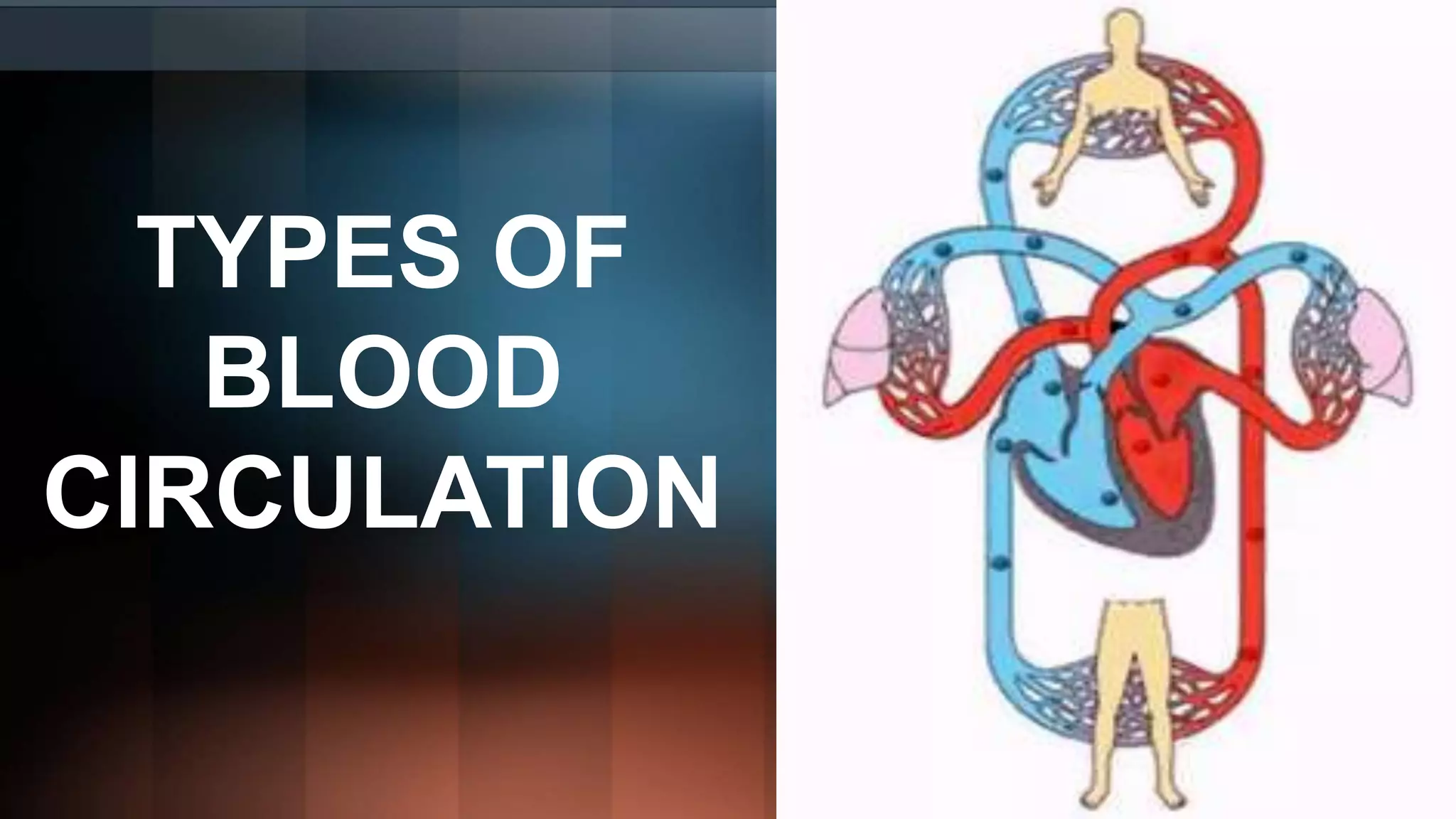
TYPES OF
BLOOD
CIRCULATION
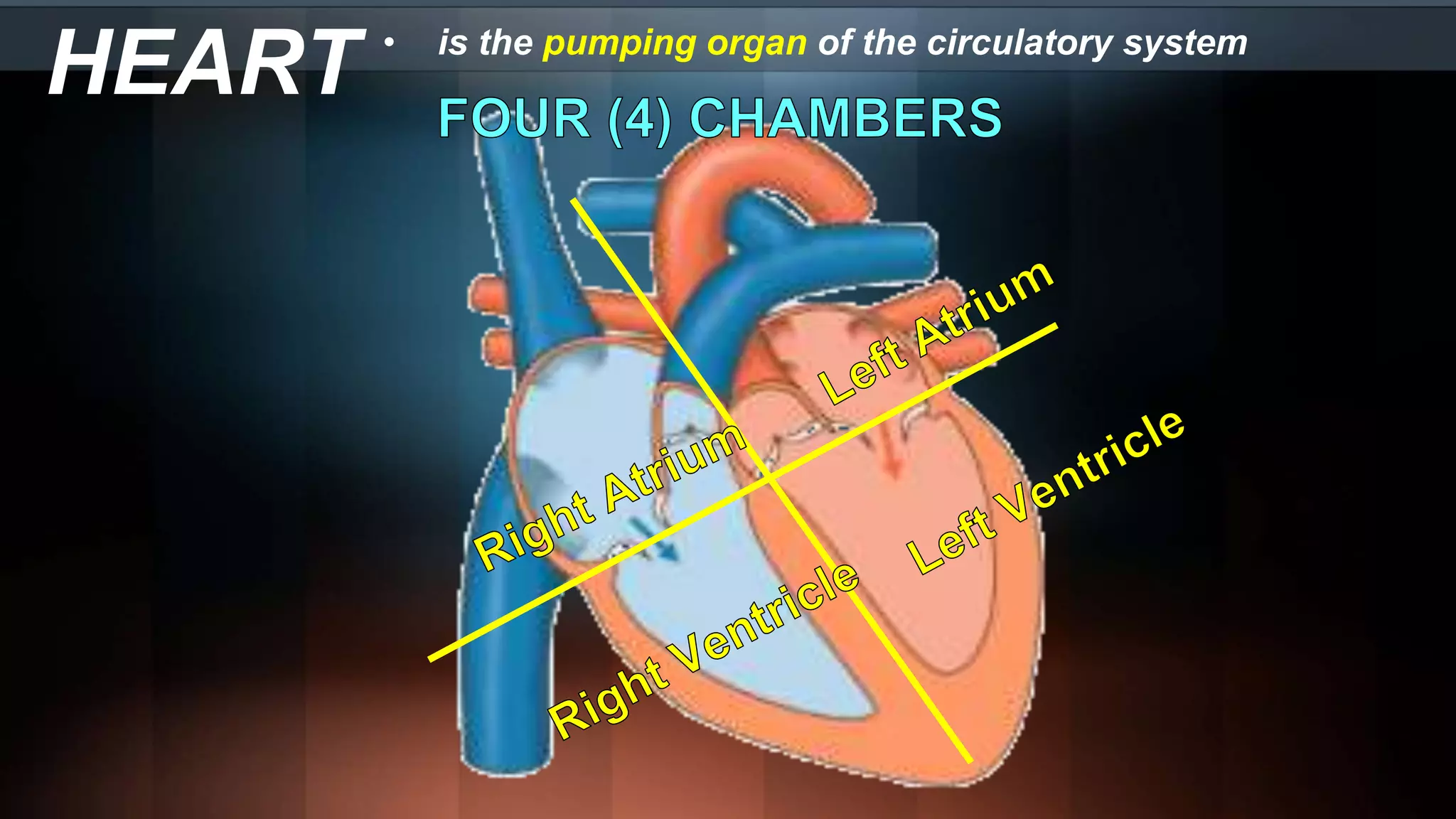
HEART • is the pumping organ of the circulatory system
SYSTEMIC
CIRCULATION
PULMONARY
CIRCULATION
TYPES OF BLOOD
CIRCULATION
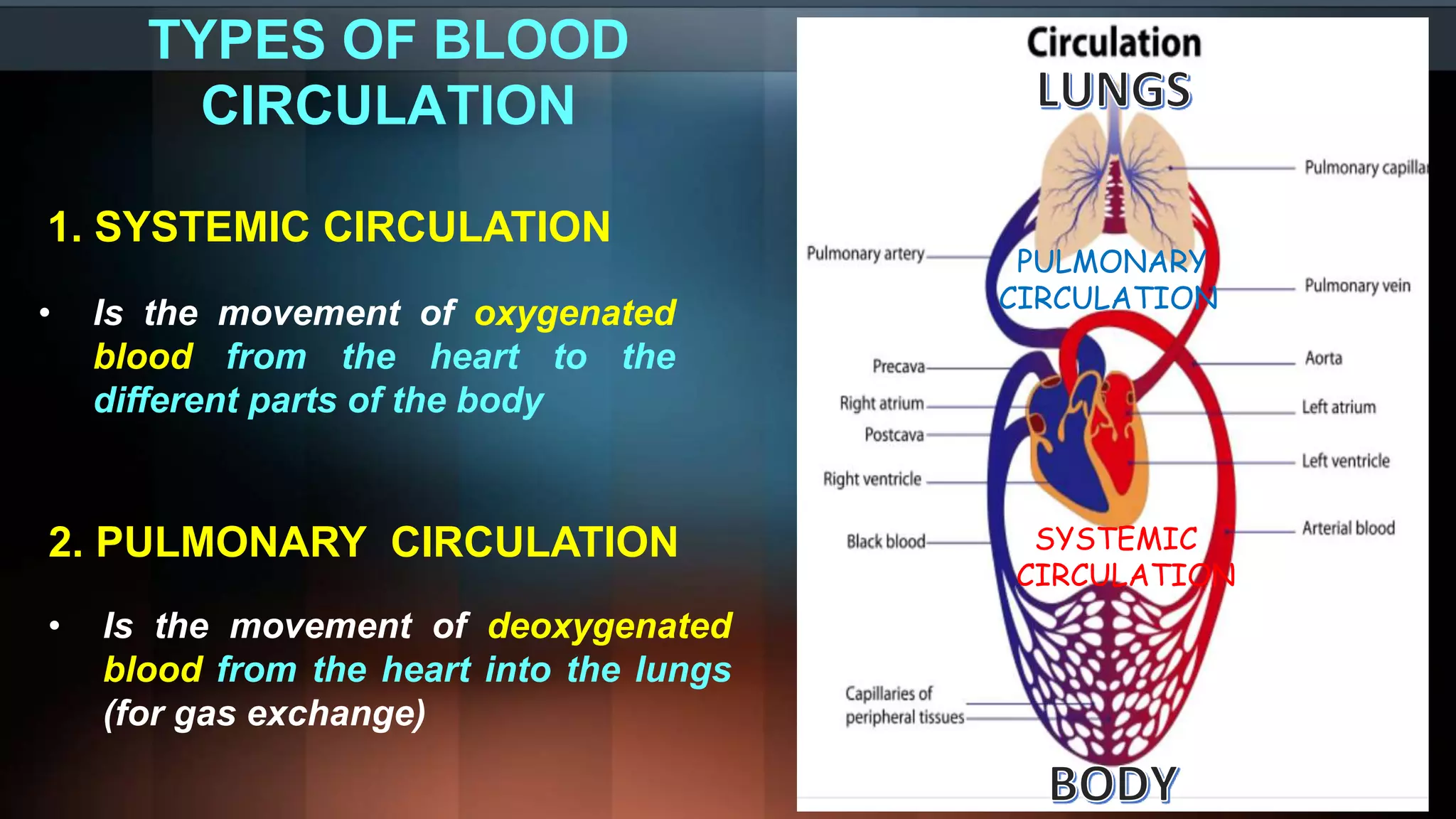
1. SYSTEMIC CIRCULATION
• Is the movement of oxygenated
blood from the heart to the
different parts of the body
2. PULMONARY CIRCULATION
• Is the movement of deoxygenated
blood from the heart into the lungs
(for gas exchange)
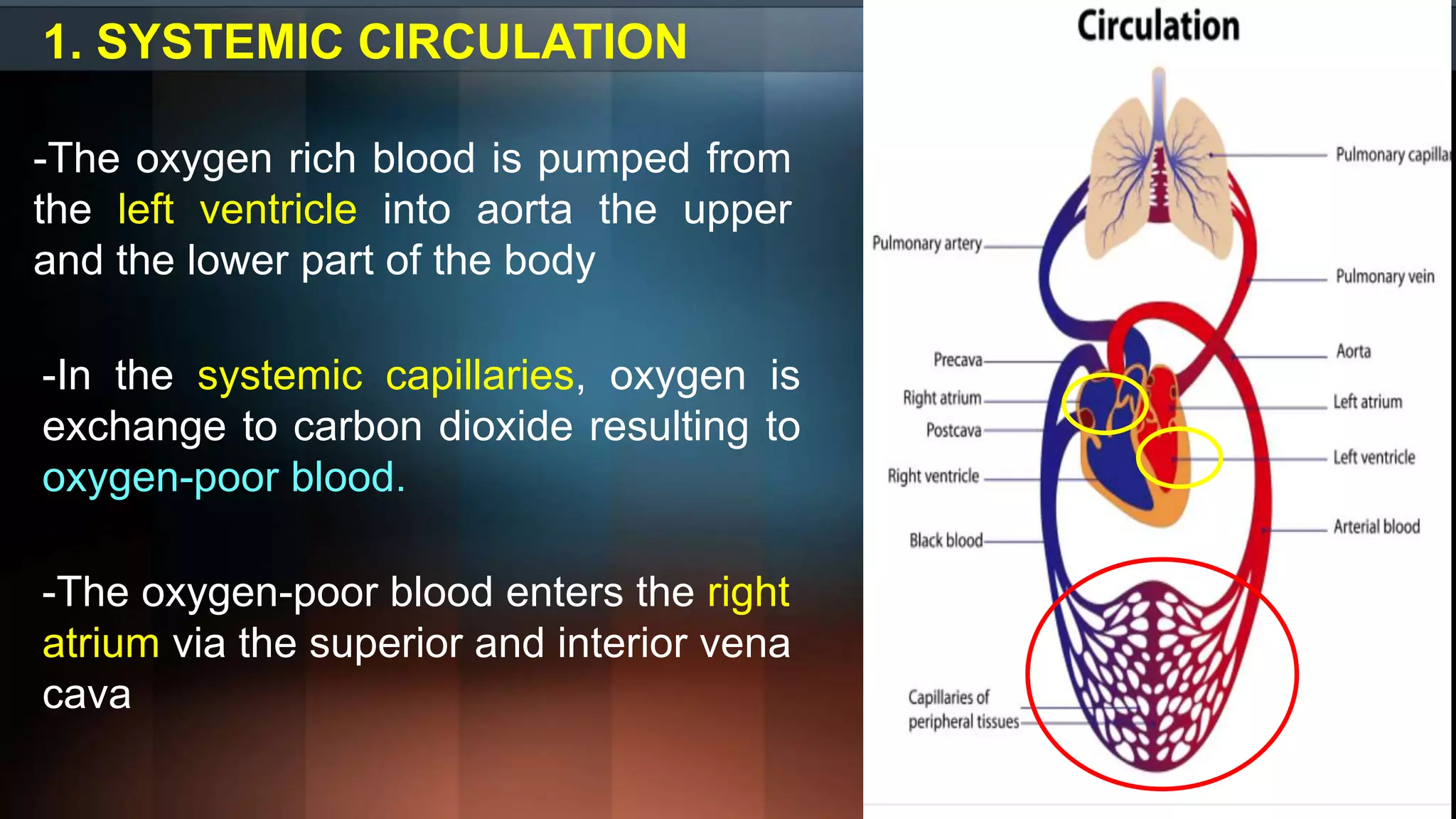
1. SYSTEMIC CIRCULATION
-The oxygen rich blood is pumped from
the left ventricle into aorta the upper
and the lower part of the body
-In the systemic capillaries, oxygen is
exchange to carbon dioxide resulting to
oxygen-poor blood.
-The oxygen-poor blood enters the right
atrium via the superior and interior vena
cava
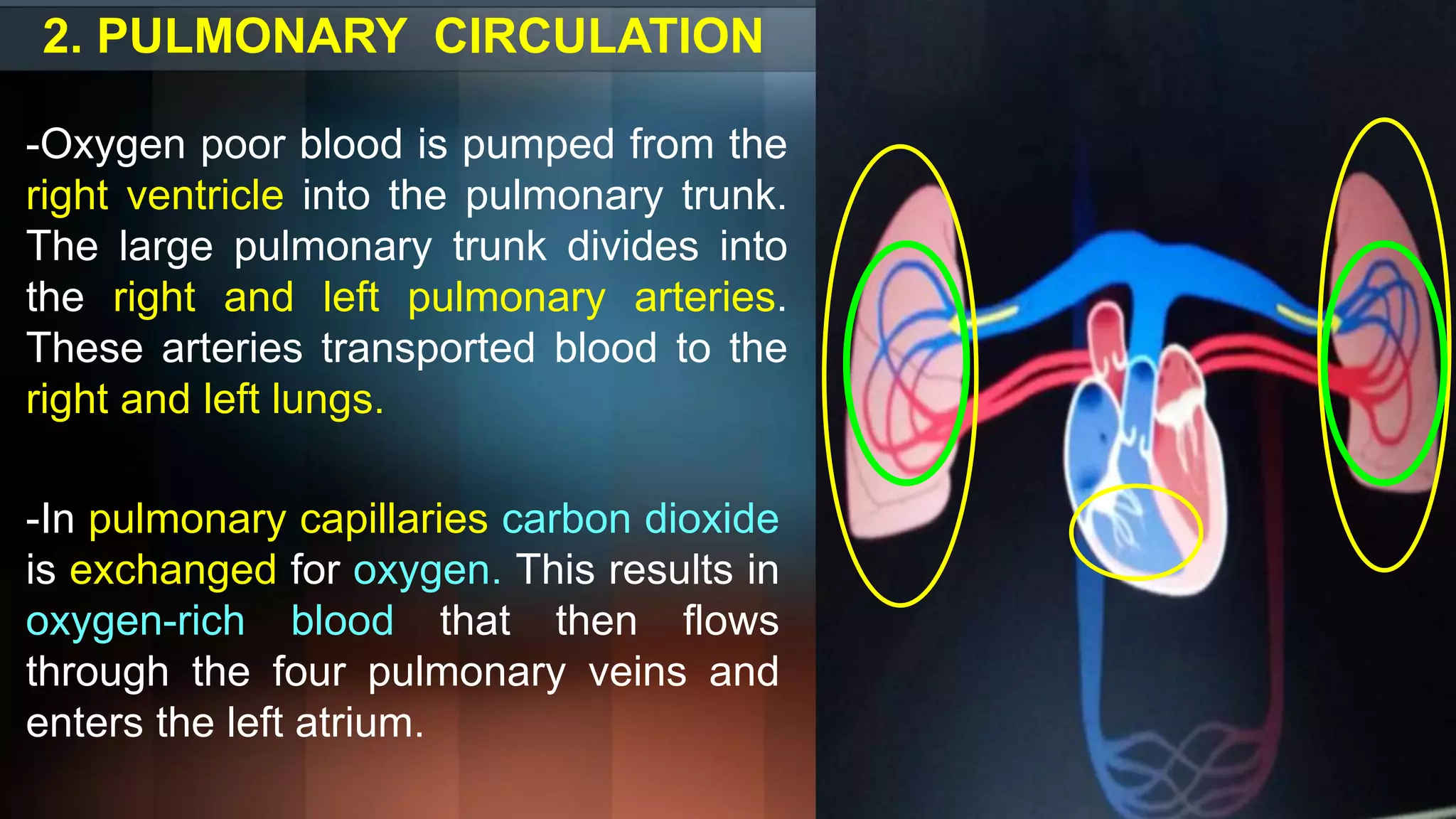
2. PULMONARY CIRCULATION
-Oxygen poor blood is pumped from the
right ventricle into the pulmonary trunk.
The large pulmonary trunk divides into
the right and left pulmonary arteries.
These arteries transported blood to the
right and left lungs.
-In pulmonary capillaries carbon dioxide
is exchanged for oxygen. This results in
oxygen-rich blood that then flows
through the four pulmonary veins and
enters the left atrium.
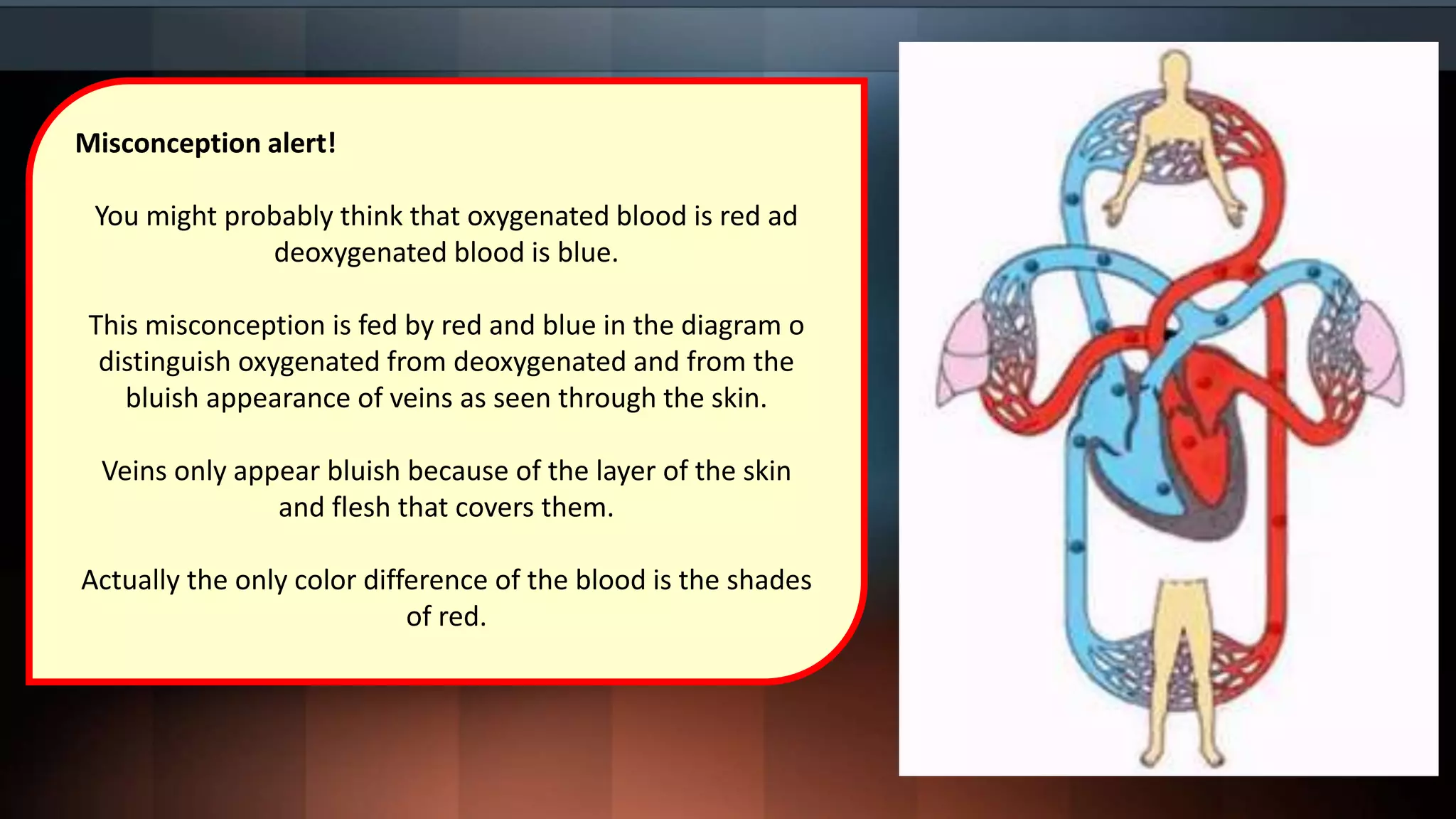
Misconception alert!
You might probably think that oxygenated blood is red ad
deoxygenated blood is blue.
This misconception is fed by red and blue in the diagram o
distinguish oxygenated from deoxygenated and from the
bluish appearance of veins as seen through the skin.
Veins only appear bluish because of the layer of the skin
and flesh that covers them.
Actually the only color difference of the blood is the shades
of red.
Directions: Trace the flow of blood in pulmonary circulation. Put
number 1 to 6 on the space provided before the statement.
______ blood flows from the right atrium to the right ventricle
______blood reaches the network of capillaries tat cover the air sacs.
______ blood leaves the air sacs
______ blood is forced into the lungs, passing through the pulmonary
artery.
______ exchange of gases occurs between the thin membranes of the
cells in the air sacs and capillaries
______ the oxygen-rich blood passes through capillaries and then into
the smallest veins called venules
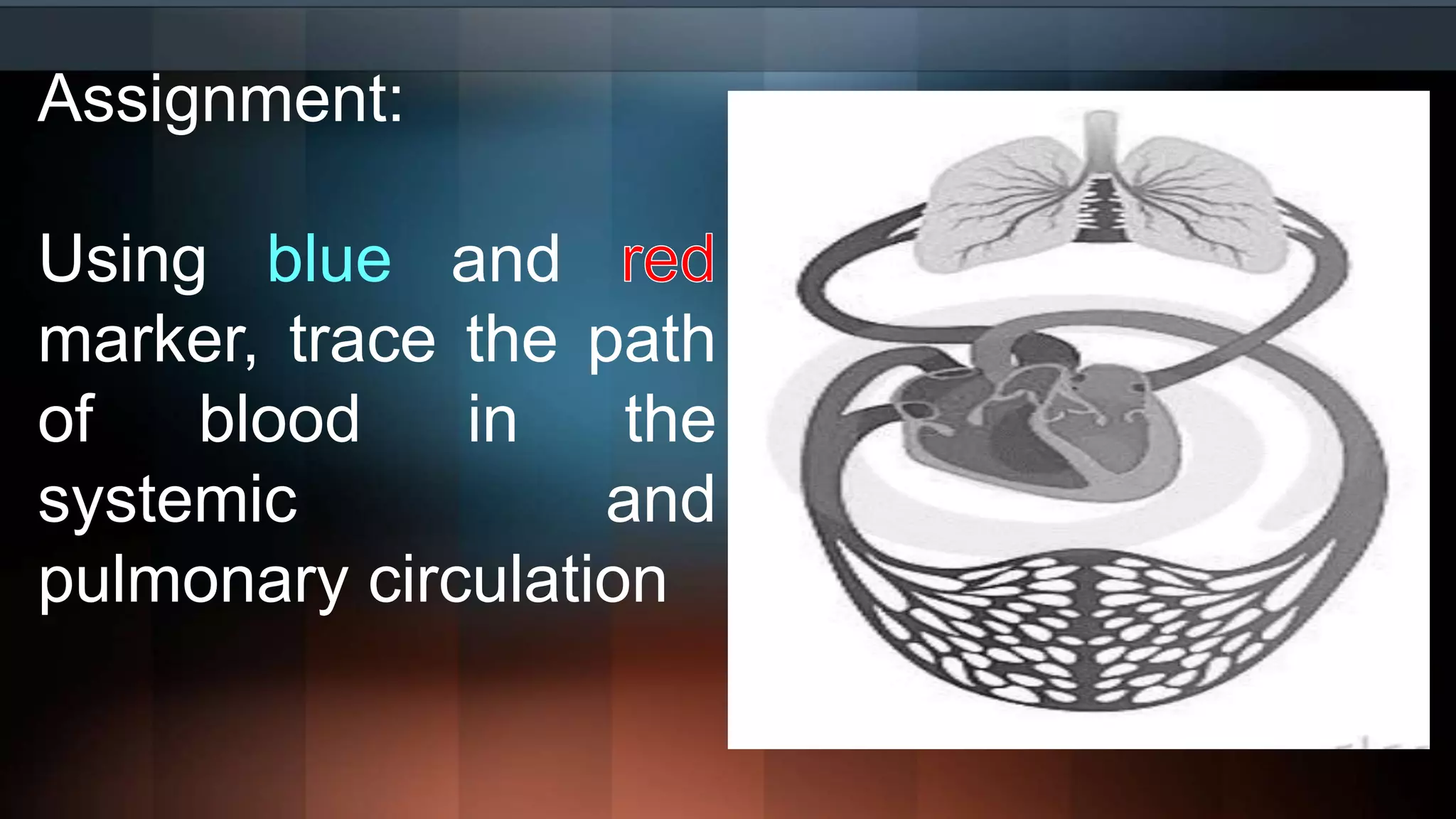
Assignment:
Using blue and
marker, trace the path
of blood in the
systemic and
pulmonary circulation
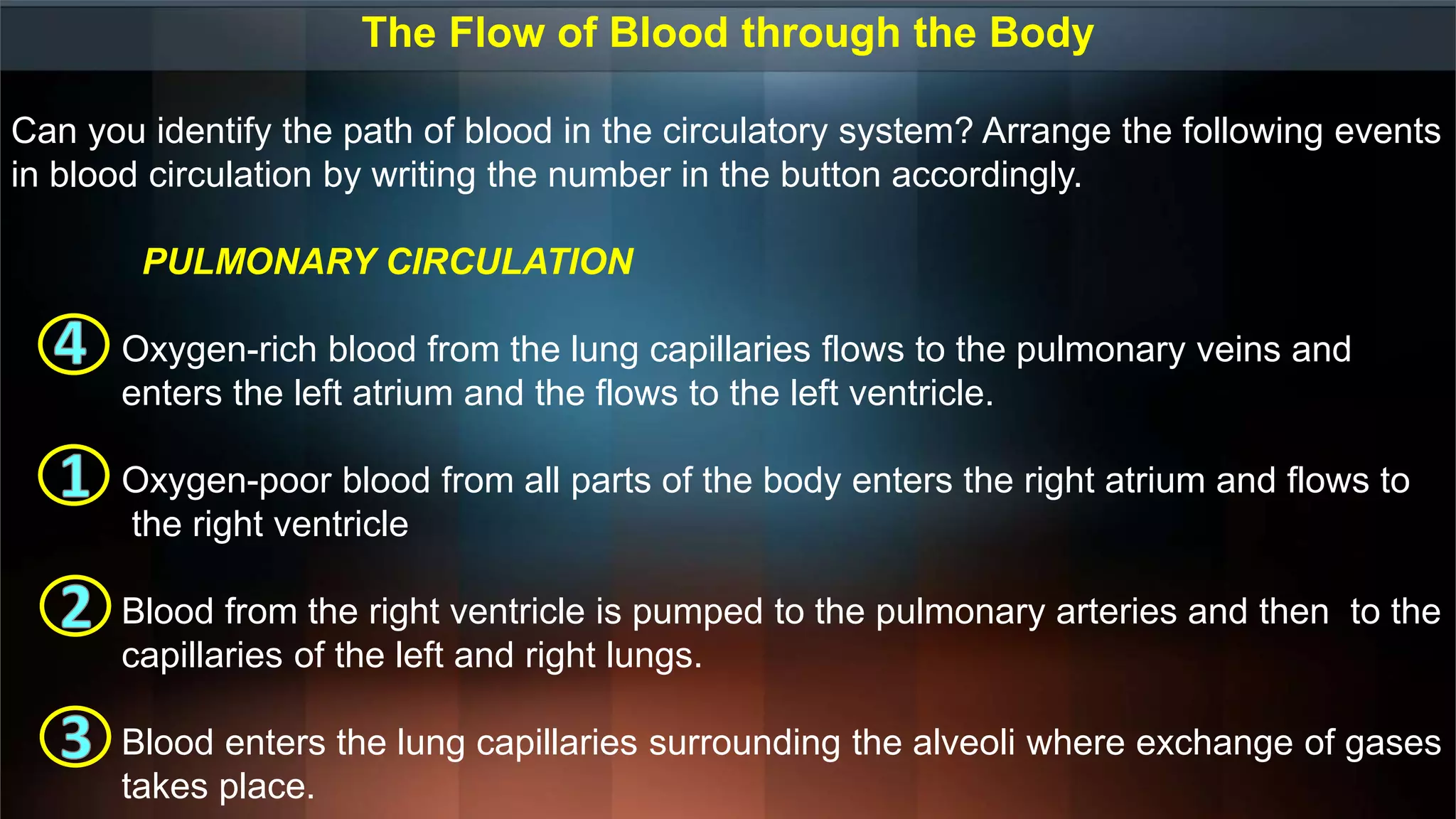
The Flow of Blood through the Body
Can you identify the path of blood in the circulatory system? Arrange the following events
in blood circulation by writing the number in the button accordingly.
PULMONARY CIRCULATION
Oxygen-rich blood from the lung capillaries flows to the pulmonary veins and
enters the left atrium and the flows to the left ventricle.
Oxygen-poor blood from all parts of the body enters the right atrium and flows to
the right ventricle
Blood from the right ventricle is pumped to the pulmonary arteries and then to the
capillaries of the left and right lungs.
Blood enters the lung capillaries surrounding the alveoli where exchange of gases
takes place.
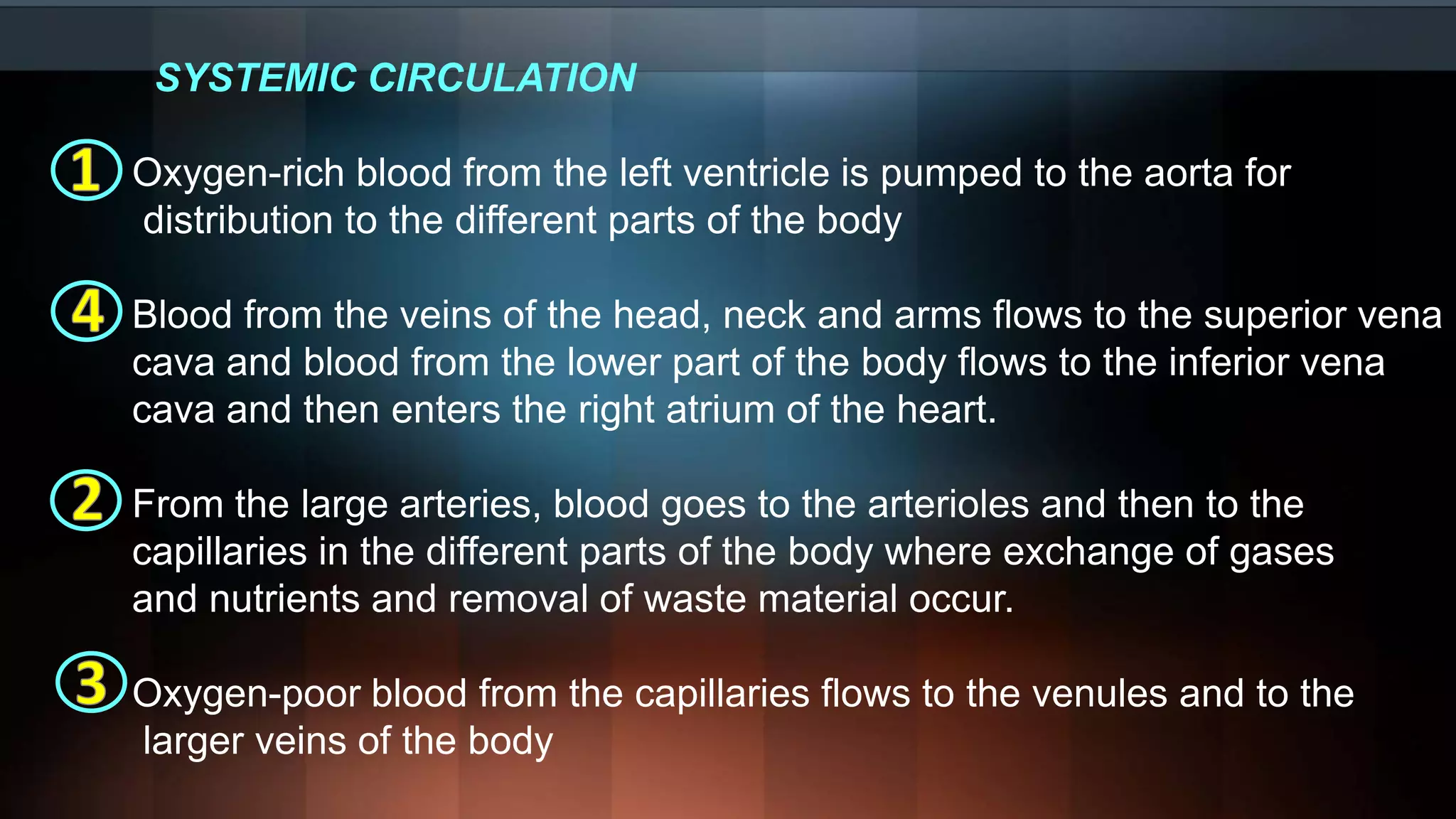
SYSTEMIC CIRCULATION
Oxygen-rich blood from the left ventricle is pumped to the aorta for
distribution to the different parts of the body
Blood from the veins of the head, neck and arms flows to the superior vena
cava and blood from the lower part of the body flows to the inferior vena
cava and then enters the right atrium of the heart.
From the large arteries, blood goes to the arterioles and then to the
capillaries in the different parts of the body where exchange of gases
and nutrients and removal of waste material occur.
Oxygen-poor blood from the capillaries flows to the venules and to the
larger veins of the body
The Flow of Blood through the Body
Can you identify the path of blood in the circulatory system? Arrange the following events
in blood circulation by writing the number in the button accordingly.
PULMONARY CIRCULATION
Oxygen-rich blood from the lung capillaries flows to the pulmonary veins and
enters the left atrium and the flows to the left ventricle.
Oxygen-poor blood from all parts of the body enters the right atrium and flows to
the right ventricle
Blood from the right ventricle is pumped to the pulmonary arteries and then to the
capillaries of the left and right lungs.
Blood enters the lung capillaries surrounding the alveoli where exchange of gases
takes place.
SYSTEMIC CIRCULATION
Oxygen-rich blood from the left ventricle is pumped to the aorta for
distribution to the different parts of the body
Blood from the veins of the head, neck and arms flows to the superior vena
cava and blood from the lower part of the body flows to the inferior vena
cava and then enters the right atrium of the heart.
From the large arteries, blood goes to the arterioles and then to the
capillaries in the different parts of the body where exchange of gases
and nutrients and removal of waste material occur.
Oxygen-poor blood from the capillaries flows to the venules and to the
larger veins of the body
Circulatory System.pptx

Circulatory System.pptx

  • 2.
    THE CIRCULATORY SYSTEM (CardiovascularSystem)  Cardio-means heart  Vascular-refers to blood vessels
  • 3.
    THE CIRCULATORY SYSTEM •is considered as the main transport system of the body • it is responsible for the transport of water, nutrients and oxygen to your body cells and carries away carbon dioxide and other wastes that the body produces
  • 4.
    The Circulatory System Itconsists of three major parts namely; HEART BLOOD BLOOD VESSELS • that work together to provide food and oxygen to the body cells.
  • 5.
    •HEART •It isa specialized muscular organ located in the middle of your chest slightly tilted to the left approximately the size of your clenched fist and weighs about 250-350 grams. • Its main function is to pump blood to the lungs and to the body cells. • The heart pumps approximately 5 liters of blood per minute.
  • 6.
    •BLOOD • The humanbody contains approximately 5 liters of blood depending on the size of the body • It is about 9% of the body’s weight • It consists of 4 components: • Red Blood Cells • White Blood Cells • Platelets • Plasma - referred as the red river of life
  • 7.
    (Erythrocytes) • are themost abundant cells in the blood and the smallest body cells • they are the living cells that are responsible for the transport of gases (oxygen and carbon dioxide) to the different parts of the body
  • 8.
    (Erythrocytes) • red incolor due to the pigment called hemoglobin, an iron containing oxygen transport protein • the body makes about 200 billon red blood cells everyday • red blood cells have a life span of 120 days (4months)
  • 9.
    •White Blood Cells(WBC) (Leucocytes) • white blood cells are irregular in shape, slightly larger than the RBC. • the blood cells that fight infections in the body
  • 10.
    •White Blood Cells(WBC) (Leucocytes) • they act as paramedics or soldiers that attack and destroy germs when they enter the body • the life span of white blood cells is about 3 days
  • 11.
    • Platelets (Thrombocytes) •are the smallest elements in the blood that help in blood clotting (help stop bleeding) • they release chemicals that cause tiny fibers to form thus, creating blood clot • they can survive for a period of approximately 5-9 days
  • 12.
    • Plasma • isthe liquid part of the blood. It is a clear yellowish fluid that makes up the rest of the blood’s volume • it is made in the liver • it is a mixture of water, minerals, nutrients, sugar, proteins and other substances
  • 13.
    55% of theblood Leukocytes and platelets, 1% of the blood Erythrocytes 45% of the blood
  • 14.
    There are threekinds of blood vessels: •BLOOD VESSELS • Arteries • Veins • Capillaries • which are the passages of blood to and from the heart. • are the vast networks of small tubes that carry blood throughout the body
  • 15.
    TYPE OF BLOODVESSELS 1. Arteries • are blood vessels that carry oxygen-rich (oxygenated) blood away from the heart • oxygen-rich blood leaves the left side of the heart • Arteries are located deeper in our body • The largest artery is the aorta
  • 16.
    TYPE OF BLOODVESSELS 2. Veins • are thin-walled and floppy blood vessels. They carry oxygen-poor (deoxygenated) blood back to the heart • the blood that flows through the veins contain carbon dioxide • the largest vein is called vena cava • veins are superficially located in our body tissue
  • 17.
    TYPE OF BLOODVESSELS 3. Capillaries • are the smallest blood vessels. They are so thin that blood cells pass through them in single file • they serve as a connection between arteries and veins • exchange of food, gases and nutrients occur in the capillaries
  • 19.
    Directions: Match ColumnA with Column B to link the parts to their respective functions A B 1. Veins a. carry blood away from the heart 2. Platelets b. distributes the nutrients and oxygen to the cells 3. White blood cells c. fight germs that enter the body 4. Arteries d. carry the blood toward the heart 5. Capillaries e. help in blood clotting
  • 21.
    Assignment: What are thetypes of blood circulation?
  • 23.
  • 24.
    HEART • isthe pumping organ of the circulatory system
  • 25.
    SYSTEMIC CIRCULATION PULMONARY CIRCULATION TYPES OF BLOOD CIRCULATION 1.SYSTEMIC CIRCULATION • Is the movement of oxygenated blood from the heart to the different parts of the body 2. PULMONARY CIRCULATION • Is the movement of deoxygenated blood from the heart into the lungs (for gas exchange)
  • 26.
    1. SYSTEMIC CIRCULATION -Theoxygen rich blood is pumped from the left ventricle into aorta the upper and the lower part of the body -In the systemic capillaries, oxygen is exchange to carbon dioxide resulting to oxygen-poor blood. -The oxygen-poor blood enters the right atrium via the superior and interior vena cava
  • 27.
    2. PULMONARY CIRCULATION -Oxygenpoor blood is pumped from the right ventricle into the pulmonary trunk. The large pulmonary trunk divides into the right and left pulmonary arteries. These arteries transported blood to the right and left lungs. -In pulmonary capillaries carbon dioxide is exchanged for oxygen. This results in oxygen-rich blood that then flows through the four pulmonary veins and enters the left atrium.
  • 29.
    Misconception alert! You mightprobably think that oxygenated blood is red ad deoxygenated blood is blue. This misconception is fed by red and blue in the diagram o distinguish oxygenated from deoxygenated and from the bluish appearance of veins as seen through the skin. Veins only appear bluish because of the layer of the skin and flesh that covers them. Actually the only color difference of the blood is the shades of red.
  • 31.
    Directions: Trace theflow of blood in pulmonary circulation. Put number 1 to 6 on the space provided before the statement. ______ blood flows from the right atrium to the right ventricle ______blood reaches the network of capillaries tat cover the air sacs. ______ blood leaves the air sacs ______ blood is forced into the lungs, passing through the pulmonary artery. ______ exchange of gases occurs between the thin membranes of the cells in the air sacs and capillaries ______ the oxygen-rich blood passes through capillaries and then into the smallest veins called venules
  • 33.
    Assignment: Using blue and marker,trace the path of blood in the systemic and pulmonary circulation
  • 35.
    The Flow ofBlood through the Body Can you identify the path of blood in the circulatory system? Arrange the following events in blood circulation by writing the number in the button accordingly. PULMONARY CIRCULATION Oxygen-rich blood from the lung capillaries flows to the pulmonary veins and enters the left atrium and the flows to the left ventricle. Oxygen-poor blood from all parts of the body enters the right atrium and flows to the right ventricle Blood from the right ventricle is pumped to the pulmonary arteries and then to the capillaries of the left and right lungs. Blood enters the lung capillaries surrounding the alveoli where exchange of gases takes place.
  • 36.
    SYSTEMIC CIRCULATION Oxygen-rich bloodfrom the left ventricle is pumped to the aorta for distribution to the different parts of the body Blood from the veins of the head, neck and arms flows to the superior vena cava and blood from the lower part of the body flows to the inferior vena cava and then enters the right atrium of the heart. From the large arteries, blood goes to the arterioles and then to the capillaries in the different parts of the body where exchange of gases and nutrients and removal of waste material occur. Oxygen-poor blood from the capillaries flows to the venules and to the larger veins of the body
  • 38.
    The Flow ofBlood through the Body Can you identify the path of blood in the circulatory system? Arrange the following events in blood circulation by writing the number in the button accordingly. PULMONARY CIRCULATION Oxygen-rich blood from the lung capillaries flows to the pulmonary veins and enters the left atrium and the flows to the left ventricle. Oxygen-poor blood from all parts of the body enters the right atrium and flows to the right ventricle Blood from the right ventricle is pumped to the pulmonary arteries and then to the capillaries of the left and right lungs. Blood enters the lung capillaries surrounding the alveoli where exchange of gases takes place.
  • 39.
    SYSTEMIC CIRCULATION Oxygen-rich bloodfrom the left ventricle is pumped to the aorta for distribution to the different parts of the body Blood from the veins of the head, neck and arms flows to the superior vena cava and blood from the lower part of the body flows to the inferior vena cava and then enters the right atrium of the heart. From the large arteries, blood goes to the arterioles and then to the capillaries in the different parts of the body where exchange of gases and nutrients and removal of waste material occur. Oxygen-poor blood from the capillaries flows to the venules and to the larger veins of the body