Circular Story Mapping By: Lora Hammon &  Lily Serrano
What is circular story mapping? Circular story- Is a story that begins and ends in the same place. (i.e. If You Gave a Mouse a Cookie by Laura Numeroff) Mapping- A story map is a visual depiction of the settings or the sequence of major events and actions of story characters.
How does this strategy aid reading comprehension? to enhance students' interpretative abilities by enabling them to visualize story characters, events and settings  to increase students' comprehension of selections by organizing and sequencing main story events  to develop students' sense of story which will assist storytelling, retelling and writing  to increase students' awareness that story characters and events are interrelated
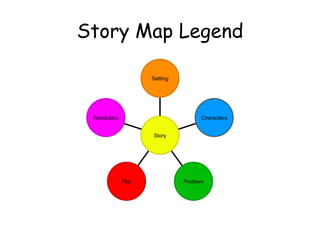
Story Map Legend Resolution Plot Problem Characters Setting Story
How to teach it: Introduce story mapping as a collaborative activity.  Introduce this strategy using a story with an uncomplicated plot.  Read the selection to students.  Encourage students to visualize the characters, settings and events as they listen.  Discuss and chart the main characters and story events.  Review the chart, focusing students' attention on the sequence of main events.  Emphasize what happened first, next, and then . . . .  As students agree upon the order of listed events, number these in sequence.
How to teach it: (cont’d) Individuals or groups could each illustrate one story event.  Display completed illustrations in sequence.  This pattern or framework can be used for retelling the story.  Students can retell the story for their own enjoyment, to a partner, to a small group or to the class.  Story illustrations can be displayed in a vertical or a horizontal sequence, in a circular pattern or as a winding trail that traces the movements of the characters.  Once students become familiar with this procedure, they can create a sequence of illustrations that will provide an outline for storytelling or for writing original stories.
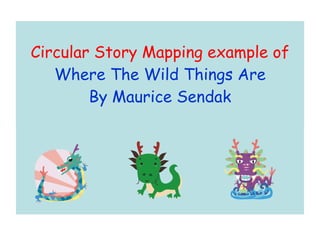
Circular Story Mapping example of  Where The Wild Things Are By Maurice Sendak
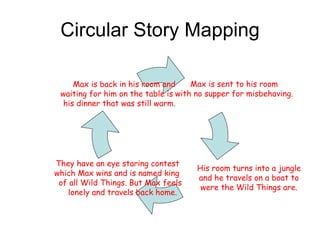
Circular Story Mapping Max is sent to his room with no supper for misbehaving. They have an eye staring contest  which Max wins and is named king  of all Wild Things. But Max feels lonely and travels back home.  Max is back in his room and waiting for him on the table is  his dinner that was still warm. His room turns into a jungle  and he travels on a boat to  were the Wild Things are.
Grade Levels  Can be adaptive to grades K-6 th   Children are at varying levels of cognitive development (Piaget). Kindergarten through Second grade Preoperational: Begin the use of primitive and concrete reasoning. (symbols and images) Third & Fourth grade Concrete Operational & Inductive Reasoning: begin  thinking logically about concrete events.  Fifth & Sixth grade Formal operations & Deductive Reasoning: Ability to hypothesize and mentally manipulate information (abstract thought).
Focus on the basic elements. Beginning, Middle and End Main Characters can be added Rainbow Fish Finds His Way By: Marcus Pfister Kindergarten through 2 nd  Grade Rainbow Fish is back home Rainbow Fish is  Lost Gathering Pebbles Near His Home
3 rd  & 4 th  Grades Focus on the series of major events and actions.  First event, next event, next event, next event Add setting, main characters, problem and solution
An Example of a 3 rd  Graders Circular Story Map
5 th  and 6 th  Grades Focus on the elements of a story and how they are interrelated.  Plot, Setting, Main Character, Supporting Characters, Problem and Solution
References About.Com Retrieved on May 21, 2011. From:http://psychology.about.com/od/piagetstheory/p/preoperational.htm  Primary School by Suite 101 http://www.suite101.com/content/teach-elementary-kids-about-circular-stories-a212382 Saskatoon Public Schools http://olc.spsd.sk.ca/de/pd/instr/strats/storymapping/index.html Vecca et all. (2009). Reading and Learning to Read.  Pearson Education In.  Seventh edition

Circular story mapping

  • 1.
    Circular Story MappingBy: Lora Hammon & Lily Serrano
  • 2.
    What is circularstory mapping? Circular story- Is a story that begins and ends in the same place. (i.e. If You Gave a Mouse a Cookie by Laura Numeroff) Mapping- A story map is a visual depiction of the settings or the sequence of major events and actions of story characters.
  • 3.
    How does thisstrategy aid reading comprehension? to enhance students' interpretative abilities by enabling them to visualize story characters, events and settings to increase students' comprehension of selections by organizing and sequencing main story events to develop students' sense of story which will assist storytelling, retelling and writing to increase students' awareness that story characters and events are interrelated
  • 4.
    Story Map LegendResolution Plot Problem Characters Setting Story
  • 5.
    How to teachit: Introduce story mapping as a collaborative activity. Introduce this strategy using a story with an uncomplicated plot. Read the selection to students. Encourage students to visualize the characters, settings and events as they listen. Discuss and chart the main characters and story events. Review the chart, focusing students' attention on the sequence of main events. Emphasize what happened first, next, and then . . . . As students agree upon the order of listed events, number these in sequence.
  • 6.
    How to teachit: (cont’d) Individuals or groups could each illustrate one story event. Display completed illustrations in sequence. This pattern or framework can be used for retelling the story. Students can retell the story for their own enjoyment, to a partner, to a small group or to the class. Story illustrations can be displayed in a vertical or a horizontal sequence, in a circular pattern or as a winding trail that traces the movements of the characters. Once students become familiar with this procedure, they can create a sequence of illustrations that will provide an outline for storytelling or for writing original stories.
  • 7.
    Circular Story Mappingexample of Where The Wild Things Are By Maurice Sendak
  • 8.
    Circular Story MappingMax is sent to his room with no supper for misbehaving. They have an eye staring contest which Max wins and is named king of all Wild Things. But Max feels lonely and travels back home. Max is back in his room and waiting for him on the table is his dinner that was still warm. His room turns into a jungle and he travels on a boat to were the Wild Things are.
  • 9.
    Grade Levels Can be adaptive to grades K-6 th Children are at varying levels of cognitive development (Piaget). Kindergarten through Second grade Preoperational: Begin the use of primitive and concrete reasoning. (symbols and images) Third & Fourth grade Concrete Operational & Inductive Reasoning: begin thinking logically about concrete events. Fifth & Sixth grade Formal operations & Deductive Reasoning: Ability to hypothesize and mentally manipulate information (abstract thought).
  • 10.
    Focus on thebasic elements. Beginning, Middle and End Main Characters can be added Rainbow Fish Finds His Way By: Marcus Pfister Kindergarten through 2 nd Grade Rainbow Fish is back home Rainbow Fish is Lost Gathering Pebbles Near His Home
  • 11.
    3 rd & 4 th Grades Focus on the series of major events and actions. First event, next event, next event, next event Add setting, main characters, problem and solution
  • 12.
    An Example ofa 3 rd Graders Circular Story Map
  • 13.
    5 th and 6 th Grades Focus on the elements of a story and how they are interrelated. Plot, Setting, Main Character, Supporting Characters, Problem and Solution
  • 14.
    References About.Com Retrievedon May 21, 2011. From:http://psychology.about.com/od/piagetstheory/p/preoperational.htm Primary School by Suite 101 http://www.suite101.com/content/teach-elementary-kids-about-circular-stories-a212382 Saskatoon Public Schools http://olc.spsd.sk.ca/de/pd/instr/strats/storymapping/index.html Vecca et all. (2009). Reading and Learning to Read. Pearson Education In. Seventh edition