CIRCUIT TRAINING
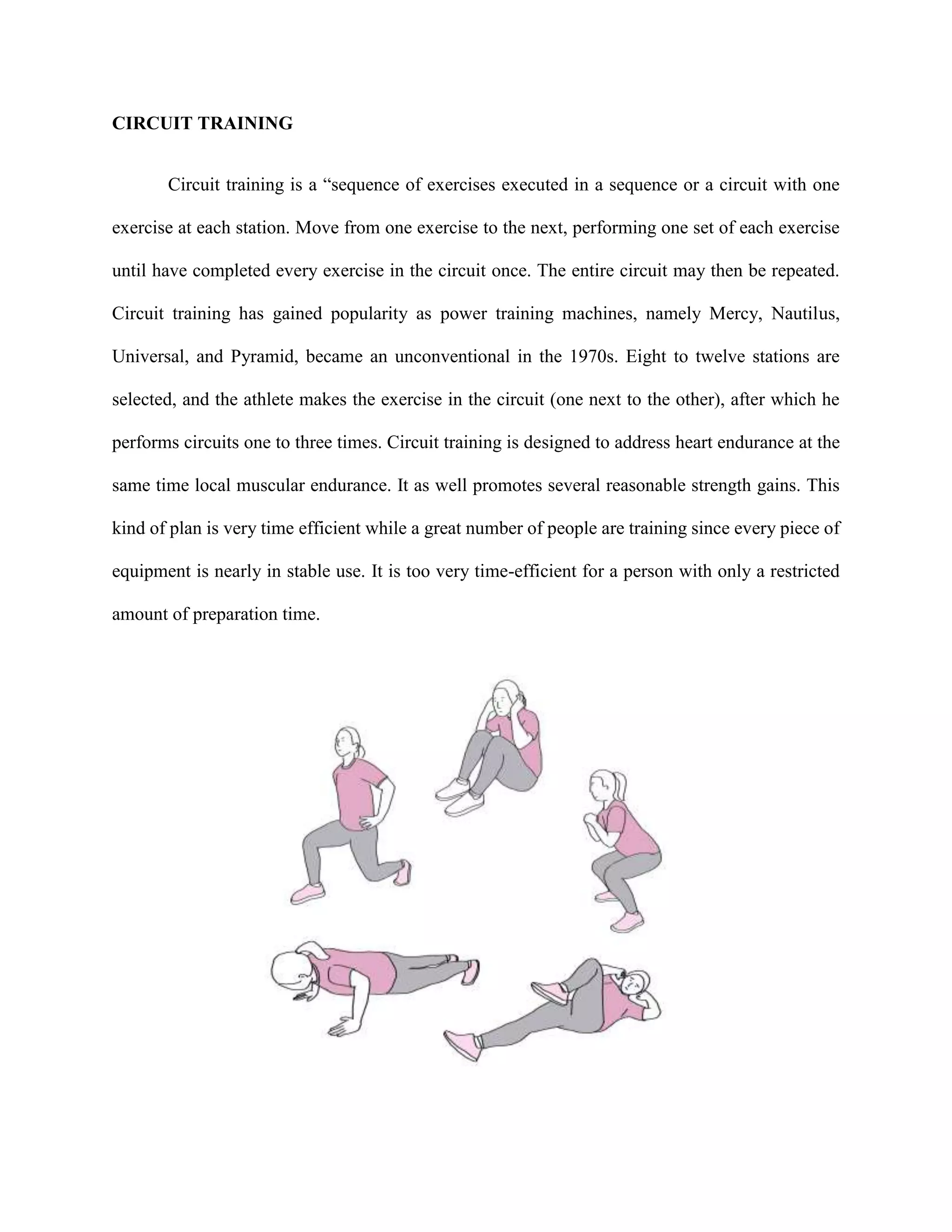
Circuit training is a “sequence of exercises executed in a sequence or a circuit with one
exercise at each station. Move from one exercise to the next, performing one set of each exercise
until have completed every exercise in the circuit once. The entire circuit may then be repeated.
Circuit training has gained popularity as power training machines, namely Mercy, Nautilus,
Universal, and Pyramid, became an unconventional in the 1970s. Eight to twelve stations are
selected, and the athlete makes the exercise in the circuit (one next to the other), after which he
performs circuits one to three times. Circuit training is designed to address heart endurance at the
same time local muscular endurance. It as well promotes several reasonable strength gains. This
kind of plan is very time efficient while a great number of people are training since every piece of
equipment is nearly in stable use. It is too very time-efficient for a person with only a restricted
amount of preparation time.
Circuit training needs that an individual to carry out one set per exercise, alternating among
upper and lower body exercises, with the least res between exercises (about thirty seconds). Then
an individual repeats the circuit if preferred. To make the most of caloric spending through
exercise, integrate as many joint movements as likely. To preserve the revolving among lower and
upper body exercises and make sure stable blood circulation between body parts, more than a few
support exercises need to be built-in.
Circuit training might be a perfect training regimen for people who contain the partial
duration to exercise. This is the source of many fitness centers aimed at the person who wishes to
make a quick rotation of strength exercises. Depending on the time available and the stage of the
situation, people can do up to two or three circuits in one exercise. This type of training will
improve aerobic training well. (Lee E. Brown, 2007).
General benefits of Circuit training
 Cardio vascular fitness
 Muscular strength
 Muscular Endurance
 Flexibility
 Motor fitness (speed, agility, power, coordination, reaction time etc.,)
References
Lee E. Brown, (2007). Strength training. National strength and conditioning association. Human
kinetics. P.No: 301.

Circuit training.docx

  • 1.
    CIRCUIT TRAINING Circuit trainingis a “sequence of exercises executed in a sequence or a circuit with one exercise at each station. Move from one exercise to the next, performing one set of each exercise until have completed every exercise in the circuit once. The entire circuit may then be repeated. Circuit training has gained popularity as power training machines, namely Mercy, Nautilus, Universal, and Pyramid, became an unconventional in the 1970s. Eight to twelve stations are selected, and the athlete makes the exercise in the circuit (one next to the other), after which he performs circuits one to three times. Circuit training is designed to address heart endurance at the same time local muscular endurance. It as well promotes several reasonable strength gains. This kind of plan is very time efficient while a great number of people are training since every piece of equipment is nearly in stable use. It is too very time-efficient for a person with only a restricted amount of preparation time.
  • 2.
    Circuit training needsthat an individual to carry out one set per exercise, alternating among upper and lower body exercises, with the least res between exercises (about thirty seconds). Then an individual repeats the circuit if preferred. To make the most of caloric spending through exercise, integrate as many joint movements as likely. To preserve the revolving among lower and upper body exercises and make sure stable blood circulation between body parts, more than a few support exercises need to be built-in. Circuit training might be a perfect training regimen for people who contain the partial duration to exercise. This is the source of many fitness centers aimed at the person who wishes to make a quick rotation of strength exercises. Depending on the time available and the stage of the situation, people can do up to two or three circuits in one exercise. This type of training will improve aerobic training well. (Lee E. Brown, 2007). General benefits of Circuit training  Cardio vascular fitness  Muscular strength  Muscular Endurance  Flexibility  Motor fitness (speed, agility, power, coordination, reaction time etc.,) References Lee E. Brown, (2007). Strength training. National strength and conditioning association. Human kinetics. P.No: 301.