Refers to a simple economic model which 
describes the reciprocal circulation of income 
between producers and consumers. 
In the circular flow model, the inter-dependent 
entities of producer and consumer 
are referred to as "firms" and "households" 
respectively and provide each other with 
factors in order to facilitate the flow of income. 
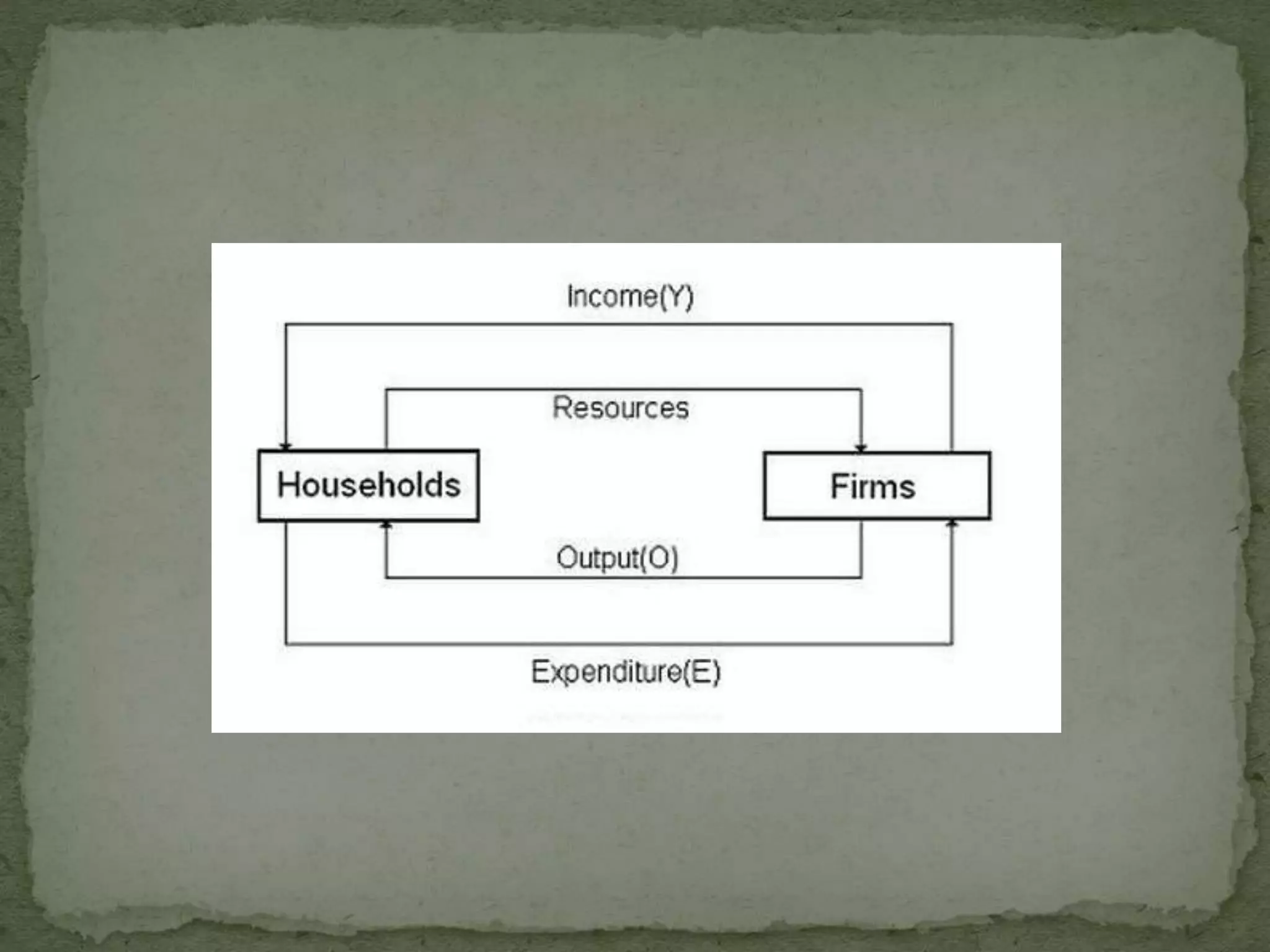
Real Flow and Money Flow. Real Flow- In a 
simple economy, the flow of factor services 
from households to firms and corresponding 
flow of goods and services from firms to 
households s known to be as real flow.
 Provide consumers with goods and services in exchange for consumer 
expenditure and "factors of production" from households. 
 Human wants are unlimited and are of recurring nature therefore, 
production process remains a continuous and demanding process. In 
this process, household sector provides various factors of production 
such as land, labor, capital and enterprise to producers who produce by 
goods and services by coordinating them. Producers or business sector 
in return makes payments in the form of rent, wages, interest and 
profits to the household sector. 
 Household sector spends this income to fulfill its wants in the form of 
consumption expenditure. 
 Business sector supplies those goods and services produced and get 
income in return of it. 
 Thus expenditure of one sector becomes the income of the other and 
supply of goods and services by one section of the community becomes 
demand for the other.
A continuous flow of production, income and 
expenditure is known as circular flow of income. It is 
circular because it has neither any beginning nor an 
end. The circular flow of income involves two basic 
assumptions 
1. In any exchange process, the seller or producer 
receives the same amount what buyer or consumer 
spends. 
2. Goods and services flow in one direction
 In a modern two sector economy, money acts as a 
medium of exchange between goods and factor 
services. 
 Money flow of income refers to a monetary payment 
from firms to households for their factor services and 
in return monetary payments from households to 
firms against their goods and services. 
 Household sector gets monetary reward for their 
services in the form of rent, wages, interest, and profit 
form firm sector and spends it for obtaining various 
types of goods to satisfy their wants. Money acts as a 
helping agent in such an exchange.
 (1) There are only two sectors in the economy; (1) Household Sector 
and (2) Business Sector. 
 (2) The business sector (or the firms) hires factors of production 
owned by the household sector and it is the sole producer of goods and 
services in the economy. 
 (3) The household sector (or the households) is the sole_ buyer of 
goods and services. It spends its entire income on the goods and 
services produced by the business sector. They are also suppliers of 
labour and various of other factors of production. 
 (4) The business sector sells the entire output to households. It does 
not store. There are, therefore, no inventories. 
 (5) The household sector receives income by selling or renting the 
factors of production owned by it 
 (6) Government does not exist for all such practical purposes (No 
public expenditures, no taxes, no subsidies, no social insurance 
contribution, etc.)
 It includes household sector, producing sector and 
government sector. 
 It will study a circular flow income in these sectors 
excluding rest of the world i.e. closed economy income. 
 Here flows from household sector and producing sector to 
government sector are in the form of taxes. 
 The income received from the government sector flows to 
producing and household sector in the form of payments 
for government purchases of goods and services as well as 
payment of subsides and transfer payments. 
 Every payment has a receipt in response of it by which 
aggregate expenditure of an economy becomes identical to 
aggregate income and makes this circular flow and 
unending.
 A modern monetary economy comprises a network of four 
sector economies this are- 
1.Household sector 
2.Firms or producing sector 
3.Government sector 
4.Rest of the world sector. 
 Each of the above sectors receives some payments from the 
other in lieu of goods and services which makes a regular 
flow of goods and physical services. Money facilitates such 
an exchange smoothly. 
 A residual of each market comes in capital market as saving 
which in turn is invested in firms and government sector.
 Measurement of National Income - National income is an estimation of 
aggregation of any of economic activity of the circular flow. It is either 
the income of all the factors of production or the expenditure of various 
sectors of economy. However, aggregate amount of each of the activity is 
identical to each other. 
 Knowledge of Interdependence - Circular flow of income signifies the 
interdependence of each of activity upon one another. If there is no 
consumption, there will be no demand and expenditure which in fact 
restricts the amount of production and income. 
 Unending Nature of Economic Activities - It signifies that production, 
income and expenditure are of unending nature, therefore, economic 
activities in an economy can never come to a halt. National income is 
also bound to rise in future. 
 Injections and Leakages
THANK YOU

Circlular flow of income

  • 2.
    Refers to asimple economic model which describes the reciprocal circulation of income between producers and consumers. In the circular flow model, the inter-dependent entities of producer and consumer are referred to as "firms" and "households" respectively and provide each other with factors in order to facilitate the flow of income. Real Flow and Money Flow. Real Flow- In a simple economy, the flow of factor services from households to firms and corresponding flow of goods and services from firms to households s known to be as real flow.
  • 3.
     Provide consumerswith goods and services in exchange for consumer expenditure and "factors of production" from households.  Human wants are unlimited and are of recurring nature therefore, production process remains a continuous and demanding process. In this process, household sector provides various factors of production such as land, labor, capital and enterprise to producers who produce by goods and services by coordinating them. Producers or business sector in return makes payments in the form of rent, wages, interest and profits to the household sector.  Household sector spends this income to fulfill its wants in the form of consumption expenditure.  Business sector supplies those goods and services produced and get income in return of it.  Thus expenditure of one sector becomes the income of the other and supply of goods and services by one section of the community becomes demand for the other.
  • 4.
    A continuous flowof production, income and expenditure is known as circular flow of income. It is circular because it has neither any beginning nor an end. The circular flow of income involves two basic assumptions 1. In any exchange process, the seller or producer receives the same amount what buyer or consumer spends. 2. Goods and services flow in one direction
  • 5.
     In amodern two sector economy, money acts as a medium of exchange between goods and factor services.  Money flow of income refers to a monetary payment from firms to households for their factor services and in return monetary payments from households to firms against their goods and services.  Household sector gets monetary reward for their services in the form of rent, wages, interest, and profit form firm sector and spends it for obtaining various types of goods to satisfy their wants. Money acts as a helping agent in such an exchange.
  • 6.
     (1) Thereare only two sectors in the economy; (1) Household Sector and (2) Business Sector.  (2) The business sector (or the firms) hires factors of production owned by the household sector and it is the sole producer of goods and services in the economy.  (3) The household sector (or the households) is the sole_ buyer of goods and services. It spends its entire income on the goods and services produced by the business sector. They are also suppliers of labour and various of other factors of production.  (4) The business sector sells the entire output to households. It does not store. There are, therefore, no inventories.  (5) The household sector receives income by selling or renting the factors of production owned by it  (6) Government does not exist for all such practical purposes (No public expenditures, no taxes, no subsidies, no social insurance contribution, etc.)
  • 8.
     It includeshousehold sector, producing sector and government sector.  It will study a circular flow income in these sectors excluding rest of the world i.e. closed economy income.  Here flows from household sector and producing sector to government sector are in the form of taxes.  The income received from the government sector flows to producing and household sector in the form of payments for government purchases of goods and services as well as payment of subsides and transfer payments.  Every payment has a receipt in response of it by which aggregate expenditure of an economy becomes identical to aggregate income and makes this circular flow and unending.
  • 10.
     A modernmonetary economy comprises a network of four sector economies this are- 1.Household sector 2.Firms or producing sector 3.Government sector 4.Rest of the world sector.  Each of the above sectors receives some payments from the other in lieu of goods and services which makes a regular flow of goods and physical services. Money facilitates such an exchange smoothly.  A residual of each market comes in capital market as saving which in turn is invested in firms and government sector.
  • 12.
     Measurement ofNational Income - National income is an estimation of aggregation of any of economic activity of the circular flow. It is either the income of all the factors of production or the expenditure of various sectors of economy. However, aggregate amount of each of the activity is identical to each other.  Knowledge of Interdependence - Circular flow of income signifies the interdependence of each of activity upon one another. If there is no consumption, there will be no demand and expenditure which in fact restricts the amount of production and income.  Unending Nature of Economic Activities - It signifies that production, income and expenditure are of unending nature, therefore, economic activities in an economy can never come to a halt. National income is also bound to rise in future.  Injections and Leakages
  • 13.