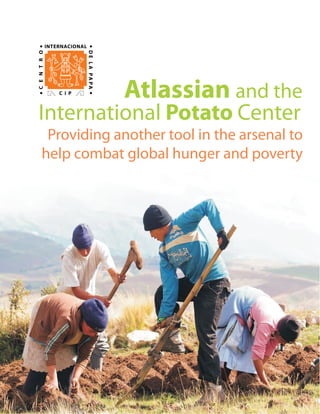
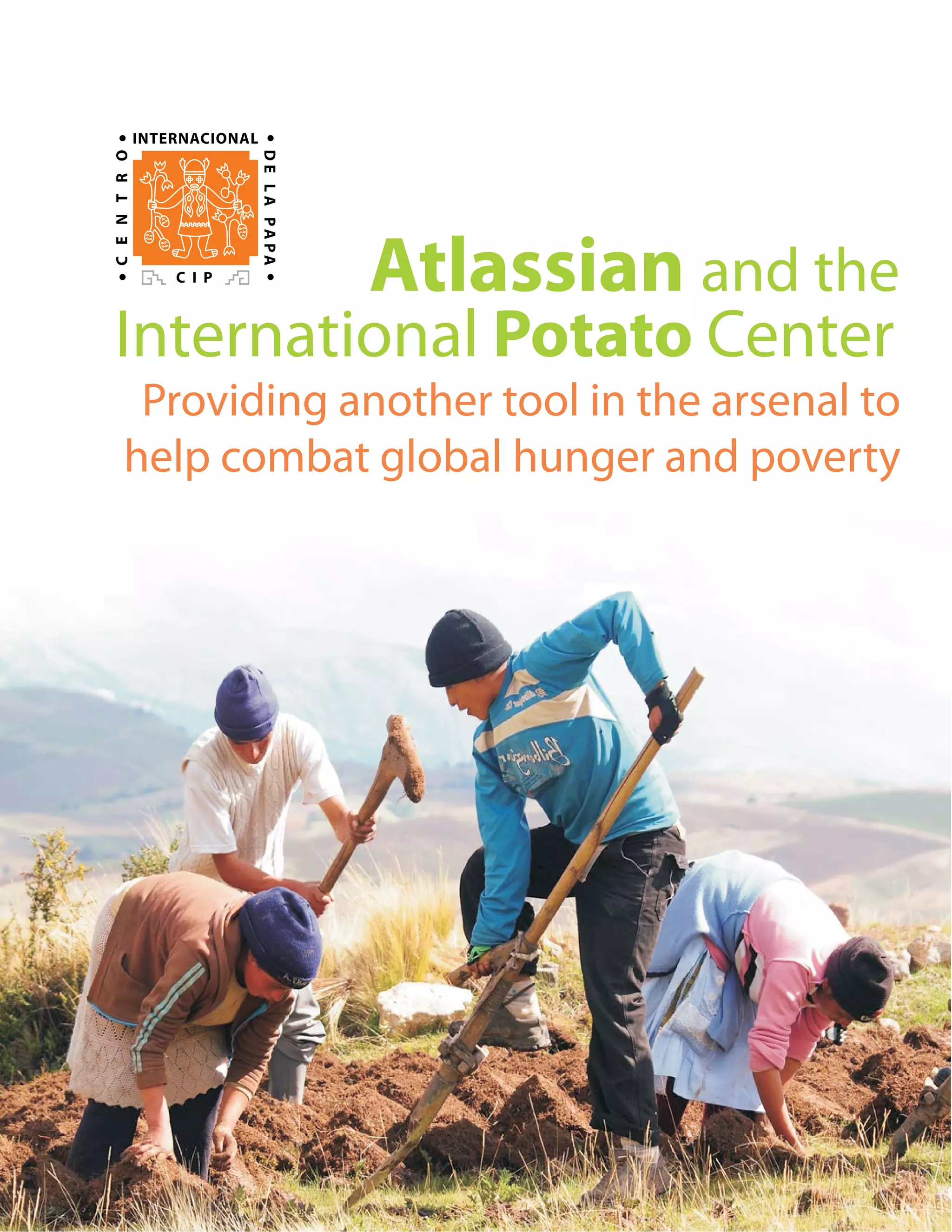
Providing another tool in the arsenal to
help combat global hunger and poverty
Atlassian and the
International Potato Center
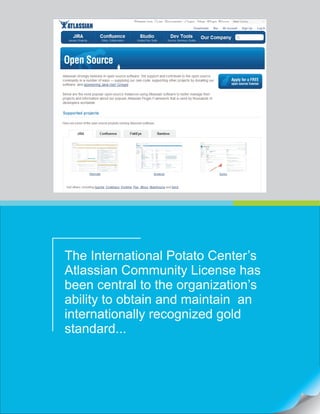
The International Potato Center’s
Atlassian Community License has
been central to the organization’s
ability to obtain and maintain an
internationally recognized gold
standard...
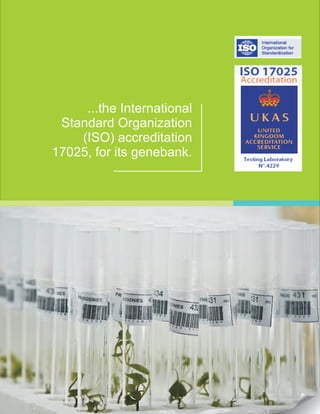
...the International
Standard Organization
(ISO) accreditation
17025, for its genebank.
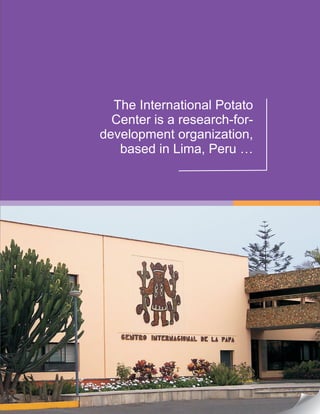
The International Potato
Center is a research-for-
development organization,
based in Lima, Peru …
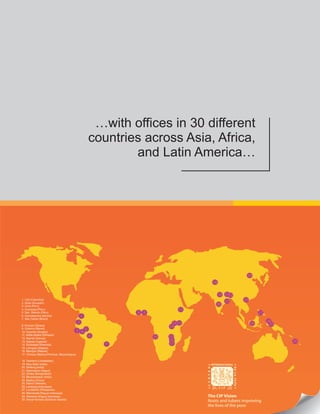
1. Cali (Colombia)
2. Quito (Ecuador)
3. Lima (Peru)
4. Huancayo (Peru)
5. San Ramon (Peru)
6. Cochabamba (Bolivia)
7. Sao Carlos (Brazil)
8. Kumasi (Ghana)
9. Cotonou (Benin)
10. Huambo (Angola)
11. Addis Ababa (Ethiopia)
12. Nairobi (Kenya)
13. Kabale (Uganda)
14. Ruhengeri (Rwanda)
15. Lilongwe (Malawi)
16. Blantyre (Malawi)
17. Chimoio (ManicaProvince, Mozambique)
18. Tashkent (Uzbekistan)
19. New Delhi (India)
20. Shillong(India)
21. Kathmandu (Nepal)
22. Dhaka (Bangladesh)
23. Bhubaneswar (India)
24. Beijing (China)
25. Hanoi (Vietnam)
26. Lembang (Indonesia)
27. Los Baños (Philippines)
28. Manokwari (Papua Indonesia)
29. Wamena (Papua Indonesia)
30. Honar Honiara (Solomon Islands)
…with offices in 30 different
countries across Asia, Africa,
and Latin America…
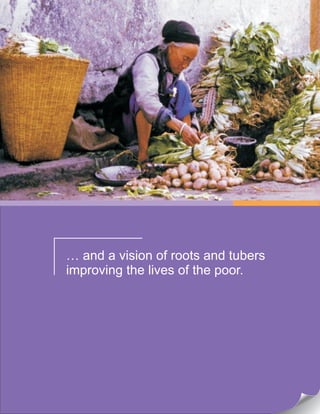
… and a vision of roots and tubers
improving the lives of the poor.
Known by its Spanish acronym
CIP, [pronounced “sip”]...
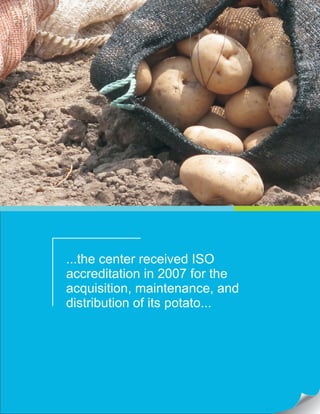
...the center received ISO
accreditation in 2007 for the
acquisition, maintenance, and
distribution of its potato...
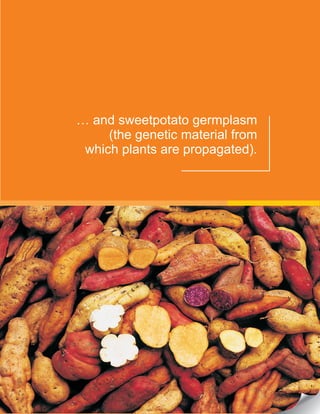
… and sweetpotato germplasm
(the genetic material from
which plants are propagated).
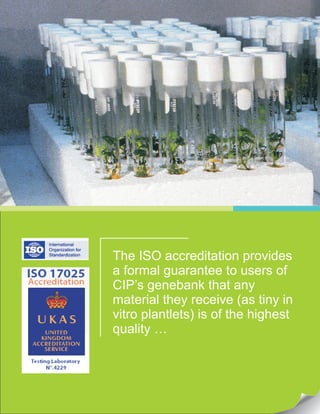
The ISO accreditation provides
a formal guarantee to users of
CIP’s genebank that any
material they receive (as tiny in
vitro plantlets) is of the highest
quality …
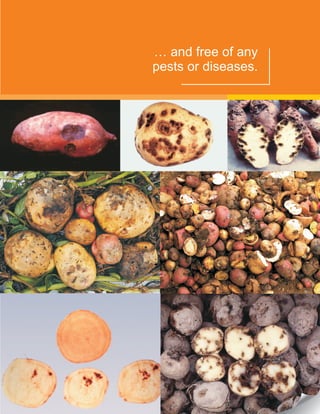
… and free of any
pests or diseases.
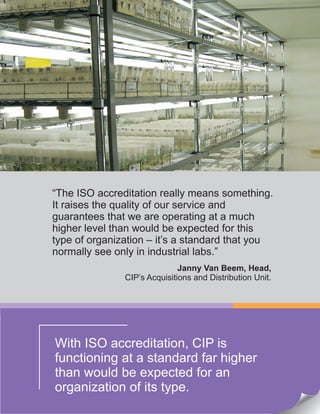
With ISO accreditation, CIP is
functioning at a standard far higher
than would be expected for an
organization of its type.
“The ISO accreditation really means something.
It raises the quality of our service and
guarantees that we are operating at a much
higher level than would be expected for this
type of organization – it’s a standard that you
normally see only in industrial labs.”
Janny Van Beem, Head,
CIP’s Acquisitions and Distribution Unit.
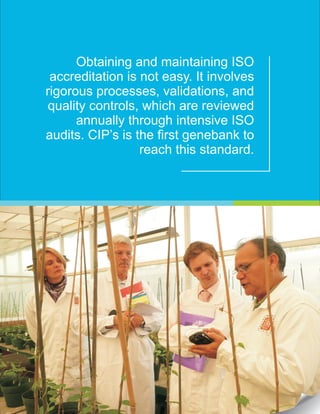
Obtaining and maintaining ISO
accreditation is not easy. It involves
rigorous processes, validations, and
quality controls, which are reviewed
annually through intensive ISO
audits. CIP’s is the first genebank to
reach this standard.
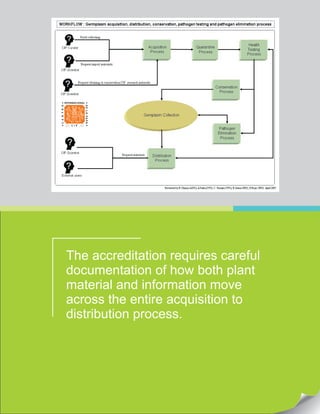
The accreditation requires careful
documentation of how both plant
material and information move
across the entire acquisition to
distribution process.
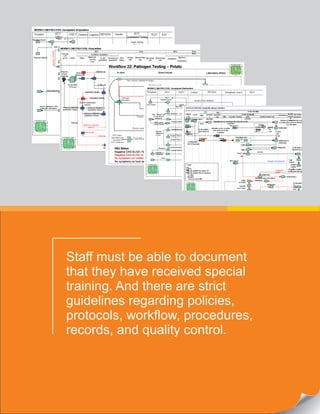
Staff must be able to document
that they have received special
training. And there are strict
guidelines regarding policies,
protocols, workflow, procedures,
records, and quality control.
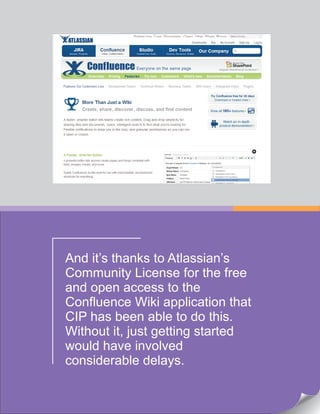
And it’s thanks to Atlassian’s
Community License for the free
and open access to the
Confluence Wiki application that
CIP has been able to do this.
Without it, just getting started
would have involved
considerable delays.
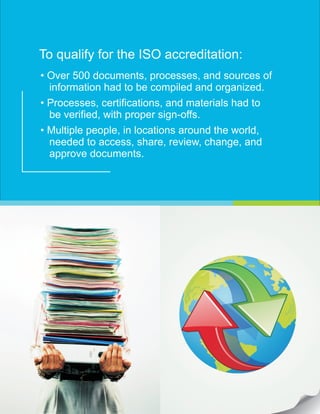
To qualify for the ISO accreditation:
• Over 500 documents, processes, and sources of
information had to be compiled and organized.
• Processes, certifications, and materials had to
be verified, with proper sign-offs.
• Multiple people, in locations around the world,
needed to access, share, review, change, and
approve documents.
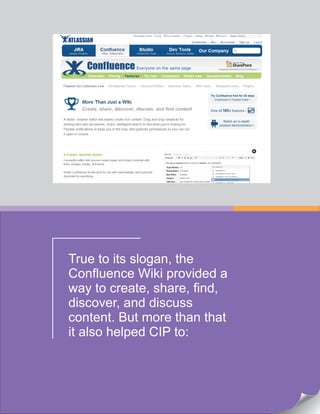
True to its slogan, the
Confluence Wiki provided a
way to create, share, find,
discover, and discuss
content. But more than that
it also helped CIP to:
Save an enormous amount of time.
We were able to compile and validate
the material needed for the
accreditation process in 6 months
instead of usual 1-2 years required.
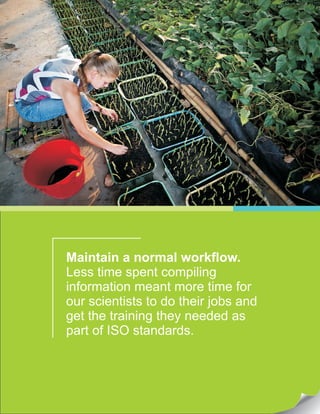
Maintain a normal workflow.
Less time spent compiling
information meant more time for
our scientists to do their jobs and
get the training they needed as
part of ISO standards.
Stay on schedule.
All aspects of the acquisition,
management, and distribution of
germplasm were brought into the
system, with participation from staff
of the genebank, pathogen testing,
distribution, administration, and
research informatics.
Save costs.
The time savings led to big cost
savings. But also, the shared platform
of the Wiki meant that we could train
staff on formats, paperwork, and work
flows more efficiently and effectively.
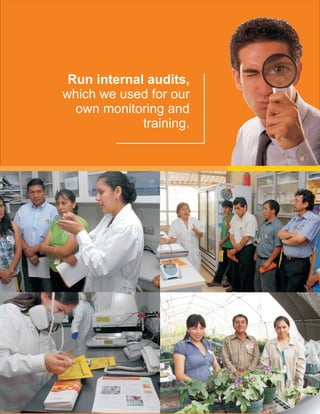
Run internal audits,
which we used for our
own monitoring and
training.
And go green.
The paper-less system helped save
trees. The collaborative software and
remote access for multiple users cut
down on the amount of travel needed
to bring people together from around
the globe – reducing the project’s
carbon footprint.
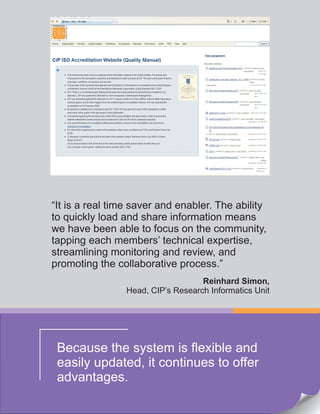
“It is a real time saver and enabler. The ability
to quickly load and share information means
we have been able to focus on the community,
tapping each members’ technical expertise,
streamlining monitoring and review, and
promoting the collaborative process.”
Reinhard Simon,
Head, CIP’s Research Informatics Unit
Because the system is flexible and
easily updated, it continues to offer
advantages.
Why does it matter?
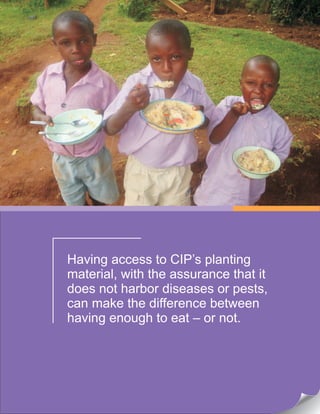
Having access to CIP’s planting
material, with the assurance that it
does not harbor diseases or pests,
can make the difference between
having enough to eat – or not.
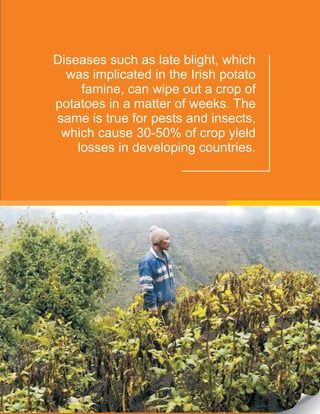
Diseases such as late blight, which
was implicated in the Irish potato
famine, can wipe out a crop of
potatoes in a matter of weeks. The
same is true for pests and insects,
which cause 30-50% of crop yield
losses in developing countries.
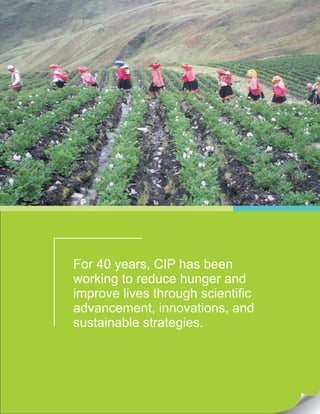
For 40 years, CIP has been
working to reduce hunger and
improve lives through scientific
advancement, innovations, and
sustainable strategies.
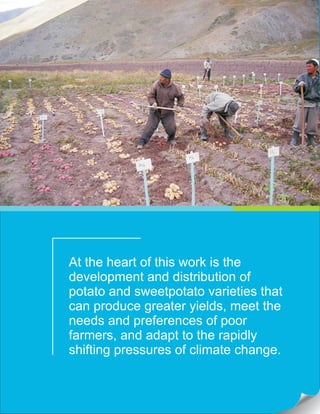
At the heart of this work is the
development and distribution of
potato and sweetpotato varieties that
can produce greater yields, meet the
needs and preferences of poor
farmers, and adapt to the rapidly
shifting pressures of climate change.
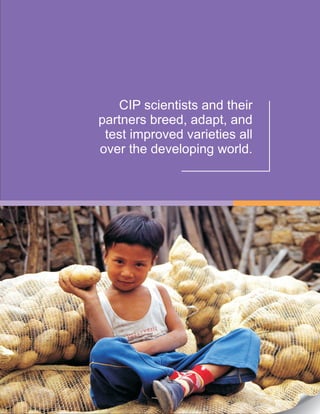
CIP scientists and their
partners breed, adapt, and
test improved varieties all
over the developing world.
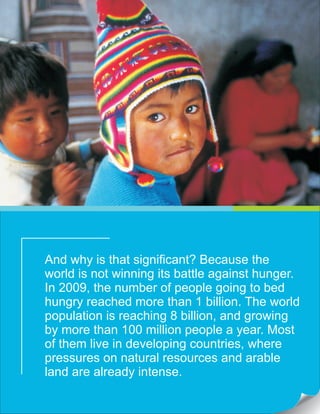
And why is that significant? Because the
world is not winning its battle against hunger.
In 2009, the number of people going to bed
hungry reached more than 1 billion. The world
population is reaching 8 billion, and growing
by more than 100 million people a year. Most
of them live in developing countries, where
pressures on natural resources and arable
land are already intense.
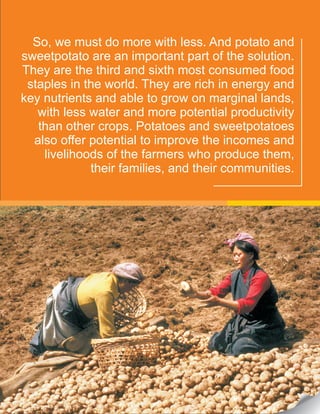
So, we must do more with less. And potato and
sweetpotato are an important part of the solution.
They are the third and sixth most consumed food
staples in the world. They are rich in energy and
key nutrients and able to grow on marginal lands,
with less water and more potential productivity
than other crops. Potatoes and sweetpotatoes
also offer potential to improve the incomes and
livelihoods of the farmers who produce them,
their families, and their communities.
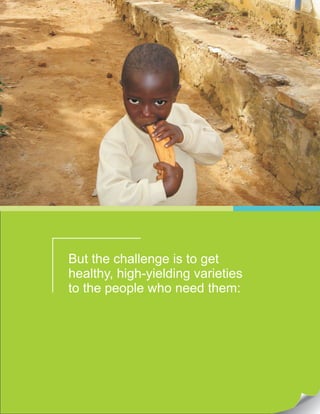
But the challenge is to get
healthy, high-yielding varieties
to the people who need them:
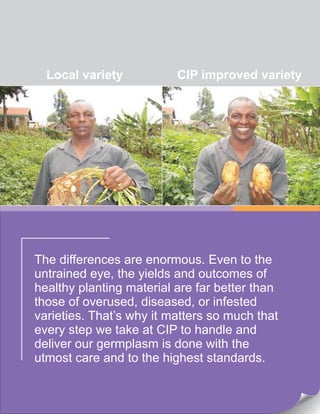
The differences are enormous. Even to the
untrained eye, the yields and outcomes of
healthy planting material are far better than
those of overused, diseased, or infested
varieties. That’s why it matters so much that
every step we take at CIP to handle and
deliver our germplasm is done with the
utmost care and to the highest standards.
Local variety CIP improved variety
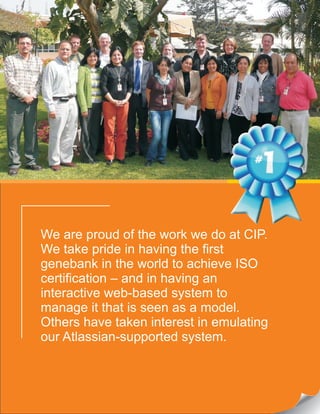
We are proud of the work we do at CIP.
We take pride in having the first
genebank in the world to achieve ISO
certification – and in having an
interactive web-based system to
manage it that is seen as a model.
Others have taken interest in emulating
our Atlassian-supported system.
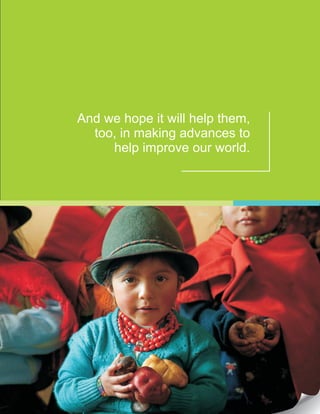
And we hope it will help them,
too, in making advances to
help improve our world.
International Potato Center (CIP)
PO Box 1558 Lima 12
Peru 51 1 349 6017
Visit us at: www.cipotato.org
CIP’s Atlassian Community License
Providing another tool in the arsenal to
help combat global hunger and poverty
Prepared by:
Valerie Gwinner
Reinhard Simon
International Potato Center
April 2011

CIP Do-Gooder Entry

  • 1.
    Providing another toolin the arsenal to help combat global hunger and poverty Atlassian and the International Potato Center
  • 2.
    The International PotatoCenter’s Atlassian Community License has been central to the organization’s ability to obtain and maintain an internationally recognized gold standard...
  • 3.
    ...the International Standard Organization (ISO)accreditation 17025, for its genebank.
  • 4.
    The International Potato Centeris a research-for- development organization, based in Lima, Peru …
  • 5.
    1. Cali (Colombia) 2.Quito (Ecuador) 3. Lima (Peru) 4. Huancayo (Peru) 5. San Ramon (Peru) 6. Cochabamba (Bolivia) 7. Sao Carlos (Brazil) 8. Kumasi (Ghana) 9. Cotonou (Benin) 10. Huambo (Angola) 11. Addis Ababa (Ethiopia) 12. Nairobi (Kenya) 13. Kabale (Uganda) 14. Ruhengeri (Rwanda) 15. Lilongwe (Malawi) 16. Blantyre (Malawi) 17. Chimoio (ManicaProvince, Mozambique) 18. Tashkent (Uzbekistan) 19. New Delhi (India) 20. Shillong(India) 21. Kathmandu (Nepal) 22. Dhaka (Bangladesh) 23. Bhubaneswar (India) 24. Beijing (China) 25. Hanoi (Vietnam) 26. Lembang (Indonesia) 27. Los Baños (Philippines) 28. Manokwari (Papua Indonesia) 29. Wamena (Papua Indonesia) 30. Honar Honiara (Solomon Islands) …with offices in 30 different countries across Asia, Africa, and Latin America…
  • 6.
    … and avision of roots and tubers improving the lives of the poor.
  • 7.
    Known by itsSpanish acronym CIP, [pronounced “sip”]...
  • 8.
    ...the center receivedISO accreditation in 2007 for the acquisition, maintenance, and distribution of its potato...
  • 9.
    … and sweetpotatogermplasm (the genetic material from which plants are propagated).
  • 10.
    The ISO accreditationprovides a formal guarantee to users of CIP’s genebank that any material they receive (as tiny in vitro plantlets) is of the highest quality …
  • 11.
    … and freeof any pests or diseases.
  • 12.
    With ISO accreditation,CIP is functioning at a standard far higher than would be expected for an organization of its type. “The ISO accreditation really means something. It raises the quality of our service and guarantees that we are operating at a much higher level than would be expected for this type of organization – it’s a standard that you normally see only in industrial labs.” Janny Van Beem, Head, CIP’s Acquisitions and Distribution Unit.
  • 13.
    Obtaining and maintainingISO accreditation is not easy. It involves rigorous processes, validations, and quality controls, which are reviewed annually through intensive ISO audits. CIP’s is the first genebank to reach this standard.
  • 14.
    The accreditation requirescareful documentation of how both plant material and information move across the entire acquisition to distribution process.
  • 15.
    Staff must beable to document that they have received special training. And there are strict guidelines regarding policies, protocols, workflow, procedures, records, and quality control.
  • 16.
    And it’s thanksto Atlassian’s Community License for the free and open access to the Confluence Wiki application that CIP has been able to do this. Without it, just getting started would have involved considerable delays.
  • 17.
    To qualify forthe ISO accreditation: • Over 500 documents, processes, and sources of information had to be compiled and organized. • Processes, certifications, and materials had to be verified, with proper sign-offs. • Multiple people, in locations around the world, needed to access, share, review, change, and approve documents.
  • 18.
    True to itsslogan, the Confluence Wiki provided a way to create, share, find, discover, and discuss content. But more than that it also helped CIP to:
  • 19.
    Save an enormousamount of time. We were able to compile and validate the material needed for the accreditation process in 6 months instead of usual 1-2 years required.
  • 20.
    Maintain a normalworkflow. Less time spent compiling information meant more time for our scientists to do their jobs and get the training they needed as part of ISO standards.
  • 21.
    Stay on schedule. Allaspects of the acquisition, management, and distribution of germplasm were brought into the system, with participation from staff of the genebank, pathogen testing, distribution, administration, and research informatics.
  • 22.
    Save costs. The timesavings led to big cost savings. But also, the shared platform of the Wiki meant that we could train staff on formats, paperwork, and work flows more efficiently and effectively.
  • 23.
    Run internal audits, whichwe used for our own monitoring and training.
  • 24.
    And go green. Thepaper-less system helped save trees. The collaborative software and remote access for multiple users cut down on the amount of travel needed to bring people together from around the globe – reducing the project’s carbon footprint.
  • 25.
    “It is areal time saver and enabler. The ability to quickly load and share information means we have been able to focus on the community, tapping each members’ technical expertise, streamlining monitoring and review, and promoting the collaborative process.” Reinhard Simon, Head, CIP’s Research Informatics Unit Because the system is flexible and easily updated, it continues to offer advantages.
  • 26.
    Why does itmatter?
  • 27.
    Having access toCIP’s planting material, with the assurance that it does not harbor diseases or pests, can make the difference between having enough to eat – or not.
  • 28.
    Diseases such aslate blight, which was implicated in the Irish potato famine, can wipe out a crop of potatoes in a matter of weeks. The same is true for pests and insects, which cause 30-50% of crop yield losses in developing countries.
  • 29.
    For 40 years,CIP has been working to reduce hunger and improve lives through scientific advancement, innovations, and sustainable strategies.
  • 30.
    At the heartof this work is the development and distribution of potato and sweetpotato varieties that can produce greater yields, meet the needs and preferences of poor farmers, and adapt to the rapidly shifting pressures of climate change.
  • 31.
    CIP scientists andtheir partners breed, adapt, and test improved varieties all over the developing world.
  • 32.
    And why isthat significant? Because the world is not winning its battle against hunger. In 2009, the number of people going to bed hungry reached more than 1 billion. The world population is reaching 8 billion, and growing by more than 100 million people a year. Most of them live in developing countries, where pressures on natural resources and arable land are already intense.
  • 33.
    So, we mustdo more with less. And potato and sweetpotato are an important part of the solution. They are the third and sixth most consumed food staples in the world. They are rich in energy and key nutrients and able to grow on marginal lands, with less water and more potential productivity than other crops. Potatoes and sweetpotatoes also offer potential to improve the incomes and livelihoods of the farmers who produce them, their families, and their communities.
  • 34.
    But the challengeis to get healthy, high-yielding varieties to the people who need them:
  • 35.
    The differences areenormous. Even to the untrained eye, the yields and outcomes of healthy planting material are far better than those of overused, diseased, or infested varieties. That’s why it matters so much that every step we take at CIP to handle and deliver our germplasm is done with the utmost care and to the highest standards. Local variety CIP improved variety
  • 36.
    We are proudof the work we do at CIP. We take pride in having the first genebank in the world to achieve ISO certification – and in having an interactive web-based system to manage it that is seen as a model. Others have taken interest in emulating our Atlassian-supported system.
  • 37.
    And we hopeit will help them, too, in making advances to help improve our world.
  • 38.
    International Potato Center(CIP) PO Box 1558 Lima 12 Peru 51 1 349 6017 Visit us at: www.cipotato.org
  • 39.
    CIP’s Atlassian CommunityLicense Providing another tool in the arsenal to help combat global hunger and poverty Prepared by: Valerie Gwinner Reinhard Simon International Potato Center April 2011