1
Customer Churn
Analysis and
Prediction
William Chen
Margaret Ji
Catherine Ruan
Overview
Goals
§ Use the consumer dataset to:
§ Segment the Fulton Bank customer base
§ Build a model that predicts customer churn
Agenda
2
Data processing
Customer segmentation
Feature scoring and predictive model implementation
Business recommendations
1
2
3
4
Data Processing
Objective § Prepare data for analysis by removing and modifying data
Numerical/Binary Categorical Balances Missing Totals
§ Keep columns
containing
relevant
characteristics of
customer
segments
§ Find appropriate
level of detail
§ One-hot encode
3
• Set missing
balances to
-10,000
• Use smooth
symmetric log
scaling
§ Fill blank cells with
0’s or -1’s
depending on
context
125 Columns
Customer Segmentation
Objective § Figure out if consumers naturally fall into certain groups
Methods
§ Dimensionality reduction
§ Finding the optimal number of segments
§ Clustering
§ Segment analysis
4
Churn
Behaviors
Results
Customer Segmentation
Objective § Find a more concise representation of data
Method
§ Dimensionality reduction
§ Autoencoder
§ Principal Component
Analysis
§ Performance analysis
§ Reconstruction loss
5
Reconstructed Data vs. Actual
Data
Percent of Data Described
Customer Segmentation
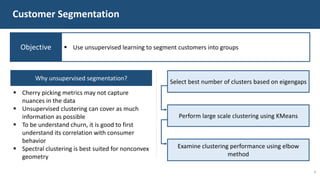
Objective § Use unsupervised learning to segment customers into groups
Why unsupervised segmentation?
§ Cherry picking metrics may not capture
nuances in the data
§ Unsupervised clustering can cover as much
information as possible
§ To be understand churn, it is good to first
understand its correlation with consumer
behavior
§ Spectral clustering is best suited for nonconvex
geometry
6
Select best number of clusters based on eigengaps
Perform large scale clustering using KMeans
Examine clustering performance using elbow
method
Customer Segmentation
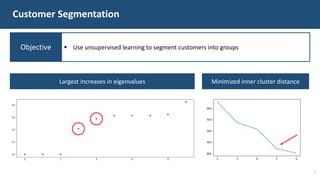
Objective § Use unsupervised learning to segment customers into groups
7
Largest increases in eigenvalues Minimized inner cluster distance
Customer Segmentation
8
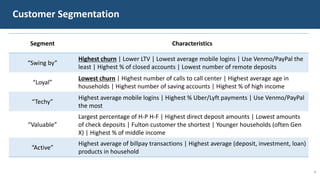
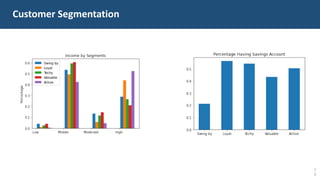
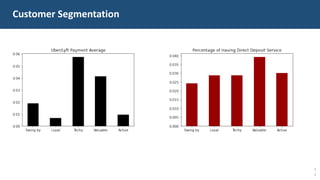
Segment Characteristics
“Swing by”
Highest churn | Lower LTV | Lowest average mobile logins | Use Venmo/PayPal the
least | Highest % of closed accounts | Lowest number of remote deposits
“Loyal”
Lowest churn | Highest number of calls to call center | Highest average age in
households | Highest number of saving accounts | Highest % of high income
“Techy”
Highest average mobile logins | Highest % Uber/Lyft payments | Use Venmo/PayPal
the most
“Valuable”
Largest percentage of H-P H-F | Highest direct deposit amounts | Lowest amounts
of check deposits | Fulton customer the shortest | Younger households (often Gen
X) | Highest % of middle income
“Active”
Highest average of billpay transactions | Highest average (deposit, investment, loan)
products in household
Customer Segmentation
9
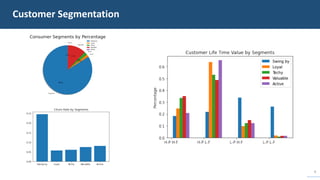
Customer Segmentation
1
0
Customer Segmentation
1
1
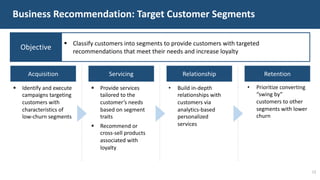
Business Recommendation: Target Customer Segments
Objective
§ Classify customers into segments to provide customers with targeted
recommendations that meet their needs and increase loyalty
Acquisition Servicing Relationship Retention
§ Identify and execute
campaigns targeting
customers with
characteristics of
low-churn segments
§ Provide services
tailored to the
customer’s needs
based on segment
traits
§ Recommend or
cross-sell products
associated with
loyalty
12
• Build in-depth
relationships with
customers via
analytics-based
personalized
services
• Prioritize converting
“swing by”
customers to other
segments with lower
churn
Feature Scoring Procedure
Objective § Which features are giving the most improvements to accuracy in a nonlinear model?
13
125 Choose 2 = 7750 Columns
Fit 7750 Random Forests
(Each column will be in 124 of the models)
Distribution of average accuracies for each model that a column participated in
Scored column as the equally weighted average of the mean, median, 90th percentile, and max of the
distribution
Graphed column scores and picked a natural cutoff point
Feature/Column Scoring Results
14
Top Scoring Columns
Bottom Scoring Columns
Score by Sorted Column Index
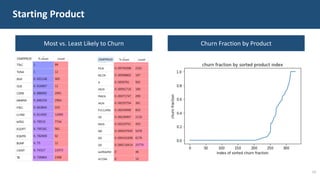
Starting Product
15
Most vs. Least Likely to Churn Churn Fraction by Product
Predictive Model Implementation
Objective § Design a model that predicts whether a household churns or is kept
16
Method Implementation Notes
§ Nonlinear model allows for complex interaction
§ By using “class_weight = ‘balanced’” in the model, we make sure the accuracy on the kept households
and churned households are prioritized equally
§ Since there are fewer churned HH, the precision suffers, but this is in line with business intuition of losing
a customer is more expensive than the cost to keep an existing customer from churning
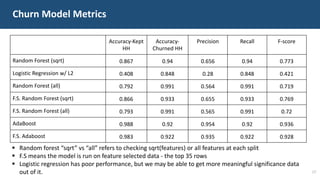
Churn Model Metrics
17
§ Random forest “sqrt” vs “all” refers to checking sqrt(features) or all features at each split
§ F.S means the model is run on feature selected data - the top 35 rows
§ Logistic regression has poor performance, but we may be able to get more meaningful significance data
out of it.
Accuracy-Kept
HH
Accuracy-
Churned HH
Precision Recall F-score
Random Forest (sqrt) 0.867 0.94 0.656 0.94 0.773
Logistic Regression w/ L2 0.408 0.848 0.28 0.848 0.421
Random Forest (all) 0.792 0.991 0.564 0.991 0.719
F.S. Random Forest (sqrt) 0.866 0.933 0.655 0.933 0.769
F.S. Random Forest (all) 0.793 0.991 0.565 0.991 0.72
AdaBoost 0.988 0.92 0.954 0.92 0.936
F.S. Adaboost 0.983 0.922 0.935 0.922 0.928
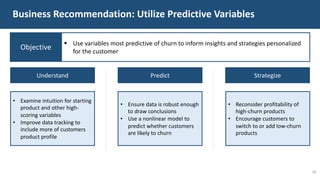
Business Recommendation: Utilize Predictive Variables
Understand Predict Strategize
18
• Examine intuition for starting
product and other high-
scoring variables
• Improve data tracking to
include more of customers
product profile
• Ensure data is robust enough
to draw conclusions
• Use a nonlinear model to
predict whether customers
are likely to churn
• Reconsider profitability of
high-churn products
• Encourage customers to
switch to or add low-churn
products
Objective
§ Use variables most predictive of churn to inform insights and strategies personalized
for the customer
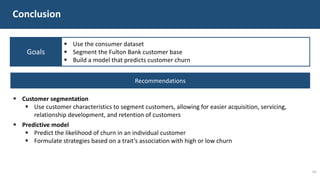
Conclusion
Goals
§ Use the consumer dataset
§ Segment the Fulton Bank customer base
§ Build a model that predicts customer churn
Recommendations
§ Customer segmentation
§ Use customer characteristics to segment customers, allowing for easier acquisition, servicing,
relationship development, and retention of customers
§ Predictive model
§ Predict the likelihood of churn in an individual customer
§ Formulate strategies based on a trait’s association with high or low churn
19

Churn analysis

  • 1.
    1 Customer Churn Analysis and Prediction WilliamChen Margaret Ji Catherine Ruan
  • 2.
    Overview Goals § Use theconsumer dataset to: § Segment the Fulton Bank customer base § Build a model that predicts customer churn Agenda 2 Data processing Customer segmentation Feature scoring and predictive model implementation Business recommendations 1 2 3 4
  • 3.
    Data Processing Objective §Prepare data for analysis by removing and modifying data Numerical/Binary Categorical Balances Missing Totals § Keep columns containing relevant characteristics of customer segments § Find appropriate level of detail § One-hot encode 3 • Set missing balances to -10,000 • Use smooth symmetric log scaling § Fill blank cells with 0’s or -1’s depending on context 125 Columns
  • 4.
    Customer Segmentation Objective §Figure out if consumers naturally fall into certain groups Methods § Dimensionality reduction § Finding the optimal number of segments § Clustering § Segment analysis 4 Churn Behaviors Results
  • 5.
    Customer Segmentation Objective §Find a more concise representation of data Method § Dimensionality reduction § Autoencoder § Principal Component Analysis § Performance analysis § Reconstruction loss 5 Reconstructed Data vs. Actual Data Percent of Data Described
  • 6.
    Customer Segmentation Objective §Use unsupervised learning to segment customers into groups Why unsupervised segmentation? § Cherry picking metrics may not capture nuances in the data § Unsupervised clustering can cover as much information as possible § To be understand churn, it is good to first understand its correlation with consumer behavior § Spectral clustering is best suited for nonconvex geometry 6 Select best number of clusters based on eigengaps Perform large scale clustering using KMeans Examine clustering performance using elbow method
  • 7.
    Customer Segmentation Objective §Use unsupervised learning to segment customers into groups 7 Largest increases in eigenvalues Minimized inner cluster distance
  • 8.
    Customer Segmentation 8 Segment Characteristics “Swingby” Highest churn | Lower LTV | Lowest average mobile logins | Use Venmo/PayPal the least | Highest % of closed accounts | Lowest number of remote deposits “Loyal” Lowest churn | Highest number of calls to call center | Highest average age in households | Highest number of saving accounts | Highest % of high income “Techy” Highest average mobile logins | Highest % Uber/Lyft payments | Use Venmo/PayPal the most “Valuable” Largest percentage of H-P H-F | Highest direct deposit amounts | Lowest amounts of check deposits | Fulton customer the shortest | Younger households (often Gen X) | Highest % of middle income “Active” Highest average of billpay transactions | Highest average (deposit, investment, loan) products in household
  • 9.
  • 10.
  • 11.
  • 12.
    Business Recommendation: TargetCustomer Segments Objective § Classify customers into segments to provide customers with targeted recommendations that meet their needs and increase loyalty Acquisition Servicing Relationship Retention § Identify and execute campaigns targeting customers with characteristics of low-churn segments § Provide services tailored to the customer’s needs based on segment traits § Recommend or cross-sell products associated with loyalty 12 • Build in-depth relationships with customers via analytics-based personalized services • Prioritize converting “swing by” customers to other segments with lower churn
  • 13.
    Feature Scoring Procedure Objective§ Which features are giving the most improvements to accuracy in a nonlinear model? 13 125 Choose 2 = 7750 Columns Fit 7750 Random Forests (Each column will be in 124 of the models) Distribution of average accuracies for each model that a column participated in Scored column as the equally weighted average of the mean, median, 90th percentile, and max of the distribution Graphed column scores and picked a natural cutoff point
  • 14.
    Feature/Column Scoring Results 14 TopScoring Columns Bottom Scoring Columns Score by Sorted Column Index
  • 15.
    Starting Product 15 Most vs.Least Likely to Churn Churn Fraction by Product
  • 16.
    Predictive Model Implementation Objective§ Design a model that predicts whether a household churns or is kept 16 Method Implementation Notes § Nonlinear model allows for complex interaction § By using “class_weight = ‘balanced’” in the model, we make sure the accuracy on the kept households and churned households are prioritized equally § Since there are fewer churned HH, the precision suffers, but this is in line with business intuition of losing a customer is more expensive than the cost to keep an existing customer from churning
  • 17.
    Churn Model Metrics 17 §Random forest “sqrt” vs “all” refers to checking sqrt(features) or all features at each split § F.S means the model is run on feature selected data - the top 35 rows § Logistic regression has poor performance, but we may be able to get more meaningful significance data out of it. Accuracy-Kept HH Accuracy- Churned HH Precision Recall F-score Random Forest (sqrt) 0.867 0.94 0.656 0.94 0.773 Logistic Regression w/ L2 0.408 0.848 0.28 0.848 0.421 Random Forest (all) 0.792 0.991 0.564 0.991 0.719 F.S. Random Forest (sqrt) 0.866 0.933 0.655 0.933 0.769 F.S. Random Forest (all) 0.793 0.991 0.565 0.991 0.72 AdaBoost 0.988 0.92 0.954 0.92 0.936 F.S. Adaboost 0.983 0.922 0.935 0.922 0.928
  • 18.
    Business Recommendation: UtilizePredictive Variables Understand Predict Strategize 18 • Examine intuition for starting product and other high- scoring variables • Improve data tracking to include more of customers product profile • Ensure data is robust enough to draw conclusions • Use a nonlinear model to predict whether customers are likely to churn • Reconsider profitability of high-churn products • Encourage customers to switch to or add low-churn products Objective § Use variables most predictive of churn to inform insights and strategies personalized for the customer
  • 19.
    Conclusion Goals § Use theconsumer dataset § Segment the Fulton Bank customer base § Build a model that predicts customer churn Recommendations § Customer segmentation § Use customer characteristics to segment customers, allowing for easier acquisition, servicing, relationship development, and retention of customers § Predictive model § Predict the likelihood of churn in an individual customer § Formulate strategies based on a trait’s association with high or low churn 19