







6 STAGES OF
CHURCH PLANTING
1
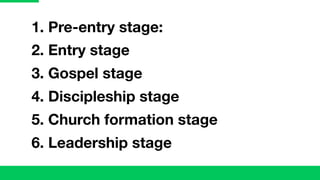
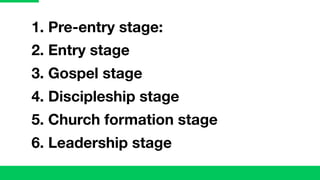
1. Pre-entry stage:
2. Entry stage
3. Gospel stage
4. Discipleship stage
5. Church formation stage
6. Leadership stage
Note that these are broad stages which are
designed to help the CP team see what they
are doing and where they are in terms of the
planting process.
“What have we done, what are we
doing, are we doing things well?”
These stages can take place at the same
time - there will be overlap evangelism-born
again-making disciples, all at the same time.
As the CP develops there should be a
movement through the stages.
What generally takes place in each
stage?
Personal Opinion: Church planting is
birthed and lived out in prayer and
intercession. There is a strong link
between P&I and accomplishing all the
Lord has told us to do.
1. PRE-ENTRY STAGE
The basic question is: What do we need to do
before arriving and how will we do it?
This is everything that is done by the team
before arriving on location.
	 -	Developing as a team
	 -	Studying the culture and context, via books
etc. and conversations
	 -	Learning languages
-	Identifying places to live
	 -	Finding a local job
	 -	Identifying, and solving, anything you think
needs doing before arrival
In your location what would you do
before starting a church plant in a
new village?
2. ENTRY STAGE
The basic question is: How do we enter the
location?
Everything the team does as they arrive.
This is about your entry as outsiders into a
community:
	 -	How do we connect with neighbours?
-	Getting to know and understand the
community
	 -	Starting to share the Gospel / living an
evangelistic lifestyle
The team can ask about their own gifts,
skills, passions etc. and how these can
help them to engage the people they are
working amongst.
3.GOSPEL STAGE
The basic question is: How do we connect with
people and share the gospel?
•	Everything the team does to share the
Gospel; in word or action.
	 •	Share the Gospel at all times and with all
peoples.
•	There should be deliberate reliance upon the
Spirit of God.
James Harvey in Nashville uses this approach:
1. Let people know that I am a follower of
Jesus Christ as soon as possible
James Harvey in Nashville uses this approach:
1. Let people know that I am a follower of
Jesus Christ as soon as possible
2. Offer to pray God’s blessing for them
James Harvey in Nashville uses this approach:
1. Let people know that I am a follower of
Jesus Christ as soon as possible
2. Offer to pray God’s blessing for them
3. Ask if they would be interested in
studying the Bible in their own homes
This is Harveys comment about his method, “We
use this approach to quickly get to the gospel.
This method works here but probably would not
work well in a different cultural context.”
Harvey suggests that the church:
	 -	look for houses of peace, Lk 10:5-6
	 -	look for the spiritually hungry
	 -	are open to the prompting of the Holy Spirit
4. DISCIPLESHIP STAGE
The basic question is: What is necessary for short-
term and long-term discipleship?
Evangelism is the start of obeying the Great
Commission.
Faith in Jesus is followed by a process of
disciple making.
The CP team has to equip and empower men
and women to walk as disciples.
Main question: What do these people need for
immediate short-term discipleship and for long-
term discipleship?
This stage is strongly connected to the next stage
and involves emphasis on baptism and teaching
core spiritual disciplines.
1. Pre-entry stage:
2. Entry stage
3. Gospel stage
4. Discipleship stage
5. Church formation stage
6. Leadership stage
5. CHURCH FORMATION
STAGE:
The basic question is: How will we lead the new
believers to self-identity as a church and organise
themselves for mission?
New believers need to identify as a local
church.
Care is taken to teach them biblical
ecclesiology.
Nathan and Kari Shank write that it is
important for the new believers to ask
questions such as:
	 (1)	Who is the church?
	 (2)	When do we meet?
(3)	Where do we meet?
	 (4)	Why do we meet?
	 (5)	What do we do?
This stage also includes leading the church
to appoint elders, mentoring those elders
and partnering with the new church to plant
other churches.
6. LEADERSHIP STAGE
The basic question is: How will we model and
teach leadership and work with the new believers
to appoint pastors?
Leadership development starts with	
proclaiming the Gospel…from the moment of
sharing the Gospel you are showing what it
means to be a leader in the KOG.
It is important that throughout each of these
stages the CP team are working with the end
in mind—that means thinking they will be
departing and leaving a new church (without
them).
The CP team wants to leave a local church
engaged in mission with its own leaders.
This thinking shapes all decision making
through the stages of planting.
Common idea is of a scaffold used in new
buildings.
The scaffold is always temporary .
SUMMARY
	 •	Knowing the big picture is helpful for developing
the strategy.
	 •	The church-planting process can be thought of
as six stages (pre-entry, entry, gospel,
discipleship, church and leadership).
•	The stages overlap at times—they are not
mutually exclusive.
	 •	The leadership stage runs parallel to the
gospel, discipleship and church stages.
•	The stages emphasise both reaching and
teaching new believers.
	 •	Phase-out forces the team to begin with its
end in mind.
	 •	The team should think of themselves as a
scaffold—a temporary, supportive structure.
The End

Church planting 5

  • 1.
  • 2.
    1. Pre-entry stage: 2.Entry stage 3. Gospel stage 4. Discipleship stage 5. Church formation stage 6. Leadership stage
  • 3.
    Note that theseare broad stages which are designed to help the CP team see what they are doing and where they are in terms of the planting process. “What have we done, what are we doing, are we doing things well?”
  • 4.
    These stages cantake place at the same time - there will be overlap evangelism-born again-making disciples, all at the same time. As the CP develops there should be a movement through the stages.
  • 5.
    What generally takesplace in each stage?
  • 7.
    Personal Opinion: Churchplanting is birthed and lived out in prayer and intercession. There is a strong link between P&I and accomplishing all the Lord has told us to do.
  • 8.
    1. PRE-ENTRY STAGE Thebasic question is: What do we need to do before arriving and how will we do it?
  • 9.
    This is everythingthat is done by the team before arriving on location. - Developing as a team - Studying the culture and context, via books etc. and conversations - Learning languages
  • 10.
    - Identifying places tolive - Finding a local job - Identifying, and solving, anything you think needs doing before arrival
  • 11.
    In your locationwhat would you do before starting a church plant in a new village?
  • 12.
    2. ENTRY STAGE Thebasic question is: How do we enter the location? Everything the team does as they arrive.
  • 13.
    This is aboutyour entry as outsiders into a community: - How do we connect with neighbours?
  • 14.
    - Getting to knowand understand the community - Starting to share the Gospel / living an evangelistic lifestyle
  • 15.
    The team canask about their own gifts, skills, passions etc. and how these can help them to engage the people they are working amongst.
  • 16.
    3.GOSPEL STAGE The basicquestion is: How do we connect with people and share the gospel?
  • 17.
    • Everything the teamdoes to share the Gospel; in word or action. • Share the Gospel at all times and with all peoples.
  • 18.
    • There should bedeliberate reliance upon the Spirit of God.
  • 20.
    James Harvey inNashville uses this approach:
  • 21.
    James Harvey inNashville uses this approach: 1. Let people know that I am a follower of Jesus Christ as soon as possible
  • 22.
    James Harvey inNashville uses this approach: 1. Let people know that I am a follower of Jesus Christ as soon as possible 2. Offer to pray God’s blessing for them
  • 23.
    James Harvey inNashville uses this approach: 1. Let people know that I am a follower of Jesus Christ as soon as possible 2. Offer to pray God’s blessing for them 3. Ask if they would be interested in studying the Bible in their own homes
  • 24.
    This is Harveyscomment about his method, “We use this approach to quickly get to the gospel. This method works here but probably would not work well in a different cultural context.”
  • 25.
    Harvey suggests thatthe church: - look for houses of peace, Lk 10:5-6 - look for the spiritually hungry - are open to the prompting of the Holy Spirit
  • 26.
    4. DISCIPLESHIP STAGE Thebasic question is: What is necessary for short- term and long-term discipleship?
  • 27.
    Evangelism is thestart of obeying the Great Commission. Faith in Jesus is followed by a process of disciple making.
  • 28.
    The CP teamhas to equip and empower men and women to walk as disciples.
  • 29.
    Main question: Whatdo these people need for immediate short-term discipleship and for long- term discipleship?
  • 30.
    This stage isstrongly connected to the next stage and involves emphasis on baptism and teaching core spiritual disciplines.
  • 31.
    1. Pre-entry stage: 2.Entry stage 3. Gospel stage 4. Discipleship stage 5. Church formation stage 6. Leadership stage
  • 32.
    5. CHURCH FORMATION STAGE: Thebasic question is: How will we lead the new believers to self-identity as a church and organise themselves for mission?
  • 33.
    New believers needto identify as a local church. Care is taken to teach them biblical ecclesiology.
  • 34.
    Nathan and KariShank write that it is important for the new believers to ask questions such as: (1) Who is the church? (2) When do we meet?
  • 35.
    (3) Where do wemeet? (4) Why do we meet? (5) What do we do?
  • 36.
    This stage alsoincludes leading the church to appoint elders, mentoring those elders and partnering with the new church to plant other churches.
  • 37.
    6. LEADERSHIP STAGE Thebasic question is: How will we model and teach leadership and work with the new believers to appoint pastors?
  • 38.
    Leadership development startswith proclaiming the Gospel…from the moment of sharing the Gospel you are showing what it means to be a leader in the KOG.
  • 39.
    It is importantthat throughout each of these stages the CP team are working with the end in mind—that means thinking they will be departing and leaving a new church (without them).
  • 40.
    The CP teamwants to leave a local church engaged in mission with its own leaders. This thinking shapes all decision making through the stages of planting.
  • 41.
    Common idea isof a scaffold used in new buildings. The scaffold is always temporary .
  • 42.
    SUMMARY • Knowing thebig picture is helpful for developing the strategy. • The church-planting process can be thought of as six stages (pre-entry, entry, gospel, discipleship, church and leadership).
  • 43.
    • The stages overlapat times—they are not mutually exclusive. • The leadership stage runs parallel to the gospel, discipleship and church stages.
  • 44.
    • The stages emphasiseboth reaching and teaching new believers. • Phase-out forces the team to begin with its end in mind. • The team should think of themselves as a scaffold—a temporary, supportive structure.
  • 45.