Making an Impact – Collective
Actions Towards SCP Conference

              “Meeting in the Middle”
     Hosted by: the European Economic and Social Committee


                  Marta Szigeti Bonifert
                   Executive Director
The REC
•  “… is an international organisation with
   a mission to assist in solving
   environmental problems (…)”
     •  The REC is legally based on a charter
        signed by the governments of 29
        countries and the EC
     •  Multi-stakeholder International Board
     •  190 staff (some 30 nationalities)
     •  12 million Euro annual turnover
     •  Offices in 17 countries
     •  Operations beyond Central and
        Eastern Europe
     •  100% project based organization (over
        300 running projects)
     •  Project portfolio is handled by Topic
        Area system
            •  SCP Topic Area

                                                www.rec.org
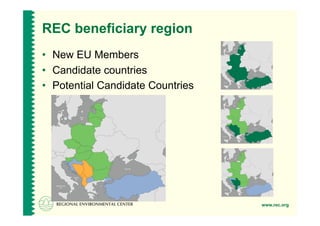
REC beneficiary region
•  New EU Members
•  Candidate countries
•  Potential Candidate Countries


                                   www.rec.org
"The battle against climate change must be
fought on all fronts and everyone must contribute.
It is not only the remit of companies and
governments; consumers also have their part to
play. By purchasing environmentally and climate-
friendly products individual customers send the
right signal to producers who respond in turn by
producing more eco-friendly products."
         EU Environment Commissioner Stavros Dimas July 2009


                                                     www.rec.org
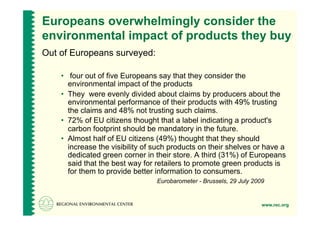
Europeans overwhelmingly consider the
environmental impact of products they buy
Out of Europeans surveyed:

    •  four out of five Europeans say that they consider the
       environmental impact of the products
    •  They were evenly divided about claims by producers about the
       environmental performance of their products with 49% trusting
       the claims and 48% not trusting such claims.
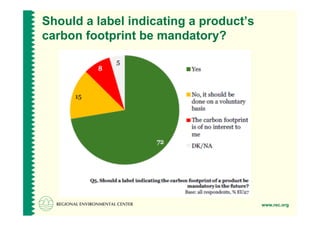
    •  72% of EU citizens thought that a label indicating a product's
       carbon footprint should be mandatory in the future.
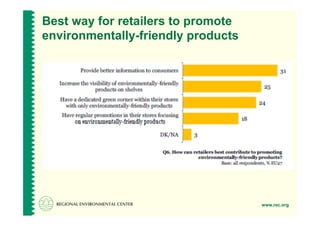
    •  Almost half of EU citizens (49%) thought that they should
       increase the visibility of such products on their shelves or have a
       dedicated green corner in their store. A third (31%) of Europeans
       said that the best way for retailers to promote green products is
       for them to provide better information to consumers.
                                 Eurobarometer - Brussels, 29 July 2009


                                                                      www.rec.org
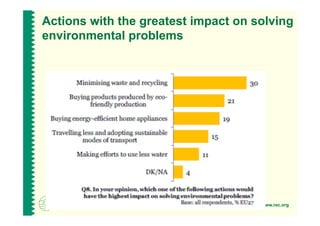
Actions with the greatest impact on solving
environmental problems


                                     www.rec.org
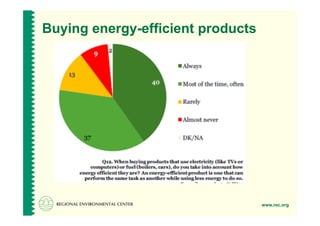
Buying energy-efficient products


                                   www.rec.org
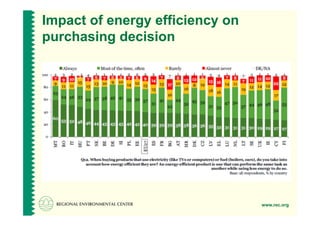
Impact of energy efficiency on
purchasing decision


                                 www.rec.org
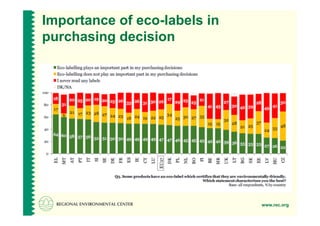
Importance of eco-labels in
purchasing decision


                              www.rec.org
Should a label indicating a product’s
carbon footprint be mandatory?


                                        www.rec.org
Best way for retailers to promote
environmentally-friendly products


                                    www.rec.org
How
  do you

      promote SCP

           in your region?

                             www.rec.org
How do you promote SCP in your
region?
•  SCP Topic Area (SCP TA) under the thematic cluster
   “Sustainable management and use of natural resources”
    •  Several of our projects, even if they are implemented under
       other TAs or thematic clusters are directly related to SCP
•  As one of the main building blocks of our project-based
   activities, the REC works closely together with the EEA
   via its Topic Centres on SCP (earlier on resource and
   waste management) and Climate Change
    •  In the Topic Centres we are in general responsible for our region
       at the same time we also contribute to their work in the EU15
       region
          •  e.g. by developing methods for reporting etc.
          •  REC is a regular contributor e.g. to the EEA’s State of the
             Environment in Europe report (SCP and waste chapters), but
             also to other relevant regular and non-regular EEA reports


                                                                   www.rec.org
Examples of relevant projects


                                www.rec.org
Examples of relevant projects
•    Other examples:
       •  The role of the EU Eco-label in Green Public Procurement
       •  Guidelines to national authorities on how to prepare national waste prevention
          programmes
       •  In general trainings to governmental officials on sustainable development
          (Course for Sustainability) and the REC’s Green Pack etc. are also very relevant

       •  Country Office Hungary runs the Hungarian “SCP network” and is implementing
          the project “Campaign to promote environmentally aware and healthier
          consumption patterns and to green the retail sector”

       •  SEE region
               •  Promotion of Green Public Procurement (2008/09): first steps “planting the seeds of
                  GPP” as it is very novel area of policy in the region
               •  Promotion of high-efficiency household appliances (2009/10): explore what
                  governments and retailers can do to enhance the markets for high-efficiency
                  household appliances and to promote the use of the EU Energy Label
               •  Promoting Financing Mechanisms for Eco-Innovation (2008/09): the objective was
                  to identify existing and potential mechanisms for the stimulation and financing eco-
                  innovation in the selected SEE countries


                                                                                           www.rec.org
www.rec.org
What is in the moment urgent in the
SCP policy agenda in your region?
•  It is necessary to create a better understanding
   of what SCP is and why it is important,
   •  i.e. what the interrelations are between the economy,
      the environment and social wellbeing, not only in
      general, but also in the particular sub-regional /
      national context.
        •  (It is important to note that NMSs and also SEE countries
           have many distinctive features e.g. lower levels of
           consumption and household waste generation, many
           times good, although deteriorating public transport
           infrastructure etc., at the same time higher energy
           intensity, lower levels of environmental awareness etc.,
           finally cultural factors and values, attitudes etc. are also
           very important.)
                                                                www.rec.org
„Radical” change: the roots


“The problem is not simply economic and
  technological; it is moral and spiritual. A
  solution at the economic and technological
  level can be found only if we undergo, in the
  most radical way, an inner change of heart,
  which can lead to a change in lifestyle and of
  unsustainable patterns of consumption and
  production.”
                  The Venice Declaration on Environmental Ethics, June 2002


                                                                     www.rec.org
Thank You for Your Attention!

Regional Environmental Center for CEE countries

  • 1.
    Making an Impact– Collective Actions Towards SCP Conference “Meeting in the Middle” Hosted by: the European Economic and Social Committee Marta Szigeti Bonifert Executive Director
  • 2.
    The REC •  “…is an international organisation with a mission to assist in solving environmental problems (…)” •  The REC is legally based on a charter signed by the governments of 29 countries and the EC •  Multi-stakeholder International Board •  190 staff (some 30 nationalities) •  12 million Euro annual turnover •  Offices in 17 countries •  Operations beyond Central and Eastern Europe •  100% project based organization (over 300 running projects) •  Project portfolio is handled by Topic Area system •  SCP Topic Area www.rec.org
  • 3.
    REC beneficiary region • New EU Members •  Candidate countries •  Potential Candidate Countries www.rec.org
  • 4.
    "The battle againstclimate change must be fought on all fronts and everyone must contribute. It is not only the remit of companies and governments; consumers also have their part to play. By purchasing environmentally and climate- friendly products individual customers send the right signal to producers who respond in turn by producing more eco-friendly products." EU Environment Commissioner Stavros Dimas July 2009 www.rec.org
  • 5.
    Europeans overwhelmingly considerthe environmental impact of products they buy Out of Europeans surveyed: •  four out of five Europeans say that they consider the environmental impact of the products •  They were evenly divided about claims by producers about the environmental performance of their products with 49% trusting the claims and 48% not trusting such claims. •  72% of EU citizens thought that a label indicating a product's carbon footprint should be mandatory in the future. •  Almost half of EU citizens (49%) thought that they should increase the visibility of such products on their shelves or have a dedicated green corner in their store. A third (31%) of Europeans said that the best way for retailers to promote green products is for them to provide better information to consumers. Eurobarometer - Brussels, 29 July 2009 www.rec.org
  • 6.
    Actions with thegreatest impact on solving environmental problems www.rec.org
  • 7.
  • 8.
    Impact of energyefficiency on purchasing decision www.rec.org
  • 9.
    Importance of eco-labelsin purchasing decision www.rec.org
  • 10.
    Should a labelindicating a product’s carbon footprint be mandatory? www.rec.org
  • 11.
    Best way forretailers to promote environmentally-friendly products www.rec.org
  • 12.
    How doyou promote SCP in your region? www.rec.org
  • 13.
    How do youpromote SCP in your region? •  SCP Topic Area (SCP TA) under the thematic cluster “Sustainable management and use of natural resources” •  Several of our projects, even if they are implemented under other TAs or thematic clusters are directly related to SCP •  As one of the main building blocks of our project-based activities, the REC works closely together with the EEA via its Topic Centres on SCP (earlier on resource and waste management) and Climate Change •  In the Topic Centres we are in general responsible for our region at the same time we also contribute to their work in the EU15 region •  e.g. by developing methods for reporting etc. •  REC is a regular contributor e.g. to the EEA’s State of the Environment in Europe report (SCP and waste chapters), but also to other relevant regular and non-regular EEA reports www.rec.org
  • 14.
    Examples of relevantprojects www.rec.org
  • 15.
    Examples of relevantprojects •  Other examples: •  The role of the EU Eco-label in Green Public Procurement •  Guidelines to national authorities on how to prepare national waste prevention programmes •  In general trainings to governmental officials on sustainable development (Course for Sustainability) and the REC’s Green Pack etc. are also very relevant •  Country Office Hungary runs the Hungarian “SCP network” and is implementing the project “Campaign to promote environmentally aware and healthier consumption patterns and to green the retail sector” •  SEE region •  Promotion of Green Public Procurement (2008/09): first steps “planting the seeds of GPP” as it is very novel area of policy in the region •  Promotion of high-efficiency household appliances (2009/10): explore what governments and retailers can do to enhance the markets for high-efficiency household appliances and to promote the use of the EU Energy Label •  Promoting Financing Mechanisms for Eco-Innovation (2008/09): the objective was to identify existing and potential mechanisms for the stimulation and financing eco- innovation in the selected SEE countries www.rec.org
  • 16.
  • 17.
    What is inthe moment urgent in the SCP policy agenda in your region? •  It is necessary to create a better understanding of what SCP is and why it is important, •  i.e. what the interrelations are between the economy, the environment and social wellbeing, not only in general, but also in the particular sub-regional / national context. •  (It is important to note that NMSs and also SEE countries have many distinctive features e.g. lower levels of consumption and household waste generation, many times good, although deteriorating public transport infrastructure etc., at the same time higher energy intensity, lower levels of environmental awareness etc., finally cultural factors and values, attitudes etc. are also very important.) www.rec.org
  • 18.
    „Radical” change: theroots “The problem is not simply economic and technological; it is moral and spiritual. A solution at the economic and technological level can be found only if we undergo, in the most radical way, an inner change of heart, which can lead to a change in lifestyle and of unsustainable patterns of consumption and production.” The Venice Declaration on Environmental Ethics, June 2002 www.rec.org
  • 19.
    Thank You forYour Attention!