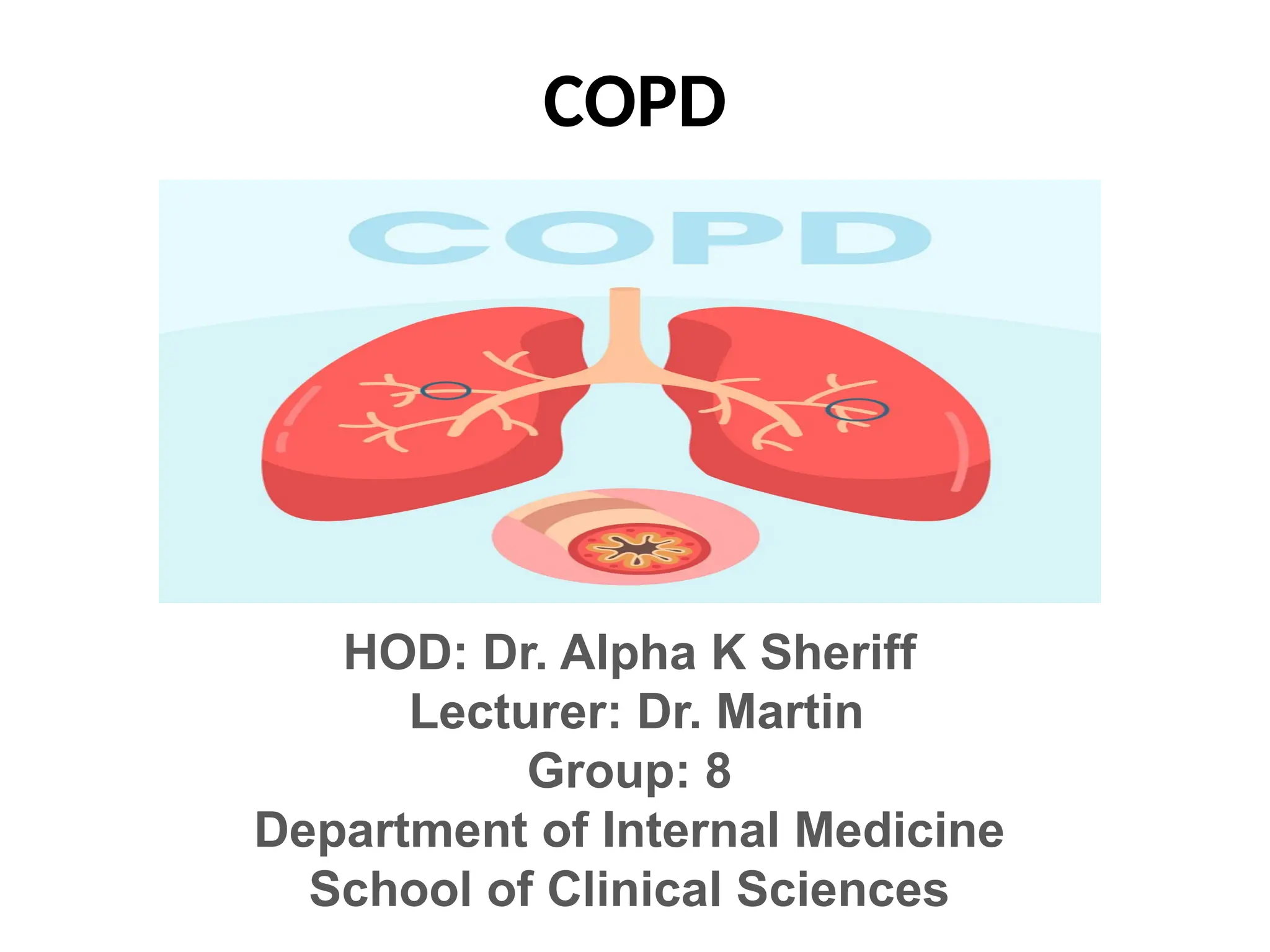
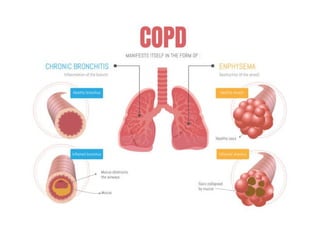
COPD
HOD: Dr. Alpha K Sheriff
Lecturer: Dr. Martin
Group: 8
Department of Internal Medicine
School of Clinical Sciences
NAMES OF GROUP MEMBERS AND ID
NUMBERS
1. Fatima Zainab Kamara 22044
2. Isata Kattie Koroma 22058
3. Mohamed Saidu Mansaray 22064
4. Patricia King Conteh 22016
5. Mariama M. Bendu 22011
6. Precious Faith Kanu 22048
7. Isatu N. Turay 22081
8. Ramatulai Sall 22068
OUTLINE
• Introduction (Definition)
• Etiology & Risk factors
• Pathophysiology
• Common presentations of COPD
• Emphysema
• Chronic Bronchitis
• Bronchiectasis
• Investigations
• management
• Questions
• Summary
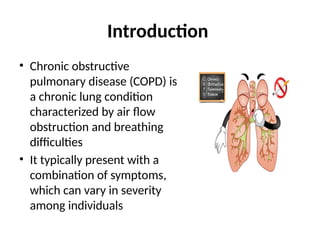
Introduction
• Chronic obstructive
pulmonary disease (COPD) is
a chronic lung condition
characterized by air flow
obstruction and breathing
difficulties
• It typically present with a
combination of symptoms,
which can vary in severity
among individuals
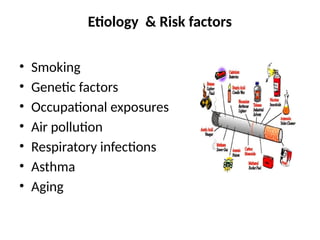
Etiology & Risk factors
• Smoking
• Genetic factors
• Occupational exposures
• Air pollution
• Respiratory infections
• Asthma
• Aging
Pathophysiology
• The pathophysiology of COPD involves a
complex interplay of various factors, which
includes:
Genetic predisposition ands
Environmental pollutants
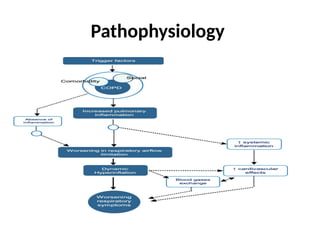
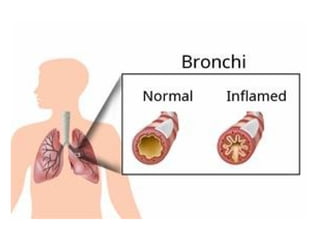
Pathophysiology
Common features – signs & symptoms
• Progressive breathlessness
• Chronic cough
• Increased sputum production
• Wheezing
• Chest tightness
• Fatigue
• Recurrent respiratory infections
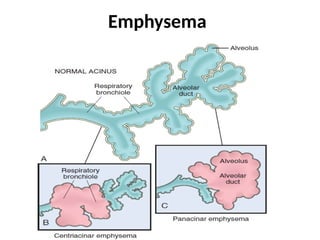
Emphysema
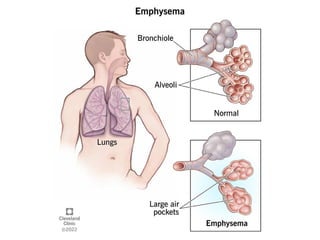
• Emphysema is characterized by permanent
enlargement of the air spaces distal to the
terminal bronchioles, accompanied by
destruction of their walls without significant
fibrosis.
N.B. the acinus is the structure distal to
terminal bronchioles, and a cluster of three to
five acini is called a lobule
Emphysema
• There are four major types of emphysema:
• (1) centriacinar, (2) panacinar, (3) distal acinar,
and (4) irregular.
• Only the first two types cause significant
airway obstruction, with centriacinar
emphysema being about 20 times more
common than panacinar disease.
Emphysema
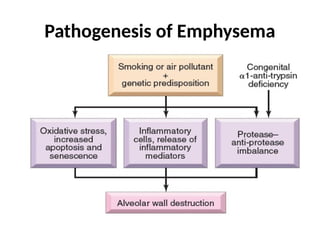
Pathogenesis of Emphysema
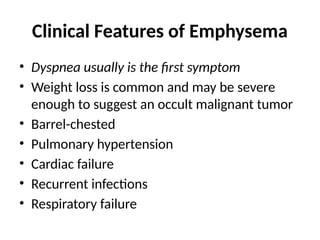
Clinical Features of Emphysema
• Dyspnea usually is the first symptom
• Weight loss is common and may be severe
enough to suggest an occult malignant tumor
• Barrel-chested
• Pulmonary hypertension
• Cardiac failure
• Recurrent infections
• Respiratory failure
Chronic Bronchitis
• Chronic bronchitis is diagnosed on clinical
grounds: it is defined by the presence of a
persistent productive cough for at least 3
consecutive months in at least 2 consecutive
years.
• It is common among cigarette smokers and
urban dwellers in smog-ridden cities
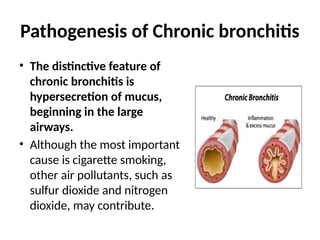
Pathogenesis of Chronic bronchitis
• The distinctive feature of
chronic bronchitis is
hypersecretion of mucus,
beginning in the large
airways.
• Although the most important
cause is cigarette smoking,
other air pollutants, such as
sulfur dioxide and nitrogen
dioxide, may contribute.
Pathogenesis of Chronic bronchitis cont…
• These environmental irritants induce
hypertrophy of mucous glands in the trachea
and bronchi as well as an increase in mucin-
secreting goblet cells in the epithelial surfaces
of smaller bronchi and bronchioles.
• These irritants also cause inflammation
marked by the infiltration of macrophages,
neutrophils, and lymphocytes
Pathogenesis of Chronic bronchitis
• The airflow obstruction in chronic bronchitis
results from:
1. Small airway disease, induced by mucous
plugging of the bronchiolar lumen,
inflammation, and bronchiolar wall fibrosis,
and
2. Coexistent emphysema.
Clinical Features of Chronic bronchitis
• Productive cough
• Hypercapnia
• Hypoxemia
• Cyanosis
• Pulmonary hypertension
• Cardiac failure
• Recurrent infections
• Respiratory failure
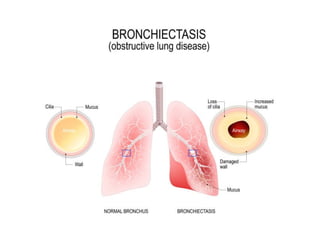
Bronchiectasis
• Bronchiectasis is the permanent dilation of
bronchi and bronchioles caused by destruction
of smooth muscle and the supporting elastic
tissue; it typically results from or is associated
with chronic necrotizing infections.
• It is not a primary disorder, as it always occurs
secondary to persistent infection or
obstruction caused by a variety of conditions.
Predisposing factors of Bronchiectasis
• Bronchial obstruction
• Congenital or hereditary conditions
Cystic fibrosis
Immunodeficiency states
Primary ciliary dyskinesia (also called the immotile cilia
syndrome).
• Necrotizing, or suppurative, pneumonia, particularly with virulent
organisms such as Staphylococcus aureus or Klebsiella spp.,
predispose affected patients to development of bronchiectasis.
• Post-tuberculosis bronchiectasis continues to be a significant
cause of morbidity in endemic areas.
Pathogenesis of Bronchiectasis
• Two intertwined processes contribute to
bronchiectasis: obstruction and chronic
infection.
• Either may be the initiator.
• For example, obstruction caused by a foreign
body impairs clearance of secretions,
providing a favorable substrate for
superimposed infection.
Pathogenesis of Bronchiectasis cont…
• The resultant inflammatory damage to the
bronchial wall and the accumulating exudate
further distend the airways, leading to irreversible
dilation.
• Conversely, a persistent necrotizing infection in the
bronchi or bronchioles may lead to poor clearance
of secretions, obstruction, and inflammation with
peribronchial fibrosis and traction on the bronchi,
culminating again in full-blown bronchiectasis.
Clinical Features of Bronchiectasis
• Bronchiectasis is characterized by severe,
persistent cough associated with expectoration
of mucopurulent, sometimes fetid, sputum.
• Dyspnea
• Rhinosinusitis and
• Hemoptysis
• Hypoxemia, hypercapnia, pulmonary
hypertension, and cor pulmonale.
Investigations
• History taking
• Clinical examination
• Spirometry
• Chest x-ray
• Alpha -1 testing
• CT scan
• Oximetry or arterial blood gas
• Others ( lung volume test, diffusion capacity test,
exercise testing e.t.c)
Managements
• There is currently no cure for COPD, but
treatments can help slow the progression of
the condition and control the symptoms
• The various treatments include:
Stopping smoking
Inhalers and tablets
Pulmonary rehabilitation
Surgery or a lung transplant
Any Question(s)?
THE END

CHRONIC OBSTRUCTIVE PULMONARY DISEASE 🫁

  • 1.
    COPD HOD: Dr. AlphaK Sheriff Lecturer: Dr. Martin Group: 8 Department of Internal Medicine School of Clinical Sciences
  • 2.
    NAMES OF GROUPMEMBERS AND ID NUMBERS 1. Fatima Zainab Kamara 22044 2. Isata Kattie Koroma 22058 3. Mohamed Saidu Mansaray 22064 4. Patricia King Conteh 22016 5. Mariama M. Bendu 22011 6. Precious Faith Kanu 22048 7. Isatu N. Turay 22081 8. Ramatulai Sall 22068
  • 3.
    OUTLINE • Introduction (Definition) •Etiology & Risk factors • Pathophysiology • Common presentations of COPD • Emphysema • Chronic Bronchitis • Bronchiectasis • Investigations • management • Questions • Summary
  • 4.
    Introduction • Chronic obstructive pulmonarydisease (COPD) is a chronic lung condition characterized by air flow obstruction and breathing difficulties • It typically present with a combination of symptoms, which can vary in severity among individuals
  • 6.
    Etiology & Riskfactors • Smoking • Genetic factors • Occupational exposures • Air pollution • Respiratory infections • Asthma • Aging
  • 7.
    Pathophysiology • The pathophysiologyof COPD involves a complex interplay of various factors, which includes: Genetic predisposition ands Environmental pollutants
  • 8.
  • 9.
    Common features –signs & symptoms • Progressive breathlessness • Chronic cough • Increased sputum production • Wheezing • Chest tightness • Fatigue • Recurrent respiratory infections
  • 10.
    Emphysema • Emphysema ischaracterized by permanent enlargement of the air spaces distal to the terminal bronchioles, accompanied by destruction of their walls without significant fibrosis. N.B. the acinus is the structure distal to terminal bronchioles, and a cluster of three to five acini is called a lobule
  • 12.
    Emphysema • There arefour major types of emphysema: • (1) centriacinar, (2) panacinar, (3) distal acinar, and (4) irregular. • Only the first two types cause significant airway obstruction, with centriacinar emphysema being about 20 times more common than panacinar disease.
  • 13.
  • 14.
  • 15.
    Clinical Features ofEmphysema • Dyspnea usually is the first symptom • Weight loss is common and may be severe enough to suggest an occult malignant tumor • Barrel-chested • Pulmonary hypertension • Cardiac failure • Recurrent infections • Respiratory failure
  • 16.
    Chronic Bronchitis • Chronicbronchitis is diagnosed on clinical grounds: it is defined by the presence of a persistent productive cough for at least 3 consecutive months in at least 2 consecutive years. • It is common among cigarette smokers and urban dwellers in smog-ridden cities
  • 18.
    Pathogenesis of Chronicbronchitis • The distinctive feature of chronic bronchitis is hypersecretion of mucus, beginning in the large airways. • Although the most important cause is cigarette smoking, other air pollutants, such as sulfur dioxide and nitrogen dioxide, may contribute.
  • 19.
    Pathogenesis of Chronicbronchitis cont… • These environmental irritants induce hypertrophy of mucous glands in the trachea and bronchi as well as an increase in mucin- secreting goblet cells in the epithelial surfaces of smaller bronchi and bronchioles. • These irritants also cause inflammation marked by the infiltration of macrophages, neutrophils, and lymphocytes
  • 20.
    Pathogenesis of Chronicbronchitis • The airflow obstruction in chronic bronchitis results from: 1. Small airway disease, induced by mucous plugging of the bronchiolar lumen, inflammation, and bronchiolar wall fibrosis, and 2. Coexistent emphysema.
  • 21.
    Clinical Features ofChronic bronchitis • Productive cough • Hypercapnia • Hypoxemia • Cyanosis • Pulmonary hypertension • Cardiac failure • Recurrent infections • Respiratory failure
  • 22.
    Bronchiectasis • Bronchiectasis isthe permanent dilation of bronchi and bronchioles caused by destruction of smooth muscle and the supporting elastic tissue; it typically results from or is associated with chronic necrotizing infections. • It is not a primary disorder, as it always occurs secondary to persistent infection or obstruction caused by a variety of conditions.
  • 24.
    Predisposing factors ofBronchiectasis • Bronchial obstruction • Congenital or hereditary conditions Cystic fibrosis Immunodeficiency states Primary ciliary dyskinesia (also called the immotile cilia syndrome). • Necrotizing, or suppurative, pneumonia, particularly with virulent organisms such as Staphylococcus aureus or Klebsiella spp., predispose affected patients to development of bronchiectasis. • Post-tuberculosis bronchiectasis continues to be a significant cause of morbidity in endemic areas.
  • 25.
    Pathogenesis of Bronchiectasis •Two intertwined processes contribute to bronchiectasis: obstruction and chronic infection. • Either may be the initiator. • For example, obstruction caused by a foreign body impairs clearance of secretions, providing a favorable substrate for superimposed infection.
  • 26.
    Pathogenesis of Bronchiectasiscont… • The resultant inflammatory damage to the bronchial wall and the accumulating exudate further distend the airways, leading to irreversible dilation. • Conversely, a persistent necrotizing infection in the bronchi or bronchioles may lead to poor clearance of secretions, obstruction, and inflammation with peribronchial fibrosis and traction on the bronchi, culminating again in full-blown bronchiectasis.
  • 27.
    Clinical Features ofBronchiectasis • Bronchiectasis is characterized by severe, persistent cough associated with expectoration of mucopurulent, sometimes fetid, sputum. • Dyspnea • Rhinosinusitis and • Hemoptysis • Hypoxemia, hypercapnia, pulmonary hypertension, and cor pulmonale.
  • 28.
    Investigations • History taking •Clinical examination • Spirometry • Chest x-ray • Alpha -1 testing • CT scan • Oximetry or arterial blood gas • Others ( lung volume test, diffusion capacity test, exercise testing e.t.c)
  • 29.
    Managements • There iscurrently no cure for COPD, but treatments can help slow the progression of the condition and control the symptoms • The various treatments include: Stopping smoking Inhalers and tablets Pulmonary rehabilitation Surgery or a lung transplant
  • 30.
  • 31.