A presentation on mutation and chromosomal mapping
1.
Sex determination, Sexlinked,Sex
influenced And Sex limited traits in farm
animal
Presented to:
DR. Md. Uzzal Hossain
Assistant Professor
Department Of Animal Science
Khulna Agricultural University, Khulna
3.
Presented by :
Sumaiyakhatun
ID No: 2201009
Overview
•Sex determination, Sex linked,Sex influenced And Sex limited traits in
farm animal
4.
Determination Of Sex
•The sexually reproducing organisms may be classified into two types: monoecious or
hermaphrodite and dioecious.
• In the monoecious organisms both male and female gametes or sex cells are produced by a
single individual, eg, most higher plants and some animals of lower groups.
• Further, the organisms in which both male and female gametes are produced by different
individuals are called dioecious.
• The phenomenon of molecular, morphological, physiological or behavioural differentiation
between male and female sexes is called sexual dimorphism.
5.
Determination of sexin human
The chromosomes that determine the sex of an organism are called sex chromosomes. These
chromosomes are commonly called X and Y chromosomes
Human cells have 23 pairs of chromosomes. Of these, 22 pairs are the same in both sexes and are called
autosomes. But the chromosomes of the 23rd
pair are different in male and female members and they are
called heterosome or sex chromosome.
• The gametes produced in the female member contain only the X chromosome. For this reason, women
are homogametic sex and these gametes are called homogametes.
• On the other hand, the male member produces two gametes. One type of gamete contains the X
chromosome, the other type of gamete contains the Y chromosome. Male is therefore heterogametic
sex and these gametes are called heterogametes.
6.
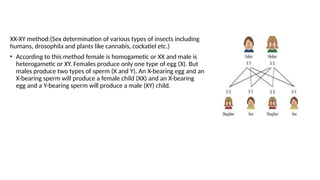
XX-XY method:(Sex determinationof various types of insects including
humans, drosophila and plants like cannabis, cockatiel etc.)
• According to this method female is homogametic or XX and male is
heterogametic or XY. Females produce only one type of egg (X). But
males produce two types of sperm (X and Y). An X-bearing egg and an
X-bearing sperm will produce a female child (XX) and an X-bearing
egg and a Y-bearing sperm will produce a male (XY) child.
7.
Determination of sexin Birds
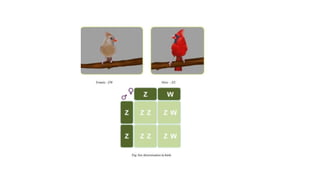
• The ZW sex-determining system is a chromosomal system that determines the sex of offspring
in birds, some fish and crustaceans such as giant prawns, some insects (including butterflies
and moths), the schistosome family of flatworms, and some reptiles, such as most snakes.
• The letters Z and W are used to distinguish this system from the XY sex-determination system.
In the ZW system, females have a pair of heterozygous ZW chromosomes, and males have
two identical ZZ chromosome.
• Unlike the XY sex-determination system and the XO sex-determination system, where the
sperm determines the sex, in the ZW system, the egg determines the child’s sex. Males are
the homogametic sex (ZZ), and females are the heterogametic sex (ZW). The Z chromosome is
larger and contains more genes, similarly to the X chromosome
9.
Sex linked
Sex-linked refersto genes that are located on the sex chromosomes, which determine the biological
sex of an individual. In most species, including humans and cattle, there are two sex chromosomes: X
and Y.
1. X-linked genes: These genes are located on the X chromosome. Since females have two X
chromosomes (XX) and males have one X and one Y chromosome (XY), X-linked traits can be inherited
differently in males and females. Males are more likely to express X-linked recessive traits because
they have only one X chromosome. If that X carries a recessive gene for a certain trait, they will
express the condition, whereas females would need both X chromosomes to carry the recessive gene
to express the same trait.
2. Y-linked genes: These genes are located on the Y chromosome and are typically passed down from
father to son. Since females do not have a Y chromosome, Y-linked traits are only inherited by males.
10.
Sex- Influenced Genes
Sex-influencedgenes are genes that are expressed in both sexes, but the
degree of expression varies between the sexes. This is due to the influence
of sex hormones, such as testosterone, estrogen, and progesterone.
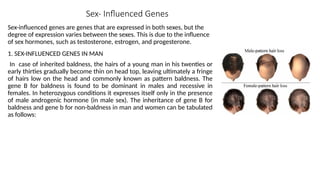
1. SEX-INFLUENCED GENES IN MAN
In case of inherited baldness, the hairs of a young man in his twenties or
early thirties gradually become thin on head top, leaving ultimately a fringe
of hairs low on the head and commonly known as pattern baldness. The
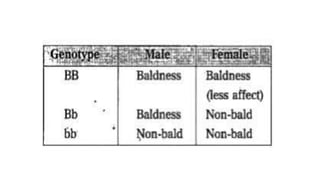
gene B for baldness is found to be dominant in males and recessive in
females. In heterozygous conditions it expresses itself only in the presence
of male androgenic hormone (in male sex). The inheritance of gene B for
baldness and gene b for non-baldness in man and women can be tabulated
as follows:
12.
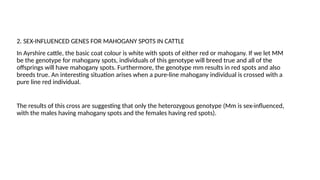
2. SEX-INFLUENCED GENESFOR MAHOGANY SPOTS IN CATTLE
In Ayrshire cattle, the basic coat colour is white with spots of either red or mahogany. If we let MM
be the genotype for mahogany spots, individuals of this genotype will breed true and all of the
offsprings will have mahogany spots. Furthermore, the genotype mm results in red spots and also
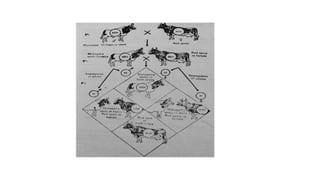
breeds true. An interesting situation arises when a pure-line mahogany individual is crossed with a
pure line red individual.
The results of this cross are suggesting that only the heterozygous genotype (Mm is sex-influenced,
with the males having mahogany spots and the females having red spots).
14.
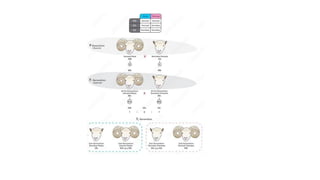
3. SEX-INFLUENCED GENESFOR HORN IN SHEEP
The sheep of the Dorset breed possess horns in both of the sexes, while, both sexes of
suffolk breed are hornless. The genes for horned condition (HH) are dominant over
recessive genes (hh) for hornless condition. When a pure-line horned sheep is crossed
with a pure line hornless sheep, then the heterozygous genotype, Hh, is found to be
sex-influenced, with the males having horns and the females having no horns. The
inheritance of sex-influenced genes for horns in sheep can be represented
diagrammatically as
16.
Sex limited traitsin farm animal
Definition of Sex-Limited Traits: Sex-limited traits are those that are expressed in only one sex,
despite being present in both males and females.
These traits are often controlled by autosomal genes, but their expression is regulated by the
hormones associated with the sex of the animal.
Unlike sex-linked traits (which are found on sex chromosomes), sex-limited traits are typically not
dependent on the presence of the sex chromosomes themselves.
Examples of Sex-Limited Traits in Farm Animals:
Milk Production in Dairy Cattle:
Only female cattle (cows) express the trait of milk production. The genetic potential for milk
production is present in both males and females, but it is hormonally activated only in females after
calving.
17.
Wool Production inSheep:
Wool production is primarily observed in female sheep, although males may also produce wool, but it is
more prevalent in females, especially in breeds selectively bred for wool.
Feathering in Turkeys:
The presence of certain feather types (e.g., certain patterns or feather development) may be more
pronounced in hens than in male turkeys.
Mammary Development in Livestock (Cattle, Sheep, Goats):
Mammary development, which is essential for milk production, is a trait that is predominantly expressed
in females, influenced by hormones such as estragon and progesterone.
Sex limited traits in Human:
Bread growth: A trait that is limited to male.
Breast development: A trait that is limited to female.
Premature baldness: A trait that is more common in males, but can appear in females after menopause
18.
Interference and Coincidence,
ChromosomeMapping, and
Three-Point Crossing Over
Presented to:
DR. Md. Uzzal Hossain
Assistant Professor
Department Of Animal Science
Khulna Agricultural University, Khulna
19.
Presented by
Overview
• Interferenceand Coincidence in Genetics
• Chromosome Mapping and Three-point crossing over
Md. Mustafizur Rahman ID:2201005
20.
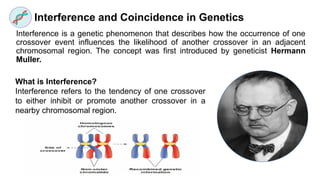
Interference and Coincidencein Genetics
Interference is a genetic phenomenon that describes how the occurrence of one
crossover event influences the likelihood of another crossover in an adjacent
chromosomal region. The concept was first introduced by geneticist Hermann
Muller.
What is Interference?
Interference refers to the tendency of one crossover
to either inhibit or promote another crossover in a
nearby chromosomal region.
21.
Cont’d…..
• Dependence :
Themagnitude of interference depends on the distance between genes on the
chromosome.
Smaller gene distance → Greater interference (crossovers less likely).
Larger gene distance → Lesser interference (crossovers more likely).
Key Concepts of Interference :
Coefficient of Interference (I):Formula: I=(1−Coefficient of Coincidence)×100
Measures the percentage reduction (or enhancement) of expected
crossovers.
22.
Cont’d….
Types of Interference:
1.PositiveInterference:
Effect: Reduces the likelihood of a second crossover in adjacent regions.
Organisms: Observed in prokaryotes and eukaryotes.
Indicator: Coefficient of Coincidence (CoC) < 1
2.Negative Interference:Effect: Enhances the likelihood of a second crossover in adjacent
regions.
Organisms: Common in lower organisms like Aspergillus and bacteriophages.
Indicator: Coefficient of Coincidence (CoC) > 1.
Coincidence
Definition: Coined by Muller, it measures the degree or strength of interference by
comparing observed crossovers to the expected.
Formula: Coefficient of Coincidence (CoC)=Observed Double Crossovers/Expected Double
Crossovers
23.
Interpreting CoC:
Meaning
CoC <1
Positive Interference (fewer crossovers)
CoC>1
Negative Interference (more crossovers).
CoC = 0
Absence of interference.
CoC = 1
Complete or absolute interference.
Calculating Coincidence
Understanding Recombination Frequencies
:Consider three genes (A, B, and C) arranged on a chromosome.
Measure recombination rates between:
A & B
B & C
24.
Expected Double Crossovers:
ExpectedRate=(A-B Recombination Rate)×(B-C Recombination Rate)
Observed Double Crossovers: Count crossovers observed in both regions.
Coefficient of Coincidence:CoC (%)=Observed Double Crossovers/Expected
Double Crossovers×100
Comparison:
Positive vs. Negative Interference
Feature Positive
Interference
Negative
Interference
Effect on crossovers Reduces adjacent
crossovers.
Enhanaces adjacent
crossovers.
Organisms
Observed
Prokaryotes,
Eukaryotes
Lower organisms
(Aspergillus,etc)
Coefficient of
Coincidence
CoC<1 CoC>1
25.
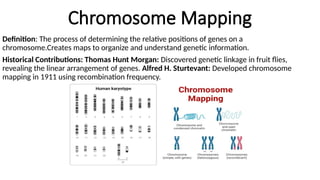
Chromosome Mapping
Definition: Theprocess of determining the relative positions of genes on a
chromosome.Creates maps to organize and understand genetic information.
Historical Contributions: Thomas Hunt Morgan: Discovered genetic linkage in fruit flies,
revealing the linear arrangement of genes. Alfred H. Sturtevant: Developed chromosome
mapping in 1911 using recombination frequency.
26.
Cont’d….
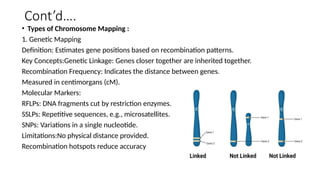
• Types ofChromosome Mapping :
1. Genetic Mapping
Definition: Estimates gene positions based on recombination patterns.
Key Concepts:Genetic Linkage: Genes closer together are inherited together.
Recombination Frequency: Indicates the distance between genes.
Measured in centimorgans (cM).
Molecular Markers:
RFLPs: DNA fragments cut by restriction enzymes.
SSLPs: Repetitive sequences, e.g., microsatellites.
SNPs: Variations in a single nucleotide.
Limitations:No physical distance provided.
Recombination hotspots reduce accuracy
27.
Cont’d…..
2. Physical Mapping
Definition:Determines precise DNA locations using base pair measurements.
Methods:
•Cytogenetic Mapping: Uses unique chromosome banding patterns.
•FISH: Visualizes DNA sequences with fluorescent probes.
•Restriction Mapping: Identifies restriction enzyme sites.
•STS Mapping: Uses short DNA sequences for detailed maps.
•Radiation Hybrid Mapping: Estimates distances using radiation breaks.
•Limitations:Incomplete coverage or mapping errors.Slow and complex processes.
Importance of Chromosome Mapping
•Gene Organization: Understands genome structure and function.
•Genetic Disorders: Identifies gene locations for studying diseases.
•Evolutionary Studies: Compares gene arrangements among species.
•Gene Interactions: Studies relationships between genes.
28.
Three point crossingover
Introduction
• Three-point crossing over is a genetic mapping method used to determine the
order and relative distances between three linked genes on the same
chromosome.
• Key ConceptsLinkage: Genes close together on a chromosome are inherited
together.Crossing Over: Exchange of genetic material between homologous
chromosomes during meiosis, producing recombinant gametes.
• PurposeDetermine the sequence of three linked genes.
• Measure genetic distances in centimorgans (cM).
29.
Cont’d….
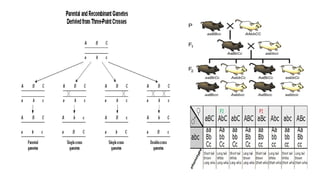
Steps in Three-Point
•CrossParental Generation Setup: Cross a heterozygous individual (AaBbCc) with a homozygous
recessive individual (aabbcc).
• Offspring Phenotypes:
• 8 classes:
• 2 parental types (most frequent).
• 4 single crossovers (intermediate frequency).
• 2 double crossovers (least frequent).
• Gene Order Identification:
• Compare double crossover phenotypes to parental types.
• The gene that “switches” is in the middle.
• Recombination Frequency Calculation: Recombination Frequency=(Number of
Recombinants/Total Offspring)×100
• Distance between genes is measured in cM.
• Coefficient of Coincidence (CoC): CoC=Observed Double Crossovers/Expected Double
Crossovers
31.
Cont’d…..
Interference (I): I=1−CoC
Indicateshow one crossover affects another.
Applications
•Gene Mapping: Determine gene sequence and distances.
•Recombination Studies: Understand genetic recombination mechanisms.
•Genetic Disorders: Identify gene linkage and disease associations.
•Evolutionary Studies: Explore genetic variations and evolutionary processes.
Conclusion
Three-point crossing over is a vital tool in genetics, providing insights into gene linkage,
recombination, and genetic mapping for research and practical applications.






![CASE_PRESENTATION_ON_subdural_hematoma(SDH)[1 FINAL PPT]-1.pptx](https://cdn.slidesharecdn.com/ss_thumbnails/casepresentationonsubduralhematomasdh1finalppt-1-260129172522-d405d375-thumbnail.jpg?width=640&height=640&fit=bounds)


