SEX CHROMATIN or BARR BODIES
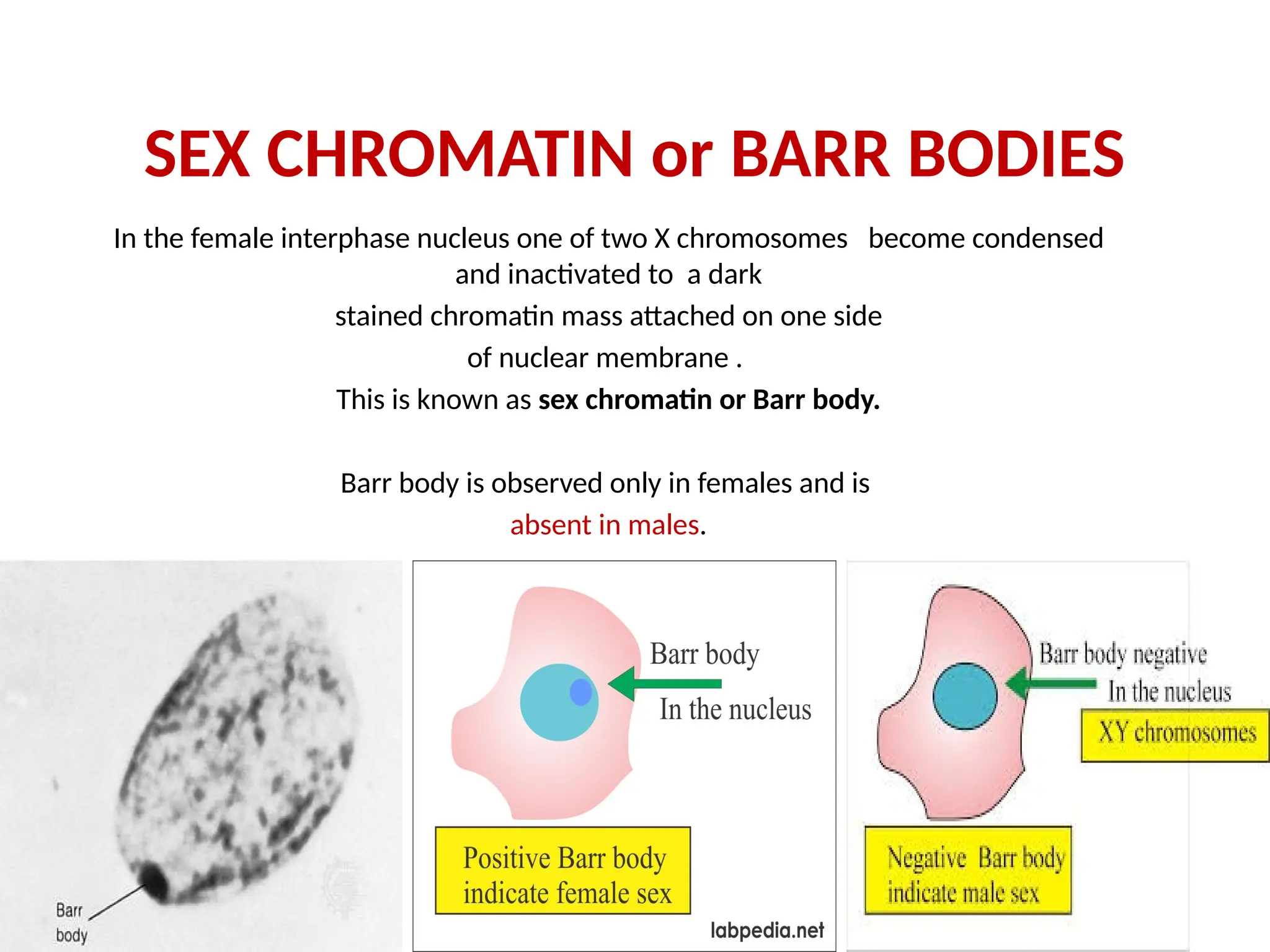
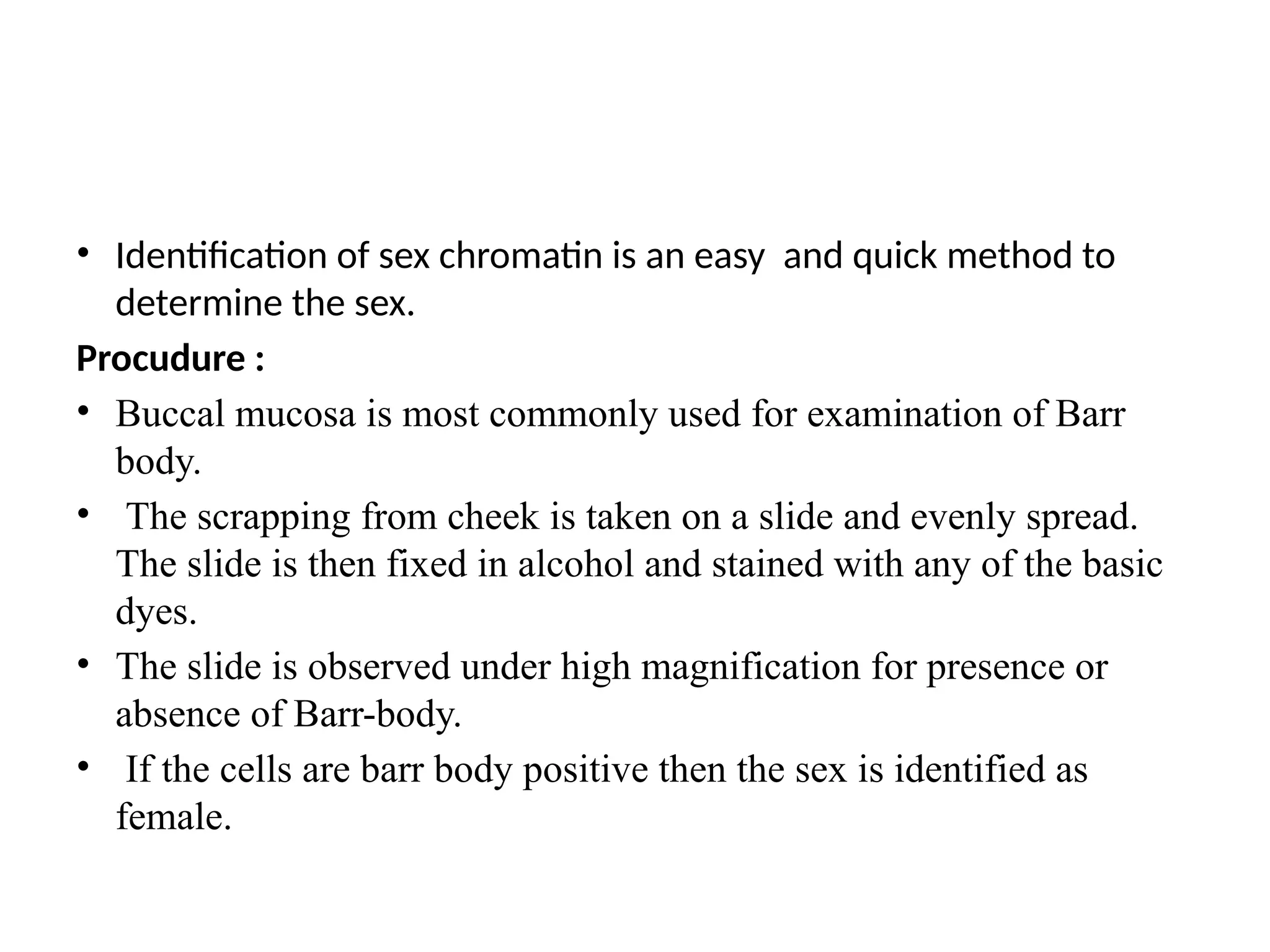
In the female interphase nucleus one of two X chromosomes become condensed
and inactivated to a dark
stained chromatin mass attached on one side
of nuclear membrane .
This is known as sex chromatin or Barr body.
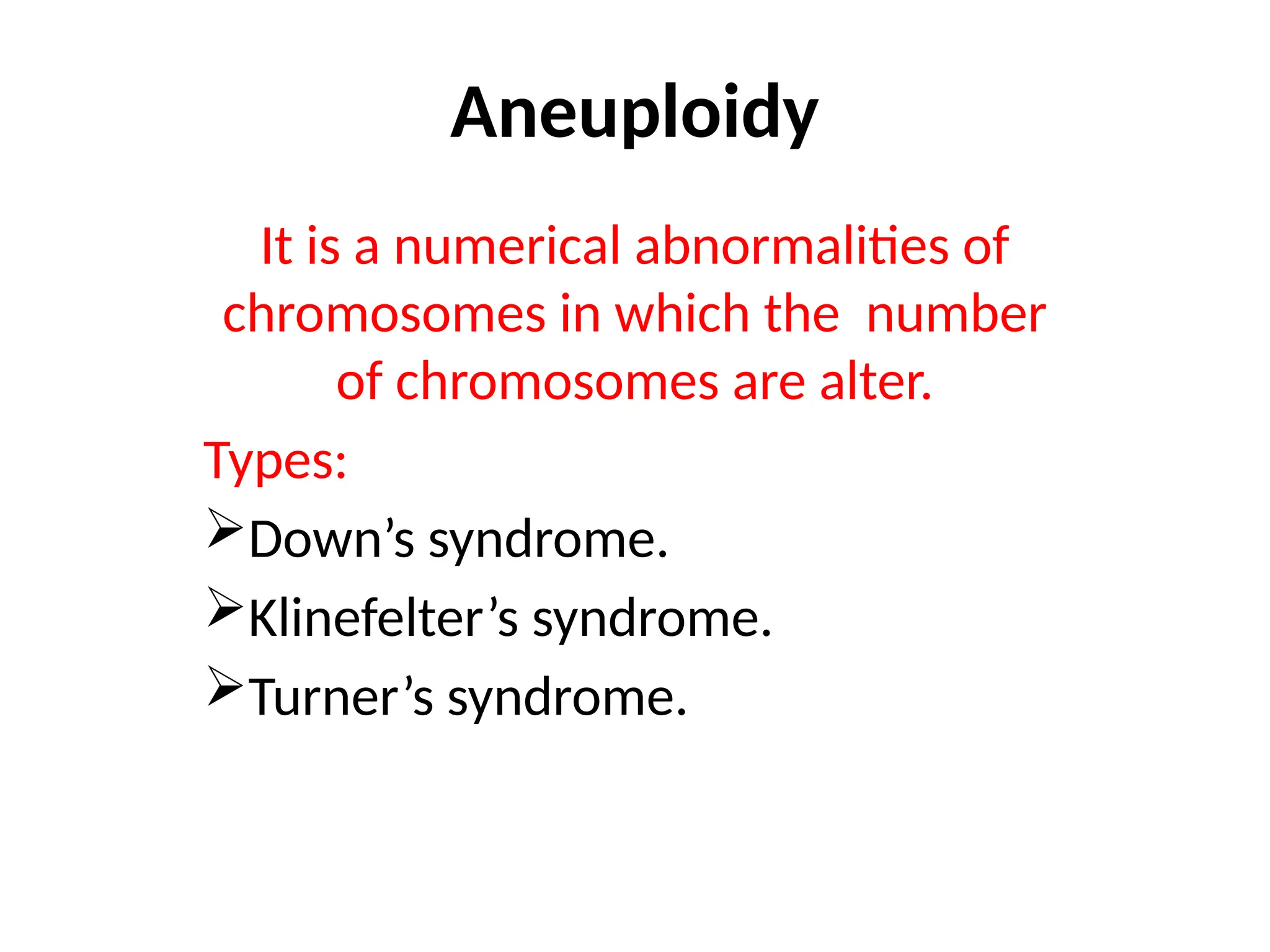
Barr body is observed only in females and is
absent in males.
• Identification of sex chromatin is an easy and quick method to
determine the sex.
Procudure :
• Buccal mucosa is most commonly used for examination of Barr
body.
• The scrapping from cheek is taken on a slide and evenly spread.
The slide is then fixed in alcohol and stained with any of the basic
dyes.
• The slide is observed under high magnification for presence or
absence of Barr-body.
• If the cells are barr body positive then the sex is identified as
female.
Lyon's hypothesis
• Mary F. Lyon demonstrated that one of two X chromosomes in
females become condensed and inactive and form Barr body.
• This inactivation is for dosage compensation.
• The process of X inactivation is often referred to as Lyonization.
Features of the Lyonization:
• Inactivation of one X inactivation occurs early in embryonic life of
about 5000 cell stage at 15th or 16th
day of gestation.
• The inactivation one X chromosome in each cell is chosen at random.
• In some cells maternal and in others paternal X chromosome may
become inactive.
• During mitosis the inactive X chromosome is late replicating.
• The number of Barr bodies is always one less than number of X
chromosomes.
• It means that there is one Barr body in normal female and none in
normal male.
• Normal Male (XY) - No Barr body
• Normal Female (XX) - One Barr body
• Turner Syndrome (XO) - No Barr body
• Klinefelter Syndrome (XXY) - One Barr body
• Triple X Syndrome (XXX) - Two Barr bodies
Aneuploidy
It is a numerical abnormalities of
chromosomes in which the number
of chromosomes are alter.
Types:
Down’s syndrome.
Klinefelter’s syndrome.
Turner’s syndrome.
Down’s syndrome
(mongolism or trisomy 21)
• In this disorder there are
three copies of chromosome
21 (trisomy 21).
• The patient has an extra
chromosome 21.
Causes:
Non-disjunction of
chromosomes.
Increased maternal age.
Karyotype:
 47,XY +21 or 47,XX+21
Clinical features
• Round face with oblique
palpebral fissures and inner
epicanthic folds, i.e., mongoloid
facies, hence the name
mongolism.
• Small nose and low-set small
square ears.
• Short and broad hands with
single transverse crease in the
palm called Simian crease
across the bases of four fingers.
• Open mouth with long
protruding tongue.
• Mental retardation (IQ 25–50).
• Short stature with
hyperflexibility of joints due to
hypotonia.
Klinefelter’s syndrome
• It is a trisomic condition
found only in males.
• Presence of one extra
X chromosome in male
leads to Klinefelter’s
syndrome.
• The individual is
phenotypically a male but
Barr body is positive due to
presence of an extra
X chromosome.
Causes:
Non-disjunction of
chromosomes.
Increased maternal
age.
Karyotype:
 47,XXY.
Clinical features
• Syndrome cannot be detected until
adolescence.
• Small testis (Hypogonadism) but
normal penis and scrotum and
associated azoospermia and sterility.
• Secondary sexual character not
develop fully.
• Gynecomastia.
• Axillary and pubic hair absent, chest
hair reduced.
• Slight Mental retardation.
• Length of legs and arms are usually
longer than normal.
• Increased gonadotropin levels.
Turner’s syndrome
• It is a monosomic
condition found only in
females.
• It occurs due to loss of
one X chromosome.
• The individual is
phenotypically a female
but Barr body is negative
due to absence of one
X chromosome.
Causes:
Non-disjunction of
chromosomes.
Increased maternal
age.
Karyotype:
 45,XO.
Clinical features
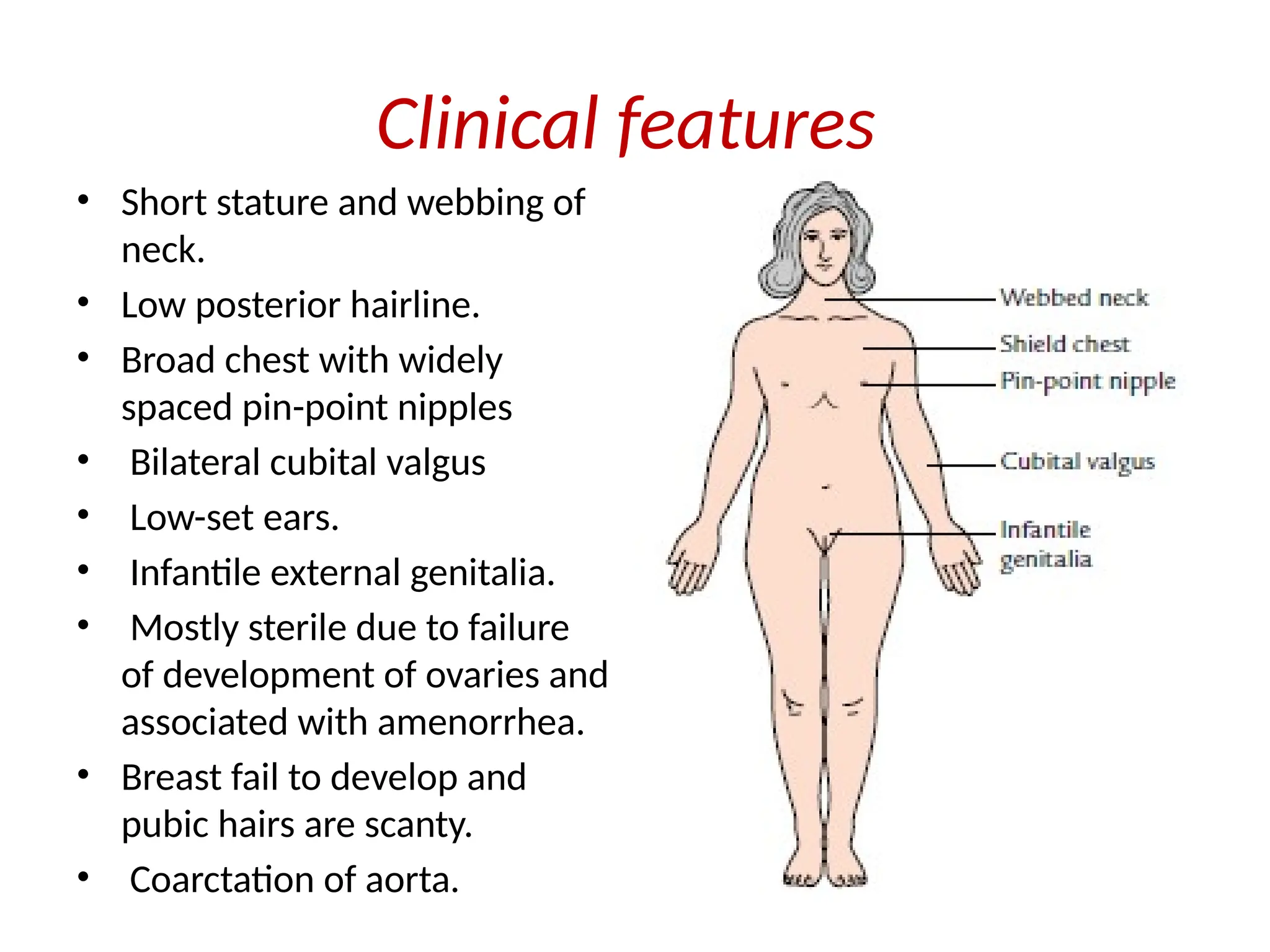
• Short stature and webbing of
neck.
• Low posterior hairline.
• Broad chest with widely
spaced pin-point nipples
• Bilateral cubital valgus
• Low-set ears.
• Infantile external genitalia.
• Mostly sterile due to failure
of development of ovaries and
associated with amenorrhea.
• Breast fail to develop and
pubic hairs are scanty.
• Coarctation of aorta.
Inheritance
Inheritance is the process of transmission of
characters/traits from generation to generation.
The inheritance of traits or disorders from
parents to offspring takes place through genes
which carry all information about all types of
traits.
Types of inheritance:
1. Autosomal inheritance
2. Sex-linked inheritance
3. Multifactorial inheritance.
1.Autosomal Inheritance:
• The inheritance occurring through genes of
autosomes is called autosomal inheritance.
• They are 2 types:
Autosomal Dominant Inheritance.
Autosomal Recessive Inheritance.
Autosomal Dominant Inheritance
• The gene responsible for this
kind of trait is present on
autosomes.
• It can manifest the disorder
even if the abnormal gene
present on one chromosome of
the pair(heterozygous states).
Examples :
• Common baldness
• Neurofibromatosis
• ABO blood group
• Rh blood group
• Polycystic kidney
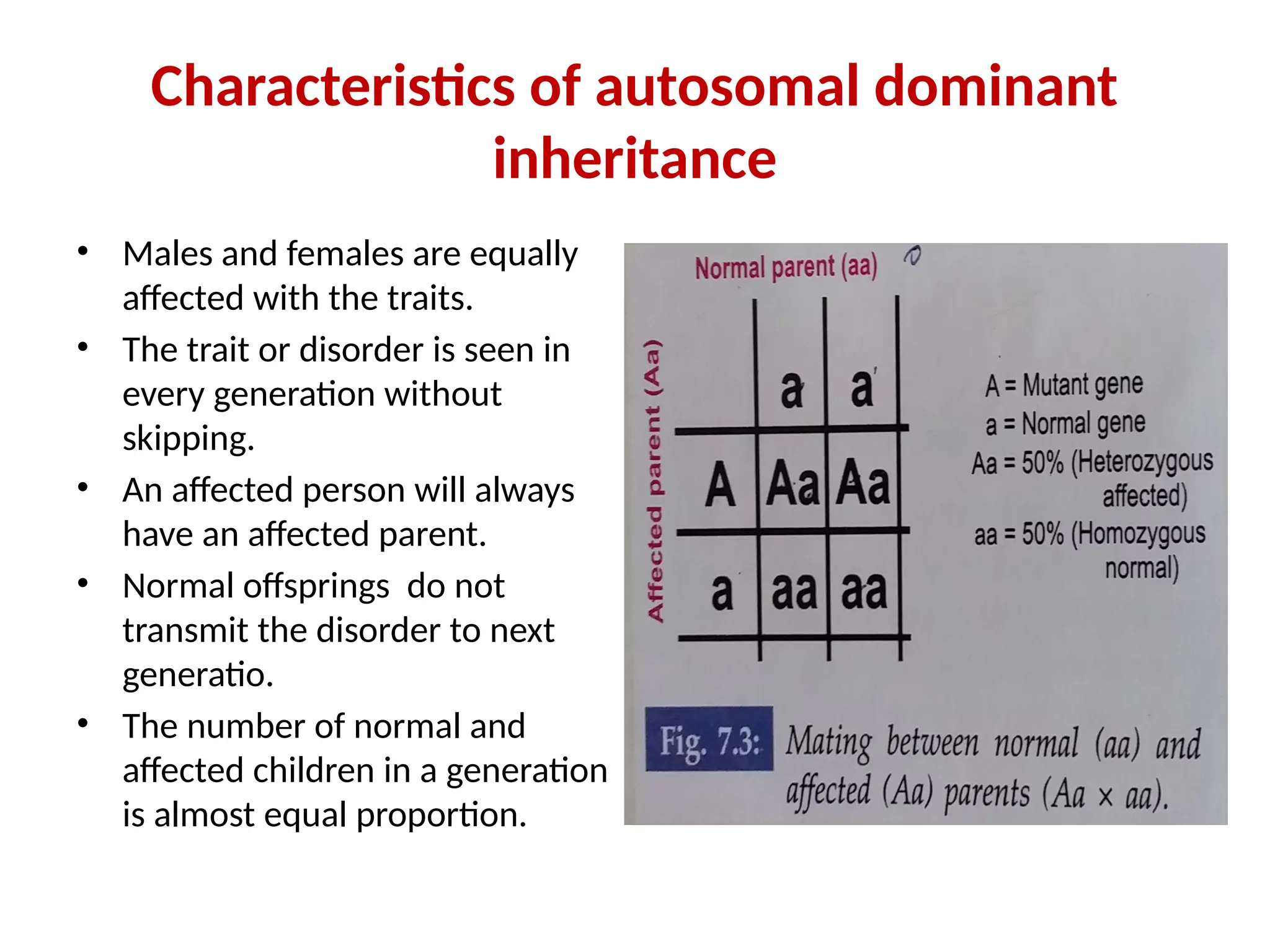
Characteristics of autosomal dominant
inheritance
• Males and females are equally
affected with the traits.
• The trait or disorder is seen in
every generation without
skipping.
• An affected person will always
have an affected parent.
• Normal offsprings do not
transmit the disorder to next
generatio.
• The number of normal and
affected children in a generation
is almost equal proportion.
Autosomal Recessive Inheritance
• The gene responsible for this
kind of trait is present on
autosomes.
• It can manifest the disorder if
the abnormal gene present on
both chromosomes of the
pair(homozygous states).
Examples :
 Sickle cell anemia
 Albinism
 Schizophrenia
 Phernylketonuria
Characteristics of autosomal recessive inheritance
• A person having a single abnormal
gene (heterozygous) does not express
the disorder and is perfectly healthy
but they are carriers.
• This trait is seen in same generation,
among siblings.
• It may not seen in previous or
subsequent generation
• Males and females are equally
affected.
• If the parents are cousins the
chances of manifesting recessive
disorder increases many folds as
compared to parents who are
unrelated.(consahguineous marriage)
2. Sex-linked Inheritance
• This kind of inheritance
is due to the abnormal
genes located on X or Y
chromosomes.
• Two types:
 X- linked
Y – linked
X-linked Inheritance
• This kind of inheritance
is due to the abnormal
genes located on X
chromosomes.
• Two types:
• X-linked recessive
• X-linked dominant
X-linked Recessive Inheritance
• This kind of inheritance
is due to the abnormal
genes located on both X
chromosomes in female
and one X in male.
• Recessive traits are very
rare in female.
• Predominantly males are
affected.
Examples :
 Haemophilia .
 Duchenne muscular
dystrophy.
Features :
• As females have two X-
chromosomes the heterozyous
female will not manifest the
trait..
• However, an heterozygous
female will transmit the gene to
next generation and are called as
carriers.
• As the males have only one X
chromosome the mutant gene
will manifest the disorder even in
single dose.
• The affected male will transmit
this gene to all his daughters who
will become carrier.
• This disorder is transmitted
through unaffected carrier
females to their son.
X-linked dominant
inheritance
• This kind of inheritance
is due to the abnormal
genes located on X
chromosomes.
• As the gene is dominant
it express in
heterozygous females
and males.
• It resembles autosomal
dominant inheritace.
Y-linked inheritance
• They are very few.
• An affected male
transmits trait to all
sons but daughters
remain unaffected.
• Eg. Hairy ears.
3. Multifactorial inheritance
• The inheritance which
occurs due to interaction
of gene and environmental
factors, viz., infectious
agents, drugs, or ionizing
radiation.
Examples :
 Diabetes mellitus
 Hypertension
 Heart defect

genetics..................................

  • 1.
    SEX CHROMATIN orBARR BODIES In the female interphase nucleus one of two X chromosomes become condensed and inactivated to a dark stained chromatin mass attached on one side of nuclear membrane . This is known as sex chromatin or Barr body. Barr body is observed only in females and is absent in males.
  • 2.
    • Identification ofsex chromatin is an easy and quick method to determine the sex. Procudure : • Buccal mucosa is most commonly used for examination of Barr body. • The scrapping from cheek is taken on a slide and evenly spread. The slide is then fixed in alcohol and stained with any of the basic dyes. • The slide is observed under high magnification for presence or absence of Barr-body. • If the cells are barr body positive then the sex is identified as female.
  • 3.
    Lyon's hypothesis • MaryF. Lyon demonstrated that one of two X chromosomes in females become condensed and inactive and form Barr body. • This inactivation is for dosage compensation. • The process of X inactivation is often referred to as Lyonization. Features of the Lyonization: • Inactivation of one X inactivation occurs early in embryonic life of about 5000 cell stage at 15th or 16th day of gestation. • The inactivation one X chromosome in each cell is chosen at random. • In some cells maternal and in others paternal X chromosome may become inactive. • During mitosis the inactive X chromosome is late replicating. • The number of Barr bodies is always one less than number of X chromosomes. • It means that there is one Barr body in normal female and none in normal male.
  • 4.
    • Normal Male(XY) - No Barr body • Normal Female (XX) - One Barr body • Turner Syndrome (XO) - No Barr body • Klinefelter Syndrome (XXY) - One Barr body • Triple X Syndrome (XXX) - Two Barr bodies
  • 6.
    Aneuploidy It is anumerical abnormalities of chromosomes in which the number of chromosomes are alter. Types: Down’s syndrome. Klinefelter’s syndrome. Turner’s syndrome.
  • 7.
    Down’s syndrome (mongolism ortrisomy 21) • In this disorder there are three copies of chromosome 21 (trisomy 21). • The patient has an extra chromosome 21. Causes: Non-disjunction of chromosomes. Increased maternal age. Karyotype:  47,XY +21 or 47,XX+21
  • 8.
    Clinical features • Roundface with oblique palpebral fissures and inner epicanthic folds, i.e., mongoloid facies, hence the name mongolism. • Small nose and low-set small square ears. • Short and broad hands with single transverse crease in the palm called Simian crease across the bases of four fingers. • Open mouth with long protruding tongue. • Mental retardation (IQ 25–50). • Short stature with hyperflexibility of joints due to hypotonia.
  • 9.
    Klinefelter’s syndrome • Itis a trisomic condition found only in males. • Presence of one extra X chromosome in male leads to Klinefelter’s syndrome. • The individual is phenotypically a male but Barr body is positive due to presence of an extra X chromosome.
  • 10.
  • 11.
    Clinical features • Syndromecannot be detected until adolescence. • Small testis (Hypogonadism) but normal penis and scrotum and associated azoospermia and sterility. • Secondary sexual character not develop fully. • Gynecomastia. • Axillary and pubic hair absent, chest hair reduced. • Slight Mental retardation. • Length of legs and arms are usually longer than normal. • Increased gonadotropin levels.
  • 12.
    Turner’s syndrome • Itis a monosomic condition found only in females. • It occurs due to loss of one X chromosome. • The individual is phenotypically a female but Barr body is negative due to absence of one X chromosome.
  • 13.
  • 14.
    Clinical features • Shortstature and webbing of neck. • Low posterior hairline. • Broad chest with widely spaced pin-point nipples • Bilateral cubital valgus • Low-set ears. • Infantile external genitalia. • Mostly sterile due to failure of development of ovaries and associated with amenorrhea. • Breast fail to develop and pubic hairs are scanty. • Coarctation of aorta.
  • 16.
    Inheritance Inheritance is theprocess of transmission of characters/traits from generation to generation. The inheritance of traits or disorders from parents to offspring takes place through genes which carry all information about all types of traits.
  • 17.
    Types of inheritance: 1.Autosomal inheritance 2. Sex-linked inheritance 3. Multifactorial inheritance. 1.Autosomal Inheritance: • The inheritance occurring through genes of autosomes is called autosomal inheritance. • They are 2 types: Autosomal Dominant Inheritance. Autosomal Recessive Inheritance.
  • 18.
    Autosomal Dominant Inheritance •The gene responsible for this kind of trait is present on autosomes. • It can manifest the disorder even if the abnormal gene present on one chromosome of the pair(heterozygous states). Examples : • Common baldness • Neurofibromatosis • ABO blood group • Rh blood group • Polycystic kidney
  • 19.
    Characteristics of autosomaldominant inheritance • Males and females are equally affected with the traits. • The trait or disorder is seen in every generation without skipping. • An affected person will always have an affected parent. • Normal offsprings do not transmit the disorder to next generatio. • The number of normal and affected children in a generation is almost equal proportion.
  • 20.
    Autosomal Recessive Inheritance •The gene responsible for this kind of trait is present on autosomes. • It can manifest the disorder if the abnormal gene present on both chromosomes of the pair(homozygous states). Examples :  Sickle cell anemia  Albinism  Schizophrenia  Phernylketonuria
  • 21.
    Characteristics of autosomalrecessive inheritance • A person having a single abnormal gene (heterozygous) does not express the disorder and is perfectly healthy but they are carriers. • This trait is seen in same generation, among siblings. • It may not seen in previous or subsequent generation • Males and females are equally affected. • If the parents are cousins the chances of manifesting recessive disorder increases many folds as compared to parents who are unrelated.(consahguineous marriage)
  • 22.
    2. Sex-linked Inheritance •This kind of inheritance is due to the abnormal genes located on X or Y chromosomes. • Two types:  X- linked Y – linked
  • 23.
    X-linked Inheritance • Thiskind of inheritance is due to the abnormal genes located on X chromosomes. • Two types: • X-linked recessive • X-linked dominant
  • 24.
    X-linked Recessive Inheritance •This kind of inheritance is due to the abnormal genes located on both X chromosomes in female and one X in male. • Recessive traits are very rare in female. • Predominantly males are affected. Examples :  Haemophilia .  Duchenne muscular dystrophy.
  • 25.
    Features : • Asfemales have two X- chromosomes the heterozyous female will not manifest the trait.. • However, an heterozygous female will transmit the gene to next generation and are called as carriers. • As the males have only one X chromosome the mutant gene will manifest the disorder even in single dose. • The affected male will transmit this gene to all his daughters who will become carrier. • This disorder is transmitted through unaffected carrier females to their son.
  • 26.
    X-linked dominant inheritance • Thiskind of inheritance is due to the abnormal genes located on X chromosomes. • As the gene is dominant it express in heterozygous females and males. • It resembles autosomal dominant inheritace.
  • 27.
    Y-linked inheritance • Theyare very few. • An affected male transmits trait to all sons but daughters remain unaffected. • Eg. Hairy ears.
  • 28.
    3. Multifactorial inheritance •The inheritance which occurs due to interaction of gene and environmental factors, viz., infectious agents, drugs, or ionizing radiation. Examples :  Diabetes mellitus  Hypertension  Heart defect