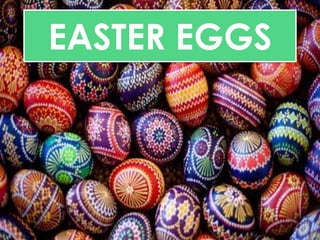
EASTER EGGS
INDEX:
• History
• Celebration
• Decoration
• Symbolism
• Legends
• How to make it
• Easter bunny
• Different countries
HISTORY
o Easter eggs are said to represent Jesus’
emergence from the tomb and
resurrection.
o Decorating eggs for Easter is a tradition
that dates back to at least the 13th
century, according to some sources.
o One explanation for this custom is that
eggs are a prohibited food during the
Lenten season.
CELEBRATION
o First day of Easter the people, generally the
parents, hide the Easter eggs at home, at
the garden, at garage… And the children
should look for them.
DECORATION
o Hold the egg to paint.
o Insert a toothpick into the empty egg and
stick it on a surface.
o Paint the base.
o Create different drawings.
o Let dry in the egg carton.
SYMBOLISM
o White: purity and innocence.
o Yellow: wisdom, recognition, harvest and
reward.
o Orange: strength, endurance and ambition.
o Red: happiness, hope or passion.
o Green: sign of spring, hope and innocence.
o Blue: good health.
o Purple: royal color, faith and trust.
o Brown: earth and mountain color, harvest
color, positive symbolizing happiness.
o Grey: not a positive color.
o Black: strong color, meaning of
remembrance.
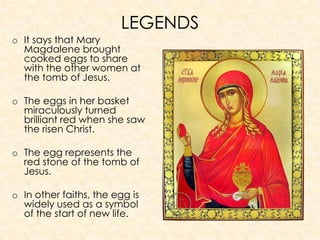
LEGENDS
o It says that Mary
Magdalene brought
cooked eggs to share
with the other women at
the tomb of Jesus.
o The eggs in her basket
miraculously turned
brilliant red when she saw
the risen Christ.
o The egg represents the
red stone of the tomb of
Jesus.
o In other faiths, the egg is
widely used as a symbol
of the start of new life.
HOW TO MAKE IT
o Boil the egg.
o Dye eggs.
o Introduce the egg in a cup.
o Put coloring and vinegar.
o Paint the eggs.
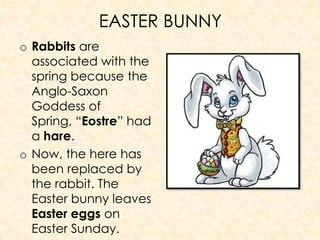
EASTER BUNNY
o Rabbits are
associated with the
spring because the
Anglo-Saxon
Goddess of
Spring, “Eostre” had
a hare.
o Now, the here has
been replaced by
the rabbit. The
Easter bunny leaves
Easter eggs on
Easter Sunday.
EASTER EGGS FROM DIFFERENT COUNTRIES
SLAVIC COUNTRIES
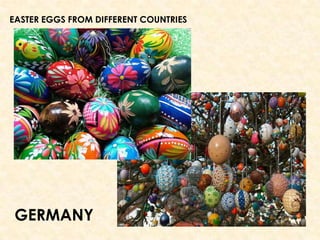
EASTER EGGS FROM DIFFERENT COUNTRIES
GERMANY
EASTER EGGS FROM DIFFERENT COUNTRIES
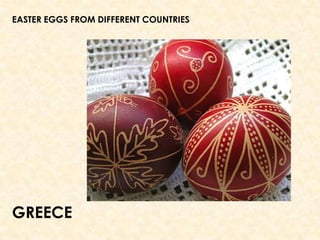
GREECE
EASTER EGGS FROM DIFFERENT COUNTRIES
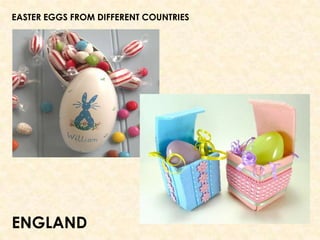
ENGLAND
END

Easter eggs

  • 1.
  • 2.
    INDEX: • History • Celebration •Decoration • Symbolism • Legends • How to make it • Easter bunny • Different countries
  • 3.
    HISTORY o Easter eggsare said to represent Jesus’ emergence from the tomb and resurrection. o Decorating eggs for Easter is a tradition that dates back to at least the 13th century, according to some sources. o One explanation for this custom is that eggs are a prohibited food during the Lenten season.
  • 4.
    CELEBRATION o First dayof Easter the people, generally the parents, hide the Easter eggs at home, at the garden, at garage… And the children should look for them.
  • 5.
    DECORATION o Hold theegg to paint. o Insert a toothpick into the empty egg and stick it on a surface. o Paint the base. o Create different drawings. o Let dry in the egg carton.
  • 6.
    SYMBOLISM o White: purityand innocence. o Yellow: wisdom, recognition, harvest and reward. o Orange: strength, endurance and ambition. o Red: happiness, hope or passion. o Green: sign of spring, hope and innocence. o Blue: good health. o Purple: royal color, faith and trust. o Brown: earth and mountain color, harvest color, positive symbolizing happiness. o Grey: not a positive color. o Black: strong color, meaning of remembrance.
  • 7.
    LEGENDS o It saysthat Mary Magdalene brought cooked eggs to share with the other women at the tomb of Jesus. o The eggs in her basket miraculously turned brilliant red when she saw the risen Christ. o The egg represents the red stone of the tomb of Jesus. o In other faiths, the egg is widely used as a symbol of the start of new life.
  • 8.
    HOW TO MAKEIT o Boil the egg. o Dye eggs. o Introduce the egg in a cup. o Put coloring and vinegar. o Paint the eggs.
  • 9.
    EASTER BUNNY o Rabbitsare associated with the spring because the Anglo-Saxon Goddess of Spring, “Eostre” had a hare. o Now, the here has been replaced by the rabbit. The Easter bunny leaves Easter eggs on Easter Sunday.
  • 10.
    EASTER EGGS FROMDIFFERENT COUNTRIES SLAVIC COUNTRIES
  • 11.
    EASTER EGGS FROMDIFFERENT COUNTRIES GERMANY
  • 12.
    EASTER EGGS FROMDIFFERENT COUNTRIES GREECE
  • 13.
    EASTER EGGS FROMDIFFERENT COUNTRIES ENGLAND
  • 14.