Safety, Return to Work and Support Division
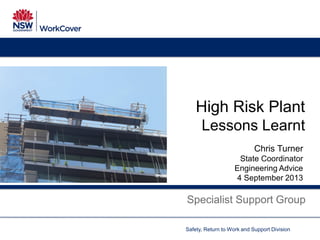
High Risk Plant
Lessons Learnt
Specialist Support Group
Chris Turner
State Coordinator
Engineering Advice
4 September 2013
Safety, Return to Work and Support Division
Objectives
What is High Risk Plant?
Why worry about other peoples incidents?
Sources of information
Lessons learnt
FINAL 2Commercial in confidence
Safety, Return to Work and Support Division
What is High Risk Plant?
General meaning; not limited to WHS legislation definition
Plant with the potential to seriously injure numerous people,
including registrable plant and non-registrable plant, eg
• Pressure vessels, gas cylinders and boilers
• Cranes, concrete placing booms, elevating work
platforms and piling rigs
• Suspended scaffolds and building maintenance units
• Scaffolding, formwork and perimeter screen systems
• Amusement devices and lifts
FINAL 3Commercial in confidence
Safety, Return to Work and Support Division
Why worry about other’s incidents?
• Opportunity to learn without experiencing the incident and
its consequences
• An opportunity to identify blind spots in previous thinking
• A reminder to review practices as complacency may have
crept in
• Demonstration of compliance with due diligence
obligations under the WHS Legislation
• Preparation for a possible regulator (or client) intervention
FINAL 4Commercial in confidence
Safety, Return to Work and Support Division
Why worry about other’s incidents?
Identification of factors that lead to the incident
or could have lead to another:
• design deficiencies
• lack of information from designers
• unsafe usage practices
• maintenance issues, or
• More often a combination of the above, and
• Solutions
• To remedy any of the above
• New technology that can be retrofitted
• Alternative plant or processes
FINAL 5Commercial in confidence
Safety, Return to Work and Support Division
Sources of information
• Media reports
• Word of mouth
• Internet – Google, industry incident websites, eg
• www.craneaccidents.com
• www.rideaccidents.com
• Industry contacts
• Plant manufacturers or suppliers
• Association or Union newsletters, e-mail groups, etc
• Regulators – websites, newsletters, safety alerts, etc
• www.workcover.nsw.gov.au
FINAL 6Commercial in confidence
Safety, Return to Work and Support Division
Extract from WorkCover NSW website
FINAL 7Commercial in confidence
Safety, Return to Work and Support Division
Extracts from WorkCover NSW website
FINAL 8Commercial in confidence
Safety, Return to Work and Support Division
Typical Lessons
Many incidents have multiple causation factors
• Design
o Defects
o Old, without modern safety systems
• Inspection and maintenance
o wear, fatigue and direct damage
• Repairs
• Common sense is not that common - it is unique to each
individual
• Operator competence on the specific piece of plant
• Misuse – deliberate or inadvertent
• Over-reliance on technology
FINAL 9Commercial in confidence
Safety, Return to Work and Support Division
Corresponding Solutions
• Pay attention to all factors as it may only be one that is
preventing your incident
• Upgrade plant with safety systems
• Be on the lookout for manufacturer updates/bulletins
• Deal with reputable suppliers
o if a deal is too good to be true it might be
• Inspect & maintain to manufacturer’s specifications and
repair correctly
• Provide training, instruction and assessment - don’t
assume operators know it all
• Supervision / review of practices
• Operators should understand the correct usage and
limitations, not solely rely on safety systems
FINAL 10Commercial in confidence
Safety, Return to Work and Support Division
Suspended scaffold incident
Two men painting from a suspended scaffold
cradle.
One end of the cradle failed resulting in the
platform swinging down and hanging vertically
from the other end.
Both were wearing fall arrest harnesses
One worker fell to his death, the other worker was
suspended in his fall-arrest harness until rescued,
relatively uninjured.
FINAL 11Commercial in confidence
Safety, Return to Work and Support Division
Suspended scaffold incident
Lessons:
• Lack of bracing for the scaffold hoist mounting point on
one end of the cradle left it susceptible to fatigue
FINAL 12Commercial in confidence
Safety, Return to Work and Support Division
Suspended scaffold incident
Lessons:
• Fatigue cracking at the base of the mounting point
should have been detectable for some time prior to the
incident
• A fall arrest system including a lanyard with energy
absorber (see Australian Standard AS1891 series)
should be used , and connected whenever practical,
especially when raising or lowering the cradle.
See WorkCover NSW Suspended Scaffold Safety Alert
FINAL 13Commercial in confidence
Safety, Return to Work and Support Division
Suspended scaffold incident
(Part 2)
The mobile crane called to recover the suspended scaffold
cradle from the above incident overturned.
No one was injured.
• The crane could not get into position for the lift so was
doing preparatory set up work that would normally be
done once in position
• As not in final position had not extended outriggers
• Crane could not detect outrigger position so believed
outriggers were out and did not stop the operation
FINAL 14Commercial in confidence
Safety, Return to Work and Support Division
MEWP incidents
FINAL 15Commercial in confidence
Safety, Return to Work and Support Division
MEWP Incidents
More than this one incident - Various lessons
• Overturned due to:
• operating on a slope in excess of manufacturers limitations
• footpath pit cover failed and wheel fell in
• design did not prevent operating in a rearward unstable
configuration
• Design defects
• Maintenance
• Fatigue
• Incorrect bolt
• Contact with power lines
• Inadvertent control operation => crushed against overhead
structure
• Incidents made worse - not having fall arrest harness connected
FINAL 16Commercial in confidence
Safety, Return to Work and Support Division
Tower crane incident 1996
Structural failure
of A-frame.
Boom fell onto
two workers.
Both died.
FINAL 17Commercial in confidence
Safety, Return to Work and Support Division
Tower crane incident 1996
Lessons
• Design issues:
o Larger boom with very limited capacity at max radius and load
gauge hard to read near max radius
o A frame subsequently modified
o Boom components heavier than considered in design and
therefore in determining load chart
o Manufactured before rated capacity limiters available, and not
retrofitted with one
• Maintenance, including repair
o Hydraulic controls jerky
o Weld in A frame brace repair
FINAL 18Commercial in confidence
Safety, Return to Work and Support Division
Tower crane incident 1996
Lessons
• Operator inexperienced with the specific crane
• Windy day
• Site management issues
o wanted a bigger crane, but not available
o Provided the leaky smaller kibble
• Crane significantly overloaded, kibble & concrete
weighing 2.96t, crane rated for 1.5t at the radius
FINAL 19Commercial in confidence
Safety, Return to Work and Support Division
Tower crane incident 2012
Luff rope failure due
to fire in engine
compartment.
Boom collapsed
onto the site.
No injuries.
FINAL 20Commercial in confidence
Safety, Return to Work and Support Division
Tower crane incident 2012
Lessons so far
(see Safety Alert – Risks associated with fires on tower cranes)
• Potential for fires on diesel/hydraulic and
electric powered tower cranes
• Communication between builder and crane
companies, re servicing intervals and repair of
minor defects
• Measures to reduce the likelihood of a fire and
to limit the potential damage
• Site evacuation plans
FINAL 21Commercial in confidence
Safety, Return to Work and Support Division
Amusement Device UK
HSE UK Media release 15 August 2013 re
prosecution result
• rope termination on “Parafan”, parachute jump simulator
failed
• first use after rope replacement.
• person fell 9m - broken back, 6 months paralysed from
waist down and foot amputated
• rope supplier used wrong termination component
(swage) and failed to operate their quality control
system
• Lesson relevant to other industries that use swaged
rope terminations
FINAL 22Commercial in confidence
Safety, Return to Work and Support Division
Questions?
(or lessons you want to share)
Commercial in confidence 23FINAL
© Copyright Safety, Return to Work and Support Division
Safety, Return to Work and Support DivisionFINAL 24
Disclaimer
This presentation may contain work health and safety and workers compensation information. It may include some of your obligations
under the various legislation that WorkCover NSW administers. To ensure you comply with your legal obligations you must refer to the
appropriate legislation in its most current form.
Information on the latest laws can be checked by visiting the NSW legislation website (www.legislation.nsw.gov.au) or by contacting the
free hotline service on 02 9321 3333.
This presentation does not represent a comprehensive statement of the law as it applies to particular problems or to individuals or as a
substitute for legal advice. You should seek independent legal advice if you need assistance on the application of the law toyour
situation.
Although all care has been taken to ensure that the information is correct at the time of publication, the laws change over time and you
need to ensure that you are accessing the most current legislation to ensure that the information is up to date.
The information contained in this presentation is provided as a guide and it does not necessarily represent the views of WorkCover. You
may use this presentation for educational purposes in your organisation for internal training and development however, you are not
permitted to edit, change or add to this presentation in any way. You are not allowed to remove this disclaimer from the presentation and
you are not allowed to charge any fees for using this presentation.
Commercial in confidence

Chris Turner

  • 1.
    Safety, Return toWork and Support Division High Risk Plant Lessons Learnt Specialist Support Group Chris Turner State Coordinator Engineering Advice 4 September 2013
  • 2.
    Safety, Return toWork and Support Division Objectives What is High Risk Plant? Why worry about other peoples incidents? Sources of information Lessons learnt FINAL 2Commercial in confidence
  • 3.
    Safety, Return toWork and Support Division What is High Risk Plant? General meaning; not limited to WHS legislation definition Plant with the potential to seriously injure numerous people, including registrable plant and non-registrable plant, eg • Pressure vessels, gas cylinders and boilers • Cranes, concrete placing booms, elevating work platforms and piling rigs • Suspended scaffolds and building maintenance units • Scaffolding, formwork and perimeter screen systems • Amusement devices and lifts FINAL 3Commercial in confidence
  • 4.
    Safety, Return toWork and Support Division Why worry about other’s incidents? • Opportunity to learn without experiencing the incident and its consequences • An opportunity to identify blind spots in previous thinking • A reminder to review practices as complacency may have crept in • Demonstration of compliance with due diligence obligations under the WHS Legislation • Preparation for a possible regulator (or client) intervention FINAL 4Commercial in confidence
  • 5.
    Safety, Return toWork and Support Division Why worry about other’s incidents? Identification of factors that lead to the incident or could have lead to another: • design deficiencies • lack of information from designers • unsafe usage practices • maintenance issues, or • More often a combination of the above, and • Solutions • To remedy any of the above • New technology that can be retrofitted • Alternative plant or processes FINAL 5Commercial in confidence
  • 6.
    Safety, Return toWork and Support Division Sources of information • Media reports • Word of mouth • Internet – Google, industry incident websites, eg • www.craneaccidents.com • www.rideaccidents.com • Industry contacts • Plant manufacturers or suppliers • Association or Union newsletters, e-mail groups, etc • Regulators – websites, newsletters, safety alerts, etc • www.workcover.nsw.gov.au FINAL 6Commercial in confidence
  • 7.
    Safety, Return toWork and Support Division Extract from WorkCover NSW website FINAL 7Commercial in confidence
  • 8.
    Safety, Return toWork and Support Division Extracts from WorkCover NSW website FINAL 8Commercial in confidence
  • 9.
    Safety, Return toWork and Support Division Typical Lessons Many incidents have multiple causation factors • Design o Defects o Old, without modern safety systems • Inspection and maintenance o wear, fatigue and direct damage • Repairs • Common sense is not that common - it is unique to each individual • Operator competence on the specific piece of plant • Misuse – deliberate or inadvertent • Over-reliance on technology FINAL 9Commercial in confidence
  • 10.
    Safety, Return toWork and Support Division Corresponding Solutions • Pay attention to all factors as it may only be one that is preventing your incident • Upgrade plant with safety systems • Be on the lookout for manufacturer updates/bulletins • Deal with reputable suppliers o if a deal is too good to be true it might be • Inspect & maintain to manufacturer’s specifications and repair correctly • Provide training, instruction and assessment - don’t assume operators know it all • Supervision / review of practices • Operators should understand the correct usage and limitations, not solely rely on safety systems FINAL 10Commercial in confidence
  • 11.
    Safety, Return toWork and Support Division Suspended scaffold incident Two men painting from a suspended scaffold cradle. One end of the cradle failed resulting in the platform swinging down and hanging vertically from the other end. Both were wearing fall arrest harnesses One worker fell to his death, the other worker was suspended in his fall-arrest harness until rescued, relatively uninjured. FINAL 11Commercial in confidence
  • 12.
    Safety, Return toWork and Support Division Suspended scaffold incident Lessons: • Lack of bracing for the scaffold hoist mounting point on one end of the cradle left it susceptible to fatigue FINAL 12Commercial in confidence
  • 13.
    Safety, Return toWork and Support Division Suspended scaffold incident Lessons: • Fatigue cracking at the base of the mounting point should have been detectable for some time prior to the incident • A fall arrest system including a lanyard with energy absorber (see Australian Standard AS1891 series) should be used , and connected whenever practical, especially when raising or lowering the cradle. See WorkCover NSW Suspended Scaffold Safety Alert FINAL 13Commercial in confidence
  • 14.
    Safety, Return toWork and Support Division Suspended scaffold incident (Part 2) The mobile crane called to recover the suspended scaffold cradle from the above incident overturned. No one was injured. • The crane could not get into position for the lift so was doing preparatory set up work that would normally be done once in position • As not in final position had not extended outriggers • Crane could not detect outrigger position so believed outriggers were out and did not stop the operation FINAL 14Commercial in confidence
  • 15.
    Safety, Return toWork and Support Division MEWP incidents FINAL 15Commercial in confidence
  • 16.
    Safety, Return toWork and Support Division MEWP Incidents More than this one incident - Various lessons • Overturned due to: • operating on a slope in excess of manufacturers limitations • footpath pit cover failed and wheel fell in • design did not prevent operating in a rearward unstable configuration • Design defects • Maintenance • Fatigue • Incorrect bolt • Contact with power lines • Inadvertent control operation => crushed against overhead structure • Incidents made worse - not having fall arrest harness connected FINAL 16Commercial in confidence
  • 17.
    Safety, Return toWork and Support Division Tower crane incident 1996 Structural failure of A-frame. Boom fell onto two workers. Both died. FINAL 17Commercial in confidence
  • 18.
    Safety, Return toWork and Support Division Tower crane incident 1996 Lessons • Design issues: o Larger boom with very limited capacity at max radius and load gauge hard to read near max radius o A frame subsequently modified o Boom components heavier than considered in design and therefore in determining load chart o Manufactured before rated capacity limiters available, and not retrofitted with one • Maintenance, including repair o Hydraulic controls jerky o Weld in A frame brace repair FINAL 18Commercial in confidence
  • 19.
    Safety, Return toWork and Support Division Tower crane incident 1996 Lessons • Operator inexperienced with the specific crane • Windy day • Site management issues o wanted a bigger crane, but not available o Provided the leaky smaller kibble • Crane significantly overloaded, kibble & concrete weighing 2.96t, crane rated for 1.5t at the radius FINAL 19Commercial in confidence
  • 20.
    Safety, Return toWork and Support Division Tower crane incident 2012 Luff rope failure due to fire in engine compartment. Boom collapsed onto the site. No injuries. FINAL 20Commercial in confidence
  • 21.
    Safety, Return toWork and Support Division Tower crane incident 2012 Lessons so far (see Safety Alert – Risks associated with fires on tower cranes) • Potential for fires on diesel/hydraulic and electric powered tower cranes • Communication between builder and crane companies, re servicing intervals and repair of minor defects • Measures to reduce the likelihood of a fire and to limit the potential damage • Site evacuation plans FINAL 21Commercial in confidence
  • 22.
    Safety, Return toWork and Support Division Amusement Device UK HSE UK Media release 15 August 2013 re prosecution result • rope termination on “Parafan”, parachute jump simulator failed • first use after rope replacement. • person fell 9m - broken back, 6 months paralysed from waist down and foot amputated • rope supplier used wrong termination component (swage) and failed to operate their quality control system • Lesson relevant to other industries that use swaged rope terminations FINAL 22Commercial in confidence
  • 23.
    Safety, Return toWork and Support Division Questions? (or lessons you want to share) Commercial in confidence 23FINAL
  • 24.
    © Copyright Safety, Returnto Work and Support Division Safety, Return to Work and Support DivisionFINAL 24 Disclaimer This presentation may contain work health and safety and workers compensation information. It may include some of your obligations under the various legislation that WorkCover NSW administers. To ensure you comply with your legal obligations you must refer to the appropriate legislation in its most current form. Information on the latest laws can be checked by visiting the NSW legislation website (www.legislation.nsw.gov.au) or by contacting the free hotline service on 02 9321 3333. This presentation does not represent a comprehensive statement of the law as it applies to particular problems or to individuals or as a substitute for legal advice. You should seek independent legal advice if you need assistance on the application of the law toyour situation. Although all care has been taken to ensure that the information is correct at the time of publication, the laws change over time and you need to ensure that you are accessing the most current legislation to ensure that the information is up to date. The information contained in this presentation is provided as a guide and it does not necessarily represent the views of WorkCover. You may use this presentation for educational purposes in your organisation for internal training and development however, you are not permitted to edit, change or add to this presentation in any way. You are not allowed to remove this disclaimer from the presentation and you are not allowed to charge any fees for using this presentation. Commercial in confidence