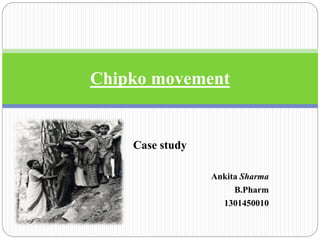
Case study
Ankita Sharma
B.Pharm
1301450010
Chipko movement
IDENTIFICATION
ISSUE
 Deforestation is a severe problem in northern India and
local people have banded together to prevent
commercial timber harvesting.
 These people adopted a unique strategy in recognizing
trees as valuable, living beings.
 The chipko movement adherents are known literally
as “tree huggers”.
DESCRIPTION
 The meaning of chipko, translated in hindi means tree
huggers.
 In the 1970’s a group of Indian villagers in the
uttrakhand region of the himalayas formed a group
comprised predominantly of women to protect local
forests from deforestation.
 however, during the 1970’s the local government
threatened to change this pattern as it considered new
forestery practices that would cede local contracts
under which these corporations would develop a
logging industry.
 The women (with some men) organized a non voilent
movement modeled after gandhian resistance
methods, calling themselves the chipko.
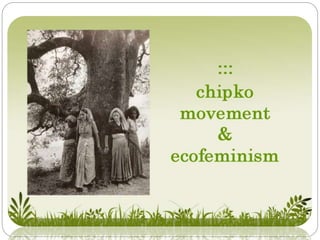
 In protest, the women and children linked their arms
around the trees slated for felling and effectively halted
the deforestation in that area.
 The chipko were protesting not just deforestation but
also a shift toward outside control,since the trees had
been treated as a “commons” used by the villagers.
Chipko movement at Rajasthan
 Not many people know that over the last few centuries
many communities in India have helped to save nature.
 One such is the Bishnoi community of Rajasthan.
 The original chipko movement was started around 260
years back in the early 18th century in rajasthan.
 A large group of them from 84 villages led by a lady
called Amrita Devi laid down their lives in effort to
protect the trees from being felled on the orders of
Maharaja of jodhpur.
The first chipko movement, khejarli 1730 AD
 Khejarli or khejadli is a village in jodhpur district of
rajasthan , india,
 In this village 363 bishnois, led by amrita devi
sacrificed their lives in 1730 AD while protecting
green khejri trees considered sacred by the community
by hugging them this incident is the first event of
chipko movement in the recorded history.
 Honouring the courage of the bishnoi community the
ruler of jodhpur maharaja abhay singh apolozied for
the mistake.
 After that all cutting of green trees and hunting of
animals within the revenue boundaries of bishnoi
villages was strictly prohibited.
 It was also ordered that if by mistake any individual
violated this order, he would be prosecuted by state
and a severe penalty imposed.
 Even the members of ruling family did not shoot
animals in or even near the bishnoi’s village.
Some persons involved in the movement have
given it proper direction.
 Mr. sunderlal bahuguna a gandhian activist and
philosopher, whose appeal to Mrs. Indira Gandhi,
the then prime minister of India,resulted in the green
felling ban.
Mr. Bahuguna coined chipko slogan:
“ecology is permanent economy”
 Mr. chandi prasad bhatt, is another leader who
encouraged the development of local industries
based on conservation and sustainable use of forest.
 Mr. Ghanashyam Raturi the chipko poet , whose songs
echo throughout the himalayas of Uttarakhand, wrote a
poem describing the method of embracing the trees to
save them from felling:
‘Embrace the trees and
save them from being felled;
The property of our hills,
Save them from being looted.’
References
1. http://www1.american.edu/ted/chipko.htm
2. Waren,karen.ecofeminism: women ,culture ,nature
1997.

Chipko movement case study

  • 1.
  • 2.
    IDENTIFICATION ISSUE  Deforestation isa severe problem in northern India and local people have banded together to prevent commercial timber harvesting.  These people adopted a unique strategy in recognizing trees as valuable, living beings.  The chipko movement adherents are known literally as “tree huggers”.
  • 3.
    DESCRIPTION  The meaningof chipko, translated in hindi means tree huggers.  In the 1970’s a group of Indian villagers in the uttrakhand region of the himalayas formed a group comprised predominantly of women to protect local forests from deforestation.  however, during the 1970’s the local government threatened to change this pattern as it considered new forestery practices that would cede local contracts under which these corporations would develop a logging industry.
  • 5.
     The women(with some men) organized a non voilent movement modeled after gandhian resistance methods, calling themselves the chipko.  In protest, the women and children linked their arms around the trees slated for felling and effectively halted the deforestation in that area.  The chipko were protesting not just deforestation but also a shift toward outside control,since the trees had been treated as a “commons” used by the villagers.
  • 6.
    Chipko movement atRajasthan  Not many people know that over the last few centuries many communities in India have helped to save nature.  One such is the Bishnoi community of Rajasthan.  The original chipko movement was started around 260 years back in the early 18th century in rajasthan.  A large group of them from 84 villages led by a lady called Amrita Devi laid down their lives in effort to protect the trees from being felled on the orders of Maharaja of jodhpur.
  • 7.
    The first chipkomovement, khejarli 1730 AD  Khejarli or khejadli is a village in jodhpur district of rajasthan , india,  In this village 363 bishnois, led by amrita devi sacrificed their lives in 1730 AD while protecting green khejri trees considered sacred by the community by hugging them this incident is the first event of chipko movement in the recorded history.  Honouring the courage of the bishnoi community the ruler of jodhpur maharaja abhay singh apolozied for the mistake.
  • 8.
     After thatall cutting of green trees and hunting of animals within the revenue boundaries of bishnoi villages was strictly prohibited.  It was also ordered that if by mistake any individual violated this order, he would be prosecuted by state and a severe penalty imposed.  Even the members of ruling family did not shoot animals in or even near the bishnoi’s village.
  • 9.
    Some persons involvedin the movement have given it proper direction.  Mr. sunderlal bahuguna a gandhian activist and philosopher, whose appeal to Mrs. Indira Gandhi, the then prime minister of India,resulted in the green felling ban. Mr. Bahuguna coined chipko slogan: “ecology is permanent economy”  Mr. chandi prasad bhatt, is another leader who encouraged the development of local industries based on conservation and sustainable use of forest.
  • 10.
     Mr. GhanashyamRaturi the chipko poet , whose songs echo throughout the himalayas of Uttarakhand, wrote a poem describing the method of embracing the trees to save them from felling: ‘Embrace the trees and save them from being felled; The property of our hills, Save them from being looted.’
  • 11.