Sports
Dragon Boat
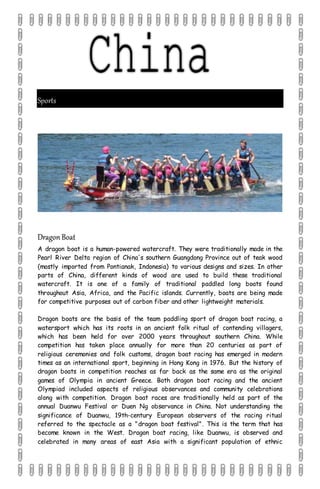
A dragon boat is a human-powered watercraft. They were traditionally made in the
Pearl River Delta region of China's southern Guangdong Province out of teak wood
(mostly imported from Pontianak, Indonesia) to various designs and sizes. In other
parts of China, different kinds of wood are used to build these traditional
watercraft. It is one of a family of traditional paddled long boats found
throughout Asia, Africa, and the Pacific islands. Currently, boats are being made
for competitive purposes out of carbon fiber and other lightweight materials.
Dragon boats are the basis of the team paddling sport of dragon boat racing, a
watersport which has its roots in an ancient folk ritual of contending villagers,
which has been held for over 2000 years throughout southern China. While
competition has taken place annually for more than 20 centuries as part of
religious ceremonies and folk customs, dragon boat racing has emerged in modern
times as an international sport, beginning in Hong Kong in 1976. But the history of
dragon boats in competition reaches as far back as the same era as the original
games of Olympia in ancient Greece. Both dragon boat racing and the ancient
Olympiad included aspects of religious observances and community celebrations
along with competition. Dragon boat races are traditionally held as part of the
annual Duanwu Festival or Duen Ng observance in China. Not understanding the
significance of Duanwu, 19th-century European observers of the racing ritual
referred to the spectacle as a "dragon boat festival". This is the term that has
become known in the West. Dragon boat racing, like Duanwu, is observed and
celebrated in many areas of east Asia with a significant population of ethnic
Chinese such as Singapore, Malaysia, and the Riau Islands, as well as having been
adopted by the Ryukyu Islands since ancient times. The date on which races are
held is referred to as the "double fifth" since Duanwu is reckoned as the fifth day
of the fifth lunar month, which often falls on the Gregorian calendar month of
June and occasionally in May or July.
Traditional Dress
The term“tang suit”is originated from abroad. A Chinatown is a section of an urban
area associated with a large number of Chinese within a city outside the majority.
The local people always named the Chinatown as“town of people from Tang
Dynasty”(唐人街)and called these Chinese“people from Tang Dynasty”(in Chinese唐
人) since Tang dynasty was the most thriving, prosperous, splendid, and glorious
period of ancient Chinese. Thus, the clothing worn by the Chinese is called“tang
suit”.
The cheongsam (/ˈtʃiːɒŋˈsæm/,[1] /ˈtʃɒŋˈsæm/ or /ˈtʃɒŋˈsɑːm/) is a body-hugging
one-piece Chinese dress for women, also known in Mandarin Chinese as qipao (旗袍;
pronounced [t͡ɕʰǐ pʰɑ̌ ʊ̯ ] Wade-Giles ch'i-p'ao), and Mandarin gown in English. The
stylish and often tight-fitting cheongsam or qipao (chipao) that is best known
today was created in the 1920s in Shanghai and made fashionable by socialites and
upper class women.
The modern Chinese tunic suit is a
style of male attire traditionally
known in China as the Zhongshan
suit (simplified Chinese: 中山装;
traditional Chinese: 中山裝; pinyin:
Zhōngshān zhuāng) (after Sun Yat-
Sen, otherwise Romanized as Sun
Zhongshan), and later as the Mao suit (after Mao Zedong). Sun Yat-sen introduced
the style shortly after the founding of the Republic of China as a form of national
dress although with a distinctly political and later governmental implication.
Chines Cuisine
Food has a special meaning to the Chinese people.
The "waste not, want not" ethos means that a
surprising range and variety of plants and animals,
and every part of a plant or animal is used. This
has given rise to a remarkable diversity in
regional cuisine, but to Westerners it can be
overwhelming - surprising, fantastic, delicious,
horrifying or disgusting - but above all, different.
China Food Culture also called China Cuisine
Culture as an important part of China Culture is a
systematic show of Chinese cooking art. In
different regions of China, different famous
cuisines or dishes are most welcomed. So China
has many different types of cuisine tradition. In
Shandong, we call it Shangdong cuisine, which is
themed with strong taste and diverse ingredients.
In Sichuan, we call it Sichuan cuisine featuring
the hot taste and pepper-centered ingredients. In
Canton, we call the food Cantonese food, which is
vividly featured of the cooking materials and
diverse tastes. In Jiangsu, we call the cuisine
Huiyang Cuisine, which is themed with the local
delicacies of Huaian and Yangzhou. In Anhui province, We call the food as Hui cuisine,
which is strongly characterized of the strong oil and taste. Differnt styles of cuisine
reflect different preferences of local citizens and also release the local tradition
MAJOR CHINESE FOOD
Chinese New Year Food
Chinese New Year Foods are very important to
Chinese people. All family members come together
to eat at this time. Chinese New Year foods are
not only delicious but it is traditional to eat
certain foods over this festival. Chinese
Dumplings, Fish, Spring Rolls, Nian Gao are usually
seen as delicious and eaten at this time.
Chinese Vegetarian Food
Most Chinese vegetarians are Buddhists, following
the Buddhist teachings about minimizing suffering.
In addition, many Yoga enthusiasts in China are
vegetarians or vegans. Nowadays, in order to keep
healthy and fit, more and more Chinese people who
are not vegetarians or vegans, tend to eat
vegetarian food from time to time.
Chinese Medicinal Food
Medicinal food is food with the function of
dietetic therapy, which is made by taking medicine
and food as materials and processing them through
cooking. It is the product of the combination of
Chinese traditional medical knowledge and cooking experience.
Festival
Lantern Festival
Falling on the 15th day of the first lunar
month, Lantern Festival is the first
significant feast after Spring Festival, so
called because the most important
activity during the night of the event is
watching various wonderful Chinese
lanterns. And because every household
eats yuanxiao (a rice ball stuffed with
different fillings) on that day, it is called
Yuan Xiao Festival. For its rich and
colorful activities, it is regarded as the
most recreational among all the Chinese
festivals and a day for appreciating the bright full moon, and family reunion.
Qingming Festival
Qingming Festival (also known as Pure
Brightness Festival or Tomb-sweeping Day),
which falls on either April 4th or 5th of the
gregorian calendar, is one of the Chinese
Twenty-four Solar Terms. From that date
temperatures begin to rise and rainfall
increases, indicating that it is the crucial time
for plowing and sowing in the spring. The
festival therefore has a close relationship
with agriculture. However, it is not only a
seasonal symbol; it is also a day of paying
respect to the dead, a spring outing, and other activities.
Dragon Boat Festival
Dragon Boat Festival of 2015 falls on
June 20. The holiday in China starts from
June 20 to 22, 2015. Welcome to China
and explore the traditional folk customs
of this interesting festival! Falling on the
5th day of the 5th month according to
Chinese lunar calendar, the Dragon Boat
Festival is one of great significance. It
has been held annually for more than
2,000 years and is notable for its
educational influence. The festival
commemorates the patriotic poet Qu Yuan
(340-278 BC), and also acts as a chance for Chinese people to build their bodies and dispel
diseases.
China

China

  • 1.
    Sports Dragon Boat A dragonboat is a human-powered watercraft. They were traditionally made in the Pearl River Delta region of China's southern Guangdong Province out of teak wood (mostly imported from Pontianak, Indonesia) to various designs and sizes. In other parts of China, different kinds of wood are used to build these traditional watercraft. It is one of a family of traditional paddled long boats found throughout Asia, Africa, and the Pacific islands. Currently, boats are being made for competitive purposes out of carbon fiber and other lightweight materials. Dragon boats are the basis of the team paddling sport of dragon boat racing, a watersport which has its roots in an ancient folk ritual of contending villagers, which has been held for over 2000 years throughout southern China. While competition has taken place annually for more than 20 centuries as part of religious ceremonies and folk customs, dragon boat racing has emerged in modern times as an international sport, beginning in Hong Kong in 1976. But the history of dragon boats in competition reaches as far back as the same era as the original games of Olympia in ancient Greece. Both dragon boat racing and the ancient Olympiad included aspects of religious observances and community celebrations along with competition. Dragon boat races are traditionally held as part of the annual Duanwu Festival or Duen Ng observance in China. Not understanding the significance of Duanwu, 19th-century European observers of the racing ritual referred to the spectacle as a "dragon boat festival". This is the term that has become known in the West. Dragon boat racing, like Duanwu, is observed and celebrated in many areas of east Asia with a significant population of ethnic
  • 2.
    Chinese such asSingapore, Malaysia, and the Riau Islands, as well as having been adopted by the Ryukyu Islands since ancient times. The date on which races are held is referred to as the "double fifth" since Duanwu is reckoned as the fifth day of the fifth lunar month, which often falls on the Gregorian calendar month of June and occasionally in May or July. Traditional Dress The term“tang suit”is originated from abroad. A Chinatown is a section of an urban area associated with a large number of Chinese within a city outside the majority. The local people always named the Chinatown as“town of people from Tang Dynasty”(唐人街)and called these Chinese“people from Tang Dynasty”(in Chinese唐 人) since Tang dynasty was the most thriving, prosperous, splendid, and glorious period of ancient Chinese. Thus, the clothing worn by the Chinese is called“tang suit”. The cheongsam (/ˈtʃiːɒŋˈsæm/,[1] /ˈtʃɒŋˈsæm/ or /ˈtʃɒŋˈsɑːm/) is a body-hugging one-piece Chinese dress for women, also known in Mandarin Chinese as qipao (旗袍; pronounced [t͡ɕʰǐ pʰɑ̌ ʊ̯ ] Wade-Giles ch'i-p'ao), and Mandarin gown in English. The stylish and often tight-fitting cheongsam or qipao (chipao) that is best known today was created in the 1920s in Shanghai and made fashionable by socialites and upper class women. The modern Chinese tunic suit is a style of male attire traditionally known in China as the Zhongshan suit (simplified Chinese: 中山装; traditional Chinese: 中山裝; pinyin: Zhōngshān zhuāng) (after Sun Yat- Sen, otherwise Romanized as Sun
  • 3.
    Zhongshan), and lateras the Mao suit (after Mao Zedong). Sun Yat-sen introduced the style shortly after the founding of the Republic of China as a form of national dress although with a distinctly political and later governmental implication.
  • 4.
    Chines Cuisine Food hasa special meaning to the Chinese people. The "waste not, want not" ethos means that a surprising range and variety of plants and animals, and every part of a plant or animal is used. This has given rise to a remarkable diversity in regional cuisine, but to Westerners it can be overwhelming - surprising, fantastic, delicious, horrifying or disgusting - but above all, different. China Food Culture also called China Cuisine Culture as an important part of China Culture is a systematic show of Chinese cooking art. In different regions of China, different famous cuisines or dishes are most welcomed. So China has many different types of cuisine tradition. In Shandong, we call it Shangdong cuisine, which is themed with strong taste and diverse ingredients. In Sichuan, we call it Sichuan cuisine featuring the hot taste and pepper-centered ingredients. In Canton, we call the food Cantonese food, which is vividly featured of the cooking materials and diverse tastes. In Jiangsu, we call the cuisine Huiyang Cuisine, which is themed with the local delicacies of Huaian and Yangzhou. In Anhui province, We call the food as Hui cuisine, which is strongly characterized of the strong oil and taste. Differnt styles of cuisine reflect different preferences of local citizens and also release the local tradition MAJOR CHINESE FOOD Chinese New Year Food Chinese New Year Foods are very important to Chinese people. All family members come together to eat at this time. Chinese New Year foods are not only delicious but it is traditional to eat certain foods over this festival. Chinese Dumplings, Fish, Spring Rolls, Nian Gao are usually seen as delicious and eaten at this time. Chinese Vegetarian Food Most Chinese vegetarians are Buddhists, following the Buddhist teachings about minimizing suffering. In addition, many Yoga enthusiasts in China are vegetarians or vegans. Nowadays, in order to keep healthy and fit, more and more Chinese people who are not vegetarians or vegans, tend to eat vegetarian food from time to time. Chinese Medicinal Food Medicinal food is food with the function of dietetic therapy, which is made by taking medicine and food as materials and processing them through cooking. It is the product of the combination of
  • 5.
    Chinese traditional medicalknowledge and cooking experience. Festival Lantern Festival Falling on the 15th day of the first lunar month, Lantern Festival is the first significant feast after Spring Festival, so called because the most important activity during the night of the event is watching various wonderful Chinese lanterns. And because every household eats yuanxiao (a rice ball stuffed with different fillings) on that day, it is called Yuan Xiao Festival. For its rich and colorful activities, it is regarded as the most recreational among all the Chinese festivals and a day for appreciating the bright full moon, and family reunion. Qingming Festival Qingming Festival (also known as Pure Brightness Festival or Tomb-sweeping Day), which falls on either April 4th or 5th of the gregorian calendar, is one of the Chinese Twenty-four Solar Terms. From that date temperatures begin to rise and rainfall increases, indicating that it is the crucial time for plowing and sowing in the spring. The festival therefore has a close relationship with agriculture. However, it is not only a seasonal symbol; it is also a day of paying respect to the dead, a spring outing, and other activities. Dragon Boat Festival Dragon Boat Festival of 2015 falls on June 20. The holiday in China starts from June 20 to 22, 2015. Welcome to China and explore the traditional folk customs of this interesting festival! Falling on the 5th day of the 5th month according to Chinese lunar calendar, the Dragon Boat Festival is one of great significance. It has been held annually for more than 2,000 years and is notable for its educational influence. The festival commemorates the patriotic poet Qu Yuan (340-278 BC), and also acts as a chance for Chinese people to build their bodies and dispel diseases.