A constructivist
approach to science
teaching
• Elicitation - starts from the naive
conceptions of learners.
• Intervention.
• Reformulation.
• Evaluation.
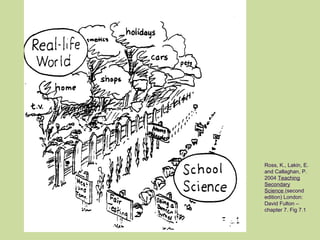
Ross, K., Lakin, E.
and Callaghan, P.
2004 Teaching
Secondary
Science (second
edition) London:
David Fulton –
chapter 7. Fig 7.1
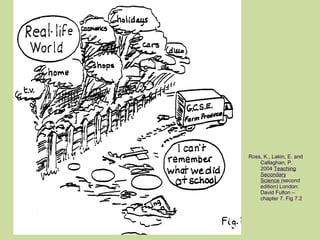
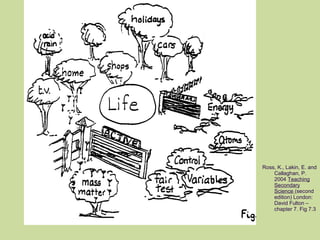
Ross, K., Lakin, E. and
Callaghan, P.
2004 Teaching
Secondary
Science (second
edition) London:
David Fulton –
chapter 7. Fig 7.2
Ross, K., Lakin, E. and
Callaghan, P.
2004 Teaching
Secondary
Science (second
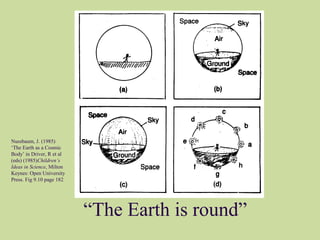
edition) London:
David Fulton –
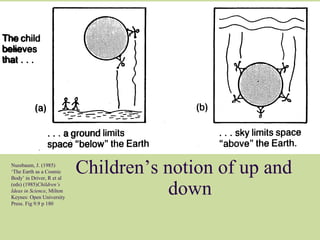
chapter 7. Fig 7.3
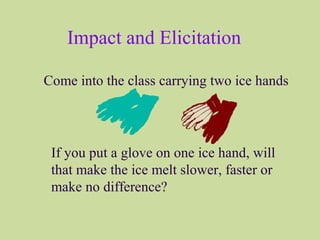
Impact and Elicitation
Come into the class carrying two ice hands
If you put a glove on one ice hand, will
that make the ice melt slower, faster or
make no difference?
Elicitation - Tell each Other
Tell each other:
Compared with the unwrapped ice hand,
will the wrapped ice:
• melt faster?
• melt at the same rate?
• melt more slowly?
Explain why you think this way.
Tell each other why it is better than
‘Hands up’ (and why it sometimes isn’t)
• all think it out for themselves
• rehearse a verbal response without making a fool
or exhibition of themselves.
• Those without an answer hear one from their
neighbour (instead of silence)
• pupils who were not asked say to themselves “yes
- that’s what I said”, or “I didn’t think that”.
• Chaos?
Insulation means making you warm
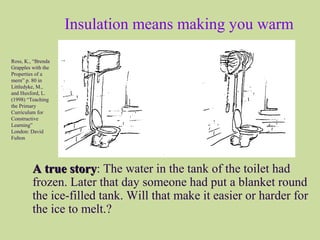
A true storyA true story: The water in the tank of the toilet had
frozen. Later that day someone had put a blanket round
the ice-filled tank. Will that make it easier or harder for
the ice to melt.?
Ross, K., “Brenda
Grapples with the
Properties of a
mern” p. 80 in
Littledyke, M.,
and Huxford, L.
(1998) “Teaching
the Primary
Curriculum for
Constructive
Learning”
London: David
Fulton
Ice Cream Elicitation
How do you keep things warm when you’ve
got a ......?
You wrap them in towels and things like
that / ....?.... / newspapers
Now how does the newspaper keep things
warm? What’s the things it keeps warm?
Fish and cips
So if you wrap fish & chips up in newspaper
and you bring it home it’s warm when you get
home is it?
yes / yes
What about ice cream?
... ? ... / it melts
If you wrapped it up in some newspaper how
would that help it to melt?
.... .... / It would insulate it / it would
make it warm
Where would the warmth come from
… from the air trapped inside ..
… but the air might get cold?
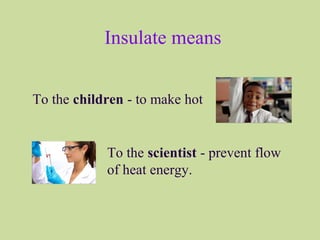
Insulate means
To the children - to make hot
To the scientist - prevent flow
of heat energy.
Intervention
Aim is to challenge (or support) their views
Get each group of pupils to set up some ice -
wrapped and unwrapped.
Re-construction and
Application
• the blanket material prevents heat from
flowing
• oven gloves, gloves for making snowballs
• Your bed, covered in a blanket all day is not
warm when you get in at night
• cool boxes used to keep things hot
• ’fridges and ovens are lagged.
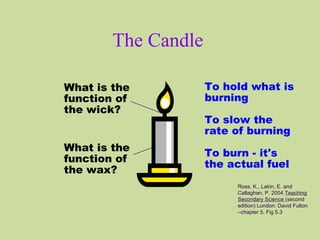
The Candle
What is the
function of
the wax?
To hold what is
burning
To slow the
rate of burning
To burn - it's
the actual fuel
What is the
function of
the wick?
Ross, K., Lakin, E. and
Callaghan, P. 2004 Teaching
Secondary Science (second
edition) London: David Fulton
–chapter 5. Fig 5.3
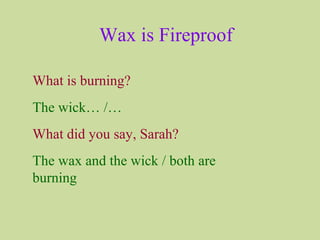
Wax is Fireproof
What is burning?
The wick… /…
What did you say, Sarah?
The wax and the wick / both are
burning
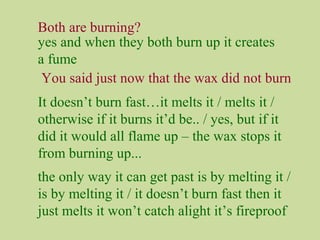
Both are burning?
You said just now that the wax did not burn
It doesn’t burn fast…it melts it / melts it /
otherwise if it burns it’d be.. / yes, but if it
did it would all flame up – the wax stops it
from burning up...
yes and when they both burn up it creates
a fume
the only way it can get past is by melting it /
is by melting it / it doesn’t burn fast then it
just melts it won’t catch alight it’s fireproof
So wax is fireproof is it?
well it melts / it melts / doesn’t flame up /
‘cos the flame goes up not down so that’s
why if you held a bit of candle there [to
side of candle] the flame would go up the
side of the wax and melt it
So what is the purpose of the wax?
to stop it burning
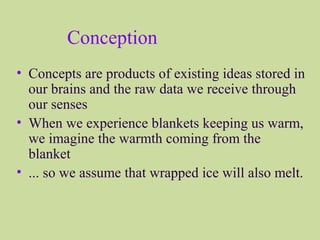
Conception
• Concepts are products of existing ideas stored in
our brains and the raw data we receive through
our senses
• When we experience blankets keeping us warm,
we imagine the warmth coming from the
blanket
• ... so we assume that wrapped ice will also melt.
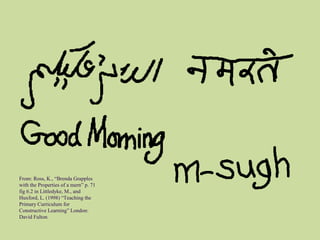
From: Ross, K., “Brenda Grapples
with the Properties of a mern” p. 71
fig 6.2 in Littledyke, M., and
Huxford, L. (1998) “Teaching the
Primary Curriculum for
Constructive Learning” London:
David Fulton
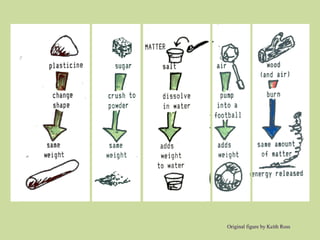
Original figure by Keith Ross
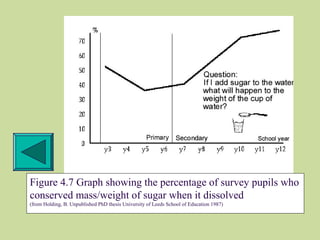
Figure 4.7 Graph showing the percentage of survey pupils who
conserved mass/weight of sugar when it dissolved
(from Holding, B. Unpublished PhD thesis University of Leeds School of Education 1987)
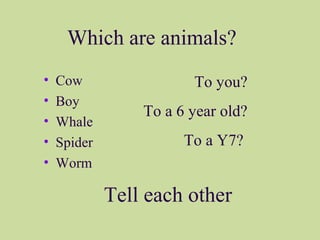
Which are animals?
• Cow
• Boy
• Whale
• Spider
• Worm
To you?
To a 6 year old?
To a Y7?
Tell each other
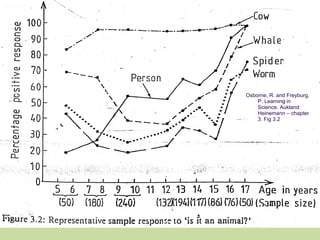
Osborne, R. and Freyburg,
P. Learning in
Science. Aukland:
Heinemann – chapter
3. Fig 3.2
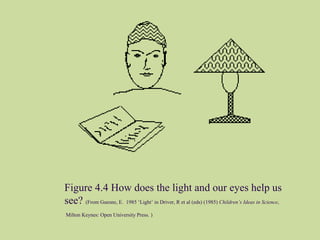
Figure 4.4 How does the light and our eyes help us
see? (From Guesne, E. 1985 ‘Light’ in Driver, R et al (eds) (1985) Children’s Ideas in Science,
Milton Keynes: Open University Press. )
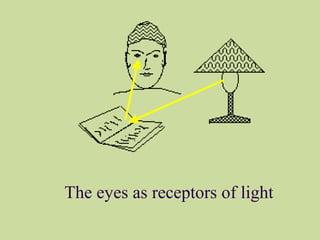
The eyes as receptors of light
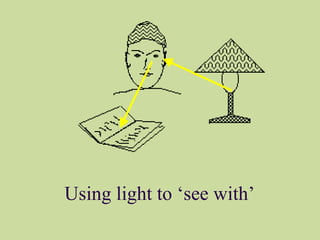
Using light to ‘see with’
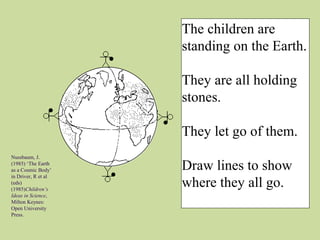
The children are
standing on the Earth.
They are all holding
stones.
They let go of them.
Draw lines to show
where they all go.
Nussbaum, J.
(1985) ‘The Earth
as a Cosmic Body’
in Driver, R et al
(eds)
(1985)Children’s
Ideas in Science,
Milton Keynes:
Open University
Press.
“The Earth is round”
Nussbaum, J. (1985)
‘The Earth as a Cosmic
Body’ in Driver, R et al
(eds) (1985)Children’s
Ideas in Science, Milton
Keynes: Open University
Press. Fig 9.10 page 182
Children’s notion of up and
down
Nussbaum, J. (1985)
‘The Earth as a Cosmic
Body’ in Driver, R et al
(eds) (1985)Children’s
Ideas in Science, Milton
Keynes: Open University
Press. Fig 9.9 p 180
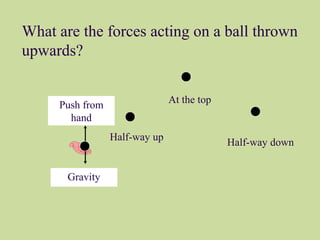
Half-way up
At the top
Half-way down
Push from
hand
Gravity
What are the forces acting on a ball thrown
upwards?
Finding out children’s ideas
• Interview, not teach
• Ask for reasons
• Be interested but supply no ‘right’
answers
The misty mountain of
science
• and the valley where we live with our
everyday ideas
[Ref Ross, K., “Brenda Grapples with the Properties of a mern” p. 80 in
Littledyke, M., and Huxford, L. (1998) “Teaching the Primary Curriculum for
Constructive Learning” London: David Fulton]
Telling children scientific
ideas.
• This is like landing them on a mountain
top in the mist, with no idea where they
are
• It will be isolated knowledge, and
likely to be forgotten in a few years.
Progressive, child-centred or
discovery methods
• Letting them play in the valleys. They
never see the mountain tops which are
covered in mist.
Constructivist approaches to
learning
• take children’s existing ideas into account -
their view of their valley of understanding
• children can then be led up the mountain, in
sight of the valley below, and now are able
to see how the whole landscape links up and
how limited their existing view was
Science
• Not learnt by heart
• A set of ideas and models
which attempt to explain natural
phenomena.
The real world helps us make sense
of the way it works
• Would we avoid entering a butcher’s shop,
despite the notice “No animals allowed”?
• Would we refrain from saying “I need
some warmer clothes for Christmas”?

Children ideas in Science

  • 1.
  • 2.
    • Elicitation -starts from the naive conceptions of learners. • Intervention. • Reformulation. • Evaluation.
  • 3.
    Ross, K., Lakin,E. and Callaghan, P. 2004 Teaching Secondary Science (second edition) London: David Fulton – chapter 7. Fig 7.1
  • 4.
    Ross, K., Lakin,E. and Callaghan, P. 2004 Teaching Secondary Science (second edition) London: David Fulton – chapter 7. Fig 7.2
  • 5.
    Ross, K., Lakin,E. and Callaghan, P. 2004 Teaching Secondary Science (second edition) London: David Fulton – chapter 7. Fig 7.3
  • 6.
    Impact and Elicitation Comeinto the class carrying two ice hands If you put a glove on one ice hand, will that make the ice melt slower, faster or make no difference?
  • 7.
    Elicitation - Telleach Other Tell each other: Compared with the unwrapped ice hand, will the wrapped ice: • melt faster? • melt at the same rate? • melt more slowly? Explain why you think this way.
  • 8.
    Tell each otherwhy it is better than ‘Hands up’ (and why it sometimes isn’t) • all think it out for themselves • rehearse a verbal response without making a fool or exhibition of themselves. • Those without an answer hear one from their neighbour (instead of silence) • pupils who were not asked say to themselves “yes - that’s what I said”, or “I didn’t think that”. • Chaos?
  • 9.
    Insulation means makingyou warm A true storyA true story: The water in the tank of the toilet had frozen. Later that day someone had put a blanket round the ice-filled tank. Will that make it easier or harder for the ice to melt.? Ross, K., “Brenda Grapples with the Properties of a mern” p. 80 in Littledyke, M., and Huxford, L. (1998) “Teaching the Primary Curriculum for Constructive Learning” London: David Fulton
  • 10.
    Ice Cream Elicitation Howdo you keep things warm when you’ve got a ......? You wrap them in towels and things like that / ....?.... / newspapers Now how does the newspaper keep things warm? What’s the things it keeps warm? Fish and cips
  • 11.
    So if youwrap fish & chips up in newspaper and you bring it home it’s warm when you get home is it? yes / yes What about ice cream? ... ? ... / it melts
  • 12.
    If you wrappedit up in some newspaper how would that help it to melt? .... .... / It would insulate it / it would make it warm Where would the warmth come from … from the air trapped inside .. … but the air might get cold?
  • 13.
    Insulate means To thechildren - to make hot To the scientist - prevent flow of heat energy.
  • 14.
    Intervention Aim is tochallenge (or support) their views Get each group of pupils to set up some ice - wrapped and unwrapped.
  • 15.
    Re-construction and Application • theblanket material prevents heat from flowing • oven gloves, gloves for making snowballs • Your bed, covered in a blanket all day is not warm when you get in at night • cool boxes used to keep things hot • ’fridges and ovens are lagged.
  • 16.
    The Candle What isthe function of the wax? To hold what is burning To slow the rate of burning To burn - it's the actual fuel What is the function of the wick? Ross, K., Lakin, E. and Callaghan, P. 2004 Teaching Secondary Science (second edition) London: David Fulton –chapter 5. Fig 5.3
  • 17.
    Wax is Fireproof Whatis burning? The wick… /… What did you say, Sarah? The wax and the wick / both are burning
  • 18.
    Both are burning? Yousaid just now that the wax did not burn It doesn’t burn fast…it melts it / melts it / otherwise if it burns it’d be.. / yes, but if it did it would all flame up – the wax stops it from burning up... yes and when they both burn up it creates a fume the only way it can get past is by melting it / is by melting it / it doesn’t burn fast then it just melts it won’t catch alight it’s fireproof
  • 19.
    So wax isfireproof is it? well it melts / it melts / doesn’t flame up / ‘cos the flame goes up not down so that’s why if you held a bit of candle there [to side of candle] the flame would go up the side of the wax and melt it So what is the purpose of the wax? to stop it burning
  • 20.
    Conception • Concepts areproducts of existing ideas stored in our brains and the raw data we receive through our senses • When we experience blankets keeping us warm, we imagine the warmth coming from the blanket • ... so we assume that wrapped ice will also melt.
  • 21.
    From: Ross, K.,“Brenda Grapples with the Properties of a mern” p. 71 fig 6.2 in Littledyke, M., and Huxford, L. (1998) “Teaching the Primary Curriculum for Constructive Learning” London: David Fulton
  • 22.
  • 23.
    Figure 4.7 Graphshowing the percentage of survey pupils who conserved mass/weight of sugar when it dissolved (from Holding, B. Unpublished PhD thesis University of Leeds School of Education 1987)
  • 24.
    Which are animals? •Cow • Boy • Whale • Spider • Worm To you? To a 6 year old? To a Y7? Tell each other
  • 25.
    Osborne, R. andFreyburg, P. Learning in Science. Aukland: Heinemann – chapter 3. Fig 3.2
  • 26.
    Figure 4.4 Howdoes the light and our eyes help us see? (From Guesne, E. 1985 ‘Light’ in Driver, R et al (eds) (1985) Children’s Ideas in Science, Milton Keynes: Open University Press. )
  • 27.
    The eyes asreceptors of light
  • 28.
    Using light to‘see with’
  • 29.
    The children are standingon the Earth. They are all holding stones. They let go of them. Draw lines to show where they all go. Nussbaum, J. (1985) ‘The Earth as a Cosmic Body’ in Driver, R et al (eds) (1985)Children’s Ideas in Science, Milton Keynes: Open University Press.
  • 30.
    “The Earth isround” Nussbaum, J. (1985) ‘The Earth as a Cosmic Body’ in Driver, R et al (eds) (1985)Children’s Ideas in Science, Milton Keynes: Open University Press. Fig 9.10 page 182
  • 31.
    Children’s notion ofup and down Nussbaum, J. (1985) ‘The Earth as a Cosmic Body’ in Driver, R et al (eds) (1985)Children’s Ideas in Science, Milton Keynes: Open University Press. Fig 9.9 p 180
  • 32.
    Half-way up At thetop Half-way down Push from hand Gravity What are the forces acting on a ball thrown upwards?
  • 33.
    Finding out children’sideas • Interview, not teach • Ask for reasons • Be interested but supply no ‘right’ answers
  • 34.
    The misty mountainof science • and the valley where we live with our everyday ideas [Ref Ross, K., “Brenda Grapples with the Properties of a mern” p. 80 in Littledyke, M., and Huxford, L. (1998) “Teaching the Primary Curriculum for Constructive Learning” London: David Fulton]
  • 35.
    Telling children scientific ideas. •This is like landing them on a mountain top in the mist, with no idea where they are • It will be isolated knowledge, and likely to be forgotten in a few years.
  • 36.
    Progressive, child-centred or discoverymethods • Letting them play in the valleys. They never see the mountain tops which are covered in mist.
  • 37.
    Constructivist approaches to learning •take children’s existing ideas into account - their view of their valley of understanding • children can then be led up the mountain, in sight of the valley below, and now are able to see how the whole landscape links up and how limited their existing view was
  • 38.
    Science • Not learntby heart • A set of ideas and models which attempt to explain natural phenomena.
  • 39.
    The real worldhelps us make sense of the way it works • Would we avoid entering a butcher’s shop, despite the notice “No animals allowed”? • Would we refrain from saying “I need some warmer clothes for Christmas”?

Editor's Notes

  • #3 This presentation draws on the following references, which I advise presenters to read in order to make full sense of these images: Ross, K., Lakin, E. and Callaghan, P. 2004 Teaching Secondary Science (second edition) London: David Fulton – esp chapter 5. Some of the images here appear in that publication [Ref Ross, K., “Brenda Grapples with the Properties of a mern” p. 80 in Littledyke, M., and Huxford, L. (1998) “Teaching the Primary Curriculum for Constructive Learning” London: David Fulton]
  • #4 These three images show the need to link school teaching with the everyday lives of the children, else their everyday concepts will remain untouched and all science teaching in school will be in vain.
  • #7 Here is it elicitation question, which most children get ‘wrong’ thinking that gloves are ‘hot’ rather than acting as insulation. Think og oven gloves or fireman's gloves which keep the hand cool!
  • #8 This uses the talk-partner idea – see Ross, K., Lakin, E. and Callaghan, P. 2004 Teaching Secondary Science (second edition) London: David Fulton – page 63
  • #10 Another version of the ice hands elicitation question. It really happened – in 1982 in Cheltenham!
  • #11 To advance the text and hear the commentary you may need to use the down arrow key. To hear the children you must save the sound files in the same folder as your PowerPoint. These are a group pf Y6 pupils interviewed by Keith Ross. Notice that the interviewer does not give any indication of whether the children’s ideas are acceptable scientifically or not. At this stage we want to find out what they actually believe. Later their ideas need to be challenged
  • #13 Notice here that the children spontaneously begin to qurestion their first idea – this can lead to an investigation.
  • #14 This is why children’s ideas develop – they always have a grain of truth in them
  • #15 This leads to some investigative work in the classroom/lab (or at home!)
  • #16 Applying the new idea of insulation
  • #17 The interview that follows with a group of 5 Y6 pupils is another example of how to find out what children believe. Notice that the interviewer (Keith Ross in this instance) does not give any indication of whether the children’s ideas are acceptable scientifically or not. At this stage we want to find out what they actually believe. Later their ideas need to be challenged
  • #18 To advance the text and hear the commentary you may need to use the down arrow key. To hear the children you must save the sound files in the same folder as your PowerPoint
  • #22 I show this slide for a few seconds, and then ask the trainees to write down what they remembered. The Arabic greeting top left asailum aliekum (read right to left), the Hindi greeting top right (Namaste) the English greeting bottom left and a Tiv (Nigeria) greeting “mmmm Sue”. Although the same information is contained in them all only the ones in scripts we have links to in our brains will make any sense to us, and the rest, esp the top two will usually appear as squiggles. Perception is a combination of incoming sense data, and a translation/recognition process in our brains. The same effect can be achieved by asking trainees to put their hands up using a foreign language. Our everyday observations are similarly governed by the conceptions we have in our brains. We can’t expect students to ‘see’ the same way we do – sense data come to their brains but they may not be able to make sense of it, or they may make a different sense of it than we do.
  • #23 Conservation of matter build up gradually, but until pupils realise that matter is conserved (at an atomic level) even during chemical changes such as burning, our chemical view of the world will be s mystery to them.
  • #24 This U shaped grapg is common in children’s developing understanding. Ask trainee why infants get it right more often than the juniors. When you first appreciate ‘dissolving’ you think of materials disappearing.
  • #25 Animal = furry mammal to most of us. And Humans are excluded
  • #26 Another example of the U shape curve, as children learn to classify animals as ‘fish’ ‘birds’ ‘insects’ . Note that people become animals as they go through their schooling (!)
  • #28 This is the scientific model – developed by the Islamic School in the 6th Century
  • #29 This is a commonly held view – the active eye-sight
  • #30 Children have an absolute view of up and down, so the stones tend to fall off the bottom of the page.
  • #31 They rationalise a round earth in many ways
  • #32 Children have an absolute view of up and down, so the stones tend to fall off the bottom of the page, and the smoke floats up
  • #33 For a full explanation of the way children confuse momentum with force see Gunstone, R. and Watts, M. (1985) ‘Force and Motion’ in Driver, R et al (eds) (1985) Children’s Ideas in Science, Milton Keynes: Open University Press. The only force (neglecting air resistance) that acts here is gravity, which slows the ball down immediately it leaves the hand, then, as soon as it comes to a halt at the top of its flight, it pick up speed as the force id now in the same direction as the ball’s motion. So many graduate still want to put an upward arrow on the ball in the direction of its motion (this is momentum not force)
  • #34 TPS refers to our primary study guide: Littledyke et al (2004) Teaching Primary Science, Cheltenham: University of Gloucestershire.
  • #35 A useful analogy? … but treat all such analogies with care!
  • #40 Warning – we mustn’t replace the naive, everyday use of words, but show children that words can have different meanings in different contexts. The message is that we need to know what children think before we can begin to develop and challenge their ideas. Keith Ross University of Gloucestershire