Presented by
Dr. MADHURI GUPTA
PG STUDENT 2nd YEAR (2022-25)
Department of Pedodontics
D.J COLLEGE OF DENTAL SCIENCES AND
RESEARCH MODINAGAR
Erikso
n
Theor
y
Introduction
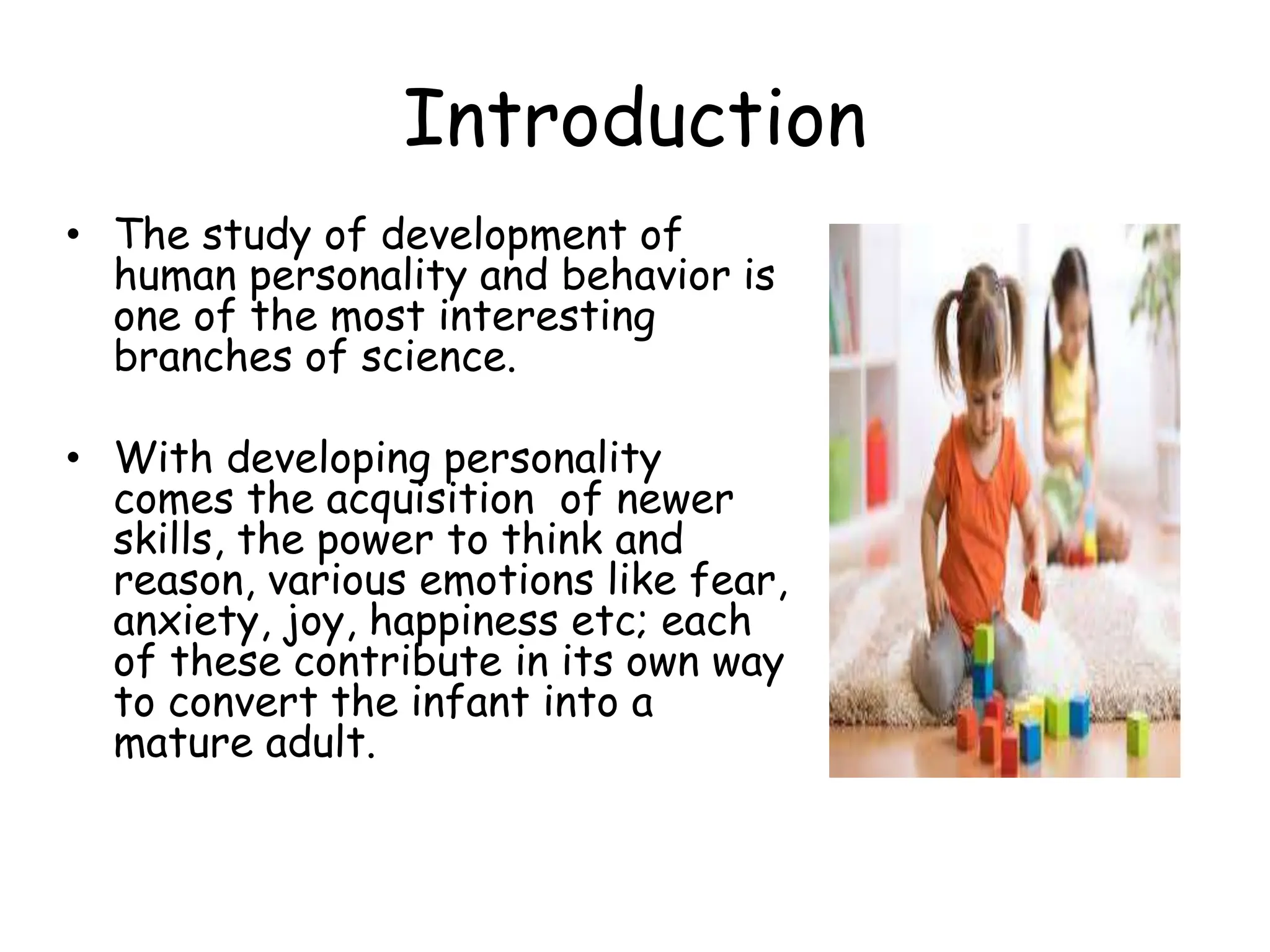
• The study of development of
human personality and behavior is
one of the most interesting
branches of science.
• With developing personality
comes the acquisition of newer
skills, the power to think and
reason, various emotions like fear,
anxiety, joy, happiness etc; each
of these contribute in its own way
to convert the infant into a
mature adult.
• Psychology is defined as science dealing
with Human mind and behavior.
• Child Psychology is defined mental power
or interaction through conscious and
subconscious elements in the child.
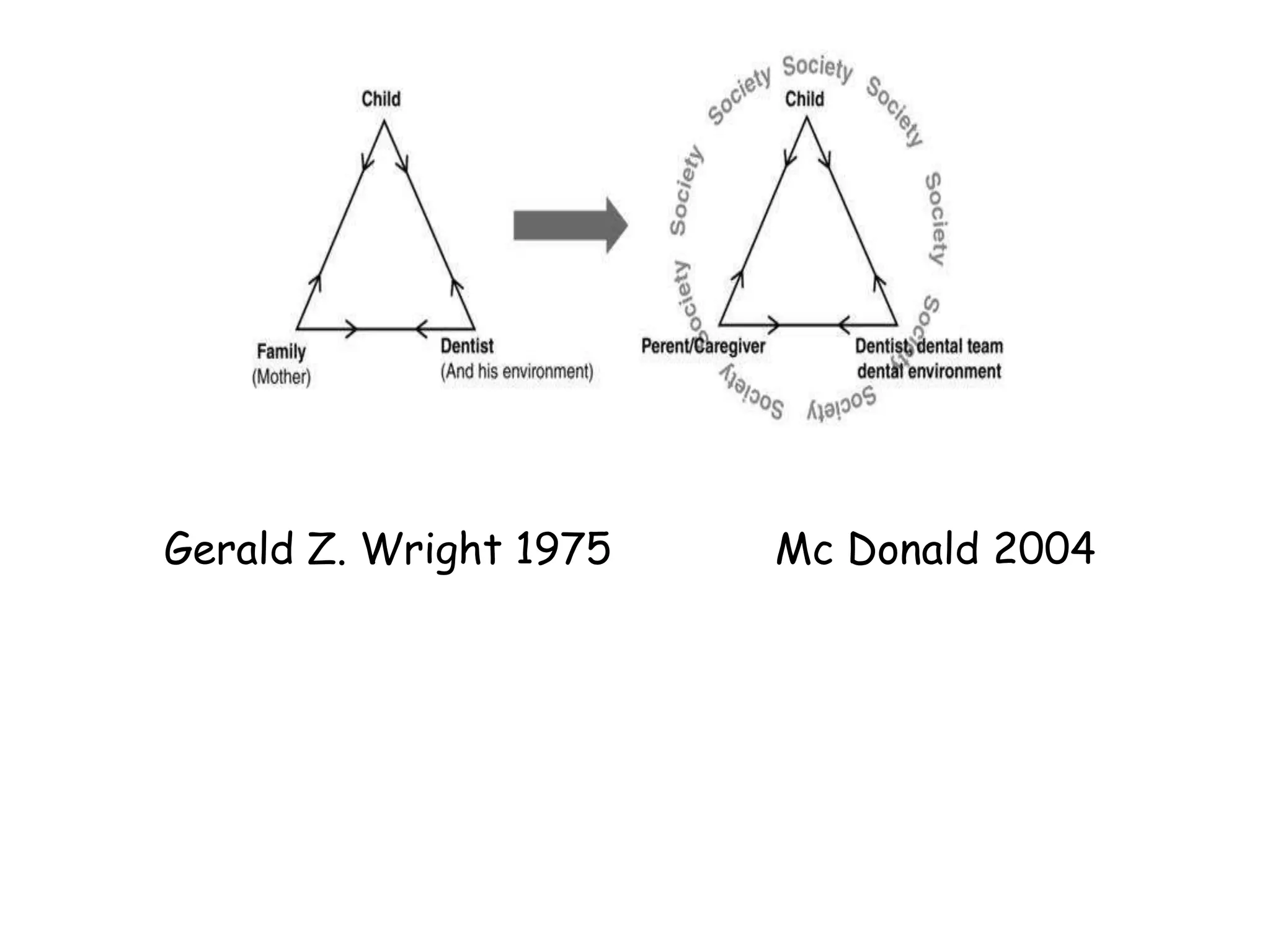
Gerald Z. Wright 1975 Mc Donald 2004
Psychosocial theory
• Developed by Erik Erikson
• Erik H Erikson was a Danish-German-
American developmental psychologist and
psychoanalyst known for his theory on
social development of human beings.
• He may be most famous for coining the
phrase identity crisis.
• 8 psychosocial stages
Psychosocial theory
Freud and Erikson share some important assumptions:
• Each stage is defined as two opposing physical tendencies
– Sytactic
– Dystonic
• Unresolved issues from early stages of life affect person’s
ability to deal with subsequent stages
Each stage is characterized by a
different psychological ‘crisis’
1. Development of trust (birth to 1 year):
Basic trust vs. mistrust – oral sensory stage
2. Development of autonomy (1 to 2 years):
Autonomy vs. shame and doubt – muscular anal
stage
3. Development of initiative (2 to 6 years):
Initiative vs. guilt – locomotor genital stage
4. Mastery of skills (6 to 12 years):
Industry vs. inferiority – latency stage
5. Development of personal identity (12 to 18 years):
Identity vs. role confusion – adolescence stage
6. 19-40 years - Young adulthood
Intimacy vs. Isolation
7. 40 – 65 years – Middle adulthood
Generativity vs. stagnation
8. 65 years onwards – Late adulthood
Integrity vs. despair
Development of trust (Basic Trust vs.
Mistrust) birth to 1 year
• Corresponds to oral stage of Freud or infancy
• Psychosocial crises in this period involves basic trust at one
extreme and mistrust at the other
Parents attitude
• If the infant’s needs are met and
discomforts removed properly they
develop a sense of trust towards
people
• If the care is inconsistent,
inadequate and rejecting, a basic
mistrust is fostered.
• Fear and suspicion develops toward
the world in general
Separation anxiety
• Tight bond between parent and
child in this early stage of
emotional development is
reflected in a strong sense of
separation anxiety when separated
from the parent
Significance in dentistry
• Dental treatment at an early stage is
preferably done in the parent’s
presence
• If possible while the child is being
held by one of the parents
• At later stages, a child who never
developed a sense of basic trust is
likely to be an extremely frightened
and uncooperative patient
Development of autonomy(autonomy
vs. shame or doubt) 1 to 2 years
• Corresponds to anal stage of Freud or toddler stage
• Child takes pride in new accomplishments
• The child who passes through this stage with a sense of
autonomy is well prepared to be autonomous in later stages of
life
Parents attitude
• If the parents allow him to develop at
his own pace and reassure when he
makes mistakes, then a sense of self-
control of muscles impulses and
environment is developed, which will
contribute to the confidence needed
to cope with future situations.
• if the caretakers are overprotective
or impatient and do everything for
the child, they reinforce a sense of
shame and doubt
Terrible Two’s
• Little angel
• Little Devil
Significance in dentistry
• have the child to think that whatever
the dentist wants to do was his or her
own choice
• For a 2 year old seeking autonomy, it is
alright to say “open your mouth if you
want to”
• offer the child reasonable choices
whenever possible
• Simple procedures should be done in
presence of parent
Development of Initiative
(initiative vs. guilt) 2 to 6 years
• Corresponds to phallic stage of Freud.
• Can initiate motor activities and language
• Achieves balance between eagerness for adventure and
responsibility
• Learn to control impulses
Parents attitude
• Encouraging
• consistent in discipline
• children will learn to accept without
guilt, that certain things are not
allowed, but at the same time will not
feel shame when using their
imagination.
Parents attitude
• Initiative is reinforced when
parents answer their questions
• If no, the child may develop a
sense of guilt over self
initiated activities in general
Significance in dentistry
• First dental visit comes during
this stage of initiative
• Visit to the dentist should be
constructed as an adventure in
which the child can experience
success
• Success in coping with the anxiety
of visiting dentist can help in a
greater sense of accomplishment
Significance in dentistry
• But if the child is poorly
managed, the dental visit can
result in a sense of guilt that
accompanies failure
• An exploratory visit with little
work is often a good way to
start the dental experience.
Mastery of Skills (industry vs.
inferiority) 6 to 12 years
• Corresponds to latency period of Freud or elementary and middle
school years (6 to 12 years)
• School is the important event at this stage.
• Children learn to make things, use tools and acquire the skills
• In Erikson’s terms, the child acquires industriousness and begins
the preparation for entrance into a competitive world. The
influence of parents as role models decreases and the influence
of peer group increases.
Parents attitude
• If children can discover pleasure
in intellectual stimulation, being
productive, seeking success they
will develop a sense of
competence.
Parents attitude
If the child is allowed too little
success, because of harsh
teachers or rejecting peers,
for example, then he or she will
develop a sense of inferiority
or incompetence.
Significance in dentistry
• Behavior guidance is done in this
stage by clearly outlining to the
child, what to do or how to
behave and then reinforcing it
positively.
• Cooperation with treatment can
be obtained
Significance in dentistry
• They like to get attention of peer
groups and motivated by the
facts that can be noticed by the
peers
• e.g. improved appearance by
dental treatment rather than
properly aligned teeth or chewing
efficiency
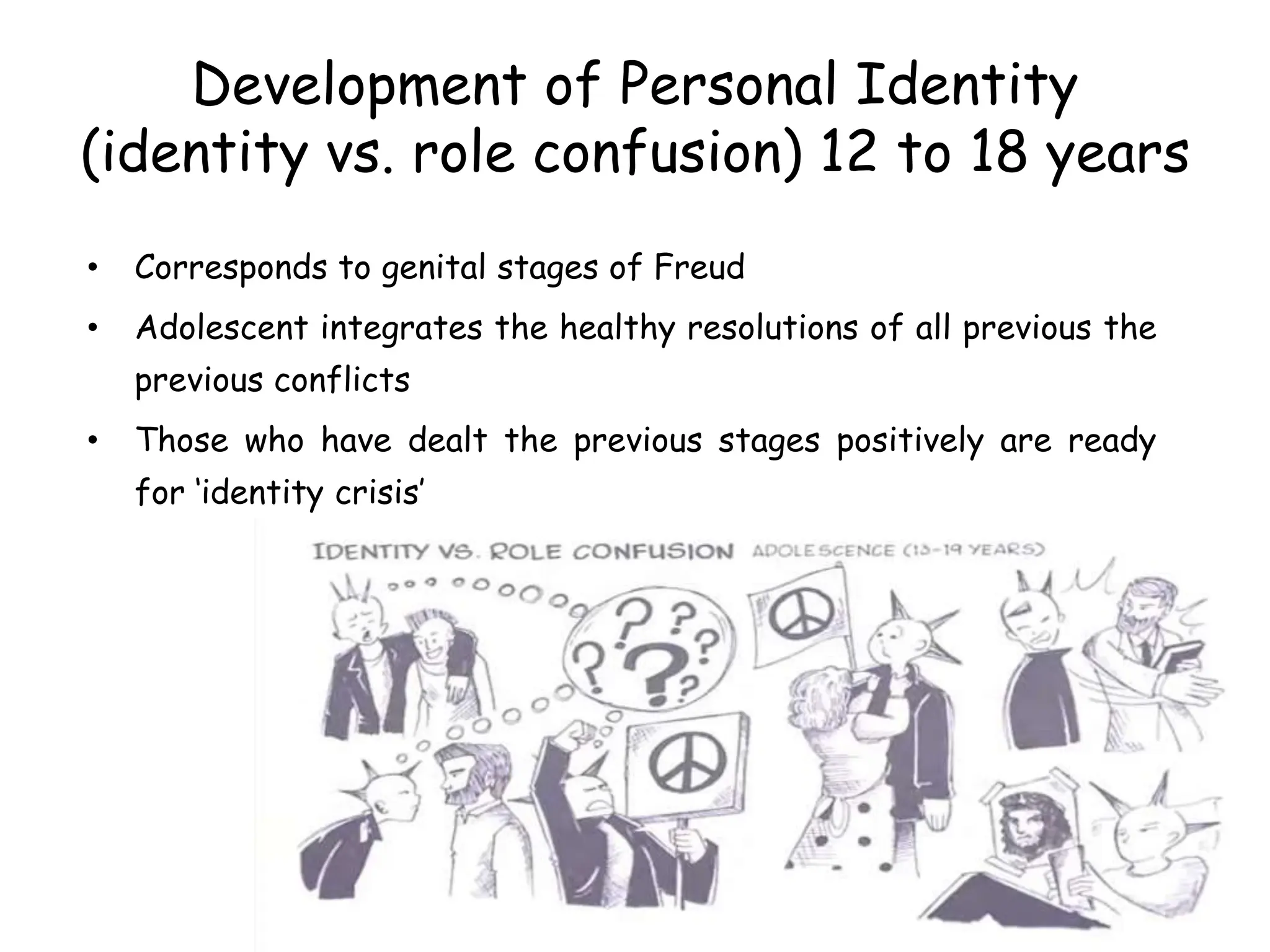
Development of Personal Identity
(identity vs. role confusion) 12 to 18 years
• Corresponds to genital stages of Freud
• Adolescent integrates the healthy resolutions of all previous the
previous conflicts
• Those who have dealt the previous stages positively are ready
for ‘identity crisis’
Parents attitude
• Authority of parents and
others is usually rejected in
this stage for establishing one’s
own identity
• members of the peer group
become important role models
Significance in dentistry
• Behavior management of adolescents can be
challenging.
• Any orthodontic treatment should be carried
out if child wants it and not parents as at this
stage, parental authority is being rejected.
• Approval of peer group is extremely important.
• For example, orthodontic treatment has
become so common that there may be a loss of
status from being one of the few in the group
who is not receiving treatment, so that
treatment may even be requested in order to
remain “one of the crowd”.
Development of Intimacy
Young adulthood (19-40 years)
• Intimacy vs. Isolation
• Not developmentally complete until you are capable of intimacy
• External appearance very important
• Focus on orthodontic and esthetic treatments
Guidance of next generation
Middle adulthood (40-65years)
• Generativity vs. stagnation
• Adult’s ability to look outside and care for others.
• Opposite : self centered behaviour
Attainment of Integrity
Late adulthood (65 years to death)
• Integrity vs. despair
• Peak of adjustment
• Sense of fulfillment about life
• Opposite: disgust and unhappiness
Criticism of Erik Erikson Theory
• Methodology is based on observation no
statistical analysis done
• No role of genetics
• Focuses heavily on stages and assuming
that the completion of one stage is
prerequisite for the next crisis of
development
• Socio economic bias
References
• Contemporary Orthodontics ; 5th edition
: William R. Proffit
• Child Psychology in Pediatric Dentistry;
J Jasmin Winnier: Lambert Publications
• Pediatric Dentistry; 3rd Edition: Shobha
Tandon
Thank you

Child Psychology Erik Erikson Theory.pptx

  • 2.
    Presented by Dr. MADHURIGUPTA PG STUDENT 2nd YEAR (2022-25) Department of Pedodontics D.J COLLEGE OF DENTAL SCIENCES AND RESEARCH MODINAGAR Erikso n Theor y
  • 3.
    Introduction • The studyof development of human personality and behavior is one of the most interesting branches of science. • With developing personality comes the acquisition of newer skills, the power to think and reason, various emotions like fear, anxiety, joy, happiness etc; each of these contribute in its own way to convert the infant into a mature adult.
  • 4.
    • Psychology isdefined as science dealing with Human mind and behavior. • Child Psychology is defined mental power or interaction through conscious and subconscious elements in the child.
  • 5.
    Gerald Z. Wright1975 Mc Donald 2004
  • 6.
    Psychosocial theory • Developedby Erik Erikson • Erik H Erikson was a Danish-German- American developmental psychologist and psychoanalyst known for his theory on social development of human beings. • He may be most famous for coining the phrase identity crisis. • 8 psychosocial stages
  • 7.
    Psychosocial theory Freud andErikson share some important assumptions: • Each stage is defined as two opposing physical tendencies – Sytactic – Dystonic • Unresolved issues from early stages of life affect person’s ability to deal with subsequent stages
  • 8.
    Each stage ischaracterized by a different psychological ‘crisis’ 1. Development of trust (birth to 1 year): Basic trust vs. mistrust – oral sensory stage 2. Development of autonomy (1 to 2 years): Autonomy vs. shame and doubt – muscular anal stage 3. Development of initiative (2 to 6 years): Initiative vs. guilt – locomotor genital stage 4. Mastery of skills (6 to 12 years): Industry vs. inferiority – latency stage 5. Development of personal identity (12 to 18 years): Identity vs. role confusion – adolescence stage
  • 9.
    6. 19-40 years- Young adulthood Intimacy vs. Isolation 7. 40 – 65 years – Middle adulthood Generativity vs. stagnation 8. 65 years onwards – Late adulthood Integrity vs. despair
  • 10.
    Development of trust(Basic Trust vs. Mistrust) birth to 1 year • Corresponds to oral stage of Freud or infancy • Psychosocial crises in this period involves basic trust at one extreme and mistrust at the other
  • 11.
    Parents attitude • Ifthe infant’s needs are met and discomforts removed properly they develop a sense of trust towards people • If the care is inconsistent, inadequate and rejecting, a basic mistrust is fostered. • Fear and suspicion develops toward the world in general
  • 12.
    Separation anxiety • Tightbond between parent and child in this early stage of emotional development is reflected in a strong sense of separation anxiety when separated from the parent
  • 13.
    Significance in dentistry •Dental treatment at an early stage is preferably done in the parent’s presence • If possible while the child is being held by one of the parents • At later stages, a child who never developed a sense of basic trust is likely to be an extremely frightened and uncooperative patient
  • 14.
    Development of autonomy(autonomy vs.shame or doubt) 1 to 2 years • Corresponds to anal stage of Freud or toddler stage • Child takes pride in new accomplishments • The child who passes through this stage with a sense of autonomy is well prepared to be autonomous in later stages of life
  • 15.
    Parents attitude • Ifthe parents allow him to develop at his own pace and reassure when he makes mistakes, then a sense of self- control of muscles impulses and environment is developed, which will contribute to the confidence needed to cope with future situations. • if the caretakers are overprotective or impatient and do everything for the child, they reinforce a sense of shame and doubt
  • 16.
    Terrible Two’s • Littleangel • Little Devil
  • 17.
    Significance in dentistry •have the child to think that whatever the dentist wants to do was his or her own choice • For a 2 year old seeking autonomy, it is alright to say “open your mouth if you want to” • offer the child reasonable choices whenever possible • Simple procedures should be done in presence of parent
  • 18.
    Development of Initiative (initiativevs. guilt) 2 to 6 years • Corresponds to phallic stage of Freud. • Can initiate motor activities and language • Achieves balance between eagerness for adventure and responsibility • Learn to control impulses
  • 19.
    Parents attitude • Encouraging •consistent in discipline • children will learn to accept without guilt, that certain things are not allowed, but at the same time will not feel shame when using their imagination.
  • 20.
    Parents attitude • Initiativeis reinforced when parents answer their questions • If no, the child may develop a sense of guilt over self initiated activities in general
  • 21.
    Significance in dentistry •First dental visit comes during this stage of initiative • Visit to the dentist should be constructed as an adventure in which the child can experience success • Success in coping with the anxiety of visiting dentist can help in a greater sense of accomplishment
  • 22.
    Significance in dentistry •But if the child is poorly managed, the dental visit can result in a sense of guilt that accompanies failure • An exploratory visit with little work is often a good way to start the dental experience.
  • 23.
    Mastery of Skills(industry vs. inferiority) 6 to 12 years • Corresponds to latency period of Freud or elementary and middle school years (6 to 12 years) • School is the important event at this stage. • Children learn to make things, use tools and acquire the skills • In Erikson’s terms, the child acquires industriousness and begins the preparation for entrance into a competitive world. The influence of parents as role models decreases and the influence of peer group increases.
  • 25.
    Parents attitude • Ifchildren can discover pleasure in intellectual stimulation, being productive, seeking success they will develop a sense of competence.
  • 26.
    Parents attitude If thechild is allowed too little success, because of harsh teachers or rejecting peers, for example, then he or she will develop a sense of inferiority or incompetence.
  • 27.
    Significance in dentistry •Behavior guidance is done in this stage by clearly outlining to the child, what to do or how to behave and then reinforcing it positively. • Cooperation with treatment can be obtained
  • 28.
    Significance in dentistry •They like to get attention of peer groups and motivated by the facts that can be noticed by the peers • e.g. improved appearance by dental treatment rather than properly aligned teeth or chewing efficiency
  • 29.
    Development of PersonalIdentity (identity vs. role confusion) 12 to 18 years • Corresponds to genital stages of Freud • Adolescent integrates the healthy resolutions of all previous the previous conflicts • Those who have dealt the previous stages positively are ready for ‘identity crisis’
  • 30.
    Parents attitude • Authorityof parents and others is usually rejected in this stage for establishing one’s own identity • members of the peer group become important role models
  • 31.
    Significance in dentistry •Behavior management of adolescents can be challenging. • Any orthodontic treatment should be carried out if child wants it and not parents as at this stage, parental authority is being rejected. • Approval of peer group is extremely important. • For example, orthodontic treatment has become so common that there may be a loss of status from being one of the few in the group who is not receiving treatment, so that treatment may even be requested in order to remain “one of the crowd”.
  • 32.
    Development of Intimacy Youngadulthood (19-40 years) • Intimacy vs. Isolation • Not developmentally complete until you are capable of intimacy • External appearance very important • Focus on orthodontic and esthetic treatments
  • 33.
    Guidance of nextgeneration Middle adulthood (40-65years) • Generativity vs. stagnation • Adult’s ability to look outside and care for others. • Opposite : self centered behaviour
  • 34.
    Attainment of Integrity Lateadulthood (65 years to death) • Integrity vs. despair • Peak of adjustment • Sense of fulfillment about life • Opposite: disgust and unhappiness
  • 35.
    Criticism of ErikErikson Theory • Methodology is based on observation no statistical analysis done • No role of genetics • Focuses heavily on stages and assuming that the completion of one stage is prerequisite for the next crisis of development • Socio economic bias
  • 36.
    References • Contemporary Orthodontics; 5th edition : William R. Proffit • Child Psychology in Pediatric Dentistry; J Jasmin Winnier: Lambert Publications • Pediatric Dentistry; 3rd Edition: Shobha Tandon
  • 37.

Editor's Notes

  • #6 In dentistry everything is very linear,the patient doctor relationship is very linear when it comes to adult, but in pediatric dentistry there is a relation with parent and the child both and because there is the relation with both it is very important for us to understand the child psychology.This theory was later modified by mc Donald in 2004 according to which whatever tt plan which we used or whatever method we use should be acceptable to society as well.
  • #18 To obtain cooperation from the child is to
  • #36 E next crisi