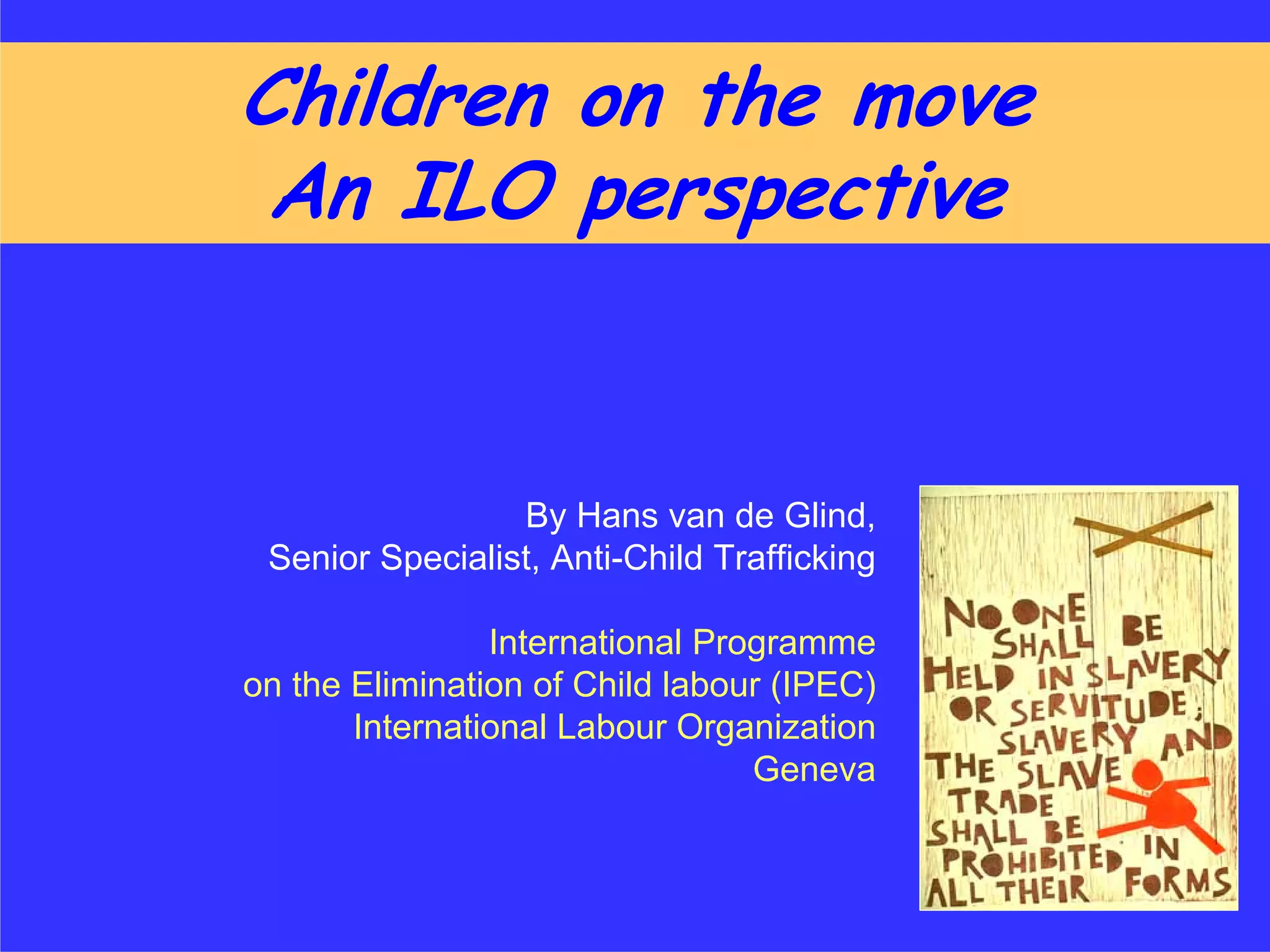
Children on the move
 An ILO perspective


                 By Hans van de Glind,
 Senior Specialist, Anti-Child Trafficking

                International Programme
on the Elimination of Child labour (IPEC)
       International Labour Organization
                                 Geneva
ILO mandate

• ILO Declaration on the Fundamental Principles and
  Rights at Work (1998): ‘All 183 member States
  respect, promote & realize the principles concerning
  fundamental rights at work’ including rights to be
  free from:

  - Child labour (Convention 138)

  - Worst Forms of Child Labour (WFCL),
    including trafficking (Convention 182)
ILO mandate & policy framework


• Global Action Plan (GAP) against WFCL
  - Elimination of WFCL by 2016;

• Roadmap for achieving the elimination of WFCL by
  2016
  Art 5:
  ‘Governments should consider ways to address the
  potential vulnerability of children to, in particular, the
  worst forms of child labour, in the context of
  migratory flows’.
Broad context
• Most developing countries are ‘young’;
  E.g. 44 % of the population in Sub Sahara Africa is
  below 15 (Population Reference Bureau).

• Where populations grow fast & have large youth
  cohort – expectation of more out-migration (World
  Bank, 2007)

• 80.7 million youth aged 15-24 are unemployed
  (ILO, 2010).

• Internal migration    >    International migration
  740 mln (UNDP, ‘09)        215 mln (UN 2010)
Stop the exploitation,
              not the movement

• Youth want to leave rural areas for perceived
  opportunities in cities
• Don’t stop voluntary migration, but prevent trafficking
  and child labour while creating an environment that
  protects children and helps them to have a positive
  experience
• Unprepared & ill-informed migration puts many at risk
  of trafficking and child labour
• Without affordable, fast & transparent migration/job
  placement services, irregular migration will continue
Recognize context specifics
• Internal versus cross-border migration
  Family versus independent child migration

• Into agriculture, domestic work, urban informal economy…?

• Reasons for migration: E.g. unemployment, poverty, natural
  disaster, conflict, seasonal flooding, history of migration,
  culture, gender discrimination, domestic violence…?

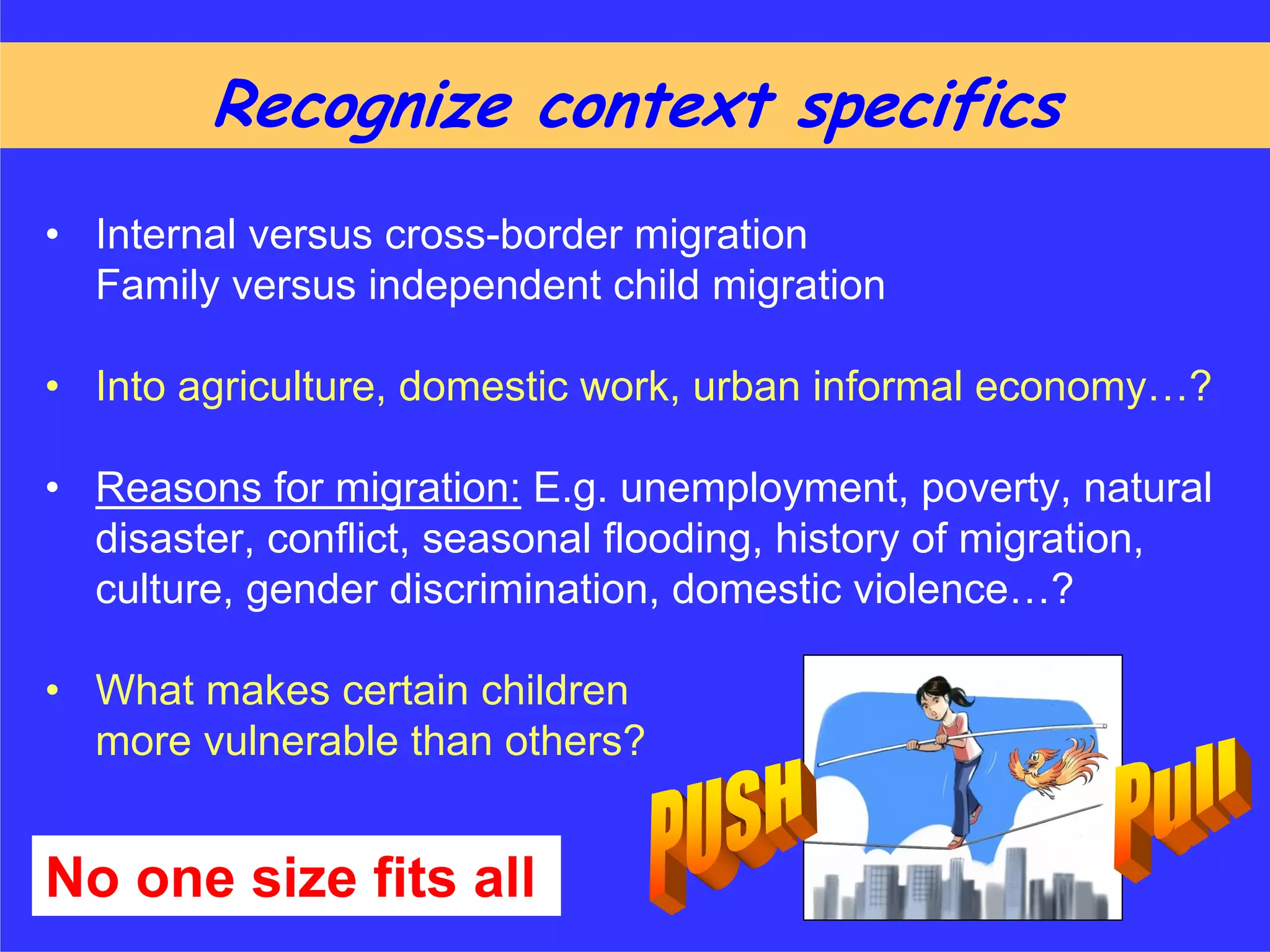
• What makes certain children
  more vulnerable than others?


No one size fits all
Safe(r) migration……
Policies and services at source (prior to departure)
• Pre-departure orientation
• Awareness raising on rights & opportunities
• Training in life skills, negotiations, do’s and don’ts
• Vocational/skills training services
• Licensed and monitored recruitment agencies
  ILO Convention 181 (art 7):
  ‘Private employment agencies shall not
  charge [..] any fees or costs to workers’
• Access to cheap credit and low interest govt. loans
• To postpone migration: education and youth employment

Key:
- Affordability & quality service offered in rural areas
- Agencies to work together
- Possible role for LVC’s, youth homes
Safe(r) migration……
Policies and services while on the move (in transit)

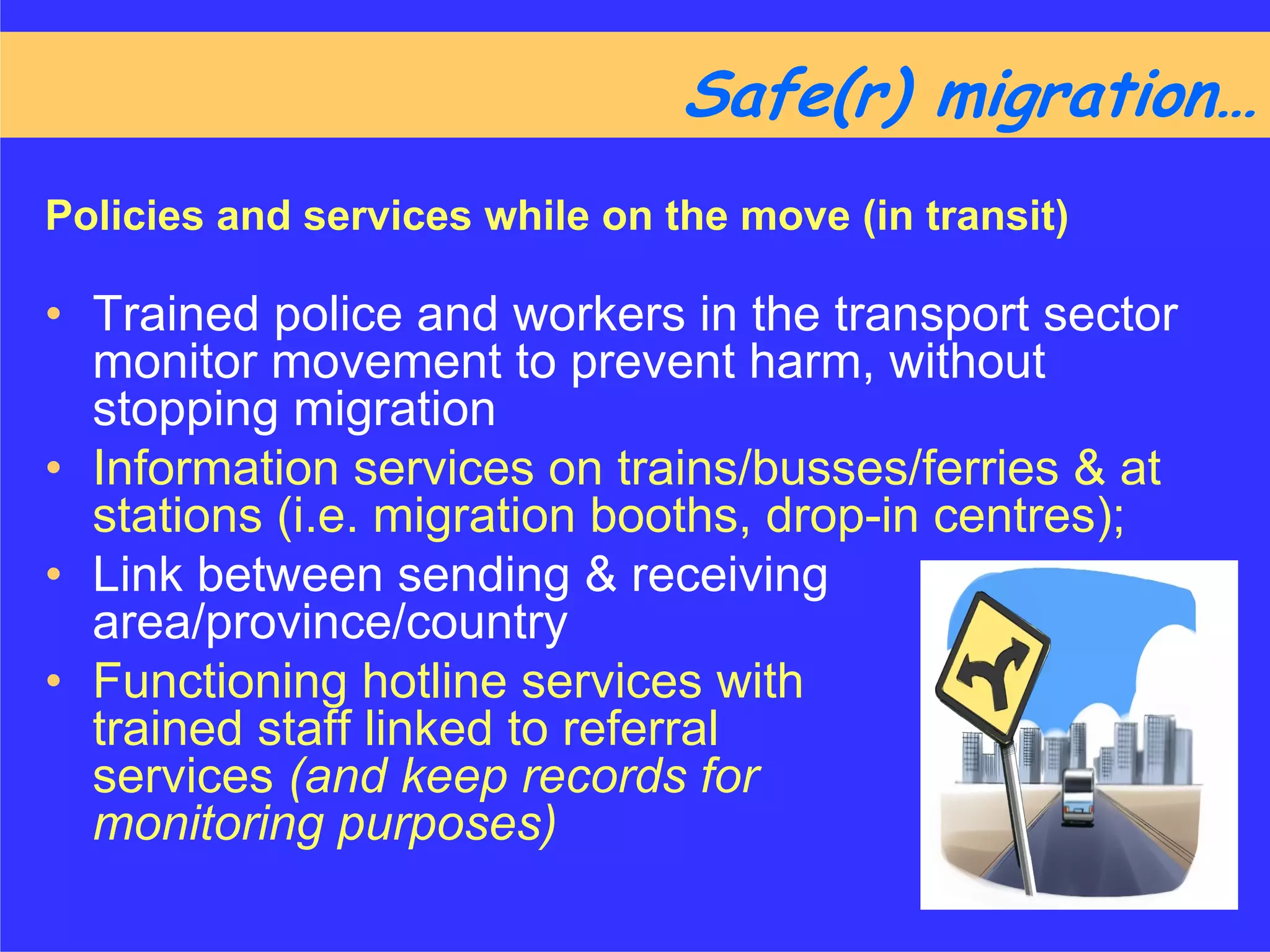
• Trained police and workers in the transport sector
  monitor movement to prevent harm, without
  stopping migration
• Information services on trains/busses/ferries & at
  stations (i.e. migration booths, drop-in centres);
• Link between sending & receiving
  area/province/country
• Functioning hotline services with
  trained staff linked to referral
  services (and keep records for
  monitoring purposes)
……for decent work
Policies and services at destination (and in workplace)

• Apply minimum employment age
• Extend the reach of labour law &
  regulate the informal economy
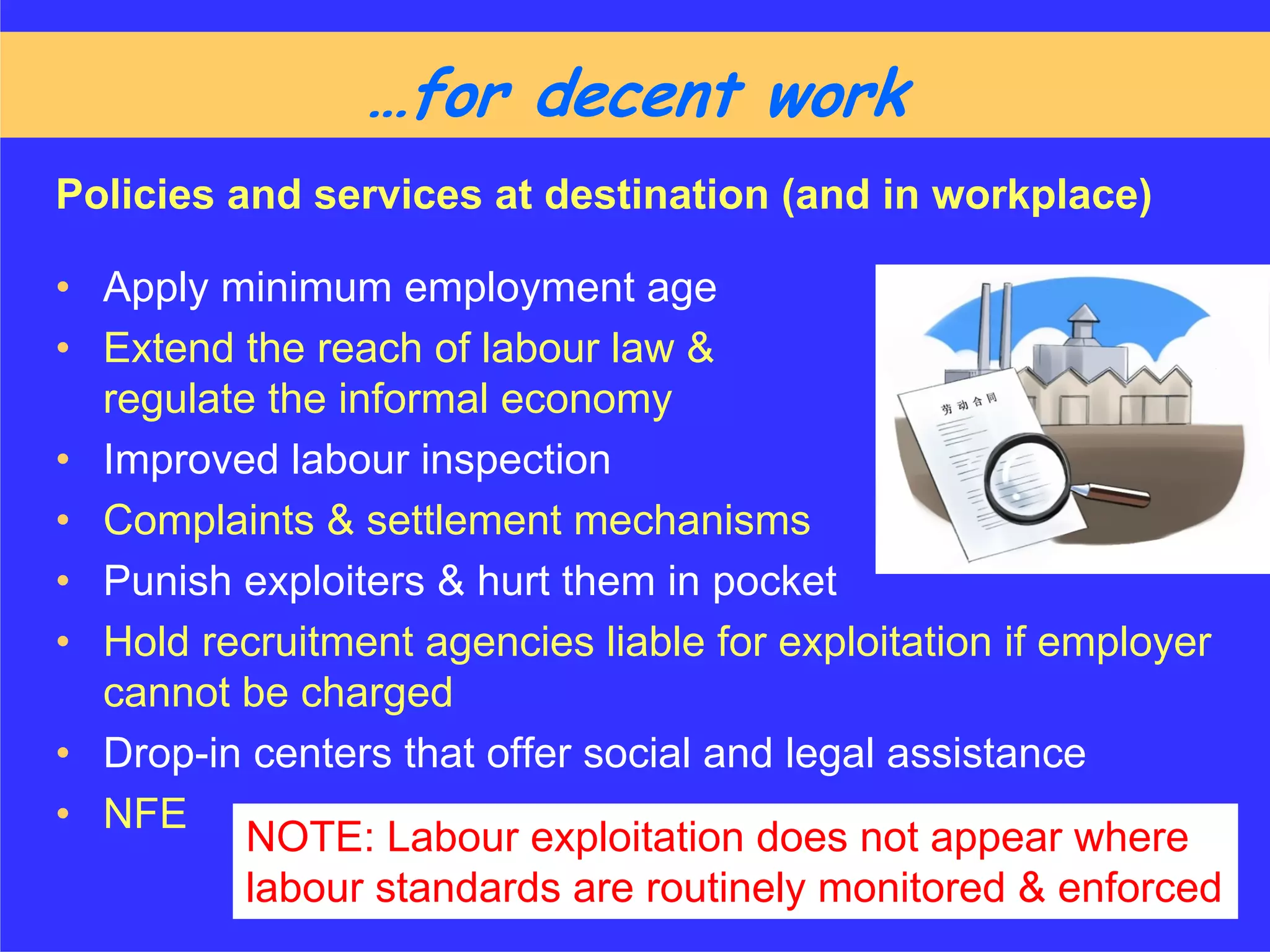
• Improved labour inspection
• Complaints & settlement mechanisms
• Punish exploiters & hurt them in pocket
• Hold recruitment agencies liable for exploitation if employer
  cannot be charged
• Drop-in centers that offer social and legal assistance
• NFE
          NOTE: Labour exploitation does not appear where
          labour standards are routinely monitored & enforced
Address public indifference
        to exploitation

• Un-mask conditions
• Set up discussion forums on specific forms of
  child exploitation
• Engage leaders and celebrities to speak out
• Run strategic campaigns – e.g. International
  Migrants Day (18 Dec) and WDACL (12 June)
Involve business community

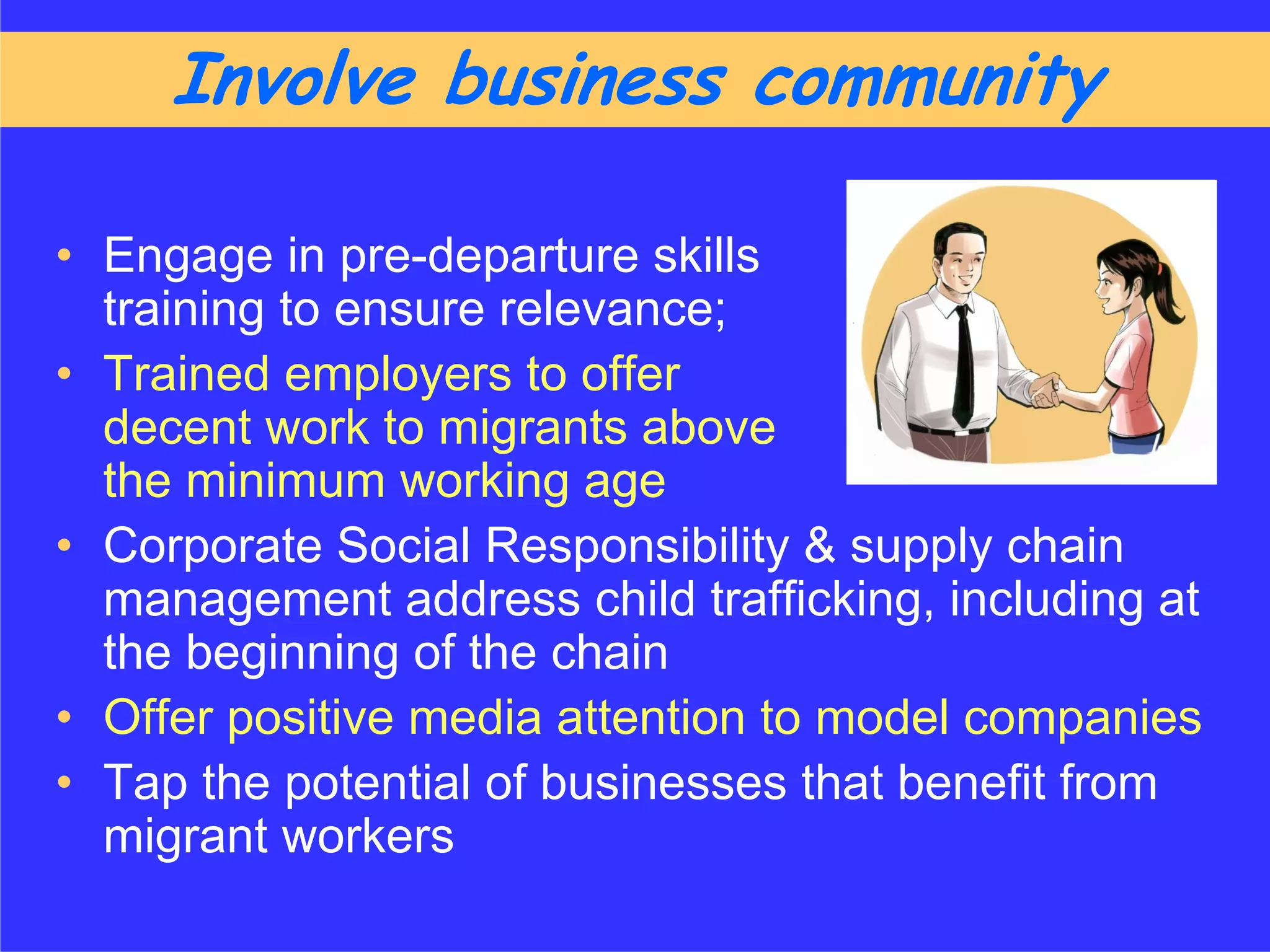
• Engage in pre-departure skills
  training to ensure relevance;
• Trained employers to offer
  decent work to migrants above
  the minimum working age
• Corporate Social Responsibility & supply chain
  management address child trafficking, including at
  the beginning of the chain
• Offer positive media attention to model companies
• Tap the potential of businesses that benefit from
  migrant workers
How to mobilize employers
What is IN It for Them? (WIN IT)
...or think from their perspective:

• Exploiters undercut profit of ‘clean’ employers;
• Exploitation increases staff turn-over;
• Manage risk & reputation (complex supply chains
  increase risk exposure to child trafficking);
• Corporate Social Responsibility & ethical business
  increases appeal of product/service & export
  potential;
• Involvement in child trafficking is legally & morally
  unacceptable;
• Most employers have kids!;
Join or associate with trade unions

  Art 2 of ILO Convention 87 on freedom of
  association:
  ‘Workers [and employers] without distinction
  whatsoever, shall have the right to establish and,
  subject only to the rules of the organization
  concerned, to join organizations of their own
  choosing without previous authorization’

  Benefit from their protection services

  NOTE: ITUC promotes portable trade union membership
        for international migrants
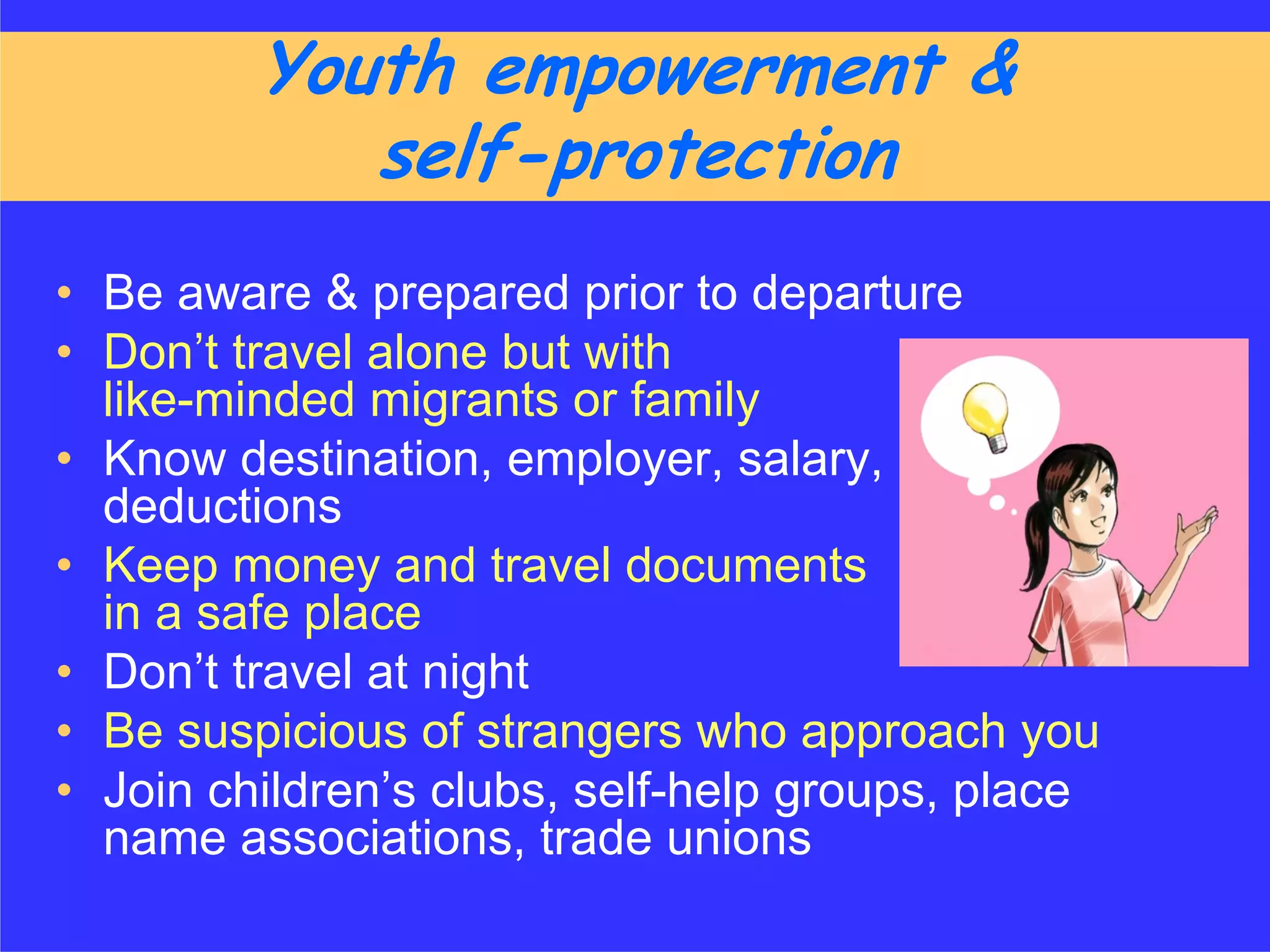
Youth empowerment &
            self-protection
• Be aware & prepared prior to departure
• Don’t travel alone but with
  like-minded migrants or family
• Know destination, employer, salary,
  deductions
• Keep money and travel documents
  in a safe place
• Don’t travel at night
• Be suspicious of strangers who approach you
• Join children’s clubs, self-help groups, place
  name associations, trade unions
Example: Spring Rain Campaign
During Chinese New Year
• Engagement of railway authorities & network of
  women’s federations and labour bureaus
• Trained staff, information booths and referral services
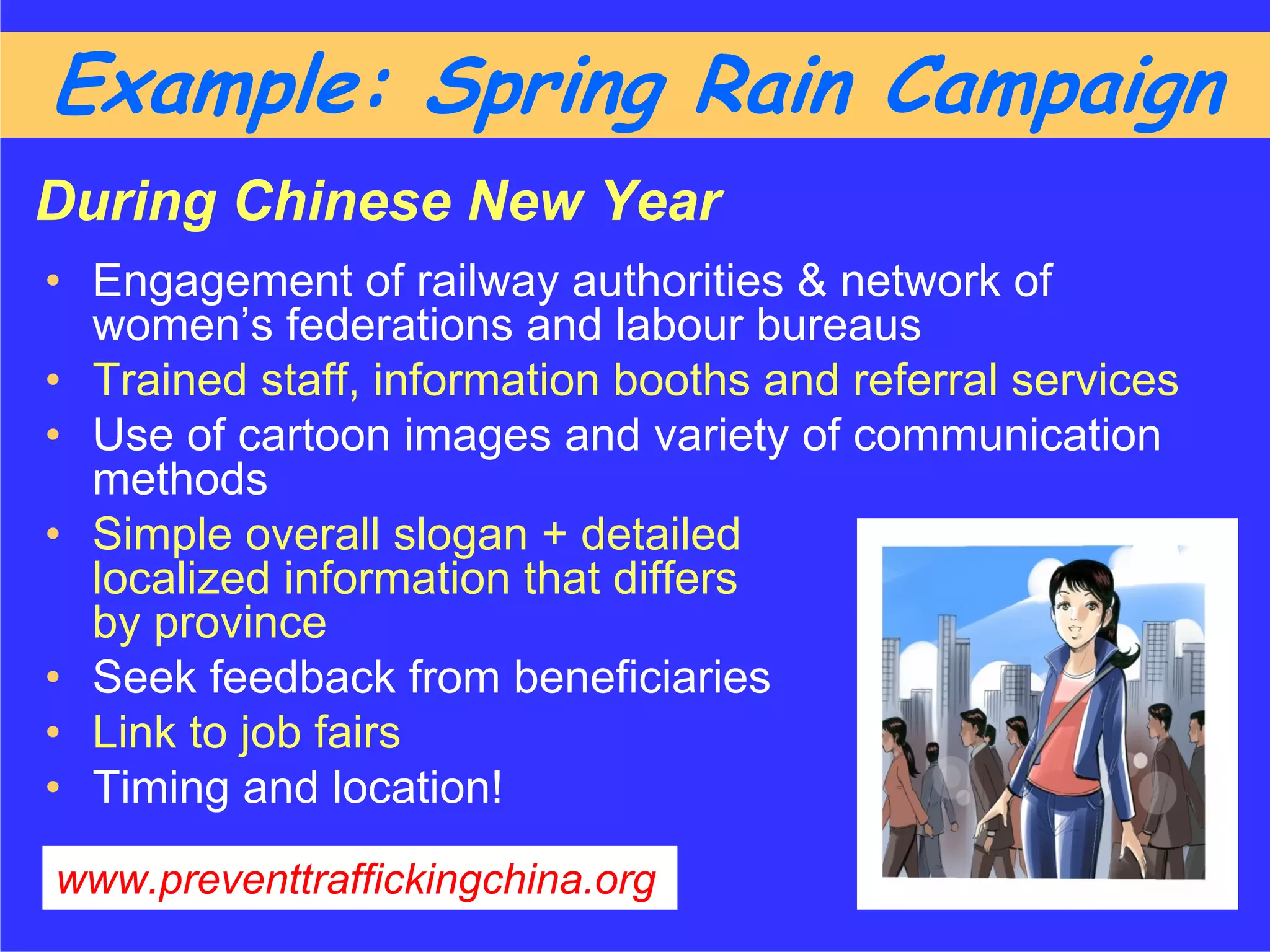
• Use of cartoon images and variety of communication
  methods
• Simple overall slogan + detailed
  localized information that differs
  by province
• Seek feedback from beneficiaries
• Link to job fairs
• Timing and location!
www.preventtraffickingchina.org
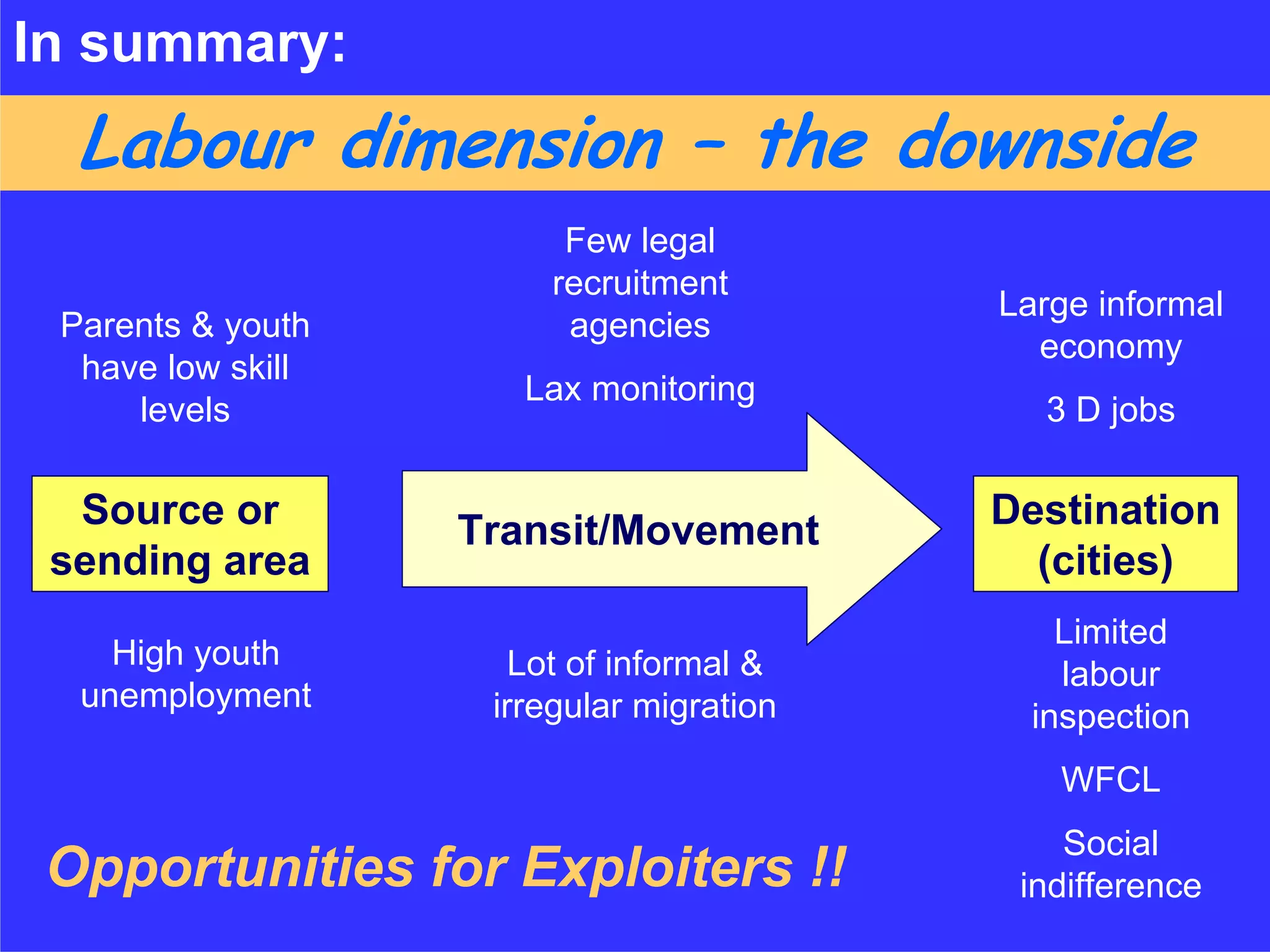
In summary:
  Labour dimension –– the downside
                        Few legal
                       recruitment
                                          Large informal
 Parents & youth        agencies
                                            economy
  have low skill
                      Lax monitoring
     levels                                 3 D jobs

  Source or        Transit/Movement       Destination
 sending area                               (cities)
                                              Limited
    High youth        Lot of informal &       labour
  unemployment      irregular migration     inspection
                                             WFCL
                                              Social
 Opportunities for Exploiters !!           indifference
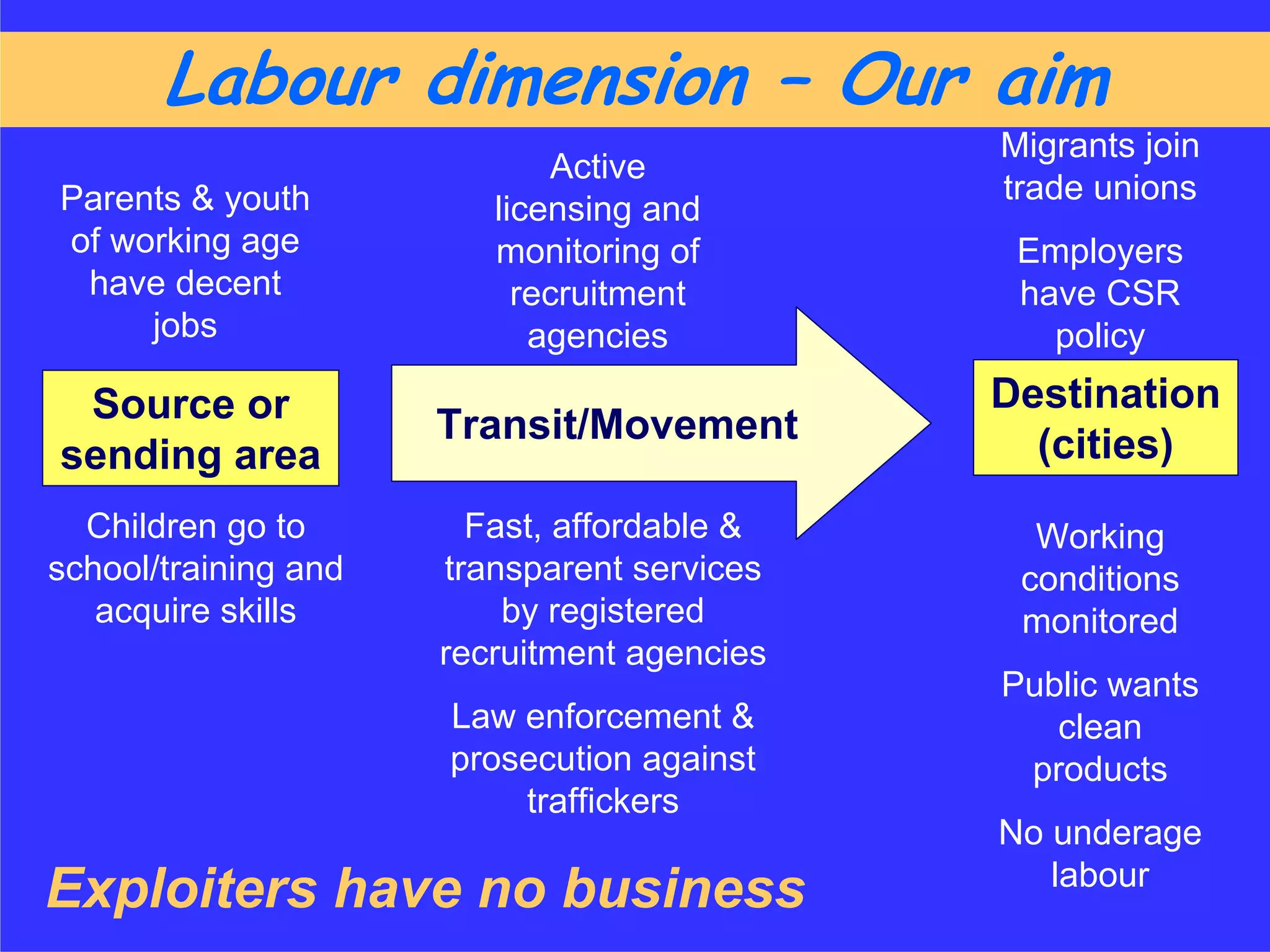
Labour dimension –– Our aim
                                             Migrants join
                             Active
Parents & youth                              trade unions
                         licensing and
of working age           monitoring of        Employers
 have decent               recruitment        have CSR
     jobs                   agencies            policy

 Source or                                   Destination
                      Transit/Movement         (cities)
sending area
  Children go to        Fast, affordable &     Working
school/training and   transparent services    conditions
   acquire skills         by registered       monitored
                      recruitment agencies
                                             Public wants
                      Law enforcement &         clean
                      prosecution against     products
                          traffickers
                                             No underage
                                                labour
Exploiters have no business
Useful resources
• Relevant Conventions (UN CRC, UN Migrant
  workers, ‘Palermo’, ILO C 29/105,
  97/143/181, 138/182);
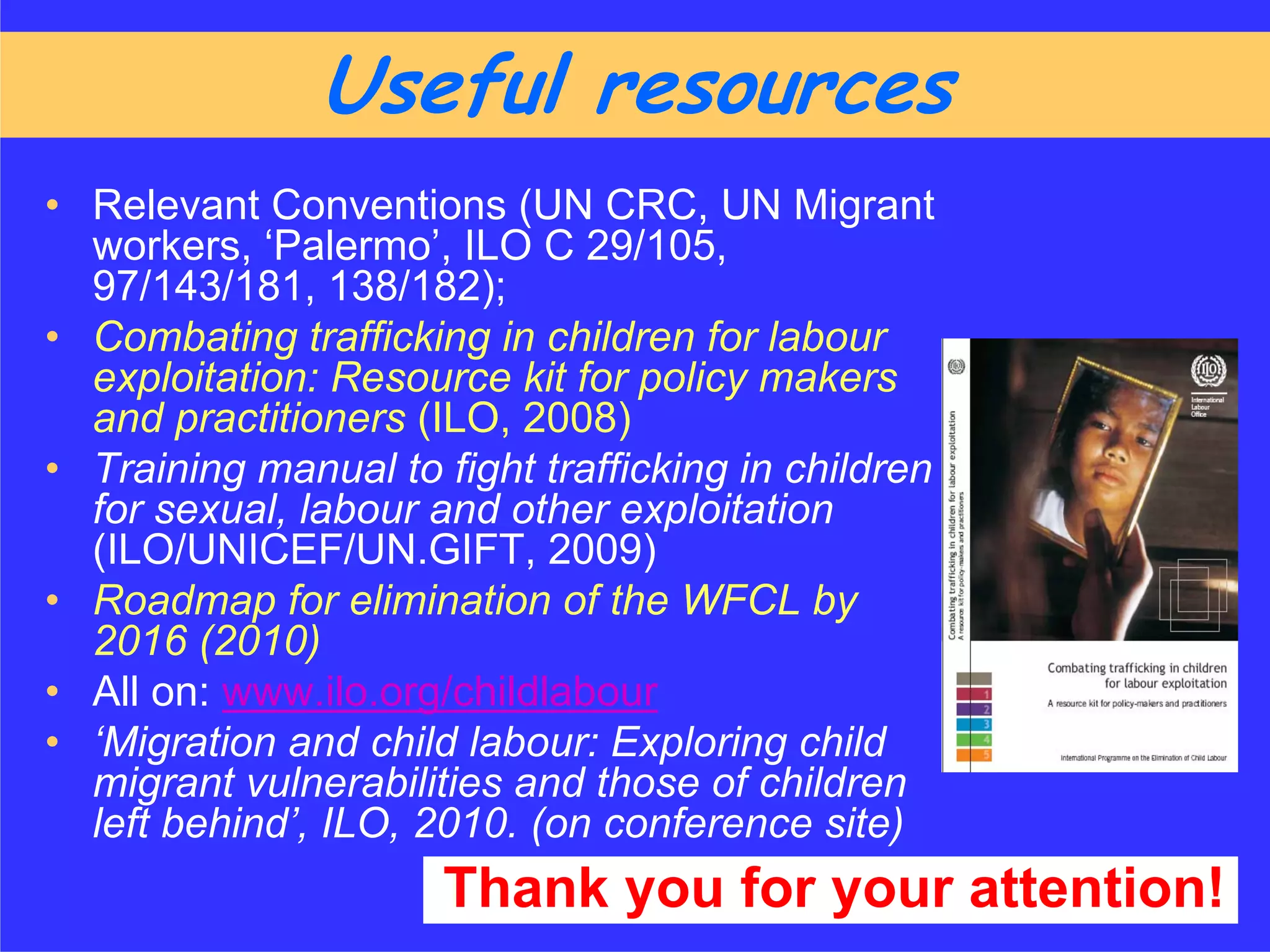
• Combating trafficking in children for labour
  exploitation: Resource kit for policy makers
  and practitioners (ILO, 2008)
• Training manual to fight trafficking in children
  for sexual, labour and other exploitation
  (ILO/UNICEF/UN.GIFT, 2009)
• Roadmap for elimination of the WFCL by
  2016 (2010)
• All on: www.ilo.org/childlabour
• ‘Migration and child labour: Exploring child
  migrant vulnerabilities and those of children
  left behind’, ILO, 2010. (on conference site)
                      Thank you for your attention!

Children on the Move, Hans Van De Glind

  • 1.
    Children on themove An ILO perspective By Hans van de Glind, Senior Specialist, Anti-Child Trafficking International Programme on the Elimination of Child labour (IPEC) International Labour Organization Geneva
  • 2.
    ILO mandate • ILODeclaration on the Fundamental Principles and Rights at Work (1998): ‘All 183 member States respect, promote & realize the principles concerning fundamental rights at work’ including rights to be free from: - Child labour (Convention 138) - Worst Forms of Child Labour (WFCL), including trafficking (Convention 182)
  • 3.
    ILO mandate &policy framework • Global Action Plan (GAP) against WFCL - Elimination of WFCL by 2016; • Roadmap for achieving the elimination of WFCL by 2016 Art 5: ‘Governments should consider ways to address the potential vulnerability of children to, in particular, the worst forms of child labour, in the context of migratory flows’.
  • 4.
    Broad context • Mostdeveloping countries are ‘young’; E.g. 44 % of the population in Sub Sahara Africa is below 15 (Population Reference Bureau). • Where populations grow fast & have large youth cohort – expectation of more out-migration (World Bank, 2007) • 80.7 million youth aged 15-24 are unemployed (ILO, 2010). • Internal migration > International migration 740 mln (UNDP, ‘09) 215 mln (UN 2010)
  • 5.
    Stop the exploitation, not the movement • Youth want to leave rural areas for perceived opportunities in cities • Don’t stop voluntary migration, but prevent trafficking and child labour while creating an environment that protects children and helps them to have a positive experience • Unprepared & ill-informed migration puts many at risk of trafficking and child labour • Without affordable, fast & transparent migration/job placement services, irregular migration will continue
  • 6.
    Recognize context specifics •Internal versus cross-border migration Family versus independent child migration • Into agriculture, domestic work, urban informal economy…? • Reasons for migration: E.g. unemployment, poverty, natural disaster, conflict, seasonal flooding, history of migration, culture, gender discrimination, domestic violence…? • What makes certain children more vulnerable than others? No one size fits all
  • 7.
    Safe(r) migration…… Policies andservices at source (prior to departure) • Pre-departure orientation • Awareness raising on rights & opportunities • Training in life skills, negotiations, do’s and don’ts • Vocational/skills training services • Licensed and monitored recruitment agencies ILO Convention 181 (art 7): ‘Private employment agencies shall not charge [..] any fees or costs to workers’ • Access to cheap credit and low interest govt. loans • To postpone migration: education and youth employment Key: - Affordability & quality service offered in rural areas - Agencies to work together - Possible role for LVC’s, youth homes
  • 8.
    Safe(r) migration…… Policies andservices while on the move (in transit) • Trained police and workers in the transport sector monitor movement to prevent harm, without stopping migration • Information services on trains/busses/ferries & at stations (i.e. migration booths, drop-in centres); • Link between sending & receiving area/province/country • Functioning hotline services with trained staff linked to referral services (and keep records for monitoring purposes)
  • 9.
    ……for decent work Policiesand services at destination (and in workplace) • Apply minimum employment age • Extend the reach of labour law & regulate the informal economy • Improved labour inspection • Complaints & settlement mechanisms • Punish exploiters & hurt them in pocket • Hold recruitment agencies liable for exploitation if employer cannot be charged • Drop-in centers that offer social and legal assistance • NFE NOTE: Labour exploitation does not appear where labour standards are routinely monitored & enforced
  • 10.
    Address public indifference to exploitation • Un-mask conditions • Set up discussion forums on specific forms of child exploitation • Engage leaders and celebrities to speak out • Run strategic campaigns – e.g. International Migrants Day (18 Dec) and WDACL (12 June)
  • 11.
    Involve business community •Engage in pre-departure skills training to ensure relevance; • Trained employers to offer decent work to migrants above the minimum working age • Corporate Social Responsibility & supply chain management address child trafficking, including at the beginning of the chain • Offer positive media attention to model companies • Tap the potential of businesses that benefit from migrant workers
  • 12.
    How to mobilizeemployers What is IN It for Them? (WIN IT) ...or think from their perspective: • Exploiters undercut profit of ‘clean’ employers; • Exploitation increases staff turn-over; • Manage risk & reputation (complex supply chains increase risk exposure to child trafficking); • Corporate Social Responsibility & ethical business increases appeal of product/service & export potential; • Involvement in child trafficking is legally & morally unacceptable; • Most employers have kids!;
  • 13.
    Join or associatewith trade unions Art 2 of ILO Convention 87 on freedom of association: ‘Workers [and employers] without distinction whatsoever, shall have the right to establish and, subject only to the rules of the organization concerned, to join organizations of their own choosing without previous authorization’ Benefit from their protection services NOTE: ITUC promotes portable trade union membership for international migrants
  • 14.
    Youth empowerment & self-protection • Be aware & prepared prior to departure • Don’t travel alone but with like-minded migrants or family • Know destination, employer, salary, deductions • Keep money and travel documents in a safe place • Don’t travel at night • Be suspicious of strangers who approach you • Join children’s clubs, self-help groups, place name associations, trade unions
  • 15.
    Example: Spring RainCampaign During Chinese New Year • Engagement of railway authorities & network of women’s federations and labour bureaus • Trained staff, information booths and referral services • Use of cartoon images and variety of communication methods • Simple overall slogan + detailed localized information that differs by province • Seek feedback from beneficiaries • Link to job fairs • Timing and location! www.preventtraffickingchina.org
  • 16.
    In summary: Labour dimension –– the downside Few legal recruitment Large informal Parents & youth agencies economy have low skill Lax monitoring levels 3 D jobs Source or Transit/Movement Destination sending area (cities) Limited High youth Lot of informal & labour unemployment irregular migration inspection WFCL Social Opportunities for Exploiters !! indifference
  • 17.
    Labour dimension ––Our aim Migrants join Active Parents & youth trade unions licensing and of working age monitoring of Employers have decent recruitment have CSR jobs agencies policy Source or Destination Transit/Movement (cities) sending area Children go to Fast, affordable & Working school/training and transparent services conditions acquire skills by registered monitored recruitment agencies Public wants Law enforcement & clean prosecution against products traffickers No underage labour Exploiters have no business
  • 18.
    Useful resources • RelevantConventions (UN CRC, UN Migrant workers, ‘Palermo’, ILO C 29/105, 97/143/181, 138/182); • Combating trafficking in children for labour exploitation: Resource kit for policy makers and practitioners (ILO, 2008) • Training manual to fight trafficking in children for sexual, labour and other exploitation (ILO/UNICEF/UN.GIFT, 2009) • Roadmap for elimination of the WFCL by 2016 (2010) • All on: www.ilo.org/childlabour • ‘Migration and child labour: Exploring child migrant vulnerabilities and those of children left behind’, ILO, 2010. (on conference site) Thank you for your attention!