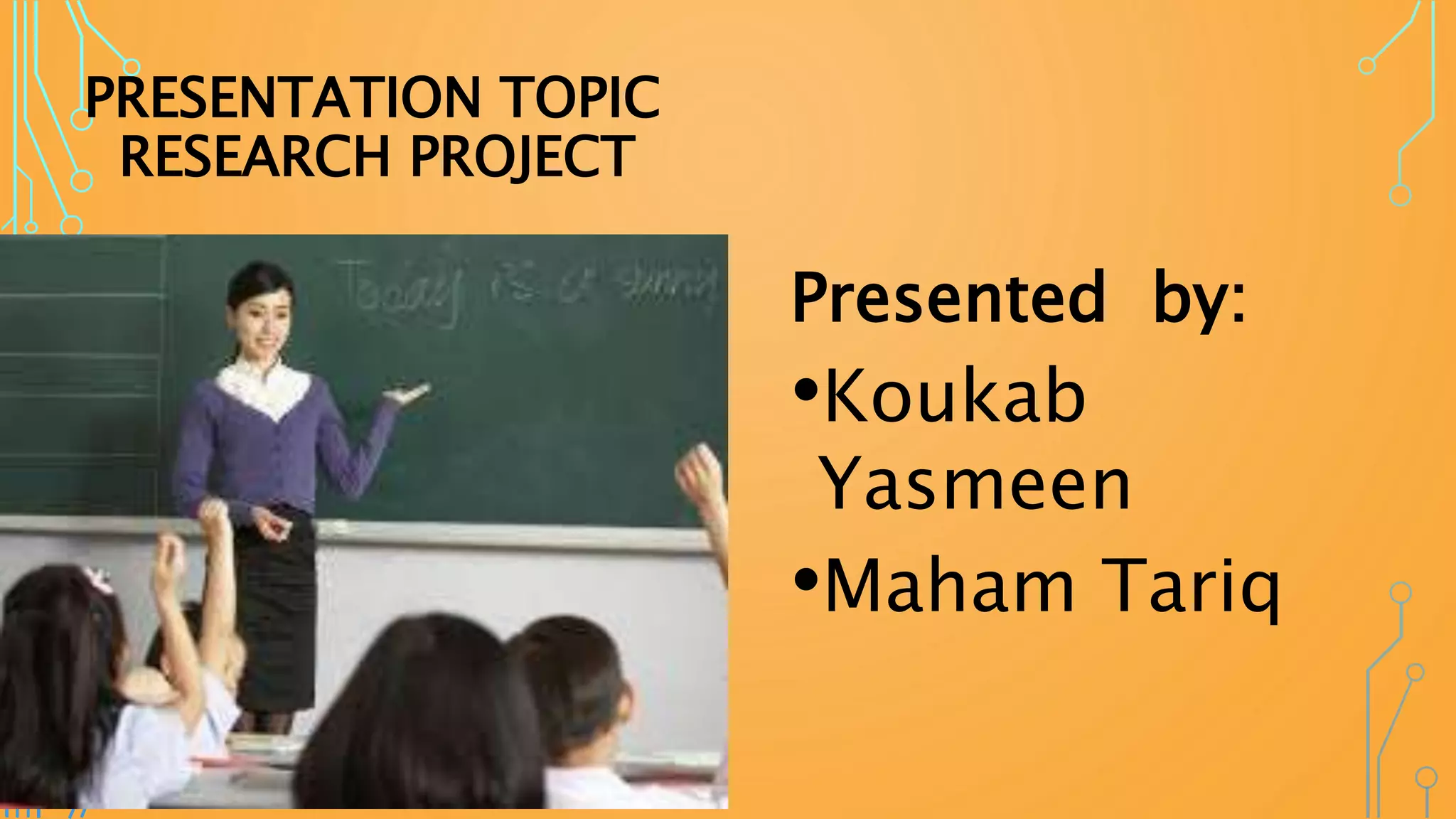
PRESENTATION TOPIC
RESEARCH PROJECT
Presented by:
•Koukab
Yasmeen
•Maham Tariq
TOPIC OF RESEARCH PROJECT :
•Effects of hands on activities on
students cognitive engagement at
primary level
INDEPENDENT
VARIABLE
•Hands on
activities
DEPENDENT
VARIABLE
•Students
cognitive
engagement
METHODOLOGY
• Experimental design
• pretest and posttest design
• ANALYSIS
•Likert scale
•T- test
INTRODUCTION
Student engagement :
Student engagement “refers to the degree of attention,
curiosity, interest, optimism, and passion that students
show when they are learning or being taught, which
extends to the level of motivation they have to learn
and progress in their education.”
STUDENTS COGNITIVE ENGAGEMENT
•Students are cognitively engaged when they
play an active role in their learning journeys. In
the face of challenges, students who are
cognitively engaged set goals, plan steps,
monitor progress, solve problems along the
way, and reflect on their learning.
•Students’ Classroom Engagement
•
•Engagement is refers to a student’s
active participation in a learning
activity.
COGNITIVE ENGAGEMENT
•
• Cognitive engagement refers to how intentionally the student
attempts to learn in terms of elaboration rather than memorization
(Walker, Greene, & Mansell, 2006).
• Skills: try to build a command on learning.
• Mastery: student idea to learn best with one skill to build on the
next.
• Mental Effort: Student understanding the material for completion
of tasks and mastering the content.
HANDS ON ACTIVITIES
•To engage the class in hands-on activity would
be the best exercise in which students were
cooperated with each other and do engaged
cognitively. For this purpose, researcher was
divided the experimental group into and these
hands-on activities were chosen from the
chapter 5th from PTBB science book, while
control group was not perform hands-on
SIGNIFICANCE OF THE STUDY
• Hands-on activities enhance student engagement and
make science learning more interesting.
• These activities stimulate students’ interest, enhance
their understanding, and foster socialization through
teamwork.
• Hands-on activities help students connect abstract
concepts with real-world applications.
• Teachers can experience reduced workload by
encouraging and rewarding students’ science learning.
STATEMENT OF THE PROBLEM
• The primary challenge globally in the 21st century is effectively engaging
learners.
• Scott (2015) suggests that teachers should adopt engaging and hands-on
activities to address this challenge.
• In developing countries like Pakistan, the focus on innovative hands-on
activities, especially in the field of science, may be lacking.
• This lack of focus on hands-on activities poses a challenge for teachers in
motivating and engaging students.
• Teachers can play a crucial and proactive role in cultivating student
engagement by incorporating hands-on activities that enhance their
learning.
• Researchers conducted an assessment to examine the impact of such
OBJECTIVE OF THE STUDY
• 1. To investigate the effect of hands on activities on
science students cognitive engagement at primary level
• Hypothesis
• There will no significance difference between the hands on
activities on science students cognitive engagement at
primary level.
METHODOLOGY
• The researchers utilized a true experimental design with a pre-test
and post-test, along with an equivalent control group.
• Randomization techniques were implemented to ensure unbiased
assignment of participants to the control and experimental groups.
•
DATA ANALYSIS AND INTERPRETATION
•The study analyzed how hands-on activities
impact the cognitive engagement of primary-
level students in Pakistan. A True Experimental
Design was used with 5th-grade students. A
pre-test and post-test questionnaire was given
with three subscales. Independent sample t-
tests were used to compare the experimental
and control groups.
REFERENCES
• Achristenson, S. L., Sinclair, M. F., & Lehr, C. A. (2004). Check & connect:
•
• The importance of relationships6, 1-4.
•
• Abuhashim, M. (2008). The components of social, emotional intelligences and
their relationship among Saudi and Egyptian University students, a comparative
study. College of Education Journal, 18(76), 71-95. achievement. Education and
Urban Society, 35, 202-218.
•
• Akhtar, S. N., Iqbal, M., & Tatlah, I. A. (2017). Relationship between Intrinsic
•
•

final project ppt.pptx

  • 1.
    PRESENTATION TOPIC RESEARCH PROJECT Presentedby: •Koukab Yasmeen •Maham Tariq
  • 2.
    TOPIC OF RESEARCHPROJECT : •Effects of hands on activities on students cognitive engagement at primary level
  • 3.
  • 4.
    METHODOLOGY • Experimental design •pretest and posttest design • ANALYSIS •Likert scale •T- test
  • 5.
    INTRODUCTION Student engagement : Studentengagement “refers to the degree of attention, curiosity, interest, optimism, and passion that students show when they are learning or being taught, which extends to the level of motivation they have to learn and progress in their education.”
  • 6.
    STUDENTS COGNITIVE ENGAGEMENT •Studentsare cognitively engaged when they play an active role in their learning journeys. In the face of challenges, students who are cognitively engaged set goals, plan steps, monitor progress, solve problems along the way, and reflect on their learning.
  • 7.
    •Students’ Classroom Engagement • •Engagementis refers to a student’s active participation in a learning activity.
  • 8.
    COGNITIVE ENGAGEMENT • • Cognitiveengagement refers to how intentionally the student attempts to learn in terms of elaboration rather than memorization (Walker, Greene, & Mansell, 2006). • Skills: try to build a command on learning. • Mastery: student idea to learn best with one skill to build on the next. • Mental Effort: Student understanding the material for completion of tasks and mastering the content.
  • 9.
    HANDS ON ACTIVITIES •Toengage the class in hands-on activity would be the best exercise in which students were cooperated with each other and do engaged cognitively. For this purpose, researcher was divided the experimental group into and these hands-on activities were chosen from the chapter 5th from PTBB science book, while control group was not perform hands-on
  • 10.
    SIGNIFICANCE OF THESTUDY • Hands-on activities enhance student engagement and make science learning more interesting. • These activities stimulate students’ interest, enhance their understanding, and foster socialization through teamwork. • Hands-on activities help students connect abstract concepts with real-world applications. • Teachers can experience reduced workload by encouraging and rewarding students’ science learning.
  • 11.
    STATEMENT OF THEPROBLEM • The primary challenge globally in the 21st century is effectively engaging learners. • Scott (2015) suggests that teachers should adopt engaging and hands-on activities to address this challenge. • In developing countries like Pakistan, the focus on innovative hands-on activities, especially in the field of science, may be lacking. • This lack of focus on hands-on activities poses a challenge for teachers in motivating and engaging students. • Teachers can play a crucial and proactive role in cultivating student engagement by incorporating hands-on activities that enhance their learning. • Researchers conducted an assessment to examine the impact of such
  • 12.
    OBJECTIVE OF THESTUDY • 1. To investigate the effect of hands on activities on science students cognitive engagement at primary level • Hypothesis • There will no significance difference between the hands on activities on science students cognitive engagement at primary level.
  • 13.
    METHODOLOGY • The researchersutilized a true experimental design with a pre-test and post-test, along with an equivalent control group. • Randomization techniques were implemented to ensure unbiased assignment of participants to the control and experimental groups. •
  • 14.
    DATA ANALYSIS ANDINTERPRETATION •The study analyzed how hands-on activities impact the cognitive engagement of primary- level students in Pakistan. A True Experimental Design was used with 5th-grade students. A pre-test and post-test questionnaire was given with three subscales. Independent sample t- tests were used to compare the experimental and control groups.
  • 15.
    REFERENCES • Achristenson, S.L., Sinclair, M. F., & Lehr, C. A. (2004). Check & connect: • • The importance of relationships6, 1-4. • • Abuhashim, M. (2008). The components of social, emotional intelligences and their relationship among Saudi and Egyptian University students, a comparative study. College of Education Journal, 18(76), 71-95. achievement. Education and Urban Society, 35, 202-218. • • Akhtar, S. N., Iqbal, M., & Tatlah, I. A. (2017). Relationship between Intrinsic • •