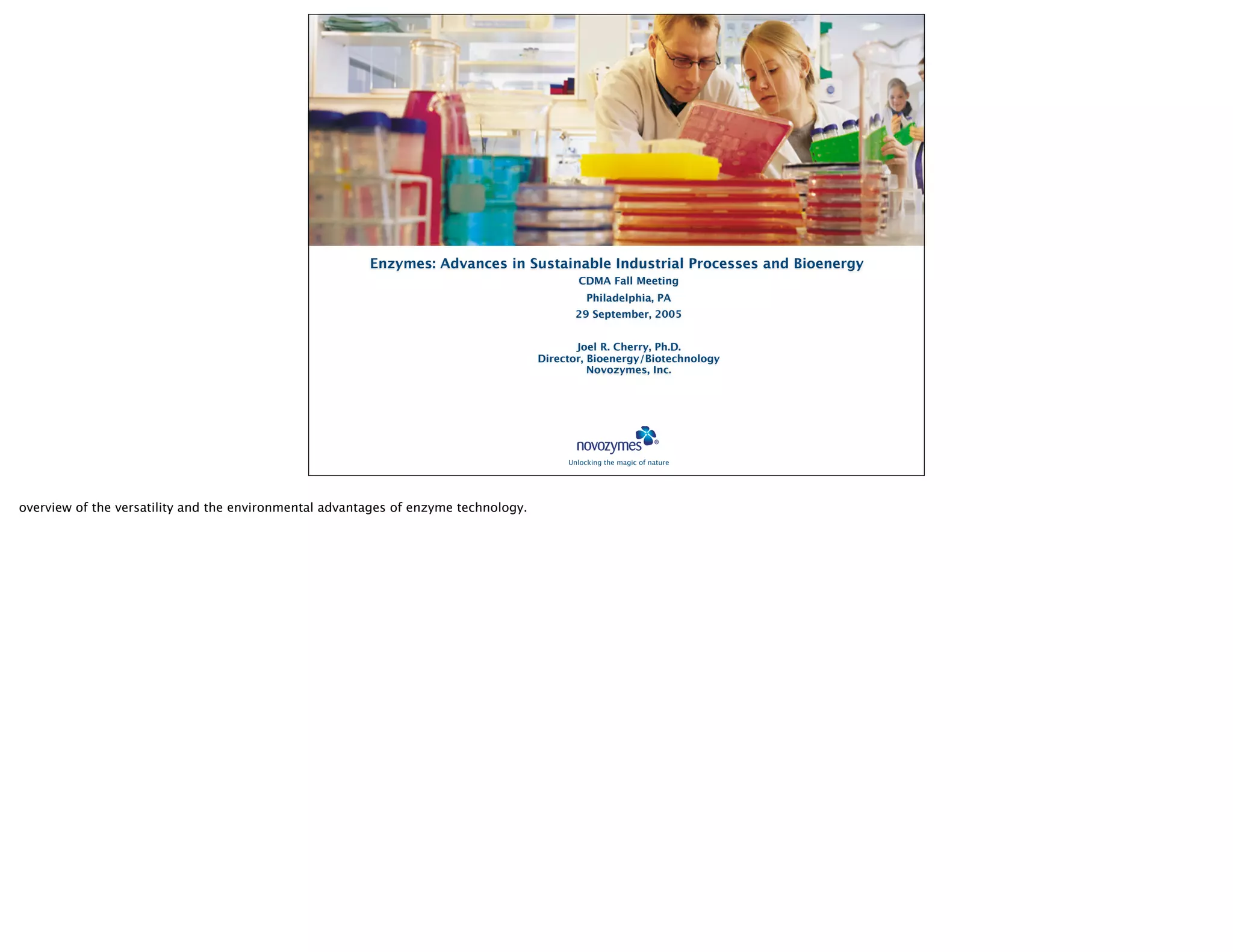
Enzymes: Advances in Sustainable Industrial Processes and Bioenergy
                                                                                            CDMA Fall Meeting
                                                                                               Philadelphia, PA
                                                                                            29 September, 2005


                                                                                            Joel R. Cherry, Ph.D.
                                                                                     Director, Bioenergy/Biotechnology
                                                                                               Novozymes, Inc.


                                                                                          Unlocking the magic of nature


overview of the versatility and the environmental advantages of enzyme technology.
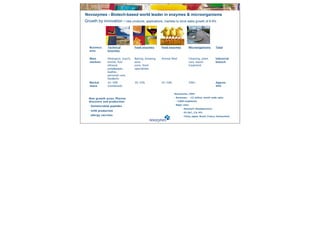
Novozymes - Biotech-based world leader in enzymes & microorganisms
Growth by innovation - new products, applications, markets to drive sales growth of 8-9%


   Business     Technical            Food enzymes       Feed enzymes          Microorganisms          Total
   area         enzymes

   Main         Detergent, starch,   Baking, brewing,   Animal feed           Cleaning, plant         Industrial
   markets      textile, fuel        wine                                     care, waste             biotech
                ethanol,             juice, food                              treatment
                pulp&paper,          specialities
                leather,
                personal care,
                fats&oils
   Market       45-50%               30-35%             45-50%                50%+                    Approx.
   share        (combined)                                                                            44%

                                                                 Novozymes, 2004

  New growth areas: Pharma                                       • Revenues: >$1 billion, world-wide sales
  discovery and production:                                      • ~3,000 employees

  • Antimicrobial peptides                                       • Major sites:
                                                                        • Denmark (Headquarters)
  • mAb production
                                                                        • US (N.C., CA, NY)
  • allergy vaccines                                                    • China, Japan, Brazil, France, Switzerland
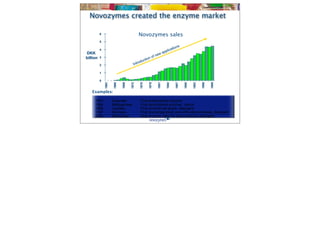
Novozymes created the enzyme market

          6                               Novozymes sales
          5

                                                                                         ons
          4                                                                  li   cati
DKK                                                                  w   app
                                                              f ne
billion   3
                                                   tio   no
                                           o   duc
          2                           Intr

          1

          0


                                                                                         1987
                            1969


                                                     1978


                                                                 1981


                                                                                                1990


                                                                                                              1996


                                                                                                                     1999
                                                                            1984
              1963


                     1966


                                   1972


                                           1975


                                                                                                       1993
   Examples:

     1974            Esperase                  First extremophile enzyme
     1984            Maltogenase               First recombinant enzyme, starch
     1988            Lipolase                  First commercial lipase, detergent
     1997            Kannase                   First low temperature and soft water protease, detergent
     2000            Mannaway                  New enzyme class for stain removal, detergent
Novozymes’ Vision

                            “We imagine a future where our
                             biological solutions create the
                           necessary balance between better
                           business, cleaner environment and
                                       better lives”


Intentionally left blank
The Novo Family, circa 1925, Denmark
              The Novo Nordisk
              Foundation


                            Holding Company


     Pharmaceuticals                          Industrial Biotechnology
Our enzymes are used everywhere
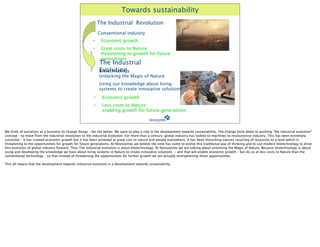
Towards sustainability
                                                               The Industrial Revolution
                                                               Conventional industry
                                                           •    Economic growth
                                                           •    Great costs to Nature
                                                                threatening to growth for future
                                                                generations
                                                               The Industrial
                                                       
       Evolution
                                                               Biotechnology
                                                               Unlocking the Magic of Nature
                                                       
       Using our knowledge about living
                                                               systems to create innovative solutions
                                                       
•       Economic growth
                                                           •    Less costs to Nature
                                                                enabling growth for future generations


We think of ourselves as a business to change things – for the better. We want to play a role in the development towards sustainability. The change boils down to pushing ”the industrial evolution”
concept – to move from the industrial revolution to the industrial evolution. For more than a century, global industry has looked to machines to revolutionise industry. This has been extremely
succesful – it has created economic growth but it has been achieved at great cost to nature and people everywhere. It has been disturbing natures recycling of resources to a level which is
threatening to the opportunities for growth for future generations. At Novozymes we believe the time has come to evolve this traditional way of thinking and to use modern biotechnology to drive
this evolution of global industry forward. Thus The industrial evolution is about biotechnology. At Novozymes we are talking about unlocking the Magic of Nature. Because biotechnology is about
using and developing the knowledge we have about living systems in Nature to create innovative solutions - and that will enable economic growth – but do so at less costs to Nature than the
conventional technology – so that instead of threatening the opportunities for further growth we are actually strengthening these opportunities.
This all means that the development towards industrial evolution is a development towards sustainability
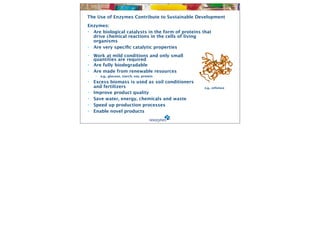
The Use of Enzymes Contribute to Sustainable Development
Enzymes:
• Are biological catalysts in the form of proteins that
  drive chemical reactions in the cells of living
  organisms
• Are very specific catalytic properties
•   Work at mild conditions and only small

   quantities are required
•   Are fully biodegradable
•   Are made from renewable resources
    •   e.g., glucose, starch, soy, protein
•   Excess biomass is used as soil conditioners
    and fertilizers                                 e.g., cellulase
•   Improve product quality
•   Save water, energy, chemicals and waste
•   Speed up production processes
•   Enable novel products
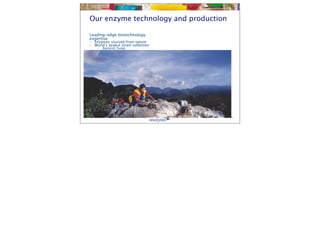
Our enzyme technology and production
                                                   Native enzyme                 Improved
   Leading-edge biotechnology                                                    alkaline activity
   expertise
   •   Enzymes sourced from nature
   •   World’s largest strain collection                                         Altered
         •   Bacteria, Fungi                                                     specificity
   •   Recombinant production
   •   Diversity generation:
         •   Strong screening tools/capabilities                                  Improved
         •   Engineering                                                          thermostabilit
         •   Shuffling                                                            y
   è We have the ability to find the right
     enzyme to do the job !                                        Activity, Performance,
                                                                   Stability,
                                                                   Compatibility, Specificity,
   State-of-the-art production                                     Temperature, pH, Pressure
   with continued optimisations                                    Chelants, New activities,
   and economies of scale                                          Expression
• More than production sites globally
   • 5 strategic
                 twenty commercialized protein engineered
   • Site DK is world’s largest plant for
    enzymes
enzymes the ability to produce the
  è We have
       right enzyme in the amount
       needed !
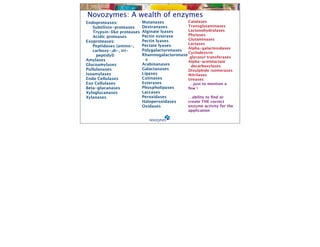
Novozymes: A wealth of enzymes
Endoproteases:              Mutanases           Catalases
   Subtilisin-proteases     Dextranases         Transglutaminases
   Trypsin-like proteases   Alginate lyases     Lactonohydrolases
   Acidic proteases         Pectin esterase     Phytases
                            Pectin lyases       Glutaminases
Exoproteases:
                            Pectate lyases      Lactases
   Peptidases (amino-,
                                                Alpha-galactosidases
   carboxy-,di-, tri-       Polygalacturonases
                                                Cyclodextrin
     peptidyl)              Rhamnogalacturonase
                                                 glycosyl transferases
Amylases                      s                 Alpha-acetolactate
Glucoamylases               Arabinanases         decarboxylases
Pullulanases                Galactanases        Disulphide isomerases
Isoamylases                 Lipases             Nitrilases
Endo Cellulases             Cutinases           Ureases
Exo Cellulases              Esterases            …just to mention a
Beta-glucanases             Phospholipases      few !
Xyloglucanases              Laccases
Xylanases                   Peroxidases         …ability to find or
                            Haloperoxidases     create THE correct
                            Oxidases            enzyme activity for the
                                                 application
The benefits of using enzymes


Enzymes in Sustainable Development
Enzymes for the Detergent
                                                   Industry
                                                     e.g., proteases, amylases, lipases, cellulases, mannanases


                                                     •   Lower temperature (from
                                                         60oC to max. 40oC)

                                                     •   Energy savings in Denmark
                                                         (28,000 tons coal/yr)

                                                     •   Less phosphate and
                                                         chemicals in the
                                                         environment
                                                                                                      e.g., Stainzyme
                                                     •   Enzymes are biologically                     • Stainzyme is a carbohydrate
                                                         degradable                                   degrading enzyme, which allows
                                                                                                      efficient removal of stains at washing
                                                                                                      temperatures as low as 300C.
                                                     •   More gentle to fabrics
                                                                                                      • If the average washing temperature in
                                                                                                      Europe is decreased from 400C to 300C
                                                                                                      a saving corresponding to 1/3 of the
                                                                                                      electricity-consumption from
                                                                                                      household washing will be achieved


Electricity consumption from household washing in Europe is around 50 TWh a year, or 1½ times the total electricity consumption in Denmark or 10 times the yearly electricity production of
Barsebäck.
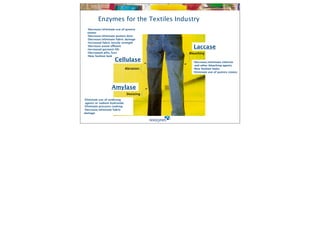
Enzymes for the Textiles Industry
  •Decrease/eliminate use of pumice
  stones
  •Decrease/eliminate pumice dust
  •Decrease/eliminate fabric damage
  •Increased fabric tensile strength
  •Decrease waste effluent
  •Increased garment life
                                        Laccase
  •Decreased pills, fuzz
  •New fashion looks
                     Cellulase          •Decrease/eliminate chlorine
                                         and other bleaching agents
                                        •New fashion looks
                                        •Eliminate use of pumice stones


                   Amylase

•Eliminate use of oxidizing
 agents or sodium hydroxide
•Eliminate pressure cooking
•Decrease/eliminate fabric
damage
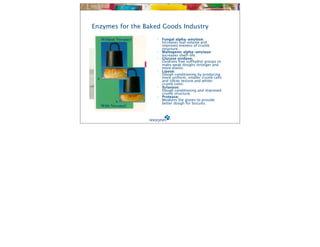
Enzymes for the Baked Goods Industry
  Without Novamyl   •   Fungal alpha-amylase: 
                        Increases loaf volume and
                        improves eveness of crumb
                        structure.
                    •   Maltogenic alpha-amylase:
                        Increases shelf-life.
                    •   Glucose oxidase:
                        Oxidizes free sulfhydryl groups to
                        make weak doughs stronger and
                        more elastic.
                    •   Lipase:
                        Dough conditioning by producing
                        more uniform, smaller crumb cells
                        and silkier testure and whiter
                        crumb color.
                    •   Xylanase:
                        Dough conditioning and improved
                        crumb structure.
                    •   Protease:
                        Weakens the gluten to provide
                        better dough for biscuits.
  With Novamyl
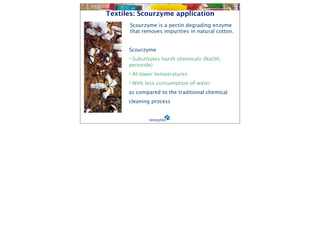
Textiles: Scourzyme application
      Scourzyme is a pectin degrading enzyme
      that removes impurities in natural cotton.


 Scourzyme
      • Substitutes harsh chemicals (NaOH,
      peroxide)
      • At lower temperatures
      • With less consumption of water
      as compared to the traditional chemical
      cleaning process
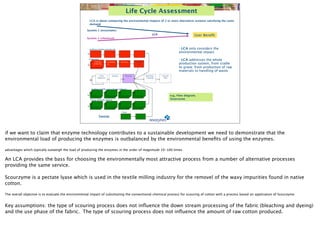
Life Cycle Assessment
                                                     LCA is about comparing the environmental impacts of 2 or more alternative systems satisfying the same
                                                     demand

                                                   System 1 (enzymatic)
                                                                                                                            LCA                                 User Benefit
                                                   System 2 (chemical)


                                                     Auxiliaries (chelator and soda ash)                                                            • LCA only considers the
                                                                                                                                                    environmental impact

                                                     Scourzyme L
                                                           Substrate
                                                                                                                                                    • LCA addresses the whole
                                                      
                                                                             Fermentati       Recovery   Formulati
                                                             LCA addresses a wide range of
                                                          productionon                on                                                            production system, from cradle
                                                             environmental impacts:                                                                 to grave; from production of raw
                                                                                                                                                    materials to handling of waste
                                                                 Consumption of resources
                                                                  Cotton   Knitting Scouring                         Bleaching/   Using the
                                                                 
 Chemicals, energy, water,
                                                                production                                   land use
                                                                                                                  Colouring         cloth


                                                                 Emissions with global impact potential:
                                                                 
 Global Warming
                                                                 
 Stratospheric Ozone Depletion
                                                       Auxiliaries (NaOH, acetic acid and surfactant)


                                                                 Emissions with local/regional impact                                         e.g., Flow diagram,
                                                                        potential:
                                                       Energy (electricity and heat)                                                          Scourzyme
                                                                 
 Acidification
                                                                 
 Nutrient Enrichment
                                                                 
 Summer smog
                                                                                 Water
                                                                 
                                                                 Toxicity


if we want to claim that enzyme technology contributes to a sustainable development we need to demonstrate that the
environmental load of producing the enzymes is outbalanced by the environmental benefits of using the enzymes.

advantages which typically outweigh the load of producing the enzymes in the order of magnitude 10-100 times


An LCA provides the bass for choosing the environmentally most attractive process from a number of alternative processes
providing the same service.

Scourzyme is a pectate lyase which is used in the textile milling industry for the removel of the waxy impurities found in native
cotton.

The overall objective is to evaluate the environmental impact of substituting the conventional chemical process for scouring of cotton with a process based on application of Scourzyme


Key assumptions: the type of scouring process does not influence the down stream processing of the fabric (bleaching and dyeing)
and the use phase of the fabric. The type of scouring process does not influence the amount of raw cotton produced.
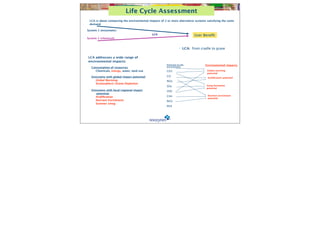
Life Cycle Assessment
     LCA is about comparing the environmental impacts of 2 or more alternative systems satisfying the same
     demand

    System 1 (enzymatic)
                                                 LCA                          User Benefit
    System 2 (chemical)


                                                                    • LCA: from cradle to grave


   LCA addresses a wide range of
    environmental impacts:
                                                          Emission to the             Environmental impacts:
       Consumption of resources                           environment:
       
 Chemicals, energy, water, land use               CO2                          Global warming
                                                                                       potential
       Emissions with global impact potential:            CO
                                                                                       Acidification potential
       
 Global Warming                                   NOx
       
 Stratospheric Ozone Depletion
                                                          SOx                         Smog formation
                                                                                      potential
       Emissions with local/regional impact               VOC
          potential:
                                                          CH4                          Nutrient enrichment
       
 Acidification                                                                  potential
       
 Nutrient Enrichment                              NO3
       
 Summer smog
       
                                                  PO4
Scourzyme application - the environmental impact

   Scouring of knitted cotton fibre


                               Source: Öeco-Institute e.V. March 2003
                                Based on case study in the Chinese market.
Examples of environmental benefits incl. contribution from
                                                                 enzyme production Normalised data (expressed as person
                                                                 equivalents)


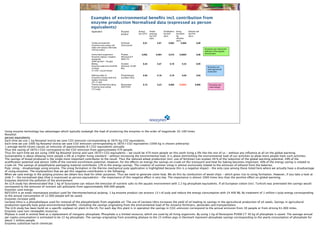
Using enzyme technology has advantages which typically outweigh the load of producing the enzymes in the order of magnitude 10-100 times
Novamyl:
person equivalents:
Each time we use 1 kg Novamyl (extra) we save CO2 emission corresponding to 3870 kg CO2 equivalents.
Each time we use 1000 kg Novamyl (extra) we save CO2 emission corrersponding to 3870 t CO2 equivalents (1000 kg is chosen arbitrarily)
1 average world citizen causes an emission of approximately 8 t CO2 equivalents annually
Thus the saving of 3870 t CO2 correspond to the CO2 emission from approximately 470 people.
Thus for each time we are using 1000 kg Novamyl (extra) and save 3870 t CO2 equivalents - we could be 470 more people on this earth living a life like the rest of us - without any influence at all on the global warming.
Sustainability is about allowing more people a life at a higher living standard - without increasing the environmental load. It is about diminishing the environmental load of our activities to allow more people have such activities. 
The savings of bread produced is the single most important contributor to the result. Thus the reduced wheat production (incl. use of fertilizer) can explain 49 % of the reduction of the global warming potential, 49% of the
acidification potential and almost 100% of the nutrient enrichment potential. However, for the effects on energy the savings on crude oil (for transport) and heat for baking becomes important. 40% of the energy saving is related to
crude oil. The savings of polyethylene packaging material contributes 12% to the energy savings. The creation of summer smog is almost exclusively related to the emission of ethanol from the bakeries.
Pulp: smog – disadvantage using enzyme. The smog formation in the thermo mechanical pulp application is highlighted because this is a negative impact - the only case among those listed here where we actually have a disadvantage
of using enzymes. The explanantion that we get this negative contribution is the following:
When we save energy in the pulping process we obtain less heat for other purposes. Thus we need to generate some heat. We do this by combustion of wood chips - which gives rise to smog formation. However, if you take a look at
slide 3 - the normalised data (that is expressed as person equivalents) - the importance of this negative effect is very low. The importance is almost 1000 times less than the positive effect on global warming.
Enzymes diminish the pollution of the environment
An LCA study has demonstrated that 1 kg of Scourzyme can reduce the emission of nutrient salts to the aquatic environment with 2,3 kg phosphate equivalents. If all European cotton (incl. Turkish) was pretreated the savings would
correspond to the emission of nutrient salt pollutants from approximately 400.000 people.
Enzymes save energy
NZ51054 is an endo-mannanase product used for thermomechanical pulping. 1 kg enzyme product can process 13 t of pulp and reduce the energy consumption with 24.400 MJ. By treatment of 1 million t pulp energy corresponding
to the annual consumption of 12.000 people will be saved.
Enzymes increase yield
Lecitase Ultra is a phospholipase used for removal of the phospholipids from vegetable oil. The use of Lecitase Ultra increases the yield of oil leading to savings in the agricultural production of oil seeds. Savings in agricultural
production typically have great environmental benefits –including the savings originating from the environmental load of for instance fertilizers, pesticides and transportation.
The LCA study has been build on a specific soybean oil plant in the US. For each day this plant is in operation the savings in CO2-emission correspond to the annual emission from 30 people or from driving 61.000 miles.
Enzymes save non-renewable resources
Phytase is used in animal feed as a replacement of inorganic phosphate. Phosphate is a limited resource, which are used by all living organisms. By using 1 kg of Ronozyme P5000 CT 30 kg of phosphate is saved. The average annual
per capita consumption is estimated to be 22 kg phosphate. The savings originating from providing phytase to the 23 million pigs in Denmark represent phosphate savings corresponding to the yearly consumption of phosphate for
about 1 million people.
Enzymes substitute harsh chemicals
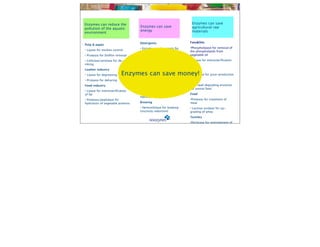
Enzymes can reduce the                                                 Enzymes can save
                                   Enzymes can save                    agricultural raw
pollution of the aquatic
                                   energy                              materials
environment

                                   Detergents                         Fats&Oils
Pulp & paper
                                   • Enzymes in detergents for        •Phospholipase for removal of
• Lipase for stickies control                                         the phospholipids from
                                   low temperature washing
• Protease for biofilm removal                                         vegetable oil
                                   Pulp&Paper
• Cellulase/amylase for de-                                           • Lipase for interesterification
                                   •Lipase for pitch control in       of fat
inking
                                   the paper industry (reduction of
Leather industry                   down time)                         Juice
• Lipase for degreasing    Enzymes can save money! for juice-production
                                Textile        •Pectinase
• Protease for deharing            •Pectinase for pretreatment        Feed
                                   of cotton
Food industry                                                         •Cell-wall degrading enzymes
                                   Juice                              for animal feed
• Lipase for interesterification
of fat                             • Pectinase for juice              Food
                                   manufacturing
• Protease/peptidase for                                              •Protease for treatment of
hydrolysis of vegetable proteins   Brewing                            meat
                                   • Hemicellulase for brewing        • Lactose oxidase for up-
                                   (viscosity reduction)              grading of whey
                                                                      Textiles
                                                                      •Pectinase for pretreatment of
                                                                      cotton
So much for enzymes and existing
          processes…
Biotechnology will have no greater impact on
  the daily lives of the people of the world
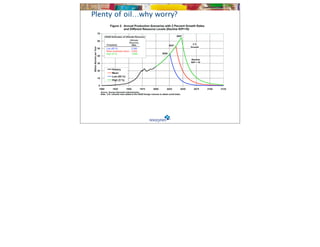
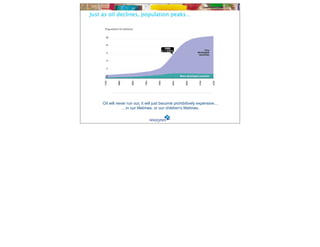
Plenty of oil…why worry?
Just as oil declines, population peaks…


          Source: United Nations, World Population Prospects, The 1998 Revision; and estimates by the Population Reference Bureau.


     Oil will never run out, it will just become prohibitively expensive…
                 …in our lifetimes, or our children’s lifetimes.
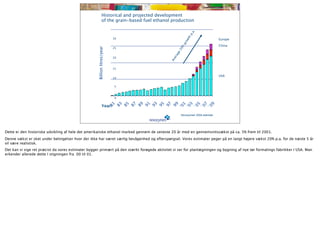
Historical and projected development
                                                               of the grain-based fuel ethanol production


                                                                                                                                     a.
                                                                                                                                     p.
                                                                                                                                    h
                                                                           30                                                                           Europe


                                                                                                                                 wt
                                                                                                                                 o
                                                                                                                              gr
                                                                                                                                                        China


                                                                                                                             %
                                                    Billion litres/year
                                                                           25


                                                                                                                            20
                                                                                                                         e
                                                                                                                       ag
                                                                                                                     er
                                                                           20


                                                                                                                   Av
                                                                           15

                                                                                                                                                        USA
                                                                           10


                                                                               5


                                                                               0


                                                                Year:
                                                                          81
                                                                               83
                                                                                    85
                                                                                         87
                                                                                              89
                                                                                                   91
                                                                                                        93
                                                                                                             95
                                                                                                                  97
                                                                                                                       99

                                                                                                                               1
                                                                                                                                     3
                                                                                                                                     5
                                                                                                                                     7
                                                                                                                                     9
                                                                                                                            '0
                                                                                                                                  '0
                                                                                                                                 `0
                                                                                                                                 `0
                                                                                                                                 `0
                                                                                                                             Novozymes’ 2004 estimate


Dette er den historiske udvikling af hele det amerikanske ethanol marked gennem de seneste 20 år med en gennemsnitsvækst på ca. 5% frem til 2001.
Denne vækst er sket under betingelser hvor der ikke har været særlig bevågenhed og efterspørgsel. Vores estimater peger på en langt højere vækst 20% p.a. for de næste 5 år
vil være realistisk.
Det kan vi sige ret præcist da vores estimater bygger primært på den stærkt forøgede aktivitet vi ser for planlægningen og bygning af nye tør formalings fabrikker I USA. Man
erkender allerede dette I stigningen fra 00 til 01.
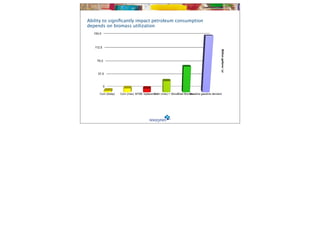
Ability to significantly impact petroleum consumption
depends on biomass utilization
   150.0


   112.5


                                                                                                Billion gallons / yr
     75.0


     37.5


           0

       Corn (today)   Corn (max) MTBE replacement (max) + Stover
                                              Corn             Total Biomass
                                                                         Baseline gasoline demand
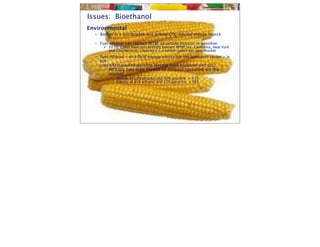
Issues: Bioethanol
Environmental
  • Biofuel is a sustainable and almost CO2-neutral energy source

  • Fuel ethanol can replace MTBE as octane booster in gasoline
       10 US states have successfully banned MTBE (ex. California, New York
        and Connecticut), creating a 1.4 billion gallon per year market
  • Fuel ethanol - as a fluid energy source for the transport sector - is
    the
    only alternative to gasoline (except from biodiesel and gas)
      • Already two type blends of ethanol/gasoline on the
        market
          •   blends of 10% ethanol and 90% gasoline = E10
          •   blends of 85% ethanol and 15% gasoline = E85
Novozymes Biotech, Inc.
National Renewable Energy Labs
       US Dept of Energy

       BioEnergy Project
     $17.8 million/4 years


          Unlocking the magic of nature
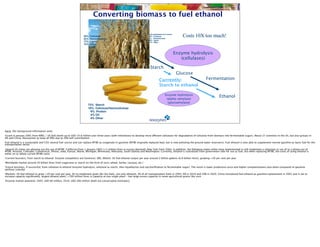
Converting biomass to fuel ethanol
                                                                          Biomass
                                                                   38%   Cellulose
                                                                                             Pre-treatment                 Acid pretreated corn stover
                                                                                                                           56% Cellulose                     Costs 10X too much!
                                                                   32%   Hemicellulose                                     5% Hemicellulose
                                                                                                                           28% Lignin
                                                                   17%   Lignin                                            13% Other
                                                                   13%   Other
                                                                                                         Processed
                                                                                                          biomass                                        Enzyme hydrolysis
                                                                                                         (cellulose)                                        (cellulases)

                                                                                                                            Starch
                                                                                                                                                          Glucose
                                                                                                                                      Currently:                            Fermentation
                                                                                                                                      Starch to ethanol

                                                                                                                                             Enzyme hydrolysis
                                                                                                                                              (alpha-amylase)
                                                                                                                                                                                       Ethanol
                                                                                                                                               (glucoamylase)
                                                                       72% Starch
                                                                       10% Cellulose/Hemicellulose
                                                                        9% Protein
                                                                        4% Oil
                                                                        4% Other


Facts: (for background information only)
•Grant in January 2001 from NREL / US DoE worth up to USD 14.8 million over three years (with milestones) to develop more efficient cellulases for degradation of cellulose from biomass into fermentable sugars. About 27 scientists in the US, but also groups in
DK and China. Novozymes to keep all IPRs due to 20% self-contribution.
Fuel ethanol is a sustainable and CO2 neutral fuel source and can replace MTBE as oxygenate in gasoline (MTBE originally replaced lead, but is now polluting the ground water reservoirs). Fuel ethanol is also able to supplement normal gasoline as basic fuel for the
transportation sector
•Several US states are phasing out the use of MTBE; California from 1 January 2003 (>2 million litres in excess demand), New York from 2004. In addition, the following states either have implemented or will implement a reduction in use of or a phase out of
MTBE: Arizona, Colorado, Connecticut, Illinois, Iowa, Kansas, Maine, Michigan, Minnesota, Nebraska, South Dakota and Washington. Currently, ethanol is subsidized from government side for use as fuel, but when replacing MTBE, the costs of using ethanol is
either on or below current MTBE costs
•Current business, from starch to ethanol: Enzyme competitors are Genencor, EBS, Alltech. US fuel ethanol output per year around 2 billion gallons (6.8 billion litres), growing >20 per cent per year
•Worldwide market around 20 billion litres from sugarcane or starch (in the form of corn, wheat, barley, cassava, etc.)
•Future business, if successful, from cellulose to ethanol (enzyme hydrolysis; cellulose to starch, then liquefaction and saccharification to fermentable sugar). The result is lower production price and higher competitiveness also when compared to gasoline
(without subsidy)
•Markets: US fuel ethanol to grow >20 per cent per year. EU to implement goals (for bio fuels, not only ethanol), 2% of all transportation fuels in 2005, 6% in 2010 and 20% in 2020. China introduced fuel ethanol as gasoline replacement in 2001 and is set to
increase capacity significantly, largest ethanol plant; >700 million litres in capacity at one single plant - has large excess capacity in some agricultural grains like corn
•Enzyme market potential: 2005; USD 60 million, 2010; USD 200 million (both are conservative estimates)
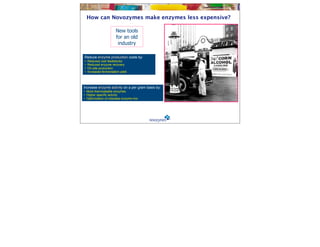
How can Novozymes make enzymes less expensive?

                        New tools
                        for an old
                         industry

Reduce enzyme production costs by:
•   Reduced cost feedstocks
•   Reduced enzyme recovery
•   On-site production
•   Increased fermentation yield


Increase enzyme activity on a per gram basis by:
• More thermostable enzymes
• Higher specific activity
• Optimization of cellulase enzyme mix
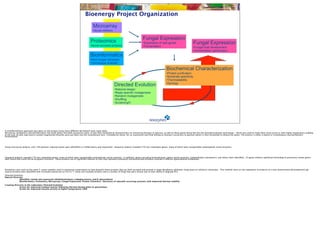
Bioenergy Project Organization

                                                                                         Microarray
                                                                                         •Novel mRNA’s

                                                                                                                                           Fungal Expression
                                                                                      Proteomics                                           •Expression of new genes                           Fungal Expression
                                                                                      •Novel secreted proteins                             •Fermentation                                      •Fungal host development
                                                                                                                                                                                              •Fermentation optimization
                                                                                      Bioinformatics
                                                                                      •New fungal cellulases
                                                                                      •Homologue analysis

                                                                                                                                                                   Biochemical Characterization
                                                                                                                                                                   •Protein purification
                                                                                                                                                                   •Substrate specificity
                                                                                                                                                                   •Thermostability
                                                                                                                                                                   •Synergy
                                                                                                              Directed Evolution
                                                                                                              •Rational design
                                                                                                              •Regio-specific mutagenesis
                                                                                                              •Random mutagenesis
                                                                                                              •Shuffling
                                                                                                              •Screening!!!


A multidisciplinary approach was taken on the project using many different NZ biotech tools (read slide).
Microarray, proteomics and bioinformatics fed novel genes into both expression work, to test their biochemical characteristics on converting biomass to glucose, as well as these genes being fed into the directed evolution technology – which was used to make them more active or with higher temperature stability.
In the end, all wild-type and/or protein engineered enzymes were put back into the recombinant host, Trichoderma reesei, for co-expression and final testing on biomass conversion to glucose (which is then fermented to ethanol by yeast). The process is either a hybrid or simultaneous saccharifiaction/
fermentation.


Using microarray analysis, over 728 biomass-induced clones were identified in a cDNA library and sequenced. Sequence analysis revealed 170 non-redundant genes, many of which were recognizable carbohydrate-active enzymes.


Sequence analysis revealed 170 non-redundant genes, many of which were recognizable carbohydrate-active enzymes. In addition, genes encoding hemicellulases, lignin-active enzymes, carbohydrates transporters, and others were identified. 24 genes without significant homology to previously cloned genes
were found that could not be assigned a function. These proteins are of significant interest as they may represent previously uncharacterized enzymes involved in efficient lignocellulose breakdown.


Proteomics was used on the same T. reesei samples used in microarray experiments to help pinpoint those proteins that are both secreted and present in large abundance celluloytic fungi grow on cellulosic substrates. This method relies on the separation of proteins on a two-dimensional electrophoretic gel
Several proteins were identified with increased expression on PCS in T. reesei and multiple proteins were a number of fungi that were chosen due to their ability to degrade PCS.
Directed Evolution:
Natural Diversity:
               Identified, cloned and expressed cellobiohydrolases, endoglucanases, and β-glucosidases
               Bioinformatics, Proteomics, Microarrays, Fungal Expression, Protein Chemistry : Discovery of naturally occurring enzymes with improved thermal stability
Creating Diversity in the Laboratory: Directed Evolution
             Screen for improved residual activity following thermal denaturation: β-glucosidase
             Screen for improved enzyme activity at higher temperature: CBHI
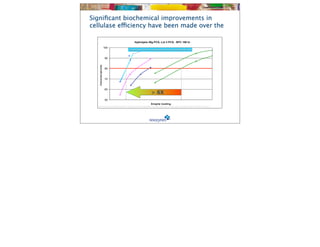
Significant biochemical improvements in
cellulase efficiency have been made over the


             Expression of four recombinant proteins in production host


                                 > 6X
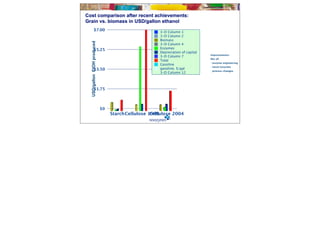
Cost comparison after recent achievements:
Grain vs. biomass in USD/gallon ethanol
              $7.00                                    3-D Column 1
                                                       3-D Column 2
                                                       Biomass


  USD/gallon EtOH produced
                                                       3-D Column 4
              $5.25                                    Enzymes
                                                       Depreciation of capital
                                                                                 Improvements:
                                                       3-D Column 7
                                                                                 Mix of:
                                                       Total
                                                                                 • enzyme engineering
                                                       Gasoline
                                                                                 • novel enzymes
              $3.50                                    gasoline, $/gal
                                                                                 • process changes
                                                       3-D Column 12


              $1.75


                             $0
                                  StarchCellulose 1999
                                                   Cellulose 2004
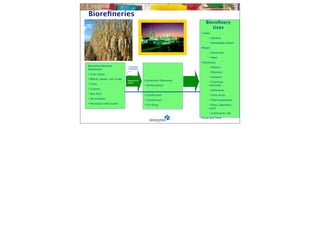
Biorefineries
                                                                       Biorefinery
                                                                          Uses
                                                                   • Fuels:
                                                                         • Ethanol
                                                                         • Renewable Diesel
                                                                   •Power:
                                                                         • Electricity
                                                                         • Heat
                                                                   •Chemicals
Abundant Biomass               Enzymatic                                 • Plastics
Feedstocks                     hydrolysis

                                                                         • Polymers
• Corn stover
                                                                         • Solvents
• Wheat, barley, rice straw   Inexpensive   Conversion Processes
                              sugars                                     • Chemical
• Trees                                     • Fermentation               intermed.
• Grasses                                                                • Adhesives
• Saw dust                                  • Gasification                • Fatty Acids
• Ag residues                               • Combustion                 • Pharmaceuticals
• Municipal solid waste                     • Co-firing                   • Dyes, pigments,
                                                                         paint
                                                                         • Surfactants, Etc.
                                                                   •Food and Feed
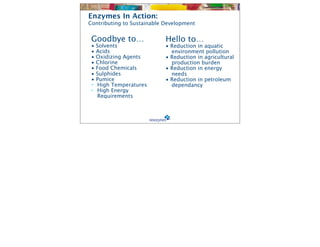
Enzymes In Action:
Contributing to Sustainable Development


 Goodbye to…                Hello to…
 •   Solvents               • Reduction in aquatic
 •   Acids                    environment pollution
 •   Oxidizing Agents       • Reduction in agricultural
 •   Chlorine                 production burden
 •   Food Chemicals         • Reduction in energy
 •   Sulphides                needs
 •   Pumice                 • Reduction in petroleum
 •   High Temperatures        dependancy
 •   High Energy
     Requirements
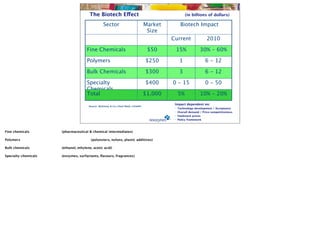
The Biotech Effect
                            
     
             (in billions of dollars)

                                                   Sector                           Market             Biotech Impact
                                                                                     Size
                                                                                                 Current                  2010

                                       Fine Chemicals                                $50              15%            30% - 60%

                                       Polymers                                     $250               1                 6 - 12

                                       Bulk Chemicals                               $300               3                 6 - 12

                                       Specialty                                    $400         0 - 15                  0 - 50
                                       Chemicals
                                       Total                                        $1,000            5%             10% - 20%
                                                                                                  Impact dependent on:
                                        Source: McKinsey & Co.; Chem Week 11Feb04
                                                                                                  •   Technology development / Acceptance
                                                                                                  •   Overall demand / Price competitiveness
                                                                                                  •   Feedstock prices
                                                                                                  •   Policy framework


Fine chemicals 

      (pharmaceutical & chemical intermediates)

Polymers
       
      
                 (polyesters, nylons, plastic additives)

Bulk chemicals
 
      (ethanol, ethylene, acetic acid)

Specialty chemicals
   (enzymes, surfactants, flavours, fragrances)
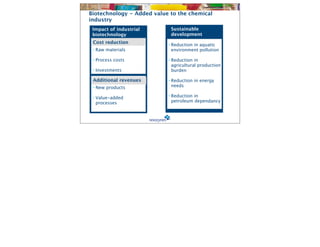
Biotechnology - Added value to the chemical
industry
 Impact of industrial       Sustainable
 biotechnology              development
 Cost reduction
                           • Reduction in aquatic
 • Raw materials             environment pollution

 • Process costs           • Reduction in
                             agricultural production
 • Investments               burden

 Additional revenues       • Reduction in energy
 • New products              needs

 • Value-added             • Reduction in
   processes                 petroleum dependancy
Microorganisms, the art of our business


                                                                                      sustainable
                                                                                      development


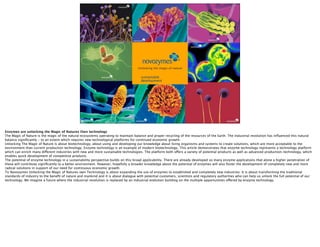
Enzymes are unlocking the Magic of Natures Own technology
The Magic of Nature is the magic of the natural ecosystems operating to maintain balance and proper recycling of the resources of the Earth. The industrial revolution has influenced this natural
balance significantly - to an extent which requires new technological platforms for continued economic growth.
Unlocking The Magic of Nature is about biotechnology, about using and developing our knowledge about living organisms and systems to create solutions, which are more acceptable to the
environment than current production technology. Enzyme technology is an example of modern biotechnology. This article demonstrates that enzyme technology represents a technology platform
which can enrich many different industries with new and more sustainable technologies. The platform both offers a variety of potential products as well as advanced production-technology, which
enables quick development of competitive products.
The potential of enzyme technology in a sustainability perspective builds on this broad applicability. There are already developed so many enzyme applications that alone a higher penetration of
these will contribute significantly to a better environment. However, hopefully a broader knowledge about the potential of enzymes will also foster the development of completely new and more
radical solutions in support of our need for continuous economic growth.
To Novozymes Unlocking the Magic of Natures own Technology is about expanding the use of enzymes to established and completely new industries. It is about transforming the traditional
standards of industry to the benefit of nature and mankind and it is about dialogue with potential customers, scientists and regulatory authorities who can help us unlock the full potential of our
technology. We imagine a future where the industrial revolution is replaced by an industrial evolution building on the multiple opportunities offered by enzyme technology.

Cherry 2005

  • 1.
    Enzymes: Advances inSustainable Industrial Processes and Bioenergy CDMA Fall Meeting Philadelphia, PA 29 September, 2005 Joel R. Cherry, Ph.D. Director, Bioenergy/Biotechnology Novozymes, Inc. Unlocking the magic of nature overview of the versatility and the environmental advantages of enzyme technology.
  • 2.
    Novozymes - Biotech-basedworld leader in enzymes & microorganisms Growth by innovation - new products, applications, markets to drive sales growth of 8-9% Business Technical Food enzymes Feed enzymes Microorganisms Total area enzymes Main Detergent, starch, Baking, brewing, Animal feed Cleaning, plant Industrial markets textile, fuel wine care, waste biotech ethanol, juice, food treatment pulp&paper, specialities leather, personal care, fats&oils Market 45-50% 30-35% 45-50% 50%+ Approx. share (combined) 44% Novozymes, 2004 New growth areas: Pharma • Revenues: >$1 billion, world-wide sales discovery and production: • ~3,000 employees • Antimicrobial peptides • Major sites: • Denmark (Headquarters) • mAb production • US (N.C., CA, NY) • allergy vaccines • China, Japan, Brazil, France, Switzerland
  • 3.
    Novozymes created theenzyme market 6 Novozymes sales 5 ons 4 li cati DKK w app f ne billion 3 tio no o duc 2 Intr 1 0 1987 1969 1978 1981 1990 1996 1999 1984 1963 1966 1972 1975 1993 Examples: 1974 Esperase First extremophile enzyme 1984 Maltogenase First recombinant enzyme, starch 1988 Lipolase First commercial lipase, detergent 1997 Kannase First low temperature and soft water protease, detergent 2000 Mannaway New enzyme class for stain removal, detergent
  • 4.
    Novozymes’ Vision “We imagine a future where our biological solutions create the necessary balance between better business, cleaner environment and better lives” Intentionally left blank
  • 5.
    The Novo Family,circa 1925, Denmark The Novo Nordisk Foundation Holding Company Pharmaceuticals Industrial Biotechnology
  • 6.
    Our enzymes areused everywhere
  • 7.
    Towards sustainability The Industrial Revolution Conventional industry • Economic growth • Great costs to Nature threatening to growth for future generations The Industrial Evolution Biotechnology Unlocking the Magic of Nature Using our knowledge about living systems to create innovative solutions • Economic growth • Less costs to Nature enabling growth for future generations We think of ourselves as a business to change things – for the better. We want to play a role in the development towards sustainability. The change boils down to pushing ”the industrial evolution” concept – to move from the industrial revolution to the industrial evolution. For more than a century, global industry has looked to machines to revolutionise industry. This has been extremely succesful – it has created economic growth but it has been achieved at great cost to nature and people everywhere. It has been disturbing natures recycling of resources to a level which is threatening to the opportunities for growth for future generations. At Novozymes we believe the time has come to evolve this traditional way of thinking and to use modern biotechnology to drive this evolution of global industry forward. Thus The industrial evolution is about biotechnology. At Novozymes we are talking about unlocking the Magic of Nature. Because biotechnology is about using and developing the knowledge we have about living systems in Nature to create innovative solutions - and that will enable economic growth – but do so at less costs to Nature than the conventional technology – so that instead of threatening the opportunities for further growth we are actually strengthening these opportunities. This all means that the development towards industrial evolution is a development towards sustainability
  • 8.
    The Use ofEnzymes Contribute to Sustainable Development Enzymes: • Are biological catalysts in the form of proteins that drive chemical reactions in the cells of living organisms • Are very specific catalytic properties • Work at mild conditions and only small quantities are required • Are fully biodegradable • Are made from renewable resources • e.g., glucose, starch, soy, protein • Excess biomass is used as soil conditioners and fertilizers e.g., cellulase • Improve product quality • Save water, energy, chemicals and waste • Speed up production processes • Enable novel products
  • 9.
    Our enzyme technologyand production Native enzyme Improved Leading-edge biotechnology alkaline activity expertise • Enzymes sourced from nature • World’s largest strain collection Altered • Bacteria, Fungi specificity • Recombinant production • Diversity generation: • Strong screening tools/capabilities Improved • Engineering thermostabilit • Shuffling y è We have the ability to find the right enzyme to do the job ! Activity, Performance, Stability, Compatibility, Specificity, State-of-the-art production Temperature, pH, Pressure with continued optimisations Chelants, New activities, and economies of scale Expression • More than production sites globally • 5 strategic twenty commercialized protein engineered • Site DK is world’s largest plant for enzymes enzymes the ability to produce the è We have right enzyme in the amount needed !
  • 10.
    Novozymes: A wealthof enzymes Endoproteases: Mutanases Catalases Subtilisin-proteases Dextranases Transglutaminases Trypsin-like proteases Alginate lyases Lactonohydrolases Acidic proteases Pectin esterase Phytases Pectin lyases Glutaminases Exoproteases: Pectate lyases Lactases Peptidases (amino-, Alpha-galactosidases carboxy-,di-, tri- Polygalacturonases Cyclodextrin peptidyl) Rhamnogalacturonase glycosyl transferases Amylases s Alpha-acetolactate Glucoamylases Arabinanases decarboxylases Pullulanases Galactanases Disulphide isomerases Isoamylases Lipases Nitrilases Endo Cellulases Cutinases Ureases Exo Cellulases Esterases …just to mention a Beta-glucanases Phospholipases few ! Xyloglucanases Laccases Xylanases Peroxidases …ability to find or Haloperoxidases create THE correct Oxidases enzyme activity for the application
  • 11.
    The benefits ofusing enzymes Enzymes in Sustainable Development
  • 12.
    Enzymes for theDetergent Industry e.g., proteases, amylases, lipases, cellulases, mannanases • Lower temperature (from 60oC to max. 40oC) • Energy savings in Denmark (28,000 tons coal/yr) • Less phosphate and chemicals in the environment e.g., Stainzyme • Enzymes are biologically • Stainzyme is a carbohydrate degradable degrading enzyme, which allows efficient removal of stains at washing temperatures as low as 300C. • More gentle to fabrics • If the average washing temperature in Europe is decreased from 400C to 300C a saving corresponding to 1/3 of the electricity-consumption from household washing will be achieved Electricity consumption from household washing in Europe is around 50 TWh a year, or 1½ times the total electricity consumption in Denmark or 10 times the yearly electricity production of Barsebäck.
  • 13.
    Enzymes for theTextiles Industry •Decrease/eliminate use of pumice stones •Decrease/eliminate pumice dust •Decrease/eliminate fabric damage •Increased fabric tensile strength •Decrease waste effluent •Increased garment life Laccase •Decreased pills, fuzz •New fashion looks Cellulase •Decrease/eliminate chlorine and other bleaching agents •New fashion looks •Eliminate use of pumice stones Amylase •Eliminate use of oxidizing agents or sodium hydroxide •Eliminate pressure cooking •Decrease/eliminate fabric damage
  • 14.
    Enzymes for theBaked Goods Industry Without Novamyl • Fungal alpha-amylase:  Increases loaf volume and improves eveness of crumb structure. • Maltogenic alpha-amylase: Increases shelf-life. • Glucose oxidase: Oxidizes free sulfhydryl groups to make weak doughs stronger and more elastic. • Lipase: Dough conditioning by producing more uniform, smaller crumb cells and silkier testure and whiter crumb color. • Xylanase: Dough conditioning and improved crumb structure. • Protease: Weakens the gluten to provide better dough for biscuits. With Novamyl
  • 15.
    Textiles: Scourzyme application Scourzyme is a pectin degrading enzyme that removes impurities in natural cotton. Scourzyme • Substitutes harsh chemicals (NaOH, peroxide) • At lower temperatures • With less consumption of water as compared to the traditional chemical cleaning process
  • 16.
    Life Cycle Assessment LCA is about comparing the environmental impacts of 2 or more alternative systems satisfying the same demand System 1 (enzymatic) LCA User Benefit System 2 (chemical) Auxiliaries (chelator and soda ash) • LCA only considers the environmental impact Scourzyme L Substrate • LCA addresses the whole Fermentati Recovery Formulati LCA addresses a wide range of productionon on production system, from cradle environmental impacts: to grave; from production of raw materials to handling of waste Consumption of resources Cotton Knitting Scouring Bleaching/ Using the Chemicals, energy, water, production land use Colouring cloth Emissions with global impact potential: Global Warming Stratospheric Ozone Depletion Auxiliaries (NaOH, acetic acid and surfactant) Emissions with local/regional impact e.g., Flow diagram, potential: Energy (electricity and heat) Scourzyme Acidification Nutrient Enrichment Summer smog Water Toxicity if we want to claim that enzyme technology contributes to a sustainable development we need to demonstrate that the environmental load of producing the enzymes is outbalanced by the environmental benefits of using the enzymes. advantages which typically outweigh the load of producing the enzymes in the order of magnitude 10-100 times An LCA provides the bass for choosing the environmentally most attractive process from a number of alternative processes providing the same service. Scourzyme is a pectate lyase which is used in the textile milling industry for the removel of the waxy impurities found in native cotton. The overall objective is to evaluate the environmental impact of substituting the conventional chemical process for scouring of cotton with a process based on application of Scourzyme Key assumptions: the type of scouring process does not influence the down stream processing of the fabric (bleaching and dyeing) and the use phase of the fabric. The type of scouring process does not influence the amount of raw cotton produced.
  • 17.
    Life Cycle Assessment LCA is about comparing the environmental impacts of 2 or more alternative systems satisfying the same demand System 1 (enzymatic) LCA User Benefit System 2 (chemical) • LCA: from cradle to grave LCA addresses a wide range of environmental impacts: Emission to the Environmental impacts: Consumption of resources environment: Chemicals, energy, water, land use CO2 Global warming potential Emissions with global impact potential: CO Acidification potential Global Warming NOx Stratospheric Ozone Depletion SOx Smog formation potential Emissions with local/regional impact VOC potential: CH4 Nutrient enrichment Acidification potential Nutrient Enrichment NO3 Summer smog PO4
  • 18.
    Scourzyme application -the environmental impact Scouring of knitted cotton fibre Source: Öeco-Institute e.V. March 2003 Based on case study in the Chinese market.
  • 19.
    Examples of environmentalbenefits incl. contribution from enzyme production Normalised data (expressed as person equivalents) Using enzyme technology has advantages which typically outweigh the load of producing the enzymes in the order of magnitude 10-100 times Novamyl: person equivalents: Each time we use 1 kg Novamyl (extra) we save CO2 emission corresponding to 3870 kg CO2 equivalents. Each time we use 1000 kg Novamyl (extra) we save CO2 emission corrersponding to 3870 t CO2 equivalents (1000 kg is chosen arbitrarily) 1 average world citizen causes an emission of approximately 8 t CO2 equivalents annually Thus the saving of 3870 t CO2 correspond to the CO2 emission from approximately 470 people. Thus for each time we are using 1000 kg Novamyl (extra) and save 3870 t CO2 equivalents - we could be 470 more people on this earth living a life like the rest of us - without any influence at all on the global warming. Sustainability is about allowing more people a life at a higher living standard - without increasing the environmental load. It is about diminishing the environmental load of our activities to allow more people have such activities.  The savings of bread produced is the single most important contributor to the result. Thus the reduced wheat production (incl. use of fertilizer) can explain 49 % of the reduction of the global warming potential, 49% of the acidification potential and almost 100% of the nutrient enrichment potential. However, for the effects on energy the savings on crude oil (for transport) and heat for baking becomes important. 40% of the energy saving is related to crude oil. The savings of polyethylene packaging material contributes 12% to the energy savings. The creation of summer smog is almost exclusively related to the emission of ethanol from the bakeries. Pulp: smog – disadvantage using enzyme. The smog formation in the thermo mechanical pulp application is highlighted because this is a negative impact - the only case among those listed here where we actually have a disadvantage of using enzymes. The explanantion that we get this negative contribution is the following: When we save energy in the pulping process we obtain less heat for other purposes. Thus we need to generate some heat. We do this by combustion of wood chips - which gives rise to smog formation. However, if you take a look at slide 3 - the normalised data (that is expressed as person equivalents) - the importance of this negative effect is very low. The importance is almost 1000 times less than the positive effect on global warming. Enzymes diminish the pollution of the environment An LCA study has demonstrated that 1 kg of Scourzyme can reduce the emission of nutrient salts to the aquatic environment with 2,3 kg phosphate equivalents. If all European cotton (incl. Turkish) was pretreated the savings would correspond to the emission of nutrient salt pollutants from approximately 400.000 people. Enzymes save energy NZ51054 is an endo-mannanase product used for thermomechanical pulping. 1 kg enzyme product can process 13 t of pulp and reduce the energy consumption with 24.400 MJ. By treatment of 1 million t pulp energy corresponding to the annual consumption of 12.000 people will be saved. Enzymes increase yield Lecitase Ultra is a phospholipase used for removal of the phospholipids from vegetable oil. The use of Lecitase Ultra increases the yield of oil leading to savings in the agricultural production of oil seeds. Savings in agricultural production typically have great environmental benefits –including the savings originating from the environmental load of for instance fertilizers, pesticides and transportation. The LCA study has been build on a specific soybean oil plant in the US. For each day this plant is in operation the savings in CO2-emission correspond to the annual emission from 30 people or from driving 61.000 miles. Enzymes save non-renewable resources Phytase is used in animal feed as a replacement of inorganic phosphate. Phosphate is a limited resource, which are used by all living organisms. By using 1 kg of Ronozyme P5000 CT 30 kg of phosphate is saved. The average annual per capita consumption is estimated to be 22 kg phosphate. The savings originating from providing phytase to the 23 million pigs in Denmark represent phosphate savings corresponding to the yearly consumption of phosphate for about 1 million people. Enzymes substitute harsh chemicals
  • 20.
    Enzymes can reducethe Enzymes can save Enzymes can save agricultural raw pollution of the aquatic energy materials environment Detergents Fats&Oils Pulp & paper • Enzymes in detergents for •Phospholipase for removal of • Lipase for stickies control the phospholipids from low temperature washing • Protease for biofilm removal vegetable oil Pulp&Paper • Cellulase/amylase for de- • Lipase for interesterification •Lipase for pitch control in of fat inking the paper industry (reduction of Leather industry down time) Juice • Lipase for degreasing Enzymes can save money! for juice-production Textile •Pectinase • Protease for deharing •Pectinase for pretreatment Feed of cotton Food industry •Cell-wall degrading enzymes Juice for animal feed • Lipase for interesterification of fat • Pectinase for juice Food manufacturing • Protease/peptidase for •Protease for treatment of hydrolysis of vegetable proteins Brewing meat • Hemicellulase for brewing • Lactose oxidase for up- (viscosity reduction) grading of whey Textiles •Pectinase for pretreatment of cotton
  • 21.
    So much forenzymes and existing processes…
  • 22.
    Biotechnology will haveno greater impact on the daily lives of the people of the world
  • 23.
  • 24.
    Just as oildeclines, population peaks… Source: United Nations, World Population Prospects, The 1998 Revision; and estimates by the Population Reference Bureau. Oil will never run out, it will just become prohibitively expensive… …in our lifetimes, or our children’s lifetimes.
  • 25.
    Historical and projecteddevelopment of the grain-based fuel ethanol production a. p. h 30 Europe wt o gr China % Billion litres/year 25 20 e ag er 20 Av 15 USA 10 5 0 Year: 81 83 85 87 89 91 93 95 97 99 1 3 5 7 9 '0 '0 `0 `0 `0 Novozymes’ 2004 estimate Dette er den historiske udvikling af hele det amerikanske ethanol marked gennem de seneste 20 år med en gennemsnitsvækst på ca. 5% frem til 2001. Denne vækst er sket under betingelser hvor der ikke har været særlig bevågenhed og efterspørgsel. Vores estimater peger på en langt højere vækst 20% p.a. for de næste 5 år vil være realistisk. Det kan vi sige ret præcist da vores estimater bygger primært på den stærkt forøgede aktivitet vi ser for planlægningen og bygning af nye tør formalings fabrikker I USA. Man erkender allerede dette I stigningen fra 00 til 01.
  • 26.
    Ability to significantlyimpact petroleum consumption depends on biomass utilization 150.0 112.5 Billion gallons / yr 75.0 37.5 0 Corn (today) Corn (max) MTBE replacement (max) + Stover Corn Total Biomass Baseline gasoline demand
  • 27.
    Issues: Bioethanol Environmental • Biofuel is a sustainable and almost CO2-neutral energy source • Fuel ethanol can replace MTBE as octane booster in gasoline  10 US states have successfully banned MTBE (ex. California, New York and Connecticut), creating a 1.4 billion gallon per year market • Fuel ethanol - as a fluid energy source for the transport sector - is the only alternative to gasoline (except from biodiesel and gas) • Already two type blends of ethanol/gasoline on the market • blends of 10% ethanol and 90% gasoline = E10 • blends of 85% ethanol and 15% gasoline = E85
  • 28.
    Novozymes Biotech, Inc. NationalRenewable Energy Labs US Dept of Energy BioEnergy Project $17.8 million/4 years Unlocking the magic of nature
  • 29.
    Converting biomass tofuel ethanol Biomass 38% Cellulose Pre-treatment Acid pretreated corn stover 56% Cellulose Costs 10X too much! 32% Hemicellulose 5% Hemicellulose 28% Lignin 17% Lignin 13% Other 13% Other Processed biomass Enzyme hydrolysis (cellulose) (cellulases) Starch Glucose Currently: Fermentation Starch to ethanol Enzyme hydrolysis (alpha-amylase) Ethanol (glucoamylase) 72% Starch 10% Cellulose/Hemicellulose 9% Protein 4% Oil 4% Other Facts: (for background information only) •Grant in January 2001 from NREL / US DoE worth up to USD 14.8 million over three years (with milestones) to develop more efficient cellulases for degradation of cellulose from biomass into fermentable sugars. About 27 scientists in the US, but also groups in DK and China. Novozymes to keep all IPRs due to 20% self-contribution. Fuel ethanol is a sustainable and CO2 neutral fuel source and can replace MTBE as oxygenate in gasoline (MTBE originally replaced lead, but is now polluting the ground water reservoirs). Fuel ethanol is also able to supplement normal gasoline as basic fuel for the transportation sector •Several US states are phasing out the use of MTBE; California from 1 January 2003 (>2 million litres in excess demand), New York from 2004. In addition, the following states either have implemented or will implement a reduction in use of or a phase out of MTBE: Arizona, Colorado, Connecticut, Illinois, Iowa, Kansas, Maine, Michigan, Minnesota, Nebraska, South Dakota and Washington. Currently, ethanol is subsidized from government side for use as fuel, but when replacing MTBE, the costs of using ethanol is either on or below current MTBE costs •Current business, from starch to ethanol: Enzyme competitors are Genencor, EBS, Alltech. US fuel ethanol output per year around 2 billion gallons (6.8 billion litres), growing >20 per cent per year •Worldwide market around 20 billion litres from sugarcane or starch (in the form of corn, wheat, barley, cassava, etc.) •Future business, if successful, from cellulose to ethanol (enzyme hydrolysis; cellulose to starch, then liquefaction and saccharification to fermentable sugar). The result is lower production price and higher competitiveness also when compared to gasoline (without subsidy) •Markets: US fuel ethanol to grow >20 per cent per year. EU to implement goals (for bio fuels, not only ethanol), 2% of all transportation fuels in 2005, 6% in 2010 and 20% in 2020. China introduced fuel ethanol as gasoline replacement in 2001 and is set to increase capacity significantly, largest ethanol plant; >700 million litres in capacity at one single plant - has large excess capacity in some agricultural grains like corn •Enzyme market potential: 2005; USD 60 million, 2010; USD 200 million (both are conservative estimates)
  • 30.
    How can Novozymesmake enzymes less expensive? New tools for an old industry Reduce enzyme production costs by: • Reduced cost feedstocks • Reduced enzyme recovery • On-site production • Increased fermentation yield Increase enzyme activity on a per gram basis by: • More thermostable enzymes • Higher specific activity • Optimization of cellulase enzyme mix
  • 31.
    Bioenergy Project Organization Microarray •Novel mRNA’s Fungal Expression Proteomics •Expression of new genes Fungal Expression •Novel secreted proteins •Fermentation •Fungal host development •Fermentation optimization Bioinformatics •New fungal cellulases •Homologue analysis Biochemical Characterization •Protein purification •Substrate specificity •Thermostability •Synergy Directed Evolution •Rational design •Regio-specific mutagenesis •Random mutagenesis •Shuffling •Screening!!! A multidisciplinary approach was taken on the project using many different NZ biotech tools (read slide). Microarray, proteomics and bioinformatics fed novel genes into both expression work, to test their biochemical characteristics on converting biomass to glucose, as well as these genes being fed into the directed evolution technology – which was used to make them more active or with higher temperature stability. In the end, all wild-type and/or protein engineered enzymes were put back into the recombinant host, Trichoderma reesei, for co-expression and final testing on biomass conversion to glucose (which is then fermented to ethanol by yeast). The process is either a hybrid or simultaneous saccharifiaction/ fermentation. Using microarray analysis, over 728 biomass-induced clones were identified in a cDNA library and sequenced. Sequence analysis revealed 170 non-redundant genes, many of which were recognizable carbohydrate-active enzymes. Sequence analysis revealed 170 non-redundant genes, many of which were recognizable carbohydrate-active enzymes. In addition, genes encoding hemicellulases, lignin-active enzymes, carbohydrates transporters, and others were identified. 24 genes without significant homology to previously cloned genes were found that could not be assigned a function. These proteins are of significant interest as they may represent previously uncharacterized enzymes involved in efficient lignocellulose breakdown. Proteomics was used on the same T. reesei samples used in microarray experiments to help pinpoint those proteins that are both secreted and present in large abundance celluloytic fungi grow on cellulosic substrates. This method relies on the separation of proteins on a two-dimensional electrophoretic gel Several proteins were identified with increased expression on PCS in T. reesei and multiple proteins were a number of fungi that were chosen due to their ability to degrade PCS. Directed Evolution: Natural Diversity: Identified, cloned and expressed cellobiohydrolases, endoglucanases, and β-glucosidases Bioinformatics, Proteomics, Microarrays, Fungal Expression, Protein Chemistry : Discovery of naturally occurring enzymes with improved thermal stability Creating Diversity in the Laboratory: Directed Evolution Screen for improved residual activity following thermal denaturation: β-glucosidase Screen for improved enzyme activity at higher temperature: CBHI
  • 32.
    Significant biochemical improvementsin cellulase efficiency have been made over the Expression of four recombinant proteins in production host > 6X
  • 33.
    Cost comparison afterrecent achievements: Grain vs. biomass in USD/gallon ethanol $7.00 3-D Column 1 3-D Column 2 Biomass USD/gallon EtOH produced 3-D Column 4 $5.25 Enzymes Depreciation of capital Improvements: 3-D Column 7 Mix of: Total • enzyme engineering Gasoline • novel enzymes $3.50 gasoline, $/gal • process changes 3-D Column 12 $1.75 $0 StarchCellulose 1999 Cellulose 2004
  • 34.
    Biorefineries Biorefinery Uses • Fuels: • Ethanol • Renewable Diesel •Power: • Electricity • Heat •Chemicals Abundant Biomass Enzymatic • Plastics Feedstocks hydrolysis • Polymers • Corn stover • Solvents • Wheat, barley, rice straw Inexpensive Conversion Processes sugars • Chemical • Trees • Fermentation intermed. • Grasses • Adhesives • Saw dust • Gasification • Fatty Acids • Ag residues • Combustion • Pharmaceuticals • Municipal solid waste • Co-firing • Dyes, pigments, paint • Surfactants, Etc. •Food and Feed
  • 35.
    Enzymes In Action: Contributingto Sustainable Development Goodbye to… Hello to… • Solvents • Reduction in aquatic • Acids environment pollution • Oxidizing Agents • Reduction in agricultural • Chlorine production burden • Food Chemicals • Reduction in energy • Sulphides needs • Pumice • Reduction in petroleum • High Temperatures dependancy • High Energy Requirements
  • 36.
    The Biotech Effect (in billions of dollars) Sector Market Biotech Impact Size Current 2010 Fine Chemicals $50 15% 30% - 60% Polymers $250 1 6 - 12 Bulk Chemicals $300 3 6 - 12 Specialty $400 0 - 15 0 - 50 Chemicals Total $1,000 5% 10% - 20% Impact dependent on: Source: McKinsey & Co.; Chem Week 11Feb04 • Technology development / Acceptance • Overall demand / Price competitiveness • Feedstock prices • Policy framework Fine chemicals (pharmaceutical & chemical intermediates) Polymers (polyesters, nylons, plastic additives) Bulk chemicals (ethanol, ethylene, acetic acid) Specialty chemicals (enzymes, surfactants, flavours, fragrances)
  • 37.
    Biotechnology - Addedvalue to the chemical industry Impact of industrial Sustainable biotechnology development Cost reduction • Reduction in aquatic • Raw materials environment pollution • Process costs • Reduction in agricultural production • Investments burden Additional revenues • Reduction in energy • New products needs • Value-added • Reduction in processes petroleum dependancy
  • 38.
    Microorganisms, the artof our business sustainable development Enzymes are unlocking the Magic of Natures Own technology The Magic of Nature is the magic of the natural ecosystems operating to maintain balance and proper recycling of the resources of the Earth. The industrial revolution has influenced this natural balance significantly - to an extent which requires new technological platforms for continued economic growth. Unlocking The Magic of Nature is about biotechnology, about using and developing our knowledge about living organisms and systems to create solutions, which are more acceptable to the environment than current production technology. Enzyme technology is an example of modern biotechnology. This article demonstrates that enzyme technology represents a technology platform which can enrich many different industries with new and more sustainable technologies. The platform both offers a variety of potential products as well as advanced production-technology, which enables quick development of competitive products. The potential of enzyme technology in a sustainability perspective builds on this broad applicability. There are already developed so many enzyme applications that alone a higher penetration of these will contribute significantly to a better environment. However, hopefully a broader knowledge about the potential of enzymes will also foster the development of completely new and more radical solutions in support of our need for continuous economic growth. To Novozymes Unlocking the Magic of Natures own Technology is about expanding the use of enzymes to established and completely new industries. It is about transforming the traditional standards of industry to the benefit of nature and mankind and it is about dialogue with potential customers, scientists and regulatory authorities who can help us unlock the full potential of our technology. We imagine a future where the industrial revolution is replaced by an industrial evolution building on the multiple opportunities offered by enzyme technology.