Agenda
1. Introduction – Main issues
2. Swot analysis
3. Porter’s five forces analysis
4. Third wine alternatives – Pros and Cons
5. Product positioning
6. Marketing mix
7. Conclusion and recommendations
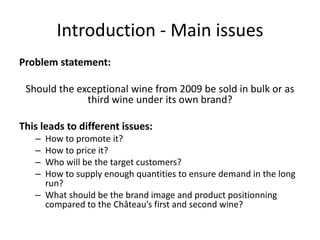
Introduction - Main issues
Problem statement:
Should the exceptional wine from 2009 be sold in bulk or as
third wine under its own brand?
This leads to different issues:
– How to promote it?
– How to price it?
– Who will be the target customers?
– How to supply enough quantities to ensure demand in the long
run?
– What should be the brand image and product positionning
compared to the Château’s first and second wine?
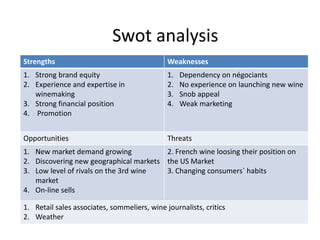
Strengths Weaknesses
1. Strong brand equity
2. Experience and expertise in
winemaking
3. Strong financial position
4. Promotion
1. Dependency on négociants
2. No experience on launching new wine
3. Snob appeal
4. Weak marketing
Opportunities Threats
1. New market demand growing
2. Discovering new geographical markets
3. Low level of rivals on the 3rd wine
market
4. On-line sells
2. French wine loosing their position on
the US Market
3. Changing consumers` habits
1. Retail sales associates, sommeliers, wine journalists, critics
2. Weather
Swot analysis
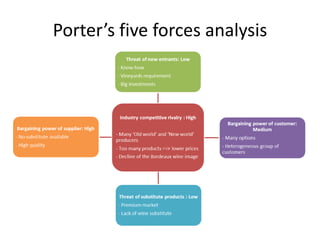
Porter’s five forces analysis
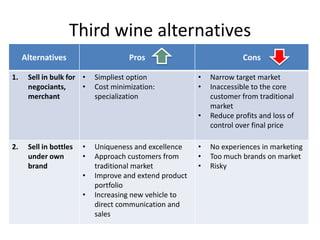
Alternatives Pros Cons
1. Sell in bulk for
negociants,
merchant
• Simpliest option
• Cost minimization:
specialization
• Narrow target market
• Inaccessible to the core
customer from traditional
market
• Reduce profits and loss of
control over final price
2. Sell in bottles
under own
brand
• Uniqueness and excellence
• Approach customers from
traditional market
• Improve and extend product
portfolio
• Increasing new vehicle to
direct communication and
sales
• No experiences in marketing
• Too much brands on market
• Risky
Third wine alternatives
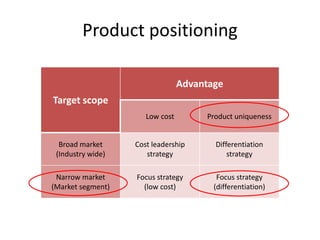
Target scope
Advantage
Low cost Product uniqueness
Broad market
(Industry wide)
Cost leadership
strategy
Differentiation
strategy
Narrow market
(Market segment)
Focus strategy
(low cost)
Focus strategy
(differentiation)
Product positioning
Marketing mix
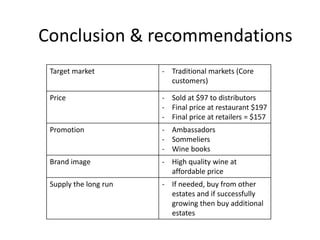
Target market - Traditional markets (Core
customers)
Price - Sold at $97 to distributors
- Final price at restaurant $197
- Final price at retailers = $157
Promotion - Ambassadors
- Sommeliers
- Wine books
Brand image - High quality wine at
affordable price
Supply the long run - If needed, buy from other
estates and if successfully
growing then buy additional
estates
Conclusion & recommendations
Thanks for your attention
Any questions?

Chateau margaux v0.1

  • 2.
    Agenda 1. Introduction –Main issues 2. Swot analysis 3. Porter’s five forces analysis 4. Third wine alternatives – Pros and Cons 5. Product positioning 6. Marketing mix 7. Conclusion and recommendations
  • 3.
    Introduction - Mainissues Problem statement: Should the exceptional wine from 2009 be sold in bulk or as third wine under its own brand? This leads to different issues: – How to promote it? – How to price it? – Who will be the target customers? – How to supply enough quantities to ensure demand in the long run? – What should be the brand image and product positionning compared to the Château’s first and second wine?
  • 4.
    Strengths Weaknesses 1. Strongbrand equity 2. Experience and expertise in winemaking 3. Strong financial position 4. Promotion 1. Dependency on négociants 2. No experience on launching new wine 3. Snob appeal 4. Weak marketing Opportunities Threats 1. New market demand growing 2. Discovering new geographical markets 3. Low level of rivals on the 3rd wine market 4. On-line sells 2. French wine loosing their position on the US Market 3. Changing consumers` habits 1. Retail sales associates, sommeliers, wine journalists, critics 2. Weather Swot analysis
  • 5.
  • 6.
    Alternatives Pros Cons 1.Sell in bulk for negociants, merchant • Simpliest option • Cost minimization: specialization • Narrow target market • Inaccessible to the core customer from traditional market • Reduce profits and loss of control over final price 2. Sell in bottles under own brand • Uniqueness and excellence • Approach customers from traditional market • Improve and extend product portfolio • Increasing new vehicle to direct communication and sales • No experiences in marketing • Too much brands on market • Risky Third wine alternatives
  • 7.
    Target scope Advantage Low costProduct uniqueness Broad market (Industry wide) Cost leadership strategy Differentiation strategy Narrow market (Market segment) Focus strategy (low cost) Focus strategy (differentiation) Product positioning
  • 8.
  • 9.
    Target market -Traditional markets (Core customers) Price - Sold at $97 to distributors - Final price at restaurant $197 - Final price at retailers = $157 Promotion - Ambassadors - Sommeliers - Wine books Brand image - High quality wine at affordable price Supply the long run - If needed, buy from other estates and if successfully growing then buy additional estates Conclusion & recommendations
  • 10.
    Thanks for yourattention Any questions?

Editor's Notes

  • #6 Industrycompetitiverivalry : HighMany ‘Old world’ producers and rising ‘New world’ producers.Excessive quantities of products forcing to lower the overall prices.Decline of the Bordeaux wine image: Sommeliers are tired and claim that the quality was reduced.Bargaining power of supplier: HighNo substitute available. Rely on its own production.Produce high quality wine.Bargaining power of customer: MediumMany possibilities and options of products.Middle switching costs for the costumers.Heterogeneous group of customers, they don’t all want the same wine characteristics.Threat of new entrants: LowPremium market requires specific knowledge and expertise; know-how.You cannot produce everywhere, there’s a need for specific weather and soil conditions.Require big investments to acquire land and production machinery.Threat of substitute products: LowPremium market requires a high quality wine, therefore; they won’t change for lower quality wine nor other alcoholic beverages.Threat of substitute products: LowPremium market requires a high quality wine, therefore; they won’t change for lower quality wine nor other alcoholic beverages.
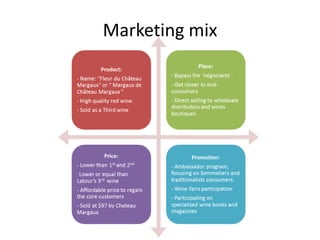
  • #9 Product: Name: “Fleur du Château Margaux” or “ Margaux de Château Margaux ”High quality red wine.Sold as a Third wine which is made after blending the two first wines.Place: Bypass the ‘négociants , better control of final price.Direct selling to wholesale distributors and wines boutiques Price: Lower than 1st and 2nd wine.Lower price than Latour’ third wine but from at least equal quality.Affordable price to regain the core customers in traditional market. Benchmark against Latour’s third wine would be sold at $97 by Chateau MargauxTo restaurant through a two-step distribution = $194 (25% profit margin for large distributor and 60% for restaurant)To end consumers through a three step distribution = $157 (25% profit margin for large distributor and 30% for retailer)Price slightly higher for US market (3% more for the distributor)Promotion:Ambassador program, focusing on known Sommeliers around the world and traditionalists consumers.Wine fairs to introduce the brand to new wine customersParticipating on specialized wine books
  • #10 Start third wind under own brand! + with own marketing strategy Supply the long run: first additional volume would be satisfy by buying from other estates which will keep the costs to a minimum. Then after few years if the demand for the third wine is growing then consider a long term investment to assure highest volume. Keep the strategy: Close to end consumer, which Château Margeaux has right now