Titan: First Views of an Alien World Jonathan I. Lunine The University of Arizona
Titan is… … a natural satellite of Saturn. …  one of a triad of giant moons with bulk densities of 1.8 g/cm 3 , and radii ~ 2500 km (Ganymede, Callisto, and Titan). …  the second-densest atmosphere of the solid bodies of the solar system—nitrogen-methane composition    organic chemistry. Surface P,T=1.5bars, 95K. Methane 2-10% near-surface, 2% in stratosphere. Target of 45+ Cassini flybys and the successful Huygens probe descent
The three great questions: 1. Why does Titan have an atmosphere? 2. How much methane is, and has been, in the surface-atmosphere system over Titan’s history? 3. How far has organic chemistry gone on the surface of Titan?
methane ethane acetylene
methane ethane acetylene nitrogen HCN
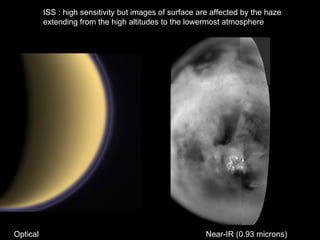
ISS : high sensitivity but images of surface are affected by the haze extending from the high altitudes to the lowermost atmosphere Optical Near-IR (0.93 microns)
Credit: C. J. Lunine Credit: G. Nierenberg Haze scattering limits the information in an image…….
Each strip covers 1% of the surface at a wavelengths of a few cm’s and resolution ½-1 km. In radar images, dark is smooth or oriented away from beam; bright is rough or oriented toward the beam Radar probes the surface unaffected by the haze.
Volcanism These features are tectonic in nature, and/or might be associated with volcanism Data from Ta (October 04) Smallest features ~ 500 meters
Weaker evidence for volcanic flows in T3 data ~ 300 km
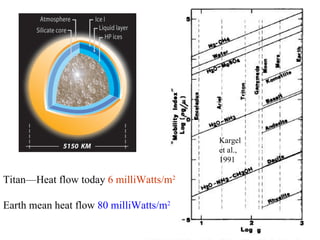
Titan—Heat flow today  6 milliWatts/m 2 Earth mean heat flow  80 milliWatts/m 2 Kargel et al., 1991
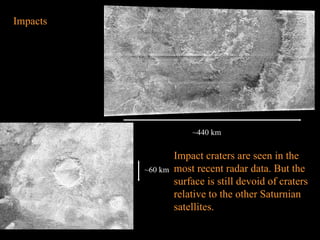
~440 km Impact craters are seen in the most recent radar data. But the surface is still devoid of craters relative to the other Saturnian satellites.   ~60 km Impacts
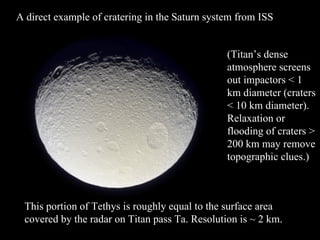
This portion of Tethys is roughly equal to the surface area covered by the radar on Titan pass Ta. Resolution is ~ 2 km. A direct example of cratering in the Saturn system from ISS (Titan’s dense atmosphere screens out impactors < 1 km diameter (craters < 10 km diameter). Relaxation or flooding of craters > 200 km may remove topographic clues.)
The bright plain in upper right of the T3 radar pass might be akin to the Huygens landing site But other areas look like none else—not cryovolcanic, fluvial, nor impact-related:  ~200 km Longest channel ~ 200 km
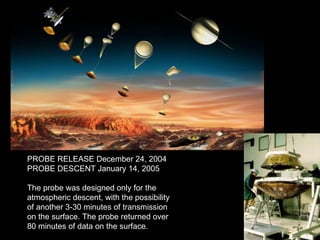
PROBE RELEASE December 24, 2004 PROBE DESCENT January 14, 2005 The probe was designed only for the atmospheric descent, with the possibility of another 3-30 minutes of transmission on the surface. The probe returned over 80 minutes of data on the surface.
Complex, dendritic patterns carved by liquid methane and shaped by topography. Some of the patterns imply rainfall; others could be liquid methane liberated from subsurface.  Descent Imager and Spectral Radiometer  ~10 km
Huygens landed near horseshoe near lower right. Surface has a hard crust below which it is the consistency of wet sand (SSP)  ~10 km
Where are the large liquid deposits of methane and liquid/solid deposits of the products of methane photochemistry? Paucity of small craters hints at burial by substantially thick deposits Huygens saw methane coming from the immediate subsurface… Large parts of the surface appear bright in optical/near-IR, yet show no evidence of specular reflection. Optical depth effect? Liquids exist subsurface in porous crust? (Stevenson) Polymers—polyacetylenes ( ρ  ~ 0.42 g/cm 3 ) floating on liquid? Methane outgassing has been limited and late? Where is ethane?  ~15 cm
Possible history of methane degassing (consistent with isotopes of carbon, nitrogen measured by Cassini-Huygens): Tobie et al.  0 0.5 1.0 2.0 3.0 4.0  Ga Accretion +  heavy bombardment Clathrate dissociation  at the interface icy layer/ocean.  Core overturn +  Formation of an  isolating MH layer  +  Heating of  the ocean Cooling  of  the ocean +  Formation of  Ice I and HP ice layers  Onset of convection Clathrate dissociation  within the conductive lid  Massive hot  NH 3 -CH 4  atmosphere N 2  atmosphere with traces of CH 4 N 2  –CH 4  atmosphere (5-10% of CH 4 ) Escape-photolysis-condensation
The evidence for ammonia as a key player in Titan’s evolution Radar bright areas suggest internal activity and cryo-volcanism, implying both a liquid layer in the interior and an agent to lower the melting point, density and mobility of liquid water. Tidal dissipation models and the observed eccentricity of Titan’s orbit (Tobie et al., 2004) require either that Titan’s interior  always  have been completely solid or have maintained a liquid layer to the present (that is, freezing is  not  allowed). Maintenance of this layer requires ammonia or similar antifreeze. Chemical evidence from two mass spectrometers on Cassini and Huygens: See presentation by Toby Owen.
Craters are being obliterated by resurfacing, by burial, by flooding Viscous relaxation or flooding of >200 km-sized craters if a liquid layer exists below Ice I crust Burial by solid/liquid organics sedimenting out of the atmosphere (the products of methane photolysis) 10 km diameter crater   0.1-1 km depth, could be completely obliterated by hydrocarbon deposits  We have sampled 2% of the surface with radar
Water and ammonia Atmospheric UV-driven chemistry    Amino Acids Impact / volcanic melt of icy crust    HCN  oligomers Purines, Pyrimidines Sugars Hydrocarbons (C-H),  Nitriles (H-C-N)

Charm 050222

  • 1.
    Titan: First Viewsof an Alien World Jonathan I. Lunine The University of Arizona
  • 2.
    Titan is… …a natural satellite of Saturn. … one of a triad of giant moons with bulk densities of 1.8 g/cm 3 , and radii ~ 2500 km (Ganymede, Callisto, and Titan). … the second-densest atmosphere of the solid bodies of the solar system—nitrogen-methane composition  organic chemistry. Surface P,T=1.5bars, 95K. Methane 2-10% near-surface, 2% in stratosphere. Target of 45+ Cassini flybys and the successful Huygens probe descent
  • 3.
    The three greatquestions: 1. Why does Titan have an atmosphere? 2. How much methane is, and has been, in the surface-atmosphere system over Titan’s history? 3. How far has organic chemistry gone on the surface of Titan?
  • 4.
  • 5.
  • 6.
    ISS : highsensitivity but images of surface are affected by the haze extending from the high altitudes to the lowermost atmosphere Optical Near-IR (0.93 microns)
  • 7.
    Credit: C. J.Lunine Credit: G. Nierenberg Haze scattering limits the information in an image…….
  • 8.
    Credit: C. J.Lunine Credit: G. Nierenberg Haze scattering limits the information in an image…….
  • 9.
    Each strip covers1% of the surface at a wavelengths of a few cm’s and resolution ½-1 km. In radar images, dark is smooth or oriented away from beam; bright is rough or oriented toward the beam Radar probes the surface unaffected by the haze.
  • 10.
    Volcanism These featuresare tectonic in nature, and/or might be associated with volcanism Data from Ta (October 04) Smallest features ~ 500 meters
  • 11.
    Weaker evidence forvolcanic flows in T3 data ~ 300 km
  • 12.
    Titan—Heat flow today 6 milliWatts/m 2 Earth mean heat flow 80 milliWatts/m 2 Kargel et al., 1991
  • 13.
    ~440 km Impactcraters are seen in the most recent radar data. But the surface is still devoid of craters relative to the other Saturnian satellites. ~60 km Impacts
  • 14.
    This portion ofTethys is roughly equal to the surface area covered by the radar on Titan pass Ta. Resolution is ~ 2 km. A direct example of cratering in the Saturn system from ISS (Titan’s dense atmosphere screens out impactors < 1 km diameter (craters < 10 km diameter). Relaxation or flooding of craters > 200 km may remove topographic clues.)
  • 15.
    The bright plainin upper right of the T3 radar pass might be akin to the Huygens landing site But other areas look like none else—not cryovolcanic, fluvial, nor impact-related: ~200 km Longest channel ~ 200 km
  • 16.
    PROBE RELEASE December24, 2004 PROBE DESCENT January 14, 2005 The probe was designed only for the atmospheric descent, with the possibility of another 3-30 minutes of transmission on the surface. The probe returned over 80 minutes of data on the surface.
  • 17.
    Complex, dendritic patternscarved by liquid methane and shaped by topography. Some of the patterns imply rainfall; others could be liquid methane liberated from subsurface. Descent Imager and Spectral Radiometer ~10 km
  • 18.
    Huygens landed nearhorseshoe near lower right. Surface has a hard crust below which it is the consistency of wet sand (SSP) ~10 km
  • 19.
    Where are thelarge liquid deposits of methane and liquid/solid deposits of the products of methane photochemistry? Paucity of small craters hints at burial by substantially thick deposits Huygens saw methane coming from the immediate subsurface… Large parts of the surface appear bright in optical/near-IR, yet show no evidence of specular reflection. Optical depth effect? Liquids exist subsurface in porous crust? (Stevenson) Polymers—polyacetylenes ( ρ ~ 0.42 g/cm 3 ) floating on liquid? Methane outgassing has been limited and late? Where is ethane? ~15 cm
  • 20.
    Possible history ofmethane degassing (consistent with isotopes of carbon, nitrogen measured by Cassini-Huygens): Tobie et al. 0 0.5 1.0 2.0 3.0 4.0 Ga Accretion + heavy bombardment Clathrate dissociation at the interface icy layer/ocean. Core overturn + Formation of an isolating MH layer + Heating of the ocean Cooling of the ocean + Formation of Ice I and HP ice layers Onset of convection Clathrate dissociation within the conductive lid Massive hot NH 3 -CH 4 atmosphere N 2 atmosphere with traces of CH 4 N 2 –CH 4 atmosphere (5-10% of CH 4 ) Escape-photolysis-condensation
  • 21.
    The evidence forammonia as a key player in Titan’s evolution Radar bright areas suggest internal activity and cryo-volcanism, implying both a liquid layer in the interior and an agent to lower the melting point, density and mobility of liquid water. Tidal dissipation models and the observed eccentricity of Titan’s orbit (Tobie et al., 2004) require either that Titan’s interior always have been completely solid or have maintained a liquid layer to the present (that is, freezing is not allowed). Maintenance of this layer requires ammonia or similar antifreeze. Chemical evidence from two mass spectrometers on Cassini and Huygens: See presentation by Toby Owen.
  • 22.
    Craters are beingobliterated by resurfacing, by burial, by flooding Viscous relaxation or flooding of >200 km-sized craters if a liquid layer exists below Ice I crust Burial by solid/liquid organics sedimenting out of the atmosphere (the products of methane photolysis) 10 km diameter crater  0.1-1 km depth, could be completely obliterated by hydrocarbon deposits We have sampled 2% of the surface with radar
  • 23.
    Water and ammoniaAtmospheric UV-driven chemistry  Amino Acids Impact / volcanic melt of icy crust  HCN oligomers Purines, Pyrimidines Sugars Hydrocarbons (C-H), Nitriles (H-C-N)