Lizzy, Sarah, Cate, Christian, & Samhita
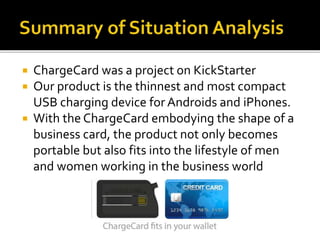
 ChargeCard was a project on KickStarter
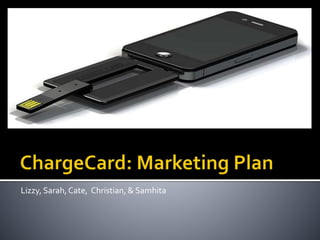
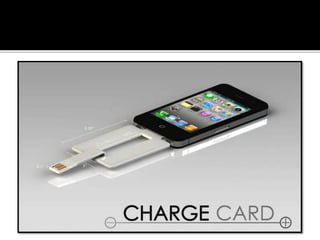
 Our product is the thinnest and most compact
USB charging device for Androids and iPhones.
 With the ChargeCard embodying the shape of a
business card, the product not only becomes
portable but also fits into the lifestyle of men
and women working in the business world
 Researchers predict Smartphones will drive
$20 billion in aftermarket accessory revenues
in 2012.
 ABI predicts Smartphone accessories
revenues will grow to $38 billion by 2017.
 Because of the insights and current trends in
the market, we believe the timing of the
marketing, selling and distributing our
product is ideal
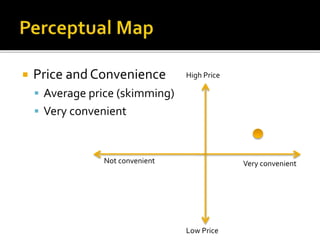
 Price and Convenience
 Average price (skimming)
 Very convenient
Low Price
High Price
Not convenient Very convenient
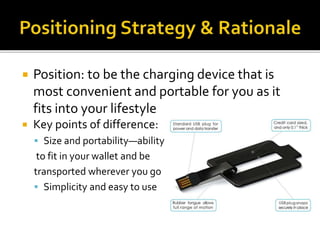
 Position: to be the charging device that is
most convenient and portable for you as it
fits into your lifestyle
 Key points of difference:
 Size and portability—ability
to fit in your wallet and be
transported wherever you go
 Simplicity and easy to use
 Positioning Statement (Marketer’s perspective)
 For the trendy, technological business man or woman on-
the-go, ChargeCard is a sleek and portable charging device
for your iPhone or other mobile phone device that fits into
your lifestyle.
 Positioning Statement (Consumer’s perspective)
 For those of us who are always on-the-go in today’s fast-
paced society, ChargeCard is the perfect solution as a
charging device that is easy to use and portable.
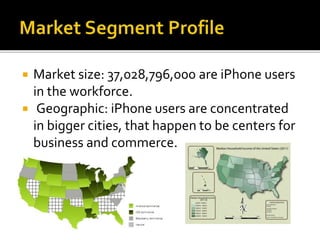
 Market size: 37,028,796,000 are iPhone users
in the workforce.
 Geographic: iPhone users are concentrated
in bigger cities, that happen to be centers for
business and commerce.
 Target Consumer’sValues, Lifestyles, &
Personality: iPhone users want to stay up-to-
date with the latest technological
advancements
 Brands of Choice:Our selected
demographics’ primary source of news isThe
Wall Street Journal.WIRED Magazine is a big
influencer on ChargeCard’s target market,
due to the technological and business theme
topics that are discussed.
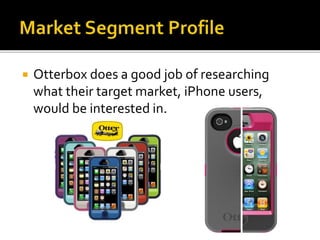
 Otterbox does a good job of researching
what their target market, iPhone users,
would be interested in.
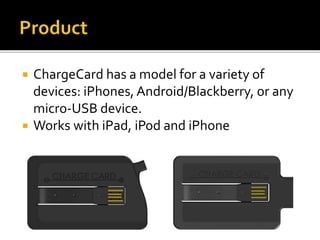
 ChargeCard has a model for a variety of
devices: iPhones, Android/Blackberry, or any
micro-USB device.
 Works with iPad, iPod and iPhone
 We would create a model for the iPhone 5,
which is in increasing demand with people
wanting to upgrade their phones
 Customers continue with the trend to keep up
with the latest trends and versions of products
 We would have to keep up with that and the
customers in making sure they are satisfied
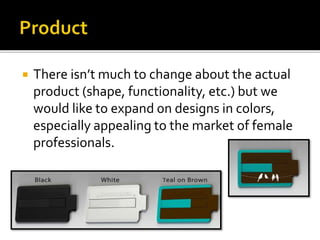
 There isn’t much to change about the actual
product (shape, functionality, etc.) but we
would like to expand on designs in colors,
especially appealing to the market of female
professionals.
 We would like to focus on the packaging of
our product.
 We would like the packaging to be
recognizable, similar to that of Apple
products, such as a “cardboard wallet” or
some sort of packaging that makes the
connection between the consumer’s busy and
“on-the-go” lifestyle and the product’s
functionality and portability
 We have chosen not to rename or rebrand
the ChargeCard
 We believe the name is memorable, easy to
say, and draws a comparison to a credit card
that can easily fit into your wallet, which
automatically hints at the product’s
convenience and portability factors
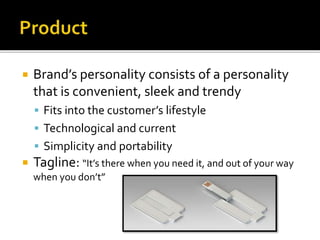
 Brand’s personality consists of a personality
that is convenient, sleek and trendy
 Fits into the customer’s lifestyle
 Technological and current
 Simplicity and portability
 Tagline: “It’s there when you need it, and out of your way
when you don’t”
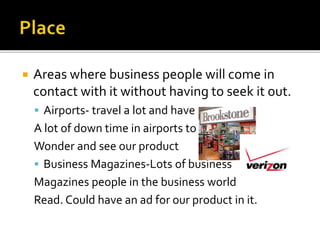
 Areas where business people will come in
contact with it without having to seek it out.
 Airports- travel a lot and have
A lot of down time in airports to
Wonder and see our product
 Business Magazines-Lots of business
Magazines people in the business world
Read. Could have an ad for our product in it.
 Online- On CBS8.com, it was found that 12.91% of all
online Cyber Monday sales were for mobile phones.The
internet is so up-and-coming, and it’s a nice way to hit a
mass audience easily.
 Deals with other companies- Almost like a test market.
Sometimes when a new product is made, it will be
delivered to a company for the employees to use and
create awareness and help figure out the glitches.
 Brookstone/AT&T andVerizon- maybe partnering with
AT&T andVerizon to have them sold in stores as an
alternative charger.We also think the consumers that
would buy the Charge Card may also shop in brookstone.
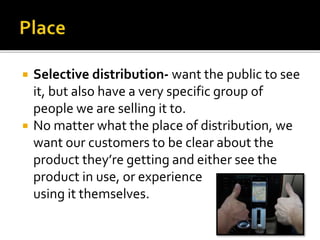
 Selective distribution- want the public to see
it, but also have a very specific group of
people we are selling it to.
 No matter what the place of distribution, we
want our customers to be clear about the
product they’re getting and either see the
product in use, or experience
using it themselves.
 Retail value set by creators at $25
 Our price: $49.99
 Skimming Strategy:
 Enough consumers willing to buy
 Consumers will interpret higher price as higher
quality.
 Higher cost will cover high cost of manufacturing.
 It is better to set price as high and then lower later
than to set as low initially and then raise price.
 Considering the average human is
overwhelmed with “over 2000 outbound
marketing interruptions per day”, people are
figuring multiple ways to block them out.
 “Get found” Strategy
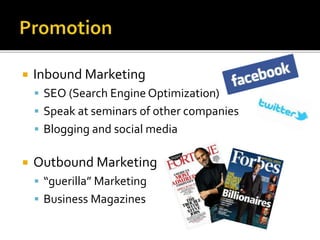
 Inbound Marketing
 SEO (Search Engine Optimization)
 Speak at seminars of other companies
 Blogging and social media
 Outbound Marketing
 “guerilla” Marketing
 Business Magazines
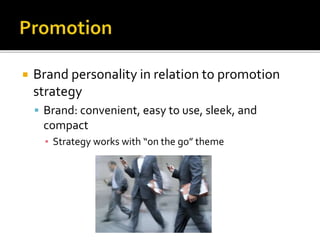
 Brand personality in relation to promotion
strategy
 Brand: convenient, easy to use, sleek, and
compact
▪ Strategy works with “on the go” theme
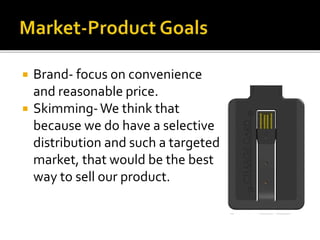
 Brand- focus on convenience
and reasonable price.
 Skimming-We think that
because we do have a selective
distribution and such a targeted
market, that would be the best
way to sell our product.
 Goals- Our quantitative goal is $150,000.
 If we sell a Charge Card at $49.99/card, we think this
goal can be reached.
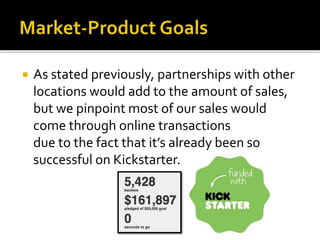
 Because this started as a product on Kickstarter, we
believe there is a lot of potential for online sales.
 So far, the Charge Card has 5, 428 backers, and they
began with a goal of $50,000, but they have already
surpassed that by generating a pledge amount of
$161,897.
http://www.kickstarter.com/projects/nomad/chargecard-for-iphone?ref=live
 As stated previously, partnerships with other
locations would add to the amount of sales,
but we pinpoint most of our sales would
come through online transactions
due to the fact that it’s already been so
successful on Kickstarter.
 Base future profit goals on assessment of test
market
 Factors:
 Number of purchases through distribution channels
 Overall sales/profit
 Consumer responses to marketing efforts
 Lower price if consumers do not purchase
initially
 Re-assess profit goals and set higher if more
consumers respond than expected
ChargeCard Marketing Presentation

ChargeCard Marketing Presentation

  • 1.
    Lizzy, Sarah, Cate,Christian, & Samhita
  • 2.
     ChargeCard wasa project on KickStarter  Our product is the thinnest and most compact USB charging device for Androids and iPhones.  With the ChargeCard embodying the shape of a business card, the product not only becomes portable but also fits into the lifestyle of men and women working in the business world
  • 3.
     Researchers predictSmartphones will drive $20 billion in aftermarket accessory revenues in 2012.  ABI predicts Smartphone accessories revenues will grow to $38 billion by 2017.  Because of the insights and current trends in the market, we believe the timing of the marketing, selling and distributing our product is ideal
  • 4.
     Price andConvenience  Average price (skimming)  Very convenient Low Price High Price Not convenient Very convenient
  • 5.
     Position: tobe the charging device that is most convenient and portable for you as it fits into your lifestyle  Key points of difference:  Size and portability—ability to fit in your wallet and be transported wherever you go  Simplicity and easy to use
  • 6.
     Positioning Statement(Marketer’s perspective)  For the trendy, technological business man or woman on- the-go, ChargeCard is a sleek and portable charging device for your iPhone or other mobile phone device that fits into your lifestyle.  Positioning Statement (Consumer’s perspective)  For those of us who are always on-the-go in today’s fast- paced society, ChargeCard is the perfect solution as a charging device that is easy to use and portable.
  • 7.
     Market size:37,028,796,000 are iPhone users in the workforce.  Geographic: iPhone users are concentrated in bigger cities, that happen to be centers for business and commerce.
  • 8.
     Target Consumer’sValues,Lifestyles, & Personality: iPhone users want to stay up-to- date with the latest technological advancements  Brands of Choice:Our selected demographics’ primary source of news isThe Wall Street Journal.WIRED Magazine is a big influencer on ChargeCard’s target market, due to the technological and business theme topics that are discussed.
  • 9.
     Otterbox doesa good job of researching what their target market, iPhone users, would be interested in.
  • 10.
     ChargeCard hasa model for a variety of devices: iPhones, Android/Blackberry, or any micro-USB device.  Works with iPad, iPod and iPhone
  • 11.
     We wouldcreate a model for the iPhone 5, which is in increasing demand with people wanting to upgrade their phones  Customers continue with the trend to keep up with the latest trends and versions of products  We would have to keep up with that and the customers in making sure they are satisfied
  • 12.
     There isn’tmuch to change about the actual product (shape, functionality, etc.) but we would like to expand on designs in colors, especially appealing to the market of female professionals.
  • 13.
     We wouldlike to focus on the packaging of our product.  We would like the packaging to be recognizable, similar to that of Apple products, such as a “cardboard wallet” or some sort of packaging that makes the connection between the consumer’s busy and “on-the-go” lifestyle and the product’s functionality and portability
  • 14.
     We havechosen not to rename or rebrand the ChargeCard  We believe the name is memorable, easy to say, and draws a comparison to a credit card that can easily fit into your wallet, which automatically hints at the product’s convenience and portability factors
  • 15.
     Brand’s personalityconsists of a personality that is convenient, sleek and trendy  Fits into the customer’s lifestyle  Technological and current  Simplicity and portability  Tagline: “It’s there when you need it, and out of your way when you don’t”
  • 16.
     Areas wherebusiness people will come in contact with it without having to seek it out.  Airports- travel a lot and have A lot of down time in airports to Wonder and see our product  Business Magazines-Lots of business Magazines people in the business world Read. Could have an ad for our product in it.
  • 17.
     Online- OnCBS8.com, it was found that 12.91% of all online Cyber Monday sales were for mobile phones.The internet is so up-and-coming, and it’s a nice way to hit a mass audience easily.  Deals with other companies- Almost like a test market. Sometimes when a new product is made, it will be delivered to a company for the employees to use and create awareness and help figure out the glitches.  Brookstone/AT&T andVerizon- maybe partnering with AT&T andVerizon to have them sold in stores as an alternative charger.We also think the consumers that would buy the Charge Card may also shop in brookstone.
  • 18.
     Selective distribution-want the public to see it, but also have a very specific group of people we are selling it to.  No matter what the place of distribution, we want our customers to be clear about the product they’re getting and either see the product in use, or experience using it themselves.
  • 19.
     Retail valueset by creators at $25  Our price: $49.99  Skimming Strategy:  Enough consumers willing to buy  Consumers will interpret higher price as higher quality.  Higher cost will cover high cost of manufacturing.  It is better to set price as high and then lower later than to set as low initially and then raise price.
  • 20.
     Considering theaverage human is overwhelmed with “over 2000 outbound marketing interruptions per day”, people are figuring multiple ways to block them out.  “Get found” Strategy
  • 21.
     Inbound Marketing SEO (Search Engine Optimization)  Speak at seminars of other companies  Blogging and social media  Outbound Marketing  “guerilla” Marketing  Business Magazines
  • 22.
     Brand personalityin relation to promotion strategy  Brand: convenient, easy to use, sleek, and compact ▪ Strategy works with “on the go” theme
  • 23.
     Brand- focuson convenience and reasonable price.  Skimming-We think that because we do have a selective distribution and such a targeted market, that would be the best way to sell our product.
  • 24.
     Goals- Ourquantitative goal is $150,000.  If we sell a Charge Card at $49.99/card, we think this goal can be reached.  Because this started as a product on Kickstarter, we believe there is a lot of potential for online sales.  So far, the Charge Card has 5, 428 backers, and they began with a goal of $50,000, but they have already surpassed that by generating a pledge amount of $161,897. http://www.kickstarter.com/projects/nomad/chargecard-for-iphone?ref=live
  • 25.
     As statedpreviously, partnerships with other locations would add to the amount of sales, but we pinpoint most of our sales would come through online transactions due to the fact that it’s already been so successful on Kickstarter.
  • 26.
     Base futureprofit goals on assessment of test market  Factors:  Number of purchases through distribution channels  Overall sales/profit  Consumer responses to marketing efforts  Lower price if consumers do not purchase initially  Re-assess profit goals and set higher if more consumers respond than expected