Characterization
Bringing characters to life
Objective:
Students will be able to identify the two types
of characterization used in literature and
understand how they establish character
traits.
Characterization
Definition: the process of conveying
information about characters in fiction
– their character traits.
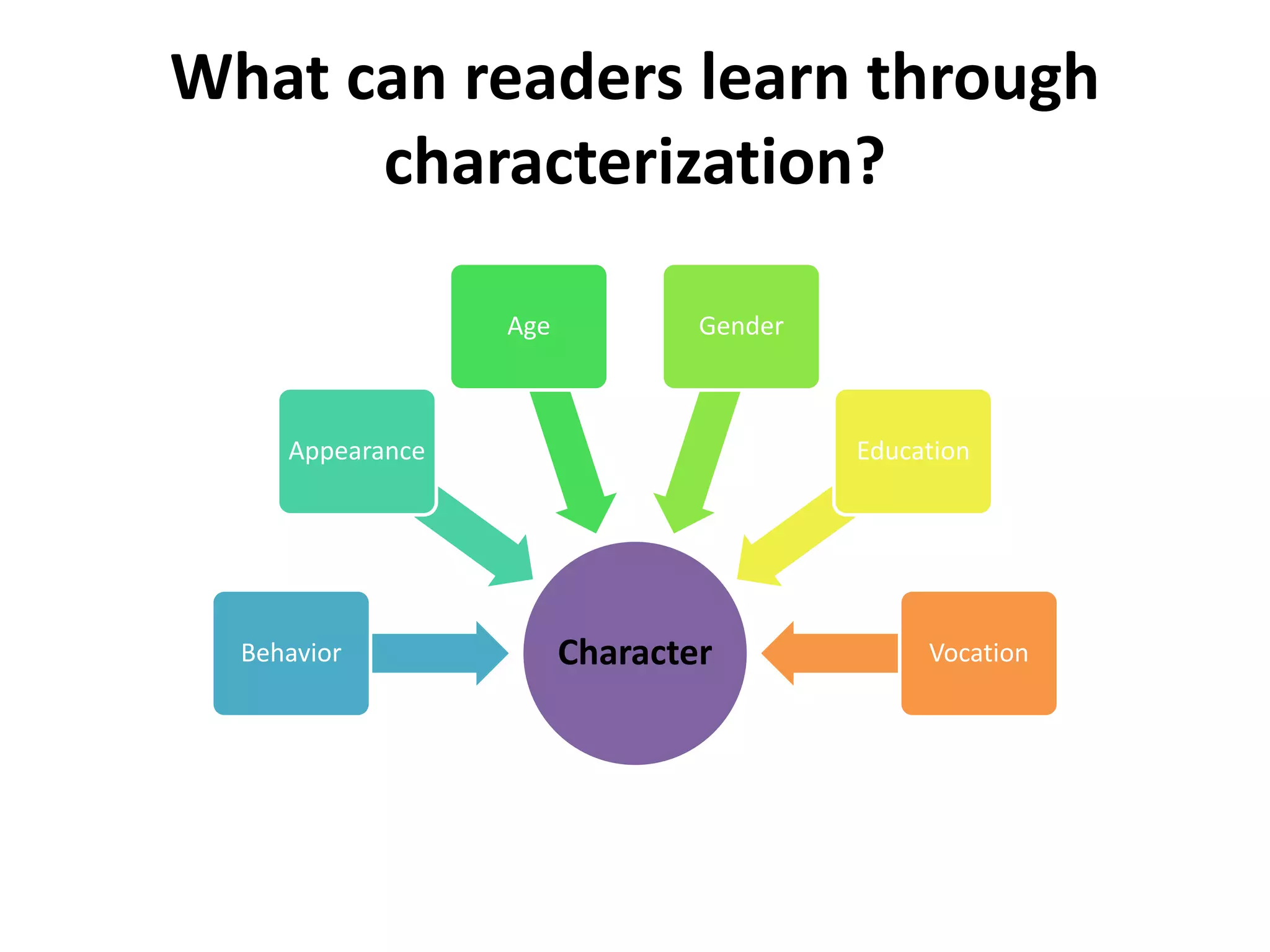
What can readers learn through
characterization?
CharacterBehavior
Appearance
Age Gender
Education
Vocation
How are character traits presented?
Character
Traits
Actions
Other
Characters
ThoughtsDescription
Dialogue
Two Types of Characterization
Direct Characterization
• the writer makes direct
statements about a
character’s personality and
tells what the character is
like.
• Think adjectives.
Indirect Characterization
• the writer reveals information
about a character and his/her
personality through that
character’s thoughts,
words, and actions, along
with how other characters
respond to that character,
including what they think and
say about him/her.
• Think verbs.
Examples of Characterization
Direct Characterization
• Gary is a nice and caring person.
• Gary can sometimes be very
mean or rude.
Indirect Characterization
• Gary watched his little brother for
two hours while their mother was
ill, taking care of his every need.
He did this without being asked
and he did not ask for anything in
return.
• “The next thing I know, Gary was
tearing up my rose garden,” said
Beatrice his elderly grandmother
as she gave her statement to the
police. She was still badly shaken
after the attack.
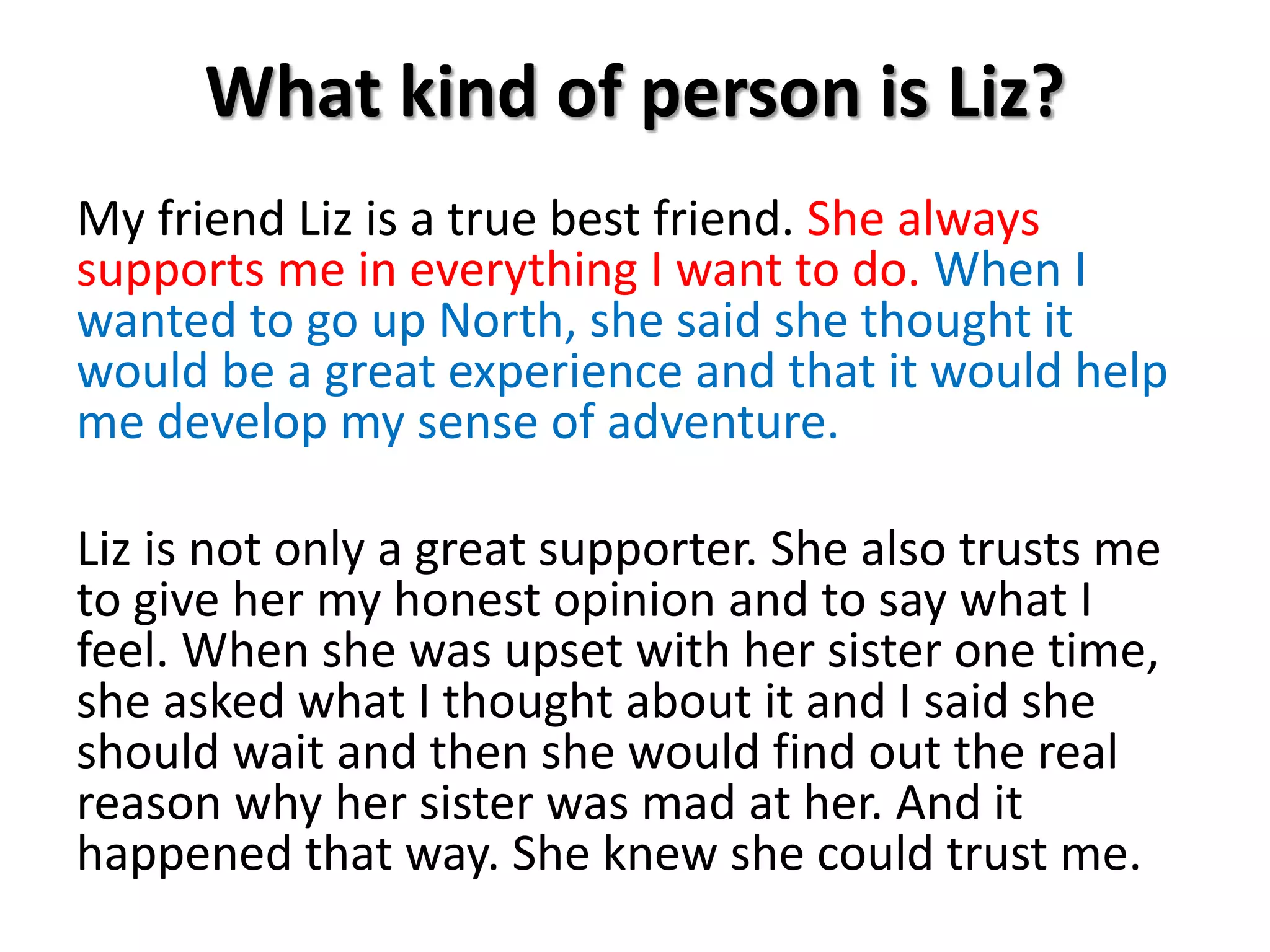
What kind of person is Liz?
My friend Liz is a true best friend. She always
supports me in everything I want to do. When I
wanted to go up North, she said she thought it
would be a great experience and that it would help
me develop my sense of adventure.
Liz is not only a great supporter. She also trusts me
to give her my honest opinion and to say what I
feel. When she was upset with her sister one time,
she asked what I thought about it and I said she
should wait and then she would find out the real
reason why her sister was mad at her. And it
happened that way. She knew she could trust me.
What kind of person is Liz?
My friend Liz is a true best friend. She always
supports me in everything I want to do. When I
wanted to go up North, she said she thought it
would be a great experience and that it would help
me develop my sense of adventure.
Liz is not only a great supporter. She also trusts me
to give her my honest opinion and to say what I
feel. When she was upset with her sister one time,
she asked what I thought about it and I said she
should wait and then she would find out the real
reason why her sister was mad at her. And it
happened that way. She knew she could trust me.
What kind of person is Liz?
My friend Liz is a true best friend. She always
supports me in everything I want to do. When I
wanted to go up North, she said she thought it
would be a great experience and that it would help
me develop my sense of adventure.
Liz is not only a great supporter. She also trusts me
to give her my honest opinion and to say what I
feel. When she was upset with her sister one time,
she asked what I thought about it and I said she
should wait and then she would find out the real
reason why her sister was mad at her. And it
happened that way. She knew she could trust me.
What kind of person is Liz?
My friend Liz is a true best friend. She always
supports me in everything I want to do. When I
wanted to go up North, she said she thought it
would be a great experience and that it would help
me develop my sense of adventure.
Liz is not only a great supporter. She also trusts me
to give her my honest opinion and to say what I
feel. When she was upset with her sister one time,
she asked what I thought about it and I said she
should wait and then she would find out the real
reason why her sister was mad at her. And it
happened that way. She knew she could trust me.
What kind of person is Liz?
My friend Liz is a true best friend. She always
supports me in everything I want to do. When I
wanted to go up North, she said she thought it
would be a great experience and that it would help
me develop my sense of adventure.
Liz is not only a great supporter. She also trusts me
to give her my honest opinion and to say what I
feel. When she was upset with her sister one time,
she asked what I thought about it and I said she
should wait and then she would find out the real
reason why her sister was mad at her. And it
happened that way. She knew she could trust me.
Your Turn!
Be prepared to read a short story by Langston Hughes entitled
“Thank You, Ma’am” in class.
Directions:
1. Using a provided graphic organizer: identify character
traits of the main characters (at least 2).
2. Give examples/quotes from the story to support your
claims.
3. Identify the type of characterization as either direct or
indirect.
4. If it is direct – go back and highlight specifically in the
passage where the author reveals this information.

Characterization

  • 1.
  • 2.
    Objective: Students will beable to identify the two types of characterization used in literature and understand how they establish character traits.
  • 3.
    Characterization Definition: the processof conveying information about characters in fiction – their character traits.
  • 4.
    What can readerslearn through characterization? CharacterBehavior Appearance Age Gender Education Vocation
  • 5.
    How are charactertraits presented? Character Traits Actions Other Characters ThoughtsDescription Dialogue
  • 6.
    Two Types ofCharacterization Direct Characterization • the writer makes direct statements about a character’s personality and tells what the character is like. • Think adjectives. Indirect Characterization • the writer reveals information about a character and his/her personality through that character’s thoughts, words, and actions, along with how other characters respond to that character, including what they think and say about him/her. • Think verbs.
  • 7.
    Examples of Characterization DirectCharacterization • Gary is a nice and caring person. • Gary can sometimes be very mean or rude. Indirect Characterization • Gary watched his little brother for two hours while their mother was ill, taking care of his every need. He did this without being asked and he did not ask for anything in return. • “The next thing I know, Gary was tearing up my rose garden,” said Beatrice his elderly grandmother as she gave her statement to the police. She was still badly shaken after the attack.
  • 8.
    What kind ofperson is Liz? My friend Liz is a true best friend. She always supports me in everything I want to do. When I wanted to go up North, she said she thought it would be a great experience and that it would help me develop my sense of adventure. Liz is not only a great supporter. She also trusts me to give her my honest opinion and to say what I feel. When she was upset with her sister one time, she asked what I thought about it and I said she should wait and then she would find out the real reason why her sister was mad at her. And it happened that way. She knew she could trust me.
  • 9.
    What kind ofperson is Liz? My friend Liz is a true best friend. She always supports me in everything I want to do. When I wanted to go up North, she said she thought it would be a great experience and that it would help me develop my sense of adventure. Liz is not only a great supporter. She also trusts me to give her my honest opinion and to say what I feel. When she was upset with her sister one time, she asked what I thought about it and I said she should wait and then she would find out the real reason why her sister was mad at her. And it happened that way. She knew she could trust me.
  • 10.
    What kind ofperson is Liz? My friend Liz is a true best friend. She always supports me in everything I want to do. When I wanted to go up North, she said she thought it would be a great experience and that it would help me develop my sense of adventure. Liz is not only a great supporter. She also trusts me to give her my honest opinion and to say what I feel. When she was upset with her sister one time, she asked what I thought about it and I said she should wait and then she would find out the real reason why her sister was mad at her. And it happened that way. She knew she could trust me.
  • 11.
    What kind ofperson is Liz? My friend Liz is a true best friend. She always supports me in everything I want to do. When I wanted to go up North, she said she thought it would be a great experience and that it would help me develop my sense of adventure. Liz is not only a great supporter. She also trusts me to give her my honest opinion and to say what I feel. When she was upset with her sister one time, she asked what I thought about it and I said she should wait and then she would find out the real reason why her sister was mad at her. And it happened that way. She knew she could trust me.
  • 12.
    What kind ofperson is Liz? My friend Liz is a true best friend. She always supports me in everything I want to do. When I wanted to go up North, she said she thought it would be a great experience and that it would help me develop my sense of adventure. Liz is not only a great supporter. She also trusts me to give her my honest opinion and to say what I feel. When she was upset with her sister one time, she asked what I thought about it and I said she should wait and then she would find out the real reason why her sister was mad at her. And it happened that way. She knew she could trust me.
  • 13.
    Your Turn! Be preparedto read a short story by Langston Hughes entitled “Thank You, Ma’am” in class. Directions: 1. Using a provided graphic organizer: identify character traits of the main characters (at least 2). 2. Give examples/quotes from the story to support your claims. 3. Identify the type of characterization as either direct or indirect. 4. If it is direct – go back and highlight specifically in the passage where the author reveals this information.