Recommended
PPT
PPTX
GENERAL CHEMISTRY OF CHEMICAL REACTION 1
PDF
General Chemistry chapter 4 presentation.pdf
PPTX
Chemical reactions and equations Class 10
PPTX
Chem9 chapt 4 chemical_reactions_stoichiometry
PPTX
introduction to puckers.pptx
PPT
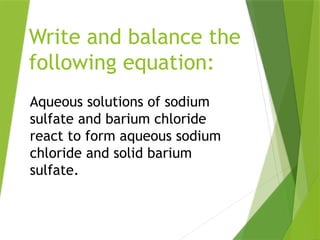
Chemistry Chapter 11 "Chemical Reactions"
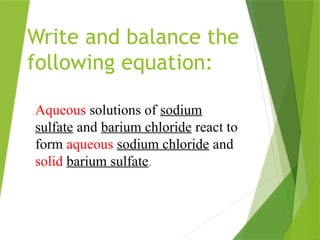
PPT
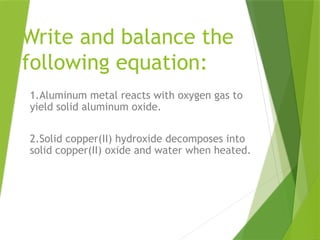
PP Chemical Reactions.pptuujjjjjjjjjjjjjjjjjjjjj
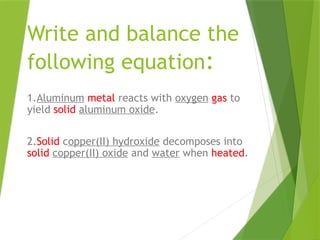
PPT
Chemistry - Chp 11 - Chemical Reactions - PowerPoint
PPT
PPTX
Chemical equations & reactions
PPT
PPT
Chapter 4 chemical reactions
PPT
Student ch 7 chemical reactions
PPTX
PPTX
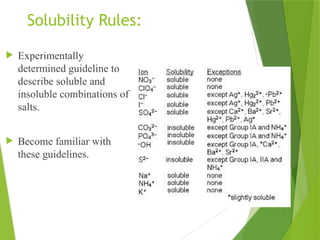
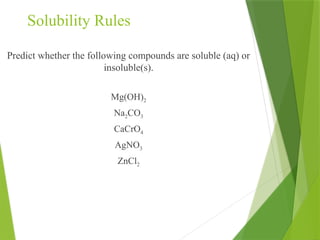
Week 2 chemistry (Net ionic Equations) chemistry
PPT
PDF
Chapt 4 chemical reactions stoichiometry
DOC
Chemistry - Chp 11 - Chemical Reactions - Notes
PPTX
chemical equations and chemical reactions
PPT
Introduction_to_Chemical_Reactions_2011-2012.ppt
PPT
PPT
Ch 8 balancing chemical reactions
PPT
Introduction to Chemical Reaction and types
PPT
PPT
Introduction_to_Chemical_Reactions_2011-2012.ppt
PPT
Introduction_to_Chemical_Reactions_2011-2012.ppt
PPT
Introduction_to_Chemical_Reactions_2011-2012 (1).ppt
PPT
CHEM12_C11_L3_LO (1).ppt.....................
PPT
chapter_12_stoichiometry_-_powerpoint.ppt
More Related Content
PPT
PPTX
GENERAL CHEMISTRY OF CHEMICAL REACTION 1
PDF
General Chemistry chapter 4 presentation.pdf
PPTX
Chemical reactions and equations Class 10
PPTX
Chem9 chapt 4 chemical_reactions_stoichiometry
PPTX
introduction to puckers.pptx
PPT
Chemistry Chapter 11 "Chemical Reactions"
PPT
PP Chemical Reactions.pptuujjjjjjjjjjjjjjjjjjjjj
Similar to Chapter3-power-points-Kotz1.pptx.........
PPT
Chemistry - Chp 11 - Chemical Reactions - PowerPoint
PPT
PPTX
Chemical equations & reactions
PPT
PPT
Chapter 4 chemical reactions
PPT
Student ch 7 chemical reactions
PPTX
PPTX
Week 2 chemistry (Net ionic Equations) chemistry
PPT
PDF
Chapt 4 chemical reactions stoichiometry
DOC
Chemistry - Chp 11 - Chemical Reactions - Notes
PPTX
chemical equations and chemical reactions
PPT
Introduction_to_Chemical_Reactions_2011-2012.ppt
PPT
PPT
Ch 8 balancing chemical reactions
PPT
Introduction to Chemical Reaction and types
PPT
PPT
Introduction_to_Chemical_Reactions_2011-2012.ppt
PPT
Introduction_to_Chemical_Reactions_2011-2012.ppt
PPT
Introduction_to_Chemical_Reactions_2011-2012 (1).ppt
More from KevWatts
PPT
CHEM12_C11_L3_LO (1).ppt.....................
PPT
chapter_12_stoichiometry_-_powerpoint.ppt
PPTX
Atomic Structure Lesson Part 3.pptx.....
PPT
beerlambert-140929110335-phpapp02.ppt....
PPTX
Copy of Periodic Trends PowerPoint.pptx.
PPTX
Unit 3 lecture notes.pptx......................
PPTX
U6L6.pptx...............................
PPTX
U6L5.pptx.................................
PPT
gas_laws_part_1.ppt........................
PPTX
solutions.pptx............................
PPT
9221397.ppt..............................
PPT
Honors Chemistry ch 5.ppt/////////////////////
PPT
Honors Chemistry ch 5.ppt............................
PPTX
Section A3 - Bonding.pptx...................
PPT
iGCSE Chemistry Section 1 Lesson 1.ppt..
PPTX
U5L1P2.pptx......................................
PPTX
U5L1P1.pptx........................................
PPTX
Zumdahl10e_PPT_Ch10.pptx.........................
PPTX
Zumdahl10e_PPT_Ch11.pptx................
PPT
C8_U4_L4_TransitionMetalNomenclature.ppt
Recently uploaded
PDF
TỔNG HỢP 156 ĐỀ CHÍNH THỨC KỲ THI CHỌN HỌC SINH GIỎI TIẾNG ANH LỚP 12 CÁC TỈN...
PPTX
How to Manage Closest Location in Odoo 18 Inventory
PPTX
Modeling Simple Equation using Bar Model.pptx
PPTX
ENGLISH-7-Quarter-4-Week-3 Matatag .pptx
PDF
Bones by Sadu Kassam (play) story ppt pdf
PPTX
GRADE 8 - QUARTER 4 TYPES AND PARTS OF LETTER.pptx
PPTX
How to Easily Track Appraisal Analysis Report in Odoo 18 Appraisal
PPTX
How to Track Employee Skill Growth with Skills Evolution Report in Odoo 18
PDF
AI Is a Tool, Not a Voice: Radio, Trust, and the Human Factor
PDF
operation with integers and finding common ground worksheet solutions/7th cla...
PPTX
Chapter 1: Introduction to Economics - Macroeconomics and Microeconomics.pptx
PPTX
Guidelines for reporting social networks and personal networks data
PPTX
WEEK 2 (2).pptx TLE COOKERY 10 QUARTER 4
PDF
Artificial Intelligence in Research and Academic Writing, Workshop on Researc...
PDF
RAJAT ARORA SIR PHYSICAL EDUCATION NOTES ALL CHAPTERS .pdf
PPTX
MEMORY &FORGETTING. Shilpa Hotakar.Psychology pptx
PDF
Using T-Test to Analyze Research Data.pdf
PPTX
ECP Demo ppt.pptx Visualizing and Identifying solid figures using concrete an...
PPTX
Chapter 1 - Introduction to Business Research.pptx
PDF
Chapter 05 Drugs Acting on the Central Nervous System: Anticonvulsant (Antiep...
Chapter3-power-points-Kotz1.pptx......... 1. 2. Evidence of a chemical reaction:
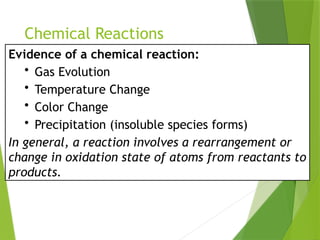
• Gas Evolution
• Temperature Change
• Color Change
• Precipitation (insoluble species forms)
In general, a reaction involves a rearrangement or
change in oxidation state of atoms from reactants to
products.
Chemical Reactions
3. Chemical Equations
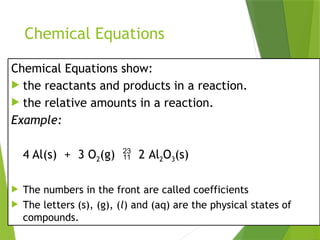
Chemical Equations show:
the reactants and products in a reaction.
the relative amounts in a reaction.
Example:
4 Al(s) + 3 O2(g) 2 Al2O3(s)
The numbers in the front are called coefficients
The letters (s), (g), (l) and (aq) are the physical states of
compounds.
4. Chemical Equations
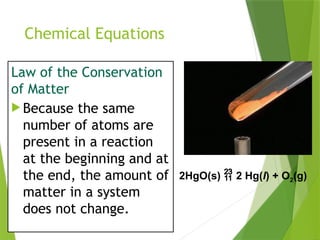
Law of the Conservation
of Matter
Because the same
number of atoms are
present in a reaction
at the beginning and at
the end, the amount of
matter in a system
does not change.
2HgO(s) 2 Hg(l) + O2(g)
5. Chemical Equations
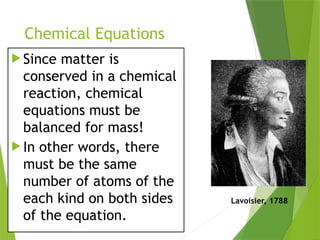
Since matter is
conserved in a chemical
reaction, chemical
equations must be
balanced for mass!
In other words, there
must be the same
number of atoms of the
each kind on both sides
of the equation.
Lavoisier, 1788
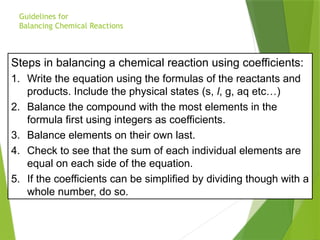
6. Steps in balancing a chemical reaction using coefficients:
1. Write the equation using the formulas of the reactants and
products. Include the physical states (s, l, g, aq etc…)
2. Balance the compound with the most elements in the
formula first using integers as coefficients.
3. Balance elements on their own last.
4. Check to see that the sum of each individual elements are
equal on each side of the equation.
5. If the coefficients can be simplified by dividing though with a
whole number, do so.
Guidelines for
Balancing Chemical Reactions
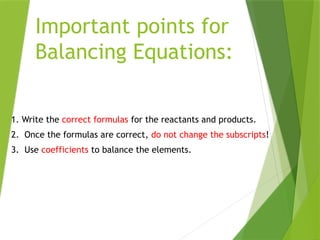
7. Important points for
Balancing Equations:
1. Write the correct formulas for the reactants and products.
2. Once the formulas are correct, do not change the subscripts!
3. Use coefficients to balance the elements.
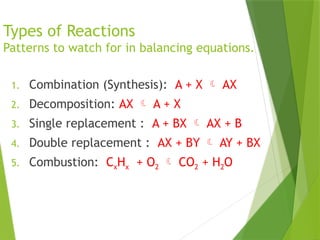
8. Types of Reactions
Patterns to watch for in balancing equations.
1. Combination (Synthesis): A + X AX
2. Decomposition: AX A + X
3. Single replacement : A + BX AX + B
4. Double replacement : AX + BY AY + BX
5. Combustion: CxHx + O2 CO2 + H2O
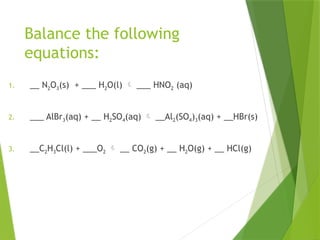
9. 10. Balance the following
equations:
1. __ N2O3(s) + ___ H2O(l) ___ HNO2 (aq)
2. ___ AlBr3(aq) + __ H2SO4(aq) __Al2(SO4)3(aq) + __HBr(s)
3. __C2H3Cl(l) + ___O2 __ CO2(g) + __ H2O(g) + __ HCl(g)
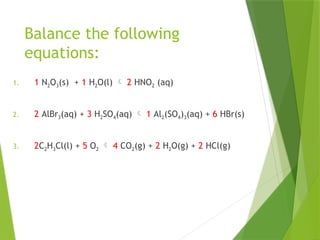
11. Balance the following
equations:
1. 1 N2O3(s) + 1 H2O(l) 2 HNO2 (aq)
2. 2 AlBr3(aq) + 3 H2SO4(aq) 1 Al2(SO4)3(aq) + 6 HBr(s)
3. 2C2H3Cl(l) + 5 O2 4 CO2(g) + 2 H2O(g) + 2 HCl(g)
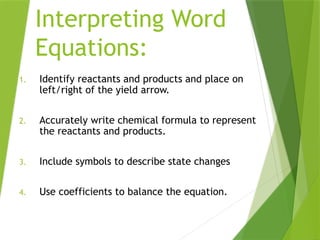
12. Interpreting Word
Equations:
1. Identify reactants and products and place on
left/right of the yield arrow.
2. Accurately write chemical formula to represent
the reactants and products.
3. Include symbols to describe state changes
4. Use coefficients to balance the equation.
13. Write and balance the
following equation:
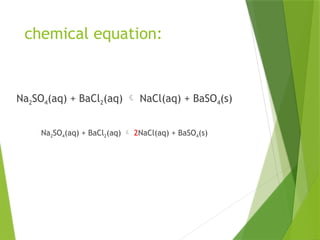
Aqueous solutions of sodium
sulfate and barium chloride
react to form aqueous sodium
chloride and solid barium
sulfate.
14. Write and balance the
following equation:
Aqueous solutions of sodium
sulfate and barium chloride react to
form aqueous sodium chloride and
solid barium sulfate.
15. Write and balance the
following equation:
1.Aluminum metal reacts with oxygen gas to
yield solid aluminum oxide.
2.Solid copper(II) hydroxide decomposes into
solid copper(II) oxide and water when heated.
16. Write and balance the
following equation:
1.Aluminum metal reacts with oxygen gas to
yield solid aluminum oxide.
2.Solid copper(II) hydroxide decomposes into
solid copper(II) oxide and water when heated.
17. A System at Equilibrium
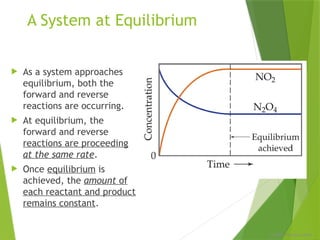
As a system approaches
equilibrium, both the
forward and reverse
reactions are occurring.
At equilibrium, the
forward and reverse
reactions are proceeding
at the same rate.
Once equilibrium is
achieved, the amount of
each reactant and product
remains constant.
© 2009, Prentice-Hall,
18. Reactions and Equilibrium
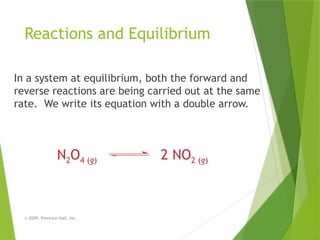
In a system at equilibrium, both the forward and
reverse reactions are being carried out at the same
rate. We write its equation with a double arrow.
© 2009, Prentice-Hall, Inc.
N2O4 (g) 2 NO2 (g)
19. © 2009, Prentice-Hall, Inc.
Solutions
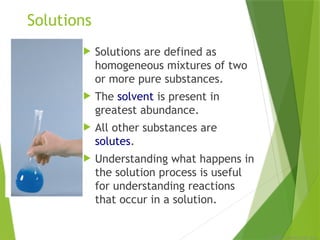
Solutions are defined as
homogeneous mixtures of two
or more pure substances.
The solvent is present in
greatest abundance.
All other substances are
solutes.
Understanding what happens in
the solution process is useful
for understanding reactions
that occur in a solution.
20. © 2009, Prentice-Hall, Inc.
Solution process: Dissociation
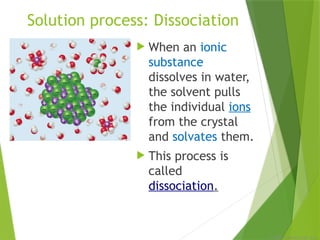
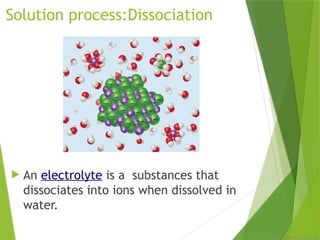
When an ionic
substance
dissolves in water,
the solvent pulls
the individual ions
from the crystal
and solvates them.
This process is
called
dissociation.
21. © 2009, Prentice-Hall, Inc.
Solution process:Dissociation
An electrolyte is a substances that
dissociates into ions when dissolved in
water.
22. © 2009, Prentice-Hall, Inc.
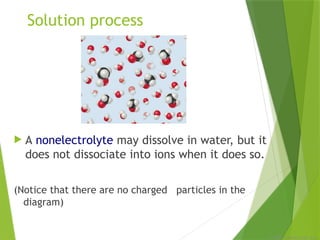
Solution process
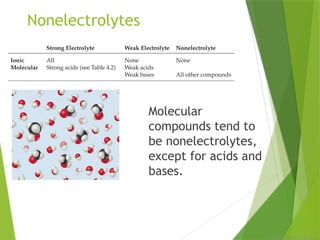
A nonelectrolyte may dissolve in water, but it
does not dissociate into ions when it does so.
(Notice that there are no charged particles in the
diagram)
23. © 2009, Prentice-Hall, Inc.
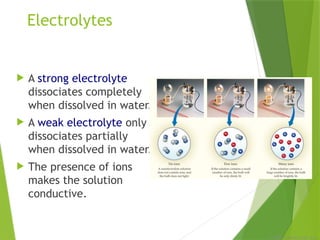
Electrolytes
A strong electrolyte
dissociates completely
when dissolved in water.
A weak electrolyte only
dissociates partially
when dissolved in water.
The presence of ions
makes the solution
conductive.
24. 25. © 2009, Prentice-Hall, Inc.
Nonelectrolytes
Molecular
compounds tend to
be nonelectrolytes,
except for acids and
bases.
26. Reactions that occur in
Aqueous Solution:
• Precipitation reactions
• Gas-forming reactions
• Acid / base reactions
• Some redox reactions
27. © 2009, Prentice-Hall, Inc.
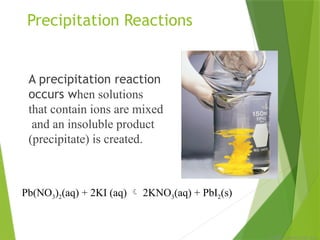
Precipitation Reactions
A precipitation reaction
occurs when solutions
that contain ions are mixed
and an insoluble product
(precipitate) is created.
Pb(NO3)2(aq) + 2KI (aq) 2KNO3(aq) + PbI2(s)
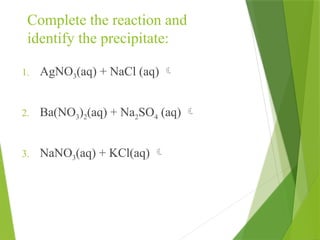
28. 29. 30. Complete the reaction and
identify the precipitate:
1. AgNO3(aq) + NaCl (aq)
2. Ba(NO3)2(aq) + Na2SO4 (aq)
3. NaNO3(aq) + KCl(aq)
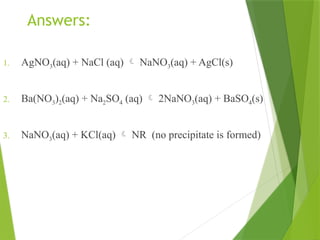
31. Answers:
1. AgNO3(aq) + NaCl (aq) NaNO3(aq) + AgCl(s)
2. Ba(NO3)2(aq) + Na2SO4 (aq) 2NaNO3(aq) + BaSO4(s)
3. NaNO3(aq) + KCl(aq) NR (no precipitate is formed)
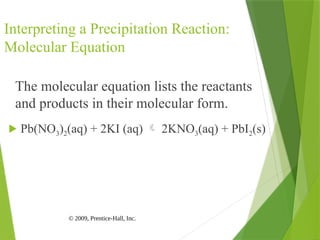
32. © 2009, Prentice-Hall, Inc.
Interpreting a Precipitation Reaction:
Molecular Equation
The molecular equation lists the reactants
and products in their molecular form.
Pb(NO3)2(aq) + 2KI (aq) 2KNO3(aq) + PbI2(s)
33. © 2009, Prentice-Hall, Inc.
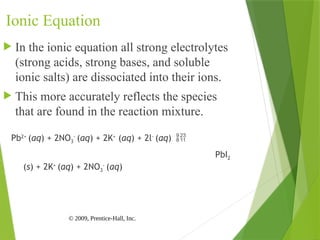
Ionic Equation
In the ionic equation all strong electrolytes
(strong acids, strong bases, and soluble
ionic salts) are dissociated into their ions.
This more accurately reflects the species
that are found in the reaction mixture.
Pb2+
(aq) + 2NO3
-
(aq) + 2K+
(aq) + 2l-
(aq)
PbI2
(s) + 2K+
(aq) + 2NO3
-
(aq)
34. © 2009, Prentice-Hall, Inc.
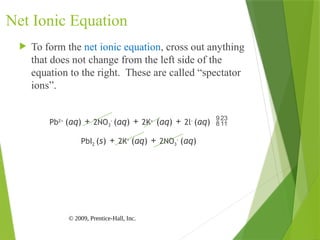
Net Ionic Equation
To form the net ionic equation, cross out anything
that does not change from the left side of the
equation to the right. These are called “spectator
ions”.
Pb2+
(aq) + 2NO3
-
(aq) + 2K+
(aq) + 2l-
(aq)
PbI2 (s) + 2K+
(aq) + 2NO3
-
(aq)
35. © 2009, Prentice-Hall, Inc.
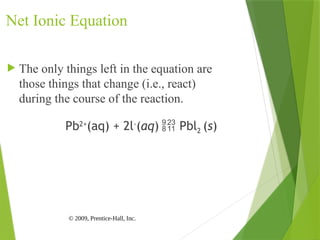
Net Ionic Equation
The only things left in the equation are
those things that change (i.e., react)
during the course of the reaction.
Pb2+
(aq) + 2l-
(aq) Pbl2 (s)
36. © 2009, Prentice-Hall, Inc.
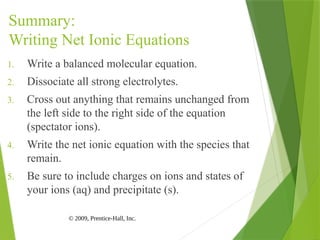
Summary:
Writing Net Ionic Equations
1. Write a balanced molecular equation.
2. Dissociate all strong electrolytes.
3. Cross out anything that remains unchanged from
the left side to the right side of the equation
(spectator ions).
4. Write the net ionic equation with the species that
remain.
5. Be sure to include charges on ions and states of
your ions (aq) and precipitate (s).
37. © 2009, Prentice-Hall, Inc.
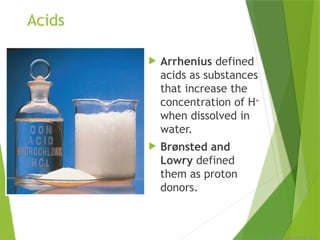
Acids
Arrhenius defined
acids as substances
that increase the
concentration of H+
when dissolved in
water.
Brønsted and
Lowry defined
them as proton
donors.
38. © 2009, Prentice-Hall, Inc.
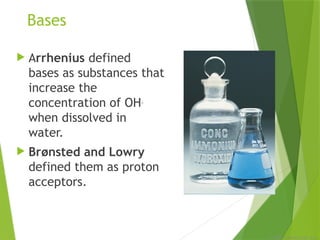
Bases
Arrhenius defined
bases as substances that
increase the
concentration of OH−
when dissolved in
water.
Brønsted and Lowry
defined them as proton
acceptors.
39. © 2009, Prentice-Hall, Inc.
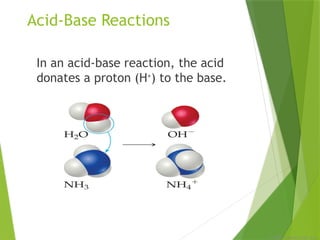
Acid-Base Reactions
In an acid-base reaction, the acid
donates a proton (H+
) to the base.
40. © 2009, Prentice-Hall, Inc.
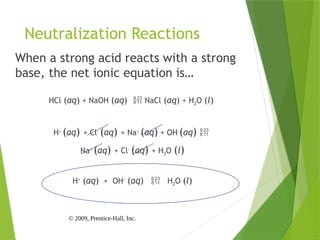
Neutralization Reactions
When a strong acid reacts with a strong
base, the net ionic equation is…
HCl (aq) + NaOH (aq) NaCl (aq) + H2O (l)
H+
(aq) + Cl-
(aq) + Na+
(aq) + OH-
(aq)
Na+
(aq) + Cl-
(aq) + H2O (l)
H+
(aq) + OH-
(aq) H2O (l)
41. Neutralization Reactions:
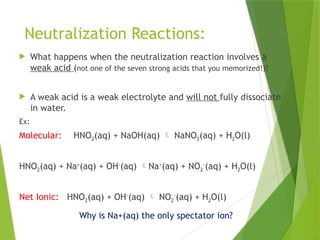
What happens when the neutralization reaction involves a
weak acid (not one of the seven strong acids that you memorized!)?
A weak acid is a weak electrolyte and will not fully dissociate
in water.
Ex:
Molecular: HNO2(aq) + NaOH(aq) NaNO2(aq) + H2O(l)
HNO2(aq) + Na+
(aq) + OH-
(aq) Na+
(aq) + NO2
-
(aq) + H2O(l)
Net Ionic: HNO2(aq) + OH-
(aq) NO2
-
(aq) + H2O(l)
Why is Na+(aq) the only spectator ion?
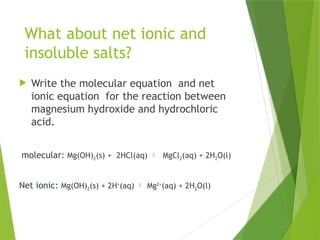
42. What about net ionic and
insoluble salts?
Write the molecular equation and net
ionic equation for the reaction between
magnesium hydroxide and hydrochloric
acid.
molecular: Mg(OH)2(s) + 2HCl(aq) MgCl2(aq) + 2H2O(l)
Net ionic: Mg(OH)2(s) + 2H+
(aq) Mg2+
(aq) + 2H2O(l)
43. © 2009, Prentice-Hall, Inc.
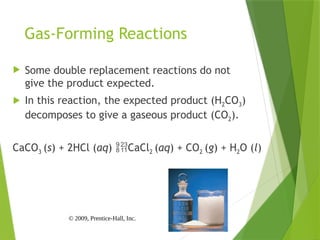
Gas-Forming Reactions
Some double replacement reactions do not
give the product expected.
In this reaction, the expected product (H2CO3)
decomposes to give a gaseous product (CO2).
CaCO3 (s) + 2HCl (aq) CaCl2 (aq) + CO2 (g) + H2O (l)
44. © 2009, Prentice-Hall, Inc.
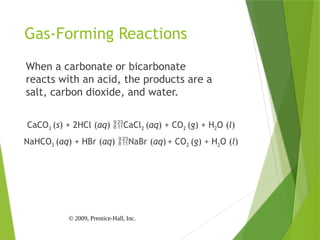
Gas-Forming Reactions
When a carbonate or bicarbonate
reacts with an acid, the products are a
salt, carbon dioxide, and water.
CaCO3 (s) + 2HCl (aq) CaCl2 (aq) + CO2 (g) + H2O (l)
NaHCO3 (aq) + HBr (aq) NaBr (aq) + CO2 (g) + H2O (l)
45. © 2009, Prentice-Hall, Inc.
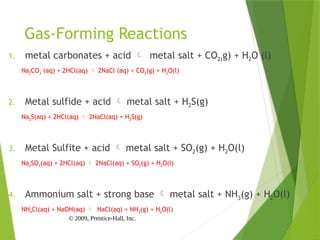
Gas-Forming Reactions
1. metal carbonates + acid metal salt + CO2(g) + H2O (l)
Na2CO3 (aq) + 2HCl(aq) 2NaCl (aq) + CO2(g) + H2O(l)
2. Metal sulfide + acid metal salt + H2S(g)
Na2S(aq) + 2HCl(aq) 2NaCl(aq) + H2S(g)
3. Metal Sulfite + acid metal salt + SO2(g) + H2O(l)
Na2SO3(aq) + 2HCl(aq) 2NaCl(aq) + SO2(g) + H2O(l)
4. Ammonium salt + strong base metal salt + NH3(g) + H2O(l)
NH4Cl(aq) + NaOH(aq) NaCl(aq) + NH3(g) + H2O(l)
46. © 2009, Prentice-Hall, Inc.
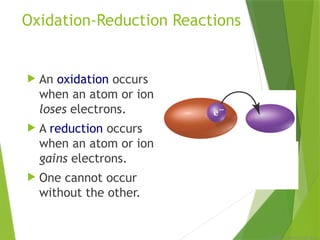
Oxidation-Reduction Reactions
An oxidation occurs
when an atom or ion
loses electrons.
A reduction occurs
when an atom or ion
gains electrons.
One cannot occur
without the other.
47. © 2009, Prentice-Hall, Inc.
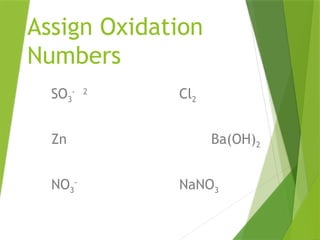
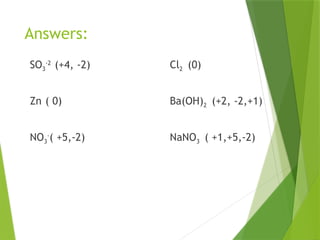
Oxidation Numbers
To determine if an oxidation-reduction reaction has
occurred, we assign an oxidation number to each
element in a neutral compound or charged ion.
Oxidation numbers reflect the association
(distribution) of electrons in a compound or
molecule.
Guidelines have been established to help assign
oxidation number
48. © 2009, Prentice-Hall, Inc.
Guidelines for Assigning
Oxidation Numbers
1. Elements in their elemental form have an oxidation
number of 0 .
2. The oxidation number of a monatomic ion is the
same as its charge .
3. Oxygen is assigned an oxidation state of -2 in its
covalent compounds (ex. CO2). An exception to this
rule occurs with peroxides(O2
2-
).
4. Hydrogen is assigned +1 when found in covalent
compounds with nonmetals. When forming metal
hydrides, it is assigned -1.
5. Fluorine is always assigned an oxidation state of -1.
49. © 2009, Prentice-Hall, Inc.
Oxidation Numbers cont.
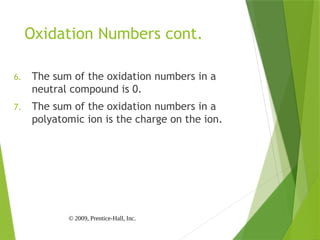
6. The sum of the oxidation numbers in a
neutral compound is 0.
7. The sum of the oxidation numbers in a
polyatomic ion is the charge on the ion.
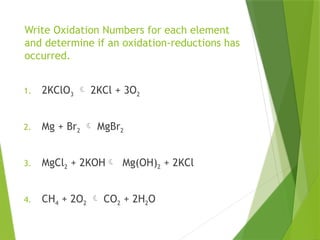
50. 51. 52. Write Oxidation Numbers for each element
and determine if an oxidation-reductions has
occurred.
1. 2KClO3 2KCl + 3O2
2. Mg + Br2 MgBr2
3. MgCl2 + 2KOH Mg(OH)2 + 2KCl
4. CH4 + 2O2 CO2 + 2H2O
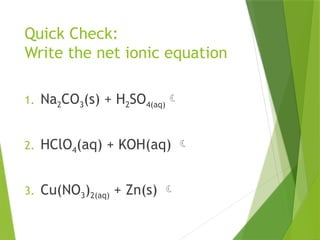
53. Quick Check:
Write the net ionic equation
1. Na2CO3(s) + H2SO4(aq)
2. HClO4(aq) + KOH(aq)
3. Cu(NO3)2(aq) + Zn(s)
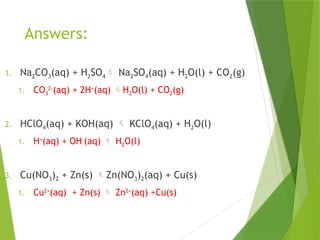
54. Answers:
1. Na2CO3(aq) + H2SO4 Na2SO4(aq) + H2O(l) + CO2(g)
1. CO3
2-
(aq) + 2H+
(aq) H2O(l) + CO2(g)
2. HClO4(aq) + KOH(aq) KClO4(aq) + H2O(l)
1. H+
(aq) + OH-
(aq) H2O(l)
3. Cu(NO3)2 + Zn(s) Zn(NO3)2(aq) + Cu(s)
1. Cu2+
(aq) + Zn(s) Zn2+
(aq) +Cu(s)
55. © 2009, Prentice-Hall, Inc.
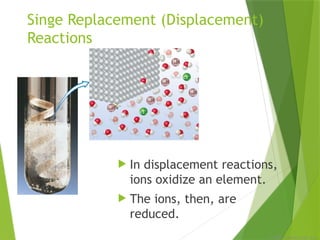
Singe Replacement (Displacement)
Reactions
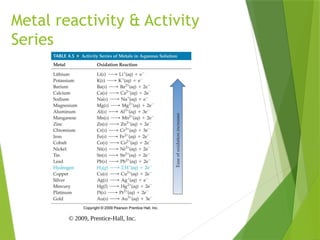
In displacement reactions,
ions oxidize an element.
The ions, then, are
reduced.
56. © 2009, Prentice-Hall, Inc.
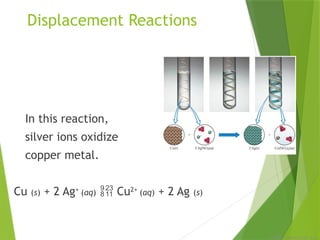
Displacement Reactions
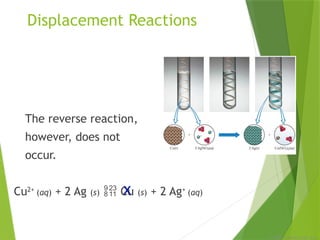
In this reaction,
silver ions oxidize
copper metal.
Cu (s) + 2 Ag+
(aq) Cu2+
(aq) + 2 Ag (s)
57. © 2009, Prentice-Hall, Inc.
Displacement Reactions
The reverse reaction,
however, does not
occur.
Cu2+
(aq) + 2 Ag (s) Cu (s) + 2 Ag+
(aq)
x
58. 59. Steps for balancing half reactions:
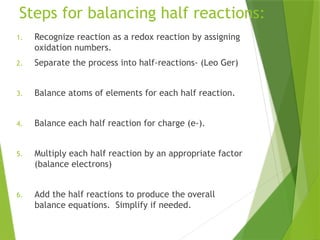
1. Recognize reaction as a redox reaction by assigning
oxidation numbers.
2. Separate the process into half-reactions- (Leo Ger)
3. Balance atoms of elements for each half reaction.
4. Balance each half reaction for charge (e-).
5. Multiply each half reaction by an appropriate factor
(balance electrons)
6. Add the half reactions to produce the overall
balance equations. Simplify if needed.
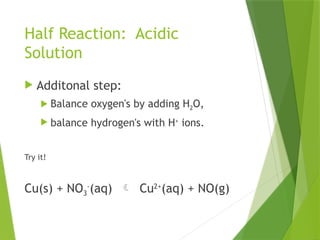
60. 61. Half Reaction: Acidic
Solution
Additonal step:
Balance oxygen's by adding H2O,
balance hydrogen's with H+
ions.
Try it!
Cu(s) + NO3
-
(aq) Cu2+
(aq) + NO(g)
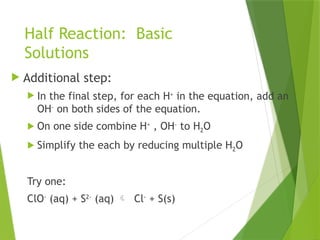
62. Half Reaction: Basic
Solutions
Additional step:
In the final step, for each H+
in the equation, add an
OH-
on both sides of the equation.
On one side combine H+
, OH-
to H2O
Simplify the each by reducing multiple H2O
Try one:
ClO-
(aq) + S2-
(aq) Cl-
+ S(s)
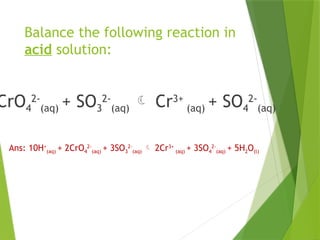
63. Balance the following reaction in
acid solution:
CrO4
2-
(aq) + SO3
2-
(aq) Cr3+
(aq) + SO4
2-
(aq)
Ans: 10H+
(aq) + 2CrO4
2-
(aq) + 3SO3
2-
(aq) 2Cr3+
(aq) + 3SO4
2-
(aq) + 5H2O(l)
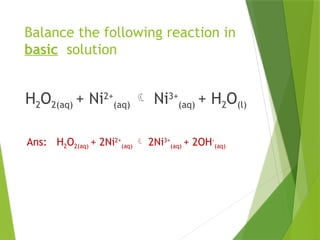
64. Balance the following reaction in
basic solution
H2O2(aq) + Ni2+
(aq) Ni3+
(aq) + H2O(l)
Ans: H2O2(aq) + 2Ni2+
(aq) 2Ni3+
(aq) + 2OH-
(aq)
Editor's Notes #4 See Chapter 3 Video Presentation Slide 4