Signals & Systems
LECTURE 3
Dr. Haris Masood
Lecture 3
Signals & Systems
1
Even/Odd Signals
 Even
 Odd
 Any signal can be discomposed into a sum of an
even and an odd
]
)
(
)
(
[
2
1
)
(
,
)]
(
)
(
[
2
1
)
( 2
1 t
x
t
x
t
x
t
x
t
x
t
x 





]
[
]
[
,
)
(
)
( n
x
n
x
t
x
t
x 



]
[
]
[
,
)
(
)
( n
x
n
x
t
x
t
x 





Even/Odd
Even Odd
x(-t)=x(t) x(-t)=-x(t)
30 March 2023
4
Even and Odd Signals
Even
Functions xe(t)=xe(-t)
Odd
Functions xo(t)=-xo(-t)
2A
0
-1
-2
-A
1 2 t
xe(t)
A
2A
0
-1
-2
-A
1 2 t
xo(t)
A
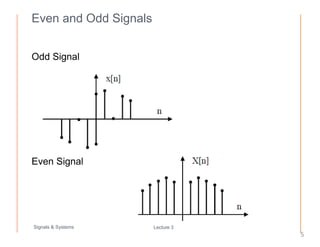
Even and Odd Signals
Odd Signal
Even Signal
Signals & Systems Lecture 3
5
30 March 2023
Veton Këpuska
6
Even and Odd Signals
Any signal can be expressed as the sum of even part
and on odd part:
   
)
(
)
(
2
1
)
(
)
(
)
(
2
1
)
(
)
(
)
(
)
(
)
(
)
(
)
(
)
(
)
(
)
(
t
x
t
x
t
x
t
x
t
x
t
x
t
x
t
x
t
x
t
x
t
x
t
x
t
x
t
x
t
x
o
e
o
e
o
e
o
e


















Find Even and Odd Components
Expression?
Veton Këpuska 30 March
2023 7
Expression?
Signals & Systems Lecture 3
8
Find Even and Odd Components
Signals & Systems Lecture 3
9
Find Even and Odd Components
• Are there sets of “basic” signals, xk[n], such that:
We can represent any signal as a linear combination (e.g, weighted sum) of these
building blocks? (Hint: Recall Fourier Series.)
The response of an LTI system to these basic signals is easy to compute and provides
significant insight.
• For LTI Systems (CT or DT) there are two natural choices for these building blocks:
Later we will learn that there are many families of such functions: sinusoids,
exponentials, and even data-dependent functions. The latter are extremely useful in
compression and pattern recognition applications.
Exploiting Superposition and Time-Invariance
DT LTI
System
[ ] [ ]
k k
k
x n a x n
  

k
k
k n
y
b
n
y ]
[
]
[
DT Systems:
(unit pulse)
 CT Systems:
(impulse)
 
0
t
t 

 
0
n
n 

Representation of DT Signals Using Unit Pulses
Convolution
• Mixing of Two Signals
• Convolution is a mathematical operation on two functions
(f and g) that produces a third function
Applications:
i. Edge Detection
ii. Region Detection
iii. Radar Technology
Signals & Systems Lecture 3
12
Response of a DT LTI Systems – Convolution
• Define the unit pulse response, h[n], as the response of a DT LTI system to a unit
pulse function, [n].
• Using the principle of time-invariance:
• Using the principle of linearity:
• Comments:
Recall that linearity implies the weighted sum of input signals will produce a
similar weighted sum of output signals.
Each unit pulse function, [n-k], produces a corresponding time-delayed version
of the system impulse response function (h[n-k]).
The summation is referred to as the convolution sum.
The symbol “*” is used to denote the convolution operation.
DT LTI


k
k
k n
x
a
n
x ]
[
]
[ 

k
k
k n
y
b
n
y ]
[
]
[
 
n
h
]
[
]
[
]
[
]
[ k
n
h
k
n
n
h
n 



 

]
[
]
[
]
[
]
[
]
[
]
[
]
[
]
[ n
h
n
x
k
n
h
k
x
n
y
k
n
k
x
n
x
k
k






 








convolution sum
convolution operator
LTI Systems and Impulse Response
• The output of any DT LTI is a convolution of the input signal with the unit pulse
response:
• Any DT LTI system is completely characterized by its unit pulse response.
• Convolution has a simple graphical interpretation:
DT LTI
]
[n
x ]
[
*
]
[
]
[ n
h
n
x
n
y 
 
n
h
]
[
]
[
]
[
]
[
]
[
]
[
]
[
]
[ n
h
n
x
k
n
h
k
x
n
y
k
n
k
x
n
x
k
k






 








Discrete Time Convolution
Two Main Methods
1. Graphical Method
2. Summation Method
3. Checking Method
Signals & Systems Lecture 3
15
Graphical Method
Signals & Systems Lecture 3
16
Signals & Systems Lecture 3
17
Signals & Systems Lecture 3
18
Signals & Systems Lecture 3
19
Representation of output signal y[n]
1. Draw the output signal
2. Represent the signal Mathematically
y[n]= [1, 2, 3,0,0,0,0,0,0,1]
Signals & Systems Lecture 3
20
Signals & Systems Lecture 3
21
Signals & Systems Lecture 3
22
Signals & Systems Lecture 3
23
Signals & Systems Lecture 3
24
Signals & Systems Lecture 3
25
Signals & Systems Lecture 3
26
Signals & Systems Lecture 3
27
Signals & Systems Lecture 3
28
Signals & Systems Lecture 3
29
• Convolution method used for both the discrete
and continuous time signals
• The methods (graphical and summation) cannot
be employed when one or both of signals
involving in convolution sum approaches infinity
• Analytical convolution specializes in convolving
the two signals in which one or both the signals
approaches infinity
Signals & Systems Lecture 3
30
Analytical Evaluation of the Convolution
31
Analytical Evaluation of the Convolution
     


 






otherwise
N
n
N
n
u
n
u
n
h
0
1
0
1
Convolve the following two signals.
     
k
y n x k h n k


 

Find the output at index n
   
n
u
a
n
x n

input
1
a 
3/30/2023
32
Analytical Evaluation of the Convolution
     


 






otherwise
N
n
N
n
u
n
u
n
h
0
1
0
1
h(k)
0
   
n
u
a
n
x n

input
1
a 
Steps:
1. Draw both the signals carefully
2. Understand the formula
3. Change the domain of signals from “n” to k (replace any
“n” in amplitude of the signal with “k”)
4. Flip signal of your choice? Why [Commutative]
5. Shift the flipped signal “n” locations to make it, say x[n-k]
6. Start shifting the flipped signal
7. Whenever the two signals overlap, calculate convolution
sum
Signals & Systems Lecture 3 33
Analytical Evaluation of the Convolution
     
k
y n x k h n k


 

34
0
 ,
 


 



otherwise
N
n
n
h
0
1
0
1
   
n
u
a
n
x n

h(k)
0
0
h(n-k)
x(k)
h(-k)
0
0
n  ,     
k
y n x k h n k


 

3/30/2023
35 Zhongguo Liu_Biomedical Engineering_Shandong Univ.
 
1 0
0, 0 1
n n N n N
       
     
 
a
a
a
n
k
h
k
x
n
y
n
n
k
k
n
k 










 1
1 1
0
0
h(-k)
0
h(k)
0
h(n-k)
x(k)
36
     
1 1
n n
k
k n N k n N
y n x k h k n a
     
 
   
 
 
h(-k)
0
h(k)
0
 
1 0 1
n N n N
     
1 1
1 1
1 1
n N n N
n N
a a a
a
a a
  
   
 
   
 
 
Analytical Evaluation of Convolution Sum
Determine the output of Linear Time Invariant System if the
input x[n] and h[n] are shown below:
Signals & Systems Lecture 3
37
𝑥[𝑛 = 𝜇[𝑛 ℎ[𝑛 = 𝑎𝑛𝜇[−𝑛 − 1
𝑥[𝑛 = 𝜇[𝑛 − 4 ℎ[𝑛 = 2𝑛
𝜇[−𝑛 − 1

Lecture 3 (ADSP).pptx

  • 1.
    Signals & Systems LECTURE3 Dr. Haris Masood Lecture 3 Signals & Systems 1
  • 2.
    Even/Odd Signals  Even Odd  Any signal can be discomposed into a sum of an even and an odd ] ) ( ) ( [ 2 1 ) ( , )] ( ) ( [ 2 1 ) ( 2 1 t x t x t x t x t x t x       ] [ ] [ , ) ( ) ( n x n x t x t x     ] [ ] [ , ) ( ) ( n x n x t x t x      
  • 3.
  • 4.
    30 March 2023 4 Evenand Odd Signals Even Functions xe(t)=xe(-t) Odd Functions xo(t)=-xo(-t) 2A 0 -1 -2 -A 1 2 t xe(t) A 2A 0 -1 -2 -A 1 2 t xo(t) A
  • 5.
    Even and OddSignals Odd Signal Even Signal Signals & Systems Lecture 3 5
  • 6.
    30 March 2023 VetonKëpuska 6 Even and Odd Signals Any signal can be expressed as the sum of even part and on odd part:     ) ( ) ( 2 1 ) ( ) ( ) ( 2 1 ) ( ) ( ) ( ) ( ) ( ) ( ) ( ) ( ) ( ) ( t x t x t x t x t x t x t x t x t x t x t x t x t x t x t x o e o e o e o e                  
  • 7.
    Find Even andOdd Components Expression? Veton Këpuska 30 March 2023 7
  • 8.
    Expression? Signals & SystemsLecture 3 8 Find Even and Odd Components
  • 9.
    Signals & SystemsLecture 3 9 Find Even and Odd Components
  • 10.
    • Are theresets of “basic” signals, xk[n], such that: We can represent any signal as a linear combination (e.g, weighted sum) of these building blocks? (Hint: Recall Fourier Series.) The response of an LTI system to these basic signals is easy to compute and provides significant insight. • For LTI Systems (CT or DT) there are two natural choices for these building blocks: Later we will learn that there are many families of such functions: sinusoids, exponentials, and even data-dependent functions. The latter are extremely useful in compression and pattern recognition applications. Exploiting Superposition and Time-Invariance DT LTI System [ ] [ ] k k k x n a x n     k k k n y b n y ] [ ] [ DT Systems: (unit pulse)  CT Systems: (impulse)   0 t t     0 n n  
  • 11.
    Representation of DTSignals Using Unit Pulses
  • 12.
    Convolution • Mixing ofTwo Signals • Convolution is a mathematical operation on two functions (f and g) that produces a third function Applications: i. Edge Detection ii. Region Detection iii. Radar Technology Signals & Systems Lecture 3 12
  • 13.
    Response of aDT LTI Systems – Convolution • Define the unit pulse response, h[n], as the response of a DT LTI system to a unit pulse function, [n]. • Using the principle of time-invariance: • Using the principle of linearity: • Comments: Recall that linearity implies the weighted sum of input signals will produce a similar weighted sum of output signals. Each unit pulse function, [n-k], produces a corresponding time-delayed version of the system impulse response function (h[n-k]). The summation is referred to as the convolution sum. The symbol “*” is used to denote the convolution operation. DT LTI   k k k n x a n x ] [ ] [   k k k n y b n y ] [ ] [   n h ] [ ] [ ] [ ] [ k n h k n n h n        ] [ ] [ ] [ ] [ ] [ ] [ ] [ ] [ n h n x k n h k x n y k n k x n x k k                 convolution sum convolution operator
  • 14.
    LTI Systems andImpulse Response • The output of any DT LTI is a convolution of the input signal with the unit pulse response: • Any DT LTI system is completely characterized by its unit pulse response. • Convolution has a simple graphical interpretation: DT LTI ] [n x ] [ * ] [ ] [ n h n x n y    n h ] [ ] [ ] [ ] [ ] [ ] [ ] [ ] [ n h n x k n h k x n y k n k x n x k k                
  • 15.
    Discrete Time Convolution TwoMain Methods 1. Graphical Method 2. Summation Method 3. Checking Method Signals & Systems Lecture 3 15
  • 16.
    Graphical Method Signals &Systems Lecture 3 16
  • 17.
    Signals & SystemsLecture 3 17
  • 18.
    Signals & SystemsLecture 3 18
  • 19.
    Signals & SystemsLecture 3 19
  • 20.
    Representation of outputsignal y[n] 1. Draw the output signal 2. Represent the signal Mathematically y[n]= [1, 2, 3,0,0,0,0,0,0,1] Signals & Systems Lecture 3 20
  • 21.
    Signals & SystemsLecture 3 21
  • 22.
    Signals & SystemsLecture 3 22
  • 23.
    Signals & SystemsLecture 3 23
  • 24.
    Signals & SystemsLecture 3 24
  • 25.
    Signals & SystemsLecture 3 25
  • 26.
    Signals & SystemsLecture 3 26
  • 27.
    Signals & SystemsLecture 3 27
  • 28.
    Signals & SystemsLecture 3 28
  • 29.
    Signals & SystemsLecture 3 29
  • 30.
    • Convolution methodused for both the discrete and continuous time signals • The methods (graphical and summation) cannot be employed when one or both of signals involving in convolution sum approaches infinity • Analytical convolution specializes in convolving the two signals in which one or both the signals approaches infinity Signals & Systems Lecture 3 30 Analytical Evaluation of the Convolution
  • 31.
    31 Analytical Evaluation ofthe Convolution                 otherwise N n N n u n u n h 0 1 0 1 Convolve the following two signals.       k y n x k h n k      Find the output at index n     n u a n x n  input 1 a 
  • 32.
    3/30/2023 32 Analytical Evaluation ofthe Convolution                 otherwise N n N n u n u n h 0 1 0 1 h(k) 0     n u a n x n  input 1 a 
  • 33.
    Steps: 1. Draw boththe signals carefully 2. Understand the formula 3. Change the domain of signals from “n” to k (replace any “n” in amplitude of the signal with “k”) 4. Flip signal of your choice? Why [Commutative] 5. Shift the flipped signal “n” locations to make it, say x[n-k] 6. Start shifting the flipped signal 7. Whenever the two signals overlap, calculate convolution sum Signals & Systems Lecture 3 33 Analytical Evaluation of the Convolution       k y n x k h n k     
  • 34.
    34 0  ,         otherwise N n n h 0 1 0 1     n u a n x n  h(k) 0 0 h(n-k) x(k) h(-k) 0 0 n  ,      k y n x k h n k     
  • 35.
    3/30/2023 35 Zhongguo Liu_BiomedicalEngineering_Shandong Univ.   1 0 0, 0 1 n n N n N                 a a a n k h k x n y n n k k n k             1 1 1 0 0 h(-k) 0 h(k) 0 h(n-k) x(k)
  • 36.
    36      1 1 n n k k n N k n N y n x k h k n a                 h(-k) 0 h(k) 0   1 0 1 n N n N       1 1 1 1 1 1 n N n N n N a a a a a a                 
  • 37.
    Analytical Evaluation ofConvolution Sum Determine the output of Linear Time Invariant System if the input x[n] and h[n] are shown below: Signals & Systems Lecture 3 37 𝑥[𝑛 = 𝜇[𝑛 ℎ[𝑛 = 𝑎𝑛𝜇[−𝑛 − 1 𝑥[𝑛 = 𝜇[𝑛 − 4 ℎ[𝑛 = 2𝑛 𝜇[−𝑛 − 1