Chapter 2:
Global Marketing
strategies
OBJECTIVES
In this chapter, you will :
 Understand the Concept of Global Marketing Strategies
 Analyze the Benefits and Challenges of Global Marketing
 Explore Effective Execution of Global Marketing Strategies
 Develop Strategic Global Marketing Plans
 Evaluate Different Types of Marketing Strategies
 Understand the Role of E-commerce in Global Marketing
 Appreciate the Importance of Localization and Global
Standardization
 Develop Adaptability and Agility in Global Marketing
 Enhance Competitive Advantage in Global Markets
2
I. What are global
marketing
strategies?
• Global marketing strategies are a part of a comprehensive business plan. It is
the process of adapting a company's marketing strategies to meet the needs of
potential customers in other countries. Entering a new international market
can give a company access to a new customer base, which can increase the
company's revenue. This can also bring various other benefits, such as lower
labor costs, access to additional resources and the ability to diversify risks.
• Creating a consistent brand that everyone is familiar with is a priority when
expanding into international markets. When implementing your marketing
strategies, some aspects of the business may remain the same, while other
aspects may be heavily influenced. For example, the name and logo may
remain the same, although some companies may choose to change these
aspects as well. Your marketing approach may also change significantly. For
example, the messaging, advertising and PR approach may change in each
new market.
3
II.EFFECTIVE
GLOBAL
MARKETING
• When you implement strategies effectively, it can
have a positive impact on a company's bottom line in
a number of ways, such as improved public
perception and higher profit margins. Tapping into
new markets can help you discover business
potential and enable new opportunities and stronger
international relationships.
• It is important to know your target audience.
Understanding who needs your products and how
you can get the message across in a way that grows
the business is at the heart of global marketing. If a
company chooses not to expand internationally, it
can face direct competition from international
companies that are expanding their presence.
4
III. TIPS FOR DEVELOPING A SUCCESSFUL
GLOBAL MARKETING STRATEGY
A global marketing strategy can serve as a guide for the future and increase a business's
success rate in other locations. It can help a business expand internationally to increase sales
around the world and generate more publicity. To develop a good global strategy, it is
important to recognize how a business's products or services can work in global markets.
Keep the following tips in mind when developing a global marketing strategy:
1- Know your audience: Familiarizing yourself with your customers' regions of origin and
why they support your products or services will help you determine where a business is in
high demand..
2- Set achievable goals: It's important to determine what kind of customer loyalty you can
realistically expect in each region you expand into. If you set specific goals, you can use them
as a benchmark for your progress
3- Recognize your competitors: When expanding internationally, it's important to identify
other companies that offer similar services and products. Understanding the culture of the
local competition in each region and how they approach the market will help you develop a
better strategy.
5
IV. TYPES OF
MARKETING
STRATEGIES
There are many approaches to global marketing. The three
main types of global marketing approaches include:
1- Standardization
With a standardization strategy, you sell the same products in
every location. With a standardization strategy, the overall
control of the company remains centralized instead of
delegating decisions to other local markets. The benefits of a
standardization strategy include the ability to develop
products faster and coordinate activities across locations
more easily.
Imagine you run a luxury handbag company and want to
expand the business on a global scale. With the
standardization strategy, you may sell essentially the same
handbags in every location. With this strategy, it is important
that your products/services vary less. This strategy allows
you to keep your products consistent in every market.
6
IV. TYPES OF
MARKETING
STRATEGIES
2- International
An international strategy involves importing and exporting
products. An international strategy allows you to work with
foreign suppliers and sell to customers all over the world
while keeping your headquarters in your home country. As a
rule, international strategies still focus on the company's
home market, while some business is conducted abroad.
This strategy incorporates ideals from many countries. For
example, the physical production of wallets would still take
place in your home country, but you would still export some
wallets abroad.
2- Multinational
If you pursue a multinational strategy, you can tailor your
products to each individual market. This includes physical
business locations and employees working in these different
locations. The main advantage of a multinational strategy is
the ability to adapt the business to the individual locations.
With the multinational strategy, you create different luxury
bags for each location where you sell. More variation in your
products/services is important with this strategy. This allows
you to customize your purses to appeal to different markets.
Prices may also vary depending on the demographic or
demand for the product in a market
7
V. UTILIZING
E-COMMERCE TO
YOUR BENEFIT
• E-commerce enables companies of all sizes to expand
internationally with the help of good global marketing approaches.
The internet alters the way people shop and the way business owners
are marketing their products. E-commerce allows companies to easily
expand into other markets and reach a wider range of consumers
without having a physical store in every region. Although expansion
is more easily accessible, it creates a competitive market. Brands
prove their products or services worthy to gain customers' trust.
• Through social media, websites, and live chats, businesses can
adopt new consumer shopping habits and learn what's trending. It's
important to create an online presence for potential customers to learn
about your brand. Plus, online platforms store data and can track
results to improve the relationship between the business and the
consumer. You can use online data from your platforms to refine your
marketing campaigns and specify your goals. There is more to global
marketing than simply selling your products or services
internationally, but keep in mind that e-commerce relies heavily on
trends and is a competitive field.
VI. LOCALIZATION AND GLOBAL
STANDARDIZATION
STRATEGIES
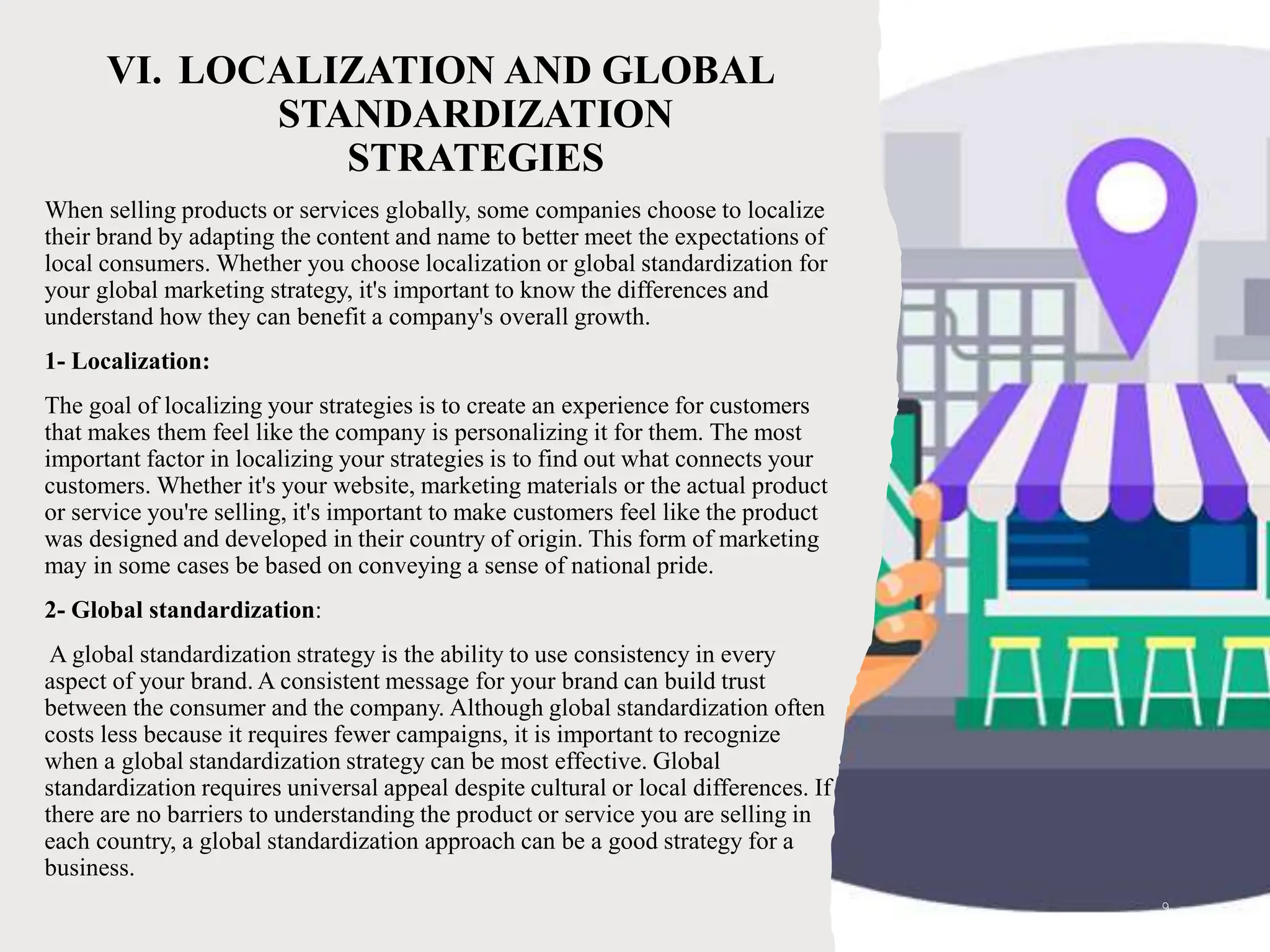
When selling products or services globally, some companies choose to localize
their brand by adapting the content and name to better meet the expectations of
local consumers. Whether you choose localization or global standardization for
your global marketing strategy, it's important to know the differences and
understand how they can benefit a company's overall growth.
1- Localization:
The goal of localizing your strategies is to create an experience for customers
that makes them feel like the company is personalizing it for them. The most
important factor in localizing your strategies is to find out what connects your
customers. Whether it's your website, marketing materials or the actual product
or service you're selling, it's important to make customers feel like the product
was designed and developed in their country of origin. This form of marketing
may in some cases be based on conveying a sense of national pride.
2- Global standardization:
A global standardization strategy is the ability to use consistency in every
aspect of your brand. A consistent message for your brand can build trust
between the consumer and the company. Although global standardization often
costs less because it requires fewer campaigns, it is important to recognize
when a global standardization strategy can be most effective. Global
standardization requires universal appeal despite cultural or local differences. If
there are no barriers to understanding the product or service you are selling in
each country, a global standardization approach can be a good strategy for a
business.
9

chapter2: global marketing strategies .pptx

  • 1.
  • 2.
    OBJECTIVES In this chapter,you will :  Understand the Concept of Global Marketing Strategies  Analyze the Benefits and Challenges of Global Marketing  Explore Effective Execution of Global Marketing Strategies  Develop Strategic Global Marketing Plans  Evaluate Different Types of Marketing Strategies  Understand the Role of E-commerce in Global Marketing  Appreciate the Importance of Localization and Global Standardization  Develop Adaptability and Agility in Global Marketing  Enhance Competitive Advantage in Global Markets 2
  • 3.
    I. What areglobal marketing strategies? • Global marketing strategies are a part of a comprehensive business plan. It is the process of adapting a company's marketing strategies to meet the needs of potential customers in other countries. Entering a new international market can give a company access to a new customer base, which can increase the company's revenue. This can also bring various other benefits, such as lower labor costs, access to additional resources and the ability to diversify risks. • Creating a consistent brand that everyone is familiar with is a priority when expanding into international markets. When implementing your marketing strategies, some aspects of the business may remain the same, while other aspects may be heavily influenced. For example, the name and logo may remain the same, although some companies may choose to change these aspects as well. Your marketing approach may also change significantly. For example, the messaging, advertising and PR approach may change in each new market. 3
  • 4.
    II.EFFECTIVE GLOBAL MARKETING • When youimplement strategies effectively, it can have a positive impact on a company's bottom line in a number of ways, such as improved public perception and higher profit margins. Tapping into new markets can help you discover business potential and enable new opportunities and stronger international relationships. • It is important to know your target audience. Understanding who needs your products and how you can get the message across in a way that grows the business is at the heart of global marketing. If a company chooses not to expand internationally, it can face direct competition from international companies that are expanding their presence. 4
  • 5.
    III. TIPS FORDEVELOPING A SUCCESSFUL GLOBAL MARKETING STRATEGY A global marketing strategy can serve as a guide for the future and increase a business's success rate in other locations. It can help a business expand internationally to increase sales around the world and generate more publicity. To develop a good global strategy, it is important to recognize how a business's products or services can work in global markets. Keep the following tips in mind when developing a global marketing strategy: 1- Know your audience: Familiarizing yourself with your customers' regions of origin and why they support your products or services will help you determine where a business is in high demand.. 2- Set achievable goals: It's important to determine what kind of customer loyalty you can realistically expect in each region you expand into. If you set specific goals, you can use them as a benchmark for your progress 3- Recognize your competitors: When expanding internationally, it's important to identify other companies that offer similar services and products. Understanding the culture of the local competition in each region and how they approach the market will help you develop a better strategy. 5
  • 6.
    IV. TYPES OF MARKETING STRATEGIES Thereare many approaches to global marketing. The three main types of global marketing approaches include: 1- Standardization With a standardization strategy, you sell the same products in every location. With a standardization strategy, the overall control of the company remains centralized instead of delegating decisions to other local markets. The benefits of a standardization strategy include the ability to develop products faster and coordinate activities across locations more easily. Imagine you run a luxury handbag company and want to expand the business on a global scale. With the standardization strategy, you may sell essentially the same handbags in every location. With this strategy, it is important that your products/services vary less. This strategy allows you to keep your products consistent in every market. 6
  • 7.
    IV. TYPES OF MARKETING STRATEGIES 2-International An international strategy involves importing and exporting products. An international strategy allows you to work with foreign suppliers and sell to customers all over the world while keeping your headquarters in your home country. As a rule, international strategies still focus on the company's home market, while some business is conducted abroad. This strategy incorporates ideals from many countries. For example, the physical production of wallets would still take place in your home country, but you would still export some wallets abroad. 2- Multinational If you pursue a multinational strategy, you can tailor your products to each individual market. This includes physical business locations and employees working in these different locations. The main advantage of a multinational strategy is the ability to adapt the business to the individual locations. With the multinational strategy, you create different luxury bags for each location where you sell. More variation in your products/services is important with this strategy. This allows you to customize your purses to appeal to different markets. Prices may also vary depending on the demographic or demand for the product in a market 7
  • 8.
    V. UTILIZING E-COMMERCE TO YOURBENEFIT • E-commerce enables companies of all sizes to expand internationally with the help of good global marketing approaches. The internet alters the way people shop and the way business owners are marketing their products. E-commerce allows companies to easily expand into other markets and reach a wider range of consumers without having a physical store in every region. Although expansion is more easily accessible, it creates a competitive market. Brands prove their products or services worthy to gain customers' trust. • Through social media, websites, and live chats, businesses can adopt new consumer shopping habits and learn what's trending. It's important to create an online presence for potential customers to learn about your brand. Plus, online platforms store data and can track results to improve the relationship between the business and the consumer. You can use online data from your platforms to refine your marketing campaigns and specify your goals. There is more to global marketing than simply selling your products or services internationally, but keep in mind that e-commerce relies heavily on trends and is a competitive field.
  • 9.
    VI. LOCALIZATION ANDGLOBAL STANDARDIZATION STRATEGIES When selling products or services globally, some companies choose to localize their brand by adapting the content and name to better meet the expectations of local consumers. Whether you choose localization or global standardization for your global marketing strategy, it's important to know the differences and understand how they can benefit a company's overall growth. 1- Localization: The goal of localizing your strategies is to create an experience for customers that makes them feel like the company is personalizing it for them. The most important factor in localizing your strategies is to find out what connects your customers. Whether it's your website, marketing materials or the actual product or service you're selling, it's important to make customers feel like the product was designed and developed in their country of origin. This form of marketing may in some cases be based on conveying a sense of national pride. 2- Global standardization: A global standardization strategy is the ability to use consistency in every aspect of your brand. A consistent message for your brand can build trust between the consumer and the company. Although global standardization often costs less because it requires fewer campaigns, it is important to recognize when a global standardization strategy can be most effective. Global standardization requires universal appeal despite cultural or local differences. If there are no barriers to understanding the product or service you are selling in each country, a global standardization approach can be a good strategy for a business. 9