Business Market Management 3 rd  edition Managing Market Offerings Chapter 5
Section III:  Creating Value Business Market Management,  3 rd  edition Chapter 5-
Chapter 5:  Managing Market Offerings Overview Some Conventional Thinking About Market Offerings Constructing Flexible Market Offerings Value-Based Pricing Managing Market Offerings Across Borders Summary Business Market Management,  3 rd  edition Chapter 5-
Business Market Management,  3 rd  edition Chapter 5- Guiding Principles Crafting Market Strategy Understanding Firms   as   Customers Marketing  Sensing Managing Market Offerings New Offering Realization Business  Channel Management Gaining New   Business Sustaining Reseller Partnerships Managing Customers Regard Value as the Cornerstone Accentuate   Working Relationships & Business Networks Focus   on Business Market Processes Stress   Doing Business Across Borders Understanding   Value Creating Value Delivering Value Business Market Processes
Overview The business market processes of 1) market sensing, 2) understanding firms as customers, and 3) crafting market strategy provide supplier firms with an  understanding of value Firms put this understanding of value to use in creating value for the market segments and customer firms that it has decided are of the greatest value Business Market Management,  3 rd  edition Chapter 5-
Managing Market Offerings Placing: products, services, programs, and systems together in ways that create the greatest value for targeted market segments and customer firms Business’s challenge: construct offerings that uniquely leverage a business’s resources to provide value Business Market Management,  3 rd  edition Chapter 5-
What is Market Offering? Business Market Management,  3 rd  edition Chapter 5- Core Product The fundamental, functional performance a generic product provides that solves a customer’s basic problem Minimally Augmented Product  Adds to the core product the least amount or number of services, programs, or systems considered absolutely essential Augmented Product Adds to the core product those services, programs, and systems a supplier offers to meet a broader set of customer requirements and preferences, or to exceed customer expectations Potential Product Encompasses any imaginable product change or service, program, or system a supplier might create to add value or reduce cost in ways that set it apart from others
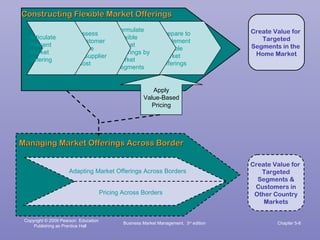
Business Market Management,  3 rd  edition Chapter 5- Create Value for  Targeted Segments in the  Home Market Create Value for  Targeted Segments & Customers in Other Country Markets Constructing Flexible Market Offerings Managing Market Offerings Across Border Adapting Market Offerings Across Borders Pricing Across Borders Prepare to Implement Flexible Market  Offerings Formulate Flexible Market Offerings by Market Segments Assess Customer Value & Supplier Cost Articulate Present Market Offering Apply Value-Based Pricing
I.   Some Conventional Thinking About Market Offerings Business Market Management,  3 rd  edition Chapter 5-
Tunnel Vision of Commodity Markets If you think you’re in a commodity market, you’re thinking too narrowly about the market you’re in.  Business Market Management,  3 rd  edition Chapter 5-
Commodity Market Commoditization:   Convincing  suppliers that no differences exists  among offerings Business market mangers need to persuasively demonstrate to customers that  their offering is different in valuable ways Commodity Magnet:   inexorable pull on a market towards commoditization  Business Market Management,  3 rd  edition Chapter 5-
“ Marketing Success Through Differentiation--of Anything”  (Source:  Theodore Levitt)   There is no such things as a commodity All goods and services are differentiable Business Market Management,  3 rd  edition Chapter 5-
Understanding Commoditization Market offerings contain: Supplementary services, programs, and systems that enhance the core product/service Provides additional value to customers Business Market Management,  3 rd  edition Chapter 5-
Understanding Commoditization Suppliers should: Examine the differences between their offerings and competitors Consider the service and social benefits of the offering Gather data to understand competitors’ prices Validate own market pricing Gain estimates of their share of customer’s business Business Market Management,  3 rd  edition Chapter 5-
Rebuilding Differentiation Business Market Management,  3 rd  edition Chapter 5- Creating Knowledge Banks Search for knowledge valuable for customers, but is difficult for them to gain Best practices database Building Leveraging Expertise Search for problems/nuisances that a number of customers experience Offer solutions to solve/alleviate problems Changing the Customer's Frame of Reference Focus customer’s attention to  total cost of product Building Flexibility into their Market Offerings Customers within a segment may be the same in many requirements, but remain different in others
Services as Core Products in Market Offerings Two View Points Services are fundamentally different Intangibility Inseparability of production and consumption Perishability Heterogeneity Differences between products and services are a matter of degree, and market offerings fall along a continuum of tangibility Business Market Management,  3 rd  edition Chapter 5-
II.   Constructing Flexible Market Offerings Business Market Management,  3 rd  edition Chapter 5-
Augmenting Services, Programs, and Systems Business Market Management,  3 rd  edition Chapter 5- Services Fulfillment : Availability, assurance, emergency delivery, installation, training, maintenance, disposal/recycling Technical : Specification, testing & analysis, troubleshooting, problem-solving, calibration, customer productivity improvement Programs Economic : Terms & conditions; deals, discounts, allowances & rebates/bonuses; warranty; guaranteed cost savings Relationship : Advice & consulting, design, process engineering, product & process redesign, analysis of cost & performance, joint market research, co-marketing & co-promotion Systems Linking : Order management intranet, automated replenishment & vendor-managed inventory, ERP, CMM Efficacy : Information & design assistance intranet, expert systems, integrated logistics management, assessment management, responsiveness systems
Constructing Flexible Market Offerings Balancing 3 pervasive, conflicting marketplace requirements: Markets are becoming highly fragmented; customer requesting and getting more customized offering Customers uncompromising in demand for lowest price or lowest total cost Purchasers take quality as a given and few meaningful differences separate competing products Business Market Management,  3 rd  edition Chapter 5-
The Concept of Flexible Market Offerings Business Market Management,  3 rd  edition Chapter 5- Standard Bundles/ Packages: Designed to meet the needs of the “average customer” Vanilla: Offered across all segments Naked Solutions: Bare minimum of products or services that all segment members uniformly value Options: Offered separately for those segment members that value them Mass Customization: Capability to offer individually specified products or services on a large scale:  Elicitation, Flexibility, Logistics
Flexible Market Offering Composed of a few  well-chosen naked solutions each wrapped with well-chosen options supplier makes choices prior to offering them to customer Akin to modularity and commonality in product design Business Market Management,  3 rd  edition Chapter 5-
Articulate the Present Market Offering for Each Market Segment Take stock of how firm is doing business by detailing current market offerings for each segment Supplier managers can gain at least three different insights from this process: true breadth of the market offering the arbitrary nature of charges lack of variation across segments Business Market Management,  3 rd  edition Chapter 5-
Business Market Management,  3 rd  edition Chapter 5- Baxter Healthcare Market offerings to Two Segments:  Transactional and Strategic Hospital Customers Segment Marketing   Offering   Element Transactional   Customer Strategic   Customer Product returns Standard Standard Technical assistance Standard Standard Single point-of-contact Not offered Standard Future disease incidence forecast Not offered Option Price deals Standard Standard Corporate customer bonus Not offered Standard Executive perspectives Not offered Standard Consolidated purchase report summary Not offered Standard ACCESS Program Not offered Option Baxter Corporate Consulting Not offered Option ASAP order entry system Standard Standard COMDISCO Technology Assessment Not offered Standard Value Link stockless inventory program Option Option COMDISCO asset management system Option Option Programs Services Systems
Assess Customer Value and Supplier Cost Measuring Customer Value Cost-in-Use Studies:  document  incremental cost savings Coming to Grips with Service Costs ABC Techniques (activity-based-costing) Time Equations The Payoff from Value Assessment Identify & eliminate value drains CVM process (Customer Value Management) Business Market Management,  3 rd  edition Chapter 5-
Formulate Flexible Market Offerings  by Market Segment Strategic alternatives for each service element: Do not market the service Market it as standard—no charge Market it as an option with a charge Business Market Management,  3 rd  edition Chapter 5-
Flexible Market Offering Strategy Matrix Business Market Management,  3 rd  edition Chapter 5- Service Element Deployment Service Element  Status Do Not Market Market as “Standard” Market as “Option” Existing “standard” service Prune from standard offering Retain in standard offering Recast as surcharge option Existing “optional” service Discontinue option Enhance standard offering Retain as value-added option New service Keep on shelf Augment standard offering Introduce as value-added option
Reevaluating Existing Standard Services Keep the standard offering as “naked” as possible Only services, programs, and systems that all firms within a segment highly value should be standard Business Market Management,  3 rd  edition Chapter 5-
Reevaluating Existing Standard Services Prune or recast services  Look for seldom used services Surcharge options for infrequently performed services (training, installation, retrofitting) Recast services as valued-added options Customers pay in full or in part for options with “bonus dollars”  Business Market Management,  3 rd  edition Chapter 5-
Reexamining Optional Services Reexamine existing optional services to determine whether they should be: discontinued, used to enhance the standard offering, or continued as an option Business Market Management,  3 rd  edition Chapter 5-
Building Flexibility with New Services Sources of new services: Focus on cost structures and strategic priorities of key customers Innovate new services  to assist customers in lowering their costs or improving performance Enhance   standard   offerings  with new services Add   new   services  to standard offering to thwart or stymie competitors Offer new elements separately as “ value-added ”  options Business Market Management,  3 rd  edition Chapter 5-
Pricing Implications Pricing is based on the supplier’s strategy for each market segment Customers may value certain standard services; but only affordable to supplier if it has all of the customers’ business Offering services separately provides flexibility to both the customer and the supplier Business Market Management,  3 rd  edition Chapter 5-
Implement Flexible Marketing Option Menu Transparent to the customer List of all optional elements Tailored Package Keeps the flexible market offering opaque to customers Salesperson develops a list of specifications and crafts an offering based on a menu of options known only to the salesperson Business Market Management,  3 rd  edition Chapter 5-
Branding Market Offerings Promised value delivered to targeted customers Means of differentiating this value from other market offerings make intangible benefits tangible build differentiation in near-commodity markets achieve identity and preference with customers’ customers differentiate market offerings with same or similar core product but augmented with services, programs, and systems Business Market Management,  3 rd  edition Chapter 5-
Branding Ingredient Branding Strategy Applicable when the customers’ customer who is receiving the significant value are consumers Brand-building focused primary on customers’ customers Example:  Intel Inside® Business Market Management,  3 rd  edition Chapter 5-
Brand Building Use brand building initiatives to reinforce the  distinctive character  of each brand and the value it delivers to its target customers Acer’s ability to sustain multiple brands in global markets Business Market Management,  3 rd  edition Chapter 5-
Anticipate Implementation Problems Minimize implementation problems by: Understanding customer requirements Shaping customer expectations  Manage service and pricing expectations Be relentless in communicating the  value story  to customers Business Market Management,  3 rd  edition Chapter 5-
Breaking Away from the Pack Guarantee outcomes based on service 24-Hour Shipment Guarantee Guaranteed Cost Savings Program Turn discussions to services and away from price Going against industry standard can be first step toward industry paradigm shift and rule changes Be disciplined, operating within the imposed structures of the flexible market offerings Business Market Management,  3 rd  edition Chapter 5-
III.   Value-Based Pricing Business Market Management,  3 rd  edition Chapter 5-
Value-Based Pricing “ In most firms prices are determined by intuition,  opinions,  rules of thumb,  outright dogma,  top management’s higher wisdom,  or internal power fights.” --Hermann Simon Business Market Management,  3 rd  edition Chapter 5-
Value-Based Pricing Business Market Management,  3 rd  edition Chapter 5- Pricing Strategy Focuses on where within this range to position the market offering and how to shift the range itself and the supplier’s relative position within it Pricing Tactics Focus on shifting the supplier’s position within the existing price range and are often transitory in nature Transaction Price Focuses on realizing the greatest net price for each individual order
Traditional Pricing Approaches Cost-Plus   Pricing :   Knowledge of own costs plus a percentage Cost:   cost of goods, variable costs, and full costs Plus:   supplier’s target profit Competitive-Based   Pricing:  Set price in relation to competition’s prices Supplier managers essentially give control of their marketing strategy to competitors Supplier with largest market share usually provides price leadership Business Market Management,  3 rd  edition Chapter 5-
An Approach to Value-Based Pricing Value-Based Pricing:   Price should be set in relation to a market offering’s value Fundamental Value Equation: Business Market Management,  3 rd  edition Chapter 5- Business Market Management,  3 rd  edition (Value f   – Price f   )  >   (Value a  – Price a )
Value-Based Pricing Model Business Market Management,  3 rd  edition Chapter 5- - (Value f   – Price f   )  >   (Value a  – Price a  ) ( Value f  – Value a )  >   (Price f  – Price a  ) ∆ Value f,a   >   (Price f  – Price a  ) Price f  <   Price a   +  ∆ Value f,a
Value-Based Pricing Framework Business Market Management,  3 rd  edition Chapter 5- Rs./Unit 0 Cost  f,a Price  a Value  a Value  f Profit for Offering  a Customer  Incentive ( Į ) To Purchase Offering  a Incremental Value (∆ Value  f,a )
Pricing Strategies Penetrating Pricing Strategy:   overall profit earned by selling a larger number of units at a lower profit per unit Skimming   Pricing   Strategy:   overall profits earned by selling fewer units at a higher profit per unit Business Market Management,  3 rd  edition Chapter 5- Pricing strategy can only be understood within the context of the business unit’s market strategy for each segment
Pricing Strategy Factor supporting pursuit of a pricing strategy: Market size Forecasted growth Significance of any learning effects Experience curve Market knowledge Anticipated reaction by present or potential competitors How persuasively demonstrable the value proposition is Business Market Management,  3 rd  edition Chapter 5-
IV.   Managing Market Offerings Across Borders Business Market Management,  3 rd  edition Chapter 5-
Adapting Market Offerings Across Borders Firms progress through 3 phases: Phase I:   Initial foreign market entry Phase II:   Local or national market expansion Phase III:   Global rationalization Business Market Management,  3 rd  edition Chapter 5-
Phase I Market offering varies little from home market Attention centered on pinpointing the closest match Business Market Management,  3 rd  edition Chapter 5- “ 60% of U.S. companies that do business in only one foreign country  do business in Canada.” --Pankaj Ghemawat
Phase II Attempt to broaden base in each  country market by gaining greater market penetration Tailor market offerings to the unique, local market requirements Emphasis shifts from export of strategy to development on a country-by-country basis Business Market Management,  3 rd  edition Chapter 5-
Phase III Global Rationalization Managing market offerings across  borders becomes paramount Think global, act local Transnational capabilities: manage across national boundaries retain local flexibility while achieving global integration Business Market Management,  3 rd  edition Chapter 5-
Providing Transnational Market Offerings Business Market Management,  3 rd  edition Chapter 5- Adaptation Aggregation Arbitration AAA   Triangle
Making a Global Strategy Work Excel in one or two of the A’s Evaluate which country markets are most significant and interesting Lead Country Model:   product carefully tailored to the dominant and distinct needs of individual national markets Face to customer must remain local Goal:   regarded as a local company in every country market it participates Business Market Management,  3 rd  edition Chapter 5-
Pricing in Local Markets Price relative to local competitors Incremental value of market offering  varies across its country markets Perceived superior value relative to local market offering is a critical factor in initial foreign entry Dumping:   accepting a lower price than in the home market Pricing Across Borders Business Market Management,  3 rd  edition Chapter 5-
Harmonizing Pricing Across Borders: Customers that operate across borders  increasingly expect  unified pricing Cross-border arbitrage forces supplier to confront  widely   varying   prices  across countries Pricing Bandwidth:   pricing within each country market is within a agreed-upon range Web-based  electronic   commerce  may compel supplier to move to a single price Fluctuating   currency  exchange rates add complexity Pricing Across Borders Business Market Management,  3 rd  edition Chapter 5-
IV. Summary Business Market Management,  3 rd  edition Chapter 5-
Summary Managing market offerings is the process of putting products, services, programs, and system together to create the greatest value for targeted segments and customers Business market managers need to rethink and have a true understanding of the extent of commoditization Market offerings are changing and are moving closer to the center of the tangibility continuum Flexible market offerings provide naked solutions consisting of offering elements that all segment members highly value Business market managers should pursue value-based pricing, selecting a price for the feasible range defined by what the customer is willing to pay How market offerings are adapted across borders depends on their firm’s stage of international market development Flexible market offerings prove useful in constructing transnational offerings Business Market Management,  3 rd  edition Chapter 5-
Business Market Management,  3 rd  edition Chapter 5- All rights reserved. No part of this publication may be reproduced, stored in a retrieval system, or transmitted, in any form or by any means, electronic, mechanical, photocopying, recording, or otherwise, without the prior written permission of the publisher. Printed in the United States of America. Copyright © 2009 Pearson Education, Inc.   Publishing as Prentice Hall

Chapter05

  • 1.
    Business Market Management3 rd edition Managing Market Offerings Chapter 5
  • 2.
    Section III: Creating Value Business Market Management, 3 rd edition Chapter 5-
  • 3.
    Chapter 5: Managing Market Offerings Overview Some Conventional Thinking About Market Offerings Constructing Flexible Market Offerings Value-Based Pricing Managing Market Offerings Across Borders Summary Business Market Management, 3 rd edition Chapter 5-
  • 4.
    Business Market Management, 3 rd edition Chapter 5- Guiding Principles Crafting Market Strategy Understanding Firms as Customers Marketing Sensing Managing Market Offerings New Offering Realization Business Channel Management Gaining New Business Sustaining Reseller Partnerships Managing Customers Regard Value as the Cornerstone Accentuate Working Relationships & Business Networks Focus on Business Market Processes Stress Doing Business Across Borders Understanding Value Creating Value Delivering Value Business Market Processes
  • 5.
    Overview The businessmarket processes of 1) market sensing, 2) understanding firms as customers, and 3) crafting market strategy provide supplier firms with an understanding of value Firms put this understanding of value to use in creating value for the market segments and customer firms that it has decided are of the greatest value Business Market Management, 3 rd edition Chapter 5-
  • 6.
    Managing Market OfferingsPlacing: products, services, programs, and systems together in ways that create the greatest value for targeted market segments and customer firms Business’s challenge: construct offerings that uniquely leverage a business’s resources to provide value Business Market Management, 3 rd edition Chapter 5-
  • 7.
    What is MarketOffering? Business Market Management, 3 rd edition Chapter 5- Core Product The fundamental, functional performance a generic product provides that solves a customer’s basic problem Minimally Augmented Product Adds to the core product the least amount or number of services, programs, or systems considered absolutely essential Augmented Product Adds to the core product those services, programs, and systems a supplier offers to meet a broader set of customer requirements and preferences, or to exceed customer expectations Potential Product Encompasses any imaginable product change or service, program, or system a supplier might create to add value or reduce cost in ways that set it apart from others
  • 8.
    Business Market Management, 3 rd edition Chapter 5- Create Value for Targeted Segments in the Home Market Create Value for Targeted Segments & Customers in Other Country Markets Constructing Flexible Market Offerings Managing Market Offerings Across Border Adapting Market Offerings Across Borders Pricing Across Borders Prepare to Implement Flexible Market Offerings Formulate Flexible Market Offerings by Market Segments Assess Customer Value & Supplier Cost Articulate Present Market Offering Apply Value-Based Pricing
  • 9.
    I. Some Conventional Thinking About Market Offerings Business Market Management, 3 rd edition Chapter 5-
  • 10.
    Tunnel Vision ofCommodity Markets If you think you’re in a commodity market, you’re thinking too narrowly about the market you’re in. Business Market Management, 3 rd edition Chapter 5-
  • 11.
    Commodity Market Commoditization: Convincing suppliers that no differences exists among offerings Business market mangers need to persuasively demonstrate to customers that their offering is different in valuable ways Commodity Magnet: inexorable pull on a market towards commoditization Business Market Management, 3 rd edition Chapter 5-
  • 12.
    “ Marketing SuccessThrough Differentiation--of Anything” (Source: Theodore Levitt) There is no such things as a commodity All goods and services are differentiable Business Market Management, 3 rd edition Chapter 5-
  • 13.
    Understanding Commoditization Marketofferings contain: Supplementary services, programs, and systems that enhance the core product/service Provides additional value to customers Business Market Management, 3 rd edition Chapter 5-
  • 14.
    Understanding Commoditization Suppliersshould: Examine the differences between their offerings and competitors Consider the service and social benefits of the offering Gather data to understand competitors’ prices Validate own market pricing Gain estimates of their share of customer’s business Business Market Management, 3 rd edition Chapter 5-
  • 15.
    Rebuilding Differentiation BusinessMarket Management, 3 rd edition Chapter 5- Creating Knowledge Banks Search for knowledge valuable for customers, but is difficult for them to gain Best practices database Building Leveraging Expertise Search for problems/nuisances that a number of customers experience Offer solutions to solve/alleviate problems Changing the Customer's Frame of Reference Focus customer’s attention to total cost of product Building Flexibility into their Market Offerings Customers within a segment may be the same in many requirements, but remain different in others
  • 16.
    Services as CoreProducts in Market Offerings Two View Points Services are fundamentally different Intangibility Inseparability of production and consumption Perishability Heterogeneity Differences between products and services are a matter of degree, and market offerings fall along a continuum of tangibility Business Market Management, 3 rd edition Chapter 5-
  • 17.
    II. Constructing Flexible Market Offerings Business Market Management, 3 rd edition Chapter 5-
  • 18.
    Augmenting Services, Programs,and Systems Business Market Management, 3 rd edition Chapter 5- Services Fulfillment : Availability, assurance, emergency delivery, installation, training, maintenance, disposal/recycling Technical : Specification, testing & analysis, troubleshooting, problem-solving, calibration, customer productivity improvement Programs Economic : Terms & conditions; deals, discounts, allowances & rebates/bonuses; warranty; guaranteed cost savings Relationship : Advice & consulting, design, process engineering, product & process redesign, analysis of cost & performance, joint market research, co-marketing & co-promotion Systems Linking : Order management intranet, automated replenishment & vendor-managed inventory, ERP, CMM Efficacy : Information & design assistance intranet, expert systems, integrated logistics management, assessment management, responsiveness systems
  • 19.
    Constructing Flexible MarketOfferings Balancing 3 pervasive, conflicting marketplace requirements: Markets are becoming highly fragmented; customer requesting and getting more customized offering Customers uncompromising in demand for lowest price or lowest total cost Purchasers take quality as a given and few meaningful differences separate competing products Business Market Management, 3 rd edition Chapter 5-
  • 20.
    The Concept ofFlexible Market Offerings Business Market Management, 3 rd edition Chapter 5- Standard Bundles/ Packages: Designed to meet the needs of the “average customer” Vanilla: Offered across all segments Naked Solutions: Bare minimum of products or services that all segment members uniformly value Options: Offered separately for those segment members that value them Mass Customization: Capability to offer individually specified products or services on a large scale: Elicitation, Flexibility, Logistics
  • 21.
    Flexible Market OfferingComposed of a few well-chosen naked solutions each wrapped with well-chosen options supplier makes choices prior to offering them to customer Akin to modularity and commonality in product design Business Market Management, 3 rd edition Chapter 5-
  • 22.
    Articulate the PresentMarket Offering for Each Market Segment Take stock of how firm is doing business by detailing current market offerings for each segment Supplier managers can gain at least three different insights from this process: true breadth of the market offering the arbitrary nature of charges lack of variation across segments Business Market Management, 3 rd edition Chapter 5-
  • 23.
    Business Market Management, 3 rd edition Chapter 5- Baxter Healthcare Market offerings to Two Segments: Transactional and Strategic Hospital Customers Segment Marketing Offering Element Transactional Customer Strategic Customer Product returns Standard Standard Technical assistance Standard Standard Single point-of-contact Not offered Standard Future disease incidence forecast Not offered Option Price deals Standard Standard Corporate customer bonus Not offered Standard Executive perspectives Not offered Standard Consolidated purchase report summary Not offered Standard ACCESS Program Not offered Option Baxter Corporate Consulting Not offered Option ASAP order entry system Standard Standard COMDISCO Technology Assessment Not offered Standard Value Link stockless inventory program Option Option COMDISCO asset management system Option Option Programs Services Systems
  • 24.
    Assess Customer Valueand Supplier Cost Measuring Customer Value Cost-in-Use Studies: document incremental cost savings Coming to Grips with Service Costs ABC Techniques (activity-based-costing) Time Equations The Payoff from Value Assessment Identify & eliminate value drains CVM process (Customer Value Management) Business Market Management, 3 rd edition Chapter 5-
  • 25.
    Formulate Flexible MarketOfferings by Market Segment Strategic alternatives for each service element: Do not market the service Market it as standard—no charge Market it as an option with a charge Business Market Management, 3 rd edition Chapter 5-
  • 26.
    Flexible Market OfferingStrategy Matrix Business Market Management, 3 rd edition Chapter 5- Service Element Deployment Service Element Status Do Not Market Market as “Standard” Market as “Option” Existing “standard” service Prune from standard offering Retain in standard offering Recast as surcharge option Existing “optional” service Discontinue option Enhance standard offering Retain as value-added option New service Keep on shelf Augment standard offering Introduce as value-added option
  • 27.
    Reevaluating Existing StandardServices Keep the standard offering as “naked” as possible Only services, programs, and systems that all firms within a segment highly value should be standard Business Market Management, 3 rd edition Chapter 5-
  • 28.
    Reevaluating Existing StandardServices Prune or recast services Look for seldom used services Surcharge options for infrequently performed services (training, installation, retrofitting) Recast services as valued-added options Customers pay in full or in part for options with “bonus dollars” Business Market Management, 3 rd edition Chapter 5-
  • 29.
    Reexamining Optional ServicesReexamine existing optional services to determine whether they should be: discontinued, used to enhance the standard offering, or continued as an option Business Market Management, 3 rd edition Chapter 5-
  • 30.
    Building Flexibility withNew Services Sources of new services: Focus on cost structures and strategic priorities of key customers Innovate new services to assist customers in lowering their costs or improving performance Enhance standard offerings with new services Add new services to standard offering to thwart or stymie competitors Offer new elements separately as “ value-added ” options Business Market Management, 3 rd edition Chapter 5-
  • 31.
    Pricing Implications Pricingis based on the supplier’s strategy for each market segment Customers may value certain standard services; but only affordable to supplier if it has all of the customers’ business Offering services separately provides flexibility to both the customer and the supplier Business Market Management, 3 rd edition Chapter 5-
  • 32.
    Implement Flexible MarketingOption Menu Transparent to the customer List of all optional elements Tailored Package Keeps the flexible market offering opaque to customers Salesperson develops a list of specifications and crafts an offering based on a menu of options known only to the salesperson Business Market Management, 3 rd edition Chapter 5-
  • 33.
    Branding Market OfferingsPromised value delivered to targeted customers Means of differentiating this value from other market offerings make intangible benefits tangible build differentiation in near-commodity markets achieve identity and preference with customers’ customers differentiate market offerings with same or similar core product but augmented with services, programs, and systems Business Market Management, 3 rd edition Chapter 5-
  • 34.
    Branding Ingredient BrandingStrategy Applicable when the customers’ customer who is receiving the significant value are consumers Brand-building focused primary on customers’ customers Example: Intel Inside® Business Market Management, 3 rd edition Chapter 5-
  • 35.
    Brand Building Usebrand building initiatives to reinforce the distinctive character of each brand and the value it delivers to its target customers Acer’s ability to sustain multiple brands in global markets Business Market Management, 3 rd edition Chapter 5-
  • 36.
    Anticipate Implementation ProblemsMinimize implementation problems by: Understanding customer requirements Shaping customer expectations Manage service and pricing expectations Be relentless in communicating the value story to customers Business Market Management, 3 rd edition Chapter 5-
  • 37.
    Breaking Away fromthe Pack Guarantee outcomes based on service 24-Hour Shipment Guarantee Guaranteed Cost Savings Program Turn discussions to services and away from price Going against industry standard can be first step toward industry paradigm shift and rule changes Be disciplined, operating within the imposed structures of the flexible market offerings Business Market Management, 3 rd edition Chapter 5-
  • 38.
    III. Value-Based Pricing Business Market Management, 3 rd edition Chapter 5-
  • 39.
    Value-Based Pricing “In most firms prices are determined by intuition, opinions, rules of thumb, outright dogma, top management’s higher wisdom, or internal power fights.” --Hermann Simon Business Market Management, 3 rd edition Chapter 5-
  • 40.
    Value-Based Pricing BusinessMarket Management, 3 rd edition Chapter 5- Pricing Strategy Focuses on where within this range to position the market offering and how to shift the range itself and the supplier’s relative position within it Pricing Tactics Focus on shifting the supplier’s position within the existing price range and are often transitory in nature Transaction Price Focuses on realizing the greatest net price for each individual order
  • 41.
    Traditional Pricing ApproachesCost-Plus Pricing : Knowledge of own costs plus a percentage Cost: cost of goods, variable costs, and full costs Plus: supplier’s target profit Competitive-Based Pricing: Set price in relation to competition’s prices Supplier managers essentially give control of their marketing strategy to competitors Supplier with largest market share usually provides price leadership Business Market Management, 3 rd edition Chapter 5-
  • 42.
    An Approach toValue-Based Pricing Value-Based Pricing: Price should be set in relation to a market offering’s value Fundamental Value Equation: Business Market Management, 3 rd edition Chapter 5- Business Market Management, 3 rd edition (Value f – Price f ) > (Value a – Price a )
  • 43.
    Value-Based Pricing ModelBusiness Market Management, 3 rd edition Chapter 5- - (Value f – Price f ) > (Value a – Price a ) ( Value f – Value a ) > (Price f – Price a ) ∆ Value f,a > (Price f – Price a ) Price f < Price a + ∆ Value f,a
  • 44.
    Value-Based Pricing FrameworkBusiness Market Management, 3 rd edition Chapter 5- Rs./Unit 0 Cost f,a Price a Value a Value f Profit for Offering a Customer Incentive ( Į ) To Purchase Offering a Incremental Value (∆ Value f,a )
  • 45.
    Pricing Strategies PenetratingPricing Strategy: overall profit earned by selling a larger number of units at a lower profit per unit Skimming Pricing Strategy: overall profits earned by selling fewer units at a higher profit per unit Business Market Management, 3 rd edition Chapter 5- Pricing strategy can only be understood within the context of the business unit’s market strategy for each segment
  • 46.
    Pricing Strategy Factorsupporting pursuit of a pricing strategy: Market size Forecasted growth Significance of any learning effects Experience curve Market knowledge Anticipated reaction by present or potential competitors How persuasively demonstrable the value proposition is Business Market Management, 3 rd edition Chapter 5-
  • 47.
    IV. Managing Market Offerings Across Borders Business Market Management, 3 rd edition Chapter 5-
  • 48.
    Adapting Market OfferingsAcross Borders Firms progress through 3 phases: Phase I: Initial foreign market entry Phase II: Local or national market expansion Phase III: Global rationalization Business Market Management, 3 rd edition Chapter 5-
  • 49.
    Phase I Marketoffering varies little from home market Attention centered on pinpointing the closest match Business Market Management, 3 rd edition Chapter 5- “ 60% of U.S. companies that do business in only one foreign country do business in Canada.” --Pankaj Ghemawat
  • 50.
    Phase II Attemptto broaden base in each country market by gaining greater market penetration Tailor market offerings to the unique, local market requirements Emphasis shifts from export of strategy to development on a country-by-country basis Business Market Management, 3 rd edition Chapter 5-
  • 51.
    Phase III GlobalRationalization Managing market offerings across borders becomes paramount Think global, act local Transnational capabilities: manage across national boundaries retain local flexibility while achieving global integration Business Market Management, 3 rd edition Chapter 5-
  • 52.
    Providing Transnational MarketOfferings Business Market Management, 3 rd edition Chapter 5- Adaptation Aggregation Arbitration AAA Triangle
  • 53.
    Making a GlobalStrategy Work Excel in one or two of the A’s Evaluate which country markets are most significant and interesting Lead Country Model: product carefully tailored to the dominant and distinct needs of individual national markets Face to customer must remain local Goal: regarded as a local company in every country market it participates Business Market Management, 3 rd edition Chapter 5-
  • 54.
    Pricing in LocalMarkets Price relative to local competitors Incremental value of market offering varies across its country markets Perceived superior value relative to local market offering is a critical factor in initial foreign entry Dumping: accepting a lower price than in the home market Pricing Across Borders Business Market Management, 3 rd edition Chapter 5-
  • 55.
    Harmonizing Pricing AcrossBorders: Customers that operate across borders increasingly expect unified pricing Cross-border arbitrage forces supplier to confront widely varying prices across countries Pricing Bandwidth: pricing within each country market is within a agreed-upon range Web-based electronic commerce may compel supplier to move to a single price Fluctuating currency exchange rates add complexity Pricing Across Borders Business Market Management, 3 rd edition Chapter 5-
  • 56.
    IV. Summary BusinessMarket Management, 3 rd edition Chapter 5-
  • 57.
    Summary Managing marketofferings is the process of putting products, services, programs, and system together to create the greatest value for targeted segments and customers Business market managers need to rethink and have a true understanding of the extent of commoditization Market offerings are changing and are moving closer to the center of the tangibility continuum Flexible market offerings provide naked solutions consisting of offering elements that all segment members highly value Business market managers should pursue value-based pricing, selecting a price for the feasible range defined by what the customer is willing to pay How market offerings are adapted across borders depends on their firm’s stage of international market development Flexible market offerings prove useful in constructing transnational offerings Business Market Management, 3 rd edition Chapter 5-
  • 58.
    Business Market Management, 3 rd edition Chapter 5- All rights reserved. No part of this publication may be reproduced, stored in a retrieval system, or transmitted, in any form or by any means, electronic, mechanical, photocopying, recording, or otherwise, without the prior written permission of the publisher. Printed in the United States of America. Copyright © 2009 Pearson Education, Inc.   Publishing as Prentice Hall