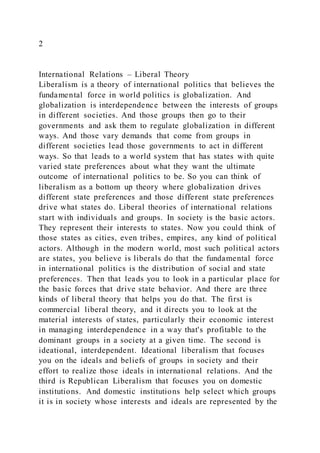
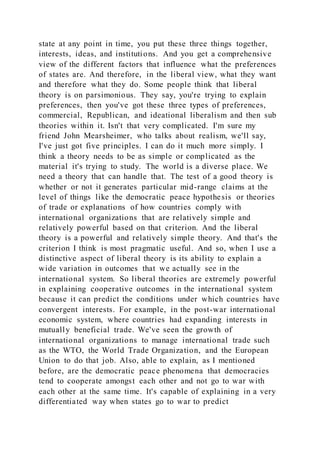
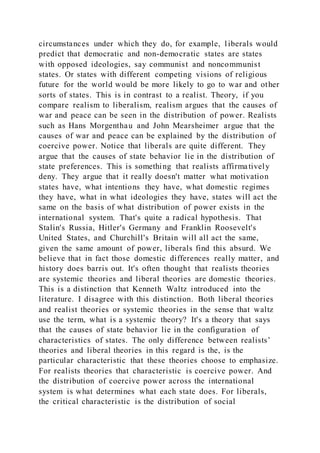
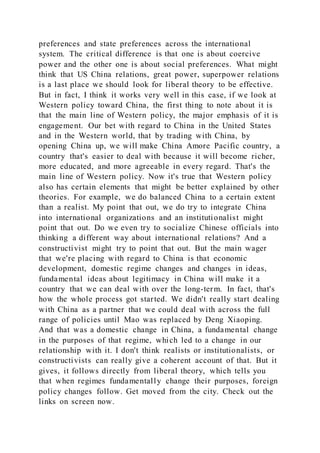
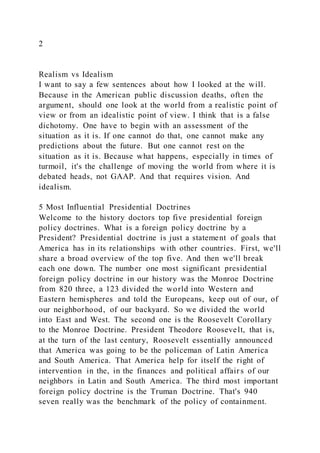
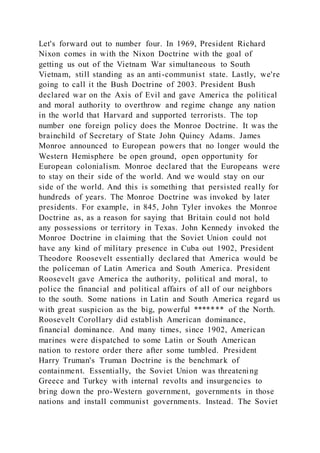
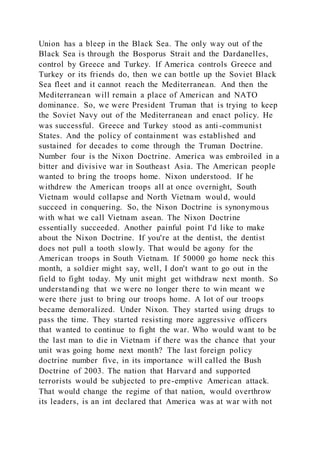
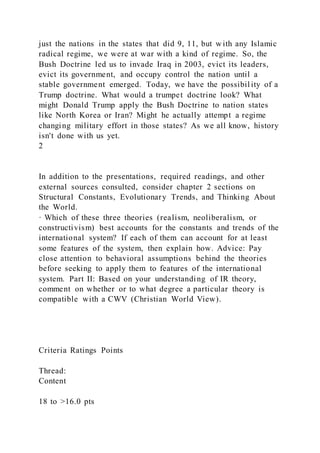
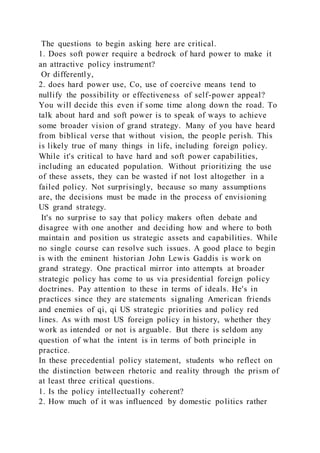
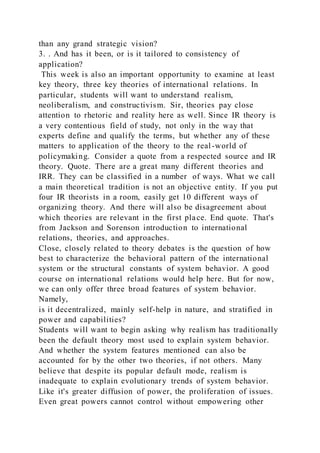
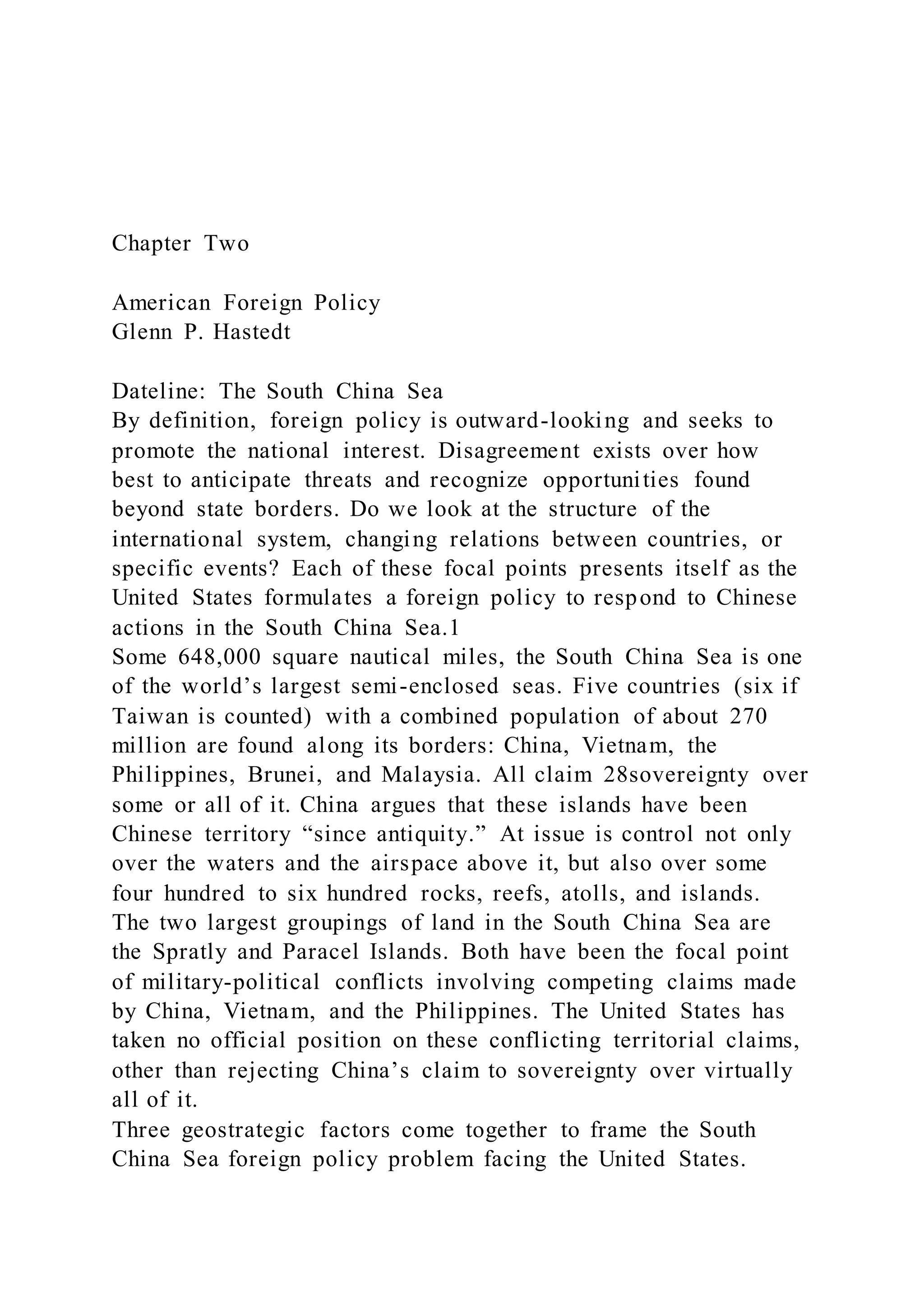
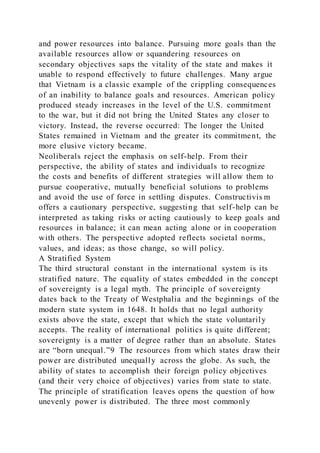
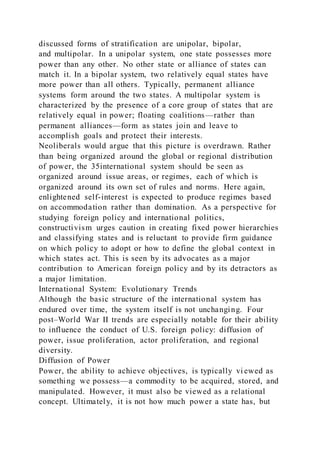
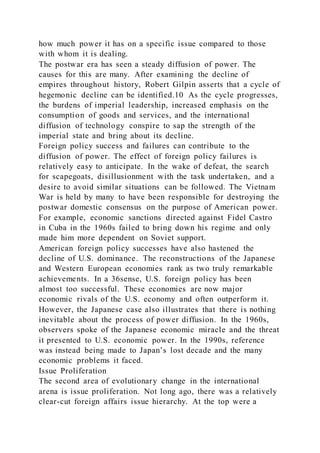
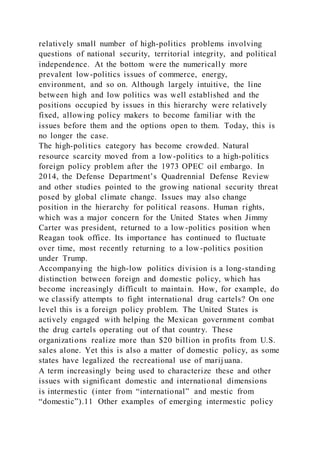
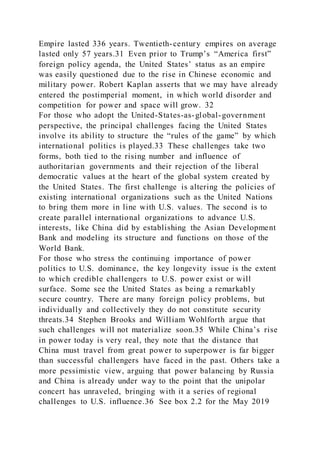
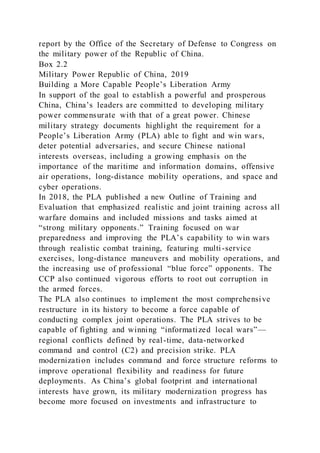
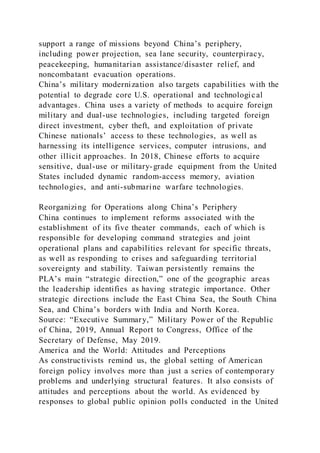
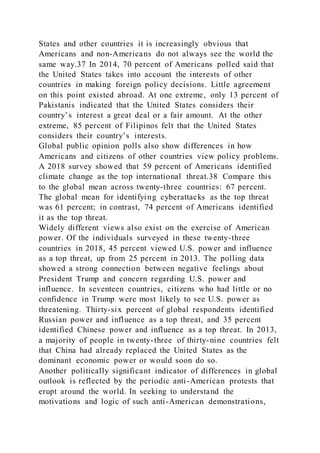
Chapter two discusses the complexities of American foreign policy in the South China Sea, focusing on the tensions arising from China's territorial claims and military expansion. The U.S. response has evolved, with notable events including military patrols and increased naval presence aimed at countering China's actions, while geopolitical interests surrounding shipping routes and energy reserves influence policy decisions. The chapter also outlines theoretical perspectives, such as realism, neoliberalism, and constructivism, which provide insights into understanding international relations and the interplay of power in defining foreign policy.

![I hope these comments help!
If you have any specific questions that I did not address here,
feel free to email the OWC at [email protected] or schedule a
live appointment
at https://www.liberty.edu/online/casas/writing-center/ Also,
please be sure to complete the Student Satisfaction
Survey located at the bottom of your completed request.
Thanks for using the OWC,
Adam S.
Disclaimer: Remember that the OWC is not an editing service.
Our comments and suggestions are not exhaustive. Our
service is designed to help you recognize and correct your
writing so that you can become a better writer. Except where
otherwise noted, formatting suggestions follow the latest (9th)
edition of A Manual for Writers by Kate L. Turabian.
Student’s Name:
Theories That Best Accounts for The IRs Trend.
Professor’s Name:
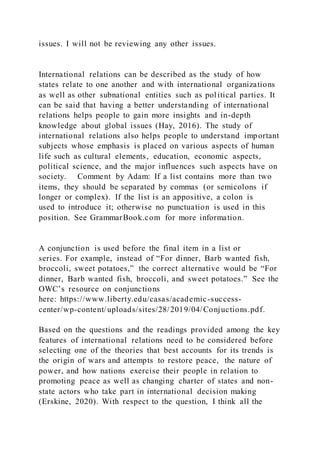
Date. Comment by Adam: You have chosen a
Grammar/Mechanics targeted review, asking that your paper be
reviewed only for glaring errors in sentence structure, word
usage, spelling, punctuation, capitalization, and other grammar](https://image.slidesharecdn.com/chaptertwoamericanforeignpolicyglennp-220921144101-98ef31cc/85/Chapter-TwoAmerican-Foreign-PolicyGlenn-P-HastedtDa-38-320.jpg)
![Survey located at the bottom of your completed request. If you
have any additional questions, please contact the OWC
at [email protected] or via live chat by completing a simple
form. If you would like further assistance with this
assignment, schedule a live appointment here or contact us
using our live chat feature. Finally, you may avail yourself
of the many writing aids on the OWC website.
References
Barder, A. D. (2019). Social constructivism and actor-network
theory. Tactical Constructivism, Method, and International
Relations, 38-50. https://doi.org/10.4324/9781315109039-4
Erskine, T. (2020). 13. Normative international relations
theory. International Relations Theories, 236-
262. https://doi.org/10.1093/hepl/9780198814443.003.0013
Hay, C. (2016). 15. International relations theory and
globalization. International Relations
Theories. https://doi.org/10.1093/hepl/9780198707561.003.0016
Jung, H. (2019). The evolution of social constructivism in
political science: Past to present. SAGE Open, 9(1),
215824401983270. https://doi.org/10.1177/2158244019832703
Theys, S. (2018, August 5). Introducing constructivism in
international relations theory. E-International
Relations. https://www.e-ir.info/2018/02/23/introducing-
constructivism-in-international-relations-theory/
Joseph Nye - On Soft Power
What power is the ability to get what you want from others?
And you can do three ways. You can do it with coercion. You
can do with payment, or you can do it with attraction,
persuasion, coercion, and payment, I call hard power, the ability
yet what you want through retraction persuasion is soft power.
Well, probably the greatest example would be the Cold War.
When the Berlin Wall went down. It did not go down under
artillery barrage of hard power that went down under people](https://image.slidesharecdn.com/chaptertwoamericanforeignpolicyglennp-220921144101-98ef31cc/85/Chapter-TwoAmerican-Foreign-PolicyGlenn-P-HastedtDa-43-320.jpg)