Training Community Rangerson
Wildfire Prevention, Surveillance
& Law Enforcement
Strengthening Forest Protection through
Community Empowerment
Presented by: MELCA ETHIOPIA
Date: 22/05/205
2.
Background
• - FMCscurrently use traditional rotational
patrols.
• - Threats: illegal logging, wildfires, land
encroachment, settlements.
• - Traditional surveillance is limited in reach,
speed, and documentation.
• - Community members often lack formal training
or tools.
3.
Objectives of theTraining
• - Equip rangers with wildfire prevention
knowledge.
• - Introduce modern surveillance tools and
methods.
• - Strengthen law enforcement capabilities.
• - Promote sustainable forest management.
• - Foster community ownership and proactive
protection.
4.
Key Training Topics
1.Wildfire Prevention & Management
• Fire risk identification and mitigation
• Community-led firebreak creation
• Early warning systems
2. Modern Surveillance Techniques
• GPS and smartphone-based monitoring
• Drones (if available)
• Systematic reporting and record-keeping
3. Law Enforcement Fundamentals
• Overview of forest protection laws
• Evidence collection and secure reporting
• Arrest protocols and safety practices
5.
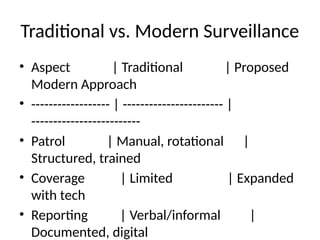
Traditional vs. ModernSurveillance
• Aspect | Traditional | Proposed
Modern Approach
• ------------------ | ----------------------- |
-------------------------
• Patrol | Manual, rotational |
Structured, trained
• Coverage | Limited | Expanded
with tech
• Reporting | Verbal/informal |
Documented, digital
6.
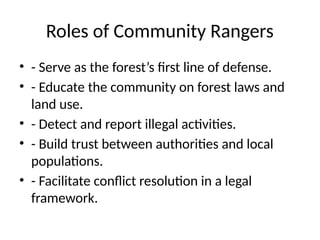
Roles of CommunityRangers
• - Serve as the forest’s first line of defense.
• - Educate the community on forest laws and
land use.
• - Detect and report illegal activities.
• - Build trust between authorities and local
populations.
• - Facilitate conflict resolution in a legal
framework.
7.
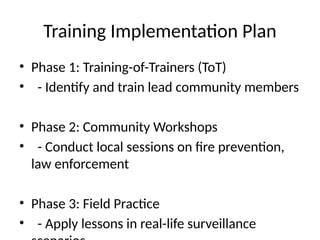
Training Implementation Plan
•Phase 1: Training-of-Trainers (ToT)
• - Identify and train lead community members
• Phase 2: Community Workshops
• - Conduct local sessions on fire prevention,
law enforcement
• Phase 3: Field Practice
• - Apply lessons in real-life surveillance
8.
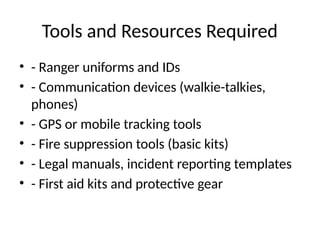
Tools and ResourcesRequired
• - Ranger uniforms and IDs
• - Communication devices (walkie-talkies,
phones)
• - GPS or mobile tracking tools
• - Fire suppression tools (basic kits)
• - Legal manuals, incident reporting templates
• - First aid kits and protective gear
9.
Expected Outcomes
• -Reduction in wildfire incidents and illegal
activities.
• - Better law enforcement and community
cooperation.
• - Enhanced reporting and evidence gathering.
• - Greater awareness and stewardship among
locals.
• - Long-term forest conservation and
biodiversity protection.
10.
Conclusion and Callto Action
• - Empowering rangers is crucial for forest
safety.
• - Training and tools transform community
roles from passive to proactive.
• - Collaborate, equip, and sustain these efforts.
• - Let’s work together to protect our forests for
generations to come.