10/11/2024 1
Public Finance(C# 306)
Ch-01:Introduction
Issues to be learned
Concept and constituents of public finance
 Theories of public finance - classical theory, Keynesian
theory, and Musgrave theory.
 Allocation and distribution – Pareto and social
optimality, Pareto optimality and the competitive solution:
Efficiency in consumption, Efficiency in production
 Good governance – Accountability and Transparency.
10/11/2024 2
1.1 Understanding Public Finance
10/11/2024 3
1.1 Understanding Public Finance
The word public refers to general people and the word finance
means resources. So public finance means resources of the
masses, how they are collected and utilized and to understand
the proper role of the government in the economy.
Public finance is the field of economics that studies government
activities and the alternative means of financing government
expenditures
Thus, Public Finance is the branch of economics that studies the
taxing and spending activities of government.
10/11/2024 4
1.2 Concepts and meaning of Public Finance
10/11/2024 5
Government and its Economic Role of
Governments are organizations formed to exercise authority over the actions of
persons who live together in a society and to provide and finance essential
services.
The main Role played by government in the society:
 To maintain and improve the welfare of the people;
 To protect the people from harmful activities;
 To provide the institutions that allow market to function (e.g. protection of
property rights);
 To provide the essential goods and services that markets fail to adequately provide
10/11/2024 6
1.2 Concepts and meaning of Public Finance
In simple sense, public finance is the study of finance related to
government entities. It revolves around the role of government income
and expenditure in the economy.
Prof. Dalton in his book Principles of Public Finance states that “Public
Finance is concerned with income and expenditure of public authorities
and with the adjustment of one to the other”.
Prof. R. R. Musgrave, “The complex of problems that centre around the
revenue expenditure process of the government is referred to as public
finance”
Prof. P. E. Taylor, “Public finance deals with the finances of the public in an
organized group under the institutions of government”.
10/11/2024 7
Contd.
So, public finance is the study of how governments collect and
spend money and real resources.
Public finance also analyses-
• How do governments collect/spend money? Positive analysis
• How should governments collect/spend money? Normative
analysis
From this definition, we can understand that public finance
deals with income and expenditure of government entity at
any level be it central, state or local. However in the modern
day context, public finance has a wider scope – it studies the
impact of government policies on the economy.
10/11/2024 8
1.3 Nature of Public Finance
 Public finance as an art- As an art, public finance enables the concerned personnel to adopt
the principles and policies in solving the financial problems of the Government in the best
possible way to the maximum benefit of the society. The way to be adopted should be logical,
suitable and proper according to the time. Besides, Public finance is defined as an art as it applies
knowledge for obtaining various objectives. Its essential component that is fiscal policy uses
knowledge of government income and expenses for achieving numerous goals like full
employment, economic equality, and development.
 Public finance as a Science -It is referred to as a science as it systematically studies the
relationship between various facts of government finance. Public finance studies the relationship
between income and expenditure of the government.

10/11/2024 9
Contd.
 Public finance as a subject
The scope of public finance is not just to study the
composition of public revenue and public expenditure. It
covers a full discussion of the influence of government fiscal
operations on the level of overall activity, employment, prices
and growth process of the economic system as a whole.
10/11/2024 10
1.4 The scope/ constituents of Public Finance
If we explain the definition of public finance, we find the the
scope of public finance. Besides, Prof. Dalton classifies the scope
of public finance into four areas as follows :
• Public Income(revenue)
• Public Expenditure
• Public Debt
• Public Administration (Financial)
10/11/2024 11
Public Income
i) Public Income
public income refers to the income of the government. The government earns
income in two ways – tax income and non-tax income. Tax income is easy to
recognize, it’s the tax paid by people of the country in the form of income tax,
sales tax, duties, VAT etc.
On the other hand non-tax income includes interest income from lending
money to other countries, rent & income from government properties,
donations from world organizations, etc.
This area studies methods of taxation, revenue classification, methods of
increasing government revenue and its impact on the economy as a whole, etc.
RQ – What is tax income and non-tax income of Govt? Give example
10/11/2024 12
Public Expenditure
ii) Public Expenditure
Public expenditure is the money spent by government entities. Logically,
the government is going to spend money on infrastructure, defense,
education, healthcare, etc. for the growth and welfare of the country.
This area studies the objectives and classification of public expenditure,
effects of expenditure in different areas, effects of public expenditure on
various factors such as employment, production, growth, etc.
RQ :List out some recent govt. expenditure of GOB.
10/11/2024 13
Public Debt
iii) Public debt,
When public expenditure exceeds public income, the gap is filled by
borrowing money from the public, or from other countries or world
organizations such as The World Bank, IMF These borrowed funds are
public debt.
So, this area of public finance explains the burden of public debt, why it is
necessary and its effect on the economy. It also suggests methods to
manage public debt efficiently and effectively.
RQ: Write down some good and bad effects of govt. debt in Bangladesh
10/11/2024 14
Public Financial Administration
iv) Financial Administration- This is a more practical part of public finance. It
studies the procedure to be followed by the government in imposing taxes, collecting
the taxes, spending the collected money and getting the government income &
expenditure audited by the competent authority.
This area of public finance is all about the administration of all public finance i.e. public
income, public expenditure, and public debt. Financial administration includes
preparation, passing, and implementation of government budget and various
government policies. It also studies the policy impact on the social-economic
environment, inter-governmental relationships, foreign relationships, etc.
• RQ- What do you meant by public administration in PF? Explain their
functions and role.
10/11/2024 15
1.5 Functions of Public Finance
There are three main functions of public finance as follows –
• The Allocation Function- The government has to perform various
functions such as maintaining law and order, defense against foreign
attacks, providing healthcare and education, building infrastructure,
etc. The list is endless. The performance of these functions requires
large scale expenditure, and it is important to allocate the
expenditure efficiently.
The allocation function studies how to allocate public expenditure
most efficiently to reap maximum benefits with the available public
wealth. However, The allocation function deals with the allocation of
public goods.
10/11/2024 16
Contd.
There are two types of goods in an economy – private
goods and public goods. Private goods have a kind of
exclusivity to themselves. Only those who pay for these
goods can get the benefit of such goods, for example – a
car.
In contrast, public goods are non-exclusive. Everyone,
regardless of paying or not, can benefit from public
goods, for example – a road, primary education, defense
10/11/2024 17
Contd
• The Distribution Function
There are large disparities of income and wealth in every country in the world. These
income inequalities plague society and increase the crime rate of the country. The
distribution function of public finance is to lessen these inequalities as much as possible
through redistribution of income and wealth.
In public finance, primarily three measures are outlined to achieve this target such as :
 A tax-transfer scheme or using progressive taxing, i.e. in simpler words charging higher
tax from the rich and giving subsidies to the low-income
 Progressive taxes can be used to finance public services such as affordable housing,
health care, education etc.
 A higher tax can be applied to luxury goods or goods that are purchased by the high-
income group, for example, higher taxes on luxury cars, other luxury goods.
10/11/2024 18
Contd
• The Stabilization Function- defines
10/11/2024 19
Contd.
Every economy goes through periods of booms and depression. It’s the
most normal and common business cycles that lead to this scenario.
However, these periods cause instability in the economy. The objective
of the stabilization function is to eliminate or at least reduce these
business fluctuations and its impact on the economy. Policies such as
deficit budgeting during the time of depression and surplus budgeting
during the time of boom helps achieve the required economic stability.
• RQ: Why is stabilization function necessary?
10/11/2024 20
1.5 Key Players of Public Finance
A. Ministry of Finance- the ministry of finance
(mof), a key player in the stewardship of public finances, is
responsible for government finance operations, including
annual budget preparation, fiscal management, public debt
management, taxation, and economic policy formulation. it
oversees the operations of the country’s financial
institutions, and it plans, implements, and controls the public
expenditure policies and programs of the government.
10/11/2024 21
Contd.
together with other relevant ministries and divisions, the mof is
responsible for the preparation of the medium-term budgeting
framework (mtBf) and the annual budget (both non development
and development).
It also develops and updates the medium-term macroeconomic
framework in collaboration with the Planning commission, the
Bangladesh Bureau of statistics, the national Board of revenue,
Bangladesh Bank, and other relevant agencies.
10/11/2024 22
Contd.
Economic Relations Division-
The economic relations Division (erD) of the mof plays a key role in the
overall management of external aid including loans and grants. the aDB
Wing of the erD, headed by a joint secretary, is primarily responsible for
selecting aDB-financed programs and projects to be included in the annual
development program (aDP), and for maintaining the government’s overall
relationship with aDB. according to the “allocation of Business” section of
the Rules of Business (1996), the main functions of the erD are as follows
10/11/2024 23
Contd
B. Ministry of Planning-the ministry of Planning oversees
the financial policies of the government and is responsible for
socioeconomic planning and statistical management. it has
three divisions: the Planning Division; the statistics and
informatics Division; and the implementation, monitoring,
and evaluation Division (imeD).
• Planning Commission
• Implementation, Monitoring, and Evaluation Division
10/11/2024 24
Contd.
C. Office of the Controller General of Accounts
D. Office of the Comptroller and Auditor General
E. Bangladesh Bank
F. Asian Development Bank
10/11/2024 25
1.7 Public Finance Vs Private finance
10/11/2024 26
1.8 Theories of public finance
• Classical theory,
• Keynesian theory, and
• Musgrave theory.
10/11/2024 27
1.8.1 Classical theory,
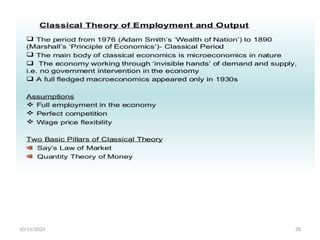
The fundamental principle of the classical
theory is that the economy is self regulating
‐ .
The classical doctrine—that the economy is
always at or near the natural level of real GDP
—is based on two firmly held beliefs: J.B. Say's
Law and the belief that prices, wages, and
interest rates are flexible.
10/11/2024 28
10/11/2024 29
1.8.1 Classical theory,
10/11/2024 30
Contd.
10/11/2024 31
Law of Market
10/11/2024 32
Contd.
10/11/2024 33
Criticism of Classical theory
The following are the main points of Keynes’ criticisms against the
classical theory:
1. Unrealistic Assumption of Full Employment Condition:
2. Undue Importance to the Long Period-Keynes opposed the classical
insistence on long-term equilibrium; instead, he attached greater importance
to short-term equilibrium.
3. Keynes’ Denial of Say’s Law of Markets-Classical economists rest on Say’s
Law which blindly assumed that supply always creates its own demand and
affirmed the impossibility of general overproduction and disequilibrium in the
economy. Keynes totally disagreed with this view and stressed the possibility
of supply exceeding demand, causing disequilibrium in the economy and
pointed out that there is no automatic self-adjustment in the economy.
10/11/2024 34
Contd
4. Keynes’ Attack on Laissez-faire Policy-Keynes strongly
attacked the classicists for their unrealistic approach to the
problems of contemporary capitalist economic system. Pigou’s
plea for a return to free perfect competition to solve the problem
of unemployment seemed ‘obsolete’ in the changed conditions of
the modern world.
5. Attack on Money Wage Cut Policy-Keynes objected to
the classical formulation of employment theory,
particularly, Pigou’s notion that unemployment will
disappear if the workers will just accept sufficiently low
wage rates (i.e., a voluntary cut in money wage). He
rejected Pigou s plea for wage flexibility as a means of
promoting employment at a time of depression.
10/11/2024 35
1.8.2 Keynes Theory
10/11/2024 36
1.8.2 Keynes Theory
10/11/2024 37
1.8.2 Keynes Theory
10/11/2024 38
Contd.
10/11/2024 39
Keynesian Model
10/11/2024 40
Contd.
10/11/2024 41
Money wage Vs Real wage
Labours are generally paid a certain sum of money per day or
week,month etc. The amount of money paid is called the money
wages.
The /Labour, however, is more interested in the goods and
services which he can get with his money wages or otherwise.
The amount of goods and services which the labourer actually
gets is called his real wages.
The standard of living and the prosperity of a labor depend not
on his money wages but on his real wages.
10/11/2024 42
Classical Vs Keynesian Theory
10/11/2024 43
Classical Vs Keynesian Theory
10/11/2024 44
Classical Vs Keynesian Theory
10/11/2024 45
Contd.
10/11/2024 46
Contd.
RQ 1: Explain Law of Market as per classical
Economists
RQ 2: Distinguish between Keynesian Theory
and Classical theory
RQ 3; How do you make difference between
real wage and money wage?
10/11/2024 47
1.8.3 Musgrave theory
Musgrave, widely regarded as the founder of modern
public finance and an adviser on fiscal policy and taxation
to governments. Musgrave's theory broke down governmental
economic activity into three parts:
i. the allocation of resources;
ii. the distribution of goods and services; and
iii. the stabilization of the broader economy
So, According to Professor Musgrave there are three major fiscal
or budgetary functions of the governments. They are: a)
Allocation functions b) Distribution functions and c) Stabilization
functions
10/11/2024 48
Contribution of Musgrave Theory
The use of fiscal instruments to secure adjustments
in the allocation of resources between private and
public goods;
 The use of fiscal instruments to secure proper
adjustments in the distribution of Income and
wealth; and
 The use of fiscal instruments to secure economic
stability and growth
10/11/2024 49
1.9 Allocation and distribution
An allocation is efficient if it is impossible to reallocate resources
such that one person can be made better off without making at
least one other person worse off. Moreover, the people themselves
must be the judges of whether they are better or worse off, by the
principle of consumer sovereignty. An immediate outcome is that
the government should pursue all pareto-superior allocations, those
that make at least one person better off without making anyone else
worse off. This is the basic concept of Pareto-optimality.
10/11/2024 50
1.10 Pareto Optimality and Social Optimality
Pareto-optimality, a concept of efficiency used in the
social sciences, including economics and political science, named
for the Italian sociologist Pareto. A state of affairs is Pareto-
optimal (or Pareto-efficient) if and only if there is no alternative
state that would make some people better off without making
anyone worse off. More precisely, a state of affairs x is said to be
Pareto-inefficient (or suboptimal) if and only if there is some state
of affairs y such that no one strictly prefers x to y and at least one
person strictly prefers y to x. Vilfredo Pareto.
10/11/2024 51
Contd.
The concept of Pareto-optimality thus assumes that anyone
would prefer an option that is cheaper, more efficient, or
more reliable or that otherwise comparatively improves one’s
condition.
10/11/2024 52
1.11 Good Governance- – Accountability and
Transparency
Governance refers to all processes of governing, the institutions,
processes and practices through which issues of common
concern are decided upon and regulated. Good governance
adds a normative or evaluative attribute to the process of
governing. From a human rights perspective, it refers primarily
to the process whereby public institutions conduct public affairs,
manage public resources and guarantee the realization/ensuring
of human rights.
Example
10/11/2024 53
Key attributes of good governance
The Human Rights Council has identified the key
attributes of good governance:
• transparency
• responsibility
• accountability
• participation
• responsiveness (to the needs of the people)
RQ: Define Good Governance- Key attributes of
good governance
10/11/2024 54
“Transparency”& “Accountability”
Transparency” is government's obligation to
share information with citizens that is needed
to make informed decisions/ issues and hold
officials accountable for the conduct of the
people's business. Transparency exists on
government websites largely at the generosity
of officials.
10/11/2024 55
Contd.
Transparency implies openness,
communication, and accountability. The term
transparency has a very different meaning in
information security where it is used to
describe security mechanisms that are
intentionally indetectable or hidden from view.
10/11/2024 56
Contd.
To achieve transparency, an organization must provide
information about its activities and governance to
stakeholders that is accurate, complete and made
available in a timely way. Transparency enables
accountability. This does not mean all information should
be made publicly available.
RQ: How do you relate Good Governance, Accountability and
Transparency in an economy?
10/11/2024 57
What is accountability?
Accountability exists in a relationship between two parties where one has
expectations of the other, and the other is obliged to provide information
about how they have met these expectations or face the consequences of
failing to do so.
There are two components of accountability:
a. Answerability – which means providing information and justification for
how one’s actions align with expectations; and
b. Enforcement – which means being subject to, and accepting the
consequences of, failing to meet these expectations.
10/11/2024 58
Contd.
However, accountability in an organization will involve multiple
parties, it is important there is clarity about who is accountable to
whom and how.
The way this accountability is achieved will generally be set out in an
organization's governing documents, such as its constitution, and any
laws that apply to it. For example, an NFP may be required to provide
an annual financial report to its regulator and the penalty for failing to
do this may be a fine.
10/11/2024 59
Contd.
It is important that the documents and policies that
enable accountability are made available to relevant
stakeholders.
Subject to necessary confidentiality, usually this is done by
providing such information on the organization's website,
but it should be available on request at a minimum.
For accountability to be achieved, there must be
transparency.
10/11/2024 60
Maximum Social Advantage
10/11/2024 61
Contd.
10/11/2024 62
Contd.
10/11/2024 63
Review Questions

Chapter- One 01- Introduction -Final.pptx

  • 1.
    10/11/2024 1 Public Finance(C#306) Ch-01:Introduction Issues to be learned Concept and constituents of public finance  Theories of public finance - classical theory, Keynesian theory, and Musgrave theory.  Allocation and distribution – Pareto and social optimality, Pareto optimality and the competitive solution: Efficiency in consumption, Efficiency in production  Good governance – Accountability and Transparency.
  • 2.
  • 3.
    10/11/2024 3 1.1 UnderstandingPublic Finance The word public refers to general people and the word finance means resources. So public finance means resources of the masses, how they are collected and utilized and to understand the proper role of the government in the economy. Public finance is the field of economics that studies government activities and the alternative means of financing government expenditures Thus, Public Finance is the branch of economics that studies the taxing and spending activities of government.
  • 4.
    10/11/2024 4 1.2 Conceptsand meaning of Public Finance
  • 5.
    10/11/2024 5 Government andits Economic Role of Governments are organizations formed to exercise authority over the actions of persons who live together in a society and to provide and finance essential services. The main Role played by government in the society:  To maintain and improve the welfare of the people;  To protect the people from harmful activities;  To provide the institutions that allow market to function (e.g. protection of property rights);  To provide the essential goods and services that markets fail to adequately provide
  • 6.
    10/11/2024 6 1.2 Conceptsand meaning of Public Finance In simple sense, public finance is the study of finance related to government entities. It revolves around the role of government income and expenditure in the economy. Prof. Dalton in his book Principles of Public Finance states that “Public Finance is concerned with income and expenditure of public authorities and with the adjustment of one to the other”. Prof. R. R. Musgrave, “The complex of problems that centre around the revenue expenditure process of the government is referred to as public finance” Prof. P. E. Taylor, “Public finance deals with the finances of the public in an organized group under the institutions of government”.
  • 7.
    10/11/2024 7 Contd. So, publicfinance is the study of how governments collect and spend money and real resources. Public finance also analyses- • How do governments collect/spend money? Positive analysis • How should governments collect/spend money? Normative analysis From this definition, we can understand that public finance deals with income and expenditure of government entity at any level be it central, state or local. However in the modern day context, public finance has a wider scope – it studies the impact of government policies on the economy.
  • 8.
    10/11/2024 8 1.3 Natureof Public Finance  Public finance as an art- As an art, public finance enables the concerned personnel to adopt the principles and policies in solving the financial problems of the Government in the best possible way to the maximum benefit of the society. The way to be adopted should be logical, suitable and proper according to the time. Besides, Public finance is defined as an art as it applies knowledge for obtaining various objectives. Its essential component that is fiscal policy uses knowledge of government income and expenses for achieving numerous goals like full employment, economic equality, and development.  Public finance as a Science -It is referred to as a science as it systematically studies the relationship between various facts of government finance. Public finance studies the relationship between income and expenditure of the government. 
  • 9.
    10/11/2024 9 Contd.  Publicfinance as a subject The scope of public finance is not just to study the composition of public revenue and public expenditure. It covers a full discussion of the influence of government fiscal operations on the level of overall activity, employment, prices and growth process of the economic system as a whole.
  • 10.
    10/11/2024 10 1.4 Thescope/ constituents of Public Finance If we explain the definition of public finance, we find the the scope of public finance. Besides, Prof. Dalton classifies the scope of public finance into four areas as follows : • Public Income(revenue) • Public Expenditure • Public Debt • Public Administration (Financial)
  • 11.
    10/11/2024 11 Public Income i)Public Income public income refers to the income of the government. The government earns income in two ways – tax income and non-tax income. Tax income is easy to recognize, it’s the tax paid by people of the country in the form of income tax, sales tax, duties, VAT etc. On the other hand non-tax income includes interest income from lending money to other countries, rent & income from government properties, donations from world organizations, etc. This area studies methods of taxation, revenue classification, methods of increasing government revenue and its impact on the economy as a whole, etc. RQ – What is tax income and non-tax income of Govt? Give example
  • 12.
    10/11/2024 12 Public Expenditure ii)Public Expenditure Public expenditure is the money spent by government entities. Logically, the government is going to spend money on infrastructure, defense, education, healthcare, etc. for the growth and welfare of the country. This area studies the objectives and classification of public expenditure, effects of expenditure in different areas, effects of public expenditure on various factors such as employment, production, growth, etc. RQ :List out some recent govt. expenditure of GOB.
  • 13.
    10/11/2024 13 Public Debt iii)Public debt, When public expenditure exceeds public income, the gap is filled by borrowing money from the public, or from other countries or world organizations such as The World Bank, IMF These borrowed funds are public debt. So, this area of public finance explains the burden of public debt, why it is necessary and its effect on the economy. It also suggests methods to manage public debt efficiently and effectively. RQ: Write down some good and bad effects of govt. debt in Bangladesh
  • 14.
    10/11/2024 14 Public FinancialAdministration iv) Financial Administration- This is a more practical part of public finance. It studies the procedure to be followed by the government in imposing taxes, collecting the taxes, spending the collected money and getting the government income & expenditure audited by the competent authority. This area of public finance is all about the administration of all public finance i.e. public income, public expenditure, and public debt. Financial administration includes preparation, passing, and implementation of government budget and various government policies. It also studies the policy impact on the social-economic environment, inter-governmental relationships, foreign relationships, etc. • RQ- What do you meant by public administration in PF? Explain their functions and role.
  • 15.
    10/11/2024 15 1.5 Functionsof Public Finance There are three main functions of public finance as follows – • The Allocation Function- The government has to perform various functions such as maintaining law and order, defense against foreign attacks, providing healthcare and education, building infrastructure, etc. The list is endless. The performance of these functions requires large scale expenditure, and it is important to allocate the expenditure efficiently. The allocation function studies how to allocate public expenditure most efficiently to reap maximum benefits with the available public wealth. However, The allocation function deals with the allocation of public goods.
  • 16.
    10/11/2024 16 Contd. There aretwo types of goods in an economy – private goods and public goods. Private goods have a kind of exclusivity to themselves. Only those who pay for these goods can get the benefit of such goods, for example – a car. In contrast, public goods are non-exclusive. Everyone, regardless of paying or not, can benefit from public goods, for example – a road, primary education, defense
  • 17.
    10/11/2024 17 Contd • TheDistribution Function There are large disparities of income and wealth in every country in the world. These income inequalities plague society and increase the crime rate of the country. The distribution function of public finance is to lessen these inequalities as much as possible through redistribution of income and wealth. In public finance, primarily three measures are outlined to achieve this target such as :  A tax-transfer scheme or using progressive taxing, i.e. in simpler words charging higher tax from the rich and giving subsidies to the low-income  Progressive taxes can be used to finance public services such as affordable housing, health care, education etc.  A higher tax can be applied to luxury goods or goods that are purchased by the high- income group, for example, higher taxes on luxury cars, other luxury goods.
  • 18.
    10/11/2024 18 Contd • TheStabilization Function- defines
  • 19.
    10/11/2024 19 Contd. Every economygoes through periods of booms and depression. It’s the most normal and common business cycles that lead to this scenario. However, these periods cause instability in the economy. The objective of the stabilization function is to eliminate or at least reduce these business fluctuations and its impact on the economy. Policies such as deficit budgeting during the time of depression and surplus budgeting during the time of boom helps achieve the required economic stability. • RQ: Why is stabilization function necessary?
  • 20.
    10/11/2024 20 1.5 KeyPlayers of Public Finance A. Ministry of Finance- the ministry of finance (mof), a key player in the stewardship of public finances, is responsible for government finance operations, including annual budget preparation, fiscal management, public debt management, taxation, and economic policy formulation. it oversees the operations of the country’s financial institutions, and it plans, implements, and controls the public expenditure policies and programs of the government.
  • 21.
    10/11/2024 21 Contd. together withother relevant ministries and divisions, the mof is responsible for the preparation of the medium-term budgeting framework (mtBf) and the annual budget (both non development and development). It also develops and updates the medium-term macroeconomic framework in collaboration with the Planning commission, the Bangladesh Bureau of statistics, the national Board of revenue, Bangladesh Bank, and other relevant agencies.
  • 22.
    10/11/2024 22 Contd. Economic RelationsDivision- The economic relations Division (erD) of the mof plays a key role in the overall management of external aid including loans and grants. the aDB Wing of the erD, headed by a joint secretary, is primarily responsible for selecting aDB-financed programs and projects to be included in the annual development program (aDP), and for maintaining the government’s overall relationship with aDB. according to the “allocation of Business” section of the Rules of Business (1996), the main functions of the erD are as follows
  • 23.
    10/11/2024 23 Contd B. Ministryof Planning-the ministry of Planning oversees the financial policies of the government and is responsible for socioeconomic planning and statistical management. it has three divisions: the Planning Division; the statistics and informatics Division; and the implementation, monitoring, and evaluation Division (imeD). • Planning Commission • Implementation, Monitoring, and Evaluation Division
  • 24.
    10/11/2024 24 Contd. C. Officeof the Controller General of Accounts D. Office of the Comptroller and Auditor General E. Bangladesh Bank F. Asian Development Bank
  • 25.
    10/11/2024 25 1.7 PublicFinance Vs Private finance
  • 26.
    10/11/2024 26 1.8 Theoriesof public finance • Classical theory, • Keynesian theory, and • Musgrave theory.
  • 27.
    10/11/2024 27 1.8.1 Classicaltheory, The fundamental principle of the classical theory is that the economy is self regulating ‐ . The classical doctrine—that the economy is always at or near the natural level of real GDP —is based on two firmly held beliefs: J.B. Say's Law and the belief that prices, wages, and interest rates are flexible.
  • 28.
  • 29.
  • 30.
  • 31.
  • 32.
  • 33.
    10/11/2024 33 Criticism ofClassical theory The following are the main points of Keynes’ criticisms against the classical theory: 1. Unrealistic Assumption of Full Employment Condition: 2. Undue Importance to the Long Period-Keynes opposed the classical insistence on long-term equilibrium; instead, he attached greater importance to short-term equilibrium. 3. Keynes’ Denial of Say’s Law of Markets-Classical economists rest on Say’s Law which blindly assumed that supply always creates its own demand and affirmed the impossibility of general overproduction and disequilibrium in the economy. Keynes totally disagreed with this view and stressed the possibility of supply exceeding demand, causing disequilibrium in the economy and pointed out that there is no automatic self-adjustment in the economy.
  • 34.
    10/11/2024 34 Contd 4. Keynes’Attack on Laissez-faire Policy-Keynes strongly attacked the classicists for their unrealistic approach to the problems of contemporary capitalist economic system. Pigou’s plea for a return to free perfect competition to solve the problem of unemployment seemed ‘obsolete’ in the changed conditions of the modern world. 5. Attack on Money Wage Cut Policy-Keynes objected to the classical formulation of employment theory, particularly, Pigou’s notion that unemployment will disappear if the workers will just accept sufficiently low wage rates (i.e., a voluntary cut in money wage). He rejected Pigou s plea for wage flexibility as a means of promoting employment at a time of depression.
  • 35.
  • 36.
  • 37.
  • 38.
  • 39.
  • 40.
  • 41.
    10/11/2024 41 Money wageVs Real wage Labours are generally paid a certain sum of money per day or week,month etc. The amount of money paid is called the money wages. The /Labour, however, is more interested in the goods and services which he can get with his money wages or otherwise. The amount of goods and services which the labourer actually gets is called his real wages. The standard of living and the prosperity of a labor depend not on his money wages but on his real wages.
  • 42.
  • 43.
  • 44.
  • 45.
  • 46.
    10/11/2024 46 Contd. RQ 1:Explain Law of Market as per classical Economists RQ 2: Distinguish between Keynesian Theory and Classical theory RQ 3; How do you make difference between real wage and money wage?
  • 47.
    10/11/2024 47 1.8.3 Musgravetheory Musgrave, widely regarded as the founder of modern public finance and an adviser on fiscal policy and taxation to governments. Musgrave's theory broke down governmental economic activity into three parts: i. the allocation of resources; ii. the distribution of goods and services; and iii. the stabilization of the broader economy So, According to Professor Musgrave there are three major fiscal or budgetary functions of the governments. They are: a) Allocation functions b) Distribution functions and c) Stabilization functions
  • 48.
    10/11/2024 48 Contribution ofMusgrave Theory The use of fiscal instruments to secure adjustments in the allocation of resources between private and public goods;  The use of fiscal instruments to secure proper adjustments in the distribution of Income and wealth; and  The use of fiscal instruments to secure economic stability and growth
  • 49.
    10/11/2024 49 1.9 Allocationand distribution An allocation is efficient if it is impossible to reallocate resources such that one person can be made better off without making at least one other person worse off. Moreover, the people themselves must be the judges of whether they are better or worse off, by the principle of consumer sovereignty. An immediate outcome is that the government should pursue all pareto-superior allocations, those that make at least one person better off without making anyone else worse off. This is the basic concept of Pareto-optimality.
  • 50.
    10/11/2024 50 1.10 ParetoOptimality and Social Optimality Pareto-optimality, a concept of efficiency used in the social sciences, including economics and political science, named for the Italian sociologist Pareto. A state of affairs is Pareto- optimal (or Pareto-efficient) if and only if there is no alternative state that would make some people better off without making anyone worse off. More precisely, a state of affairs x is said to be Pareto-inefficient (or suboptimal) if and only if there is some state of affairs y such that no one strictly prefers x to y and at least one person strictly prefers y to x. Vilfredo Pareto.
  • 51.
    10/11/2024 51 Contd. The conceptof Pareto-optimality thus assumes that anyone would prefer an option that is cheaper, more efficient, or more reliable or that otherwise comparatively improves one’s condition.
  • 52.
    10/11/2024 52 1.11 GoodGovernance- – Accountability and Transparency Governance refers to all processes of governing, the institutions, processes and practices through which issues of common concern are decided upon and regulated. Good governance adds a normative or evaluative attribute to the process of governing. From a human rights perspective, it refers primarily to the process whereby public institutions conduct public affairs, manage public resources and guarantee the realization/ensuring of human rights. Example
  • 53.
    10/11/2024 53 Key attributesof good governance The Human Rights Council has identified the key attributes of good governance: • transparency • responsibility • accountability • participation • responsiveness (to the needs of the people) RQ: Define Good Governance- Key attributes of good governance
  • 54.
    10/11/2024 54 “Transparency”& “Accountability” Transparency”is government's obligation to share information with citizens that is needed to make informed decisions/ issues and hold officials accountable for the conduct of the people's business. Transparency exists on government websites largely at the generosity of officials.
  • 55.
    10/11/2024 55 Contd. Transparency impliesopenness, communication, and accountability. The term transparency has a very different meaning in information security where it is used to describe security mechanisms that are intentionally indetectable or hidden from view.
  • 56.
    10/11/2024 56 Contd. To achievetransparency, an organization must provide information about its activities and governance to stakeholders that is accurate, complete and made available in a timely way. Transparency enables accountability. This does not mean all information should be made publicly available. RQ: How do you relate Good Governance, Accountability and Transparency in an economy?
  • 57.
    10/11/2024 57 What isaccountability? Accountability exists in a relationship between two parties where one has expectations of the other, and the other is obliged to provide information about how they have met these expectations or face the consequences of failing to do so. There are two components of accountability: a. Answerability – which means providing information and justification for how one’s actions align with expectations; and b. Enforcement – which means being subject to, and accepting the consequences of, failing to meet these expectations.
  • 58.
    10/11/2024 58 Contd. However, accountabilityin an organization will involve multiple parties, it is important there is clarity about who is accountable to whom and how. The way this accountability is achieved will generally be set out in an organization's governing documents, such as its constitution, and any laws that apply to it. For example, an NFP may be required to provide an annual financial report to its regulator and the penalty for failing to do this may be a fine.
  • 59.
    10/11/2024 59 Contd. It isimportant that the documents and policies that enable accountability are made available to relevant stakeholders. Subject to necessary confidentiality, usually this is done by providing such information on the organization's website, but it should be available on request at a minimum. For accountability to be achieved, there must be transparency.
  • 60.
  • 61.
  • 62.
  • 63.