Prepared By : Mukhtar Abdi Aden Ref: 659333567
Civil
Service Institute
Business Environment
Chapter Two
Student Information
St-Name: Mukhtar Abdi Aden Class : B
St-ID : CSI-ACC-27 Time : 6pm
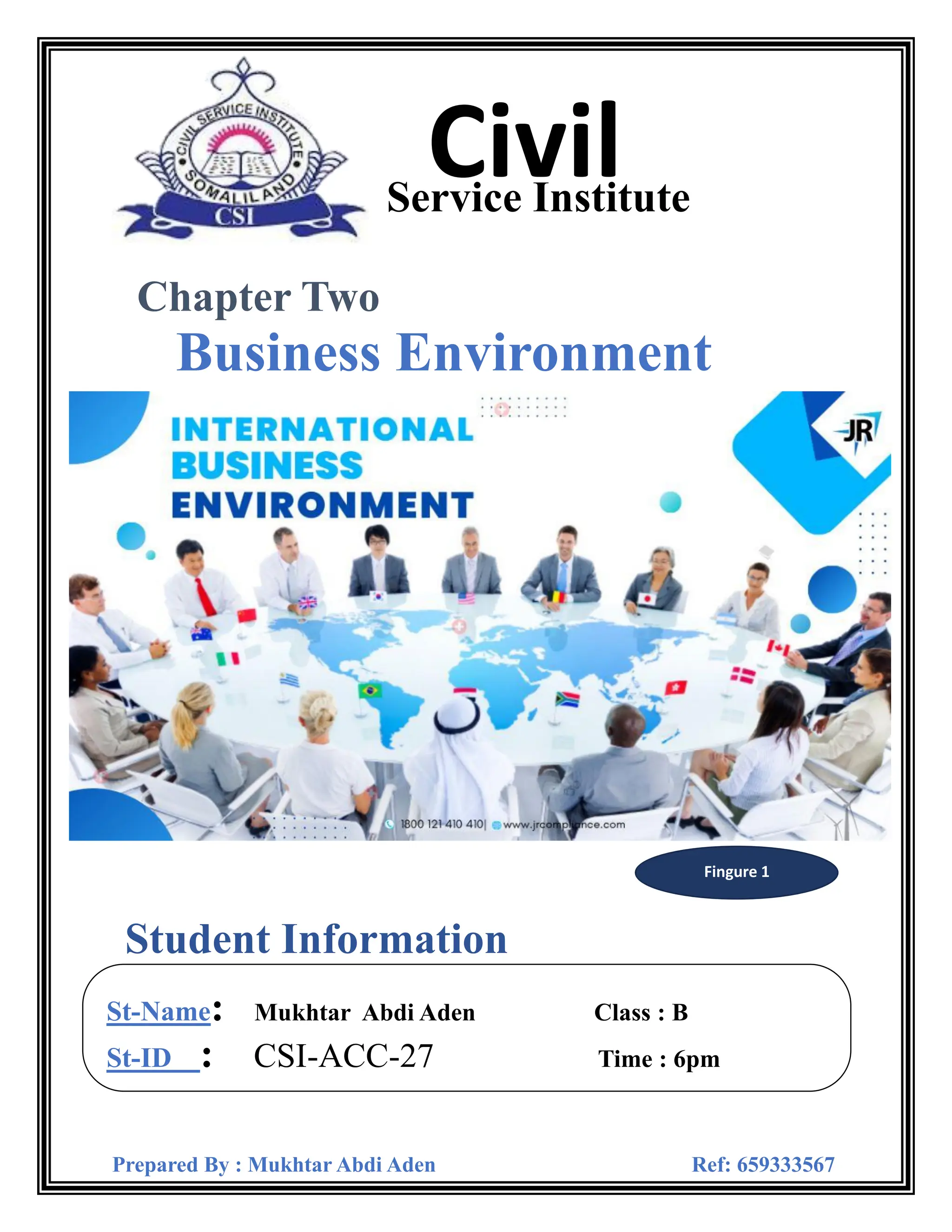
Fingure 1
Prepared By : Mukhtar Abdi Aden Ref: 659333567
Table Contents
1. What Is Business And It’s Types?
2. What Is The Business Plan
3. Business Environment and It’s Onother Name
4. Charactristics Of Business Environment
5. Components Of Business Environment
6. Importance Of Business Environment
7. Environmental Analaysis
What Is The Business ?
Business is an Organization or Enterpress for
Production of Good & Services For profit
Motive and Satisfy The Needs of customers.
Types of Businesses
Various businesses are organized per some type
of hierarchy or bureaucracy. In these businesses,
the positions have a customary role and
responsibility. And They Are :-
Sole Proprietorship: In this kind of business, a single person owns and operates the business. There
isn’t any kind of legal separation between the owner and business. Thus, the onus of legal plus tax
liability is on the owner.
Partnership: As the name suggests, it is a business where two or more people run it together. The
partners bring in resources and money, and then the shares in the profit or loss are divided amongst
them.
Corporation: In this business, a group of individuals act together as a single entity. The owners in this
business are called shareholders. They discuss their views on the common stock of the corporation.
There are unfavourable taxation rules in a corporation for the business owners.
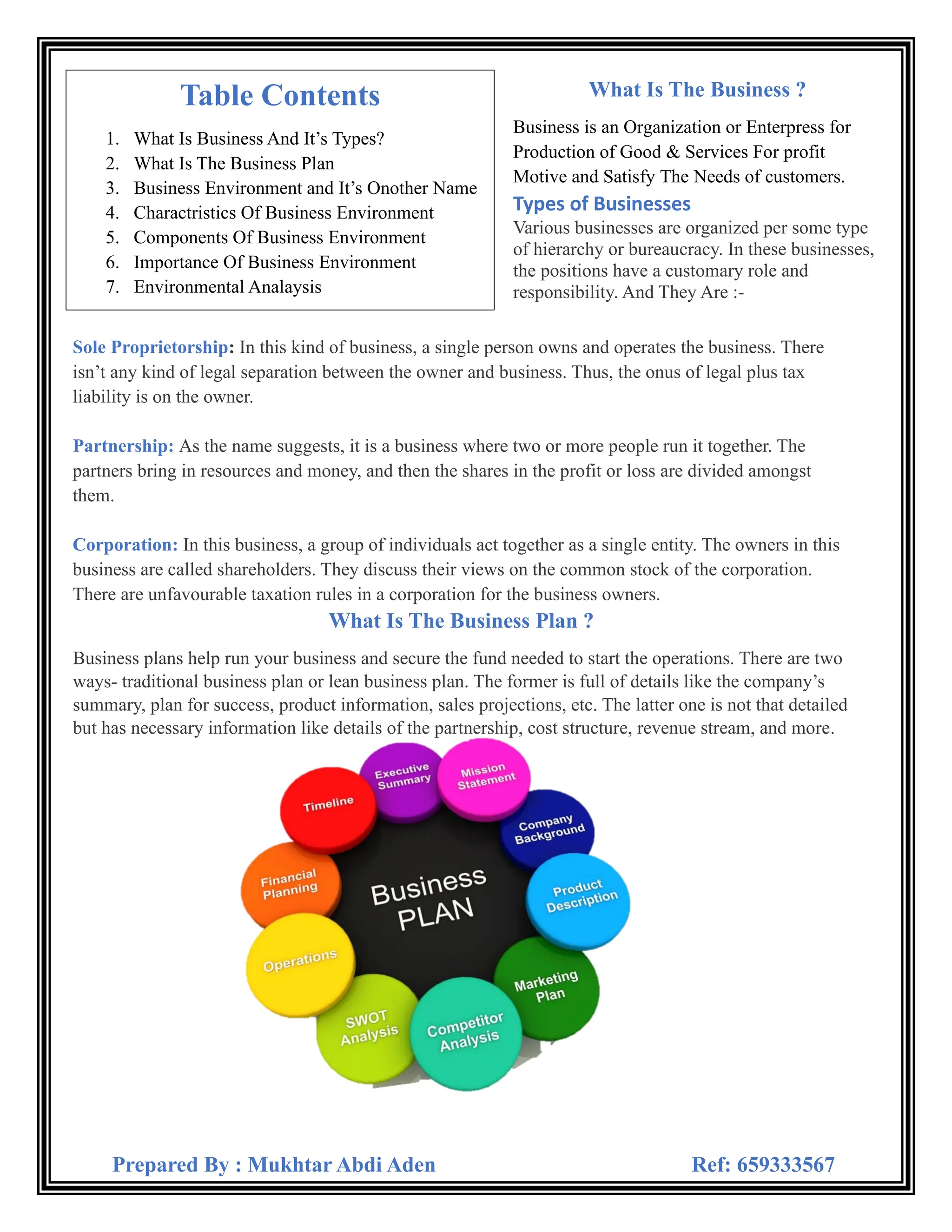
What Is The Business Plan ?
Business plans help run your business and secure the fund needed to start the operations. There are two
traditional business plan or lean business plan. The former is full of details like the company’s
-
ways
summary, plan for success, product information, sales projections, etc. The latter one is not that detailed
.
but has necessary information like details of the partnership, cost structure, revenue stream, and more
Prepared By : Mukhtar Abdi Aden Ref: 659333567

Business Envronment And It’s Another Name ?
uction
The Activity And Prod
r Forces That Effect Or Influence
ors O
Is Those Foct
-
Business Envronment :
ositive Or Negative
P
Either
ganization
Of Or
ironment
s Env
’
Manager
wned Onother Name Called :
And Have Kno
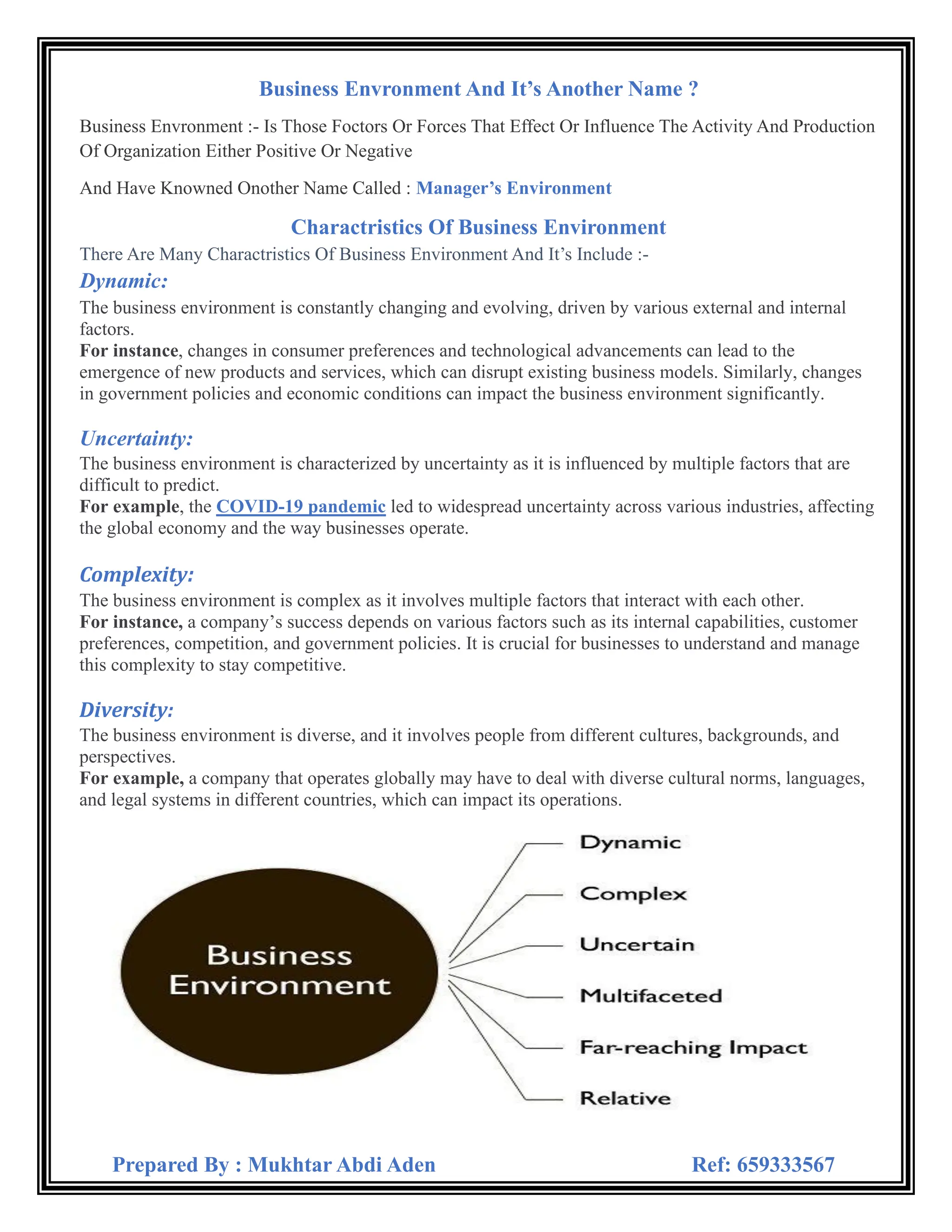
Charactristics Of Business Environment
-
s Include :
’
Environment And It
s
sines
actristics Of Bu
Many Char
Are
here
T
:
Dynamic
The business environment is constantly changing and evolving, driven by various external and internal
factors.
For instance, changes in consumer preferences and technological advancements can lead to the
emergence of new products and services, which can disrupt existing business models. Similarly, changes
in government policies and economic conditions can impact the business environment significantly.
Uncertainty:
The business environment is characterized by uncertainty as it is influenced by multiple factors that are
difficult to predict.
For example, the COVID-19 pandemic led to widespread uncertainty across various industries, affecting
the global economy and the way businesses operate.
Complexity:
The business environment is complex as it involves multiple factors that interact with each other.
For instance, a company’s success depends on various factors such as its internal capabilities, customer
preferences, competition, and government policies. It is crucial for businesses to understand and manage
this complexity to stay competitive.
Diversity:
The business environment is diverse, and it involves people from different cultures, backgrounds, and
perspectives.
For example, a company that operates globally may have to deal with diverse cultural norms, languages,
and legal systems in different countries, which can impact its operations.
Prepared By : Mukhtar Abdi Aden Ref: 659333567
Components Of Business Environment
he components of the business
environment refer to the various
factors that can impact a business’s
operations, profitability, and sustainability.
These components can be classified into two
categories: internal and external factors.
Internal Components:
1. Company culture: This refers to the
values, beliefs, and practices that
guide how employees behave and
interact within the organization.
2. Management structure: This
includes the organization’s hierarchy,
the roles and responsibilities of its
employees, and the communication
channels between different
departments and levels of
management.
3. Resources: Resources include the
physical, financial, and human
resources that a business has at its
disposal.
4. Policies and procedures: These are
the rules and guidelines that govern
how employees should behave and
carry out their duties within the
organization.
External Components:
1. Economic environment: This
includes factors such as inflation,
interest rates, and economic growth,
which can impact a business’s
operations and profitability.
2. Technological environment: This
includes the advancements in
technology that can impact a
business’s operations and create new
opportunities for innovation and
growth.
3. Political and legal
environment: This includes the laws,
regulations, and policies established
by governments and regulatory bodies
that can impact a business’s
operations.
4. Social and cultural
environment: This includes factors
such as social norms, values, and
beliefs that can impact a business’s
operations and influence consumer
behavior.
5. Competitive environment: This
includes the competition that a
business faces in its industry,
including the number of competitors,
their size and market share, and the
intensity of competition.
6. Natural environment: This includes
the physical environment in which a
business operates, such as weather
patterns, natural resources, and
environmental regulations.
Types of Business Environment
While there are different ways to categorize
business environments, here are 8 types of
business environments that are commonly
recognized:
Economic environment:
This includes factors such as inflation,
interest rates, economic growth, and exchange
rates that can impact a business’s operations
and profitability.
Social environment:
This includes factors such as demographics,
social trends, lifestyle changes, and cultural
factors that can influence consumer behavior
and affect a business’s marketing strategies.
Political environment:
This includes factors such as government
policies, regulations, and political stability
that can impact a business’s operations and
decision-making process.
Legal environment:
This includes the laws, regulations, and legal
systems that can impact a business’s
T
Prepared By : Mukhtar Abdi Aden Ref: 659333567
operations, including intellectual property
laws, employment laws, and contract laws.
Technological environment:
This includes the advancements in technology
that can impact a business’s operations and
create new opportunities for innovation and
growth, such as artificial intelligence,
automation, and digital transformation.
Competitive environment:
This includes the competition that a business
faces in its industry, including the number of
competitors, their size and market share, and
the intensity of competition.
Natural environment:
This includes the physical environment in
which a business operates, such as weather
patterns, natural disasters, and environmental
regulations that can impact a business’s
operations and sustainability.
Global environment:
This includes the international factors that can
impact a business’s operations and
opportunities, including global economic
trends, trade policies, and cultural differences
Importance Of Business Environment
The business environment plays a crucial role
in shaping a company’s operations, decision-
making processes, and overall success. Below
are some of the key reasons why the business
environment is important:
• Helps identify opportunities and
threats
• Provides insights into consumer
behavior
• Shapes government policies
• Enables effective risk management
• Drives innovation
• Influences organizational culture
Environment Analysis for Business
Environmental analysis is a process of
identifying and evaluating the internal and
external factors that can impact a business. It
is an essential part of business strategy
development, as it enables businesses to
understand their strengths, weaknesses,
opportunities, and threats (SWOT analysis)
and develop strategies to leverage their
strengths and opportunities while addressing
their weaknesses and threats.
The following are the steps involved in
conducting an environmental analysis for a
business:
• Identify the internal factors
• Identify the external factors
• Conduct a SWOT analysis
• Analyze your competition
• Evaluate the macro-environment
• Develop strategies
Prepared By : Mukhtar Abdi Aden Ref: 659333567
SWOT Analysis
WOT analysis is a strategic planning
tool used by businesses to assess their
internal and external environment.
SWOT stands for strengths, weaknesses,
opportunities, and threats, and the analysis
helps businesses to identify their internal
strengths and weaknesses and external
opportunities and threats that they face.
SWOT analysis involves four steps:
1. Strengths: This step involves
identifying the internal strengths of a
business, such as its unique selling
proposition, strong brand recognition,
talented employees, efficient
operations, and access to financial
resources.
2. Weaknesses: This step involves
identifying the internal weaknesses of
a business, such as poor financial
performance, outdated technology,
inefficient operations, lack of skilled
workforce, or a negative reputation.
3. Opportunities: This step involves
identifying the external opportunities
that a business can capitalize on, such
as emerging markets, new technology,
changes in consumer behavior, or
strategic partnerships.
4. Threats: This step involves
identifying the external threats that a
business may face, such as changes in
regulations, economic downturns,
increased competition, or
technological disruptions.
S

Chapter Four Management Assignment .pdf

  • 1.
    Prepared By :Mukhtar Abdi Aden Ref: 659333567 Civil Service Institute Business Environment Chapter Two Student Information St-Name: Mukhtar Abdi Aden Class : B St-ID : CSI-ACC-27 Time : 6pm Fingure 1
  • 2.
    Prepared By :Mukhtar Abdi Aden Ref: 659333567 Table Contents 1. What Is Business And It’s Types? 2. What Is The Business Plan 3. Business Environment and It’s Onother Name 4. Charactristics Of Business Environment 5. Components Of Business Environment 6. Importance Of Business Environment 7. Environmental Analaysis What Is The Business ? Business is an Organization or Enterpress for Production of Good & Services For profit Motive and Satisfy The Needs of customers. Types of Businesses Various businesses are organized per some type of hierarchy or bureaucracy. In these businesses, the positions have a customary role and responsibility. And They Are :- Sole Proprietorship: In this kind of business, a single person owns and operates the business. There isn’t any kind of legal separation between the owner and business. Thus, the onus of legal plus tax liability is on the owner. Partnership: As the name suggests, it is a business where two or more people run it together. The partners bring in resources and money, and then the shares in the profit or loss are divided amongst them. Corporation: In this business, a group of individuals act together as a single entity. The owners in this business are called shareholders. They discuss their views on the common stock of the corporation. There are unfavourable taxation rules in a corporation for the business owners. What Is The Business Plan ? Business plans help run your business and secure the fund needed to start the operations. There are two traditional business plan or lean business plan. The former is full of details like the company’s - ways summary, plan for success, product information, sales projections, etc. The latter one is not that detailed . but has necessary information like details of the partnership, cost structure, revenue stream, and more
  • 3.
    Prepared By :Mukhtar Abdi Aden Ref: 659333567 Business Envronment And It’s Another Name ? uction The Activity And Prod r Forces That Effect Or Influence ors O Is Those Foct - Business Envronment : ositive Or Negative P Either ganization Of Or ironment s Env ’ Manager wned Onother Name Called : And Have Kno Charactristics Of Business Environment - s Include : ’ Environment And It s sines actristics Of Bu Many Char Are here T : Dynamic The business environment is constantly changing and evolving, driven by various external and internal factors. For instance, changes in consumer preferences and technological advancements can lead to the emergence of new products and services, which can disrupt existing business models. Similarly, changes in government policies and economic conditions can impact the business environment significantly. Uncertainty: The business environment is characterized by uncertainty as it is influenced by multiple factors that are difficult to predict. For example, the COVID-19 pandemic led to widespread uncertainty across various industries, affecting the global economy and the way businesses operate. Complexity: The business environment is complex as it involves multiple factors that interact with each other. For instance, a company’s success depends on various factors such as its internal capabilities, customer preferences, competition, and government policies. It is crucial for businesses to understand and manage this complexity to stay competitive. Diversity: The business environment is diverse, and it involves people from different cultures, backgrounds, and perspectives. For example, a company that operates globally may have to deal with diverse cultural norms, languages, and legal systems in different countries, which can impact its operations.
  • 4.
    Prepared By :Mukhtar Abdi Aden Ref: 659333567 Components Of Business Environment he components of the business environment refer to the various factors that can impact a business’s operations, profitability, and sustainability. These components can be classified into two categories: internal and external factors. Internal Components: 1. Company culture: This refers to the values, beliefs, and practices that guide how employees behave and interact within the organization. 2. Management structure: This includes the organization’s hierarchy, the roles and responsibilities of its employees, and the communication channels between different departments and levels of management. 3. Resources: Resources include the physical, financial, and human resources that a business has at its disposal. 4. Policies and procedures: These are the rules and guidelines that govern how employees should behave and carry out their duties within the organization. External Components: 1. Economic environment: This includes factors such as inflation, interest rates, and economic growth, which can impact a business’s operations and profitability. 2. Technological environment: This includes the advancements in technology that can impact a business’s operations and create new opportunities for innovation and growth. 3. Political and legal environment: This includes the laws, regulations, and policies established by governments and regulatory bodies that can impact a business’s operations. 4. Social and cultural environment: This includes factors such as social norms, values, and beliefs that can impact a business’s operations and influence consumer behavior. 5. Competitive environment: This includes the competition that a business faces in its industry, including the number of competitors, their size and market share, and the intensity of competition. 6. Natural environment: This includes the physical environment in which a business operates, such as weather patterns, natural resources, and environmental regulations. Types of Business Environment While there are different ways to categorize business environments, here are 8 types of business environments that are commonly recognized: Economic environment: This includes factors such as inflation, interest rates, economic growth, and exchange rates that can impact a business’s operations and profitability. Social environment: This includes factors such as demographics, social trends, lifestyle changes, and cultural factors that can influence consumer behavior and affect a business’s marketing strategies. Political environment: This includes factors such as government policies, regulations, and political stability that can impact a business’s operations and decision-making process. Legal environment: This includes the laws, regulations, and legal systems that can impact a business’s T
  • 5.
    Prepared By :Mukhtar Abdi Aden Ref: 659333567 operations, including intellectual property laws, employment laws, and contract laws. Technological environment: This includes the advancements in technology that can impact a business’s operations and create new opportunities for innovation and growth, such as artificial intelligence, automation, and digital transformation. Competitive environment: This includes the competition that a business faces in its industry, including the number of competitors, their size and market share, and the intensity of competition. Natural environment: This includes the physical environment in which a business operates, such as weather patterns, natural disasters, and environmental regulations that can impact a business’s operations and sustainability. Global environment: This includes the international factors that can impact a business’s operations and opportunities, including global economic trends, trade policies, and cultural differences Importance Of Business Environment The business environment plays a crucial role in shaping a company’s operations, decision- making processes, and overall success. Below are some of the key reasons why the business environment is important: • Helps identify opportunities and threats • Provides insights into consumer behavior • Shapes government policies • Enables effective risk management • Drives innovation • Influences organizational culture Environment Analysis for Business Environmental analysis is a process of identifying and evaluating the internal and external factors that can impact a business. It is an essential part of business strategy development, as it enables businesses to understand their strengths, weaknesses, opportunities, and threats (SWOT analysis) and develop strategies to leverage their strengths and opportunities while addressing their weaknesses and threats. The following are the steps involved in conducting an environmental analysis for a business: • Identify the internal factors • Identify the external factors • Conduct a SWOT analysis • Analyze your competition • Evaluate the macro-environment • Develop strategies
  • 6.
    Prepared By :Mukhtar Abdi Aden Ref: 659333567 SWOT Analysis WOT analysis is a strategic planning tool used by businesses to assess their internal and external environment. SWOT stands for strengths, weaknesses, opportunities, and threats, and the analysis helps businesses to identify their internal strengths and weaknesses and external opportunities and threats that they face. SWOT analysis involves four steps: 1. Strengths: This step involves identifying the internal strengths of a business, such as its unique selling proposition, strong brand recognition, talented employees, efficient operations, and access to financial resources. 2. Weaknesses: This step involves identifying the internal weaknesses of a business, such as poor financial performance, outdated technology, inefficient operations, lack of skilled workforce, or a negative reputation. 3. Opportunities: This step involves identifying the external opportunities that a business can capitalize on, such as emerging markets, new technology, changes in consumer behavior, or strategic partnerships. 4. Threats: This step involves identifying the external threats that a business may face, such as changes in regulations, economic downturns, increased competition, or technological disruptions. S