BUSINESS
ENVIRONMENT
Dr. Ridhima Sharma
WHAT IS
BUSINESS?
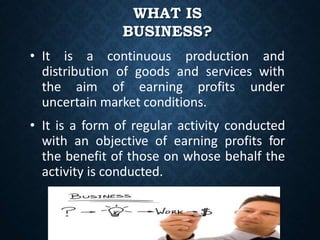
• It is a continuous production and
distribution of goods and services with
the aim of earning profits under
uncertain market conditions.
• It is a form of regular activity conducted
with an objective of earning profits for
the benefit of those on whose behalf the
activity is conducted.
NATURE OF
BUSINESS
ECONOMIC/NON-ECONOMIC
ACTIVITY
 An activity is said to be economic, if the
purpose is to earn profit not social service.
– e.g.
• Running a restaurant: Economic Activity
• House wife cooking : Non-Economic
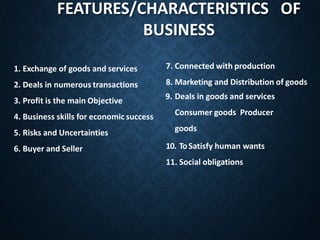
1. Exchange of goods and services
2. Deals in numerous transactions
3. Profit is the main Objective
4. Business skills for economic success
5. Risks and Uncertainties
6. Buyer and Seller
7. Connected with production
8. Marketing and Distribution of goods
9. Deals in goods and services
Consumer goods Producer
goods
10. ToSatisfy human wants
11. Social obligations
FEATURES/CHARACTERISTICS OF
BUSINESS
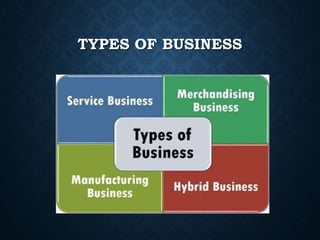
TYPES OF BUSINESS
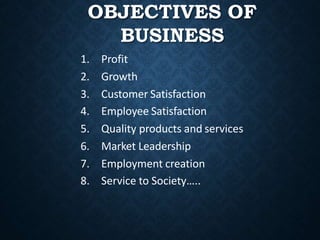
OBJECTIVES OF
BUSINESS
1. Profit
2. Growth
3. Customer Satisfaction
4. Employee Satisfaction
5. Quality products and services
6. Market Leadership
7. Employment creation
8. Service to Society…..
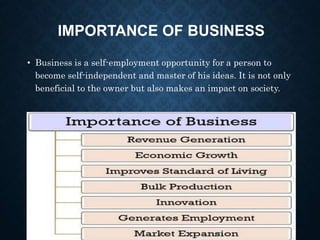
IMPORTANCE OF BUSINESS
• Business is a self-employment opportunity for a person to
become self-independent and master of his ideas. It is not only
beneficial to the owner but also makes an impact on society.
WHAT IS BUSINESS
ENVIRONMENT?
It consists of all those factors that
have bearing on the business…..
A set of conditions – Social, Legal,
Economical, Political or Institutional
that are uncontrollable in nature and
affects the functioning of organization.
TYPES OF BUSINESS
ENVIRONMENT
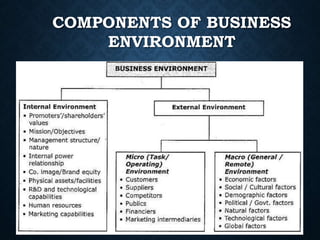
• Mainly Business Environment divided into two
types. These are:
1. Internal Environment
2. External Environment
INTERNAL
ENVIRONMENT
The factors which can be controlled by
company or
Primary factors which directly affects the
growth of organization….. man, material,
money, machinery and management.
TYPES OF INTERNAL
ENVIRONMENT
1. Value System
2. Mission & Objectives
3. Management Structure and Nature
4. Internal Power relationship
5. Human Resources
6. Company Image & Brand Equity …..
EXTERNAL
ENVIRONMENT
• Those factors which are beyond the control of
business enterprise are included in external
environment.
• External Environment is divided into two parts
1. Micro Environment: The environment which
is close to business and affects its capacity to
work is known as Micro Environment.
2. Macro Environment: It includes factors that
create opportunities and threats to business
units. Following are the elements of Macro
Environment.
MICRO
ENVIRONMENT
• Suppliers
• Customers
– Wholesalers
– Retailers
– Industries
– Government and Other Institutions
– Foreigners
• Market Intermediaries
– Middleman
– Marketing Agencies
– Financial Intermediaries
– Physical Intermediaries
• Competitors
• Public
MACRO ENVIRONMENT
• Economic Environment: It is very complex
and dynamic in nature that keeps on changing
with the change in policies or political
situations. It has three elements:
– Economic Conditions of Public
– Economic Policies of the country
– Economic System
– Other Economic Factors: Infrastructural Facilities, Banking,
Insurance companies, money markets, capital markets etc.
MACRO ENVIRONMENT
units
1. Political Environment: It affects different business
extensively. Components are
• Political Belief of Government
• Political Strength of the Country
• Relation with other countries
• Defense and Military Policies
• Centre State Relationship in the Country
• Thinking Opposition Parties towards Business Unit
MACRO ENVIRONMENT
2. Socio-Cultural Environment
– Influence exercised by social and cultural factors, not within the
control of business, is known as Socio-Cultural Environment.
family
– These factors include: attitude of people to work,
system, caste system, religion, education, marriage etc.
3. Technological Environment
– A systematic application of scientific knowledge to practical
task is known as technology.
– Everyday there has been vast changes in products, services,
lifestyles and living conditions, these changes must be analysed
by every business unit and should adapt these changes.
MACRO ENVIRONMENT
4. Natural Environment
– It includes natural resources, weather, climatic conditions,
port facilities, topographical factors such as soil, sea, rivers,
rainfall etc.
– Every business unit must look for these factors before
choosing the location for their business.
5. Demographic Environment
– It is a study of perspective of population i.e. its size,
standard of living, growth rate, age-sex composition, family
size, income level (upper level, middle level and lower
level), education level etc.
– Every business unit must see these features of population
and recognize their various needs and produce accordingly.
MACRO ENVIRONMENT
6. International Environment
– It is particularly important for industries directly
depending on import or exports.
– The factors that affect the business are
• Globalization
• Liberalization
• Foreign business policies
• Cultural exchange
COMPONENTS OF BUSINESS
ENVIRONMENT
SOCIO CULTURAL
ENVIRONMENT
For example, in the US we purchase “cans” of various
grocery products, but the British purchase “tins”. A number of
cultural differences can cause marketers problems in
attempting to market their products overseas. These include:
(a) language, (b) color, (c) customs and taboos, (d) values,
(e) aesthetics, (f) time, (g) business norms, (h) religion, and
(i) social structures.
CHARACTERISTICS
• Business environment is compound in nature.
• It is constantly changing process.
• It is different for different business units.
• It has both long term and short term impact.
• Unlimited influence of external environment
factors.
• It is very uncertain.
• Inter-related components.
• It includes both internal and external
environment.

Unit 1 - Business Environment - Overview.pptx

  • 1.
  • 2.
    WHAT IS BUSINESS? • Itis a continuous production and distribution of goods and services with the aim of earning profits under uncertain market conditions. • It is a form of regular activity conducted with an objective of earning profits for the benefit of those on whose behalf the activity is conducted.
  • 3.
  • 4.
    ECONOMIC/NON-ECONOMIC ACTIVITY  An activityis said to be economic, if the purpose is to earn profit not social service. – e.g. • Running a restaurant: Economic Activity • House wife cooking : Non-Economic
  • 5.
    1. Exchange ofgoods and services 2. Deals in numerous transactions 3. Profit is the main Objective 4. Business skills for economic success 5. Risks and Uncertainties 6. Buyer and Seller 7. Connected with production 8. Marketing and Distribution of goods 9. Deals in goods and services Consumer goods Producer goods 10. ToSatisfy human wants 11. Social obligations FEATURES/CHARACTERISTICS OF BUSINESS
  • 6.
  • 7.
    OBJECTIVES OF BUSINESS 1. Profit 2.Growth 3. Customer Satisfaction 4. Employee Satisfaction 5. Quality products and services 6. Market Leadership 7. Employment creation 8. Service to Society…..
  • 8.
    IMPORTANCE OF BUSINESS •Business is a self-employment opportunity for a person to become self-independent and master of his ideas. It is not only beneficial to the owner but also makes an impact on society.
  • 9.
    WHAT IS BUSINESS ENVIRONMENT? Itconsists of all those factors that have bearing on the business….. A set of conditions – Social, Legal, Economical, Political or Institutional that are uncontrollable in nature and affects the functioning of organization.
  • 10.
    TYPES OF BUSINESS ENVIRONMENT •Mainly Business Environment divided into two types. These are: 1. Internal Environment 2. External Environment
  • 11.
    INTERNAL ENVIRONMENT The factors whichcan be controlled by company or Primary factors which directly affects the growth of organization….. man, material, money, machinery and management.
  • 12.
    TYPES OF INTERNAL ENVIRONMENT 1.Value System 2. Mission & Objectives 3. Management Structure and Nature 4. Internal Power relationship 5. Human Resources 6. Company Image & Brand Equity …..
  • 13.
    EXTERNAL ENVIRONMENT • Those factorswhich are beyond the control of business enterprise are included in external environment. • External Environment is divided into two parts 1. Micro Environment: The environment which is close to business and affects its capacity to work is known as Micro Environment. 2. Macro Environment: It includes factors that create opportunities and threats to business units. Following are the elements of Macro Environment.
  • 14.
    MICRO ENVIRONMENT • Suppliers • Customers –Wholesalers – Retailers – Industries – Government and Other Institutions – Foreigners • Market Intermediaries – Middleman – Marketing Agencies – Financial Intermediaries – Physical Intermediaries • Competitors • Public
  • 15.
    MACRO ENVIRONMENT • EconomicEnvironment: It is very complex and dynamic in nature that keeps on changing with the change in policies or political situations. It has three elements: – Economic Conditions of Public – Economic Policies of the country – Economic System – Other Economic Factors: Infrastructural Facilities, Banking, Insurance companies, money markets, capital markets etc.
  • 16.
    MACRO ENVIRONMENT units 1. PoliticalEnvironment: It affects different business extensively. Components are • Political Belief of Government • Political Strength of the Country • Relation with other countries • Defense and Military Policies • Centre State Relationship in the Country • Thinking Opposition Parties towards Business Unit
  • 17.
    MACRO ENVIRONMENT 2. Socio-CulturalEnvironment – Influence exercised by social and cultural factors, not within the control of business, is known as Socio-Cultural Environment. family – These factors include: attitude of people to work, system, caste system, religion, education, marriage etc. 3. Technological Environment – A systematic application of scientific knowledge to practical task is known as technology. – Everyday there has been vast changes in products, services, lifestyles and living conditions, these changes must be analysed by every business unit and should adapt these changes.
  • 18.
    MACRO ENVIRONMENT 4. NaturalEnvironment – It includes natural resources, weather, climatic conditions, port facilities, topographical factors such as soil, sea, rivers, rainfall etc. – Every business unit must look for these factors before choosing the location for their business. 5. Demographic Environment – It is a study of perspective of population i.e. its size, standard of living, growth rate, age-sex composition, family size, income level (upper level, middle level and lower level), education level etc. – Every business unit must see these features of population and recognize their various needs and produce accordingly.
  • 19.
    MACRO ENVIRONMENT 6. InternationalEnvironment – It is particularly important for industries directly depending on import or exports. – The factors that affect the business are • Globalization • Liberalization • Foreign business policies • Cultural exchange
  • 20.
  • 21.
    SOCIO CULTURAL ENVIRONMENT For example,in the US we purchase “cans” of various grocery products, but the British purchase “tins”. A number of cultural differences can cause marketers problems in attempting to market their products overseas. These include: (a) language, (b) color, (c) customs and taboos, (d) values, (e) aesthetics, (f) time, (g) business norms, (h) religion, and (i) social structures.
  • 22.
    CHARACTERISTICS • Business environmentis compound in nature. • It is constantly changing process. • It is different for different business units. • It has both long term and short term impact. • Unlimited influence of external environment factors. • It is very uncertain. • Inter-related components. • It includes both internal and external environment.

Editor's Notes

  • #3 Commercial activities of an individual or group engaging in some type of financial transaction. Organization that is formed to operate some time of commercial activity/service …… from single proprietor to MNC The type of commerce in which someone engages Generally, a business begins with a business concept (the idea) and a name. Depending on the nature of the business, extensive market research may be necessary to determine whether turning the idea into a business is feasible and if the business can deliver value to consumers. The business name can be one of the most valuable assets of a firm
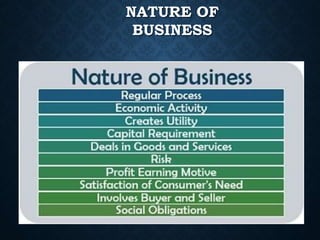
  • #4 Regular Process: It is an activity which is performed repeatedly to generate profit. Economic Activity: The whole sole purpose is maximising wealth. Creates Utility: The goods or service must be such that it creates form utility – conversion of products in a consumable form, time utility – making the goods and services available when needed; and place utility – availability of goods or services wherever required, for the consumers. Capital Requirement: Any venture requires fund depending on the size and its type. Deals in Goods and Services: It is related to manufacturing and offering goods for sale or catering services. Risk: All businesses have a risk factor or uncertainties of failure and loss. Profit Earning Motive: The initial motive of a businessman is making a profit out of his venture. Satisfaction of Consumer’s Need: It is concerned with the fulfilment of the customer’s demands and needs. Involves Buyer and Seller: There are majorly two parties involved, the customer and the merchandise. Social Obligations: It has some social responsibilities, like creating job opportunities, dealing with licensed products, etc.
  • #7 Service: An activity performed to earn money through customer satisfaction is known as a service. It involves professional skills and expertise. E.g. A professional teacher earns money by taking tuition class Merchandising: Merchandising means procurement of goods from manufacturers or wholesalers, at a low price and selling it at a higher price to make a profit. It is also known as a retail business. E.g. A florist selling flowers Manufacturing: Making profit through production or creation of goods from raw material in such a way that it derives some utility to the consumer is known as a manufacturing business. E.g. Processing of sugarcane in a sugar mill to get fine sugar Hybrid: A business which involves all the three activities, i.e. manufacturing of goods, merchandising of products and delivering service falls under the hybrid category. E.g. A furniture seller, who manufactures furniture, buys old furniture and sells it at a higher price after repairing and also provides services for polishing old furniture.
  • #9 Revenue Generation: It is the key to revenue generation for the business owner since it brings in profit and proves to be a source of income for the owner. Economic Growth: It is essential for the economic growth of a country since high revenue means higher tax collection. Improves Standard of Living: A country with more industrial units and companies experience a higher rate of employment and better living standards. Bulk Production: Manufacturing units involve large-scale production, which ultimately reduces the cost of production, and people get a continuous supply of goods at a reasonable price. Innovation: It involves brainstorming and generation of new ideas which opens up the way for innovation and creativity. Generates Employment: It is a long-term process which requires the human resource to function correctly. Therefore, it creates job opportunities. Market Expansion: A good strategy and high customer satisfaction lead to a strong customer base aiming at market expansion.
  • #10 Environment means anything that surround us OR the surroundings or conditions in which a person, animal, or plant lives or operates. We live in a dynamic environment that changes all the time. Businesses must understand the changes in the environment and how these changes affect their performance. The process of thinking strategically requires that managers understand how the structure and competitive dynamics of their industry affect the performance and profitability of their companies. Armed with an appreciation of the forces in their industry that give rise to opportunities and threats, managers should be able to make better strategic decisions.  “Business environment is an aggregate of all conditions, events and influences that surround and affect it. It is broad and ever changing as its separate elements interact. A single firm’s environment is narrow in scope than the total environment of business. It is complicated and continuously changing.”
  • #11 A business depends on certain internal and external factors. These factors are treated as given and business enterprise is expected to operate under a particular set of environmental system. These factors are generally uncontrollable and beyond the control of business enter­prises. But progress, success and survival largely depend upon their capacity and ability to adapt successfully to environmental changes available in surroundings of a business. In its operational behaviour, an organization interacts with the various forces in its environ­ment. It may be in terms of receiving inputs, returning outputs and using feedback to modify inputs and the transformation process. Moreover, the organization does not operate in a vacuum but must interact with its environment in order to function. However, level of interaction may differ from organization to organization and the impact can vary overtime. Thus, business organizations deal with the environment by undertaking following transactions: (i) They Receive Inputs- The manufacturer receives raw materials, a stock broker receives the latest financial information and a local authority receives data on housing needs. (ii) They Transform Inputs- The Manufacturer produces the goods from the raw materials the stock broker interprets the information and the local authority produces housing plans. (iii) They Produce Outputs- The manufacture sell products, the stock broker advice and the local builds houses. The external environment reveals opportunities and threats and the internal environment uncovers strengths and weaknesses. Which part of environment is more important? While analyzing the total (macro] environment, it is more effective to deal with the external forces first and then the internal, although some opine that the reverse order is better. For example, analysis of the internal environment might reveal a cash surplus, and top management might then decide to search the external environment for an investment opportunity, such as an acquisition. Even here, examining external environment is essential to find whether the timing is right for an acquisition or any other use of cash. While deciding the internal-external order of analysis, one should not lose sight of aspects that work well in one set of conditions and change colour in another set of circumstances. In actual practice, since both external and internal forces interact and impact organisational survival and growth, managers would do well to examine both sets of factors at the same time. The external environment reveals opportunities and threats and the internal environment uncovers strengths and weaknesses. Literally, environment refers the surroundings external objects or circumstances in which someone or something exists. Here someone or something can be an individual, or a group of people, or an organisation. The performance of an individual or an organisation depends on the environment- The environment comprises forces which are outside or external to the business and forces that are internal to it.
  • #12 1. Internal Environment: The internal environment consists of conditions and forces within an organisation that affect the organisation’s management. Aspects of the internal environment include the organisation’s mission, cor­porate culture, owners and the board of directors, employees, other units of the organisation and unions.
  • #13 Internal Environment is that part of the business environment which is concerned with the different factors present within the organization. It comprises of conditions, forces, members and events which has the capability to influence the company’s decisions and operations. It determines the procedures and methods in which activities are carried out in the organization, as well as it includes all of the immediate and information resources, such as technical, financial and physical resources of the organization.  Value System: Value system can be defined as a set of rules and the logical and consistent values adopted by the firm, as a standard guide, so as to regulate the conduct in any type of circumstances. Vision, Mission and Objectives: Vision refers to the overall picture of what the enterprise wants to attain, whereas mission talks about the organization and its business, and the reason for its existence. Lastly, objectives refer to the basic milestones, which are set to be achieved within the specific period of time, with the available resources. Management structure and Internal Power Relationship: Management structure implies the organizational hierarchy, the way in which tasks are delegated and how they relate, a span of management, relationship amidst various functional areas, the composition of the board of directors, shareholding pattern and so forth.On the other hand, internal power relationship describes the relationship and cordiality between the CEO and board of directors. Further, the degree of support and contribution received from the employees and other members of the organization strengthens the organization’s decision making power and its organization-wide implementation. Human Resource: Human resources are the most important asset of the organization, as they play a critical role in making or breaking the organization. The skills, competencies, attitude, dedication, morale and commitment, amounts to the company’s strengths or weakness. Tangible and Intangible Assets: The tangible assets refers to the physical assets which are owned by the company such as land, building, machinery, stock etc. Intangible assets amount to the research and development, technological capabilities, marketing and financial resources etc.
  • #14 External Business environment comprises of all the extrinsic factors, influences, events, entities and conditions, often existing outside the company’s boundaries but they have a significant influence on the operation, performance, profitability and survival of the business enterprise. For the purpose of continuous and uninterrupted functioning of the business, the enterprise has to act, react or adjust according to these factors. These factors are not under the control of the enterprise.  Micro Environment Otherwise called as task environment, these factors directly influence the company’s operations, as it covers the immediate environment that surrounds the company.  Macro Environment Otherwise called as general environment, macro environment affects the entire industry and not the firm specifically. That is why these factors are completely uncontrollable in nature. The firm needs to adapt itself according to the changes in the macro-environment, so as to survive and grow.
  • #15 Suppliers: To carry out the production process, the raw material is required which is provided by the suppliers. The behaviour of the supplier has a direct impact on a company’s business operations. Customers: Customers are the target audience, i.e. the one who purchases and consumes the product. The customers are given the most important place in every business, because, the products are created and promoted for customers only. Intermediaries: There are a number of individuals or firms that help the business enterprise in the promotion, selling, distribution and delivery of the product to the end buyer, which are called as marketing intermediaries. It includes agents, distributors, dealers, wholesalers, retailers, delivery boys, etc. Competitors: Competitors are the business rivals, which operate in the same industry, offering the same product and services, and cater to the same audience. Shareholders: Shareholders are the actual owners of the company, as they invest their money in the company. They get their share in the profits also, in the form of a dividend. In fact, they have the right to vote at the company’s general meeting. Employees: Employees refers to the company’s staff, who are hired to work for the company to help the company reach its mission. Therefore, it is very important for the firm, to employ the right people, retain and keep them motivated so as to get the best out of them. Media: Media plays an important role in the life of every company because it has the capability to make the company’s product popular overnight or it can also defame them, in just one go. This is due to the fact that the reach of media is very large and so every content which is going to air on any form of media can affect the company positively or adversely depending on what kind of information it contains.
  • #16 Economic Environment: The economic conditions of the region and the country as a whole has a significant bearing on the company’s profitability. This is because the purchasing power, saving habits, per capita income, credit facilities etc. depends greatly on the country’s economic conditions, which regulates the demand for the company’s products.
  • #17 Political and Legal Environment: The political and legal environment consists of the laws, rules, regulations and policies which the company needs to adhere. The changes in these laws and government may affect the company’s decisions, open doors of new opportunities for the business or pose a threat to the business.
  • #18 Technological Environment: Technology is ever-changing, as everyday a new and improved version of something is launched which is created with the state-of-the-art technology.This can be a plus point if the company is the first mover in the race, subject to the success of the product. However, if it turns out as a failure, it will prove as a wastage of time, money and efforts. Further, every company has to keep itself updated with the changing technology. Socio-Cultural Environment: Socio-cultural environment consist of those factors which are concerned with human relationships such as customs, traditions, beliefs, values, morals, tastes and preferences of the society at large. The company must consider these factors on various matters such as the hiring of employees, advertising the product and service, decision making etc.
  • #19 Demographic Environment: As the name suggests, the demographic environment covers the size, type, structure, education level, and distribution of population in a geographical area. The knowledge of this environment will help the firm in deciding the optimal marketing mix for the target population.
  • #20 Global Environment: Due to liberalization domestic company’s can offer their products and services for sale to other countries. In fact, there are many companies which are operating in a number of nations worldwide.Hence, such companies have to follow the laws prevalent in these countries as well as they have to adhere to international laws and guidelines. Further, the responses and the company’s norms must be in alignment with the global environment
  • #22 The sociocultural environment of a business is customs and value, which directs business practices. It is created by the demographic characteristics of its leaders as well as their leaders. This can be evident in the company’s vision and mission statement. The value of a company is reflected in its Sociocultural environment policies. For example, a company with a strong family-focused culture will provide more employee benefits-focused on this value. This company can offer flex-time, maternity leave, and daycare services or discounts for both its employees, flex-time, both father and mother. For example, when McDonald’s started opening stores in India, then he had to keep in mind the sociocultural environment because most of his new customers did not eat beef and had many vegetarians. So they had to consider menu changes to meet the needs of their new customer base.